Top 10 Strongest Currencies in the World in 2025

Top 10 Most Powerful Currencies in the World

Currencies play a crucial role in global finance, affecting trade, investment, and economic stability. While many assume the US Dollar (USD) or Euro (EUR) is the most valuable currency in the world, the reality is quite different. Some currencies surpass them in exchange rate value due to strong economic policies, financial stability, and trade advantages. In this article, we will explore the top 10 strongest currencies in the world, what makes them valuable, and how traders can take advantage of currency fluctuations.

What Defines Whether a Currency Is Strong or Weak?

A currency’s strength is determined by its exchange rate against major global currencies like the USD and EUR. However, several economic, financial, and geopolitical factors contribute to its actual value, demand, and stability.

Economic Stability: Countries with strong GDP growth, low unemployment, and controlled inflation tend to have stronger currencies. A stable economy boosts investor confidence, increasing demand for the currency.

Foreign Exchange Reserves: Nations with large reserves of gold, foreign currencies, and financial assets can better manage market fluctuations and maintain currency stability. Higher reserves signal economic strength.

Interest Rates & Monetary Policy: Higher interest rates attract foreign investment, increasing demand for a currency. Central banks play a crucial role in adjusting rates to control inflation and maintain stability.

Trade Balance & Global Demand: A trade surplus—where exports exceed imports—leads to increased demand for a country’s currency. Oil-rich nations like Kuwait and Bahrain benefit from strong exports, keeping their currencies highly valued.

Top 10 Strongest Currencies in the World in 2025

Currencies are valued based on economic strength, monetary policies, and global demand. While USD and EUR dominate global trade, several currencies have higher exchange rates due to oil wealth, financial stability, and controlled currency pegs. This ranking is accumulated as of March 2025, and exchange rates may fluctuate over time due to market conditions, interest rate changes, and geopolitical events.

RankCurrencyCurrency CodeExchange Rate (USD)Exchange Rate (EUR)
1Kuwaiti DinarKWD3.252.98
2Bahraini DinarBHD2.652.44
3Omani RialOMR2.592.38
4Jordanian DinarJOD1.411.29
5British PoundGBP1.291.18
6Gibraltar PoundGIP1.291.18
7Cayman Islands DollarKYD1.201.10
8Swiss FrancCHF1.131.03
9EuroEUR1.081
10US DollarUSD10.91

1. Kuwaiti Dinar (KWD) – Strongest Currency in the World

The Kuwaiti Dinar (KWD) is the strongest currency in the world and has maintained this status due to Kuwait’s vast oil reserves and high GDP per capita. The nation is a major oil exporter, and petroleum accounts for nearly 90% of government revenue. To maintain stability, the KWD is pegged to a basket of currencies rather than a single currency, allowing for more flexibility in fluctuating global markets. During the Gulf War in 1990, the KWD was temporarily removed from circulation, but it was restored after Kuwait’s liberation and has remained the highest-valued currency globally ever since.

2. Bahraini Dinar (BHD)

The Bahraini Dinar (BHD) is one of the strongest currencies in the world, largely due to Bahrain’s wealth in oil production and its diversified financial sector. Unlike many resource-rich nations, Bahrain has also developed a strong banking industry and is recognized as a hub for Islamic finance. The currency is pegged to the US Dollar, which helps ensure stability in exchange rates. Expatriates working in Bahrain often benefit from its strong value when sending remittances abroad.

3. Omani Rial (OMR)

The Omani Rial (OMR) is one of the highest-valued currencies, primarily due to Oman’s strategic control over oil and gas exports. The country’s economy relies heavily on energy production, and its currency is pegged to the US Dollar, which helps maintain financial stability. The high value of the Omani Rial has resulted in the introduction of ¼ and ½ Rial banknotes, making smaller denominations more practical for daily transactions.

4. Jordanian Dinar (JOD)

The Jordanian Dinar (JOD) has remained strong despite Jordan not being an oil-producing nation. Its strength comes from a stable banking system and consistent monetary policies. The JOD has been pegged to the US Dollar for decades, ensuring a reliable and predictable exchange rate. In some areas of Jordan, the Israeli Shekel and US Dollar are also widely accepted, but the Dinar remains the strongest and most stable currency in the country.

5. British Pound (GBP)

The British Pound Sterling (GBP) is one of the oldest and most widely traded currencies in the world. Its strength is backed by the UK’s robust financial sector, global economic influence, and high investor confidence. Unlike many other currencies, the GBP is not pegged, meaning it fluctuates freely based on market conditions. The City of London’s financial hub plays a major role in keeping the Pound valuable, making it one of the most desirable currencies for international trade and investment.

6. Gibraltar Pound (GIP)

The Gibraltar Pound (GIP) is fully pegged to the British Pound Sterling (GBP) at a 1:1 ratio, meaning its value mirrors that of GBP. Gibraltar, a British Overseas Territory, has a stable economy driven by tourism, finance, and online gaming industries. Although the Gibraltar Pound is the official currency, British Pounds are widely accepted across Gibraltar, making them interchangeable within the region.

7. Cayman Islands Dollar (KYD)

The Cayman Islands Dollar (KYD) is the currency of one of the world’s largest offshore financial centers. The Cayman Islands is home to hundreds of international banks, investment funds, and corporate entities, contributing to its currency’s high valuation. The KYD is pegged to the USD, which ensures stability. With no income tax, capital gains tax, or corporate tax, the Cayman Islands remains a preferred destination for financial institutions and high-net-worth individuals.

8. Swiss Franc (CHF)

The Swiss Franc (CHF) is considered a safe-haven currency due to Switzerland’s strong economy, political neutrality, and world-renowned banking system. Unlike most modern currencies, the Swiss Franc was historically backed by gold, and although it is no longer directly tied to gold reserves, Switzerland still holds large amounts of gold as part of its monetary policy. During times of global economic uncertainty, investors often move their funds to CHF due to its stability and low inflation rates.

9. Euro (EUR)

The Euro (EUR) is the official currency of 20+ European nations, making it one of the most traded currencies in the world. Its strength comes from the combined economic power of the Eurozone, with major economies like Germany, France, and Italy backing its value. The European Central Bank (ECB) regulates the Euro, ensuring financial stability and low inflation. The Euro simplifies cross-border trade and travel within Europe, eliminating currency exchange risks. It is also widely used in global financial transactions and held as a secondary reserve currency by central banks worldwide.

10. US Dollar (USD)

The US Dollar (USD) is the world’s most widely used currency, accounting for over 60% of global forex reserves. Its strength is driven by the size and stability of the US economy, which is the largest in the world. The US Federal Reserve (Fed) influences global markets through its monetary policies, further reinforcing the Dollar’s dominance. The USD is the main currency for international trade and commodities like oil and gold, requiring countries to exchange their local currency for USD. Many emerging markets peg their currency to the Dollar, ensuring stability in financial transactions.

Discover whether forex trading is profitable

How to Start Trading Currencies?

Trading the strongest currencies in the world requires knowledge, strategy, and the right forex trading platform. Here’s how to get started:

1. Understand the Forex Market

Forex trading involves buying and selling currency pairs based on exchange rate movements. Strong currencies like KWD, BHD, and CHF are often traded against major pairs like EUR/USD. Understanding market trends and volatility is essential.

2. Choose a Reliable Forex Broker

A trusted forex broker provides access to tight spreads, fast execution, and advanced trading tools. Brokers like VT Markets offer a secure and user-friendly platform, allowing traders to execute trades efficiently on major currencies.

3. Open & Fund Your Forex Trading Account

To start trading, register an account with a regulated broker and deposit funds via bank transfers, credit cards, or e-wallets.

4. Choose the Right Forex Trading Strategies

Each forex trading strategy has its own uniqueness. Whether it’s trend following for long-term moves, scalping for quick profits, or swing trading for mid-term trades, choosing a strategy depends on your trading goals and the risk tolerance that best suits you.

5. Utilise Risk Management Tools

Risk management is crucial in forex trading. Setting stop-loss and take-profit orders can help limit potential losses and secure profits. Diversify your portfolio with a mix of strong and stable currencies to reduce exposure.

6. Stay Informed with Global Economic Events

Currency values are affected by interest rates, inflation reports, and geopolitical events. Staying updated with economic news and financial reports helps traders make informed decisions.

New to forex trading? Learn how to trade forex for beginners.

Conclusion

A currency’s strength is largely influenced by economic stability, foreign exchange reserves, and monetary policies. The Kuwaiti Dinar (KWD) remains the strongest currency and the highest-valued currency in the world, holding the highest exchange rate. Oil-rich nations like Kuwait, Bahrain, and Oman benefit from trade surpluses and controlled currency pegs, keeping their currencies highly valued.

Trade the World’s Strongest Currencies with VT Markets

VT Markets offers a professional trading environment where traders can access the strongest currencies in the world with low spreads and advanced trading tools. The platform supports MetaTrader 4 (MT4) and MetaTrader 5 (MT5), providing traders with powerful charting capabilities and technical indicators features for a seamless trading experience. Whether you’re a beginner or an experienced trader, VT Markets provides the right tools to trade the world’s strongest currencies with confidence.

Start trading currencies today with VT Markets and take advantage of market opportunities!

Frequently Asked Questions (FAQs)

1. What is the strongest currency in the world?

The Kuwaiti Dinar (KWD) is the strongest currency in the world, valued at 3.25 USD per 1 KWD.

2. What is the most expensive currency in the world?

The Kuwaiti Dinar (KWD) is the most expensive currency, with the highest exchange rate globally due to Kuwait’s strong oil exports and stable economy.

3. Why is the US Dollar not the strongest currency?

The USD is the most traded currency, but not the strongest in exchange rate. KWD, BHD, and OMR have higher valuations due to currency pegs and oil-backed economies.

4. Are the strongest currencies always the best to trade?

Not necessarily. While strong currencies offer stability, forex traders often seek volatility and liquidity for trading opportunities. The USD, GBP, and EUR are among the most traded due to their high liquidity.

5. What is the highest currency in the world?

The highest currency by exchange rate is also the Kuwaiti Dinar (KWD), consistently holding the top position due to its peg to a currency basket and strong economic backing.

6. How can I trade the currencies?

You can trade currencies through a regulated forex broker like VT Markets, which offers tight spreads, fast execution, and access to strong and liquid currency pairs

7. What are the most volatile forex pairs?

The most volatile forex pairs include GBP/JPY, EUR/JPY, and AUD/JPY, which have large price swings due to economic events.

8. What is the difference between the strongest and most traded currencies?

The strongest currencies have high exchange rates against the USD, whereas the most traded currencies are those used in global trade, forex markets, and financial reserves (e.g., USD, EUR, JPY, GBP, CHF).

9. What are the most traded currency pairs in the world?

The most traded currency pairs are those with the highest trading volume, driven by economic influence and global demand. The top eight most traded pairs are:


  • EUR/USD (Euro / US Dollar)
  • USD/JPY (US Dollar / Japanese Yen)
  • GBP/USD (British Pound / US Dollar)
  • USD/CHF (US Dollar / Swiss Franc)
  • AUD/USD (Australian Dollar / US Dollar)
  • USD/CAD (US Dollar / Canadian Dollar)
  • NZD/USD (New Zealand Dollar / US Dollar)
  • EUR/GBP (Euro / British Pound)

An Exclusive Matchday Experience, Crafted by VT Markets – NUFC vs Everton

Join VT Markets for an exclusive 6-day football journey across the UK from May 22–27, 2025.

Begin in London with a welcome dinner and city tour, then travel to Newcastle for an exclusive experience with our partners, Newcastle United. Enjoy a training ground visit, a possible stadium tour, and the main highlight—matchday at St. James’ Park as NUFC takes on Everton, followed by a post-match party.

Wrap up with a media event and meet-and-greet, leaving with unforgettable memories of Premier League action and VT Markets hospitality.

VT Markets Gala Dinner – A Billionaire’s Odyssey

VT Markets “A Billionaire’s Odyssey”, a spectacular Gala Night on 22 February 2025 at Bangkok’s Siam Kempinski Hotel, celebrating a phenomenal 2024 and unveiling plans for its 10th anniversary in 2025. Anchored by the theme “Into Tomorrow,” the event will highlight the company’s commitment to innovation, global expansion, and redefining industry standards. The event brings key clients, partners, Maserati VIPs, and industry leaders together to reflect on a year of exceptional growth and to outline future opportunities in emerging markets and financial instruments. Speeches from VT Markets’ leaders and Maserati MSG Racing’s Ben Mitchell highlight the company’s commitment to innovation, sustainability, and collaboration, setting the stage for an exciting decade ahead.

Venue: Bangkok’s Siam Kempinski Hotel
Date: 22 February 2025
Time: 7PM till late | Registration will start at 6PM
Dress Code: Black Tie

Forex market analysis: 14 March 2025

Investors are turning to Chinese stocks as a safer option amid global market uncertainty. With hopes of government support through economic stimulus, confidence in China’s market is growing. This shift is driving strong buying interest, making Chinese equities an appealing choice for traders looking for stability.

China50 index surges as investors shift capital to Chinese markets

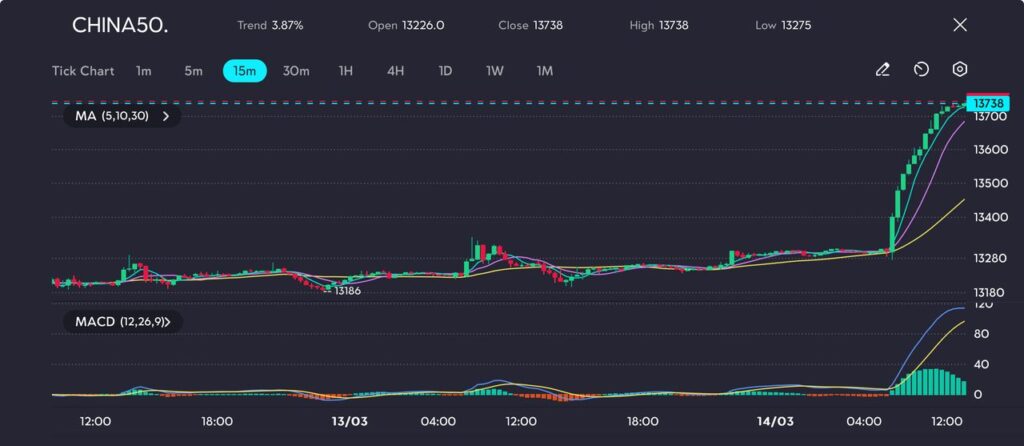
Chinese equities experienced a strong rally on Thursday, with the China50 index soaring 3.87% to close at 13,738.

This marked a significant rebound following a period of consolidation. The index opened at 13,226, trading within a narrow range before a late-session breakout drove prices higher.

The surge was fuelled by an influx of hedge fund capital, as global investors sought refuge from the volatility in US markets.

Chinese stocks outperformed other global equities, with traders increasing their exposure amid growing expectations of monetary easing and fiscal stimulus from Beijing.

The breakout above 13,700 indicates renewed bullish sentiment in China’s stock market after a prolonged phase of underperformance.

Technical indicators reinforce this momentum, with the MACD signalling strong upward movement and key moving averages pointing towards a well-established uptrend.

Hedge funds boost exposure to China as US market volatility increases

Hedge funds focused on Asia outperformed their global counterparts, with Chinese equities leading the gains.

Industry estimates suggest that hedge fund investments in Chinese stocks have nearly doubled compared to the rally in September 2024.

This capital shift was primarily driven by uncertainty in US markets, where Wall Street faced heavy selling pressure due to concerns over aggressive trade policies and economic downturn risks.

In contrast, Chinese equities benefited from improving investor sentiment, growing expectations of economic stimulus, and a steady influx of foreign capital.

The Hang Seng Index and other major Chinese benchmarks posted strong gains, reinforcing confidence in the resilience of the region’s markets.

Technical analysis

The China50 index surged by 3.87% to close at 13,738, decisively breaking above the 13,186 support level.

Price action suggests a robust bullish rally, with the MACD confirming upward momentum and short-to-medium-term moving averages (5, 10, 30) trending higher, reflecting strong buying pressure.

While the steep climb hints at an overbought condition, momentum remains intact.

China50 soars past 13,700 as bulls drive a breakout rally, as seen on the VT Markets app.

If the bullish trend persists, the next key resistance zone is expected near 13,800–14,000. However, traders should remain cautious of potential retracements if profit-taking occurs.

A decline below 13,600 could indicate a temporary pullback towards the 13,400–13,300 range.

Market participants should closely monitor Chinese economic data, policy developments, and broader global risk sentiment, as these factors could influence future price movements.

With the China50 index reaching its highest levels in months, all eyes are on Beijing’s next policy steps to sustain market confidence.

For now, China remains a key destination for investors seeking stability amid global market fluctuations, with the latest breakout signalling strong potential for further upside.

Click here to open account and start trading.

10 Best Blue-Chip Stocks to Watch in the UK 

10 Best UK Blue-Chip Stocks to Watch in 2025

Looking for stable, high-performing stocks in the UK? This guide explores the 10 best blue-chip stocks in 2025, covering what makes a stock “blue-chip,” why they remain popular among traders, and how to trade them effectively. Whether you’re a long-term investor or a short-term trader, these top companies offer a mix of stability, dividends, and growth potential.

What is a Blue-Chip Company?

A blue-chip company is a well-established, financially stable business with a history of consistent performance, strong earnings, and regular dividend payments. These companies are usually market leaders in their respective industries and are known for their reliability, even in times of economic uncertainty.

In the UK, blue-chip companies are typically those listed on the FTSE 100 Index, which tracks the largest 100 firms on the London Stock Exchange (LSE) based on market capitalization. These companies operate across various industries, including finance, healthcare, energy, and consumer goods, making them attractive to traders and investors seeking stability and long-term growth.

Find out the top 10 largest stock exchanges in the world by market capitalization

10 Best Blue-Chip Stocks in the UK

Here are some of the best blue-chip stocks in the UK, ranked based on market capitalization, industry strength, and long-term stability. Each of these companies plays a significant role in the UK economy and holds a unique competitive advantage in its respective industry.

CompanyMarket Capitalization (Approximately) IndustryUnique Strength
AstraZeneca (AZN.L)£180 BillionPharmaceuticals & BiotechnologyLeader in oncology and rare disease treatments
Shell (SHEL.L)£154 BillionEnergy (Oil, Gas, and Renewables)Strong presence in renewable energy and LNG
HSBC Holdings (HSBA.L)£150 BillionFinancial Services (Banking & Investment)Dominance in Asian markets and commercial banking
Unilever (ULVR.L)£115 BillionConsumer Goods (Food, Personal Care, and Home Products)Sustainability-driven innovation and diverse portfolio
Rio Tinto (RIO.L)£79 BillionMetals & MiningPioneer in AI-driven mining and resource extraction
British American Tobacco (BATS.L)£69 BillionConsumer Goods (Tobacco & Nicotine Alternatives)Transitioning to reduced-risk nicotine products
BP (BP.L)£66 BillionEnergy (Oil, Gas, and Renewables)Integrated operations from oil exploration to retail
GlaxoSmithKline (GSK.L)£60 BillionPharmaceuticals & BiotechnologyStrong vaccine and specialty medicine pipeline
Diageo (DGE.L)£46 BillionConsumer Goods (Alcoholic Beverages)Premiumization strategy in the spirits industry
Reckitt Benckiser (RKT.L)£35 BillionConsumer Goods (Healthcare, Hygiene & Nutrition)Diverse health and hygiene brand portfolio

Note: Market capitalization and other financial data are accurate as of March 2025 and may change based on market conditions.

1. AstraZeneca (AZN.L) – Pharmaceutical Leader

Market Capitalization: Approximately £180 billion

Industry: Pharmaceuticals & Biotechnology

AstraZeneca was established in 1999 after a merger between the Swedish firm Astra AB and the British company Zeneca Group. Headquartered in Cambridge, UK, it has expanded its footprint across more than 100 countries, specializing in treatments for cancer, cardiovascular diseases, and respiratory conditions. 

The company reported an 18% revenue growth in Q4 2024, with total revenue reaching $14.9 billion, driven by strong demand for oncology and rare disease treatments.

Unique Strength: AstraZeneca continues to drive advancements in biotechnology and pharmaceuticals, with a strong pipeline of innovative medicines. It was a key player in global vaccine development, further reinforcing its position as a leader in healthcare.

2. Shell (SHEL.L) – Energy Sector Giant

Market Capitalization: Approximately £154 billion

Industry: Energy (Oil, Gas, and Renewables)

Shell’s origins trace back to 1907 when Royal Dutch Petroleum and Shell Transport & Trading Company merged to form one of the largest energy firms globally. Based in London, the company operates in over 70 countries, engaging in oil and gas exploration, refining, and renewable energy initiatives. 

The company posted $6 billion in Q3 2024 profits, exceeding expectations due to strong performance in liquefied natural gas (LNG) sales, despite weaker refining margins.

Unique Strength: Shell is transitioning toward sustainable energy, investing significantly in hydrogen, wind, and solar power, positioning itself as a leader in the green energy shift.

3. HSBC Holdings (HSBA.L) – Banking Giant

Market Capitalization: Approximately £150 billion

Industry: Financial Services (Banking & Investment)

HSBC was established in 1865 in Hong Kong to finance trade between China and Europe. Today, it is one of the world’s largest banks, headquartered in London, with operations in over 60 countries. HSBC provides commercial banking, investment banking, and wealth management services, catering to a diverse global client base. 

The bank reported $134.9 billion in annual revenue, with robust earnings supported by higher interest rates and strong performance in commercial banking.

Unique Strength: HSBC’s dominance in Asia gives it a competitive edge, particularly in China and emerging markets, benefiting from cross-border trade and investment flows.

4. Unilever (ULVR.L) – Consumer Goods Giant

Market Capitalization: Approximately £115 billion

Industry: Consumer Goods (Food, Personal Care, and Home Products)

Unilever’s origins date back to 1929, resulting from the merger of the British soap manufacturer Lever Brothers and the Dutch margarine producer Margarine Unie. This strategic alliance aimed to leverage synergies between soap and margarine production, both relying on palm oil as a key ingredient. Over the decades, Unilever expanded its portfolio, acquiring numerous brands and diversifying into various consumer goods sectors. Today, Unilever operates in over 190 countries, offering products ranging from food and beverages to personal care and cleaning agents. 

Unilever reported revenues of €59.6 billion for the fiscal year ending December 31, 2023. The company’s diverse product range and global presence have contributed to its robust financial performance.

Unique Strength: The company’s strong focus on sustainability and ethical consumerism differentiates it from competitors, with major investments in eco-friendly products and supply chain efficiency.

5. Rio Tinto (RIO.L) – Mining & Natural Resources

Market Capitalization: Approximately £79 billion

Industry: Metals & Mining

Rio Tinto’s history began in 1873 when a consortium of European investors purchased the Rio Tinto mines in Spain, primarily for copper extraction. The company expanded its operations globally over the years, venturing into various minerals, including iron ore, aluminum, and diamonds. In 1962, Rio Tinto merged with the Australian company Consolidated Zinc to form the Rio Tinto – Zinc Corporation (RTZ), further diversifying its mining activities. Today, Rio Tinto operates in over 35 countries, supplying essential minerals and metals worldwide. 

In the fiscal year ending December 31, 2023, Rio Tinto reported revenues of $54.0 billion, with profits of $10.1 billion. The company’s performance was bolstered by strong demand for iron ore and aluminum, particularly from Asian markets.

Unique Strength: Rio Tinto is a pioneer in automated and AI-driven mining, which enhances operational efficiency and reduces environmental impact.

6. British American Tobacco (BATS.L) – High Dividend Yield Stock

Market Capitalization: Approximately £69 billion

Industry: Consumer Goods (Tobacco & Nicotine Alternatives)

Established in 1902, British American Tobacco (BAT) has grown into one of the world’s largest tobacco companies. Over the years, BAT expanded its global footprint through strategic acquisitions and mergers. Notably, in 2004, its U.S. subsidiary, Brown & Williamson, merged with R.J. Reynolds to form Reynolds American, solidifying BAT’s presence in the American market. In 2017, BAT acquired the remaining shares of Reynolds American for $49.4 billion, becoming the world’s largest tobacco company by sales. 

BAT reported a net loss exceeding £14 billion ($18 billion) for the fiscal year 2023, primarily due to a £33.6 billion impairment of intangible assets, reflecting the declining value of traditional cigarette brands amid shifting consumer preferences.​

Unique Strength: BAT is shifting towards reduced-risk products such as vaping, nicotine pouches, and heated tobacco products, adapting to changing consumer preferences and stricter regulations.

7. BP (BP.L) – Oil & Gas Major

Market Capitalization: Approximately £66 billion

Industry: Energy (Oil, Gas, and Renewables)

BP’s origins date back to 1909 with the founding of the Anglo-Persian Oil Company, established to exploit oil discoveries in Iran. Over the decades, BP evolved through mergers and acquisitions, including the notable merger with Amoco in 1998, becoming BP Amoco p.l.c., and later acquiring ARCO and Burmah Castrol. The company rebranded to BP p.l.c. in 2001.​ 

BP reported a significant decline in annual profits to $8.9 billion in 2024, down from nearly $14 billion in 2023. This decrease was attributed to lower oil and gas prices and challenges in the refining sector.

Unique Strength: BP’s integrated operations across the entire oil and gas value chain, from exploration to retail, provide it with a competitive advantage. The company’s strategic investments in renewable energy sources, such as wind and solar, demonstrate its commitment to transitioning towards a lower-carbon future.

8. GlaxoSmithKline (GSK.L) – Pharmaceutical Innovator

Market Capitalization: Approximately £60 billion

Industry: Pharmaceuticals & Biotechnology

GlaxoSmithKline (GSK) was formed in 2000 through the merger of Glaxo Wellcome and SmithKline Beecham, both with rich histories in pharmaceutical development. Over the years, GSK has focused on research and development in areas such as respiratory diseases, HIV, oncology, and vaccines. In 2022, GSK demerged its consumer healthcare business to form Haleon, allowing GSK to concentrate on its biopharmaceutical pursuits. 

GSK reported a 7% increase in sales, with strong performances in the HIV and cancer drug segments. The company announced a $2.5 billion share buyback and raised its long-term sales target to nearly $50 billion, reflecting confidence in its product pipeline and market position.

Unique Strength: GSK’s robust pipeline of vaccines and specialty medicines underscores its commitment to addressing global health challenges. The company’s strategic acquisitions, such as Sierra Oncology in 2022 and Bellus Health in 2023, have bolstered its position in oncology and respiratory therapeutics.

9. Diageo (DGE.L) – Beverage Powerhouse

Market Capitalization: Approximately £46 billion

Industry: Consumer Goods (Alcoholic Beverages)

Established in 1997 through the merger of Guinness Brewery and Grand Metropolitan, Diageo has grown into one of the world’s largest producers of spirits and beers. The company’s portfolio includes renowned brands such as Johnnie Walker, Smirnoff, Baileys, and Guinness. Diageo operates in over 180 countries, with significant production facilities across the globe. 

Diageo faced challenges with declining sales in certain regions and shifting consumer patterns post-COVID-19. The company’s shares have experienced volatility, and leadership is focusing on strategies to navigate these headwinds and restore growth.

Unique Strength: Diageo’s extensive brand portfolio and global distribution network provide a competitive edge in the alcoholic beverages industry. The company’s focus on premiumization and innovation has helped it adapt to changing consumer preferences.

10. Reckitt Benckiser (RKT.L) – Health & Hygiene Leader

Market Capitalization: Approximately £35 billion

Industry: Consumer Goods (Healthcare, Hygiene & Nutrition)

Reckitt Benckiser, commonly known as Reckitt, is a British multinational consumer goods company headquartered in Slough, United Kingdom. It was formed in 1999 through the merger of Reckitt & Colman plc (UK) and Benckiser NV (Netherlands), two established firms with roots dating back to the 19th century. Over the years, Reckitt has grown into a global powerhouse, operating in around 60 countries, with products available in nearly 200 countries. The company specializes in health, hygiene, and nutrition brands that are household staples worldwide. Some of its most recognized brands including Dettol, Strepsils, Nurofen, Durex, Veet and Lysol. 

Reckitt reported £14.2 billion in revenue for the 2024 fiscal year, reflecting steady growth despite market challenges. The company’s adjusted operating profit rose by 3% to £3.48 billion, supported by higher-margin health and hygiene products.

Unique Strength: Reckitt’s strength lies in its strong brand portfolio and focus on health and hygiene products, which have seen increased demand, especially during global health crises. The company’s commitment to innovation and sustainability also enhances its market position.

These best blue-chip stocks represent some of the strongest and most stable companies in the FTSE 100, each with a unique competitive advantage. Their dividend income, financial strength, and market dominance make them excellent choices for traders looking for stability and long-term opportunities.

Discover the top 10 largest UK companies by market capitalization

Why Do People Trade or Invest in Blue-Chip Stocks?

The UK blue-chip stocks are popular among traders due to their stability, dividends, and strong market presence, making them ideal for both long-term investing and short-term trading. Here’s why they remain a top choice in the UK stock market:

Lower Volatility & Stability

Blue-chip stocks tend to be less volatile than smaller companies, meaning they don’t experience drastic price swings. Their large market capitalization and established business models provide stability, making them a safer option, especially during economic downturns.

Dividend Income

Many blue-chip companies in the UK pay consistent dividends, providing traders with a steady source of passive income. Companies like HSBC and British American Tobacco offer attractive dividend yields, making them appealing to income-focused traders.

Long-Term Growth

Despite being large corporations, blue-chip companies continue to expand into new markets and industries. For example, AstraZeneca has grown due to advancements in biotechnology, while Unilever consistently innovates in the consumer goods sector.

Resilience in Economic Uncertainty

Blue-chip stocks are known for their ability to withstand recessions and financial crises better than smaller companies. During market downturns, companies like BP and Shell have remained industry leaders despite oil price fluctuations.

Liquidity & Diversification

Being part of the FTSE 100, blue-chip stocks are highly liquid, meaning they are easy to buy and sell without significant price changes. They also help traders diversify their portfolios, reducing exposure to risks from any single sector.

How to Trade Blue-Chip Stocks in the UK?

Trading blue-chip stocks in the UK requires a strategic approach, combining market research, risk management, and effective trading tools. Below is a step-by-step guide on how to effectively trading the best blue-chip stocks in the UK.

1. Research & Analyse the Stock Market

Understanding market trends, economic factors, and company performance is essential when trading blue-chip stocks. Interest rates, inflation, and industry developments can influence stock prices, so traders should monitor financial reports and historical performance to make informed decisions.

2. Choose a Reliable Trading Platform

A secure and well-equipped trading platform is crucial for executing trades efficiently. A good broker should provide real-time market data, competitive spreads, and strong risk management tools. VT Markets offers a seamless trading experience with access to UK blue-chip stocks.

3. Open and Fund Your Trading Account

To start trading, traders need to register with a broker, complete identity verification, and deposit funds. A well-funded account allows better portfolio diversification, reducing exposure to risks from individual stocks.

4. Utilise Technical and Fundamental Analysis

Fundamental analysis evaluates a company’s financial health, earnings reports, and market position, while technical analysis examines stock price trends and chart indicators. Combining both approaches helps traders identify profitable entry and exit points.

5. Implement Risk Management Strategies

Using stop-loss orders, diversifying investments, and managing position sizes are essential for minimizing risks. These strategies help protect capital and reduce the impact of market volatility.

6. Stay Informed & Adapt to Market Changes

Keeping up with financial news, stock indices like the FTSE 100, and industry updates ensures traders can adjust their strategies accordingly. Being informed helps navigate market shifts effectively.

Conclusion

Trading blue-chip stocks in the UK requires a strategic approach that includes thorough market research, choosing a reliable trading platform, applying both technical and fundamental analysis, and managing risks effectively. By staying informed about market trends, economic developments, and industry changes, traders can make better decisions and adapt to market conditions. With a strong trading environment and access to advanced tools, VT Markets provides traders with the resources needed to trade UK blue-chip stocks efficiently and confidently.

Trade UK Blue-Chip Stocks Today with VT Markets

VT Markets offers a seamless and efficient trading experience for those looking to trade UK blue-chip stocks. With competitive spreads, advanced trading tools, and an intuitive platform, traders can access the best blue-chip stocks in the UK while benefiting from low-cost trading and professional analysis features. Whether you are aiming to capitalize on market trends or build a diversified portfolio, VT Markets provides the tools and support needed to trade UK blue-chip stocks with confidence and efficiency.

Sign up with VT Markets now and start trading UK blue-chip stocks!

Frequently Asked Questions (FAQs)

1. What is a blue-chip company?

A blue-chip company is a well-established, financially strong business known for stability, reliability, and steady performance. These companies are often leaders in their industries and are part of major stock indices like the FTSE 100 in the UK. Examples include AstraZeneca, HSBC, and Shell.

2. Are blue-chip stocks a safe investment?

Blue-chip stocks are considered safer than smaller stocks due to their strong financial health and market position. While they tend to be more stable, they are still subject to market risks and economic downturns. Many also offer dividends, making them attractive for long-term investors.

3. Who should trade or invest in blue-chip stocks?

Blue-chip stocks are suitable for long-term investors looking for steady returns and dividends. Beginner traders benefit from their lower volatility, while active traders can take advantage of short-term price movements using CFDs.

4. What are the best times to trade UK blue-chip stocks?

The London Stock Exchange (LSE) operates from 8:00 AM to 4:30 PM UK time. The best trading times are during the opening and closing hours, when market activity and volatility are at their highest.

5. Can I trade blue-chip stocks with VT Markets?

Yes, VT Markets offers access to UK blue-chip stocks with competitive spreads, real-time market data, and advanced trading tools for both investors and short-term traders.

6. Do blue-chip stocks always pay dividends?

Many blue-chip stocks pay dividends, but not all. Some companies choose to reinvest profits into business growth instead. Investors should check dividend policies before investing.

7. Can I trade UK blue-chip stocks from outside the UK?

Yes, international traders can access UK blue-chip stocks through platforms like VT Markets, but it’s important to check local trading regulations and tax implications.

8. What is the difference between investing and trading blue-chip stocks?

Investing focuses on long-term growth, while trading seeks short-term gains. The key difference between trading and investing is that investors use fundamental analysis, while traders rely on technical analysis and leverage.

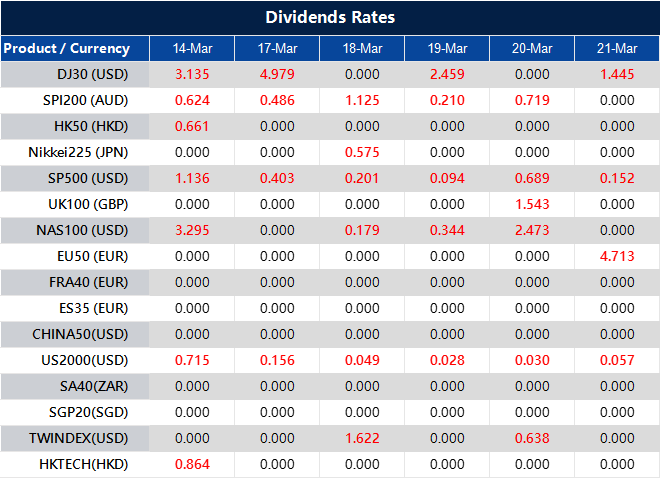
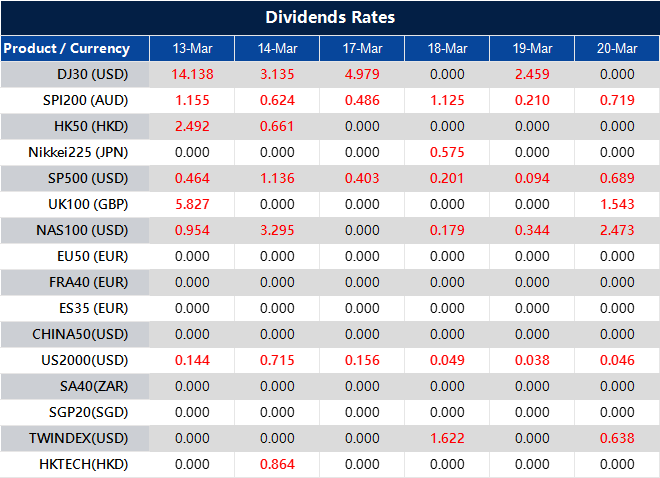
Dividend Adjustment Notice – Mar 14 ,2025

Dear Client,

Please note that the dividends of the following products will be adjusted accordingly. Index dividends will be executed separately through a balance statement directly to your trading account, and the comment will be in the following format “Div & Product Name & Net Volume”.

Please refer to the table below for more details:

The above data is for reference only, please refer to the MT4/MT5 software for specific data.

If you’d like more information, please don’t hesitate to contact info@vtmarkets.com.

Forex market analysis: 13 March 2025

Oil prices dipped as traders weighed stronger demand prospects against concerns over trade tensions and rising supply. While fuel consumption remains solid, uncertainty surrounding tariffs and OPEC+ production is keeping the market on edge. Investors are closely monitoring geopolitical risks, production trends, and economic signals that could influence the next move in oil prices.

Oil prices slip amid rising tariff concerns and market uncertainty

Oil prices edged lower on Thursday, reversing part of the previous session’s gains as investors balanced escalating trade tensions against expectations of stronger seasonal demand.

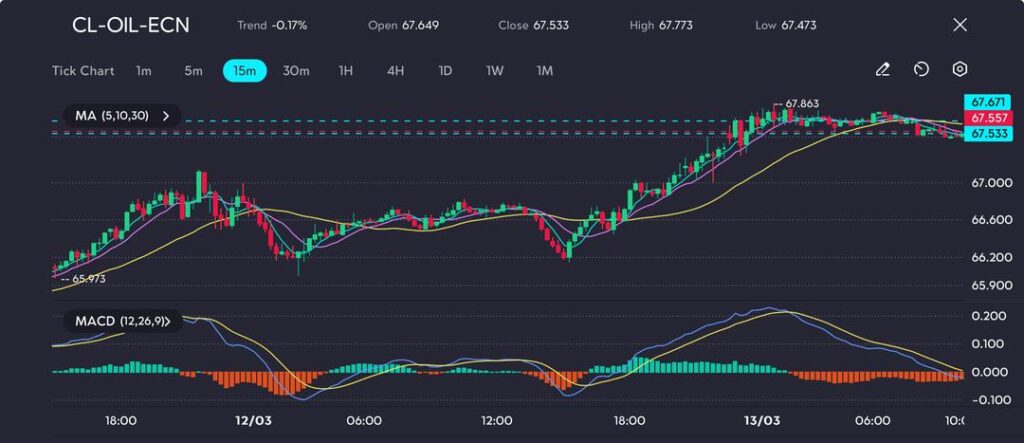
West Texas Intermediate (WTI) crude futures settled at USD 67.53, down 0.17%, after briefly reaching USD 67.77 earlier in the session. Brent crude followed a similar pattern, dipping 0.1% to USD 70.88 per barrel.

The decline comes after a 2% rally on Wednesday, driven by unexpectedly tight US oil and fuel inventories.

The Energy Information Administration (EIA) reported a 5.7 million-barrel drop in US gasoline stockpiles—far exceeding analysts’ forecasts of a 1.9 million-barrel draw.

Meanwhile, US crude inventories rose by 1.4 million barrels, a smaller-than-expected increase that signals steady demand.

Trade tensions cloud market outlook

Despite the price dip, global economic uncertainty remains a dominant theme.

US President Donald Trump’s latest tariff threats on European Union goods, along with Canada and Mexico preparing retaliatory measures, have added to investor concerns.

Traders fear that prolonged trade disputes could slow global economic growth, potentially reducing energy demand.

Meanwhile, the market is closely monitoring OPEC+ production levels. The latest data indicates an increase of 363,000 barrels per day in February, largely due to higher output from Kazakhstan.

While OPEC has maintained its global demand growth forecast for 2025, traders remain cautious about potential supply-side pressures.

Technical analysis

Crude oil (CL-OIL) is currently trading at USD 67.53, reflecting a 0.17% decline.

The session high of USD 67.77 encountered resistance near USD 67.86, leading to consolidation.

Crude oil stalls at resistance near USD 67.86, consolidation ahead, as seen on the VT Markets app.

Short-term moving averages (5, 10, 30 periods) suggest an overall uptrend, but signs of exhaustion are emerging.

The MACD remains positive, though a slight loss of momentum hints at a possible retracement.

  • Bullish scenario: A break above USD 67.86 could pave the way for a move towards USD 68.20.
  • Bearish scenario: If prices decline further, key support lies at USD 67.00, with additional downside risk towards USD 66.50.

Short-term volatility is likely to persist, with tariff developments, OPEC+ decisions, and economic data releases serving as major catalysts.

The sharp drop in US gasoline inventories indicates robust seasonal demand, which could cushion further losses.

However, any escalation in trade disputes or a rise in OPEC+ output may cap the upside potential for oil prices.

Click here to open account and start trading.

Dividend Adjustment Notice – Mar 13 ,2025

Dear Client,

Please note that the dividends of the following products will be adjusted accordingly. Index dividends will be executed separately through a balance statement directly to your trading account, and the comment will be in the following format “Div & Product Name & Net Volume”.

Please refer to the table below for more details:

The above data is for reference only, please refer to the MT4/MT5 software for specific data.

If you’d like more information, please don’t hesitate to contact info@vtmarkets.com.

Forex market analysis: 12 March 2025

Midweek trading is set to be driven by key economic data from China, the Eurozone, and the US, with investors focusing on industrial production figures, retail sales, and inflation trends. Market participants will be watching closely for any signs of slowing economic activity or shifts in central bank policy outlooks.

KEY INDICATORS

China industrial production & retail sales (February)

  • Provides insights into post-holiday economic activity.
  • A slowdown could trigger concerns about weaker global demand, impacting commodities and Asian markets.

Eurozone industrial production (January)

  • A key measure of the region’s manufacturing strength.
  • Weak data may add pressure on the ECB ahead of its next rate decision.

US 10-year Treasury auction

  • A critical test of investor demand for US government debt.
  • Higher yields could signal expectations of prolonged Fed tightening, impacting equities and the USD.

MARKET MOVERS

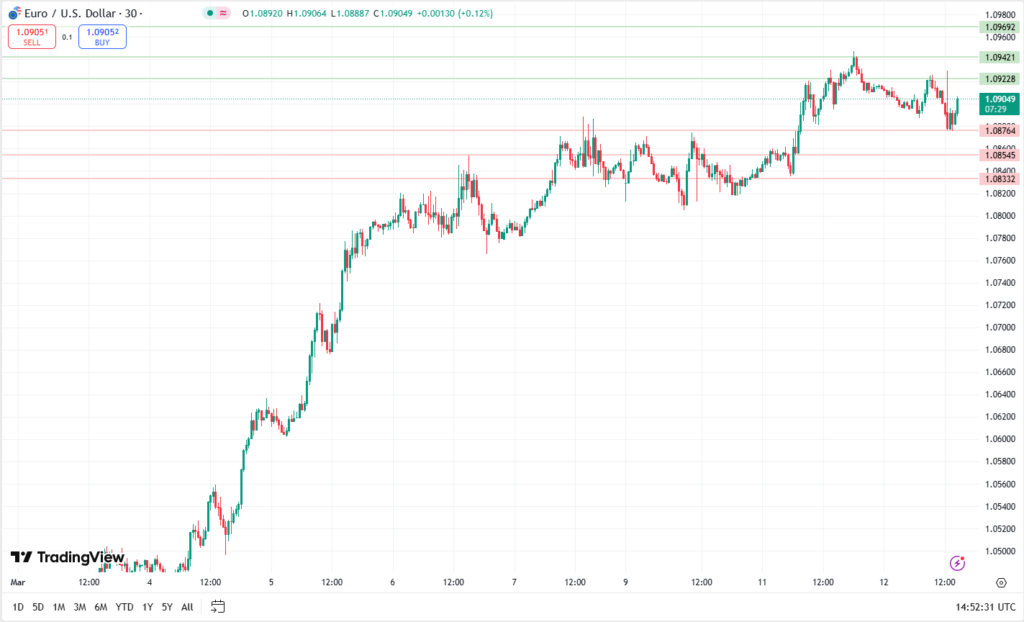
EUR/USD

Possible short preference
Short positions below 1.08764 with targets at 1.08545 & 1.08332 in extension.
Alternative scenario
Above 1.09228 look for further upside with 1.09421 & 1.09692 as targets.
The RSI calls for a new downleg.

Euro muted, dollar gains ground amid tariff turmoil and upcoming CPI data

  • The euro was broadly steady on Wednesday, while the dollar recovered mildly from recent losses as traders assessed the European response to fresh tariffs from US President Donald Trump and positioned for key consumer price index data.
  • The euro had inched down by 0.1% against the dollar to USD 1.0911 by 10:37 AM GMT. The dollar index, which measures the greenback against a basket of its currency pairs, rose by 0.2% to 103.54.
  • Brussels also vowed to impose fresh tariffs on US exports from next month in response to new American levies on more than EUR 18 billion in EU exports.
  • The focus is now on the all-important CPI data for further cues on US inflation and interest rates. The print is due later on Wednesday and is expected to show that inflation remained sticky in February.

European markets rally as US inflation rises less than expected, EU retaliates to Trump’s tariffs

European markets saw broad gains on Wednesday after the European Union announced retaliatory tariffs on a range of US imports.

The regional Stoxx 600 was 0.78% higher during afternoon trade, climbing down from earlier gains, with major bourses remaining in positive territory.

  • German stocks led gains, with the DAX index up 1.4% at 2:30 p.m. in London.
  • US markets have been on a roller-coaster ride amid uncertainty around President Donald Trump’s tariffs. A 25% duty on steel and aluminium imports went into effect on Wednesday.
  • US inflation rate hits 2.8% in February, less than expected.
  • The consumer price index, a wide-ranging measure of costs across the US economy, ticked up a seasonally adjusted 0.2% for the month, putting the annual inflation rate at 2.8%, according to the Labour Department.
  • All-item CPI had increased 0.5% in January.

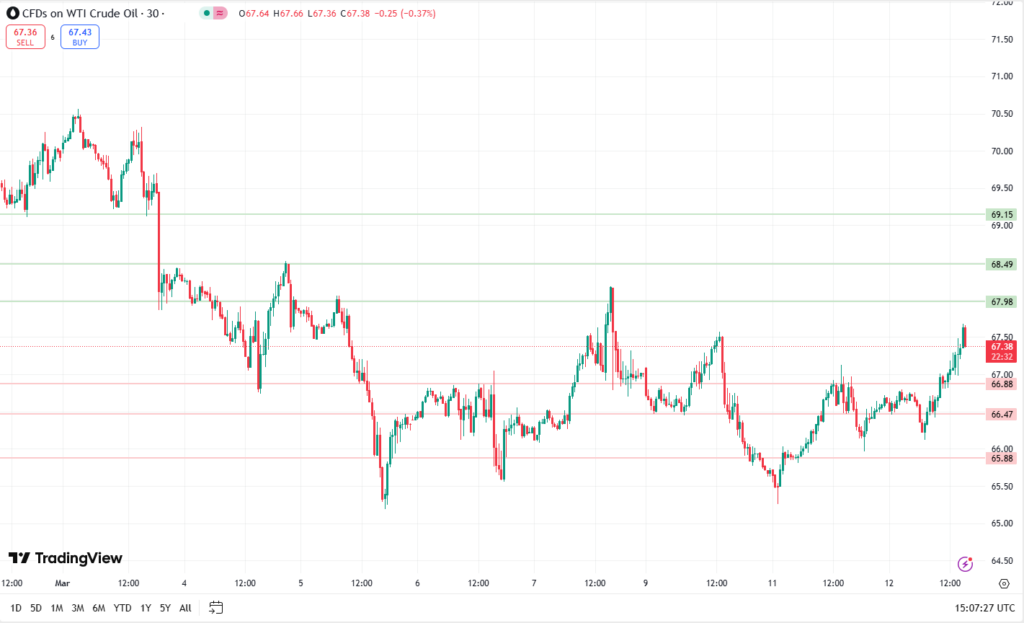
Crude Oil WTI

Possible long preference
Long positions above 67.98 with targets at 68.49 & 69.15 in extension.
Alternative scenario
Below 66.88 look for further downside with 656.47 & 65.88 as targets.
The RSI calls for a new upleg.

TODAY’S NEWS HEADLINES

China to impose retaliatory tariffs on some Canadian products as trade war heats up

  • China on Saturday announced plans to impose a 100% tariff on Canadian rapeseed oil, oil cakes, and peas, adding that a 25% levy would be placed on aquatic products and pork originating in Canada.
  • The measures are scheduled to come into force from March 20, according to a statement from China’s Customs Tariff Commission of the State Council.
  • It is the latest in a series of tariff announcements by the US, China, Canada, and Mexico in recent months.
  • Beijing said a 100% tariff would be imposed on Canadian rapeseed oil, oil cakes, and peas, while a 25% levy would be placed on aquatic products and pork originating in Canada.

Dow drops 300 points, giving up earlier gain, as trade worries hit stocks once again

  • The Dow Jones Industrial Average fell again on Wednesday as increasing tensions between the US and key trade partners continued to rattle investors.
  • The blue-chip index fell 354 points, or 0.9%.
  • The S&P 500 was trading 0.3% lower.
  • The Nasdaq Composite advanced 0.3%.
  • President Donald Trump’s steel and aluminium tariffs took effect on Wednesday, and Canada said it will impose 25% retaliatory duties on more than USD 20 billion worth of US goods.
  • The European Union also responded swiftly, pledging to impose counter-tariffs on EUR 26 billion (USD 28.33 billion) worth of US imports beginning in April.

Oil up 2% on tighter US supplies but tariff concerns loom

  • Oil prices rose 2% on Wednesday, as US government data showed tighter oil and fuel inventories than expected, though investors kept an eye on mounting fears of a US economic slowdown and the impact of tariffs on global economic growth.
  • Brent futures rose USD 1.33, or 1.9%, to USD 70.89 a barrel at 2:55 PM GMT.
  • US West Texas Intermediate crude futures gained USD 1.45, or 2.2%, to USD 67.70 a barrel.
  • US crude stockpiles rose by 1.4 million barrels in the latest week, less than an expected 2-million-barrel rise.
  • US gasoline inventories fell by 5.7 million barrels, versus expectations for a 1.9 million-barrel draw, while distillate stocks also dropped by more than expected.

Click here to open account and start trading.

Dividend Adjustment Notice – Mar 12 ,2025

Dear Client,

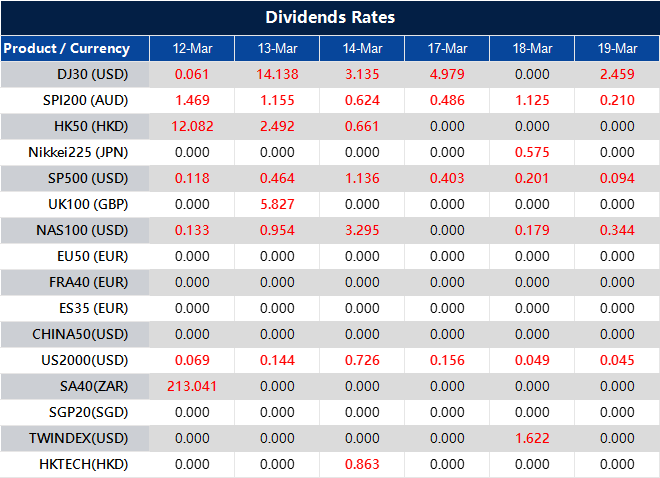
Please note that the dividends of the following products will be adjusted accordingly. Index dividends will be executed separately through a balance statement directly to your trading account, and the comment will be in the following format “Div & Product Name & Net Volume ”.

Please refer to the table below for more details:

The above data is for reference only, please refer to the MT4/MT5 software for specific data.

If you’d like more information, please don’t hesitate to contact info@vtmarkets.com.

Back To Top
server

Hello there 👋

How can I help you?

Chat with our team instantly

Live Chat

Start a live conversation through...

  • Telegram
    hold On hold
  • Coming Soon...

Hello there 👋

How can I help you?

telegram

Scan the QR code with your smartphone to start a chat with us, or click here.

Don’t have the Telegram App or Desktop installed? Use Web Telegram instead.

QR code