What is the Relative Strength Index (RSI) and How to Use It?

Understand What is Relative Strength Index 

In this article, we’ll explore what the Relative Strength Index (RSI) is and how to use this powerful momentum oscillator to identify key market conditions like overbought and oversold levels. Whether you’re a seasoned trader or just starting out, understanding how to interpret RSI signals can help you refine your trading strategy and make more informed decisions.

What is the Relative Strength Index (RSI)?

The Relative Strength Index (RSI) is a widely used momentum oscillator in technical analysis that helps traders identify overbought or oversold conditions in a market. It measures the speed and change of price movements, helping traders determine whether a particular asset is potentially due for a reversal. Developed by J. Welles Wilder in 1978, the RSI indicator has become an essential tool for market participants looking to spot potential trend reversals or confirm the strength of existing trends.

Typically, RSI is displayed on a scale of 0 to 100, with values above 70 indicating overbought conditions and values below 30 signaling oversold conditions. Traders use this information to assess entry and exit points for trades, making the Relative Strength Index an invaluable asset in a trader’s toolkit.

The Formula and Calculation for RSI

The RSI indicator is calculated by comparing the average gains and average losses over a specified period, typically 14 periods (which could be 14 days, 14 hours, etc., depending on the chart’s time frame). The process involves the following steps:

  1. Calculate the average gain: This is done by adding up all the price increases over the 14 periods and dividing it by 14. If a period shows no gain, it is counted as zero.
  2. Calculate the average loss: This is done similarly by summing all the price losses over the 14 periods and dividing it by 14. If there’s no loss, that period is counted as zero.
  3. Calculate Relative Strength (RS): RS is simply the ratio of average gain to average loss (RS = Average Gain / Average Loss). This gives you a measure of whether the asset is gaining more than it is losing.
  4. Apply the formula: The RSI is then calculated with the formula:
    RSI = 100 – (100 / (1 + RS))

The resulting number is a value between 0 and 100, where:

  • An RSI above 70 typically indicates the asset is overbought.
  • An RSI below 30 indicates the asset is oversold.

This formula helps traders assess whether an asset is potentially overextended, either due to being overbought or oversold, and might signal a potential reversal in price direction.

How to Use the RSI?

The Relative Strength Index (RSI) is a versatile tool for traders. When used effectively, it can help identify potential market reversals, trend strength, and even divergences. Let’s break down how to use the RSI in different scenarios:

1. Overbought and Oversold Conditions

The RSI is widely known for its ability to signal overbought and oversold conditions, which are crucial for identifying potential market reversals.

  • Overbought: RSI above 70 indicates an overbought market, suggesting a potential pullback or price reversal.
  • Oversold: RSI below 30 signals an oversold market, indicating a potential upward rally.

Example: If a stock’s RSI is below 30 and begins to rise, it may signal a buying opportunity.

2. Divergence

Divergence occurs when the RSI is moving in the opposite direction of the asset’s price, often signaling that the current price trend may be losing momentum and a reversal could be imminent.

  • Bullish Divergence: When the price makes lower lows but RSI forms higher lows, it suggests weakening selling pressure, signaling a possible reversal upward.
  • Bearish Divergence: When the price makes higher highs but the RSI forms lower highs, it suggests weakening buying pressure, indicating a potential downward reversal.

Example: If the price continues rising but the RSI starts falling, it could be a signal to sell.

3. Trend Confirmation

The RSI indicator is also useful for confirming the strength of a prevailing trend. Traders often use RSI readings to assess whether a trend is likely to continue or if it’s running out of steam.

  • Neutral Range (40-60): RSI between 40 and 60 suggests a neutral trend, with no clear direction.
  • Uptrend: RSI above 50 indicates an uptrend.
  • Downtrend: RSI below 50 suggests a downtrend.

Example: If a stock is consistently staying above an RSI of 50 and regularly crosses into the 60+ range, it suggests that the trend is likely to continue upward. Conversely, an RSI reading consistently below 50 indicates a bearish trend, and traders may look for shorting opportunities.

New to trading? Learn how to start trading for beginners

How to Set and Adjust the RSI?

The default setting for the RSI indicator is 14 periods, but this can be adjusted depending on the trader’s trading strategy and the market conditions.

Short-term traders: If you’re trading on shorter timeframes (like hourly or 15-minute charts), you might want to use a shorter period, such as 7 or 9. This makes the RSI indicator more sensitive to recent price movements, helping you make quicker decisions based on fast changes in the market.

Discover what are short-term trading strategies.

Long-term traders: For longer timeframes (like daily or weekly charts), using a longer period (e.g., 21 or 30) can smooth out the RSI, making it less reactive to minor fluctuations. This helps you identify more significant trends and avoid being misled by short-term noise in the market.

Adjusting the RSI period changes its sensitivity. A shorter period makes the RSI more volatile and responsive to recent price changes, while a longer period smooths out the indicator, making it better suited for identifying broader trends and reducing false signals.

Advantages of RSI

The Relative Strength Index offers numerous advantages for traders:

Versatility: The RSI indicator is adaptable across various markets—whether stocks, forex, or commodities—allowing traders to use it consistently for evaluating whether an asset is overbought or oversold, regardless of the market type.

Easy to Interpret: The RSI is intuitive and simple, even for beginners. Its 0-100 scale makes it easy for traders to spot key levels (overbought at 70, oversold at 30) and adjust their strategies accordingly without the need for complex calculations.

Predictive Power: One of the RSI indicator’s strongest features is its ability to forecast potential market reversals. By identifying overbought or oversold conditions, traders can enter or exit trades at more optimal times, helping them take advantage of price swings before they happen.

Divergence and Confirmation: The RSI also provides insight into divergence—when price and RSI move in opposite directions—indicating that a trend might be losing momentum and a reversal could be imminent. This makes it a powerful tool for confirming entry or exit points when combined with other indicators.

Disadvantages of RSI

While the Relative Strength Index is a valuable tool, it does have some limitations:

False Signals: In trending markets, the RSI indicator can remain in overbought or oversold territory for extended periods without signaling a reversal. In such cases, traders might wrongly interpret the RSI as suggesting an imminent trend change, leading to false signals if used alone.

Lagging Indicator: Since RSI is based on historical price data, it is inherently a lagging indicator. This means it can be slow to react to real-time price movements, and there might be a delay before RSI shows an overbought or oversold condition. Traders should be cautious not to rely solely on RSI for predicting immediate price movements.

Overreliance: While useful, RSI shouldn’t be used in isolation. Relying only on RSI can lead to misinterpretations, as it doesn’t account for broader market conditions. Combining it with other indicators, like moving averages or price action analysis, can provide a more comprehensive trading strategy and reduce the risk of false signals.

Conclusion

The Relative Strength Index (RSI) is an essential tool in any trader’s toolbox. It provides valuable insight into market momentum and helps identify potential trend reversals or confirmations. Whether you’re new to trading or an experienced market participant, mastering the RSI indicator can improve your decision-making and overall trading strategy.

By understanding how to use RSI effectively, you can identify overbought and oversold conditions, spot divergences, and enhance your ability to navigate volatile markets.

Elevate Your Relative Strength Index Today with VT Markets

Ready to become an expert in the Relative Strength Index and apply your knowledge in real-time trading? At VT Markets, we offer a seamless platform with MetaTrader 4 and MetaTrader 5 that empowers traders of all levels to execute their strategies with ease. Leverage our advanced tools, including the RSI indicator, and practice with a demo account to enhance your trading experience. Expert in RSI today and take your trading skills to the next level with VT Markets.

Start trading today with VT Markets and unlock the full potential of your trading journey!

Frequently Asked Questions (FAQs)

1. What is the Relative Strength Index? 

The Relative Strength Index (RSI) is a momentum oscillator used in technical analysis to measure the speed and change of price movements, helping traders identify overbought and oversold conditions in the market.

2. How do I use the RSI indicator? 

Traders use the RSI to spot overbought or oversold conditions, identify divergences, and confirm trends. A reading above 70 signals overbought conditions, while below 30 signals oversold conditions.

3. Can I adjust the RSI settings? 

Yes, traders can adjust the RSI settings based on their strategy. The default period is 14, but you can modify it to suit shorter or longer time frames depending on the asset and trading style.

4. Is RSI useful in volatile markets? 

Yes, RSI can help identify potential reversals even in volatile markets. However, during strong trends, RSI might remain in overbought or oversold levels for longer periods, which could lead to false signals. It’s important to use it in combination with other indicators for confirmation.

5. What is the RSI divergence, and why is it important? 

RSI divergence occurs when the price of an asset and the RSI move in opposite directions. Bullish divergence (lower lows in price, higher lows in RSI) suggests a potential upward reversal, while bearish divergence (higher highs in price, lower highs in RSI) signals a possible downward trend.

6. How to Use the RSI for Trend Identification?

The RSI indicator can be used to confirm the strength of a trend. In an uptrend, an RSI reading above 50 suggests that buyers are in control, and the trend may continue. Conversely, in a downtrend, an RSI reading below 50 indicates that sellers dominate the market.

Disclaimer:

This article is for informational purposes only and should not be construed as financial or trading advice. Past performance is not indicative of future results. Trading involves significant risk, and you should carefully consider whether it is suitable for you based on your individual circumstances.


Forex market analysis: 20 March 2025

The US dollar is moving cautiously as traders react to the Federal Reserve’s latest signals on interest rates. While Powell’s comments reassured markets about future rate cuts, uncertainty around global trade and geopolitical tensions keeps investors on edge. With the dollar stuck in a tight range, analysts are watching key technical levels for clues on its next move.

US Dollar Index remains range-bound following Powell’s remarks

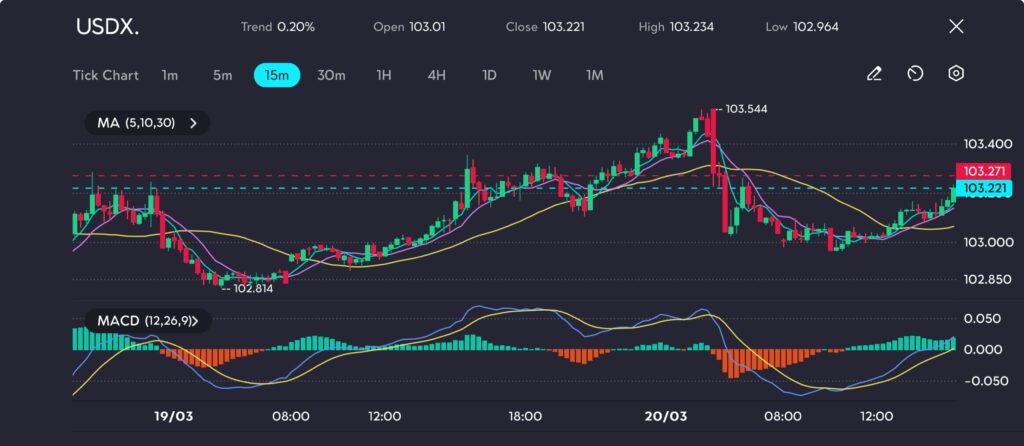
The US Dollar Index (USDX) traded sideways after Federal Reserve Chair Jerome Powell’s latest comments, showing limited reaction to the central bank’s decision to keep interest rates unchanged.

The index hovered around 103.22, reflecting the market’s cautious stance as investors awaited further economic signals.

Fed’s rate-cut outlook and market response

Powell reaffirmed the Federal Reserve’s plan for two rate cuts in 2025, helping to ease broader market concerns.

While this announcement fuelled a rally across the three major US stock indices, the dollar’s performance remained lacklustre.

Market sentiment appeared to favour the prospect of lower borrowing costs, but the USDX continued its consolidation, failing to break out of its tight trading range.

USDX technical analysis and key levels

The USDX recorded a 0.20% gain, closing at 103.221 after opening at 103.01. The session saw a notable uptick, reaching a high of 103.544 before retreating slightly.

SDX tests resistance at 103.271 after climbing from 102.814, as seen on the VT Markets app.

Technical indicators suggest a bullish bias, with short-term moving averages (MA 5,10,30) maintaining a position above longer-term averages, signalling sustained upward momentum.

The MACD (12,26,9) also indicates strong bullish pressure, with an expanding histogram and the MACD line trending above the signal line.

Key levels to monitor include 103.271 as immediate resistance and 102.814 as key support.

A breakout above resistance could drive further gains, while a decline below support might shift sentiment towards a more neutral or bearish outlook.

Market outlook: Uncertainty lingers

Despite Powell’s reaffirmation of future rate cuts, external factors such as global trade policies and geopolitical tensions continue to weigh on the greenback.

The USDX’s next significant move will likely depend on further clarity from the Federal Reserve and developments in global economic conditions, including ongoing geopolitical risks in the Middle East.

Traders should stay alert to upcoming economic data releases and Fed communications, which could provide fresh direction for the US dollar in the coming weeks.

Click here to open account and start trading.

Dividend Adjustment Notice – Mar 20 ,2025

Dear Client,

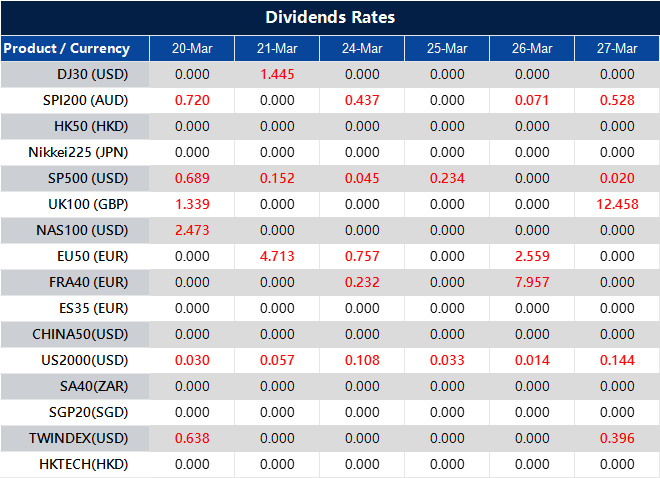
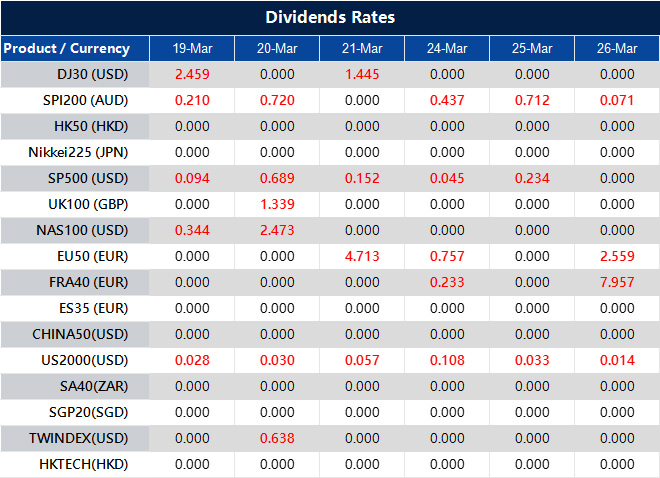
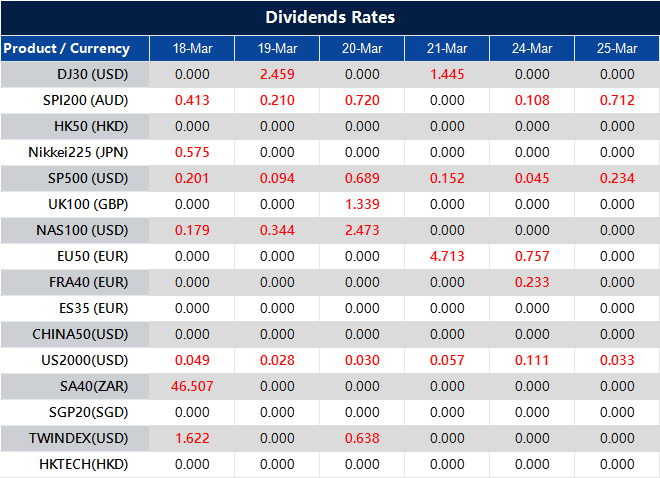
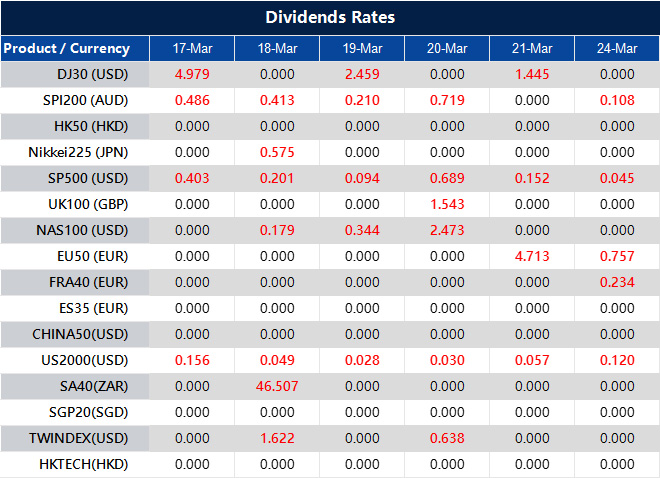
Please note that the dividends of the following products will be adjusted accordingly. Index dividends will be executed separately through a balance statement directly to your trading account, and the comment will be in the following format “Div & Product Name & Net Volume”.

Please refer to the table below for more details:

Dividend Adjustment Notice

The above data is for reference only, please refer to the MT4/MT5 software for specific data.

If you’d like more information, please don’t hesitate to contact info@vtmarkets.com.

Forex market analysis: 19 March 2025

Midweek trading will be dominated by the highly anticipated Federal Reserve interest rate decision, setting the tone for global markets. Investors will also analyse economic data from China and the US, looking for further signs of economic momentum or slowdown. Expect heightened volatility across equities, bonds, and forex markets.

KEY INDICATORS

Federal Reserve interest rate decision & economic projections

  • The Fed will announce its policy decision, with markets closely watching for any changes in interest rates.
  • The FOMC economic projections (dot plot) will provide insights into the Fed’s future rate path.
  • Fed Chair Jerome Powell’s press conference will be key in shaping market sentiment.

China industrial production & retail sales (February)

  • Indicators of post-holiday economic activity and consumer demand.
  • A slowdown could trigger concerns about weaker global growth, affecting commodities and Asian markets.

US crude oil inventories

  • A key report for energy markets, influencing oil prices and inflation expectations.

MARKET MOVERS

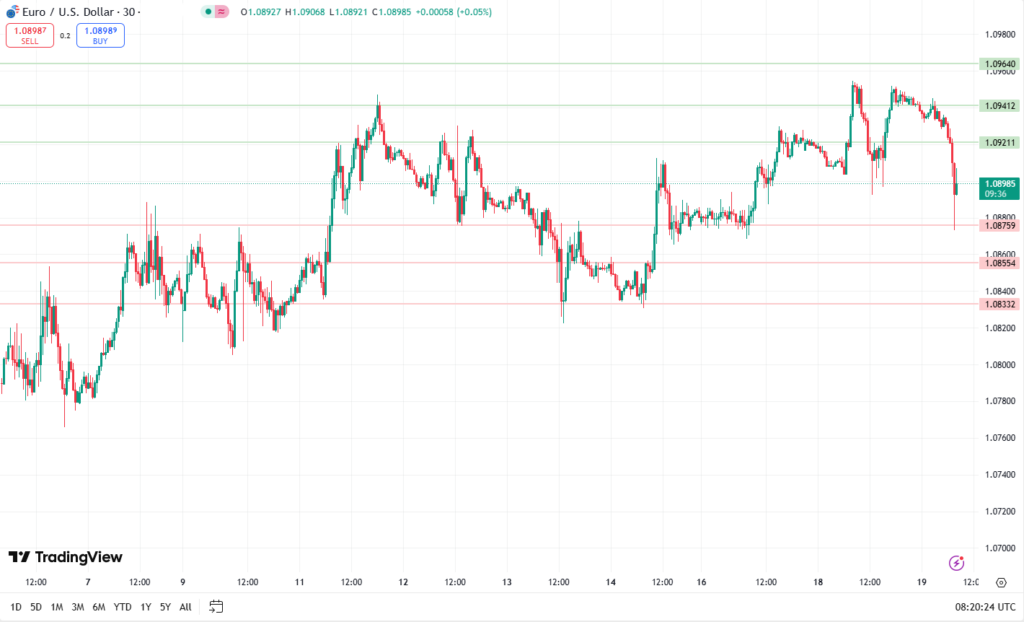
EUR/USD

Possible short preference

Short positions below 1.08759 with targets at 1.08554 and 1.08332 in extension.

Alternative scenario

Above 1.09211, look for further upside with 1.09412 and 1.09640 as targets.

The RSI calls for a new downleg.

Dollar weakens ahead of Fed meeting; euro gains ahead of German debt vote

  • The US dollar edged lower on Tuesday ahead of the start of the latest Federal Reserve meeting, while the euro gained ahead of an expected vote on Germany’s substantial stimulus plan.
  • At 9:00 AM GMT, the Dollar Index, which tracks the greenback against a basket of six other currencies, traded 0.1% lower at 102.890, remaining above last week’s five-month low.
  • In Europe, EUR/USD traded 0.3% higher at 1.0951, near its highest level since October, ahead of a scheduled parliamentary vote on Germany’s economic support package.
  • GBP/USD rose 0.1% to 1.3001, climbing above the 1.30 level for the first time since November.
  • The Bank of England is widely expected to keep interest rates unchanged on Thursday after inflation edged higher last month.
  • In Asia, USD/JPY climbed 0.3% to 149.70 ahead of the conclusion of the latest Bank of Japan meeting on Wednesday.

Oil slips after US-Russia agreement on 30-day energy ceasefire

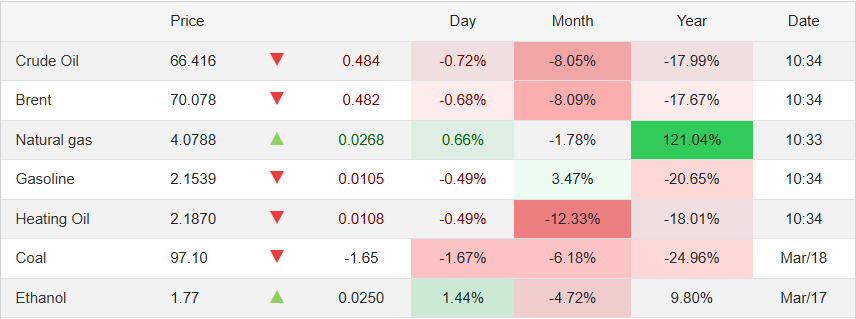
Oil prices fell on Wednesday after Russia agreed to US President Donald Trump’s proposal that Moscow and Kyiv temporarily stop attacking each other’s energy infrastructure, which could lead to more Russian oil entering global markets.

  • Brent crude futures fell 23 cents, or 0.3%, to USD 70.33 a barrel by 07:30 GMT.
  • US West Texas Intermediate crude (WTI) was down 25 cents, or 0.4%, at USD 66.65.

Russian President Vladimir Putin agreed on Tuesday to stop attacking Ukrainian energy facilities but stopped short of endorsing a full 30-day ceasefire that Trump had hoped for.

US crude oil stocks data, meanwhile, painted a mixed picture, with crude stocks rising while fuel inventories fell.

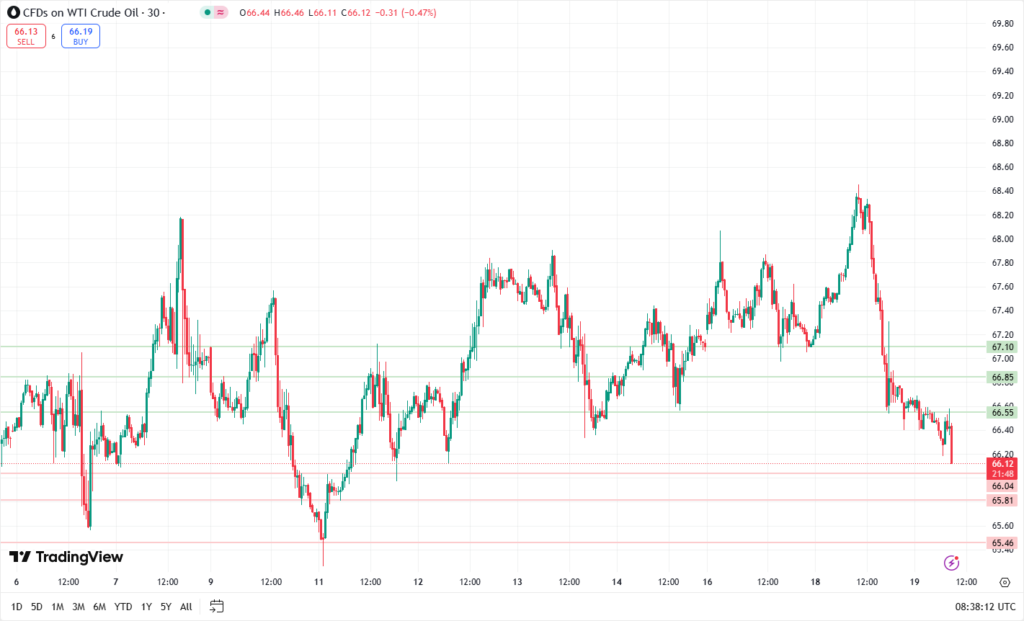
Crude Oil WTI

Possible short preference

Short positions below 66.04, with targets at 65.81 and 65.46 in extension.

Alternative scenario

Above 66.55, look for further upside with 66.85 and 67.10 as targets.

The RSI advocates for further downside.

TODAY’S NEWS HEADLINES

Gold prices hit record high as haven demand grows ahead of Fed rate decision

  • Gold prices rose slightly to a record high in Asian trade on Wednesday, as safe-haven demand remained underpinned by renewed geopolitical ructions in the Middle East and concerns over trade tariffs.
  • Investors also remained largely risk-averse before the conclusion of a Federal Reserve meeting later on Wednesday, which is expected to offer more insight into the US economy.
  • Spot gold rose 0.1% to a record high of USD 3,039.0 an ounce.
  • Gold futures expiring in May rose 0.1% to a peak of USD 3,046.12 an ounce.
  • The Fed is widely expected to keep interest rates unchanged at 4.5% after the conclusion of its meeting later on Wednesday, amid persistent uncertainty over the US economy under Trump.
  • Platinum futures fell 0.4% to USD 1,016.90 an ounce.
  • Silver futures fell 0.5% to USD 34.55 an ounce.

Europe stocks close higher as Germany passes landmark fiscal package; Trump and Putin hold call

  • European markets closed higher on Tuesday, with investor focus on Germany’s historic debt reform deal and a closely watched phone call between US President Donald Trump and Russian leader Vladimir Putin.
  • European stocks on the Stoxx 600 index closed higher for a third straight session, adding another 0.59%, provisionally.
  • Germany’s DAX closed 1.03% higher.
  • France’s CAC 40 closed 0.5% higher.
  • The UK’s FTSE 100 ended 0.29% higher.

Asia-Pacific markets rise as Hong Kong tech stocks rally; Baidu shares pop 12%

  • Asia-Pacific markets rose on Tuesday, tracking gains on Wall Street, which ticked up after US retail sales data appeared to ease recession concerns.
  • Hong Kong’s Hang Seng Index led gains in Asia, rising 2.29% in its last hour on the back of strong moves in tech giants like Baidu, which was up 12.11% as of 3:45 p.m. local time.
  • Meanwhile, mainland China’s CSI 300 advanced 0.27% to end the day at 4,007.72.
  • The BOJ’s two-day meeting coincides with the US Federal Reserve, with the latter also expected to keep interest rates unchanged.
  • Japan’s benchmark Nikkei 225 ended the day 1.20% higher at 37,845.42.
  • Over in South Korea, the Kospi index closed flat at 2,612.34, while the small-cap Kosdaq added 0.27% to end at 745.54.
  • Australia’s S&P/ASX 200 ended the day flat at 7,860.40, paring gains from earlier in the session.

Click here to open account and start trading.

Dividend Adjustment Notice – Mar 19 ,2025

Dear Client,

Please note that the dividends of the following products will be adjusted accordingly. Index dividends will be executed separately through a balance statement directly to your trading account, and the comment will be in the following format “Div & Product Name & Net Volume”.

Please refer to the table below for more details:

Dividend Adjustment Notice

The above data is for reference only, please refer to the MT4/MT5 software for specific data.

If you’d like more information, please don’t hesitate to contact info@vtmarkets.com.

Forex market analysis: 18 March 2025

WTI crude oil prices are under pressure as market sentiment weakens due to shifting global supply expectations. With Russia potentially increasing exports and OPEC set to raise production, traders are concerned about oversupply driving prices lower.

At the same time, rising US crude inventories point to a slowdown in demand, adding to the uncertainty. In this analysis, we explore the key factors influencing crude oil prices, the latest technical trends, and what traders should watch for in the coming days.

WTI crude oil declines amid Russian supply outlook and OPEC decision

WTI crude oil futures continued their downward trajectory, hitting a low of USD 66.42 per barrel on Tuesday.

The market reacted to reports that Russian President Vladimir Putin agreed to halt strikes on Ukrainian energy infrastructure but dismissed a proposed 30-day ceasefire.

This development has fuelled speculation that Western sanctions on Russian oil exports may ease in the near future, potentially increasing global supply and exerting further downward pressure on prices.

Additionally, OPEC’s announcement to boost production from next month has added to the bearish sentiment.

The prospect of higher output from both Russia and OPEC raises concerns of oversupply, making traders hesitant to take bullish positions.

Technical analysis

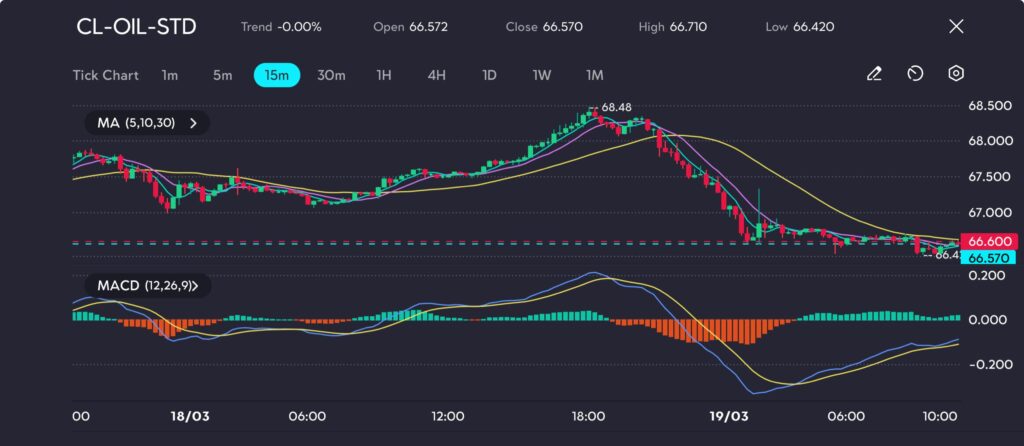
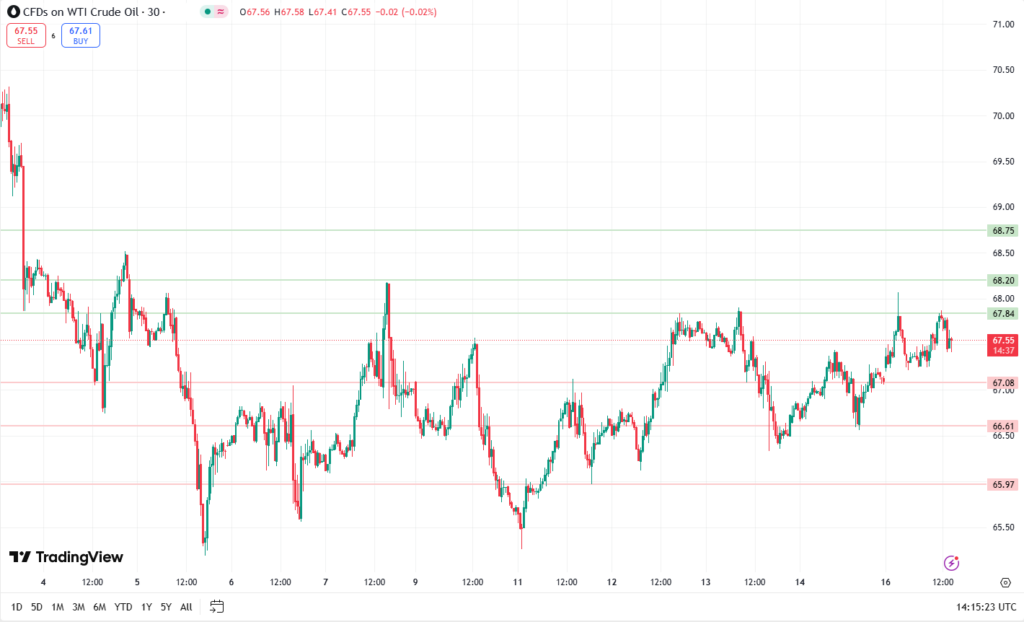
WTI crude oil settled at USD 66.570, marginally lower than its opening price of USD 66.572, after fluctuating between a session high of USD 66.710 and a low of USD 66.420.

Crude oil struggles at 66.570 as selling pressure mounts, with resistance seen near 67.50, as seen on the VT Markets app.

Prices initially climbed to USD 68.48 before pulling back sharply, reflecting ongoing demand concerns and a stronger US dollar.

Moving averages (5, 10, and 30) indicate a sustained downtrend, as short-term MAs have crossed below longer-term averages, reinforcing bearish momentum.

The MACD (12,26,9) histogram remains negative, with the signal line trending downward, suggesting continued selling pressure.

Key support lies near USD 66.00, and a break below this level could push prices toward USD 65.50.

On the upside, resistance is observed at USD 67.50, with a breakout potentially signalling a short-term rebound.

Rising US crude inventories signal softening demand

Further weighing on crude oil prices, recent industry reports have shown larger-than-expected builds in US crude inventories.

This indicates a slowdown in demand amid persistent global economic uncertainties.

Trade disputes and economic headwinds continue to pose risks, prompting caution among traders who are closely monitoring signs of further demand weakness.

Market outlook

In the short term, WTI crude oil may remain under pressure as Russian supply expectations and OPEC’s production increase contribute to concerns of an oversupplied market.

However, traders should stay vigilant for any geopolitical developments, particularly in the Middle East, which could trigger sudden price swings.

Additionally, upcoming inventory reports and key global economic data will play a crucial role in shaping market direction.

Click here to open account and start trading.

Dividend Adjustment Notice – Mar 18 ,2025

Dear Client,

Please note that the dividends of the following products will be adjusted accordingly. Index dividends will be executed separately through a balance statement directly to your trading account, and the comment will be in the following format “Div & Product Name & Net Volume”.

Please refer to the table below for more details:

Dividend Adjustment Notice

The above data is for reference only, please refer to the MT4/MT5 software for specific data.

If you’d like more information, please don’t hesitate to contact info@vtmarkets.com.

Forex market analysis: 17 March 2025

The new trading week kicks off with key economic data from Europe and the US, setting the tone for market sentiment ahead of the highly anticipated Federal Reserve policy meeting later in the week. Investors will be closely watching inflation trends and housing market indicators for clues on economic momentum.

KEY INDICATORS

Eurozone final CPI (February)

  • A confirmation of inflation trends in the eurozone.
  • Any surprises could impact European Central Bank (ECB) rate expectations and the euro.

US NAHB housing market index (March)

  • A key measure of sentiment among homebuilders.
  • Could provide insights into the strength of the US housing sector amidst interest rate uncertainty.

Market positioning ahead of the Federal Reserve meeting

  • With the Fed set to announce its rate decision on Wednesday, investors may adopt a cautious stance.
  • Potential positioning in bonds, equities, and the US dollar in anticipation of policy signals.

MARKET MOVERS

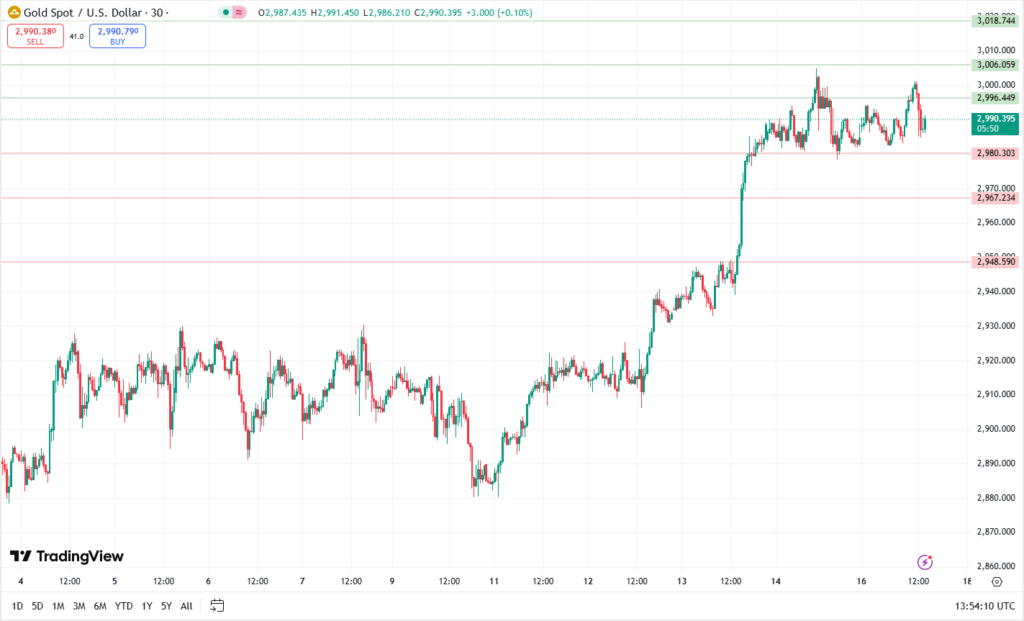
XAU/USD

Possible long preference
Long positions above 2996.44 with targets at 3006.05 & 3018.74 in extension.
Alternative scenario
Below 2980.30 look for further downside with 2967.23 & 2948.59 as targets.
A support base at 2980.30 has formed and has allowed for a temporary stabilisation.

Gold prices hover around USD 3,000; UBS lifts its price target

  • Gold prices fell slightly in Asian trade on Monday after surging to record highs, as safe-haven demand remained underpinned by uncertainty over trade tariffs and a slowing economy.
  • Gold also saw some profit-taking after reaching record highs above USD 3,000 an ounce last week.
  • Spot gold rose slightly to USD 2,997.25 an ounce.
  • Gold futures expiring in April climbed to USD 3,004.70 an ounce by 10:38 AM GMT. Spot prices hit a record high of USD 3,005.08 an ounce on Friday.
  • Benchmark copper futures on the London Metal Exchange rose 0.1% to USD 9,805.40 a tonne.
  • May copper futures were flat at USD 4.8950 a pound.

Oil, dollars, and debt: how safe is the Middle East from the global trade war?

  • For the Middle East, which has been spared from tariffs (so far), there are still reasons to worry – as well as potential opportunities.
  • The blow to growth from a trade war is likely to hurt the price of oil – the mainstay of the region’s economy.
  • There are also immediate costs for countries whose currencies are pegged to the dollar – Saudi Arabia, the UAE, Qatar, Oman, and Bahrain.

The direct impact of tariffs, such as US levies on steel and aluminium imports, remains minimal for the Middle East, economists say. The Gulf region, for instance, accounted for roughly 16% of US aluminium imports in 2024.

Crude Oil WTI

Possible long preference
Long positions above 67.98 with targets at 68.49 & 69.15 in extension.
Alternative scenario
Below 66.88 look for further downside with 66.47 & 65.88 as targets.
The RSI is bullish and calls for further advance.

TODAY’S NEWS HEADLINES

US stocks stable after retail sales rebound; Fed meeting due

  • US stocks stabilised on Monday after last week’s losses, but investors remained concerned that uncertainty over trade tariffs could weigh heavily on the world’s largest economy.
  • At 1:35 PM GMT, the Dow Jones Industrial Average gained 100 points, or 0.2%.
  • The S&P 500 index rose 11 points, or 0.2%.
  • The Nasdaq Composite edged 10 points higher, or 0.1%.
  • The Nasdaq sank deeper into correction territory last week, while the S&P 500 also briefly entered correction territory. Meanwhile, the Dow had its biggest one-week drop since 2023, losing 4.4%.

European markets rise ahead of German debt reform vote; QinetiQ down 20%

  • European stocks started the new trading week in positive territory, although investors will be watching to see if global market volatility continues.
  • The pan-European Stoxx 600 index was up around 0.8% by 1:50 a.m. London time, with most sectors moving higher.
  • European markets ended last week higher after reports that German lawmakers were moving closer to reforming the country’s so-called debt brake rule.
  • Investors will be closely monitoring US markets this week after the Dow posted its worst weekly performance since 2023, as investors grapple with President Donald Trump’s shifting tariff policies alongside growing signs of economic weakness.

Asia-Pacific markets mostly climb; 40-year JGB yield hits record high

  • Asia-Pacific markets mostly climbed on Monday, with investors keeping a close watch on Chinese equities.
  • Mainland China’s CSI 300 closed 0.24% lower at 3,996.79.
  • Hong Kong’s Hang Seng Index rose 0.77% in its final hour of trading.
  • In Japan, the benchmark Nikkei 225 ended the day 0.93% higher at 37,396.52.
  • Over in South Korea, the Kospi index advanced 1.73% to close at 2,610.69.
  • India’s benchmark Nifty 50 ticked up 0.35%.
  • Australia’s S&P/ASX 200 ended the day 0.83% higher at 7,854.10.

Click here to open account and start trading.

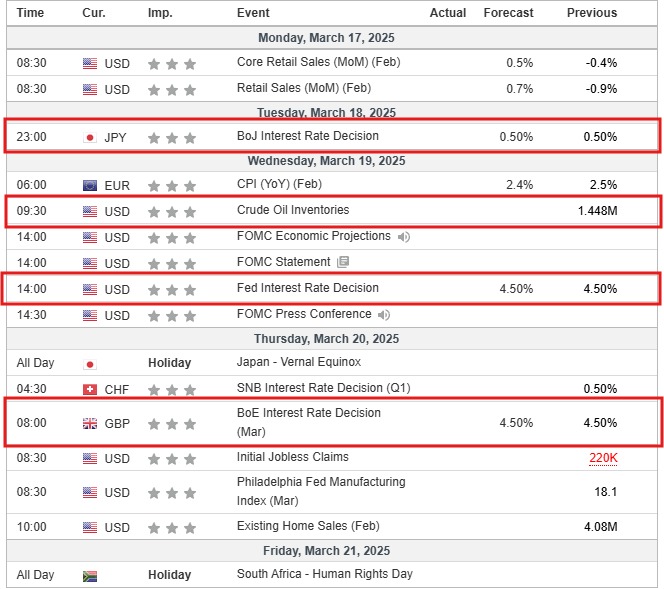
Week ahead: Fed decision and inflation data set to steer global markets

Next week, global markets will be driven by key central bank decisions, economic data releases, and geopolitical developments. Investors will focus on the Federal Reserve’s policy outlook, inflation reports, and economic activity indicators from major economies. Volatility is expected across equities, forex, and commodities as markets respond to these crucial events.

KEY INDICATORS

Monday, 17 March

  • Eurozone final CPI (February) – Confirms inflation trends ahead of the ECB’s next policy move.
  • US NAHB housing market index (March) – Provides insights into the health of the US real estate sector.

Wednesday, 19 March

  • Federal Reserve interest rate decision & economic projections – Markets will focus on Fed Chair Powell’s comments for signals on future rate moves.
  • Market reaction – Potential impact on equities, bonds, and the US dollar.

Thursday, 20 March

  • Bank of England (BoE) interest rate decision – The BoE’s stance on inflation and potential rate cuts will be closely watched.
  • US jobless claims & existing home sales (February) – Labour market trends and housing market strength will influence market sentiment.

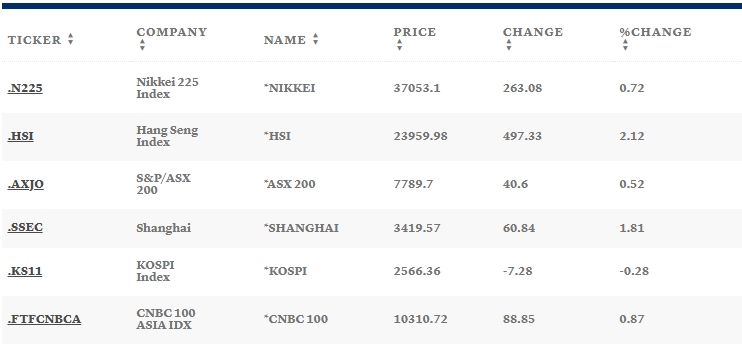
Chinese stocks close at three-month high, leading gains in Asia, despite fall on Wall Street

  • Asia-Pacific markets mostly rose on Friday, despite a plunge in all three benchmarks in the US over the previous session amid concern about President Donald Trump’s tariff plans.
  • Mainland China’s CSI 300 led gains in Asia, rising 2.43% to end the day at a three-month high of 4,006.56. This follows stronger movements in the healthcare, consumer cyclicals, and non-cyclicals sectors.
  • Hong Kong’s Hang Seng Index rose 2.12% to end the day at 23,959.98.
  • In Japan, the benchmark Nikkei 225 ended the day 0.72% higher at 37,053.10, while the broader Topix index rose 0.65% to 2,715.85.
  • South Korea’s Kospi index lost 0.28% to close at 2,566.36, while the small-cap Kosdaq advanced 1.59% to 734.26.
  • Australia’s S&P/ASX 200 ended the trading day 0.52% higher at 7,789.70.

Dollar edges higher ahead of Michigan sentiment data; euro slips

  • The US dollar edged higher on Friday amid growing expectations that a government shutdown can be averted, while the euro handed back recent gains amid concerns that a global trade war risks a sharp regional economic downturn.
  • At 9:15 AM GMT, the Dollar Index, which tracks the greenback against a basket of six other currencies, traded 0.2% higher at 103.982, moving further away from Tuesday’s trough of 103.21, its lowest since mid-October.
  • The greenback has fallen more than 4% so far this year, retreating from the six-month high seen in January, as the uncertainty surrounding the Trump administration’s trade policies raised fears of a US recession.
  • In Europe, EUR/USD traded marginally lower at 1.0851, sliding further from Tuesday’s five-month peak as the EU-US trade spat rattled traders and after Germany struggled to pass a massive spending proposal.

MARKET MOVERS

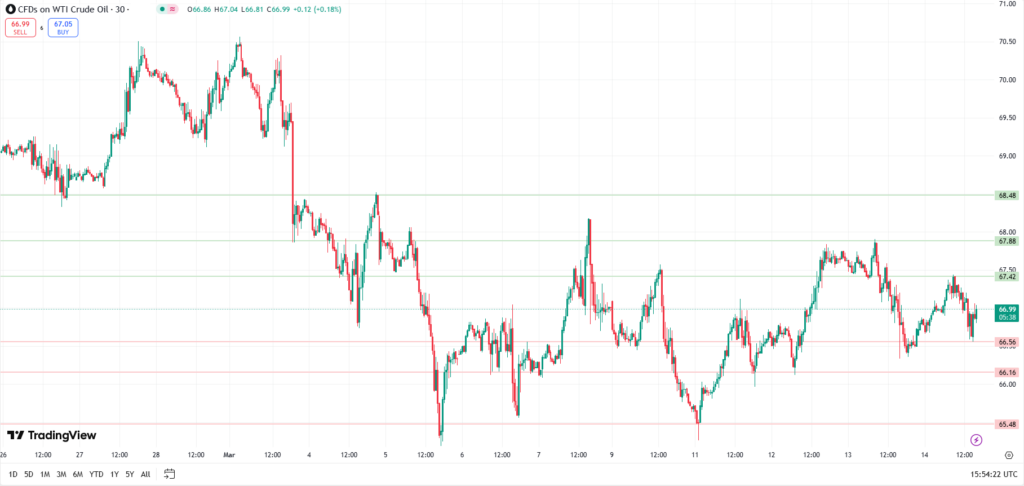
Crude Oil WTI

Potential short preference
Short positions below 66.56 with targets at 66.16 & 65.48 in extension.
Alternative scenario
Above 67.42 look for further upside with 67.88 & 68.48 as targets.
The RSI is below its neutrality area at 50%

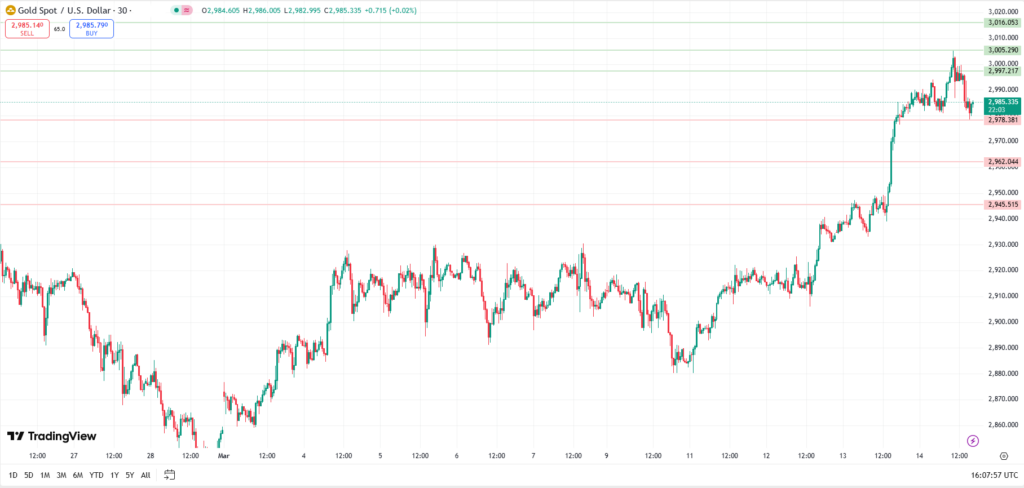
XAU/USD

Potential long preference
Long positions above 2997.21 with targets at 3005.29 & 3016.05 in extension.
Alternative scenario
Below 2978.38 look for further downside with 2962.38 & 2945.51 as targets.
The next resistances are at 3005.29 and then at 3016.05.

Technical indicators

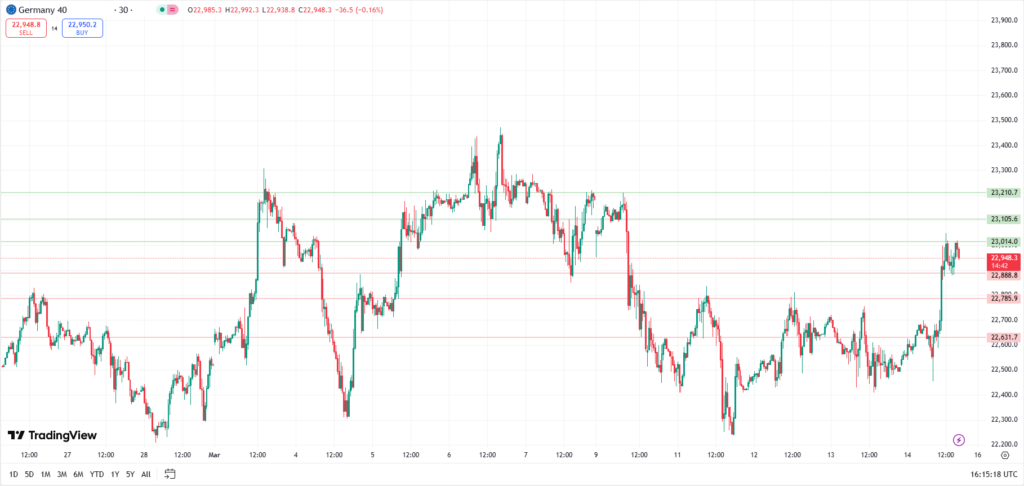
DAX40

The long preference
Long positions above 23014.0 with targets at 23105.6 & 23210.7 in extension.
Alternative scenario
Below 22888.8 look for further downside with 22785.9 & 22631.7 as targets.
A support base at 22785.9 has formed and has allowed for a temporary stabilisation.

NEWS HEADLINES

US stocks climb with government shutdown likely averted, consumer sentiment slips

  • US stocks rose on Friday, bouncing back at the end of the week after the bellwether S&P 500 index slipped into correction territory on concerns over an escalating trade war and potential recession.
  • At 1:45 PM GMT, the Dow Jones Industrial Average traded 270 points, or 0.7%, higher.
  • The S&P 500 index rose 68 points, or 1.2%.
  • The NASDAQ Composite gained 295 points, or 1.7%.
  • The S&P 500 closed 1.4% lower on Thursday, entering correction territory, which is typically defined as a 10% fall from a recent peak.
  • The Dow is on track for its second straight losing week and its worst weekly decline since June 2022. This would be the fourth consecutive negative week for the S&P 500 and Nasdaq.

Oil prices set to end the week stable as investors mull path to Ukraine ceasefire

  • Oil prices edged higher on Friday after a more than 1% loss in the previous session, as investors weighed the diminishing prospects of a quick end to the Ukraine war that could bring more Russian energy supplies back to Western markets.
  • Brent crude futures were up 36 cents, or 0.52%, to USD 70.24 per barrel at 3:30 PM GMT, after settling 1.5% lower in the previous session.
  • US West Texas Intermediate (WTI) crude was at USD 66.94 per barrel, up 39 cents, or 0.59%, after closing 1.7% lower on Thursday.
  • Prices are set to end the week relatively stable, with Brent settling at USD 70.36 and WTI at USD 67.04 last Friday.

Gold prices break USD 3,000/oz level, new record high on tariff fears

  • Gold prices surged to an all-time high on Friday, breaking through the key USD 3,000 per ounce level, supported by US President Donald Trump’s fresh tariff threats, while soft US inflation data further lifted sentiment.
  • At 12:30 AM GMT, spot gold was up 0.6% at USD 3,009.11 per ounce, after reaching a fresh record high of USD 3,017.11 earlier in the session.
  • Gold futures expiring in April gained 0.3% to USD 2,998.78 per ounce.
  • Platinum futures rose 0.9% to USD 1,015.00 per ounce.
  • Silver futures gained 1.3% to USD 34.755 per ounce.

Click here to open account and start trading.

Dividend Adjustment Notice – Mar 17 ,2025

Dear Client,

Please note that the dividends of the following products will be adjusted accordingly. Index dividends will be executed separately through a balance statement directly to your trading account, and the comment will be in the following format “Div & Product Name & Net Volume”.

Please refer to the table below for more details:

Dividend Adjustment Notice

The above data is for reference only, please refer to the MT4/MT5 software for specific data.

If you’d like more information, please don’t hesitate to contact info@vtmarkets.com.

Back To Top
server

Hello there 👋

How can I help you?

Chat with our team instantly

Live Chat

Start a live conversation through...

  • Telegram
    hold On hold
  • Coming Soon...

Hello there 👋

How can I help you?

telegram

Scan the QR code with your smartphone to start a chat with us, or click here.

Don’t have the Telegram App or Desktop installed? Use Web Telegram instead.

QR code