What Are Preference Shares? Everything You Need to Know Before Investing

Investors have many choices when it comes to building wealth. Beyond ordinary shares and bonds, companies also issue preference shares, sometimes called preferred stock. These instruments offer a balance between equity and fixed income, making them an attractive option for those seeking stability and steady returns. In this article, you will learn what preference shares are, how they work, their advantages and disadvantages, and how you can trade them through VT Markets, supported by real-life examples and figures.

What Are Preference Shares (Preferred Stock)?

Preference shares, also called preferred stock, are a special class of equity issued by companies to raise capital. They sit between bonds and ordinary shares in terms of risk and reward. Like ordinary shareholders, preference shareholders are part-owners of the company, but unlike them, they usually do not have voting rights in company decisions.

What makes preferred stock unique is its predictable dividend stream and priority status. Holders receive a fixed dividend before any payment is made to ordinary shareholders, and if the company faces liquidation, preference shareholders have a higher claim on the company’s assets. This makes them less risky than ordinary shares but not as secure as bonds.

Key characteristics include:

  • Fixed dividend payments that are often higher than ordinary share dividends.
  • Priority over ordinary shareholders for dividends and asset claims.
  • Hybrid nature, combining features of debt (steady income) and equity (ownership).
  • Limited or no voting rights, meaning less influence on company policies.

Example:

Suppose a company issues preference shares with a fixed 6% annual dividend. If an investor buys $10,000 worth of these shares, they receive $600 each year. Even if the company decides not to pay dividends to ordinary shareholders due to weak earnings, preference shareholders still receive their fixed payout first.

Types of Preference Shares

Preferred stock comes in different forms, each designed to meet specific needs for both companies and investors:

1. Cumulative Preference Shares

These shares allow unpaid dividends to accumulate and be carried forward to future years. This feature protects investors, since companies must pay all missed dividends before ordinary shareholders can receive any payments. For example, if a $2 dividend is skipped for three years, the shareholder is still entitled to $6 per share once dividends resume.

2. Non-Cumulative Preference Shares

With these shares, dividends are only paid out of current profits. If a company decides to skip the payment in a given year, those dividends are lost forever. This makes them riskier than cumulative preference shares, but they are still ranked ahead of ordinary shareholders in payouts. For instance, if a $2 dividend is missed this year, shareholders cannot claim it later even if profits improve.

3. Participating Preference Shares

Participating shares provide both a fixed dividend and the right to share in additional profits if the company performs exceptionally well. This allows investors to enjoy more upside than with traditional preference shares. For example, a shareholder might receive the usual 6% dividend and, in a record year, also gain an additional 2% bonus distribution.

4. Convertible Preference Shares

Convertible shares can be exchanged for a fixed number of ordinary shares after a certain period or under specified conditions. This feature gives investors flexibility, as they can keep collecting fixed dividends or convert to ordinary shares to benefit from share price growth. For instance, a $100 convertible preference share may be exchanged for five ordinary shares if the company’s stock price rises significantly.

5. Redeemable Preference Shares

Redeemable shares come with a maturity date at which the issuing company can buy them back, usually at a predetermined price. This provides investors with a clear exit strategy, although they may face reinvestment risk if market conditions change. For example, a company might issue redeemable preference shares at $100 each and promise to repurchase them after 10 years.

Preference Shares vs Ordinary Shares: Key Differences

Both preferred stock and ordinary shares represent ownership in a company, but they work very differently. Ordinary shares are the most common type of equity, giving investors full voting rights and the potential to benefit from rising profits. Preference shares, on the other hand, prioritise income stability and security by offering fixed dividends and higher claims on assets, but often at the cost of voting power and growth potential.

FeaturePreference SharesOrdinary Shares
DividendFixed, paid before ordinary shareholdersVariable, based on company profits
Voting RightsUsually noneFull voting rights
Risk LevelLower, more stable returnsHigher risk, potential for larger gains
Asset ClaimsPriority over ordinary sharesPaid last after creditors and preference shareholders

Example: During the 2008 financial crisis, several banks, including Citigroup, raised capital by issuing preference shares. Holders of these shares continued receiving fixed dividends and had priority in receiving dividends, even as ordinary shareholders saw their dividends suspended, highlighting the stability preference shares can provide in turbulent markets and the risk that ordinary shareholders may not be receiving dividends during periods of financial stress.

Advantages of Preference Shares

Preferred stock offers several benefits that make it appealing to certain types of investors. Their structure provides stability, priority in payouts, and a mix of bond-like and equity-like features.

  • Stable Income: Preference shares usually pay fixed dividends, giving investors predictable returns regardless of market volatility. This makes them appealing to conservative investors or those relying on steady cash flow.
  • Priority Over Ordinary Shares: Holders are paid before ordinary shareholders when dividends are declared and also rank higher in asset claims if the company is liquidated. This reduces overall investment risk.
  • Hybrid Nature: They combine features of bonds and equity, offering fixed income like a bond while still representing ownership in the company. This balance provides both security and moderate growth potential.

Disadvantages of Preference Shares

Preferred stock also comes with drawbacks that limit its appeal. Their fixed structure means less growth potential, limited rights, and possible liquidity concerns.

  • Limited Voting Rights: Preference shareholders usually have little to no say in company decisions, which means they cannot influence management or policy like ordinary shareholders can.
  • Lower Growth Potential: Dividends are fixed, so investors miss out on the potential gains from rising profits and share prices that ordinary shareholders may enjoy.
  • Liquidity Risk: Preference shares are often less actively traded than ordinary shares, which can make it harder for investors to sell quickly or at favourable prices.

Who Should Invest in Preference Shares?

Preferred stock is best suited for investors who value stability and steady returns rather than high-risk, high-reward opportunities.

  • Income-Focused Investors: Those who rely on predictable dividend payments, such as retirees, benefit from the fixed payouts of preference shares.
  • Conservative Investors: People who want less exposure to market volatility may prefer the stability that preference shares provide compared to ordinary shares.
  • Institutional Investors: Pension funds and insurance companies often include preference shares in their portfolios to balance income with moderate risk.
  • Diversified Investors: Individuals who already hold higher-risk assets, such as growth stocks, may use preference shares to stabilise overall returns.
  • Long-Term Holders: Investors comfortable with limited liquidity and fixed income may see preference shares as a dependable option for holding over time.

How to Trade Preference Shares with VT Markets

At VT Markets, you do not purchase preference shares directly. Instead, you can trade them through Contracts for Difference (CFDs), which let you take advantage of price changes without owning the actual shares. This gives you flexibility to profit in both rising and falling markets.

Step 1: Learn the basics

Understand what preference shares are, how fixed dividends work, and why they differ from ordinary equity.

Step 2: Create your trading account

Sign up with VT Markets and finish the quick verification process to start trading.

Step 3: Fund your account

Deposit fund into your trading account using safe and convenient funding methods.

Step 4: Select a preference share CFD

Pick the company you want to trade, such as major banks or global corporations that issue preference shares, and review its market outlook.

Step 5: Execute your trade

Decide whether to buy (go long) if you expect prices to increase, or sell (go short) if you expect them to decline.

Learn the difference between going long and going short

Step 6: Implement risk management

Use risk management tools such as stop-loss orders, take-profit levels, and position sizing to manage potential losses and protect your capital.

Step 7: Stay informed

Keep track of company earnings, interest rate trends, and broader market news, as these factors can influence preference share prices.

New to trading? Discover how to start as a beginner.

Summary

What are preference shares? They are hybrid instruments that provide fixed dividends and priority in payouts, making them attractive for income-focused and conservative investors. While they lack voting rights and offer limited growth compared to ordinary shares, they deliver stability and reduced risk. Through VT Markets, you can access preference shares via CFDs on global shares, giving you flexibility to speculate on price movements while managing risk effectively.

Explore the Share Market with VT Markets

VT Markets provides a secure, innovative trading platform where you can access CFDs on global shares, commodities, indices, and more. Whether you are exploring preference shares, ordinary stocks, or other markets, VT Markets offers competitive spreads, support through the Help Centre, and powerful trading tools like MetaTrader 4 (MT4) and MetaTrader 5 (MT5). You can also practise risk-free with a VT Markets demo account before moving to live trading.

Start trading today with VT Markets and experience a trusted platform designed to help you achieve your investment goals.

Frequently Asked Questions (FAQs)

1. What do preference shares mean?

Preference shares, also known as preferred stock, are a type of equity that pays fixed dividends and gives shareholders priority over ordinary shareholders for payouts and asset claims.

2. Are preference shares safer than ordinary shares?

Yes, they are generally safer because they pay fixed dividends and rank higher in asset claims, though they are not risk-free.

3. Do preference shareholders have voting rights?

Usually no. Preference shareholders typically have little to no voting power in company matters.

4. Can preference shares be converted into ordinary shares?

Some types, called convertible preference shares, can be exchanged for ordinary shares at predetermined terms.

5. Are dividends on preference shares guaranteed?

Dividends are fixed but not always guaranteed. If unpaid, cumulative preference shares allow dividends to accrue, while non-cumulative ones do not.

6. Do preference shares trade on stock exchanges?

Yes, but they are often less liquid than ordinary shares, meaning fewer buyers and sellers may be available.

7. How do preference shares compare with bonds?

Both provide fixed income, but bonds are debt while preference shares represent equity ownership. Bonds usually rank higher in repayment if a company fails.

8. Why do companies issue preference shares?

They allow firms to raise capital without giving away voting control, often making them attractive for banks and large corporations.


Dollar Index steadies before CPI release

The US dollar is navigating a mix of economic and political pressures. Softer inflation data has lifted hopes of interest rate cuts, but uncertainty around the Federal Reserve’s independence and upcoming economic releases means the outlook remains finely balanced.

Cooling PPI fuels Fed cut bets

The US dollar found stability during Asian trading hours, supported by softer inflation data and growing anticipation of rate cuts from the Federal Reserve.

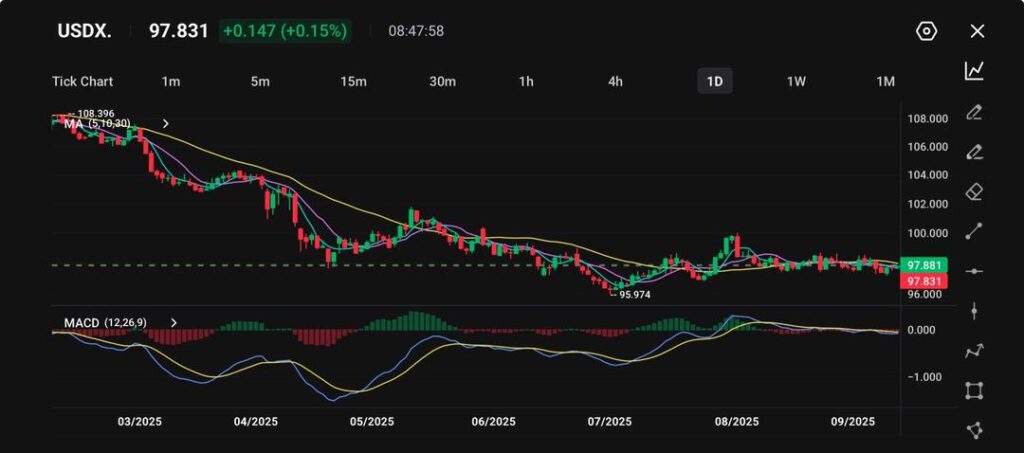
As of 08:47 GMT, the US Dollar Index (DXY) was at 97.831, showing an increase of 0.147 points or 0.15%.

This marked a third straight session of gains, following earlier weakness this month. The turning point came after the Bureau of Labor Statistics reported that the Producer Price Index (PPI) for final demand slipped 0.1% in August, compared with a downwardly revised 0.7% rise in July.

The softer print strengthened expectations of policy easing, with markets now viewing a 25-basis-point cut at the Fed’s 16-17 September meeting as highly likely.

Futures markets are even assigning close to a 9% probability to a larger 50-basis-point cut, underlining the dovish sentiment.

Still, traders remain cautious ahead of today’s US Consumer Price Index (CPI) release. Any upside surprise could temper expectations for deeper monetary easing and reverse recent dollar strength.

Political turbulence challenges Fed independence

Alongside economic data, political manoeuvres in Washington are injecting uncertainty into the Fed outlook.

The Trump administration is seeking to dismiss Federal Reserve Governor Lisa Cook, despite a court ruling temporarily blocking the move.

The White House’s push to reshape the central bank’s leadership before the September policy meeting has raised concerns about political interference.

Meanwhile, Trump-backed nominee Stephen Miran cleared the Senate Banking Committee and is edging closer to confirmation, though it remains unclear if the process will conclude before the upcoming decision.

Even partial politicisation of the Fed could undermine confidence in its independence, potentially weighing on long-term dollar sentiment and market stability.

Technical analysis

The Dollar Index is trading at 97.83 (+0.15%), but it remains in a broader downtrend from February’s 2025 peak of 108.39.

Picture: Dollar Index steady near 97.83, consolidating between 96.00 support and 99.00 resistance on the VT Markets app.

After touching a yearly low of 95.97 in July, the index has recovered modestly yet still struggles to regain the 100 threshold – evidence of ongoing selling pressure.

Short-term moving averages (5, 10, and 30) are flat, signalling indecision, while the MACD hovers near zero, pointing to subdued momentum.

Key support lies at 96.00, with a break lower exposing July’s trough. On the upside, resistance is located at 99.00 and 101.00 – levels that bulls need to reclaim to shift sentiment decisively.

Cautious forecast

In the near term, the Dollar Index is likely to trade within a narrow 97.50–98.00 range as markets digest incoming inflation figures and policy signals from the Fed.

A stronger-than-expected CPI release could push the index towards 98.30, while dovish rhetoric or political headwinds from Washington may cap gains quickly.

Looking further ahead, the Fed’s policy stance and the Trump administration’s continued pressure on central bank governance will remain the key drivers.

One or two rate cuts by year-end – if managed without unsettling forward guidance – could keep the dollar steady near present levels.

However, intensified political interference or deeper disinflation risks might send the index back towards 96.00 in the final quarter.

Click here to open account and start trading.

Dividend Adjustment Notice – Sep 11 ,2025

Dear Client,

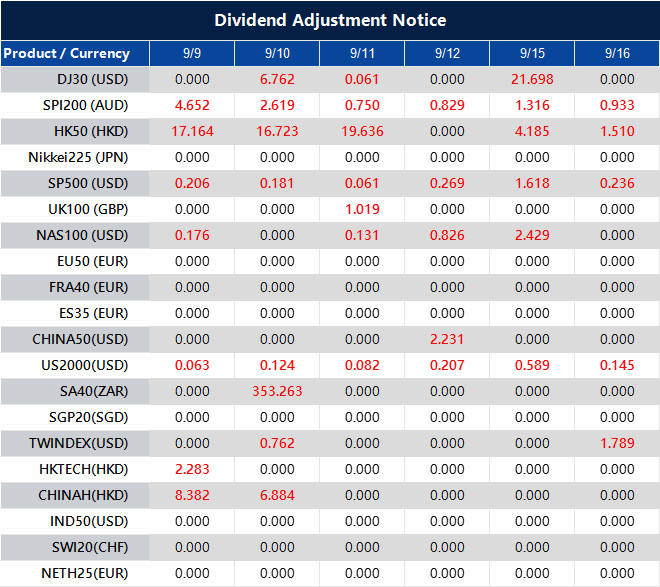
Please note that the dividends of the following products will be adjusted accordingly. Index dividends will be executed separately through a balance statement directly to your trading account, and the comment will be in the following format “Div & Product Name & Net Volume”.

Please refer to the table below for more details:

Dividend Adjustment Notice

The above data is for reference only, please refer to the MT4/MT5 software for specific data.

If you’d like more information, please don’t hesitate to contact info@vtmarkets.com.

What Are Ordinary Shares? Meaning, Examples, Pros and Cons

Ordinary shares are the foundation of modern equity markets, representing ownership in a company and giving investors rights such as voting power and the potential to receive dividends. They are also known as common stock in the United States and remain the most widely traded form of equity worldwide. In this guide, we explain the ordinary shares meaning, how they work, their advantages and disadvantages, and how you can access global shares through CFD trading with VT Markets.

What Are Ordinary Shares?

Ordinary shares are the most common type of equity issued by companies. They represent partial ownership of a business and give shareholders certain rights, such as voting at meetings and the chance to receive dividends if the company is profitable. Understanding the ordinary shares meaning is essential for investors, as they carry both potential rewards and risks compared to other forms of investment like bonds or preference shares.

Key Characteristics of Ordinary Shares

  • Voting rights: Shareholders can vote on major company decisions such as electing directors or approving mergers.
  • Dividends: Payments are not fixed and depend on company performance.
  • Residual claim: In case of liquidation, ordinary shareholders are paid after creditors and preference shareholders.
  • Capital growth: The value of ordinary shares can rise if the company performs well.
  • Transferability: They are usually easy to buy and sell on public exchanges.

Example: Consider HSBC Holdings, a multinational bank listed on the London Stock Exchange. When an investor buys HSBC’s ordinary shares, they gain part ownership in the company. This entitles them to vote at annual general meetings and potentially receive dividends when the bank reports strong earnings. If HSBC’s share price rises from £5 to £7, a shareholder who bought 1,000 shares would see the value of their investment grow from £5,000 to £7,000.

Discover the top 10 largest stock exchanges in the world by market capitalization.

How Ordinary Shares Work

Owning an ordinary share makes you a shareholder, which means you own a piece of the company, no matter how small. If a firm has 100 million shares outstanding and you own 1,000 of them, your stake equals 0.001 percent.

The value of ordinary shares depends on the company’s performance and market demand. Prices rise when investors expect growth and fall when confidence declines. Dividends may be distributed when profits are strong, but they are not guaranteed. For instance, in 2023, Shell paid billions in dividends to shareholders, while many smaller firms in the same year reinvested profits back into operations and paid no dividend at all.

Rights and Responsibilities of Shareholders

Owning ordinary shares comes with both rights and responsibilities:

  • Voting rights: Shareholders can vote on major decisions at annual general meetings.
  • Dividends: If declared, shareholders are entitled to receive dividends.
  • Information access: Companies must provide annual reports and financial statements to shareholders.
  • Residual claims: In the event of liquidation, ordinary shareholders are last in line after creditors and preference shareholders.
  • Responsibility: The main risk is financial. If the share price falls, your investment loses value, but liability is limited to the amount invested.

Advantages of Owning Ordinary Shares

Investing in ordinary shares offers several potential benefits for individuals seeking growth, income, and influence within a company. While returns are not guaranteed, these shares remain one of the most popular ways to build long-term wealth.

1. Capital growth

Share prices can rise substantially over time, creating wealth for long-term investors. For example, a £1,000 investment in Apple’s shares in 2010 would now be worth more than £10,000, showing how ordinary shareholders can benefit from company growth.

2. Dividends

When companies generate healthy profits, they often return part of these earnings to shareholders through dividends. Firms like Unilever and BP have a long history of rewarding ordinary shareholders with regular dividend payouts.

3. Voting power

Owning ordinary shares gives investors the right to vote at annual general meetings. This means shareholders can influence major company decisions, from electing board members to approving mergers.

4. Liquidity

Ordinary shares are traded daily on stock exchanges, making them easy to buy and sell. For instance, a retail investor can purchase or sell shares of FTSE 100 companies such as Tesco or HSBC within seconds through a trading platform.

Disadvantages of Owning Ordinary Shares

While ordinary shares provide growth and income opportunities, they also carry risks that investors must carefully consider before committing their capital.

1. Dividend uncertainty

Unlike preference shares or bonds, dividends on ordinary shares are not guaranteed. A company may reduce or cancel payouts during difficult times, as many UK firms did in 2020 when the pandemic hit.

2. Market volatility

Share prices fluctuate daily, influenced by company performance, economic cycles, and global events. For example, airline stocks lost more than half their value in early 2020 due to global travel restrictions.

3. Residual claim risk

In the event of liquidation, ordinary shareholders are last in line after creditors and preference shareholders. This often means receiving little to nothing if a company collapses.

4. Higher risk compared to bonds

Ordinary shares carry more risk than fixed-income investments. During the 2008 financial crisis many bank shareholders saw their investments fall by over 80 percent while bondholders continued receiving interest.

How to Trade Ordinary Shares with VT Markets

You cannot buy ordinary shares as physical assets through VT Markets. Instead, the platform offers Contracts for Difference (CFDs) on shares, which allow you to speculate on the price movements of global companies like Apple, Tesla, or HSBC without actually owning the underlying stock.

Trading share CFDs with VT Markets works as follows:

Step 1: Understand how ordinary shares work

Learn the basics of what ordinary shares are, how they generate value, and the difference between direct ownership and trading CFDs.

Step 2: Open an account

Register with VT Markets and complete the quick verification process to get access to the trading platform.

Step 3: Deposit funds

Add money to your trading account using secure and convenient payment options.

Step 4: Place your first order

Choose a share CFD (for example, Apple or Amazon) and decide whether to go long (buy) if you expect the price to rise or go short (sell) if you anticipate a decline.

Discover the key differences between a long position and a short position.

Step 5: Implement risk management strategies

Use risk management strategies like stop-loss and take-profit orders to manage potential losses and lock in profits.

Step 6: Stay informed

Keep up with company earnings, market news, and economic data to make better trading decisions.

Ordinary Shares vs Preference Shares

While ordinary shares are the most common type of equity, some companies also issue preference shares. Both represent ownership in a business, but they differ in rights, risks, and rewards. Ordinary shares typically appeal to investors seeking growth and voting power, whereas preference shares attract those who prefer fixed income and lower risk.

FeatureOrdinary SharesPreference Shares
DividendsNot guaranteed, depend on profitFixed and paid before ordinary shares
Voting rightsYesUsually none
RiskHigher, last in liquidationLower, priority in claims
Growth potentialHighLimited

For example, if a company goes into liquidation, preference shareholders are paid first. Only if assets remain will ordinary shareholders receive a payout, which highlights the higher risk but also the potential higher reward of ordinary shares.

Summary

Ordinary shares represent company ownership, offering shareholders voting rights, dividend potential, and long-term growth opportunities, but also carrying risks such as market volatility and residual claims in liquidation. Compared with preference shares, they provide more growth potential but less security. At VT Markets, we provide alternative ways to access shares by offering share CFDs, allowing you to speculate on the price movements of global companies like Apple, Tesla, and HSBC without directly owning the stock.

Start Trading Today with VT Markets

While you cannot purchase ordinary shares directly through VT Markets, we provide an alternative way to access global companies through share CFDs. This allows you to speculate on price movements of major stocks such as Apple, Tesla, and HSBC without owning the underlying assets.

With competitive spreads, flexible leverage, and advanced trading platforms like MetaTrader 4 (MT4) and MetaTrader 5 (MT5), VT Markets makes it simple to trade shares alongside other asset classes such as forex, commodities, and indices. You can also practise risk-free using a VT Markets demo account before moving to live markets, and our dedicated Help Centre is available to support you at every step.

Start trading today with VT Markets and experience fast, secure access to global share CFDs.

Frequently Asked Questions (FAQs)

1. What are ordinary shares?

Ordinary shares are the most common type of stock, giving investors ownership in a company and rights such as voting and dividends.

2. Do all ordinary shares pay dividends?

No. Dividends depend on company profits and board decisions.

3. Are ordinary shares risky?

Yes, because their value fluctuates with market conditions and dividends are not guaranteed.

4. What is the difference between ordinary and preference shares?

Preference shares usually provide fixed dividends and priority in liquidation, while ordinary shares offer voting rights and higher long-term growth potential.

5. Can I trade ordinary shares with VT Markets?

No, VT Markets does not provide direct ownership of ordinary shares. However, you can trade share CFDs, which allow you to speculate on the price movements of global companies like Apple, Tesla, or HSBC without owning the actual shares.

6. Can ordinary shares lose all their value?

Yes. If a company goes bankrupt and its assets are not enough to cover debts, ordinary shareholders may lose their entire investment.

7. Are ordinary shares the same as common stock?

Yes. In the United States, “common stock” is the equivalent term for ordinary shares.

8. Do ordinary shareholders get paid before preference shareholders?

No. Preference shareholders receive dividends and liquidation proceeds before ordinary shareholders.

Dividend Adjustment Notice – Sep 10 ,2025

Dear Client,

Please note that the dividends of the following products will be adjusted accordingly. Index dividends will be executed separately through a balance statement directly to your trading account, and the comment will be in the following format “Div & Product Name & Net Volume”.

Please refer to the table below for more details:

Dividend Adjustment Notice

The above data is for reference only, please refer to the MT4/MT5 software for specific data.

If you’d like more information, please don’t hesitate to contact info@vtmarkets.com.

Australian dollar gains support from commodity strength

The Australian dollar is strengthening as shifting commodity prices, central bank signals, and geopolitical tensions shape market sentiment. While momentum is building, uncertainty around trade and policy keeps traders alert to both opportunities and risks.

Shifting sentiment lifts the Aussie dollar

The Australian dollar has found fresh momentum, largely thanks to a surge in key commodity prices. Gold is hovering close to record levels, supported by safe-haven demand in response to global uncertainty and growing speculation that the Federal Reserve may soon deliver rate cuts.

At the same time, oil prices have firmed on renewed geopolitical risks in the Middle East, while iron ore has gained as Chinese steel producers resumed operations after maintenance downtime.

These commodity tailwinds matter greatly for Australia, where resource exports underpin much of the economy. Rising commodity values improve the nation’s terms of trade and typically translate into stronger demand for the Aussie dollar.

In terms of monetary policy, markets currently assign an 86% probability of a Reserve Bank of Australia (RBA) rate cut in November, while no change is expected at the September meeting.

Although inflationary pressures have eased modestly, the central bank remains guarded amid ongoing global uncertainty.

Adding to the cautious mood, geopolitical frictions continue to cloud risk appetite. Reports suggest US President Trump has pressed the EU to impose 100% tariffs on imports from China and India, escalating trade tensions.

Similar moves by Washington could dampen risk-sensitive currencies such as the AUD.

Technical analysis

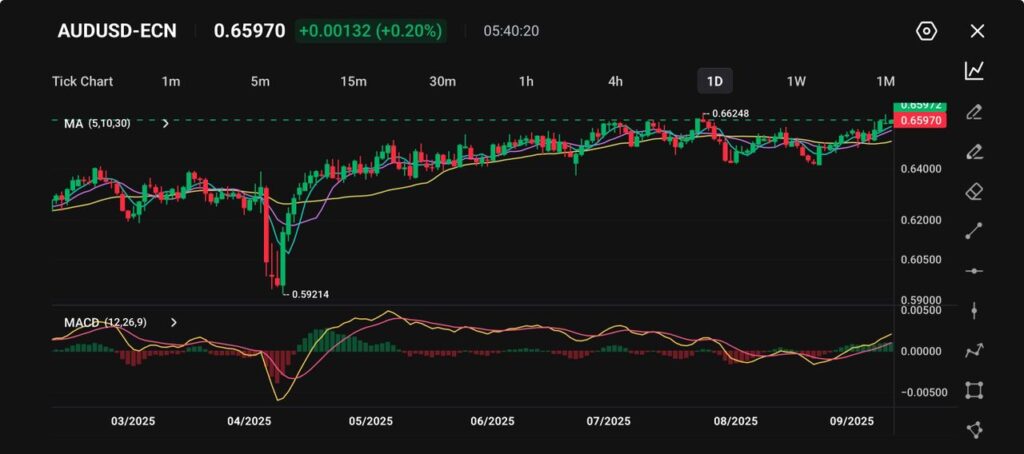
AUD/USD is currently trading at 0.6597, up +0.20%, and edging back toward the 0.6625 resistance area last tested in August.

Since bottoming at 0.5921 in April, the pair has been on a steady upward trajectory, forming higher lows and maintaining a gradually bullish structure.

Short-term momentum remains constructive, with the 5, 10, and 30-day moving averages trending positively and price holding above the shorter-term averages.

Picture: AUD/USD trading near 0.66, holding above key support as seen on the VT Markets app.

The MACD indicator continues to signal bullish momentum, reinforcing the current upside bias.

A decisive break above 0.6625 could open the path toward 0.6700 in the near term.

On the downside, immediate support lies at 0.6500, with stronger support positioned near 0.6400. As long as the pair holds above these levels, the outlook remains tilted to the upside.

Cautious forecast

Despite its resilience and constructive technical picture, AUD/USD remains vulnerable to external shocks.

A failure to break through the 0.6625 ceiling could spark a near-term retracement back toward the 0.6500 support area.

The broader outlook hinges on global risk sentiment. Any escalation in trade disputes or a slowdown in Chinese demand could limit upside potential.

Conversely, with the RBA expected to keep rates steady this month and the Federal Reserve leaning toward cuts, any hawkish shift from the RBA or dovish signals from the Fed could widen yield differentials in favour of the AUD.

For now, traders may look for a potential breakout above 0.6625, but should remain alert to volatility stemming from geopolitical and macroeconomic developments.

Click here to open account and start trading.

Oil ticks higher amid cautious supply outlook

Oil prices remain pulled between shifting OPEC+ decisions, geopolitical risks, and uneven demand growth. With politics and policy now weighing as heavily as fundamentals, traders face a market shaped by uncertainty and rapid shifts.

OPEC+ output cutback fuels price gains

Oil markets edged higher on Tuesday, with West Texas Intermediate (WTI) climbing to $62.58 and Brent crude reaching $66.37.

The gains followed a smaller-than-anticipated supply increase from OPEC+, which announced an additional 137,000 barrels per day (bpd) for October, down from 555,000 bpd in September.

The measured adjustment suggests the alliance is taking a more conservative stance amid ongoing uncertainty in supply and demand balances.

Market watchers had anticipated a larger output rise, but the restrained approach highlights weaker demand growth, oversupply concerns, and the need to safeguard price stability.

Russia sanctions back in spotlight

The supply picture was further tightened after Russia launched its most extensive air assault on Ukraine in months, reviving the possibility of tougher Western sanctions.

US President Donald Trump indicated his willingness to intensify restrictions, while European Union officials met American counterparts to discuss coordinated energy measures. Any such move could restrict global oil flows and add upside pressure to crude prices.

Technical analysis

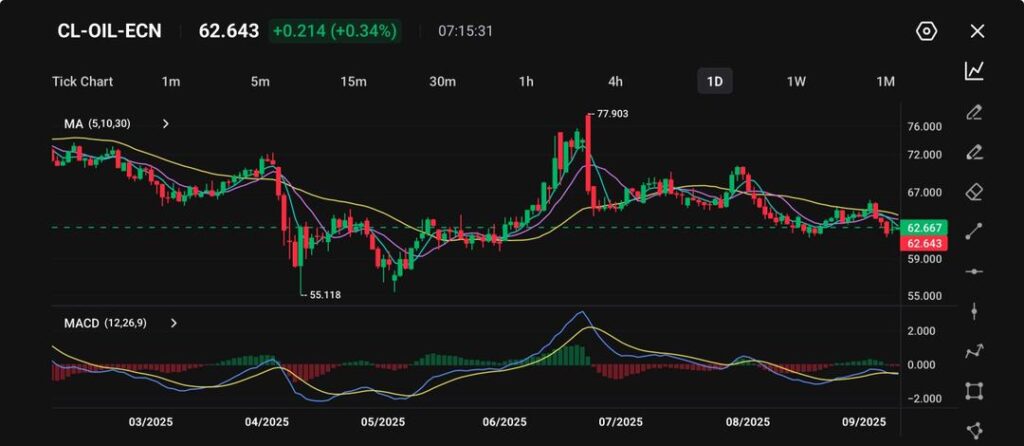
Crude oil (CL-OIL) is currently trading at $62.64, up 0.34%, yet technical indicators continue to point to weakness.

After peaking around $77.90 in July, prices have steadily drifted lower, with the $62–63 band now serving as key support.

Short-term moving averages (5, 10, 30) remain aligned bearishly, with prices struggling to break and hold above them.

Picture: WTI crude oil consolidating near $62-63 support, with bearish moving averages and weak MACD momentum signalling downside risk as seen on the VT Markets app.

The MACD indicator is flat but still below zero, signalling negative momentum. Recovery attempts have repeatedly failed under $67, underscoring sustained selling pressure.

If WTI fails to defend the $62 threshold, a decline towards $60–59–levels last seen in early Q2–remains possible.

Conversely, reclaiming $67 would be needed to revive short-term bullish momentum.

Fundamental factors, including OPEC+ supply discipline and shifts in US inventory data, will remain central to price direction.

Cautious forecast

The oil market remains highly sensitive to both supply disruptions and monetary policy shifts. A confirmed interest rate cut by the Federal Reserve next week could lift demand expectations, while tougher sanctions on Russia would further squeeze global supply.

That said, demand growth is still trailing earlier forecasts, and oversupply concerns persist, keeping rallies under pressure.

Traders should also monitor China’s economic recovery pace, as weaker industrial demand could weigh on prices despite geopolitical risks.

In addition, seasonal refinery maintenance in the US and Europe could temper near-term crude demand, offsetting potential supply tightness.

Overall, without a decisive catalyst–such as sharper production cuts, stronger-than-expected consumption, or major geopolitical escalations–any rebound in oil prices is likely to be limited and vulnerable to swift corrections.

Click here to open account and start trading.

Dividend Adjustment Notice – Sep 09 ,2025

Dear Client,

Please note that the dividends of the following products will be adjusted accordingly. Index dividends will be executed separately through a balance statement directly to your trading account, and the comment will be in the following format “Div & Product Name & Net Volume”.

Please refer to the table below for more details:

Dividend Adjustment Notice

The above data is for reference only, please refer to the MT4/MT5 software for specific data.

If you’d like more information, please don’t hesitate to contact info@vtmarkets.com.

Weak US jobs raise red flags for recession

Global markets face renewed uncertainty as weak US non-farm payrolls and rising unemployment stoke recession fears, prompting calls for Fed rate cuts while Trump finalises candidates for Fed Chair. Trade tensions intensified with new Russia sanctions, tariff exemptions on metals, and stricter terms for Japan, while OPEC+ raised output.

KEY INDICATORS

US labour market

August non-farm payrolls grew far below expectations, while June data was revised into negative territory for the first time since 2020.

The unemployment rate rose to a four-year high.

White House adviser Hassett predicted upward revisions but questioned the reliability of the current data.

Senate leader Schumer cited weak jobs data to push for overturning Trump’s tariffs.

Trump, Labour Secretary Dremer, and Treasury Secretary Bessent all criticised the Fed for delaying rate cuts.

Bessent warned that revised 2024 employment figures may reduce jobs by 800,000.

Commodities and dollar

Dollar Index fell 0.54% to 97.74, erasing most of last week’s gains.

US Treasury yields declined: 10-year at 4.08%, 2-year at 3.52%.

Spot gold closed at $3,586/oz, up 1.12% for a third week; silver rose 0.82% to $40.97/oz.

Crude prices dropped, with WTI down 2.61% to $61.69/barrel and Brent down 1.81% to $65.66/barrel.

Equities performance

US stocks ended lower: Dow -0.48%, S&P 500 -0.32%, Nasdaq -0.03%.

Broadcom +9.41%, Tesla +3.64%; Chinese tech: Baidu +4%, Alibaba +3.57%.

European equities fell: DAX 40 -0.73%, FTSE 100 -0.09%, Euro Stoxx 50 -0.53%.

MARKET MOVERS

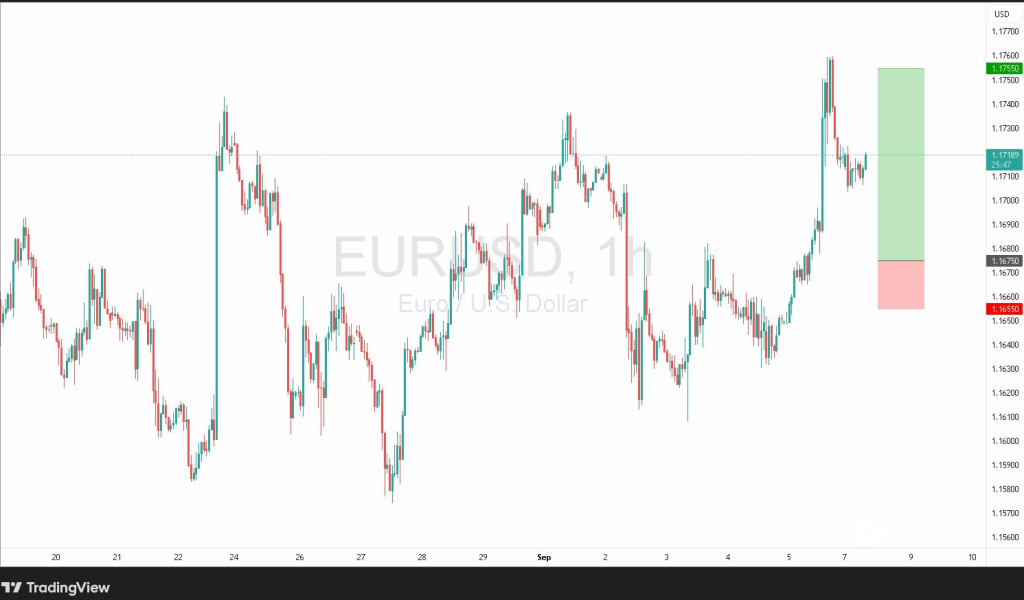
EUR/USD

  • Primary trend: Bullish, though short-term momentum is softening as RSI drifts lower.
  • Support level: 1.1675 (secondary: 1.1700)
  • Resistance zone: 1.1755 (secondary: 1.1780)
  • Long strategy: Buy on dips near 1.1675 support, target 1.1755 initially, extend towards 1.1780, stop-loss below 1.1675.
  • Short strategy: Consider tactical shorts on rallies into 1.1755–1.1780 resistance, target 1.1700 initially, extend back to 1.1675 if momentum stalls.
  • Range trade: Buy near support and sell near resistance if price consolidates between 1.1675–1.1780.
  • Risk management: Keep stops tight within the prevailing bullish bias.

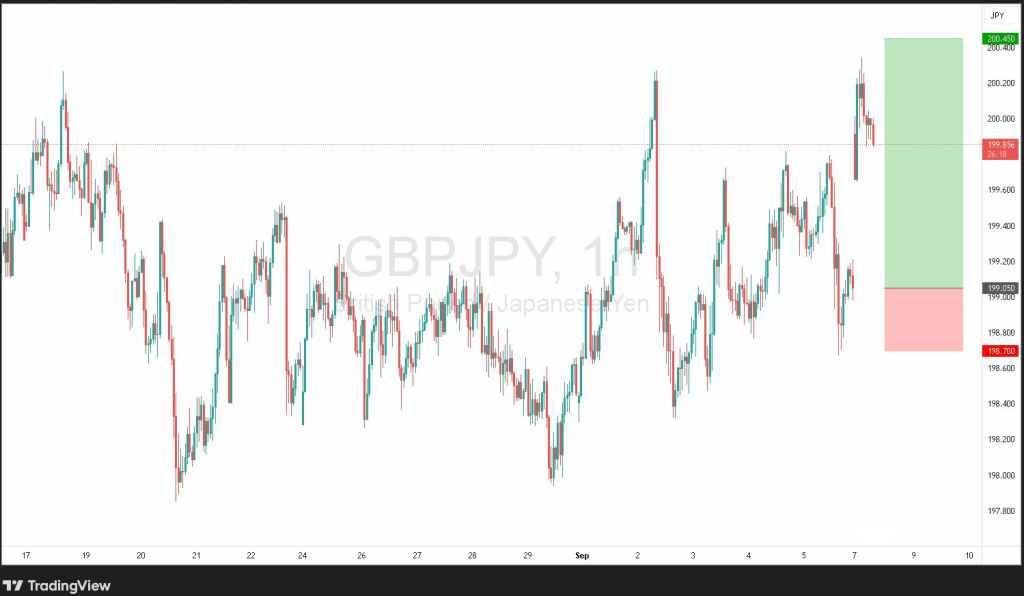
GBP/JPY

  • Primary trend: Bullish, though overbought conditions suggest a short-term pullback may unfold.
  • Support level: 199.05 (secondary: 199.50)
  • Resistance zone: 200.45 (secondary: 200.70)
  • Long strategy: Buy on dips near 199.05 support, target 200.45 initially, extend towards 200.70, stop-loss below 199.05.
  • Short strategy: Consider tactical shorts on rallies into 200.45–200.70 resistance, target 199.50 initially, extend back to 199.05 if momentum stalls.
  • Range trade: Buy near support and sell near resistance if price consolidates between 199.05–200.70.
  • Risk management: Keep stops tight given the overbought backdrop.

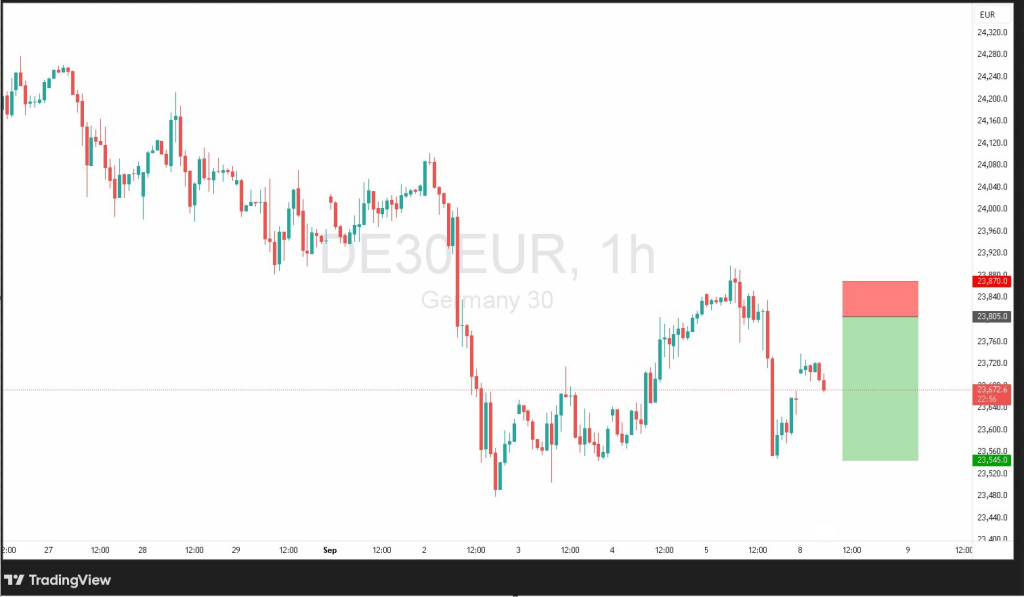
DAX 40 (Germany)

  • Primary trend: Bearish, though recent RSI strength points to a short-term bounce.
  • Support level: 23,500 (secondary: 23,545)
  • Resistance zone: 23,805 (secondary: 23,950–24,000)
  • Long strategy: Consider tactical longs only if price holds above 23,805, target 23,950 initially, extend towards 24,000, stop-loss below 23,805.
  • Short strategy: Sell into rallies near 23,805 resistance, target 23,545 initially, extend back to 23,500 if momentum stalls, stop-loss above 23,805.
  • Range trade: Sell near resistance and cover near support if price consolidates between 23,500–23,805.
  • Risk management: Keep stops tight given the prevailing bearish backdrop.

NEWS HEADLINES

Federal Reserve & policy – leadership race intensifies

Trump confirmed Fed Chair finalists as Hassett, Walsh, and Waller, while Treasury Secretary Bessent withdrew.

Senate Republicans are planning rule changes to fast-track Fed governor confirmations.

US trade & sanctions – tariff adjustments and Russia measures

Trump prepared a second wave of sanctions against Russia.

The US exempted gold, tungsten, and uranium from global tariffs, effective Monday.

Trump signed an executive order to adjust tariffs under future trade agreements, including potential zero duties on scarce goods, agricultural products, aircraft parts, and pharmaceutical inputs.

Click here to open account and start trading.

Bear Market vs Bull Market: Key Differences Every Trader Must Know

Financial markets move in cycles, alternating between periods of growth and decline. For traders and investors, recognising whether the market is bullish or bearish is crucial. This guide explains what bull and bear markets are, compares their key differences, explores historical examples, and offers practical strategies you can apply in both conditions. Whether you are a beginner or an experienced trader, this breakdown will help you navigate cycles more effectively.

What Is a Bear Market?

A bear market is defined as a period where asset prices fall 20 percent or more from recent highs. These downturns are often triggered by economic slowdowns, rising interest rates, or unexpected global events. Bear markets can affect entire stock indices, individual sectors, or even commodities, currencies, and other securities.

Key characteristics include:

  • Declining prices across major assets.
  • Investor pessimism, leading to panic selling.
  • Reduced corporate earnings and rising unemployment.
  • Higher demand for safe-haven assets like gold, government bonds, or fixed income securities.

Example: During the Global Financial Crisis of 2007–2009, the S&P 500 dropped nearly 57 percent from its peak, wiping out trillions in market value. Unemployment in the United States reached 10 percent, while Europe and Asia also suffered deep recessions.

What Is a Bull Market?

A bull market is characterised by sustained rising prices, strong investor confidence, and positive economic indicators. Traders often look for growth opportunities, with optimism pushing valuations higher and a strong economy supporting continued gains.

Key characteristics include:

  • Prices rising steadily across stocks, indices, or other assets.
  • Strong investor confidence, supported by economic growth.
  • Expanding corporate profits and higher valuations.
  • Greater participation in the markets as retail and institutional investors enter.

Example: From March 2009 to February 2020, the S&P 500 surged over 400 percent in what became the longest bull run in history, fuelled by low interest rates and steady corporate earnings.

Bear Market vs Bull Market: Key Differences

When comparing a bear market vs bull market, the differences are clear:

FactorBull MarketBear Market
Price TrendRising steadilyFalling sharply
Investor SentimentOptimistic, risk-takingPessimistic, risk-averse
Economic ConditionsGDP growth, low unemploymentRecession, rising unemployment
Trading VolumeOften increases with optimismMay decline as investors exit
OpportunitiesGrowth investing, momentum tradingShort selling, hedging strategies
DurationOften long-lasting (years)Usually shorter, but steeper losses

1. Price Trends

In a bull market, prices tend to rise gradually but consistently, supported by steady demand and growing corporate profits. In bear markets, declines are sharper and faster, often triggered by sudden shocks such as a financial crisis or geopolitical event. For example, the bull market from 2010 to 2019 saw the S&P 500 rise nearly 13 percent annually, whereas the 2008 crash wiped out over half the index’s value in just 18 months.

2. Investor Sentiment

Bulls are driven by optimism. Investors are confident, willing to take on risk, and often push valuations higher. In a bear market, fear dominates. Traders withdraw capital, leading to self-reinforcing declines as panic selling spreads.

3. Economic Conditions

Bull markets usually coincide with expanding GDP, healthy job markets, and rising consumer spending. Conversely, bear markets often emerge alongside recessions, falling corporate earnings, and higher unemployment. For instance, during the 2020 COVID crash, unemployment in the US spiked to nearly 15 percent — its highest level since the Great Depression.

4. Trading Volume

In bull markets, volume tends to climb as more participants enter. New investors are drawn by the potential for gains. During bear markets, however, volume can shrink as traders retreat to cash or safe-haven assets, though periods of panic selling can produce temporary spikes.

5. Opportunities

Bull markets reward long-term investing and momentum trading, as rising tides lift most assets. Bear markets demand more defensive or contrarian strategies — short selling, buying inverse ETFs, or rotating into gold and bonds. For example, gold prices jumped 25 percent in 2020 while equities fell sharply.

6. Duration

Bull markets often last longer, sometimes for a decade or more. Bear markets, while usually shorter, can be more severe. A 12-month bear market can erase gains accumulated over several years of bullish conditions.

From a trader’s perspective, bull vs bear conditions are not just opposites; they require entirely different approaches to risk and strategy.

How to Trade in a Bear Market and a Bull Market

The steps below outline how traders can navigate both bull markets and bear markets with clarity and discipline.

Step 1: Identify Market Conditions

Traders should evaluate the direction of the market by analyzing economic indicators like GDP, unemployment, and interest rates, as well as technical signals such as moving averages and market sentiment, to determine whether the market is bullish or bearish.

Step 2: Define Your Trading Goals

In bull markets the focus is often on long-term growth and capital appreciation, with future performance as a key consideration, while in bear markets the priority shifts to capital preservation, risk control, and setting objectives such as achieving a gain.

Step 3: Select Suitable Assets

Bull markets favour growth stocks, emerging market ETFs, and cyclical sectors such as technology and consumer discretionary, while bear markets are better suited to defensive sectors like healthcare and utilities or safe-haven assets like gold.

Step 4: Choose Your Strategy

Traders often rely on buy-and-hold investing, momentum trading, and sector rotation during bull markets, while short selling, hedging with options, and inverse ETFs are more effective in bear markets.

Step 5: Apply Risk Management

Setting stop-loss orders, managing position sizes, and using leverage carefully are essential in both phases, but diversification becomes even more important when volatility increases in bear markets.

Step 6: Monitor and Adjust

Market conditions can shift quickly, so traders should track economic releases, central bank policy, and geopolitical events, remembering that strategies successful in a bull market may become risky in a bear market.

Popular Trading Strategies for Bull vs Bear Markets

Traders often rely on tailored strategies to suit each market cycle, focusing on how these trading strategies impact their investments. Before choosing a strategy, conducting thorough research is essential to ensure it aligns with your portfolio management goals.

Bull market strategies

1. Buy and hold investing

In a bull market, traders can buy quality assets and hold them for the long term, allowing rising prices to build capital steadily. The key is to focus on strong companies with solid earnings and growth potential rather than speculative picks.

Example: An investor who bought an S&P 500 index fund in 2010 and held it until the 2020 peak would have more than tripled their investment, showing the power of patience and staying invested in an extended bull run.

2. Momentum trading

Momentum trading involves entering positions when assets show strong upward momentum, confirmed by technical indicators such as moving averages or trading volume. Traders ride the trend until signs of reversal appear, making this strategy highly responsive to market shifts.

Example: During the 2020 rally, technology stocks like Apple and Amazon surged as demand for digital services soared. Momentum traders who entered during these breakouts captured substantial gains before the trend slowed.

3. Sector rotation

Sector rotation means moving capital into industries that typically outperform during bullish conditions. Traders track economic data to identify which sectors are poised for growth and adjust their portfolios accordingly.

Example: After the 2009 financial crisis, sectors like technology, consumer discretionary, and financials outperformed defensive industries. Traders who rotated into these areas benefited from higher-than-average returns during the recovery.

Bear market strategies

1. Short selling and inverse ETFs

In bear markets, traders can profit from falling prices by short selling (borrowing shares to sell at current prices and buying them back later at lower prices) or by using inverse ETFs that rise as markets decline.

Example: During the 2008 financial crisis, short sellers targeting financial institutions like Lehman Brothers earned significant profits, while inverse ETFs tracking bank stocks gained as the sector collapsed.

2. Safe-haven hedging

Safe-haven hedging involves shifting capital into assets that retain or increase value during a market downturn, such as gold, government bonds, or the US dollar. Fixed income securities are also commonly used as defensive assets, providing stability and reducing risk during downturns. This approach not only protects portfolios but can also generate gains.

Example: In early 2020, gold prices rose by more than 25 percent as investors sought safety, helping traders offset losses from plunging stock markets.

3. Options strategies

Options give traders flexibility to manage downside risk in volatile markets. Buying protective puts allows them to lock in a selling price for stocks, while covered calls generate income on assets that are held.

Example: In 2022, when interest rate hikes triggered sharp equity declines, traders who bought protective puts on indices like the S&P 500 limited their losses while remaining positioned for the eventual rebound.

In Summary

A bull market is marked by rising prices, optimism, and economic growth, while a bear market is defined by falling prices, fear, and downturns. Bullish phases tend to reward strategies like buy-and-hold and momentum trading, whereas bearish phases call for short selling, hedging, and defensive positioning. Growth sectors such as technology and consumer discretionary often lead during bull markets, while defensive areas like healthcare, utilities, and safe-haven assets perform better in bear markets. Ultimately, success in either cycle comes down to adapting strategies, managing risk effectively, and staying flexible as conditions evolve.

Start Trading Bull and Bear Markets with VT Markets

At VT Markets, you can access global markets in both bullish and bearish conditions. With advanced platforms like MetaTrader 4 (MT4) and MetaTrader 5 (MT5), competitive spreads, and powerful trading tools, you have everything you need to capitalise on market cycles and gain an edge in your trading.

If you are new to trading, the VT Markets Help Centre provides guides and resources to support your journey. With a VT Markets demo account, you can practise trading bull and bear markets in a risk-free environment.

Create a live account with VT Markets today to access global markets and take advantage of opportunities in any market condition.

Frequently Asked Questions (FAQs)

1. What causes a bull market or a bear market?

Bull markets are typically caused by strong economic growth, low interest rates, and rising corporate earnings, while bear markets often follow recessions, geopolitical shocks, or tightening monetary policy.

2. How long do bull and bear markets last?

Bull markets can last for several years. The 2009–2020 rally in the US lasted over a decade. Bear markets are typically shorter, often lasting several months to two years, though they can be sharp and painful.

3. Can traders make money in a bear market?

Yes. Traders can profit by short selling, buying inverse ETFs, or using options. Defensive strategies such as rotating into stable sectors can also reduce losses.

4. What signals indicate a bull market is starting?

Rising GDP, improving corporate earnings, lower unemployment, and stock indices crossing above long-term moving averages are strong indicators.

5. What should beginners do in a bear market?

Beginners should avoid panic selling. Instead, they can focus on risk management, diversify into safer assets, and use demo accounts to practise strategies before risking real capital.

Back To Top
server

Hello there 👋

How can I help you?

Chat with our team instantly

Live Chat

Start a live conversation through...

  • Telegram
    hold On hold
  • Coming Soon...

Hello there 👋

How can I help you?

telegram

Scan the QR code with your smartphone to start a chat with us, or click here.

Don’t have the Telegram App or Desktop installed? Use Web Telegram instead.

QR code