Please note that the dividends of the following products will be adjusted accordingly. Index dividends will be executed separately through a balance statement directly to your trading account, and the comment will be in the following format “Div & Product Name & Net Volume”.
Please refer to the table below for more details:
The above data is for reference only, please refer to the MT4/MT5 software for specific data.
If you’d like more information, please don’t hesitate to contact info@vtmarkets.com.
Written on September 18, 2025 at 8:29 am, by anakin
Today is a pivotal day as the markets brace for the U.S. Federal Reserve’s latest meeting and rate‑decision. Speculation is high over whether the Fed will cut rates (likely by 25 basis points) and how dovish its messaging has been. Ripple effect is expected across the board, including but not limited to currencies, equities and commodities. With inflation cooling but labour market showing mixed signals, the announcements and commentary today could set the tone for the rest of Q4.
KEY INDICATORS
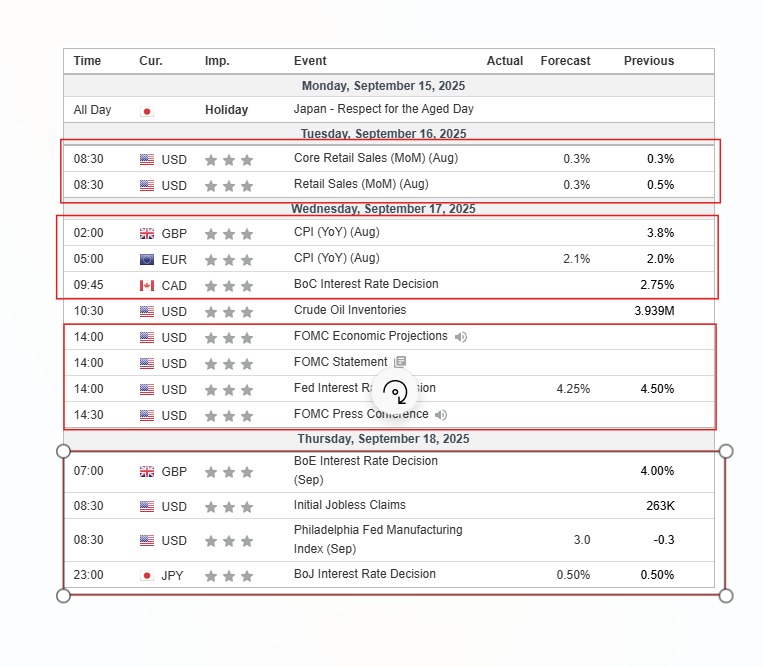
Fed Meeting & Rate Cut Expectations
The consensus is for a 25 bps cut, bringing the federal funds rate down between 4.00% to 4.25%.
Investors are focused on Fed Chair Powell’s comments.
The U.S. dollar is weak ahead of the Fed decision.
Fed governance and its independence are under attention.
Oil
Oil prices remain steady driven by drone attacks on Russian ports and refineries.
A drop in crude and gasoline inventories in the U.S. adds support to oil prices.
Equities
Major stocks like Nvidia, Meta and Palantir are being watched for buy entries.
The broader market is largely flat or mixed, waiting for the Fed meeting to provide clearer direction.
MARKET MOVERS
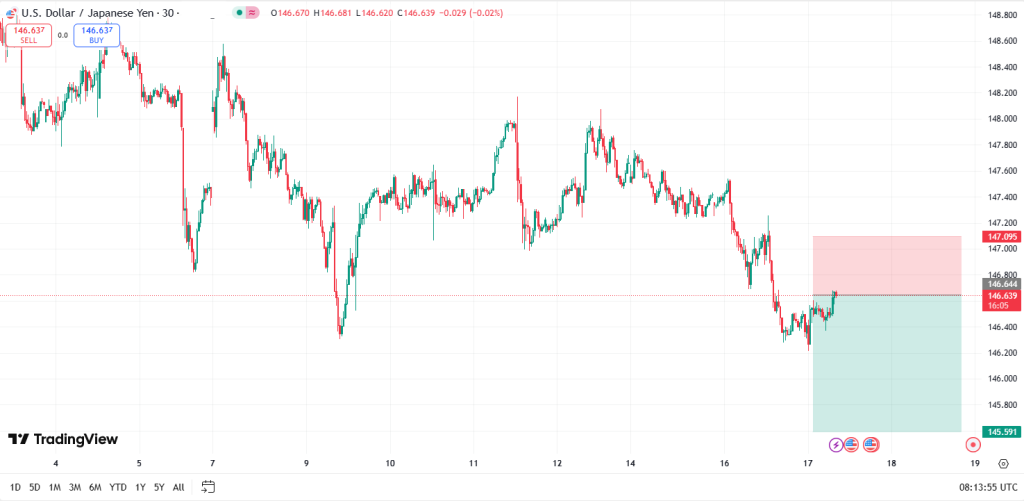
USD/JPY
Primary trend: USD/JPY is struggling to move above the 147.50–147.90 resistance zone.
Bullish case: Pushed above 147.90 with strength, potential near term targets are 148.50 and 149.35.
Bearish case: A move to the 146.20-146.57 support zone could lead to retests at 146.00 and 144.42.
Risk management: Use smaller position sizes or reduced leverage, also watch for U.S. rate cut expectations and Powell’s tone.
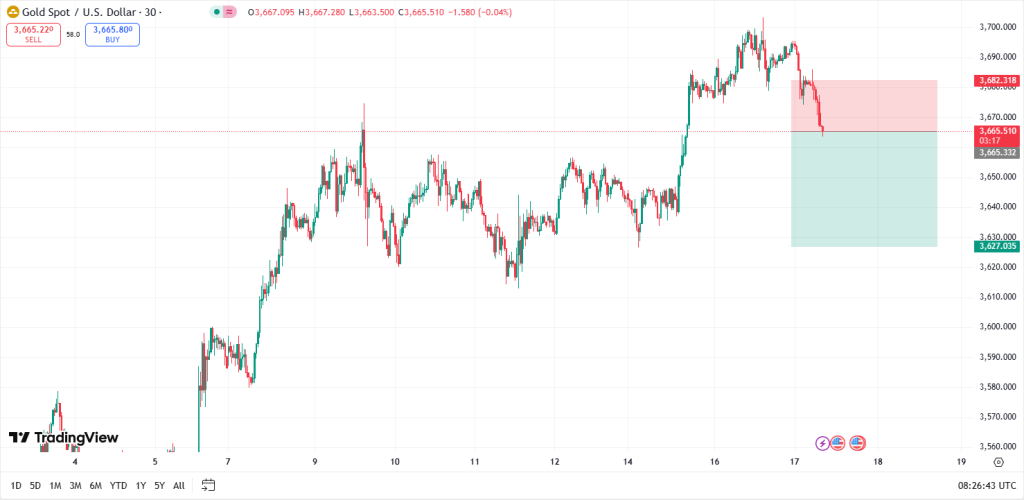
XAU/USD
Primary trend: Gold recently broke above the $3,700 mark, reaching record highs just over $3,702.
Bullish case: If momentum continues after the Fed decision, gold could push toward $3,780-$3,800.
Bearish case: Support can be found in the $3,660-$3,670 zone, with deeper support toward $3,600.
Risk management: Keep stops tight because of likely volatility around the Fed decision while keeping a watch on Fed interest rate decision as well as profit-taking after strong gains.
NEWS HEADLINES
The Fed rate decision is in focus, with signals for further easing widely expected
Trump-Modi diplomacy created unexpected positive sentiment, potentially easing trade tensions.
The U.S. dollar remains under pressure against major currencies such as Euros, Japanese yen and Australian dollar
Traders are watching closely for Fed Chair Jerome Powell’s tone for clues on future easing.
Gold has brushed above $3,700/oz, as the weaker dollar and rate cut expectations boost safe-haven demand.
Please note that the dividends of the following products will be adjusted accordingly. Index dividends will be executed separately through a balance statement directly to your trading account, and the comment will be in the following format “Div & Product Name & Net Volume”.
Please refer to the table below for more details:
The above data is for reference only, please refer to the MT4/MT5 software for specific data.
If you’d like more information, please don’t hesitate to contact info@vtmarkets.com.
Written on September 17, 2025 at 8:46 am, by anakin
Please note that the dividends of the following products will be adjusted accordingly. Index dividends will be executed separately through a balance statement directly to your trading account, and the comment will be in the following format “Div & Product Name & Net Volume”.
Please refer to the table below for more details:
The above data is for reference only, please refer to the MT4/MT5 software for specific data.
If you’d like more information, please don’t hesitate to contact info@vtmarkets.com.
Written on September 16, 2025 at 9:51 am, by anakin
Please note that the dividends of the following products will be adjusted accordingly. Index dividends will be executed separately through a balance statement directly to your trading account, and the comment will be in the following format “Div & Product Name & Net Volume”.
Please refer to the table below for more details:
The above data is for reference only, please refer to the MT4/MT5 software for specific data.
If you’d like more information, please don’t hesitate to contact info@vtmarkets.com.
Written on September 15, 2025 at 9:16 am, by anakin
US inflation and jobs data lifted expectations of Fed rate cuts, driving US stocks to record highs. In Europe, the ECB held rates steady, with its upbeat outlook on growth and inflation tempering bets on further cuts. Meanwhile, Trump dropped his nomination of a hawkish China policy adviser, fuelling speculation he may adopt a more dovish stance on China.
KEY INDICATORS
US economy and Fed
US inflation rose in August, with CPI up 0.4% month on month and 2.9% year on year.
Core CPI increased 0.3% month on month and 3.1% year on year.
Jobless claims reached 263,000 in the week ending 6 Sept, the highest level since Oct 2021.
The IMF reported slowing domestic demand and weaker job growth in the US.
The IMF warned that tariffs could add further pressure to inflation.
Europe and global outlook
The ECB kept interest rates unchanged.
Christine Lagarde said economic risks are now more balanced, but inflation remains uncertain.
Inflation in 2027 is projected at 1.9% and core inflation at 1.8%, both below the ECB’s 2% target.
The IMF said the Fed may have room for cautious rate cuts depending on upcoming data.
Looking ahead (15–19 Sept)
The Fed’s rate decision takes centre stage, with markets expecting a cut and guidance closely watched.
Key inflation data from the US and Europe.
Earnings from tech and industrials, and geopolitical risks in the Middle East and Asia, may drive volatility across FX, commodities, and equities.
MARKET MOVERS
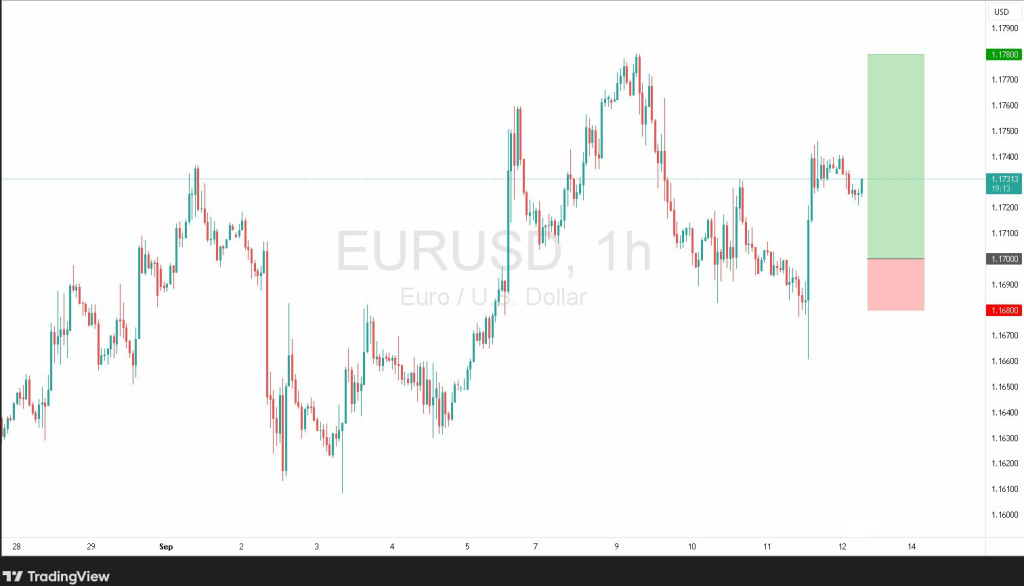
EUR/USD
Primary trend: Bullish, with pullbacks towards 1.1700 expected to attract buyers.
Support level: 1.1700 (secondary: 1.1725)
Resistance zone: 1.1780 (secondary: 1.1800)
Long strategy: Enter longs near 1.1700 support, target 1.1780 initially, extend towards 1.1800, stop-loss below 1.1700.
Short strategy: Consider tactical shorts on rallies into 1.1780–1.1800 resistance, target 1.1725 initially, extend back to 1.1700 if momentum fades.
Range trade: Buy dips near support and sell rallies near resistance if price consolidates between 1.1700–1.1800.
Risk management: Keep stops tight in line with the prevailing bullish bias.
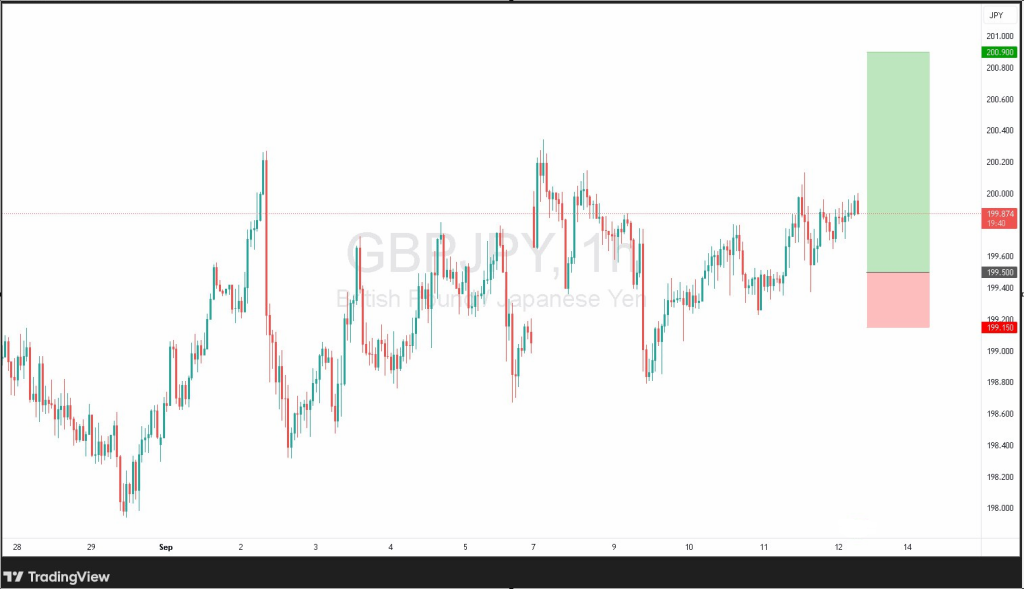
GBP/JPY
Primary trend: Bullish, though risk/reward is limited at current levels.
Support level: 199.50 (secondary: 199.80)
Resistance zone: 200.90 (secondary: 201.30)
Long strategy: Enter longs near 199.50 support, target 200.90 initially, extend towards 201.30, stop-loss below 199.50.
Short strategy: Consider tactical shorts on rallies into 200.90–201.30 resistance, target 199.80 initially, extend back to 199.50 if momentum fades.
Range trade: Buy dips near support and sell rallies near resistance if price consolidates between 199.50–201.30.
Risk management: Keep stops tight in line with the prevailing bullish bias.
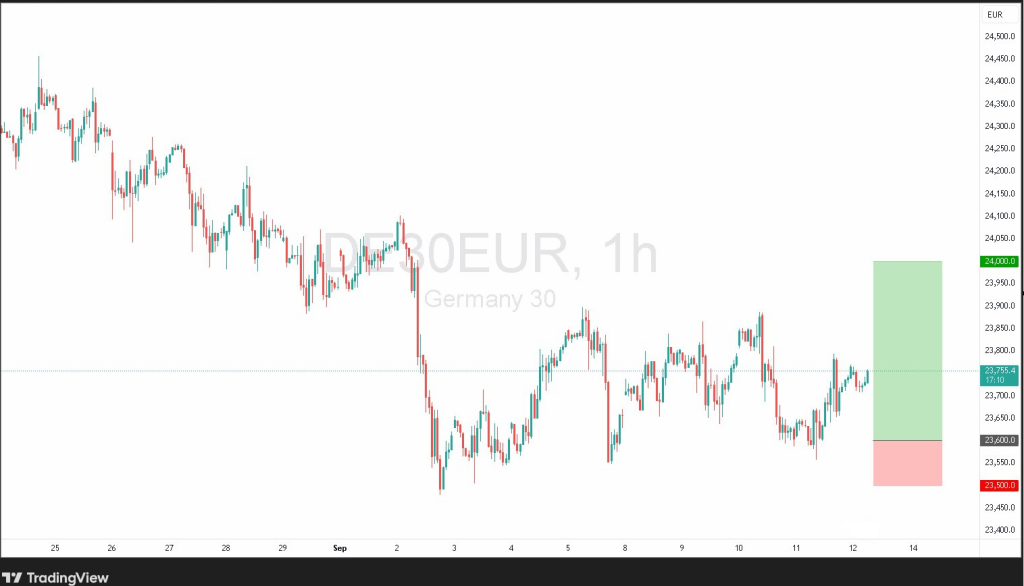
DAX 40 (Germany)
Primary trend: Bullish, with pullbacks towards 23,600 expected to attract buyers.
Support level: 23,600 (secondary: 23,750)
Resistance zone: 24,000 (secondary: 24,100)
Long strategy: Enter longs near 23,600 support, target 24,000 initially, extend towards 24,100, stop-loss below 23,600.
Short strategy: Consider tactical shorts on rallies into 24,000–24,100 resistance, target 23,750 initially, extend back to 23,600 if momentum fades.
Range trade: Buy dips near support and sell rallies near resistance if price consolidates between 23,600–24,100.
Risk management: Keep stops tight in line with the prevailing bullish bias.
NEWS HEADLINES
AI optimism lifts Wall Street
The S&P 500 and Nasdaq reached new highs as cooling inflation and robust AI demand lifted investor sentiment.
Oracle led gains on strong AI cloud demand, with chipmakers including Nvidia, Broadcom, and AMD climbing alongside.
Tech and power suppliers outperformed, while consumer discretionary and staples lagged behind.
Dollar weakens as Fed cut bets grow
The US dollar weakened as markets priced in a likely 25 bps Fed cut.
The yen strengthened against the dollar after US and Japanese officials emphasised that currency levels are not policy targets.
The euro remained steady, supported by stable risk sentiment.
Oil dips, gold benefits from Fed rate expectations
Oil prices (Brent and WTI) fell on oversupply concerns and weak US demand, despite persistent geopolitical risks.
Gold rose for a fourth consecutive week, supported by softer labour market data and growing expectations of a Fed rate cut.
Oil markets face pressure as rising supply and weakening demand outweigh short-term geopolitical headlines, keeping traders focused on fundamentals like inventories and production trends.
Market shifts focus to oversupply risks
Oil futures fell further in early Friday trading, extending the previous session’s decline as market focus shifted back to core supply and demand fundamentals.
Brent crude slipped 0.6% to $65.95 per barrel, while WTI dropped 0.7% to $61.95. Growing concerns over a potential surplus are weighing on sentiment, particularly as demand from the United States shows further signs of slowing.
Oil output from the Bakken, the second-largest US shale field, is showing signs of a slowdown as flows on a key pipeline out of the region decline https://t.co/JLJx6gwjNA
Although tensions in the Middle East and renewed sanctions rhetoric initially supported oil, the geopolitical risk premium is fading.
Earlier in the week, prices briefly spiked after President Trump urged the EU to impose tariffs on Chinese and Indian goods as part of broader efforts to increase pressure on Russia. However, the boost quickly reversed as the market refocused on fundamentals.
Trump's pressure on Europe to slap 100% tariffs on India and China raises eyebrows https://t.co/yGJMrkZSaf
The muted response to sanctions headlines highlights traders’ view that current supply dynamics carry more weight than geopolitical disruptions.
With US demand weakening and stockpiles rising, the potential for oversupply is emerging as a more dominant driver of price direction than the risk of conflict or trade restrictions.
Technical analysis
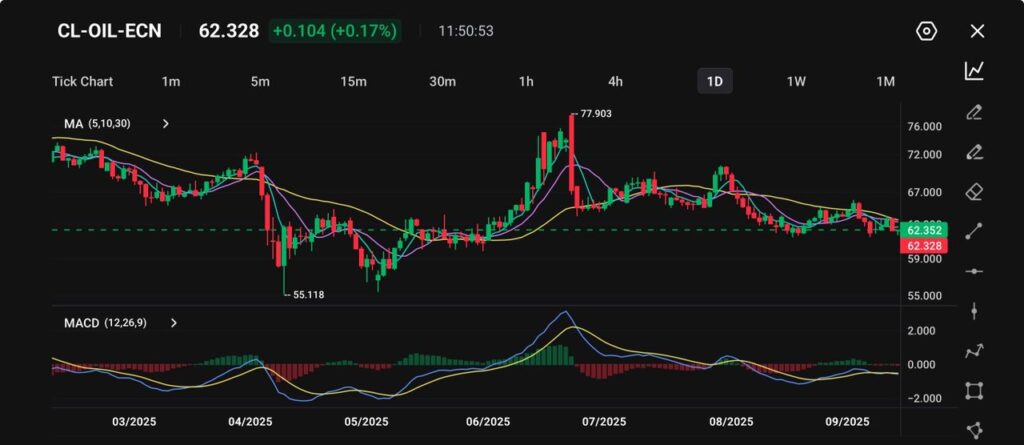
WTI crude is currently trading at $62.33, up 0.17% on the day, though overall momentum remains subdued after a turbulent year.
Picture: Brent crude slips to $65.95, consolidating between $59.00 support and $67.00 resistance on the VT Markets app.
The price chart shows crude rebounding from April’s low of $55.12, peaking at $77.90 in July before retreating to the low $60s.
Moving averages (5, 10, 30) are now converging, reflecting indecision, while the MACD hovers flat around the zero line, signalling weak momentum.
Immediate support is identified near $59.00, while resistance lies around $67.00, with July’s high of $77.90 marking the next major ceiling.
Unless a breakout occurs, oil prices are likely to consolidate within this range, with traders closely monitoring supply-demand trends and potential shifts from the Federal Reserve’s interest rate policy.
Cautious forecast
In the short term, crude oil is expected to remain under pressure between $61.00 and $64.00, as rising inventories and a stronger supply outlook outweigh geopolitical headlines.
The IEA’s revised forecast and persistent US stock builds suggest that upside potential remains capped, even in the face of sanctions or Middle East flashpoints.
Over the medium term, if demand continues to soften while OPEC+ holds to its production strategy, prices could gradually drift towards the $59.00–60.00 range.
A sharper slowdown in US consumption could accelerate losses unless offset by production cuts or unexpected supply disruptions.
Looking ahead, traders should keep an eye on next week’s EIA inventory report and OPEC+ statements for any signs of a shift in tone. Until then, upside rallies may remain limited while downside risks persist.
Please note that the dividends of the following products will be adjusted accordingly. Index dividends will be executed separately through a balance statement directly to your trading account, and the comment will be in the following format “Div & Product Name & Net Volume”.
Please refer to the table below for more details:
The above data is for reference only, please refer to the MT4/MT5 software for specific data.
If you’d like more information, please don’t hesitate to contact info@vtmarkets.com.
Written on September 12, 2025 at 8:49 am, by anakin
When companies raise capital, they often issue different classes of shares. Understanding the difference between ordinary and preference shares is essential before making investment decisions. While both represent ownership in a company, they differ in rights, income, and growth potential. This guide explains preference shares vs ordinary shares and helps investors decide which may suit their objectives.
What Are Ordinary Shares?
Ordinary shares, also called common shares, are the most widely issued type of equity. They represent a claim on a company’s profits and assets, giving investors both risks and rewards tied directly to business performance. By holding ordinary shares, investors become partial owners of the company, with their returns coming from capital appreciation and dividends when profits are distributed.
Key features include:
Voting rights: Ordinary shareholders can vote on major company decisions, including electing directors.
Dividends: Payments are not guaranteed. Companies distribute dividends from profits, and they may vary or stop entirely.
Capital growth potential: Ordinary shares can increase significantly in value if the company performs well.
Example:
Apple Inc. illustrates this clearly. Its ordinary shares traded at about $25 in 2010 and rose above $200 by 2025, an increase of roughly 700% over 15 years. Since 2012, Apple has also paid regular dividends, rewarding investors with both income and long-term growth.
What Are Preference Shares?
Preference shares, also known as preferred stock, are a class of equity that blends features of both shares and bonds. They typically provide investors with a fixed dividend and priority over ordinary shareholders in the distribution of profits and assets. However, they usually come without voting rights, which limits shareholder influence. They are less common but remain popular in sectors like banking and utilities.
Key features include:
Fixed dividends: Preference shareholders typically receive a fixed dividend, paid before ordinary shareholders.
Priority: In the event of liquidation, preference shareholders have a higher claim on assets than ordinary shareholders.
Limited or no voting rights: Most preference shares do not carry voting rights.
Types of preference shares: Cumulative, convertible, redeemable, and participating.
Example:
JPMorgan Chase issues several series of preference shares, with dividends typically ranging from 4.5% to 6% annually. These consistent payouts appeal to income-focused investors who value stability over growth potential.
Preference Shares vs Ordinary Shares: Key Differences
Investors often ask: what is the difference between ordinary and preference shares? The answer lies in how each type of share provides rights, rewards, and risks. Ordinary shares tend to suit investors looking for long-term capital appreciation and voting power, while preference shares are designed to deliver stable income with more security.
To make this clear, the table below shows the main eight differences between ordinary and preference shares:
Feature
Ordinary Shares
Preference Shares
Ownership rights
Full ownership with voting rights
Ownership, usually no voting rights
Dividend payments
Variable, not guaranteed
Fixed, paid before ordinary shareholders
Dividend priority
Paid last, after all others
Priority over ordinary shareholders
Capital growth
High long-term potential
Limited upside, mainly income-focused
Risk level
Higher, tied to market volatility
Lower, thanks to fixed payouts
Priority in liquidation
Last in line for claims
Ahead of ordinary shareholders
Convertibility
Cannot be converted
Some can be converted into ordinary shares
Investor profile
Favoured by growth-oriented investors
Favoured by income-seeking investors
1. Ownership rights
Ordinary shareholders hold voting rights that allow them to influence company decisions such as electing directors or approving mergers. Preference shareholders usually lack voting rights, which makes them less influential in governance. For example, Apple’s ordinary shareholders can vote at annual meetings while JPMorgan preference shareholders cannot.
2. Dividend payments
Ordinary share dividends depend on profits and may vary from year to year. Preference shares usually provide fixed dividends, offering a more predictable income stream. For instance, JPMorgan’s preference shareholders receive around 6 percent annually regardless of fluctuations in ordinary dividends.
3. Dividend priority
Ordinary shareholders receive dividends only after preference shareholders have been paid. This makes preference shares safer for income-focused investors. In 2008, several banks halted ordinary share dividends but continued paying preference shareholders.
4. Capital growth
Ordinary shares offer higher potential for price appreciation over time. Preference shares provide limited upside because they focus on steady income. Apple’s share price rising from $25 in 2010 to over $200 in 2025 highlights the strong growth potential of ordinary shares.
5. Risk level
Ordinary shares are more volatile since their value follows market conditions and company performance. Preference shares are less risky because of their stable payouts. This is why retirees often prefer preference shares while younger investors lean toward ordinary shares.
6. Priority in liquidation
In the event of bankruptcy, preference shareholders have a stronger claim on assets than ordinary shareholders. This added protection reduces their downside risk. For example, preference shareholders may recover part of their investment in liquidation while ordinary shareholders often lose everything.
7. Convertibility
Ordinary shares cannot be converted into other types of equity. Certain preference shares, called convertible preference shares, can be exchanged for ordinary shares at a future date. Startups sometimes issue convertible preference shares to attract venture capital investors.
8. Investor profile
Ordinary shares appeal to investors seeking growth and long-term wealth. Preference shares suit investors looking for steady income and reduced risk. A 30-year-old saving for retirement may choose ordinary shares while a retiree might prefer preference shares for reliable dividends.
Preference Shares vs Ordinary Shares: Which Should You Choose?
The choice between preference shares and ordinary shares depends on your investment objectives. Some investors prioritise growth, while others value stability and income. Here’s how different types of investors typically approach each option:
People invest in ordinary shares when:
They want long-term growth through rising share prices.
They can accept higher risk and short-term volatility.
They value voting rights and influence in company decisions.
Example:
A 30-year-old professional with a long investment horizon chooses Apple ordinary shares. He accepts short-term volatility in exchange for long-term wealth accumulation, believing the growth potential outweighs dividend uncertainty.
People invest in preference shares when:
They prioritise steady income through fixed dividends.
They want lower risk and more security in returns.
They do not mind limited or no voting rights.
Example:
A 65-year-old retiree invests in JPMorgan preference shares, such as its PSL series, which pays around 6 percent annually. She values predictable income to cover living expenses and prefers the lower risk profile, even though it means limited upside potential.
Summary
Ordinary shares offer voting rights and the potential for long-term capital growth, making them attractive to younger or growth-focused investors willing to accept higher risk. Preference shares provide fixed dividends and greater security, appealing to retirees or income-seeking investors who prioritise stability over rapid gains. By understanding the difference between ordinary shares and preference shares, investors can choose the option that best fits their goals and risk appetite.
Learn More About the Share Market with VT Markets
At VT Markets, you can trade both ordinary shares and preference shares through Contracts for Difference (CFDs). This lets you benefit from price movements in both rising and falling markets without directly owning the shares. With access to leading platforms like MetaTrader 4 (MT4) and MetaTrader 5 (MT5), along with competitive spreads and professional support, VT Markets offers a flexible way to explore global share opportunities. New traders can start with a VT Markets demo account to practise strategies in real time, while further guidance and resources are available through the VT Markets Help Centre.
1. What is the difference between ordinary and preference shares?
Ordinary shares give investors ownership rights, voting power, and the potential for long-term capital growth, but dividends are not guaranteed and risks are higher. Preference shares provide fixed dividends and priority in payouts, with less risk and more stability, but usually without voting rights or significant growth potential.
2. Which is better, preference shares or ordinary shares?
Neither is universally better, as it depends on your goals. Ordinary shares suit investors who want long-term capital growth and are comfortable with higher risk. Preference shares are better for investors seeking steady dividends and lower volatility. The right choice comes down to your investment horizon and risk appetite.
3. Do preference shares pay higher dividends than ordinary shares?
Yes, preference shares generally pay higher and more stable dividends than ordinary shares, which depend on company profits.
4. Which is safer: preference shares or ordinary shares?
Preference shares are safer in terms of income and liquidation priority, while ordinary shares carry higher risk but greater potential for long-term gains.
5. Are preference shares more common in certain industries?
Yes. They are frequently issued by banks, insurance companies, and utilities because these industries benefit from stable capital and consistent payouts.
6. Do both types of shares trade on stock exchanges?
Ordinary shares are almost always listed, while preference shares may have limited availability and liquidity, depending on the market.
7. Can I hold both preference and ordinary shares in one portfolio?
Yes. Many investors combine both to balance income stability from preference shares with growth potential from ordinary shares.
Written on September 12, 2025 at 8:36 am, by jason
You’ve mastered the demo account, executed dozens of trades, and your strategy seems flawless. But what happens when real money is on the line? Suddenly, the calm confidence you felt turns into hesitation, doubt, and sometimes panic – and the rules of the game change.
Demo trading is invaluable for learning the mechanics, testing strategies, and getting comfortable with the platform. Yet, it can never fully prepare you for the emotional and practical realities of live trading. Understanding these differences and knowing how to adapt can be the key to trading successfully and confidently.
Why demo trading matters
For beginners, demo accounts are a crucial first step. They allow you to explore the trading environment without risking a penny, helping you understand how platforms like MT4 or MT5 work, familiarise yourself with order types, and practise strategies.
Imagine placing 50 demo trades using a simple moving average crossover strategy. Each trade reinforces the mechanics, timing, and basic rules of your strategy. By the end, you might feel confident that your approach works – and in many cases, it does… in a simulated world.
Demo trading is like a flight simulator for aspiring pilots. You can practise take-offs, landings, and emergency procedures endlessly, but nothing truly replicates the pressure of a real flight. In trading, that pressure comes with real money.
With a VT Markets demo account, you can start trading at your own pace and build confidence before risking real money. You get 90 days to practise, explore different strategies, and familiarise yourself with the platform until you feel prepared to trade live.
Ready to start your journey? Open a VT Markets demo account today and take your first step towards trading with confidence.
What changes when you go live
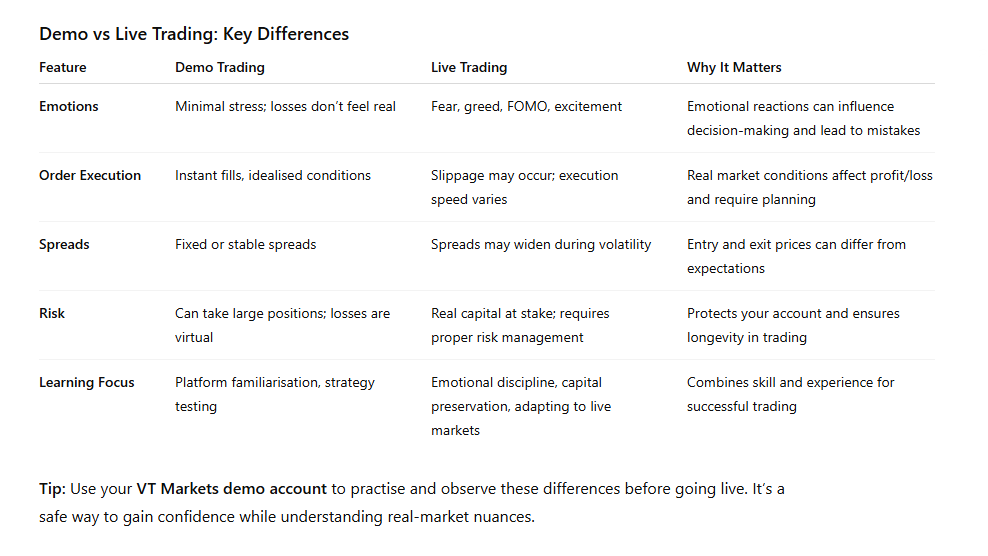
When you move from demo to live trading, three main factors make the experience fundamentally different: emotions, market conditions, and risk management.
Emotional discipline enters the game
In a demo account, losses are just numbers on a screen. Fear and greed are absent, so decisions tend to be rational.
In live trading, emotions suddenly matter. Fear of losing real money can make you hesitate, while the excitement of a winning streak may tempt you to overtrade. Even experienced traders can feel a surge of FOMO (fear of missing out) when markets move quickly.
Example: On demo, you might close a losing trade at -$200 without thinking twice. Live, that same loss could make you panic or hold onto a position too long, hoping it will recover – often with worse results.
Real market conditions
Demo accounts cannot always replicate the nuances of live markets. Two key differences are slippage and spread variability.
Slippage occurs when your order fills at a slightly different price than expected, usually during high volatility. On demo, orders fill instantly, giving a false sense of control.
Spreads – the difference between the buy and sell price – can widen during news events or market spikes. This affects your entry and exit points more noticeably on a live account.
Execution speed can also vary. Demo servers are often idealised, whereas live orders must compete in real-time market conditions.
Example: During a major economic announcement, a EUR/USD buy order may fill 5 pips away from your intended price in a live account. On demo, it would have filled perfectly. This small difference can influence your profit and loss, and it emphasises why live trading requires careful risk management.
Risk and capital management
Demo accounts often encourage traders to take larger positions or risk more per trade because losses don’t matter. In live trading, this approach can quickly lead to significant losses.
Example: A trader risking 10% per trade in demo may feel safe experimenting. On a live account, repeated 10% losses can deplete capital rapidly, making it harder to recover. Understanding proper position sizing and risk per trade is essential to survive and succeed in live markets.
How to transition smoothly
Moving from demo to live trading does not have to be intimidating. Here are practical tips to make the transition as smooth as possible:
1. Start small
Begin with a small deposit or micro-lot trades. This allows you to get used to the emotional side of live trading without risking too much.
2. Stick to your trading plan
Avoid the temptation to deviate from strategies that worked in demo. Your plan – including entry and exit rules, risk limits, and goals – is your safety net.
3. Use stop-losses consistently
Discipline in live trading is critical. Using stop-loss orders protects your capital and reinforces good habits.
4. Treat demo results as a baseline
Remember that past performance in demo is only indicative. Adjust your expectations and be ready to refine your strategy based on live results.
5. Leverage tools from VT Markets
Make use of advanced features such as AI-driven insights, real-time economic calendars, automated risk calculators, and expert support. These tools can help you make informed decisions and navigate live trading with greater confidence.
Conclusion
Moving from demo to live trading is a natural and necessary step for any trader who wants to succeed. Demo accounts teach skills; live accounts teach experience. The transition may feel daunting at first, but understanding the differences and preparing for them can make all the difference.
With discipline, realistic expectations, and the right tools, your demo success can translate into live trading confidence. Start today with a VT Markets demo account, practise at your own pace, and when you’re ready, step into live trading with exclusive tools, bonuses, and 24/5 expert support – giving you the best possible start on your live trading journey.
Written on September 11, 2025 at 2:17 pm, by valerie