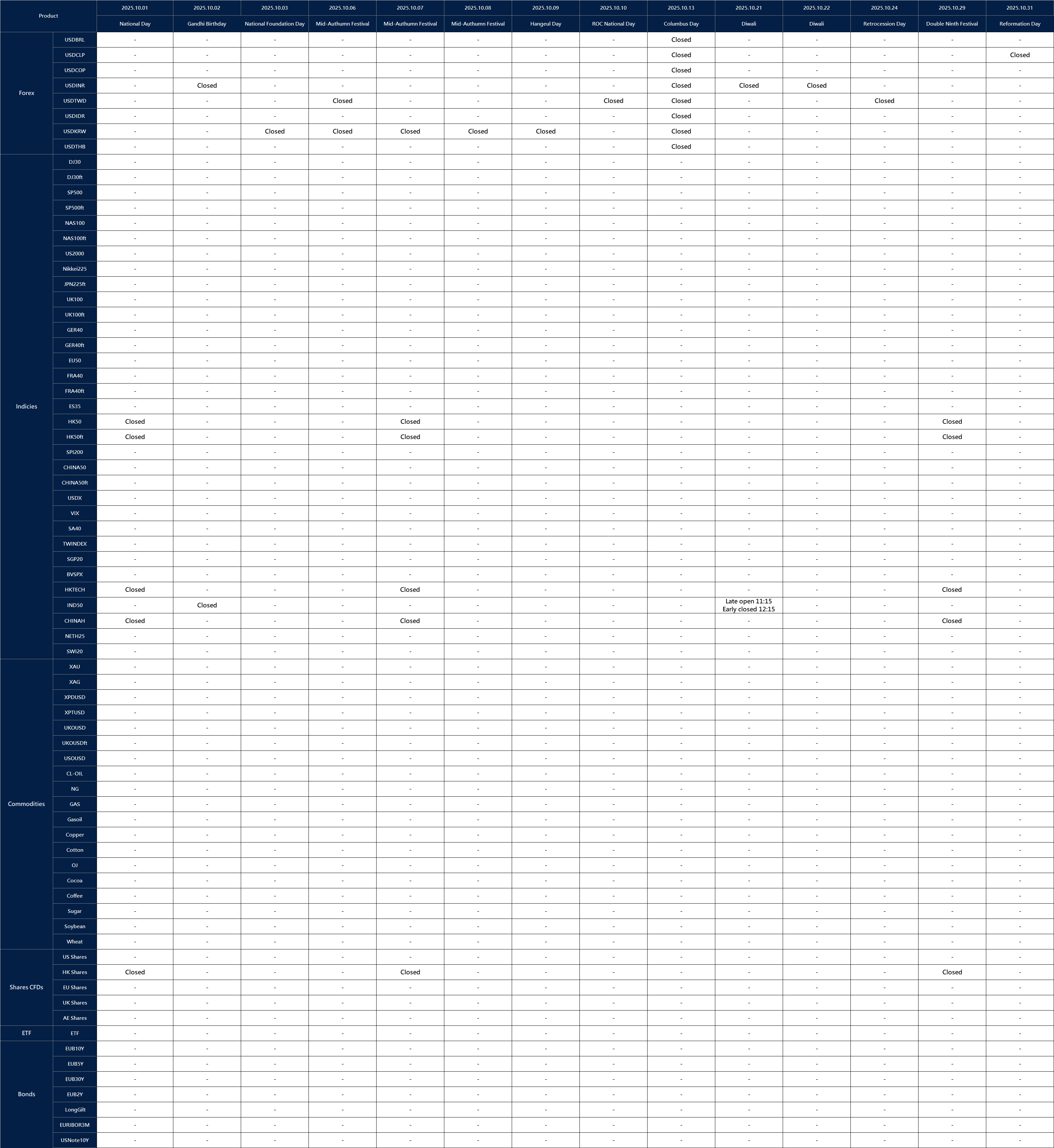
Affected by international holidays, the trading hours of some VT Markets products will be adjusted. Please check the following link for the affected products:
Please note that the dividends of the following products will be adjusted accordingly. Index dividends will be executed separately through a balance statement directly to your trading account, and the comment will be in the following format “Div & Product Name & Net Volume”.
Please refer to the table below for more details:
The above data is for reference only, please refer to the MT4/MT5 software for specific data.
If you’d like more information, please don’t hesitate to contact info@vtmarkets.com.
Written on September 29, 2025 at 7:40 am, by anakin
In the US, Q2 GDP growth was revised up to 3.8%, the highest in two years, while jobless claims fell to a two-month low. Federal Reserve officials expressed diverging views on the policy outlook, with some urging caution on rate cuts and others shifting focus toward employment. Calls to reform the Fed’s benchmark rate surfaced, highlighting liquidity advantages of the TGCR. Globally, geopolitical tensions rose as Russia extended fuel export bans.
KEY INDICATORS
US macroeconomic Data
US GDP growth for Q2 2025 was revised sharply to +3.8% from the previous estimate of +3.3%, marking the highest level in two years.
Unemployment claims for the week ending 20 September 2025 came in at 218,000, the lowest since the week of 19 July 2025.
Federal Reserve commentaries
Dallas Fed President Logan advocates replacing the Federal Funds Rate with the more liquid Tri-Party General Collateral Rate (TGCR)
Fed officials having mixed views on policy path
Fed Governor Bowman: Shift focus from inflation to employment.Kansas City Fed President Schmid: Favours more aggressive balance sheet reduction.Chicago Fed President Goolsbee: Concerned about premature rate cuts based on slowing jobs data; inflation trends still uncertain.
San Francisco Fed President Daly: Warns against fully moving to a neutral stance, citing risks.
Russia-Ukraine conflict
Russian diesel and petrol export bans extended to 31 December 2025
MARKET MOVERS
EUR/USD
Primary trend: EUR/USD keeps a medium-term bearish bias, with price action suggesting a potential top. Broader outlook favoring downside.
Support: 1.1635
Resistance: 1.1735 could offer selling opportunities, with the broader outlook favoring downside.
Long strategy: Consider tactical longs if dips hold above support at 1.1635, targeting 1.1710 – 1.1735 with tight risk controls.
Short strategy: Sell into rallies near 1.1735, aiming for 1.1635 and 1.161.
Range trade: Buy near the 1.161 support and sell into the 1.1735 resistance, with stops kept tight given the prevailing bearish bias.
GBP/JPY
Primary trend: A bullish bias retains, with price action suggesting a potential bottom near 199.5.
Support: 199.5
Resistance: 201.1 – 201.5
Long strategy: Buy on dips toward 199.5 support, targeting 201.1 and 201.5.
Short strategy: Consider tactical shorts if price fails to hold above the 201.1 – 201.5 resistance, looking for a move back toward 199.5 support.
Range trading: Buy near the 199.50 support and sell into the 201.50 resistance, with stops kept tight given the bullish bias.
XAU/USD
Primary trend: Hovering near all-time highs with a neutral to slightly bearish medium-term bias whereby short-term economic data could trigger volatility.
Support: 3680 – 3700
Resistance: 3822
Long strategy: Consider tactical longs if dips hold above 3700 – 3680, targeting 3750 – 3780 with tight stops.
Short strategy: Sell into rallies near 3822, aiming for 3675 first, with potential extension to 3646.
Range trading: Buy near the 3680 support, sell near the 3822 resistance, with stops kept tight due to indecision and limited momentum.
NEWS HEADLINES
US dollar
The US Dollar Index surged sharply on Thursday following the significant upward revision to Q2 GDP.
Precious Metals
Gold remained volatile, testing the $3,760 level multiple times intraday but failed to hold above it.
Silver rallied strongly, breaking above $45 and hitting a new high since May 2011.
Oil
Early losses were reversed during the US trading session, with the WTI crude reclaiming the $65 level and the Brent crude rose to $68.72 per barrel.
Equities
In the US, the Dow Jones fell 0.38%, the S&P 500 declined 0.5% and the Nasdaq Composite also dropped 0.5%.
In Europe, the DAX 30 fell 0.56%, the FTSE 100 (UK) declined 0.39% and the Euro Stoxx 50 is down by 0.3%.
Written on September 29, 2025 at 5:39 am, by valerie
23 September, 2025, India – VT Markets has announced the launch of a dedicated CSR initiative to support families affected by the recent floods in Punjab. Partnering with Mission Deep Education Trust, the company is channeling resources to distribute 100 comprehensive relief kits to households across some of the hardest-hit villages and relief camps.
This initiative is part of VT Markets’ ongoing commitment to stand with communities during times of crisis, extending support beyond its role as a global trading platform. By directly contributing to recovery efforts, the company seeks to ensure that vulnerable families receive urgent assistance to meet both their basic and long-term needs.
The relief kits have been carefully structured to provide holistic support. The 50 food kits are designed to cover nutritional essentials such as flour, rice, pulses, tea, sugar, dry milk to help families safeguard their health and wellbeing as they navigate the immediate aftermath of the floods. At the same time, the 50 daily essentials kits provide blankets, medicines, soaps, sanitary pads, clothing, and slippers, items that restore dignity, warmth, and hygiene for families who have lost access to everyday supplies.
Distribution will be led by volunteers from Mission Deep Education Trust, who will ensure the kits are delivered directly to those in need. To strengthen transparency and amplify awareness, the activity will be documented through photographs and videos, highlighting the impact of the initiative and encouraging broader community involvement in relief and rebuilding efforts.
Beyond short-term aid, this CSR effort also reflects VT Markets’ broader vision of responsible corporate citizenship. The company has consistently emphasized the importance of supporting communities, advancing education, and contributing to resilience in regions where people face sudden and life-altering challenges. Through collaborations with local organizations, VT Markets ensures that its contributions are not only immediate but also meaningful, sustainable, and aligned with real community needs.
About VT Markets
VT Markets is a regulated multi-asset broker with a presence in over 160 countries as of today. It has earned numerous international accolades including Best Online Trading and Fastest Growing Broker. In line with its mission to make trading accessible to all, VT Markets offers comprehensive access to over 1,000 financial instruments and clients benefit from a seamless trading experience via its award-winning mobile application.
Please note that the dividends of the following products will be adjusted accordingly. Index dividends will be executed separately through a balance statement directly to your trading account, and the comment will be in the following format “Div & Product Name & Net Volume”.
Please refer to the table below for more details:
The above data is for reference only, please refer to the MT4/MT5 software for specific data.
If you’d like more information, please don’t hesitate to contact info@vtmarkets.com.
Written on September 26, 2025 at 7:49 am, by anakin
Please note that the dividends of the following products will be adjusted accordingly. Index dividends will be executed separately through a balance statement directly to your trading account, and the comment will be in the following format “Div & Product Name & Net Volume”.
Please refer to the table below for more details:
The above data is for reference only, please refer to the MT4/MT5 software for specific data.
If you’d like more information, please don’t hesitate to contact info@vtmarkets.com.
Written on September 25, 2025 at 8:58 am, by anakin
After recent rate cuts and shifting expectations around central bank policy, investors are watching fresh data from the U.S. and Europe for signs of how much easing lies ahead. Global economic growth concerns, inflation trajectories and geopolitical undercurrents continue to influence sentiment.
KEY INDICATORS
Remarks from Fed Chair Jerome Powell that asset valuations are elevated prompted caution in the markets
Recent forecast from the OECD warns that the full impact of U.S. tariffs may still lie ahead.
Inflation trends still watched closely, particularly U.S. inflation data and European confidence indices.
Australian prime minister Albanese faces diplomatic pressure ahead of a meeting with Trump, with questions over defence (AUKUS) and foreign policy incentives.
MARKET MOVERS
USD/JPY
Primary trend: Overall bullish over the longer term. A break above 148.00 – 148.10 would signal upside continuation.
Support level: 147.50 – 147.75, followed by 147.20 – 147.30 and further down to 146.80.
Resistance level: 148.50 – 149.00, followed by 149.50.
Risk management: Use tight stop losses just below support zones to control risk while observing macro news (U.S. data, Fed speak, BoJ cues) for sudden shifts in direction.
Crude Oil WTI
Primary trend: A bullish break above 63.80 – 64.00 could trigger further upside momentum.
Support: 63.20 – 63.40, followed by 62.80 – 63.00 and 62.30 – 62.60
Resistance: 63.80 – 64.00, followed by 64.50 – 65.20 and 66.00
Range trading: Buy near support and sell near resistance if price consolidates between 63.45 – 63.84
NEWS HEADLINES
Currencies
US dollar gains strength as markets price in “elevated” asset valuations while waiting for the U.S. core PCE inflation data.
Euro under pressure from weak German IFO.
Yen weakened as the Bank of Japan kept to its current policy stance.
Inflation spiked 3% in Australia, delaying rate cuts well into 2026 and boosting volatility in the Australian dollar
Commodities
Oil edges higher after a drop in U.S. stockpiles and reports of stalled energy deals in Iraqi Kurdistan.
Gold retreats as investors took profits, though safe-haven demand remains strong given slower global growth.
Equities
Wall Street dipped overnight after Powell’s comments spurred profit-taking.
Nikkei slides on slow manufacturing numbers, while exporters are also pressured by yen weakness.
Please note that the dividends of the following products will be adjusted accordingly. Index dividends will be executed separately through a balance statement directly to your trading account, and the comment will be in the following format “Div & Product Name & Net Volume”.
Please refer to the table below for more details:
The above data is for reference only, please refer to the MT4/MT5 software for specific data.
If you’d like more information, please don’t hesitate to contact info@vtmarkets.com.
Written on September 24, 2025 at 11:10 am, by anakin
In this guide, we’ll cover the 10 most volatile stocks to watch in 2025, explain the factors behind their swings, and share practical steps to trade them. Whether you’re chasing short-term gains with high volatility stocks or simply want to understand the risks before diving in, this article gives you the insights needed to handle fast-moving markets with confidence.
What Are Volatile Stocks?
Volatile stocks are shares that frequently experience large price swings in short periods. In other words, their prices can move sharply upward or downward from day to day. Volatility is often measured by metrics such as standard deviation, beta (relative to the overall market), or average true range (ATR).
High volatility stocks tend to respond strongly to news, earnings reports, market sentiment shifts, or macroeconomic events. For example, when a technology firm unexpectedly posts weak revenue guidance, its share price might fall 10 % in a single trading day — a reaction that rarely occurs in stable, low-volatility stocks.
Volatility is a double-edged sword. On one hand, it offers traders the possibility of outsized profits; on the other, it exposes them to steep losses. In a 2025 market upheaval, global equities experienced extreme swings following macro policy changes, with some indices plunging more than 5 % in a single session.
Because volatile stocks carry higher risk, traders typically apply strict risk management when dealing in them.
10 Most Volatile Stocks to Watch
Volatility can stem from many drivers: small market capitalization, thin liquidity, earnings surprises, sector hype, or speculative trading activity. The following ten U.S. stocks have recently shown extreme price swings over the past few months, with volatility levels far above the broader market average.
Prices and volatility percentages in this section are based on recent market data as of September 2025. Both figures can change quickly depending on trading volumes, investor sentiment, and company-specific developments. Treat these numbers as indicative snapshots rather than fixed values.
Fitness Champs Holdings is a small-cap company in the sports and fitness industry. With a very limited scale and market presence, it attracts speculative interest from traders, and its stock is highly sensitive to even minor changes in buying or selling activity.
The stock recently collapsed by more than 80 % in one trading session, falling from around USD 7.44 to nearly USD 1.07, just weeks after its IPO. The move was accompanied by unusually heavy trading volume, reflecting panic selling rather than fundamental news. Overall, the share price has shown extreme swings, with volatility of roughly 600 % in recent months, a behaviour typical of microcap stocks where light liquidity allows sentiment-driven trades to cause outsized moves.
Drivers of Volatility
Post-IPO instability with limited investor confidence.
Innovation Beverage Group develops, manufactures, and markets alcoholic and non-alcoholic beverage products across brands like Australian Bitters, Twisted Shaker, and more. The company is small in scale and faces strong competitive and regulatory pressures in the consumer goods space.
The price recently surged over 100 % in a single session following the announcement of a proposed reverse merger with BlockFuel Energy Inc. The deal would result in BlockFuel shareholders owning 90 % of the combined entity. Additionally, IBG announced a 5-for-1 reverse stock split to address Nasdaq compliance following a delisting notice.
Drivers of Volatility
Merger speculation and structural shift in business model (beverages to energy / crypto).
Reverse stock split and delisting risk creating uncertainty.
Thin liquidity and small equity base amplifying reaction to news.
3. Digital Brands Group, Inc. (DBGI) – Apparel & eCommerce Hybrid
Digital Brands Group operates in the fashion/apparel space, selling through direct-to-consumer and wholesale channels under brands such as Bailey 44, DSTLD, AVO Studios, and others. The company also seeks to integrate technology and analytics into eCommerce operations to differentiate itself.
Recently, DBGI’s stock has seen extreme swings. Over a single trading day, its price ranged from a low of USD 4.25 to a high of USD 9.50 — reflecting an intraday volatility of about 120 %. On a weekly basis, the stock typically moves by around 20–25 %, far above the average of roughly 7–8 % seen in its specialty retail peers.
Drivers of Volatility
Frequent restructuring, capital raises, and reverse splits causing uncertainty and dilution risk.
Low market capitalization (approx. USD 36M) and thin trading float make each trade more impactful.
Volatile earnings and news announcements (e.g. 4Q losses, shifts in strategy) fueling reactionary trades.
Fitell Corporation is a fitness equipment and wellness company that in recent months has sought to transform itself by entering into digital assets and blockchain initiatives. For example, it has announced a $100M financing facility to build a Solana-based treasury and plans to rebrand around its crypto ambitions.
Following this announcement, Fitell’s stock price surged by nearly 60 % in a single session, climbing from around USD 8 to intraday highs above USD 12, before closing back near the USD 8–9 range. Over the past year, FTEL’s shares have traded in an extremely wide 52-week range of USD 0.36 to USD 49.50, highlighting its highly speculative nature.
Drivers of Volatility
Rapid pivot into crypto and DeFi initiatives (e.g. Solana treasury) causing speculative swings.
High short interest and possibility of short squeezes; Nasdaq temporarily halted trading in past volatility episodes.
Convertible debt and complex capital structure (e.g. recent $70M Series A Notes offering) introducing dilution and uncertainty risk.
5. American Rebel Holdings, Inc. (AREB) – Consumer Security & Lifestyle Products
American Rebel Holdings focuses on personal security, safe storage products, and lifestyle-branded merchandise. The company also recently announced property acquisitions and strategic moves aiming to diversify its operations.
In September 2025, the stock underwent a 1-for-20 reverse stock split, reducing its outstanding shares from over 10 million to about 514,000. Around the same period, management updated terms of a property transaction tied to its Nashville expansion. With a market cap near USD 10 million and thin liquidity, the stock has been swinging sharply. Over recent months, AREB has recorded volatility above 110 %, making it one of the most unstable microcap names in the U.S. market.
Drivers of Volatility
Corporate restructuring and reverse split creating uncertainty in share metrics.
Low market capitalization and thin trading volume magnify reactions.
News flows around acquisitions and property strategy provoke speculative swings.
6. Super League Enterprise, Inc. (SLE) – Esports & Digital Entertainment
Super League Enterprise is a small-cap company in the esports and digital entertainment industry. It builds creator communities, gaming content, and partnerships with media platforms, operating in a sector that is highly sentiment-driven and prone to hype cycles.
The stock price jumped more than 100 % in a single session after announcing a private placement of up to USD 20 million to reduce debt and regain Nasdaq compliance. Over the past few months, the stock has displayed volatility above 108 %, reflecting the mix of financing uncertainty, small trading float, and momentum-driven speculation.
Drivers of Volatility
Exposure to hype cycles in gaming / esports, where news can trigger rapid sentiment shifts.
Thinly traded stock with small float, so every trade has outsized impact.
High speculative interest and structural uncertainty in business direction.
7. Datavault AI Inc. (DVLT) – AI, Data Monetisation & Web3 Technologies
Datavault AI operates in artificial intelligence, blockchain, and data monetisation technologies. The company positions itself at the intersection of AI and Web3, aiming to help businesses unlock value from digital data through secure monetisation platforms.
In recent months, DVLT’s share price has swung sharply, with measured volatility around 90 %. This reflects how investor enthusiasm for AI-related stocks can drive abrupt rallies, followed by equally sharp pullbacks, particularly for microcaps with market capitalisation under USD 100 million.
Drivers of Volatility
Exposure to speculative technology trends (AI / Web3) that attract momentum traders.
Low market cap amplifies reactions to news or partnership announcements.
Thin liquidity means even modest buying/selling can trigger large moves.
Boxlight Corporation develops and markets interactive education technology, including hardware and software solutions for classrooms. The company operates in the education technology sector, which is influenced by government funding cycles, institutional budgets, and the adoption of digital learning tools.
In September 2025, BOXL’s share price fell by about 40 % in a single day, dropping from USD 4.77 to USD 2.86. Over recent months, the company has exhibited volatility of around 70 %, driven by earnings reactions, contract announcements, and heightened investor speculation in the education technology space.
Drivers of Volatility
Dependence on large contracts and funding cycles increasing earnings uncertainty.
High leverage and capital structure pressures amplify downside risk.
Low float and speculative interest cause sharp intraday moves.
9. Inno Holdings Inc. (INHD) – Building Tech & Electronics Trading
Inno Holdings builds and markets cold-formed steel framing and construction technology, and more recently has expanded into electronics distribution, digital transformation, and marketplace platforms. It is a small-cap firm with financial instability and speculative investor interest.
In September 2025, INHD’s stock dropped nearly 29 % in a single session, reflecting deepening investor concerns about mounting losses and cash flow pressures. Over recent months, the company has shown volatility above 70 %, amplified by its small market cap, a recent 1-for-10 reverse stock split, and news of fundraising activities.
Drivers of Volatility
Sharp financial deterioration and mounting losses, leading to weak investor confidence.
Recent reverse stock split (1-for-10) and structural changes adding uncertainty.
Low market capitalization and thin liquidity amplify the effect of news and trading flows.
10. New Era Energy & Digital, Inc. (NUA) – Hybrid Energy & Digital Ventures
New Era Energy & Digital operates across energy, digital businesses, and finance-related ventures. Its business model is still evolving and somewhat ambiguous to many investors, which adds to speculative pressure.
In recent months, NUA’s share price has posted wide swings, with measured volatility of about 65 %. This instability reflects its very small market cap, thin trading volume, and investor uncertainty about the company’s dual focus on energy and digital sectors.
Drivers of Volatility
Unclear business model and strategic direction, leaving room for speculation.
Sensitivity to energy sector dynamics (commodity prices, regulation).
Small market cap and limited liquidity make it vulnerable to aggressive trades.
As this list illustrates, extreme volatility is most often concentrated in microcap stocks. Their thin liquidity and speculative trading activity can spark rapid multi-day rallies, followed by equally steep declines. While larger names such as Tesla, Palantir, and Super Micro Computer also experience significant swings, the most dramatic percentage moves are usually seen in these smaller, lesser-known companies.
How to Trade the Most Volatile Stocks
Trading the most volatile stocks can be rewarding, but it also comes with higher risk. To navigate this market effectively, here are the steps traders typically follow:
Step 1: Understand how volatile stocks work
Volatile stocks experience larger and more frequent price swings compared to the broader market. These movements can be triggered by earnings, news, low liquidity, or speculative trading. Knowing what causes volatility is the first step before trading it.
Step 2: Find a reliable broker
A regulated broker with fast execution, competitive spreads, and risk management tools is essential when trading volatile stocks. A dependable platform ensures you can enter and exit positions quickly during fast market moves.
Step 3: Deposit and fund your trading account
Before placing trades, make sure your account is funded. Start with an amount you can afford to risk, as volatile stocks often move 10–20 % in a single session.
Step 4: Choose and analyse the volatile stock
Identify a stock with high recent volatility, such as one with daily moves above 5 %. Use both technical analysis (charts, ATR, Bollinger Bands) and fundamental analysis (earnings announcements, sector news) to evaluate opportunities.
Decide whether to go long (buy) or short (sell) based on your analysis. Place the trade directly through your broker’s platform, ensuring you set entry levels that align with your trading plan.
Step 6: Implement risk management strategies
Use stop-loss and take-profit orders to limit downside and lock in gains. Many traders risk no more than 1–2 % of their account on a single trade to avoid heavy losses if the stock swings unexpectedly.
Step 7: Stay informed and updated
Volatile stocks can move suddenly on earnings releases, market news, or even sector sentiment. Following financial news, company announcements, and analyst updates helps you anticipate sharp moves rather than being surprised by them.
Why Trade Volatile Stocks?
There are several reasons traders are drawn to volatile stocks despite the higher risks involved:
Greater profit potential: Daily swings let traders capture larger percentage gains compared to stable blue-chip stocks.
Frequent trading opportunities: Volatile stocks often produce multiple setups within the same week, keeping traders active.
Leverage amplification: When paired with leverage, sharp moves can magnify both returns and losses quickly.
Opportunities in both directions: Traders can go long during rallies or short-sell during declines, taking advantage of swings either way.
Stronger reaction to catalysts: Earnings reports, product launches, or sector news often spark dramatic moves that traders can target.
However, these advantages come with costs such as slippage, wider spreads, sudden whipsaws, and psychological pressure. Volatile stocks are not suitable for every trader, but for those with discipline and sound risk controls, they can serve as a core arena for active trading strategies.
Common Mistakes When Trading Volatile Stocks
Even experienced traders can slip up when dealing with volatile stocks. Here are some of the most common mistakes to watch out for:
Ignoring risk management: Skipping stop-loss orders or risking too much capital on a single trade can quickly lead to outsized losses.
Chasing price moves: Jumping in after a stock has already made a big move often results in buying the top or selling the bottom.
Overleveraging: Excessive leverage magnifies both gains and losses, risking a full account wipeout in a few trades.
Trading without a plan: Entering trades impulsively without clear entry and exit strategies makes it difficult to stay disciplined.
Letting emotions dictate decisions: Fear and greed can cause traders to exit too early, hold on too long, or revenge trade after a loss.
Neglecting news and catalysts: Earnings announcements, sector news, or regulatory updates can trigger sharp moves — traders who ignore them risk being blindsided.
In Summary
Volatile stocks remain a double-edged sword in the financial markets. Their ability to deliver rapid gains makes them appealing for active traders, but the same price swings can just as easily lead to steep losses. For investors and traders who approach them with knowledge, discipline, and proper risk controls, they can be an exciting way to capture opportunities that steadier stocks rarely provide. For those unprepared, however, volatility can quickly become costly, which is why understanding the risks is just as important as chasing the rewards.
Start Trading Volatile Stocks Today with VT Markets
VT Markets provides traders access to a wide range of volatile stocks through CFDs, alongside indices, forex, commodities, and more. With tight spreads and fast execution, the platform is designed to handle rapid price movements where timing is critical. Traders can choose between MetaTrader 4 (MT4) and MetaTrader 5 (MT5), with over 1,000 instruments available for diversification and opportunities.
For those who are new to volatile stocks, the VT Markets demo account offers the chance to practise trading in real market conditions without risking capital. At the same time, the VT Markets Help Centre provides guides, tutorials, and answers to common questions, helping traders build confidence before moving to a live account.
Volatile stocks are shares that experience larger and more frequent price swings than the overall market. These moves can be triggered by earnings, news, sector developments, or low liquidity.
2. Are volatile stocks risky to trade?
Yes. The same price swings that create profit opportunities can also lead to steep losses. That’s why strict risk management — such as stop-loss orders and proper position sizing — is essential when trading volatile stocks.
3. How do I find the most volatile stocks?
Traders often use stock screeners, volatility indicators like Average True Range (ATR), or monitor news-driven names. Stocks with daily moves above 5 % are generally considered volatile.
4. Can beginners trade volatile stocks?
Beginners can trade volatile stocks, but it’s best to start with a demo account to practise first. This allows new traders to learn strategies and risk controls without putting real money at risk.
5. Can volatile stocks be part of a long-term portfolio?
Yes, but it carries higher risk. Some investors allocate a small % to high volatility names as speculative bets, while the core is built on more stable stocks.
Written on September 24, 2025 at 10:34 am, by jason
The British pound slipped slightly below the $1.35 handle on Monday, with momentum subdued as traders digest the broader implications of the disappointing September PMI release and a worrying surge in public borrowing.
The latest S&P Global PMI showed a sharp slowdown in private-sector activity, with the services sector expanding at a slower pace and manufacturing continuing its contraction. The miss against market expectations rekindled concerns that the economic recovery in the UK is losing traction heading into Q4.
With the Autumn Budget looming in November, the figures raise alarm over the government’s limited fiscal headroom, especially as 30-year gilt yields hit record highs, tightening financial conditions and increasing the cost of servicing debt. The Bank of England opted to leave interest rates unchanged in its latest meeting, maintaining a cautious tone.
Traders are now pushing back their expectations for the next rate cut into 2026, a stark contrast to the US and Eurozone, where central banks have begun shifting toward easing.
Technical Analysis – GBPUSD
GBPUSD is currently trading at 1.3505, down a modest 0.07% on the day, showing hesitation after recent gains. The pair has been consolidating in a range after peaking at 1.3789 in July, with price action now hovering near the mid-point of that broader structure.
The moving averages (5, 10, 30) remain relatively flat, reflecting sideways momentum, while the MACD histogram shows weakening bullish momentum as the signal lines converge near the zero level. This suggests that the pair may be entering a period of consolidation unless a decisive breakout occurs.
Key support is seen at 1.3400, followed by stronger demand around 1.3200, which has acted as a floor during past corrections. On the upside, resistance stands near 1.3650, with a decisive push above 1.3789 required to resume the longer-term bullish trajectory.
Overall, GBPUSD is in a neutral-to-bullish stance. Holding above 1.3400 keeps the broader uptrend intact, but a lack of momentum may see the pair trapped in range-bound trading in the near term.
Cautious Forecast for the Pound Sterling
With weak PMI prints and a troubling fiscal outlook, GBP/USD may face renewed downside risk, especially if upcoming data confirms a broader economic slowdown.
However, the BoE’s decision to hold rates steady and delay cuts into 2026 continues to provide underlying support, keeping the pound more stable than expected.
In the short term, the pair may range between 1.3460 and 1.3600, depending on macroeconomic releases and shifts in sentiment. A break below 1.346 could expose 1.3300, while a rebound above 1.3600 would require stronger-than-expected growth or inflation figures to reassert bullish control.