Back

Dividend Adjustment Notice – Oct 03 ,2025

Dear Client,

Please note that the dividends of the following products will be adjusted accordingly. Index dividends will be executed separately through a balance statement directly to your trading account, and the comment will be in the following format “Div & Product Name & Net Volume”.

Please refer to the table below for more details:

Dividend Adjustment Notice

The above data is for reference only, please refer to the MT4/MT5 software for specific data.

If you’d like more information, please don’t hesitate to contact info@vtmarkets.com.

What is Online Trading and How to Trade Online?

Online trading has transformed the way people access financial markets, replacing traditional floor trading with internet-based platforms that allow anyone to buy and sell assets such as stocks, forex, commodities, indices, bonds, and ETFs from anywhere in the world. In this guide, you will learn what is online trading, how it works, the types of instruments available, and how to trade online step by step, along with the benefits, risks, and strategies to help you get started confidently.

Key Takeaway 

  • Online trading allows access to global markets across stocks, forex, commodities, indices, bonds, and ETFs.
  • To get started, learn how to trade online by understanding the basics, opening an account, and practising on a demo before going live.
  • Choosing a regulated broker and following a clear trading plan helps beginners build discipline and direction.
  • Combining fundamental and technical analysis improves decision-making, while strong risk management protects capital.
  • Popular strategies include day trading, swing trading, position trading, scalping, and copy trading.
  • While online trading offers accessibility and low costs, traders must manage risks like volatility, leverage, and unregulated brokers.

What is Online Trading?

If you are just starting in trading and wondering what online trading is, you are not alone. Millions of people around the world have asked the same question before taking their first steps into the markets. In simple terms, online trading is the process of buying and selling financial instruments through the internet, using broker platforms that connect traders to some of the world’s most popular financial markets.

These instruments include stocks, forex, commodities, indices, bonds, and ETFs. Many brokers also offer derivative products such as Contracts for Difference (CFDs), which allow traders to speculate on price movements of these assets without actually owning them. Unlike traditional floor trading, everything is executed electronically in real time, giving traders instant entry to markets.

Example: A trader in the United Kingdom can speculate on the price of gold (XAUUSD) through CFDs without physically owning the metal, or purchase shares of Apple directly from their trading platform. The appeal lies in convenience, exposure to global markets, and the ability to trade small or large amounts depending on individual preference.

How Does Online Trading Work?

Online trading works through online brokers that provide access to global financial markets via digital platforms such as MetaTrader 4 (MT4), MetaTrader 5 (MT5), or mobile trading apps. These platforms act as a bridge between the trader and the market, allowing orders to be sent and executed electronically.

When you place a trade, you are essentially instructing your broker to buy or sell a financial instrument at a chosen price and size. The order is processed in real time and reflected in your trading account immediately. Depending on the product, you may be purchasing the asset directly, such as company shares, or using derivatives like Contracts for Difference (CFDs) to speculate on price movements without owning the underlying asset.

Example: If a trader in the UK places a buy order on EUR/USD, they are not physically exchanging euros and dollars. Instead, through CFDs, they are speculating on whether the exchange rate will rise or fall and profiting (or losing) based on that movement. This structure makes online trading fast, flexible, and accessible to both beginners and experienced traders.

Types of Online Trading

There are several forms of trading online, each with unique characteristics:

1. Forex trading

The forex market is the largest and most liquid in the world, with daily trading volumes averaging USD 7.5 trillion. Major currency pairs include EUR/USD, GBP/USD, and USD/JPY. For example, EUR/USD often accounts for more than 20 percent of daily forex turnover.

Discover the most traded currency pairs in the world.

2. Stock trading

Stock trading involves buying and selling company shares such as Apple, Tesla, or Microsoft. Trading stocks can be done directly through a share dealing platform, which allows investors to own shares and benefit from company performance.

Explore the top 10 largest stock exchanges in the world by market capitalization.

3. Indices trading

Instead of buying individual shares, traders can invest in baskets of companies through indices. For instance, the NASDAQ 100 includes major technology firms like Nvidia, Microsoft, and Meta. In 2023–2024, the NASDAQ 100 outperformed many global indices thanks to AI-driven growth stocks.

4. ETFs trading

Exchange-Traded Funds (ETFs) allow traders to gain exposure to entire sectors or asset classes through a single instrument. These instruments are based on underlying assets, such as stocks or bonds. For example, the SPDR S&P 500 ETF tracks the performance of the 500 largest US companies and remains one of the most traded ETFs worldwide.

5. Precious metal trading

Gold and silver are the most popular metals for trading online. Traders often speculate on the price of the physical commodity rather than taking delivery. Gold surged above USD 2,600 per ounce in 2024 as investors sought safe-haven assets during inflationary pressures.

Discover the most traded commodities in the world

6. Energies trading

In the energies market, crude oil and natural gas dominate this category. Traders speculate on the price movements of these physical commodities. In 2023–2024, oil prices fluctuated between USD 70 and USD 95 per barrel due to supply concerns and geopolitical risks.

7. Soft commodities trading

Soft commodities such as coffee, cocoa, wheat, and sugar are traded globally. These soft commodities are also underlying assets for various derivative products. For example, cocoa prices hit a record high of approximately USD 12,000 per ton in 2024, due to supply shortages.

8. Bond trading

Bond trading covers both government bonds and corporate bonds, making them an important asset class for diversification. In 2023, US Treasury yields reached their highest levels in over a decade as central banks raised interest rates, creating opportunities for bond traders.

How to Trade Online: Step-by-Step Guide

If you are wondering how to trade online, here is a straightforward step-by-step guide:

Step 1: Understand how online trading works

Before you begin, it is essential to have a clear understanding of how online trading operates. Learn how brokers, platforms, and order execution function so you know what happens when you place a trade.

Step 2: Choose a reliable broker

Select a regulated broker that offers secure platforms, competitive spreads, and access to the markets you want to trade. Regulation is essential for safety and transparency.

Step 3: Open and fund your trading account

Opening an account is usually simple and requires only basic information. Many brokers also allow you to start with a small deposit. Consider practising with a demo account first to gain experience before trading with real money.

Step 4: Develop a trading plan

Creating a trading plan is one of the most important elements of long-term success. It defines your goals, preferred markets, time horizon, risk tolerance, and trading style. Traders often use both fundamental analysis (studying economic data, earnings, or central bank policies) and technical analysis (using charts, patterns, and indicators) to guide their strategies.

Discover the key differences between fundamental analysis and technical analysis

Step 5: Place your first trade

Once your plan is in place, you can enter the market. Select your chosen instrument, decide whether to buy (go long) or sell (go short), set the trade size, and place the order through your trading platform.

Step 6: Manage risk

Always use stop-loss and take-profit orders, size your positions appropriately, and avoid over-leverage. Strong risk management ensures that one bad trade does not wipe out your account.

Step 7: Stay informed

Markets move in response to economic data, company earnings, and geopolitical events. Staying updated through financial news and analysis will help you adapt your strategy and improve decision-making.

Advantages of Online Trading

There are several benefits to online trading that explain why it has become so popular worldwide:

  • Accessibility: Trade anytime and anywhere with just an internet connection, including from mobile devices.
  • Variety of instruments: Access multiple markets such as forex, stocks, indices, commodities, ETFs, and bonds from a single platform.
  • Lower costs: Online brokers often offer zero-commission trades or tight spreads, making trading more affordable.
  • Speed and transparency: Orders are executed in seconds with real-time prices and instant account updates.

Risks and Challenges of Online Trading

While online trading offers opportunities, it also carries risks:

  • Market volatility: Prices can show high volatility and move sharply in response to news, data releases, or global events, leading to sudden gains or losses.
  • Leverage risks: Trading with leverage can magnify profits but also increase losses, making risk control essential.
  • Cybersecurity threats: Online platforms may face hacking or fraud attempts if not properly protected.
  • Unregulated brokers: Choosing an unlicensed broker exposes traders to potential scams or unfair practices.

Popular Online Trading Strategies

Online traders use different strategies depending on their goals, time commitment, risk tolerance, and preferred trading style. Some of the most common online trading strategies include:

  • Day trading: Day trading involves entering and closing positions within the same day to capture short-term price moves.
  • Swing trading: Swing trading focuses on holding trades for several days or weeks to benefit from medium-term market trends.
  • Position trading: Position trading is a long-term strategy that follows major market trends over months or even years.
  • Scalping: Scalping is a high-frequency trading strategy that aims to profit from very small price changes by placing multiple trades in a day.
  • Copy trading: Copy trading allows beginners to automatically replicate the strategies of more experienced traders.

Tips for Beginners in Online Trading

Getting started in trading can feel overwhelming, but following these tips for beginners in online trading can help build a strong foundation:

  • Start with a demo account: Using a demo account allows beginners to practise online trading without risking real money.
  • Focus on education: Learning trading basics through guides, courses, and tutorials helps new traders understand how online trading works.
  • Create a trading plan: Developing a trading plan keeps beginners disciplined and prevents emotional decision-making.
  • Practise risk management: Applying proper risk management ensures losses are controlled and capital is protected.
  • Avoid over-leverage: Leverage in online trading is a double-edged sword. It can amplify gains but also magnify losses, so beginners should use it cautiously and focus on protecting their capital.
  • Stay consistent and patient: Consistency and patience are essential for beginners in online trading, as success rarely comes overnight.

Summary

Online trading has made global financial markets more accessible, allowing individuals to trade assets such as currencies, stocks, and commodities directly through broker platforms. It offers flexibility, lower costs, and opportunities across multiple markets, but also comes with risks that require careful planning and risk management. By understanding how online trading works, choosing the right broker, and staying informed, traders can build the foundation needed to pursue their financial goals with confidence.

Start Online Trading with VT Markets Today

If you are ready to begin trading online, VT Markets provides everything you need to get started. Trade on powerful platforms like MetaTrader 4 (MT4) and MetaTrader 5 (MT5), designed for speed, reliability, and advanced trading tools. New to trading? You can practise risk-free with a VT Markets demo account before moving to a live account. For ongoing support, our Help Centre offers resources and guidance to help you build confidence at every stage. 

Open your account today with VT Markets and experience secure, transparent, and competitive trading in the world’s most popular markets.

Frequently Asked Questions (FAQs)

1. Is online trading safe?

Yes, online trading is safe if you choose a regulated broker that follows strict security standards. Trading with unregulated platforms may expose you to risks.

2. Is online trading profitable?

Online trading can be profitable, but there are no guarantees. Profitability depends on having a clear strategy, consistent execution, and strong risk management.

3. Do I need a lot of money to start trading online?

No, many brokers offer low minimum deposits. Some accounts can be opened with USD 100, but having more capital provides flexibility in risk management.

4. Which platform is best for online trading?

MetaTrader 4 (MT4) and MetaTrader 5 (MT5) are widely used platforms that offer advanced charting tools, technical indicators, and fast order execution.

5. What is the difference between investing and trading online?

Investing usually involves holding assets for the long term, while trading focuses on shorter-term price movements. Trading requires more active monitoring.


Dividend Adjustment Notice – Oct 02 ,2025

Dear Client,

Please note that the dividends of the following products will be adjusted accordingly. Index dividends will be executed separately through a balance statement directly to your trading account, and the comment will be in the following format “Div & Product Name & Net Volume”.

Please refer to the table below for more details:

Dividend Adjustment Notice

The above data is for reference only, please refer to the MT4/MT5 software for specific data.

If you’d like more information, please don’t hesitate to contact info@vtmarkets.com.

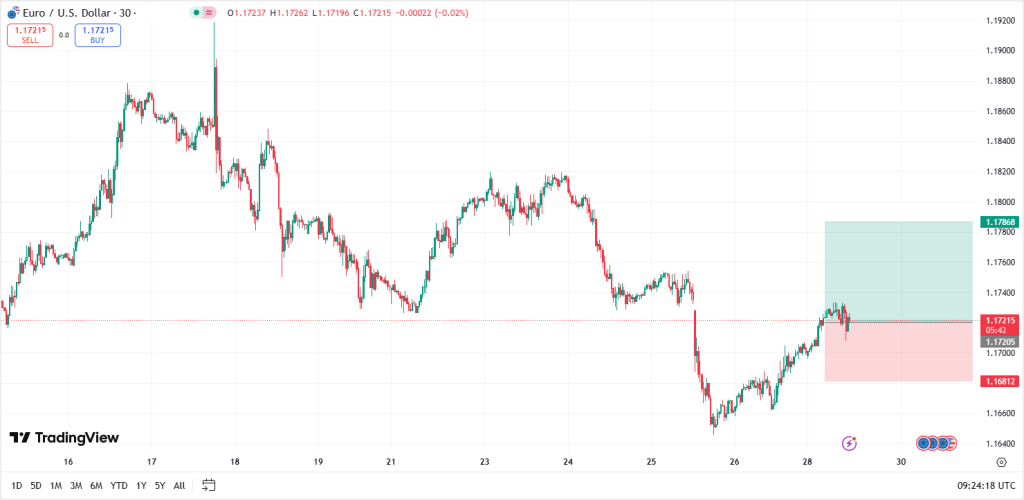
EUR/USD outlook: Dollar softness supports Euro, but resistance holds firm

The euro opens the week with mild upward pressure against the U.S. dollar, trading near 1.1710–1.1725. While recent softness in the dollar has supported EUR/USD, macroeconomic uncertainty and cautious sentiment around Federal Reserve policy continue to shape price action. Traders are watching for clarity on rate cut expectations and upcoming U.S. data releases, which could influence dollar flows and risk appetite.

Macro drivers behind the EUR/USD movement

The strength of the euro is partly driven by speculation that the Federal Reserve may pivot toward easing, amid mixed signals from the U.S. labor market and inflation data. Meanwhile, European confidence indices remain subdued, adding a layer of caution to bullish euro bets. With central banks diverging in tone, EUR/USD remains sensitive to macro headlines and yield differentials.

Technical analysis: Resistance at 1.1740 in focus

eurusd-eur-usd-euro

EUR/USD is testing resistance near 1.1740, where sellers have consistently capped upside attempts. A clean breakout above this level could confirm renewed bullish momentum, targeting 1.1780–1.1820. On the flip side, failure to hold above 1.1600 may signal deeper correction toward 1.1550 or even 1.1460.

  • Bullish setup: Look for long entries on breakout above 1.1740 or dips around 1.1600–1.1650 if support holds.
  • Bearish setup: Look for short positions if price rejects 1.1740 or breaks below 1.1600.
  • Range play: Tactical trades within 1.1600–1.1740 until breakout confirms direction.
  • Resistance: 1.1740, 1.1780 and 1.1820
  • Support: 1.1600, 1.1550 and 1.1460–1.1500

Momentum watch: Macro signals and technical confirmation

With EUR/USD hovering near a key resistance zone, traders should monitor volume, candle strength, and macro headlines for confirmation. A decisive move above 1.1740 could shift sentiment bullish, while rejection may reinforce range-bound conditions or trigger downside pressure.

Click here to open account and start trading.

Dividend Adjustment Notice – October 01 ,2025

Dear Client,

Please note that the dividends of the following products will be adjusted accordingly. Index dividends will be executed separately through a balance statement directly to your trading account, and the comment will be in the following format “Div & Product Name & Net Volume”.

Please refer to the table below for more details:

Dividend Adjustment Notice

The above data is for reference only, please refer to the MT4/MT5 software for specific data.

If you’d like more information, please don’t hesitate to contact info@vtmarkets.com.

How to Trade or Invest in Artificial Intelligence (AI) Stocks?

Artificial intelligence is no longer a futuristic concept. It is actively reshaping industries, markets, and the investment landscape. As AI technologies like generative models, machine learning, and autonomous systems gain traction, more investors are searching for how to invest in artificial intelligence (AI). In this article, we explore how to invest in AI stocks, the opportunities, risks, strategies, and steps to get started.

Key Takeaways:

  • AI stocks are shares of companies that develop or heavily use artificial intelligence, such as Nvidia, Palantir, Microsoft, and Alphabet.
  • Learning how to trade or invest in AI stocks involves understanding the industry, building a trading plan, choosing a broker, and applying risk management.
  • Investors can trade AI exposure through individual stocks, ETFs, or indices, depending on their risk profile and strategy.
  • Common strategies include fundamental analysis, technical analysis, momentum trading, and news trading, each offering different ways to approach AI stocks.
  • The tremendous growth of the AI sector brings both opportunities and risks, including high valuations, intense competition, regulatory challenges, and volatility.

What Are Artificial Intelligence (AI) Stocks?

AI stocks are shares of companies that are either directly building artificial intelligence technologies or making AI a core part of their business model. These can include firms that design AI software, provide cloud-based AI services, manufacture specialized chips and hardware needed for AI training, or companies in traditional industries like automotive and healthcare that are integrating AI to stay competitive. In short, AI stocks give investors exposure to businesses driving and benefiting from the rapid adoption of artificial intelligence.

Example: Nvidia is one of the most prominent AI stocks because its graphics processing units (GPUs) power the majority of AI applications worldwide. In fiscal 2024, Nvidia’s revenue surged 126 percent year over year to more than USD 60 billion, driven mainly by soaring demand for AI data center chips.

Discover what artificial intelligence trading is and how it works.

Why Choose AI Stocks to Trade or Invest?

AI is one of the most powerful investment themes of this decade, with an impact that stretches far beyond the technology sector. Choosing AI stocks gives investors a chance to take part in a growth story that is reshaping economies worldwide and transforming various sectors such as automation, robotics, virtual reality, and digital platforms. Below are the key reasons why AI stocks are an attractive choice for trading and investing.

Strong Growth Tailwinds

The global AI market was valued at about USD 279 billion in 2024 and is projected to grow at an annual rate of over 30 percent through 2033. Forecasts suggest the industry could expand to USD 2.4 trillion by 2032, and potentially USD 4.8 trillion by 2033, making it one of the fastest-growing sectors worldwide.

Innovation and Competitive Moats

AI companies often benefit from strong competitive advantages such as proprietary data sets, exclusive platforms, and high switching costs. Nvidia’s CUDA ecosystem is a clear example, as once developers build on it, moving away becomes difficult.

Diversification and Thematic Exposure

AI adoption extends well beyond technology firms. Healthcare providers use AI for diagnostics, financial institutions deploy it for fraud detection, and automakers integrate it into autonomous driving systems. This widespread adoption gives investors diversified exposure across the global economy when they choose AI stocks.

How to Trade or Invest in AI Stocks

With VT Markets, you can trade the AI shares through Contracts for Difference (CFDs), which let you speculate on price movements without holding the underlying stock. Below is a clear step-by-step guide on how to trade or invest in AI stocks.

Step 1: Understand How the AI Industry Works

Before trading, familiarise yourself with the AI ecosystem. This includes companies that design chips (such as Nvidia), build AI software platforms (such as Palantir), or integrate AI into broader services (such as Microsoft or Alphabet). Knowing how each business earns revenue and where it fits into the AI value chain will help you identify the most promising stocks.

Step 2: Develop a Trading Plan

Define your goals and strategy. Decide if you want short-term trades to capture volatility or longer-term positions to ride the growth trend. Your trading plan should define entry and exit rules, set your risk tolerance, and specify how much capital you are willing to commit to AI stocks.

Step 3: Choose a Reliable Broker

Select a regulated broker like VT Markets that provides access to global markets and offers AI-related instruments. VT Markets allows you to trade AI companies via CFDs, giving you the ability to go long (buy) or short (sell) depending on your outlook.

Step 4: Open and Fund Your Trading Account

Set up a trading account, complete verification, and deposit funds. Always start with an amount you are comfortable risking, as AI stocks can be highly volatile.

Step 5: Decide How You Want to Trade

Choose whether to focus on individual AI stocks, diversified ETFs, or indices with heavy AI exposure. This helps align your trading with your risk profile.

  • Stocks: Trade single companies like Nvidia or Palantir. High potential returns, but also higher volatility.
  • ETFs: Invest in a basket of AI-related companies. Lower risk than single stocks, with built-in diversification. Thematic ETFs offer convenient exposure to AI trends and emerging technologies without requiring you to pick individual stocks.
  • Indices: Trade broad markets such as the Nasdaq 100 or S&P 500. Offers exposure to many AI-driven firms with less volatility.

Step 6: Decide to Go Long or Short

After deciding whether to trade individual stocks, ETFs, or indices, the next step is to choose your market direction. If you believe the price of an AI stock will rise, you can go long. If you expect a decline, you can go short. For example, many investors went long Nvidia during its 2023–2024 surge, while others shorted overvalued smaller AI firms during sharp pullbacks.

Step 7: Open Your First Trade

Once you have chosen the asset, direction, and trade size, it is time to place your order. Enter the details into your broker’s platform, including the amount you want to invest and any stop-loss or take-profit levels. With VT Markets, this process is straightforward. Select the AI stock or related instrument, confirm whether you are buying or selling, and execute the trade.

Step 8: Stay Informed and Updated

Follow earnings reports, new product launches, regulatory changes, and global AI market news. AI is a fast-moving industry, and staying updated will help you adjust your strategy and seize opportunities.

Discover the best AI stocks to buy in 2025

Strategies to Trade AI Stocks

There are several investing and trading strategies that can help you approach AI stocks more effectively. Each method suits different styles of traders and investors, from long-term holders to short-term speculators.

Fundamental Analysis

Fundamental analysis focuses on a company’s financial health, including revenue from AI segments, R&D spending, gross margins, and strategic partnerships. For example, Palantir generated over USD 1.5 billion from government contracts in 2024, highlighting strong demand in defense and public sectors. Fundamental analysis helps investors assess whether an AI stock is undervalued or overpriced in relation to its long-term growth potential.

Technical Analysis

Technical analysis looks at price charts and indicators to spot trading opportunities. Traders often apply moving averages, RSI, and volume patterns when using technical analysis on volatile AI stocks. For instance, Nvidia’s share price moved more than 30 percent in just a few months during 2023–2024, creating opportunities for short-term trades.

Explore the key differences between fundamental analysis and technical analysis.

Thematic Diversification

Thematic diversification means spreading exposure across different parts of the AI ecosystem. Investors can apply thematic diversification by balancing AI chipmakers such as Nvidia and AMD, AI software providers like Palantir and C3.ai, and big tech integrators including Microsoft and Alphabet. This reduces reliance on any single company while keeping full exposure to AI growth.

Momentum Trading

Momentum trading relies on the idea that stocks showing strong upward or downward trends are likely to continue in the same direction for a period of time. Momentum trading in AI stocks is common after earnings reports or new product announcements, when prices surge with high volume. For example, Nvidia’s earnings momentum in 2023–2024 drove massive gains as traders followed the trend rather than fighting it.

News Trading

News trading is based on taking advantage of sharp moves that follow headlines such as earnings results, product launches, regulatory changes, or major investments. With news trading, the goal is to capture short-term trading opportunities by entering quickly after the news is released and exiting once the market stabilises. This approach can be profitable but also risky since prices may reverse just as fast.

Risks and Challenges in Trading or Investing in AI Stocks

AI stocks can offer strong opportunities, but they also carry significant risks. The industry is fast-moving and often volatile, so understanding these challenges is crucial before diving into this market.

  • Valuation Risk: Many AI stocks trade at premium valuations. If growth expectations slow, sharp corrections may occur. For example, C3.ai lost over 60 percent from its peak despite the AI hype.
  • Competition: The AI sector is fiercely competitive, with both startups and established players racing to secure market share.
  • Regulation and Ethics: Global regulation is tightening. The EU AI Act introduced in 2024 aims to govern the ethical use of AI, which could increase compliance costs for companies.
  • Volatility: AI stocks are highly sensitive to earnings reports and market sentiment. Nvidia’s market capitalization swung by over USD 400 billion between 2023 and 2024.

Conclusion

Artificial intelligence is shaping the future of global markets. Learning how to trade or invest in AI stocks gives investors a chance to participate in this transformation. The sector offers strong growth potential but also carries risks, which makes preparation and risk management essential. With VT Markets, you can access this opportunity by trading AI stocks through CFDs, allowing you to benefit from both rising and falling markets without directly owning the shares.

Start Trading AI Stocks Today with VT Markets

If you are ready to explore the opportunities in AI stocks, VT Markets offers the tools and support to get started. MetaTrader 4 (MT4) and MetaTrader 5 (MT5) provide a strong foundation with advanced charting features, fast execution, and access to a wide range of global markets. For those interested in artificial intelligence trading or investing, these platforms can also be integrated with third-party tools, giving traders the flexibility to adapt strategies to market conditions.

If you are not ready for the live market, you can practise with a VT Markets demo account to test strategies risk-free before going live. At the same time, the VT Markets Help Centre provides step-by-step guidance on platforms, strategy setup, and risk management to support your learning journey.

Start trading AI stocks today with VT Markets and take part in the future of global markets with confidence.

Frequently Asked Questions (FAQs)

1. What are AI stocks?

AI stocks are shares of companies that develop artificial intelligence technologies or make AI a central part of their products and services, such as Nvidia, Palantir, Microsoft, and Alphabet.

2. How to trade AI stock?

You can trade AI stocks by following these steps:

  • Step 1: Understand how the AI industry works
  • Step 2: Develop a trading plan
  • Step 3: Choose a reliable broker
  • Step 4: Open and fund your trading account
  • Step 5: Decide how you want to trade (stocks, ETFs, or indices)
  • Step 6: Decide to go long or short
  • Step 7: Open your first trade
  • Step 8: Stay informed and updated

3. What are the top AI stocks in 2025?

Nvidia, Microsoft, Alphabet, Palantir, and Tesla are among the most actively traded AI stocks in 2025.

4. What is the safest way to start investing in AI?

Investing in diversified AI ETFs or large-cap companies is generally safer than buying speculative small-cap AI stocks.

5. Can I trade AI stocks with CFDs?

Yes. CFDs allow you to go long or short on AI stocks with leverage, but this involves higher risk than direct investing.

6. Why are AI stocks so volatile?

High investor expectations, rapid innovation, and changing regulation make AI stocks more volatile than many other sectors.

7. Are AI stocks suitable for beginners?

Yes, but beginners should approach carefully. Starting with diversified ETFs or demo accounts can help new traders gain exposure to AI without taking on too much single-stock risk.

8. What is the difference between trading and investing in AI stocks?

Trading AI stocks usually means taking short-term positions to benefit from price movements, while investing is about holding them for the long term to capture industry growth.

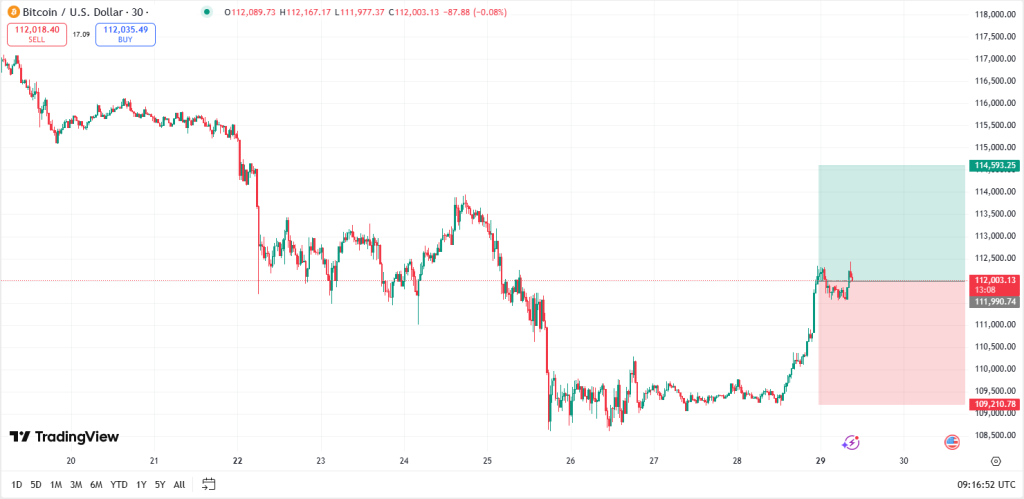
Bitcoin price analysis: $113,000 holds the key to the next move

Bitcoin (BTC/USD) opens the week near $110,000, with traders watching macroeconomic signals and crypto sentiment for directional cues. As global markets digest mixed data and central banks weigh policy shifts, the price action of Bitcoin reflects broader uncertainty as it is caught between bullish momentum and technical resistance.

Macro factors driving crypto sentiment

Speculation around Federal Reserve rate cuts, softening U.S. economic indicators, and cautious risk appetite continue to shape crypto flows. While traditional assets respond to Powell’s commentary and yield dynamics, Bitcoin remains sensitive to liquidity conditions and investor positioning. Overnight moves and macro flow will likely influence early-week momentum.

Technical setup: Breakout or breakdown?

btcusd-btc-usd-bitcoin

Bitcoin is testing resistance around $113,000, a level that has capped recent rallies. A confirmed breakout above this zone could accelerate gains toward $115,000–$117,000, with $120,000+ in sight under strong bullish flow. Conversely, failure to hold support around $108,000–$110,000 may trigger downside pressure toward $105,000 or even $100,000.

  • Bullish setup: Long entries on breakout above $113,000 or buy on dips around $108,000–$110,000 if support holds.
  • Bearish setup: Short if price rejects $113,000 or breaks below $108,000.
  • Range play: Tactical trades within $108,000–$113,000 until breakout confirms direction.
  • Resistance: $113,000, $115,000, $117,000 and $120,000
  • Support: $108,000, $105,000 and $100,000

Momentum watch: Macro flow and volume confirmation

With Bitcoin hovering near a key inflection point, traders should monitor volume signals and macro headlines for confirmation. A clean breakout with strong participation could shift sentiment decisively, while rejection may reinforce range-bound conditions.

Click here to open account and start trading.

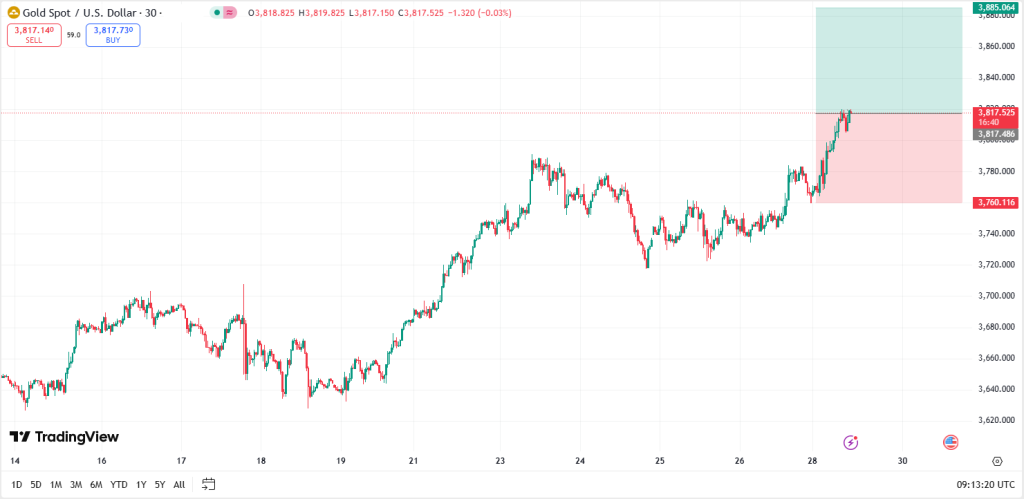
Price outlook for gold: Bullish breakout above $3,860 signals upside

Gold (XAU/USD) continues to attract bullish interest as macroeconomic uncertainty and dovish central bank expectations fuel demand for safe-haven assets. With U.S. economic data showing signs of softening and speculation mounting around a potential Federal Reserve rate cut, traders are closely watching Fed Chair Jerome Powell’s commentary for clues on monetary policy direction.

Macroeconomic backdrop supports bullish tone

Recent weakness in U.S. labor data and subdued inflation readings have reignited rate cut bets, pressuring yields and boosting the appeal of gold. Meanwhile, geopolitical tensions and cautious risk sentiment are adding to its safe-haven narrative. The performance of the U.S. dollar, particularly against the yen, shows a “Strong Buy” bias, maintaining a key cross-market influence.

Technical breakout points to further upside

xauusd-xau-usd-gold

Gold has broken above the consolidation zone around $3,750–$3,760, confirming a bullish continuation pattern. A decisive daily close above $3,820 would reinforce momentum and open the path toward $3,860 and potentially $3,900.

  • Bullish scenario: Long entries on dips to $3,750–$3,760 or breakout confirmation above $3,820, targeting $3,860 and $3,900.
  • Bearish scenario: Rejection at $3,820 or a close below $3,750 could trigger a pullback to $3,720, with deeper support at $3,660.
  • Range trading: Buy and sell between $3,750 and $3,820 with tight stops.
  • Support: $3,750–$3,760, followed by $3,720 and $3,660
  • Resistance: $3,820, followed by $3,860 and $3,900

From data to direction: What will drive XAU/USD next

With gold opening near $3,790–$3,810 and macro tailwinds in play, early-week momentum will be critical. Traders should monitor Powell’s remarks and yield movements for confirmation of continued buying interest.

Click here to open account and start trading.

Dividend Adjustment Notice – Sep 30 ,2025

Dear Client,

Please note that the dividends of the following products will be adjusted accordingly. Index dividends will be executed separately through a balance statement directly to your trading account, and the comment will be in the following format “Div & Product Name & Net Volume”.

Please refer to the table below for more details:

Dividend Adjustment Notice

The above data is for reference only, please refer to the MT4/MT5 software for specific data.

If you’d like more information, please don’t hesitate to contact info@vtmarkets.com.

Notification of Trading Adjustment – Sep 29 ,2025

Dear Client,

The trading hours of some MT4/MT5 products will change due to the upcoming Daylight-Saving Time change in Australia.

Please refer to the table below outlining the affected instruments:

Notification of Trading Adjustment

The above information is provided for reference only; please refer to the MT4/MT5 software for specific data.

If you’d like more information, please don’t hesitate to contact info@vtmarkets.com

Back To Top
server

Hello there 👋

How can I help you?

Chat with our team instantly

Live Chat

Start a live conversation through...

  • Telegram
    hold On hold
  • Coming Soon...

Hello there 👋

How can I help you?

telegram

Scan the QR code with your smartphone to start a chat with us, or click here.

Don’t have the Telegram App or Desktop installed? Use Web Telegram instead.

QR code