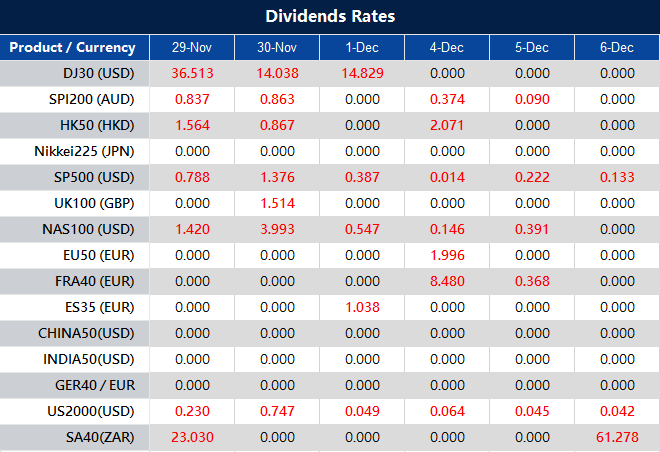
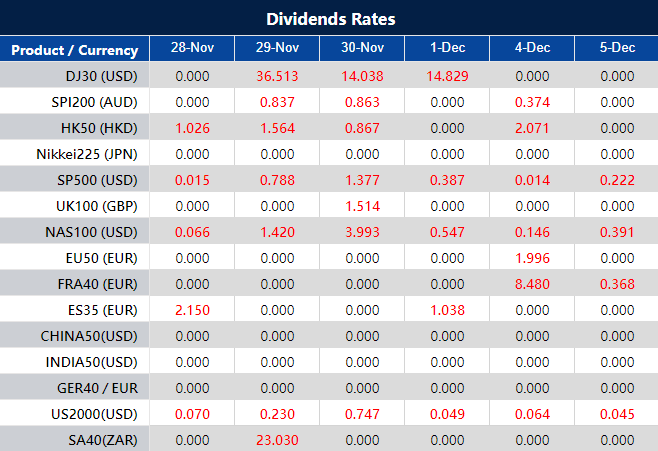
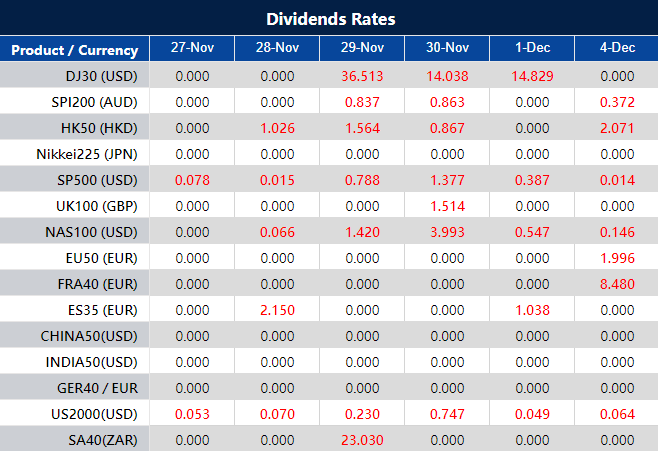
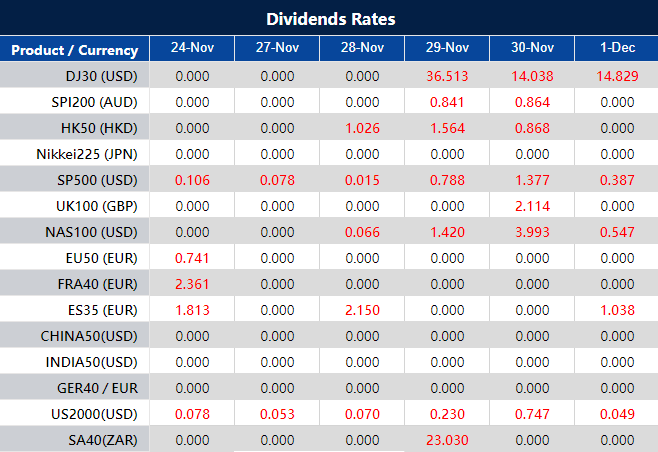
Please note that the dividends of the following products will be adjusted accordingly. Index dividends will be executed separately through a balance statement directly to your trading account, and the comment will be in the following format “Div & Product Name & Net Volume ”.
Please refer to the table below for more details:
The above data is for reference only, please refer to the MT4/MT5 software for specific data.
If you’d like more information, please don’t hesitate to contact info@vtmarkets.com.
Written on November 29, 2023 at 9:06 am, by anakin
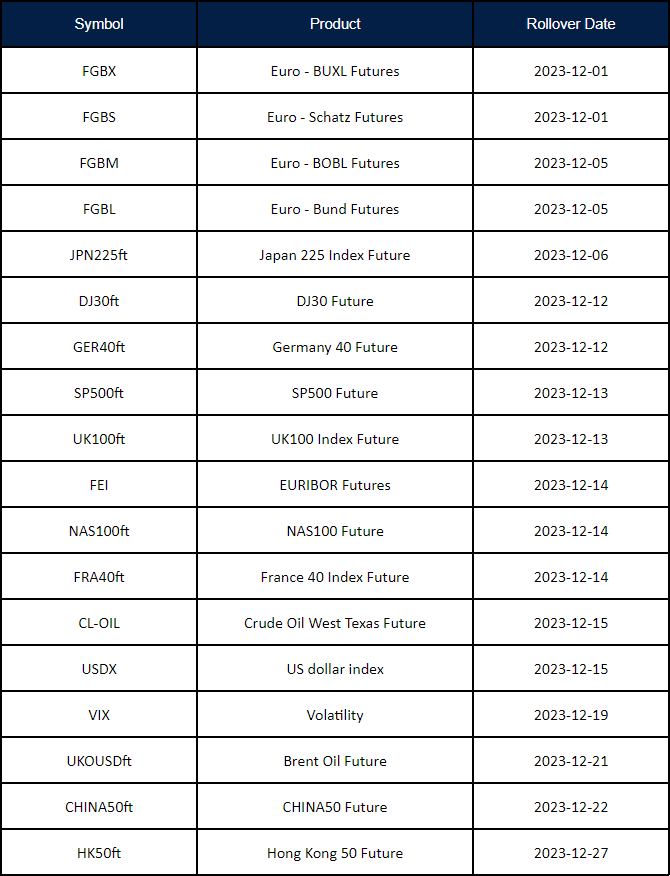
New contracts will automatically be rolled over as follows:
Please note:
• The rollover will be automatic, and any existing open positions will remain open.
• Positions that are open on the expiration date will be adjusted via a rollover charge or credit to reflect the price difference between the expiring and new contracts.
• To avoid CFD rollovers, clients can choose to close any open CFD positions prior to the expiration date.
• Please ensure that all take-profit and stop-loss settings are adjusted before the rollover occurs.
• All internal transfers for accounts under the same name will be prohibited during the first and last 30 minutes of the trading hours on the rollover dates.
If you’d like more information, please don’t hesitate to contact info@vtmarkets.com.
Written on November 29, 2023 at 9:02 am, by anakin
Amidst optimistic Federal Reserve comments signaling a possible pause in interest rate hikes, the stock market continued its climb, with the Dow Jones, S&P 500, and Nasdaq closing at record highs. Notable contributors included Boeing, Nike, and Walmart, while Newmont Corporation and Synchrony Financial surged in the S&P 500. Concurrently, currency markets responded to a more dovish Fed sentiment, leading to fluctuations in the dollar, euro, pound sterling, and USD/JPY. Speculations around potential rate cuts and pivotal economic data releases like U.S. GDP revisions and eurozone inflation figures maintain market focus as expectations lean towards a more accommodative stance from the Fed.
Stock Market Updates
On Tuesday, the stock market continued its upward trend from November, buoyed by optimistic remarks from a Federal Reserve official suggesting a possible halt in interest rate hikes. The Dow Jones Industrial Average closed at 35,416.98, up 0.24%, while the S&P 500 edged up by 0.10% to 4,554.89, and the Nasdaq Composite gained 0.29% to reach 14,281.76. Fed Governor Christopher Waller’s affirmation that current policy is well positioned to manage economic growth and inflation helped reassure markets ahead of the Federal Open Market Committee’s upcoming meeting.
Key contributors to the market’s rise included Boeing, lifting the Dow by 1.4%, alongside retailers like Nike and Walmart, which gained 0.7% and 1.2%, respectively. The S&P 500 saw boosts from Newmont Corporation and Synchrony Financial, surging by 6.3% and 5.1%. November showcased a robust rally, with the Dow and S&P 500 tracking towards gains of approximately 7.2% and 8.6%, while the Nasdaq surged by 11.1%. Meanwhile, U.S. Treasury yields experienced a decline, notably with the 10-year note slipping nearly 6 basis points to 4.33%.
Additionally, positive consumer confidence data released indicated an increase in November, with The Conference Board’s index rising to 102, surpassing both the downwardly revised October figure of 99.1 and the Dow Jones estimate of 101. Looking ahead, CrowdStrike was anticipated to report earnings after the market close, adding to the ongoing market dynamics and investor sentiment.
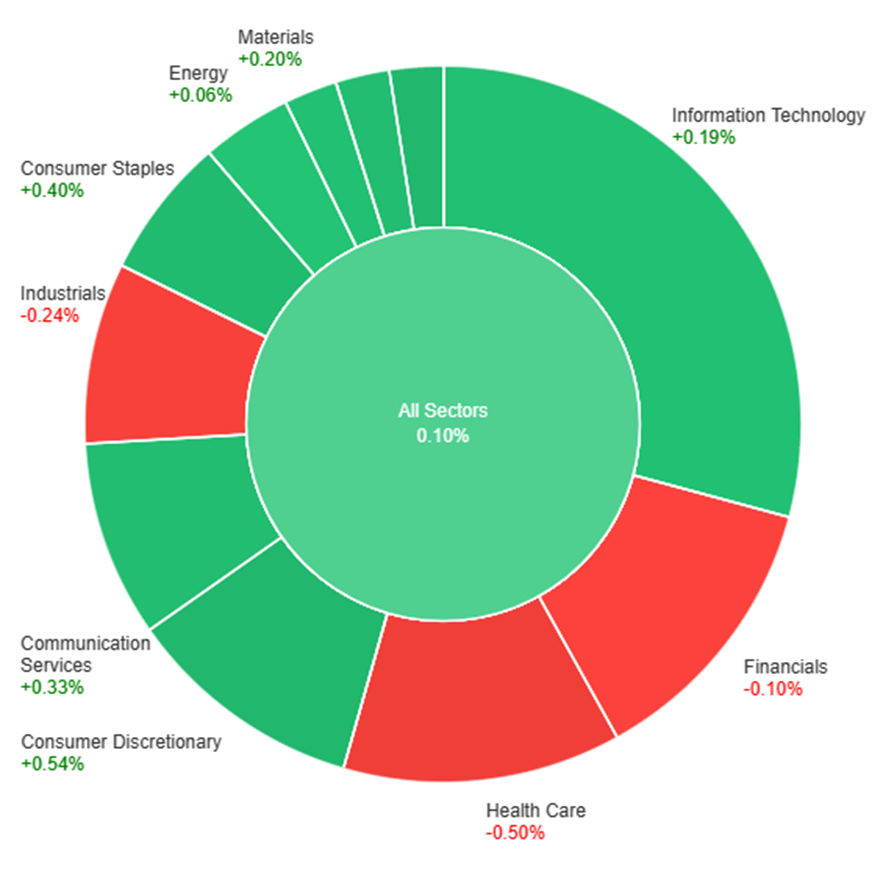
On Tuesday, the market showed a mixed performance across sectors. Consumer Discretionary and Real Estate sectors led the gains with increases of 0.54% and 0.52%, respectively, followed closely by Consumer Staples and Communication Services with gains around 0.40% to 0.33%. Utilities and Materials also saw modest upticks of 0.31% and 0.20%. Conversely, Financials and Industrials experienced declines of -0.10% and -0.24%, respectively, while Health Care faced the most significant downturn, dropping by 0.50%. Energy and Information Technology sectors had more moderate gains, with increases of 0.06% and 0.19% respectively.
Currency Market Updates
The recent movements in the currency market have been influenced by a shift in Fed sentiment towards a more dovish stance. The dollar index dipped by 0.3% as Treasury yields slid following comments from Fed speakers indicating a willingness to consider rate cuts if disinflation persists. This sentiment contrasts with the Fed’s prior messaging, prompting the futures market to anticipate a rate cut in May as twice as likely as a hold, with potential cuts of up to 100 basis points by December 2024. Consequently, the euro gained against the dollar, reaching levels above its 61.8% retracement for the year, driven by a rise in 2-year bund-Treasury yield spreads and risk-on flows due to lower U.S. and European yields.
In tandem with these developments, the pound sterling rose but halted before reaching its 61.8% Fibo of its July-October slide, with expectations that the Bank of England might delay rate cuts compared to the Fed, potentially reducing rates by 67 basis points in the coming year. Conversely, USD/JPY experienced a decline of 0.75%, continuing its reversal from 2023’s uptrend, driven by falling 2-year JGB yields and potential bearish signals if certain technical levels, like a close below the daily cloud base and last month’s low, are breached. The Bank of Japan faces pressure to reconsider negative rates and the efforts to cap JGB yields due to concerns about the weak yen’s impact on Japan’s economy and persistent low inflation.
Looking ahead, key events like German CPI, U.S. GDP revisions, and the beige book are expected to offer further insights. The market’s focus also centers around Thursday’s session with pivotal data releases including euro zone inflation figures and U.S. core PCE, income, consumption, savings rate data, jobless claims, and pending home sales. Forecasts lean towards a more dovish Fed stance and potentially weaker dollar amidst these upcoming releases.
Picks of the Day Analysis
EUR/USD (4 Hours)
EUR/USD Hovers Within Familiar Territory Amid Cautious Investor Sentiment
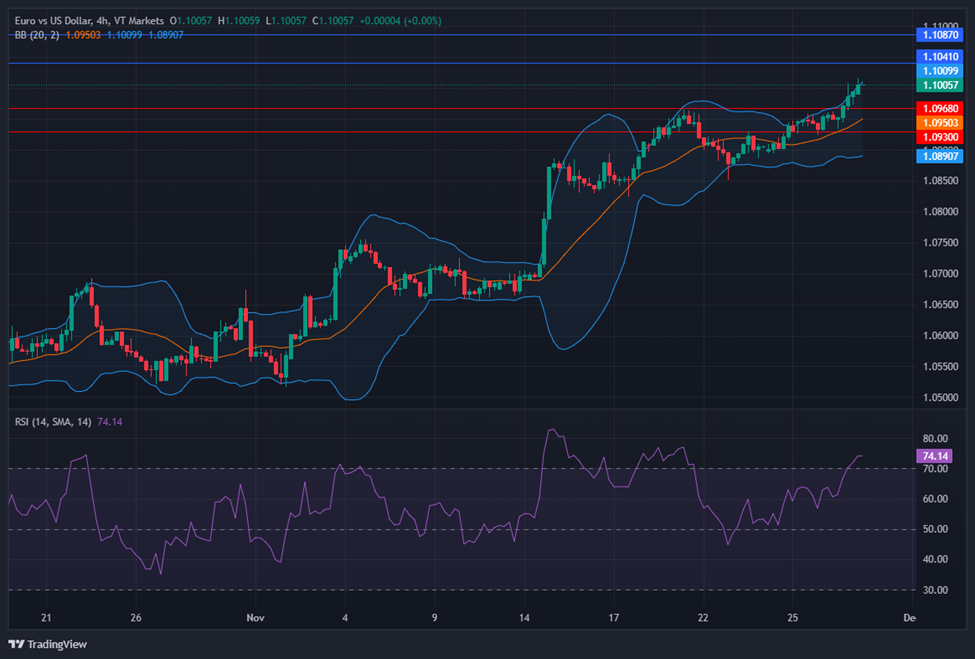
The EUR/USD pair remained steady within established ranges as investors exercised caution ahead of pivotal data releases and central bank speeches scheduled in the coming days. While reaching a high of 1.0962, the pair saw a dip to 1.0934 during European trading hours. The US Dollar’s declining appeal for the fourth consecutive day amid speculation around the Fed’s potential halt to rate hikes by May 2024 has lent support, but concerns about inflation updates in the US and Eurozone have curbed the EUR/USD rally. Key data releases, including Germany’s November HICP and the US October PCE Price Index, are anticipated, alongside speeches from Fed officials, heightening the market’s vigilance.
On Tuesday, the EUR/USD moved higher, attempting to reach the upper band of the Bollinger Bands. Currently, the price is hovering just around the upper band, showing potential for consolidation and a possible move toward the middle band. The Relative Strength Index (RSI) remains at 74, indicating a bullish stance for the currency pair.
Resistance: 1.1041, 1.1087
Support: 1.0968, 1.0930
XAU/USD (4 Hours)
XAU/USD Surge as Fed Signals Dovish Tone Amidst Inflation Debate
Gold prices soared, reaching $2,038.45 against the USD following a shift in sentiment from Federal Reserve officials. Governor Waller’s dovish remarks on the recent economic slowdown, suggesting an adequate monetary policy stance against inflation, set the tone. Chicago Fed President Goolsbee echoed progress on inflation, hinting at a potential substantial drop in rates. Meanwhile, Governor Bowman maintained a hawkish stance, leaving room for a rate hike if inflation stagnates. This shift toward dovish sentiments weakened the US Dollar, driving Treasury yields down—10-year government notes now offer 4.36%, while 2-year notes yield 4.80%, signaling market reactions to the Fed’s evolving stance.
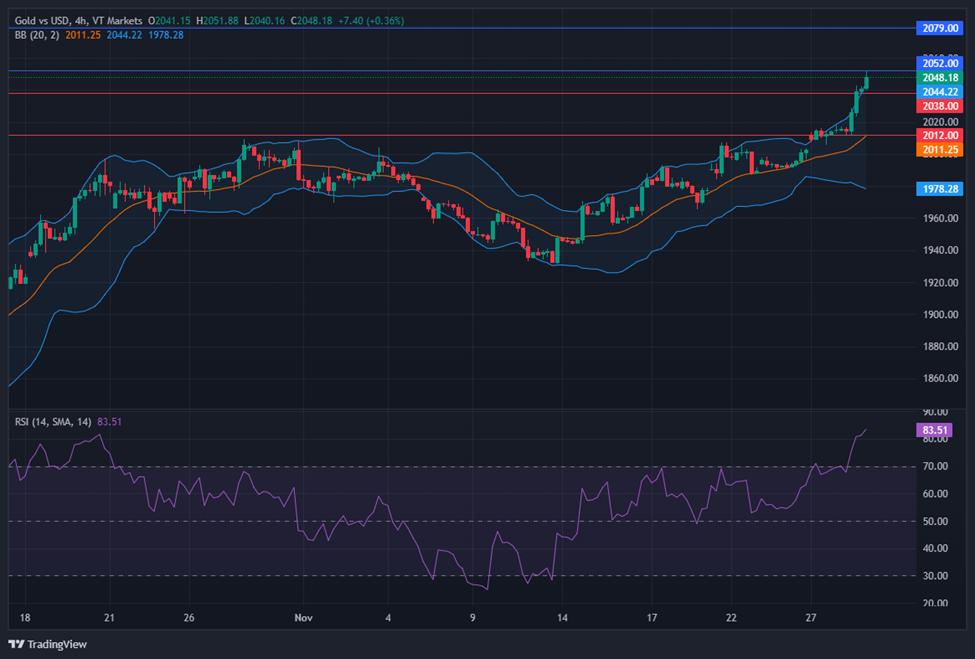
On Tuesday, the XAU/USD moved higher and managed to create a push to the upper band of the Bollinger Bands. Currently, the price is just below the upper band, indicating potential consolidation and a possible move downward toward the middle band. The Relative Strength Index (RSI) remains at 83, reflecting a bullish stance for the pair.
Resistance: $2,052, $2,079
Support: $2,038, $2,012
Economic Data
Currency
Data
Time (GMT + 8)
Forecast
AUD
CPI y/y
08:30
4.9% (Actual)
NZD
Official Cash Rate
09:00
5.50% (Actual)
NZD
RBNZ Rate Statement
09:00
NZD
RBNZ Press Conference
10:00
EUR
German Prelim CPI m/m
All Day
-0.1%
EUR
Spanish Flash CPI y/y
16:00
3.6%
USD
Prelim GDP q/q
21:30
5.0%
GBP
BOE Gov Bailey Speaks
23:05
Written on November 29, 2023 at 2:16 am, by anakin
Margin trading can be a double-edged sword, offering the potential for significant gains but also carrying substantial risks. In the realm of Forex trading, this dynamic becomes even more pronounced.
Traders, regardless of their experience level, must understand the intricacies of margin calls in this context. This article is dedicated to demystifying margin calls in the Forex market, clarifying a complex yet crucial part of trading.
Forex trading often involves using a high leverage, which means using borrowed money to increase potential profits. This makes margin trading a strong but risky approach. To use it effectively, traders need to be smart and careful. They should learn as much as they can and have a good plan for managing risks.
Basics of Margin Trading in Forex
Margin trading in the Forex market is a method where traders borrow funds from a broker to control larger positions in currency pairs than they could with just their own capital. This approach enhances their trading potential, allowing for significant market exposure.
When traders begin margin trading in Forex, they start by depositing an initial margin. This deposit acts as a base for their leveraged currency trades. It’s not just about starting out; traders must also maintain a minimum balance in their account, known as the maintenance margin. This is crucial in the Forex market, known for its volatility, to cover potential losses and keep positions open.
Leverage in Forex can significantly increase profit potential. However, it’s a double-edged sword – the same leverage that can amplify profits can also magnify losses, especially given the frequent, sometimes sharp, fluctuations in currency values.
What is a Margin Call?
In Forex trading, a margin call is a crucial event, occurring when a trader’s account equity drops below the broker’s required maintenance margin. This call for action requires the trader to add funds or securities to meet the margin level.
It’s typically triggered by a market value decrease of margin-purchased securities or currencies, reducing account equity. The maintenance margin, a broker’s safety measure, is a fixed percentage of the account’s total value. Falling below this due to market downturns triggers a margin call.
The process following a margin call typically unfolds in several key steps:
1. Notification of Margin Call: The first step is the trader receiving a notification from their broker. This usually happens through email, phone, or a direct message on the trading platform. The notification informs the trader of the deficit in their account and the amount needed to resolve the margin call.
2. Response Time: Traders are given a limited period to respond to a margin call. This timeframe varies depending on the broker’s policy but usually ranges from a few hours to a couple of days.
3. Depositing Additional Funds: To meet the margin call, traders can deposit additional cash into their margin account. This helps in bringing the account’s equity back up to the required maintenance margin.
4. Selling Securities or Currencies: If depositing additional funds is not feasible, traders have the option to sell some of their securities or currencies. The sale should be sufficient to cover the shortfall and restore the account to the required margin level.
5. Broker’s Forced Liquidation: If the trader is unable to meet the margin call within the stipulated timeframe, the broker may proceed to liquidate the trader’s positions. This is done to bring the account back in line with the maintenance requirements. The liquidation often occurs at current market prices, which may not be favorable.
6. Account Adjustment and Strategy Reassessment: After resolving the margin call, either through depositing funds or selling assets, the trader’s account is adjusted to reflect the new balance. Traders often need to reassess and modify their trading strategies post a margin call to prevent future occurrences.
The Mechanics of a Margin Call
Understanding the mechanics of a margin call is key in Forex trading.
Equity in a margin account is the value of your securities minus any borrowed funds. It varies with market values: if your securities’ value goes up, so does your equity; if it falls, your equity decreases.
The maintenance margin is the minimum equity percentage you must keep in your margin account, set by your broker. It’s a safety measure to ensure there’s enough equity to cover potential losses. If your equity falls below this level due to market declines, you’ll face a margin call.
To illustrate, consider a simple example:
A trader opens a margin account and purchases $10,000 worth of currency, using $5,000 of their own money and $5,000 borrowed from the broker. The initial equity in the account is $5,000 (the trader’s own funds).
The maintenance margin requirement set by the broker is 25%.
If the value of the currency falls to $6,000, the equity in the account would now be $1,000 ($6,000 market value minus the $5,000 borrowed).
However, 25% of the current market value ($6,000) is $1,500, which means the trader’s equity of $1,000 is now below the maintenance margin requirement.
This deficit triggers a margin call, requiring the trader to deposit additional funds or sell a portion of the securities to bring the equity back up to or above the maintenance margin level.
This example shows how market changes can lead to a margin call and underscores the importance of understanding and managing your margin account.
Responding to a Margin Call
When a trader in the Forex market receives a margin call, immediate and decisive action is required. This section outlines the crucial steps to take, the options available for meeting a margin call, and the potential consequences of failing to do so.
Immediate Actions
Upon receiving a margin call, a trader should first review their account to understand the shortfall. Quick assessment of the situation is vital to decide the next course of action. It’s important to act swiftly, as delays can lead to more severe financial implications.
Options for Meeting a Margin Call
Traders have several options to satisfy a margin call:
Adding Funds: The most straightforward approach is depositing additional cash into the margin account to cover the shortfall. This action immediately increases the account’s equity back to the required level.
Selling Assets: If adding funds isn’t feasible, traders can sell some of their assets, such as securities or currencies. The proceeds from the sale can then be used to restore the margin balance. This option, however, might involve selling assets at less-than-ideal market prices.
Consequences of Not Meeting a Margin Call
Failure to meet a margin call can have significant consequences:
Forced Liquidation: If a trader cannot satisfy the margin call, the broker may forcibly sell the trader’s securities or currencies. This liquidation is done at current market prices, which might result in substantial losses.
Account Closure: In severe cases, continued failure to meet margin requirements can lead to the closure of the margin account.
Credit Impact: Not addressing a margin call can also negatively impact the trader’s credit status with the broker and potentially affect their ability to trade on margin in the future.
In summary, effectively handling a margin call in Forex trading demands quick decisions, understanding of resolution options, and awareness of the consequences. Prompt action is key to financial stability and ongoing trading.
Best Practices for Margin Traders
In Forex margin trading, effectively managing risk is key. These are essential strategies for more secure trading:
Stop-Loss Orders: Implementing stop-loss orders is crucial to limit potential losses. These orders automatically close out trading positions once they reach a predetermined price level, helping to prevent larger losses.
Judicious Use of Leverage: Leverage can significantly amplify both gains and losses. It’s important to use leverage carefully, understanding its impact on your trading portfolio.
Clear Exit Strategy: Develop a predefined strategy for exiting trades. This helps in reducing impulsive decision-making driven by emotions.
Diversification: Diversify your investments across various currency pairs and other asset classes. This strategy helps in spreading and mitigating risk.
Continuous Monitoring: Regularly review your margin account to ensure it meets maintenance requirements. Additionally, stay informed about market news and events that could impact your trading positions.
By following these practices, traders can better navigate the complexities of Forex margin trading, balancing the potential risks and rewards. To develop your trading skills and test your strategies use VT Markets’ risk-free demo account.
In conclusion, margin calls are an integral aspect of margin trading, representing a significant risk factor that traders must be prepared to manage. While the potential for higher returns exists, the risks are equally amplified. Aspiring margin traders should continue educating themselves about these risks and seek advice from financial experts. Remember, informed trading is responsible trading.
Written on November 28, 2023 at 10:44 am, by anakin
Please note that the dividends of the following products will be adjusted accordingly. Index dividends will be executed separately through a balance statement directly to your trading account, and the comment will be in the following format “Div & Product Name & Net Volume ”.
Please refer to the table below for more details:
The above data is for reference only, please refer to the MT4/MT5 software for specific data.
If you’d like more information, please don’t hesitate to contact info@vtmarkets.com.
Written on November 28, 2023 at 7:04 am, by anakin
Stocks took a breather after a robust four-week surge as major indices, including the Dow Jones Industrial Average, S&P 500, and Nasdaq Composite, dipped slightly. Cyber Monday witnessed rises in e-commerce stocks like Amazon and Shopify while “buy now, pay later” options surged, propelling Affirm’s stock. However, concerns over weakening consumer spending raised Fed rate hike impact worries. The currency market saw the US Dollar Index dip, reflecting vulnerability amidst declining Treasury yields. Economic indicators, including new home sales, shaped concerns, while currency movements, especially the EUR/USD climb, GBP/USD trajectory, and AUD/USD surge, drew attention. Gold and silver rallied, breaching significant resistance levels.
Stock Market Updates
Stocks took a breather on Monday following a robust four-week surge across major averages. The Dow Jones Industrial Average dipped by 0.16%, closing at 35,333.47, while the S&P 500 shed 0.20% to settle at 4,550.43, and the Nasdaq Composite edged down 0.07% to 14,241.02. The recent bullish trend stemmed from a retreat in the 10-year Treasury yield from briefly surpassing the 5% mark in late October. Despite concerns over weakening consumer spending from some retailers, the market maintained momentum, evidenced by a significant month-to-date increase in the S&P 500 by 8.5%, the Dow by 6.9%, and the Nasdaq by 10.8%.
Amidst the market fluctuation, Cyber Monday saw notable rises in certain e-commerce stocks, with Amazon and Shopify marking increases of 0.7% and 4.9%, respectively. The surge in interest in “buy now, pay later” options on Cyber Monday saw Affirm’s stock soar by nearly 12%. However, weaker spending data is seen as a potential indication that the Federal Reserve’s rate hikes might be impacting the broader economy, raising questions about consumer confidence. Looking ahead, key reports like the consumer confidence report and the personal consumption expenditures price index are expected to provide further insights into the market’s trajectory. Additionally, recent data from the Commerce Department revealed a slower-than-expected pace of new home sales in October, although there was an improvement from the previous year.
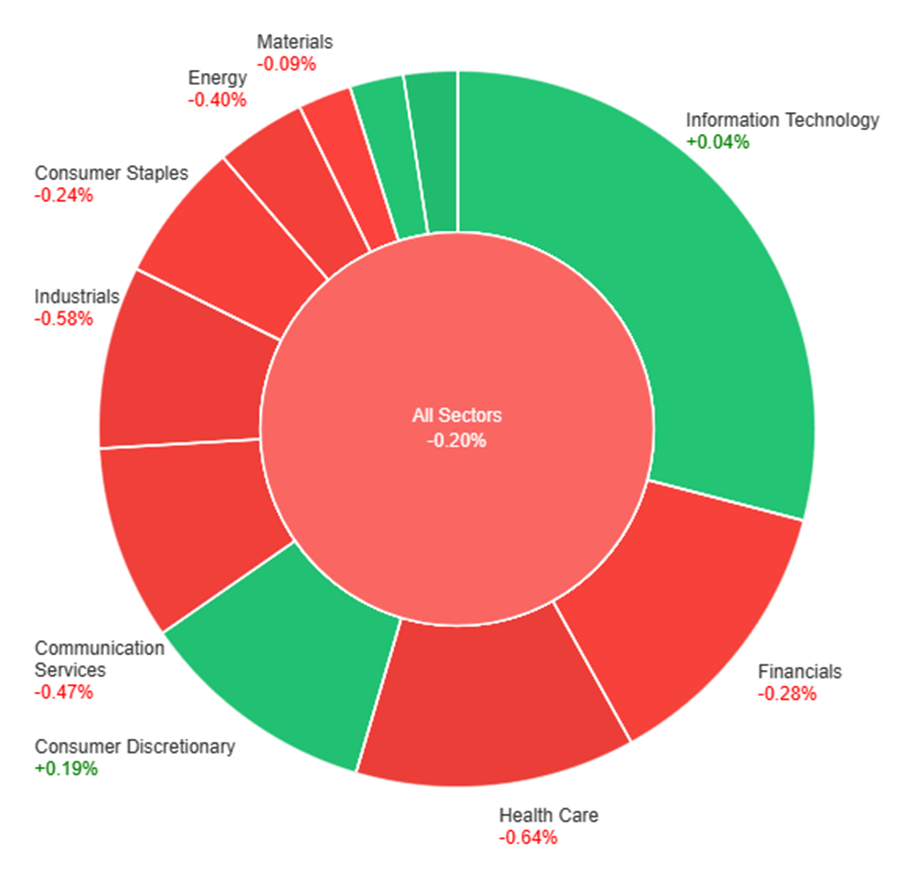
On Monday, the market saw a general decline with the overall sectors showing a negative trend of -0.20%. Real Estate and Consumer Discretionary sectors were the only ones to experience positive growth, gaining +0.38% and +0.19% respectively. Utilities and Information Technology followed with marginal increases of +0.09% and +0.04%. However, the majority of sectors faced losses, notably in Health Care (-0.64%), Industrials (-0.58%), Communication Services (-0.47%), and Energy (-0.40%). Financials and Consumer Staples also experienced declines at -0.28% and -0.24% respectively, while Materials showed a minor dip of -0.09%. Overall, it was a day marked by widespread negative performance across sectors, despite some minor gains in select areas.
Currency Market Updates
In the recent currency market updates, the US Dollar Index experienced a 0.20% dip, marking its lowest daily closure since late August, settling near 103.20. This downward trend persists, indicating the Greenback’s vulnerability, accentuated by declining Treasury yields—specifically, the 2-year fell to 4.89% and the 10-year decreased from 4.50% to 4.38%. The US New Home Sales declined unexpectedly by 5.6%, hitting 679K, below the anticipated 725K mark. This week’s US data focuses on housing metrics, consumer confidence, and manufacturing indices, culminating in the Core Personal Consumption Expenditure Index. Federal Reserve officials are slated to speak, with a blackout period commencing shortly.
Amidst this, the EUR/USD climbed to a three-month high, maintaining the potential for further growth while above 1.0950, eyeing a probable test of 1.1000. Attention in Europe hones in on upcoming inflation figures and the German GfK survey. Meanwhile, GBP/USD continued its upward trajectory, surpassing 1.2600, steering towards establishing a fresh equilibrium level. However, USD/JPY witnessed a decline, descending to around 148.50, impacted by diminished yields after a period of subdued trading.
Elsewhere, AUD/USD surged above 0.6600, marking its peak since early August and surpassing the 200-day Simple Moving Average (SMA). The Reserve Bank of Australia’s Governor Bullock is scheduled for a discussion on economic aspects, coinciding with the release of October Retail Sales data. USD/CAD stayed below the 55-day SMA, potentially aiming for the 1.3600 zone, with a downside bias ahead of the impending employment data.
Complementing these currency movements, gold and silver rallied significantly, breaching significant resistance levels—gold surged past $2,010, while silver recorded its highest daily closure above $24.50 in weeks.
Picks of the Day Analysis
EUR/USD (4 Hours)
EUR/USD Climbs to Three-Month High Amid Dollar Strain and ECB Caution
The EUR/USD marked a significant upswing, reaching its highest point in three months, propelled by a weakening US Dollar and a persistent bullish trend. With the Greenback facing continued pressure due to subdued Treasury yields, ECB President Christine Lagarde’s warnings about potential inflation upticks and tepid growth added to the Dollar’s woes. Despite disappointing US New Home Sales data and impending housing figures, the Dollar’s strain persisted, allowing the EUR/USD to soar. Nevertheless, market attention is poised to shift toward contrasting growth trajectories between the US and the Eurozone, posing a potential impact on the current bullish momentum.
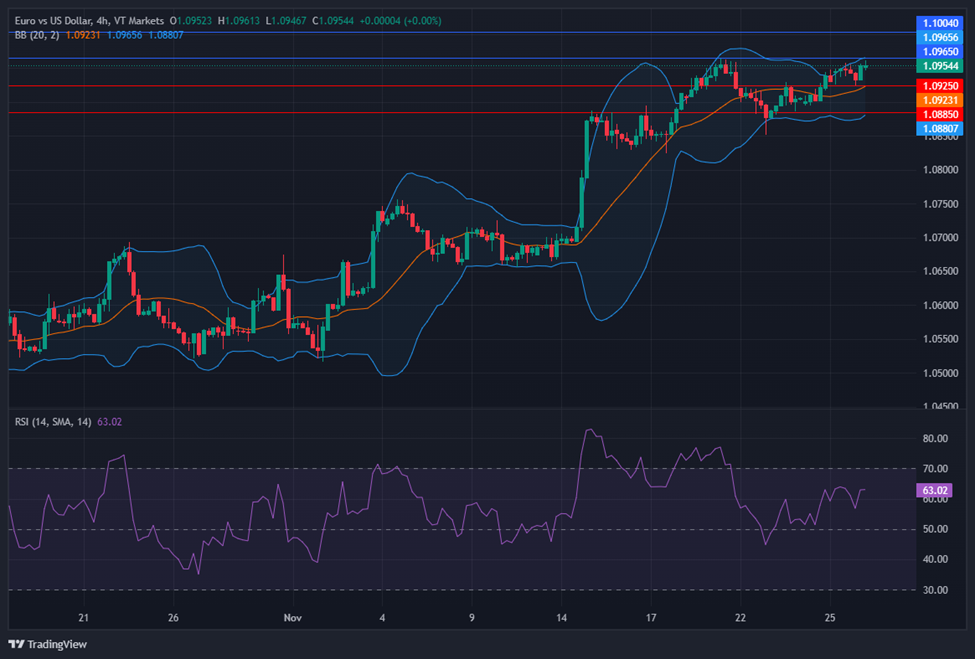
On Monday, the EUR/USD moved slightly higher, attempting to reach the upper band of the Bollinger Bands. Currently, the price is hovering just below the upper band, showing potential for consolidation and a possible move toward the middle band. The Relative Strength Index (RSI) remains at 63, indicating a neutral position for the currency pair.
Resistance: 1.0965, 1.1004
Support: 1.0925, 1.0885
XAU/USD (4 Hours)
XAU/USD Soars to $2,016 Amid Dollar Weakness: Fed Speculation and Market Mood Swings Drive Precious Metal’s Rally
Gold, represented by XAU/USD, surged to $2,016.38 an ounce propelled by broad US Dollar weakness in the initial half of the day, only to taper to $2,010 as Wall Street’s opening prompted a mild dollar rebound. The Greenback’s recovery stemmed from market sentiment shifts and waning near-term seller interest, fueled by speculation that the Federal Reserve has concluded its tightening cycle. Despite intraday stock market declines, the Dollar struggles to sustain a lasting recovery. In the absence of major economic events, the focus shifts to forthcoming inflation updates from Germany, the Eurozone, and the US, particularly the Fed’s favored inflation gauge, the October Personal Consumption Expenditures (PCE) – Price Index, anticipated next Thursday.
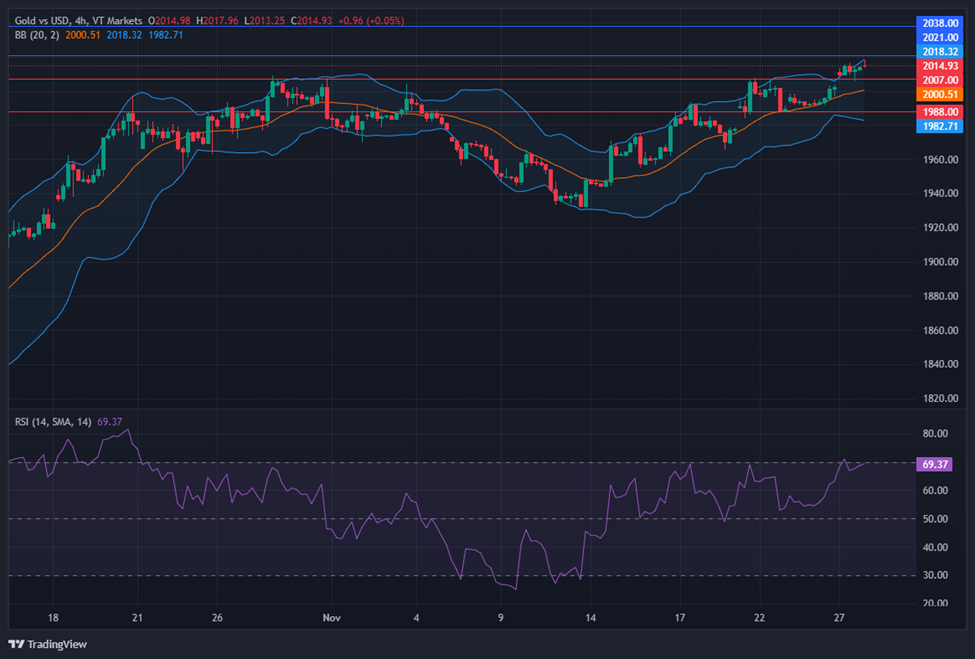
On Monday, the XAU/USD moved slightly higher and managed to reach the upper band of the Bollinger Bands. Currently, the price is just below the upper band, indicating potential consolidation and a possible move downward toward the middle band. The Relative Strength Index (RSI) remains at 69, reflecting a neutral position for the pair.
Resistance: $2,021, $2,038
Support: $2,007, $1,988
Economic Data
Currency
Data
Time (GMT + 8)
Forecast
USD
Consumer Confidence
23:00
101.0
Written on November 28, 2023 at 2:36 am, by anakin
Please note that the dividends of the following products will be adjusted accordingly. Index dividends will be executed separately through a balance statement directly to your trading account, and the comment will be in the following format “Div & Product Name & Net Volume ”.
Please refer to the table below for more details:
The above data is for reference only, please refer to the MT4/MT5 software for specific data.
If you’d like more information, please don’t hesitate to contact info@vtmarkets.com.
Written on November 27, 2023 at 7:13 am, by anakin
Several key factors are expected to impact the financial markets this week, including the Reserve Bank of New Zealand’s Rate Statement and the US Core Personal Consumption Expenditure (PCE) Price Index. Given the potential for significant market movements, we advise traders to exercise caution when undertaking any trading activity.
Australia’s Consumer Price Index (29 November 2023)
The monthly CPI in Australia increased by 5.6% in the 12 months leading up to September 2023, reaching its highest level in five months.
Analysts forecast a growth rate of 5.2% in the figures for October 2023, which are due to be released on 29 November.
Reserve Bank of New Zealand Rate Statement (29 November 2023)
During its October meeting, the Reserve Bank of New Zealand (RBNZ) held its official cash rate (OCR) steady at 5.5%, marking the third consecutive meeting without a change in the rate.
Analysts anticipate that the RBNZ will maintain its OCR at 5.5% following its upcoming meeting on 29 November.
Canada’s Gross Domestic Product (30 November 2023)
The Canadian economy experienced no change in August 2023, a downward revision from preliminary estimates of a 0.1% growth rate.
The September data for Canada’s GDP is set to be released on 30 November and is expected to reflect no change from August’s figures.
US Core PCE Price Index (30 November 2023)
The US core PCE prices, which exclude food and energy, rose by 0.3% in September 2023, the highest increase in four months.
The next set of data will be released on 30 November, with analysts expecting a growth of 0.2%.
Canada’s Employment Change (1 December 2023)
The Canadian economy added 17,500 jobs in October 2023, marking the third consecutive month of workforce expansion. Meanwhile, the unemployment rate increased to 5.7% in the same period, up from 5.5% in the previous month, reaching its highest level since January 2022.
The figures for November 2023 are scheduled to be released on 1 December, with analysts expecting the creation of 14,000 additional jobs and a rise in the unemployment rate to 5.8%.
Written on November 27, 2023 at 2:46 am, by anakin
Please note that the dividends of the following products will be adjusted accordingly. Index dividends will be executed separately through a balance statement directly to your trading account, and the comment will be in the following format “Div & Product Name & Net Volume ”.
Please refer to the table below for more details:
The above data is for reference only, please refer to the MT4/MT5 software for specific data.
If you’d like more information, please don’t hesitate to contact info@vtmarkets.com.
Written on November 24, 2023 at 7:17 am, by anakin
Whether it’s a beginner navigating the intricate world of trading or a seasoned investor seeking to expand their horizons, it’s second nature to investigate avenues to maximise profits. One popular tactic among those in the trading community is asset diversification. Diversification not only spreads risk but opens the door to maximum profit potential.
Diversifying a portfolio requires the experience and range of an esteemed broker. VT Markets is a global multi-asset CFD broker, specialising in the Forex market. Since 2015, the broker has supported traders of all levels by providing seamless access to multiple markets, from indices to energies and soft commodities.
This blog will outline various markets traders can participate in through the VT Markets platform and enter the dynamic realm of commodities trading.
Why diversification is the key to strategic trading
For many traders, diversifying their investment portfolio is a tried and true strategy. For others, it’s non-negotiable for risk management. Diverse investments act as a buffer, ensuring that potential losses in one asset class can be offset by gains in another. This approach not only reduces risk but also enhances the overall stability of a trader’s investment journey.
Diversification also allows traders to tap into various market opportunities, increasing the potential for significant profits in different economic scenarios.
Exploring commodities with VT Markets — energies, precious metals and soft commodities
From the stability of precious metals to the volatility of energy markets and the complexities of soft commodities, VT Markets offers traders a gateway to explore and invest in some of the most profitable and diverse commodities available.
Energies
With VT Markets, traders can delve into the world of energy commodities, including crude oil, gasoline and natural gas. Energy commodities are highly sought after for their stability and responsiveness to global economic trends, giving more apprehensive traders a sense of consistency.
Whether it’s an interest in WTI or Brent crude oil, VT Markets provides a platform where all traders can trade energies with confidence. Traders looking to invest in energy are encouraged to stay ahead of geopolitical events and various economic indicators to execute more strategic trades and maximise profits.
Precious metals
Precious metals like gold, silver and platinum have long been considered safe-haven assets. These commodities are not only valuable for their intrinsic worth but also act as a hedge against inflation and economic uncertainty.
VT Markets empowers traders to invest in precious metals, enabling traders to diversify their portfolios with assets that have stood the test of time. From there, traders can navigate the precious metals markets and leverage their stability to reinforce their investment strategy.
Soft commodities
From agricultural products like wheat, corn and soybeans to soft commodities like cotton and sugar, VT Markets offers a diverse array of trading options. Unlike other tradeable assets, soft commodities are influenced by weather conditions and global demand.
For traders, understanding the complexities of these markets is essential. Fortunately, VT Markets provides the tools and resources to help them make strategic decisions, ensuring that their investments in soft commodities are well-informed and profitable.
How to navigate global markets through the VT Markets platform
As traders explore the diverse world of commodity trading with VT Markets, it’s crucial to be aware of the different trading hours associated with each commodity. Markets operate on different schedules based on their geographical location and market demand. Being informed of these trading hours allows traders to optimise their trading strategy and ensures they can capitalise on market movements and emerging opportunities.
Traders can view trading hours for their selected markets by visiting the VT Markets Trade Conditions page.
VT Markets — the path to profitable diversification starts here
Diversification is one pathway to a well-rounded trading experience. Whether interested in forex, ETFs or soft commodities, the VT Markets platform provides the tools and expertise traders need to succeed. Consider VT Markets as the go-to platform for market trading and embrace the limitless possibilities.
Getting started with a VT Markets account is simple — create an account via the website, link a preferred payment method, select a market and begin trading.
About VT Markets
VT Markets is a regulated multi-asset broker with a presence in over 160 countries. The broker has won many international accolades, including Best Multi-Asset Broker and Fastest Growing Broker. Its mission is to make trading an easy, accessible and seamless experience for everyone.