FAANG Stocks: What are the FAANG Companies? 

Understanding FAANG Stocks: An Overview of the FAANG Companies

In this article, we will explore everything you need to know about FAANG stocks — Facebook (Meta), Amazon, Apple, Netflix, and Google (Alphabet). The FAANG companies have become some of the most influential and valuable in the world, driving change across industries like social media, e-commerce, and entertainment. 

What is FAANG?

FAANG is an acronym that represents a group of the most prominent and influential technology companies in the world: Facebook (Meta Platforms), Amazon, Apple, Netflix, and Google (Alphabet). These companies have reshaped various sectors, including social media, e-commerce, entertainment, and digital advertising, making them key players in the global economy. The term “FAANG” was coined to capture the dominance of these firms in the stock market, and they continue to be a popular choice among investors and market participants due to their consistent growth, innovation, and ability to adapt to changing market conditions.

A Quick Overview of All the FAANG Companies

Each of the FAANG companies has made significant contributions to their respective industries, and understanding their individual roles gives insight into their collective impact on the market:

1. Facebook (Meta Platforms)

Meta Platforms, formerly Facebook, is one of the world’s largest tech companies. It started as a social networking site in 2004 and has since expanded into virtual reality and digital advertising. As of 2025, Meta’s market capitalization is approximately $1.4 trillion, making it one of the most valuable companies globally. The company generates most of its revenue from digital advertising, and its advertising platform is one of the most lucrative in the world. Meta has over 2.8 billion active users across its platforms (Facebook, Instagram, WhatsApp, and Oculus), driving its dominant position in the social media and advertising markets.

2. Amazon

Founded in 1994 by Jeff Bezos, Amazon has grown from an online bookstore into the largest global e-commerce platform. It also leads in cloud computing with Amazon Web Services (AWS), which significantly contributes to its financial success. As of 2025, Amazon’s market capitalization stands at $2 trillion. Its financial success is driven by a mix of e-commerce, cloud services, and entertainment (Amazon Prime Video). AWS alone accounts for over 60% of Amazon’s operating income, despite representing a smaller portion of total revenue.

3. Apple

Apple is a global leader in consumer electronics, with products like the iPhone, iPad, and MacBooks. Founded in 1976, Apple has built a comprehensive ecosystem that connects its hardware, software, and services. As of 2025, Apple’s market cap is around $3.2 trillion, making it the most valuable company in the world. Apple has a robust financial position, with the iPhone being its most significant revenue generator. The company also earns a considerable portion of its revenue from services, including the App Store, Apple Music, iCloud, and Apple Pay.

4. Netflix

Netflix began as a DVD rental service in 1997 but quickly transformed the entertainment industry by pioneering streaming. With over 200 million subscribers globally, Netflix is the dominant force in streaming media. As of 2025, Netflix’s market capitalization is around $406 billion. Netflix’s financial model is based on subscription revenue, and the company has significantly invested in original content to maintain its competitive edge. Its major expenses are content production and licensing, but this investment has proven successful in driving subscriber growth and retention worldwide.

5. Google (Alphabet)

Google, now under the parent company Alphabet, was founded in 1998 and has since become the world’s most dominant search engine. It also generates significant revenue from digital advertising, cloud services, and various tech innovations. Alphabet’s market capitalization is around $2 trillion as of 2025. Google’s ad revenue dominates the digital advertising space, while its ventures like Google Cloud, YouTube, and self-driving cars (Waymo) contribute to its financial diversification. Google’s advertising revenue, primarily through Google Ads, remains its largest source of income.

Discover the top 10 largest stock exchanges in the world.

Why People Choose to Invest or Trade in FAANG Stocks?

There are several reasons why market participants and investors choose to invest or trade in FAANG stocks:

Strong Growth and Innovation: Each of the FAANG companies has a track record of rapid growth and innovation. They continue to push boundaries, creating new products and services that capture global attention.

Market Dominance: Together, the FAANG stocks represent some of the largest and most influential companies in the world. Their market capitalization often drives the performance of major stock indices like the S&P 500.

Financial Stability: FAANG companies have proven to be resilient in various market conditions. Even during periods of economic uncertainty, they tend to perform well due to their diversified revenue streams and strong business models.

Investor Sentiment: Many investors view FAANG stocks as a safe bet due to their consistent performance. Their ability to weather economic downturns and adapt to industry changes makes them a popular choice for long-term investment.

How to Trade the FAANG Stocks?

Trading FAANG stocks offers significant opportunities, but it requires a thoughtful approach to ensure success. Here’s a step-by-step guide to effectively trade FAANG stocks:

Step 1: Research and Understand the FAANG Companies

Start by researching the FAANG companies to understand their business models, financial health, and growth potential. Look at their earnings reports, recent news, and innovations to get a clearer picture of their market standing.

Step 2: Select a Reliable Trading Platform

Choose a reliable and regulated trading platform like VT Markets, which provides access to FAANG stocks, real-time data, and helpful tools for tracking market trends. Make sure the platform offers competitive spreads, secure transactions, and robust customer support.

Step 3: Open and Fund Your Trading Account

Once you’ve selected a platform, open your account and fund it based on your trading goals. Set a budget that aligns with your risk tolerance and investment strategy, and ensure you’re ready to start trading.

Step 4: Use Both Fundamental and Technical Analysis

To make informed decisions, combine fundamental analysis (e.g., company financials, market news) with technical analysis (e.g., chart patterns, price trends). This balanced approach helps you understand both the company’s value and the market’s movement.

Learn more about the difference between fundamental and technical analysis

Step 5: Open Your First Trade

Once you’ve analyzed the market, open your first trade by purchasing or selling FAANG stocks. Ensure the trade aligns with your strategy, whether you’re aiming for short-term gains or long-term growth.

Step 6: Implement Risk Management Strategies

Protect your investments by using risk management tools like stop-loss orders and position sizing. This helps mitigate potential losses and ensures you’re not exposing too much capital on a single trade.

Step 7: Monitor and Stay Informed with Market Trends

After opening your trade, stay informed by monitoring market trends, earnings announcements, and news related to the FAANG companies. This will allow you to adjust your strategy and take advantage of new opportunities.

Conclusion

In summary, FAANG stocks — Facebook (Meta), Amazon, Apple, Netflix, and Google (Alphabet) — represent some of the most influential companies in the world, shaping industries from social media to e-commerce and entertainment. Their ongoing growth, innovation, and market leadership make them highly attractive to traders and investors. Understanding the unique strengths and financial health of each company provides valuable insight into why these stocks remain key players in the global market. Whether you’re looking to trade or invest, FAANG stocks offer exciting opportunities for those ready to engage with the ever-evolving tech landscape.

Trade the FAANG Stocks with VT Markets

If you’re looking to trade FAANG stocks, VT Markets offers a powerful, user-friendly platform that integrates MetaTrader 4 and MetaTrader 5 for advanced trading. These platforms provide access to real-time market data, advanced charting tools, and comprehensive analysis features to help you make informed decisions. Whether you’re a beginner or an experienced trader, VT Markets also offers a demo account, allowing you to practice trading FAANG stocks and other global assets in a risk-free environment. With competitive spreads and a robust set of features, VT Markets is well-equipped to support traders at every level in their journey through the dynamic tech market.

Start trading today with VT Markets and take advantage of the opportunities in the fast-moving world of FAANG stocks.

Frequently Asked Questions (FAQs)

1. What is FAANG? 

FAANG stands for Facebook, Amazon, Apple, Netflix, and Google—five of the largest technology companies in the world. They are known for their strong market performance and influence across various sectors.

2. Why are FAANG stocks so popular? 

FAANG stocks are popular due to their strong growth, market dominance, financial stability, and consistent innovation. These companies are seen as reliable, long-term investments that offer substantial growth potential.

3. What factors influence the price of FAANG stocks?

The price of FAANG stocks is influenced by factors such as company earnings, market sentiment, economic conditions, innovation and product launches, regulatory changes, and competition in the tech sector.

4. How do FAANG stocks impact the overall stock market?

Due to their large market capitalizations and influence in the tech sector, FAANG stocks significantly impact major stock indices like the S&P 500 and NASDAQ. Their performance can drive market sentiment and influence investor confidence across the global market.

5. How do I start trading FAANG stocks? 

To start trading FAANG stocks, you need to choose a reliable trading platform like VT Markets, conduct thorough research on each company, select a trading strategy, and monitor your trades.

6. Can I trade FAANG stocks on MetaTrader 4 and MetaTrader 5?

Yes, FAANG stocks can be traded on both MetaTrader 4 and MetaTrader 5, as these platforms support a wide range of assets, including stocks, indices, and commodities.

7. Can I trade FAANG stocks on VT Markets? 

Yes, VT Markets provides access to a wide range of global assets, including FAANG stocks, offering traders tools to monitor, analyze, and trade efficiently.

8. What is MATANA stock?

MATANA refers to a group of high-performing tech stocks: 

  • Microsoft
  • Apple
  • Tesla
  • Amazon
  • Nvidia
  • Alphabet (Google)

9. What are the Magnificent Seven stocks?

The Magnificent Seven includes: 

  • Apple
  • Microsoft
  • Amazon
  • Nvidia
  • Alphabet (Google)
  • Meta (Facebook)
  • Tesla

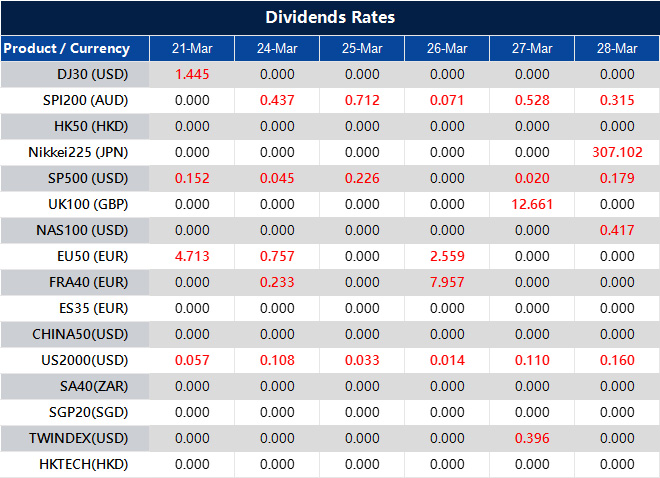
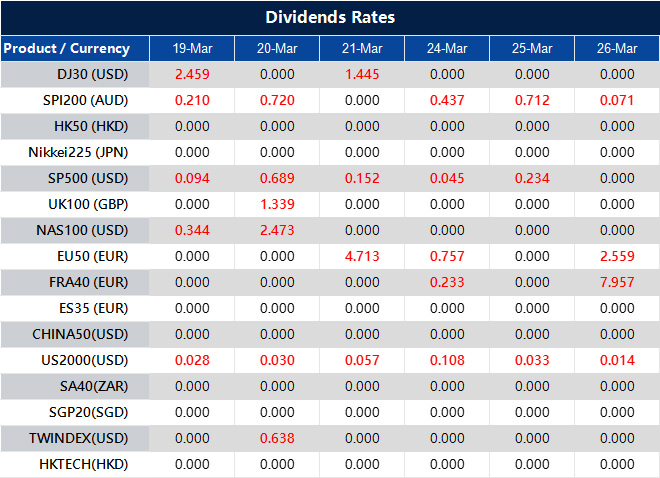
Dividend Adjustment Notice – Mar 21 ,2025

Dear Client,

Please note that the dividends of the following products will be adjusted accordingly. Index dividends will be executed separately through a balance statement directly to your trading account, and the comment will be in the following format “Div & Product Name & Net Volume”.

Please refer to the table below for more details:

Dividend Adjustment Notice

The above data is for reference only, please refer to the MT4/MT5 software for specific data.

If you’d like more information, please don’t hesitate to contact info@vtmarkets.com.

Forex market analysis: 21 March 2025

The offshore yuan is feeling the pressure as the US dollar keeps gaining strength, boosted by the Federal Reserve’s cautious approach to interest rates. While the yuan’s slide reflects broader global trends, the People’s Bank of China is treading carefully, adjusting its policies to prevent sharp fluctuations. With markets closely watching for any shifts in policy from both China and the US, all eyes are on what might drive the yuan’s next move.

Offshore yuan weakens to over a one-week low

The offshore yuan (USD/CNH) slipped past the 7.25 per dollar mark on Friday, hitting its weakest level in over a week, as the US dollar maintained its upward trajectory.

The dollar’s strength was driven by hawkish remarks from Federal Reserve Chair Jerome Powell, who indicated that the Fed is not in a hurry to lower interest rates, further supporting demand for the greenback.

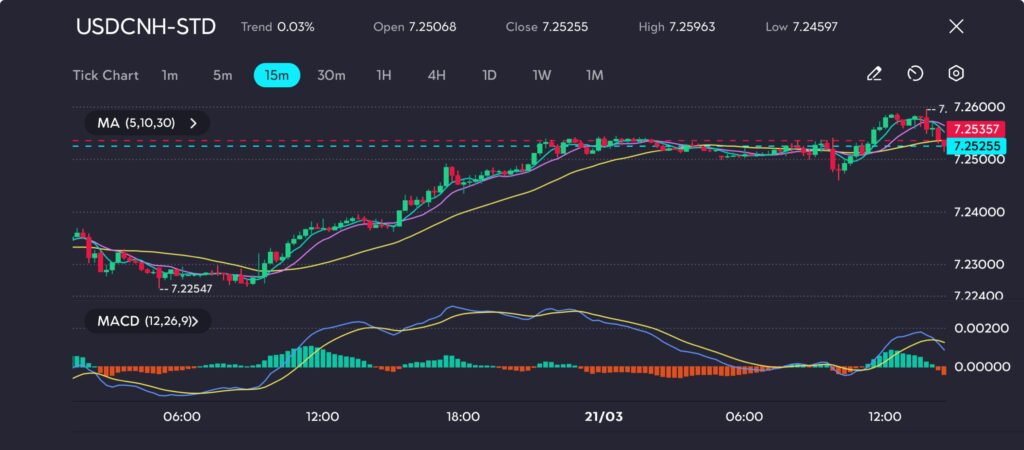
At the latest reading, the USD/CNH pair was trading at 7.25255, having touched a session high of 7.25963.

PBOC eases yuan support, holds interest rates steady

The People’s Bank of China (PBOC) has reduced its intervention to prop up the yuan, reflected in softer daily midpoint fixings, a move that hints at its intention to moderate sharp declines against the US dollar.

This has been interpreted by market participants as a signal of decreased currency market intervention.

Meanwhile, the PBOC maintained key lending rates unchanged for the fifth straight month in March 2025, aligning with market expectations.

The one-year loan prime rate remains at 3.1%, while the five-year rate holds at 3.6%. These rates remain at historically low levels following reductions in October and July 2024.

The central bank has also left the door open for potential future changes in lending rates or the reserve requirement ratio, depending on economic conditions.

Technical analysis overview

The offshore yuan (USD/CNH) advanced by 0.03% during the latest session, closing at 7.25255 after opening at 7.25068.

USDCNH tests resistance at 7.25357 after a steady rise from 7.22547, as seen on the VT Markets app.

The pair followed a gradual upward trend, hitting an intraday high of 7.25963 before slightly retracing and closing near its peak.

Key technical indicators point to bullish momentum. The moving averages (MA 5,10,30) show consistent upward movement, with shorter-term MAs staying above longer-term ones, reinforcing the positive trend.

The MACD (12,26,9) also indicates bullish sentiment, with the MACD line (blue) positioned above the signal line (yellow) and an expanding histogram supporting upward momentum.

Important levels to watch include immediate resistance at 7.25357 and key support at 7.24597.

A decisive move above resistance could open the door for further gains, while a drop below support might weaken the bullish outlook.

Market outlook and key drivers

Despite the US dollar’s continued strength—bolstered by robust economic data and tightening monetary policy expectations—the offshore yuan faces downward pressure.

However, efforts by Chinese policymakers to boost the domestic economy and stabilise the currency may provide a counterbalance.

Traders should closely monitor updates from the People’s Bank of China and any shifts in US-China relations that could influence currency movements.

Click here to open account and start trading.

What is the Relative Strength Index (RSI) and How to Use It?

Understand What is Relative Strength Index 

In this article, we’ll explore what the Relative Strength Index (RSI) is and how to use this powerful momentum oscillator to identify key market conditions like overbought and oversold levels. Whether you’re a seasoned trader or just starting out, understanding how to interpret RSI signals can help you refine your trading strategy and make more informed decisions.

What is the Relative Strength Index (RSI)?

The Relative Strength Index (RSI) is a widely used momentum oscillator in technical analysis that helps traders identify overbought or oversold conditions in a market. It measures the speed and change of price movements, helping traders determine whether a particular asset is potentially due for a reversal. Developed by J. Welles Wilder in 1978, the RSI indicator has become an essential tool for market participants looking to spot potential trend reversals or confirm the strength of existing trends.

Typically, RSI is displayed on a scale of 0 to 100, with values above 70 indicating overbought conditions and values below 30 signaling oversold conditions. Traders use this information to assess entry and exit points for trades, making the Relative Strength Index an invaluable asset in a trader’s toolkit.

The Formula and Calculation for RSI

The RSI indicator is calculated by comparing the average gains and average losses over a specified period, typically 14 periods (which could be 14 days, 14 hours, etc., depending on the chart’s time frame). The process involves the following steps:

  1. Calculate the average gain: This is done by adding up all the price increases over the 14 periods and dividing it by 14. If a period shows no gain, it is counted as zero.
  2. Calculate the average loss: This is done similarly by summing all the price losses over the 14 periods and dividing it by 14. If there’s no loss, that period is counted as zero.
  3. Calculate Relative Strength (RS): RS is simply the ratio of average gain to average loss (RS = Average Gain / Average Loss). This gives you a measure of whether the asset is gaining more than it is losing.
  4. Apply the formula: The RSI is then calculated with the formula:
    RSI = 100 – (100 / (1 + RS))

The resulting number is a value between 0 and 100, where:

  • An RSI above 70 typically indicates the asset is overbought.
  • An RSI below 30 indicates the asset is oversold.

This formula helps traders assess whether an asset is potentially overextended, either due to being overbought or oversold, and might signal a potential reversal in price direction.

How to Use the RSI?

The Relative Strength Index (RSI) is a versatile tool for traders. When used effectively, it can help identify potential market reversals, trend strength, and even divergences. Let’s break down how to use the RSI in different scenarios:

1. Overbought and Oversold Conditions

The RSI is widely known for its ability to signal overbought and oversold conditions, which are crucial for identifying potential market reversals.

  • Overbought: RSI above 70 indicates an overbought market, suggesting a potential pullback or price reversal.
  • Oversold: RSI below 30 signals an oversold market, indicating a potential upward rally.

Example: If a stock’s RSI is below 30 and begins to rise, it may signal a buying opportunity.

2. Divergence

Divergence occurs when the RSI is moving in the opposite direction of the asset’s price, often signaling that the current price trend may be losing momentum and a reversal could be imminent.

  • Bullish Divergence: When the price makes lower lows but RSI forms higher lows, it suggests weakening selling pressure, signaling a possible reversal upward.
  • Bearish Divergence: When the price makes higher highs but the RSI forms lower highs, it suggests weakening buying pressure, indicating a potential downward reversal.

Example: If the price continues rising but the RSI starts falling, it could be a signal to sell.

3. Trend Confirmation

The RSI indicator is also useful for confirming the strength of a prevailing trend. Traders often use RSI readings to assess whether a trend is likely to continue or if it’s running out of steam.

  • Neutral Range (40-60): RSI between 40 and 60 suggests a neutral trend, with no clear direction.
  • Uptrend: RSI above 50 indicates an uptrend.
  • Downtrend: RSI below 50 suggests a downtrend.

Example: If a stock is consistently staying above an RSI of 50 and regularly crosses into the 60+ range, it suggests that the trend is likely to continue upward. Conversely, an RSI reading consistently below 50 indicates a bearish trend, and traders may look for shorting opportunities.

New to trading? Learn how to start trading for beginners

How to Set and Adjust the RSI?

The default setting for the RSI indicator is 14 periods, but this can be adjusted depending on the trader’s trading strategy and the market conditions.

Short-term traders: If you’re trading on shorter timeframes (like hourly or 15-minute charts), you might want to use a shorter period, such as 7 or 9. This makes the RSI indicator more sensitive to recent price movements, helping you make quicker decisions based on fast changes in the market.

Discover what are short-term trading strategies.

Long-term traders: For longer timeframes (like daily or weekly charts), using a longer period (e.g., 21 or 30) can smooth out the RSI, making it less reactive to minor fluctuations. This helps you identify more significant trends and avoid being misled by short-term noise in the market.

Adjusting the RSI period changes its sensitivity. A shorter period makes the RSI more volatile and responsive to recent price changes, while a longer period smooths out the indicator, making it better suited for identifying broader trends and reducing false signals.

Advantages of RSI

The Relative Strength Index offers numerous advantages for traders:

Versatility: The RSI indicator is adaptable across various markets—whether stocks, forex, or commodities—allowing traders to use it consistently for evaluating whether an asset is overbought or oversold, regardless of the market type.

Easy to Interpret: The RSI is intuitive and simple, even for beginners. Its 0-100 scale makes it easy for traders to spot key levels (overbought at 70, oversold at 30) and adjust their strategies accordingly without the need for complex calculations.

Predictive Power: One of the RSI indicator’s strongest features is its ability to forecast potential market reversals. By identifying overbought or oversold conditions, traders can enter or exit trades at more optimal times, helping them take advantage of price swings before they happen.

Divergence and Confirmation: The RSI also provides insight into divergence—when price and RSI move in opposite directions—indicating that a trend might be losing momentum and a reversal could be imminent. This makes it a powerful tool for confirming entry or exit points when combined with other indicators.

Disadvantages of RSI

While the Relative Strength Index is a valuable tool, it does have some limitations:

False Signals: In trending markets, the RSI indicator can remain in overbought or oversold territory for extended periods without signaling a reversal. In such cases, traders might wrongly interpret the RSI as suggesting an imminent trend change, leading to false signals if used alone.

Lagging Indicator: Since RSI is based on historical price data, it is inherently a lagging indicator. This means it can be slow to react to real-time price movements, and there might be a delay before RSI shows an overbought or oversold condition. Traders should be cautious not to rely solely on RSI for predicting immediate price movements.

Overreliance: While useful, RSI shouldn’t be used in isolation. Relying only on RSI can lead to misinterpretations, as it doesn’t account for broader market conditions. Combining it with other indicators, like moving averages or price action analysis, can provide a more comprehensive trading strategy and reduce the risk of false signals.

Conclusion

The Relative Strength Index (RSI) is an essential tool in any trader’s toolbox. It provides valuable insight into market momentum and helps identify potential trend reversals or confirmations. Whether you’re new to trading or an experienced market participant, mastering the RSI indicator can improve your decision-making and overall trading strategy.

By understanding how to use RSI effectively, you can identify overbought and oversold conditions, spot divergences, and enhance your ability to navigate volatile markets.

Elevate Your Relative Strength Index Today with VT Markets

Ready to become an expert in the Relative Strength Index and apply your knowledge in real-time trading? At VT Markets, we offer a seamless platform with MetaTrader 4 and MetaTrader 5 that empowers traders of all levels to execute their strategies with ease. Leverage our advanced tools, including the RSI indicator, and practice with a demo account to enhance your trading experience. Expert in RSI today and take your trading skills to the next level with VT Markets.

Start trading today with VT Markets and unlock the full potential of your trading journey!

Frequently Asked Questions (FAQs)

1. What is the Relative Strength Index? 

The Relative Strength Index (RSI) is a momentum oscillator used in technical analysis to measure the speed and change of price movements, helping traders identify overbought and oversold conditions in the market.

2. How do I use the RSI indicator? 

Traders use the RSI to spot overbought or oversold conditions, identify divergences, and confirm trends. A reading above 70 signals overbought conditions, while below 30 signals oversold conditions.

3. Can I adjust the RSI settings? 

Yes, traders can adjust the RSI settings based on their strategy. The default period is 14, but you can modify it to suit shorter or longer time frames depending on the asset and trading style.

4. Is RSI useful in volatile markets? 

Yes, RSI can help identify potential reversals even in volatile markets. However, during strong trends, RSI might remain in overbought or oversold levels for longer periods, which could lead to false signals. It’s important to use it in combination with other indicators for confirmation.

5. What is the RSI divergence, and why is it important? 

RSI divergence occurs when the price of an asset and the RSI move in opposite directions. Bullish divergence (lower lows in price, higher lows in RSI) suggests a potential upward reversal, while bearish divergence (higher highs in price, lower highs in RSI) signals a possible downward trend.

6. How to Use the RSI for Trend Identification?

The RSI indicator can be used to confirm the strength of a trend. In an uptrend, an RSI reading above 50 suggests that buyers are in control, and the trend may continue. Conversely, in a downtrend, an RSI reading below 50 indicates that sellers dominate the market.

Disclaimer:

This article is for informational purposes only and should not be construed as financial or trading advice. Past performance is not indicative of future results. Trading involves significant risk, and you should carefully consider whether it is suitable for you based on your individual circumstances.

Forex market analysis: 20 March 2025

The US dollar is moving cautiously as traders react to the Federal Reserve’s latest signals on interest rates. While Powell’s comments reassured markets about future rate cuts, uncertainty around global trade and geopolitical tensions keeps investors on edge. With the dollar stuck in a tight range, analysts are watching key technical levels for clues on its next move.

US Dollar Index remains range-bound following Powell’s remarks

The US Dollar Index (USDX) traded sideways after Federal Reserve Chair Jerome Powell’s latest comments, showing limited reaction to the central bank’s decision to keep interest rates unchanged.

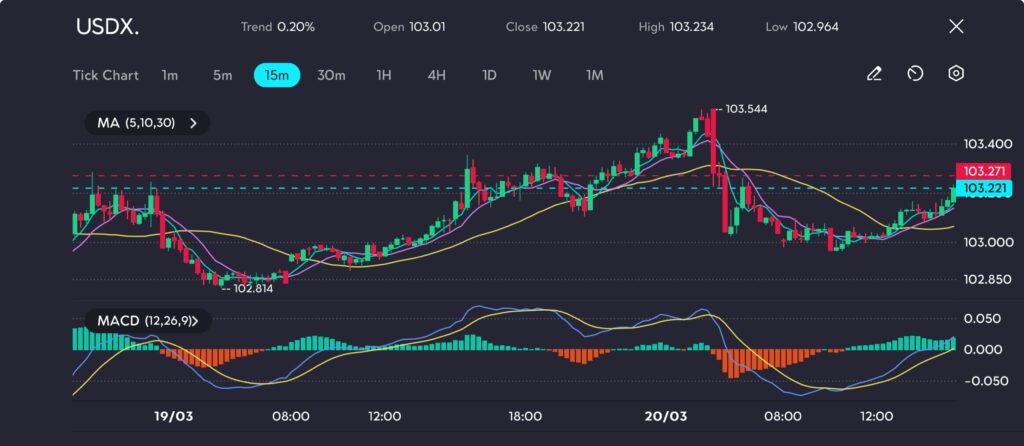
The index hovered around 103.22, reflecting the market’s cautious stance as investors awaited further economic signals.

Fed’s rate-cut outlook and market response

Powell reaffirmed the Federal Reserve’s plan for two rate cuts in 2025, helping to ease broader market concerns.

While this announcement fuelled a rally across the three major US stock indices, the dollar’s performance remained lacklustre.

Market sentiment appeared to favour the prospect of lower borrowing costs, but the USDX continued its consolidation, failing to break out of its tight trading range.

USDX technical analysis and key levels

The USDX recorded a 0.20% gain, closing at 103.221 after opening at 103.01. The session saw a notable uptick, reaching a high of 103.544 before retreating slightly.

SDX tests resistance at 103.271 after climbing from 102.814, as seen on the VT Markets app.

Technical indicators suggest a bullish bias, with short-term moving averages (MA 5,10,30) maintaining a position above longer-term averages, signalling sustained upward momentum.

The MACD (12,26,9) also indicates strong bullish pressure, with an expanding histogram and the MACD line trending above the signal line.

Key levels to monitor include 103.271 as immediate resistance and 102.814 as key support.

A breakout above resistance could drive further gains, while a decline below support might shift sentiment towards a more neutral or bearish outlook.

Market outlook: Uncertainty lingers

Despite Powell’s reaffirmation of future rate cuts, external factors such as global trade policies and geopolitical tensions continue to weigh on the greenback.

The USDX’s next significant move will likely depend on further clarity from the Federal Reserve and developments in global economic conditions, including ongoing geopolitical risks in the Middle East.

Traders should stay alert to upcoming economic data releases and Fed communications, which could provide fresh direction for the US dollar in the coming weeks.

Click here to open account and start trading.

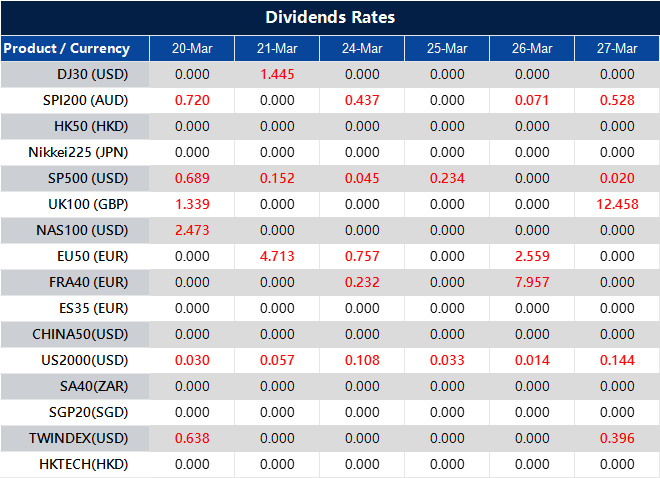
Dividend Adjustment Notice – Mar 20 ,2025

Dear Client,

Please note that the dividends of the following products will be adjusted accordingly. Index dividends will be executed separately through a balance statement directly to your trading account, and the comment will be in the following format “Div & Product Name & Net Volume”.

Please refer to the table below for more details:

Dividend Adjustment Notice

The above data is for reference only, please refer to the MT4/MT5 software for specific data.

If you’d like more information, please don’t hesitate to contact info@vtmarkets.com.

Forex market analysis: 19 March 2025

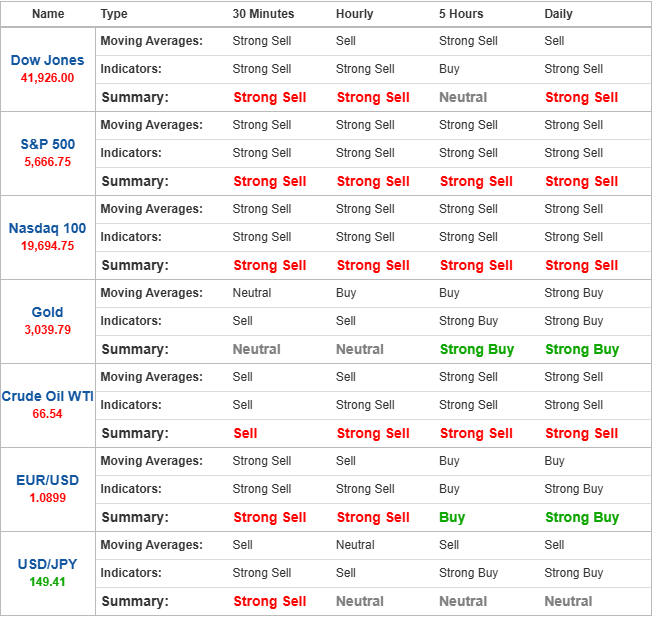
Midweek trading will be dominated by the highly anticipated Federal Reserve interest rate decision, setting the tone for global markets. Investors will also analyse economic data from China and the US, looking for further signs of economic momentum or slowdown. Expect heightened volatility across equities, bonds, and forex markets.

KEY INDICATORS

Federal Reserve interest rate decision & economic projections

  • The Fed will announce its policy decision, with markets closely watching for any changes in interest rates.
  • The FOMC economic projections (dot plot) will provide insights into the Fed’s future rate path.
  • Fed Chair Jerome Powell’s press conference will be key in shaping market sentiment.

China industrial production & retail sales (February)

  • Indicators of post-holiday economic activity and consumer demand.
  • A slowdown could trigger concerns about weaker global growth, affecting commodities and Asian markets.

US crude oil inventories

  • A key report for energy markets, influencing oil prices and inflation expectations.

MARKET MOVERS

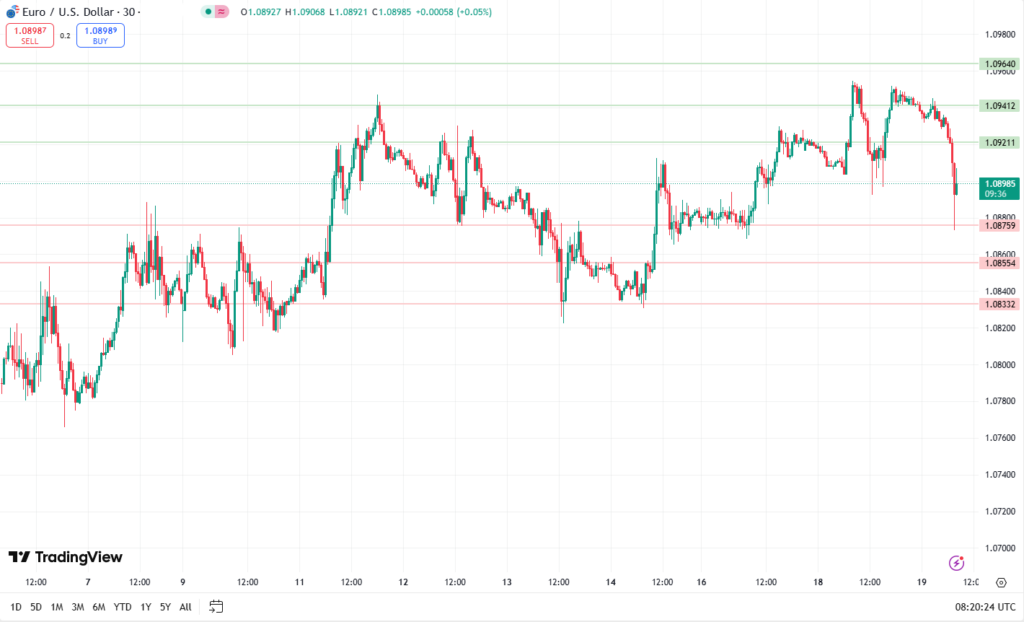
EUR/USD

Possible short preference

Short positions below 1.08759 with targets at 1.08554 and 1.08332 in extension.

Alternative scenario

Above 1.09211, look for further upside with 1.09412 and 1.09640 as targets.

The RSI calls for a new downleg.

Dollar weakens ahead of Fed meeting; euro gains ahead of German debt vote

  • The US dollar edged lower on Tuesday ahead of the start of the latest Federal Reserve meeting, while the euro gained ahead of an expected vote on Germany’s substantial stimulus plan.
  • At 9:00 AM GMT, the Dollar Index, which tracks the greenback against a basket of six other currencies, traded 0.1% lower at 102.890, remaining above last week’s five-month low.
  • In Europe, EUR/USD traded 0.3% higher at 1.0951, near its highest level since October, ahead of a scheduled parliamentary vote on Germany’s economic support package.
  • GBP/USD rose 0.1% to 1.3001, climbing above the 1.30 level for the first time since November.
  • The Bank of England is widely expected to keep interest rates unchanged on Thursday after inflation edged higher last month.
  • In Asia, USD/JPY climbed 0.3% to 149.70 ahead of the conclusion of the latest Bank of Japan meeting on Wednesday.

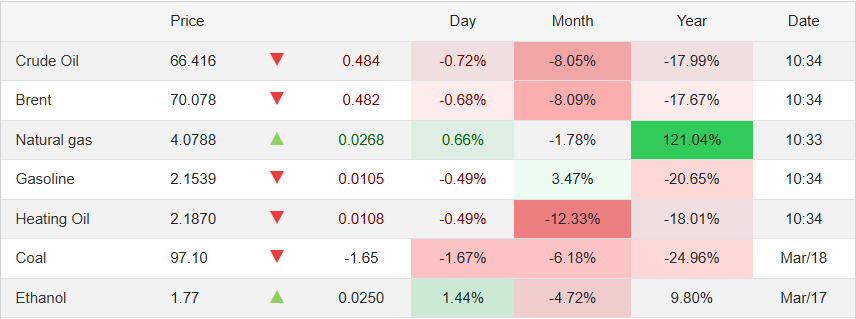
Oil slips after US-Russia agreement on 30-day energy ceasefire

Oil prices fell on Wednesday after Russia agreed to US President Donald Trump’s proposal that Moscow and Kyiv temporarily stop attacking each other’s energy infrastructure, which could lead to more Russian oil entering global markets.

  • Brent crude futures fell 23 cents, or 0.3%, to USD 70.33 a barrel by 07:30 GMT.
  • US West Texas Intermediate crude (WTI) was down 25 cents, or 0.4%, at USD 66.65.

Russian President Vladimir Putin agreed on Tuesday to stop attacking Ukrainian energy facilities but stopped short of endorsing a full 30-day ceasefire that Trump had hoped for.

US crude oil stocks data, meanwhile, painted a mixed picture, with crude stocks rising while fuel inventories fell.

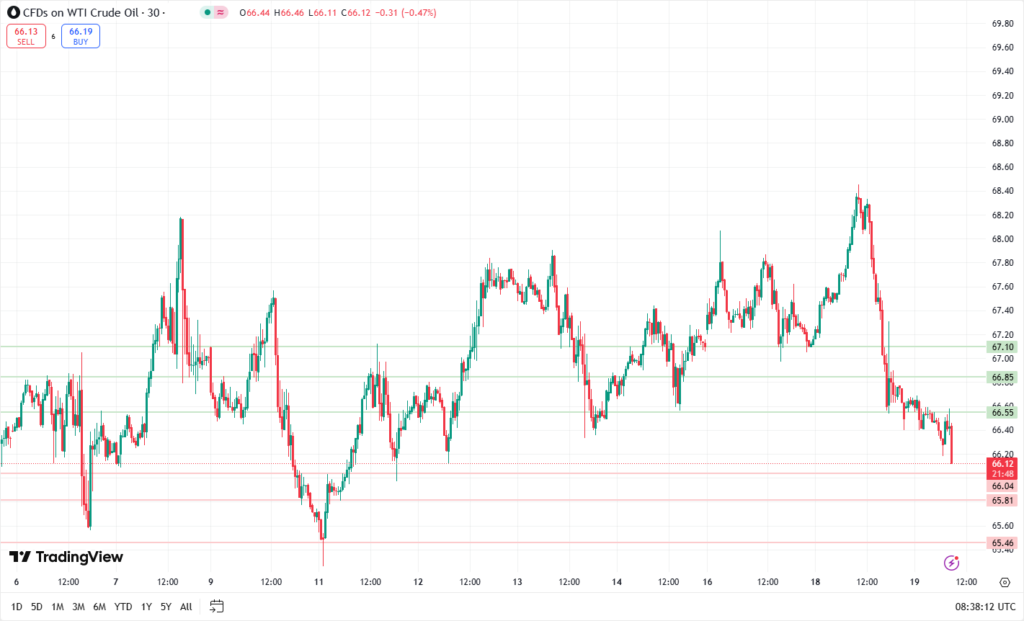
Crude Oil WTI

Possible short preference

Short positions below 66.04, with targets at 65.81 and 65.46 in extension.

Alternative scenario

Above 66.55, look for further upside with 66.85 and 67.10 as targets.

The RSI advocates for further downside.

TODAY’S NEWS HEADLINES

Gold prices hit record high as haven demand grows ahead of Fed rate decision

  • Gold prices rose slightly to a record high in Asian trade on Wednesday, as safe-haven demand remained underpinned by renewed geopolitical ructions in the Middle East and concerns over trade tariffs.
  • Investors also remained largely risk-averse before the conclusion of a Federal Reserve meeting later on Wednesday, which is expected to offer more insight into the US economy.
  • Spot gold rose 0.1% to a record high of USD 3,039.0 an ounce.
  • Gold futures expiring in May rose 0.1% to a peak of USD 3,046.12 an ounce.
  • The Fed is widely expected to keep interest rates unchanged at 4.5% after the conclusion of its meeting later on Wednesday, amid persistent uncertainty over the US economy under Trump.
  • Platinum futures fell 0.4% to USD 1,016.90 an ounce.
  • Silver futures fell 0.5% to USD 34.55 an ounce.

Europe stocks close higher as Germany passes landmark fiscal package; Trump and Putin hold call

  • European markets closed higher on Tuesday, with investor focus on Germany’s historic debt reform deal and a closely watched phone call between US President Donald Trump and Russian leader Vladimir Putin.
  • European stocks on the Stoxx 600 index closed higher for a third straight session, adding another 0.59%, provisionally.
  • Germany’s DAX closed 1.03% higher.
  • France’s CAC 40 closed 0.5% higher.
  • The UK’s FTSE 100 ended 0.29% higher.

Asia-Pacific markets rise as Hong Kong tech stocks rally; Baidu shares pop 12%

  • Asia-Pacific markets rose on Tuesday, tracking gains on Wall Street, which ticked up after US retail sales data appeared to ease recession concerns.
  • Hong Kong’s Hang Seng Index led gains in Asia, rising 2.29% in its last hour on the back of strong moves in tech giants like Baidu, which was up 12.11% as of 3:45 p.m. local time.
  • Meanwhile, mainland China’s CSI 300 advanced 0.27% to end the day at 4,007.72.
  • The BOJ’s two-day meeting coincides with the US Federal Reserve, with the latter also expected to keep interest rates unchanged.
  • Japan’s benchmark Nikkei 225 ended the day 1.20% higher at 37,845.42.
  • Over in South Korea, the Kospi index closed flat at 2,612.34, while the small-cap Kosdaq added 0.27% to end at 745.54.
  • Australia’s S&P/ASX 200 ended the day flat at 7,860.40, paring gains from earlier in the session.

Click here to open account and start trading.

Dividend Adjustment Notice – Mar 19 ,2025

Dear Client,

Please note that the dividends of the following products will be adjusted accordingly. Index dividends will be executed separately through a balance statement directly to your trading account, and the comment will be in the following format “Div & Product Name & Net Volume”.

Please refer to the table below for more details:

Dividend Adjustment Notice

The above data is for reference only, please refer to the MT4/MT5 software for specific data.

If you’d like more information, please don’t hesitate to contact info@vtmarkets.com.

Forex market analysis: 18 March 2025

WTI crude oil prices are under pressure as market sentiment weakens due to shifting global supply expectations. With Russia potentially increasing exports and OPEC set to raise production, traders are concerned about oversupply driving prices lower.

At the same time, rising US crude inventories point to a slowdown in demand, adding to the uncertainty. In this analysis, we explore the key factors influencing crude oil prices, the latest technical trends, and what traders should watch for in the coming days.

WTI crude oil declines amid Russian supply outlook and OPEC decision

WTI crude oil futures continued their downward trajectory, hitting a low of USD 66.42 per barrel on Tuesday.

The market reacted to reports that Russian President Vladimir Putin agreed to halt strikes on Ukrainian energy infrastructure but dismissed a proposed 30-day ceasefire.

This development has fuelled speculation that Western sanctions on Russian oil exports may ease in the near future, potentially increasing global supply and exerting further downward pressure on prices.

Additionally, OPEC’s announcement to boost production from next month has added to the bearish sentiment.

The prospect of higher output from both Russia and OPEC raises concerns of oversupply, making traders hesitant to take bullish positions.

Technical analysis

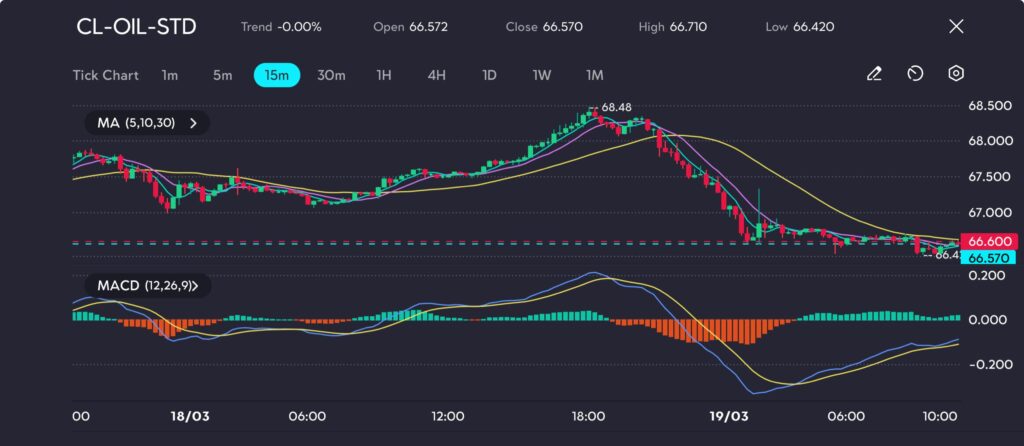
WTI crude oil settled at USD 66.570, marginally lower than its opening price of USD 66.572, after fluctuating between a session high of USD 66.710 and a low of USD 66.420.

Crude oil struggles at 66.570 as selling pressure mounts, with resistance seen near 67.50, as seen on the VT Markets app.

Prices initially climbed to USD 68.48 before pulling back sharply, reflecting ongoing demand concerns and a stronger US dollar.

Moving averages (5, 10, and 30) indicate a sustained downtrend, as short-term MAs have crossed below longer-term averages, reinforcing bearish momentum.

The MACD (12,26,9) histogram remains negative, with the signal line trending downward, suggesting continued selling pressure.

Key support lies near USD 66.00, and a break below this level could push prices toward USD 65.50.

On the upside, resistance is observed at USD 67.50, with a breakout potentially signalling a short-term rebound.

Rising US crude inventories signal softening demand

Further weighing on crude oil prices, recent industry reports have shown larger-than-expected builds in US crude inventories.

This indicates a slowdown in demand amid persistent global economic uncertainties.

Trade disputes and economic headwinds continue to pose risks, prompting caution among traders who are closely monitoring signs of further demand weakness.

Market outlook

In the short term, WTI crude oil may remain under pressure as Russian supply expectations and OPEC’s production increase contribute to concerns of an oversupplied market.

However, traders should stay vigilant for any geopolitical developments, particularly in the Middle East, which could trigger sudden price swings.

Additionally, upcoming inventory reports and key global economic data will play a crucial role in shaping market direction.

Click here to open account and start trading.

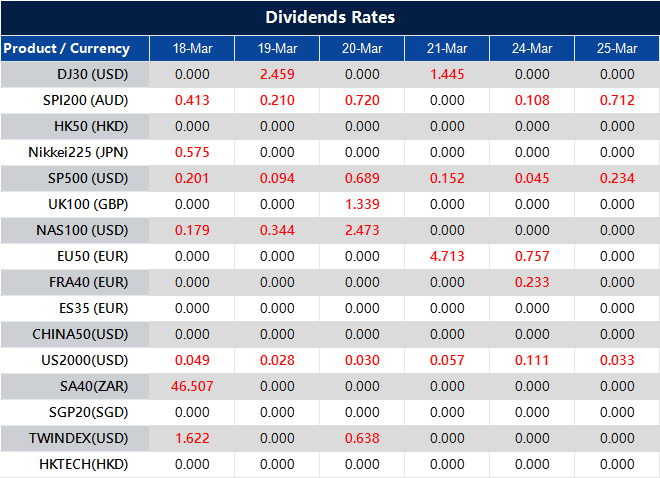
Dividend Adjustment Notice – Mar 18 ,2025

Dear Client,

Please note that the dividends of the following products will be adjusted accordingly. Index dividends will be executed separately through a balance statement directly to your trading account, and the comment will be in the following format “Div & Product Name & Net Volume”.

Please refer to the table below for more details:

Dividend Adjustment Notice

The above data is for reference only, please refer to the MT4/MT5 software for specific data.

If you’d like more information, please don’t hesitate to contact info@vtmarkets.com.

Back To Top
server

Hello there 👋

How can I help you?

Chat with our team instantly

Live Chat

Start a live conversation through...

  • Telegram
    hold On hold
  • Coming Soon...

Hello there 👋

How can I help you?

telegram

Scan the QR code with your smartphone to start a chat with us, or click here.

Don’t have the Telegram App or Desktop installed? Use Web Telegram instead.

QR code