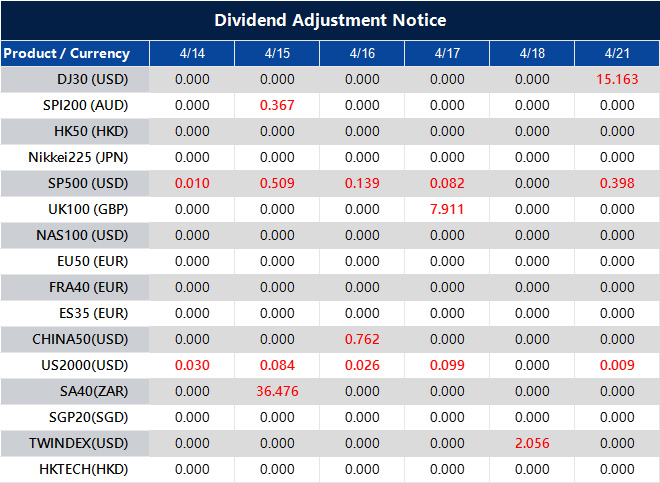
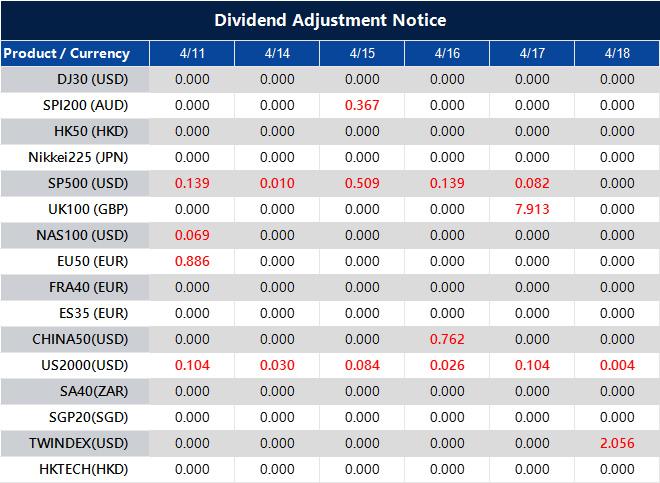
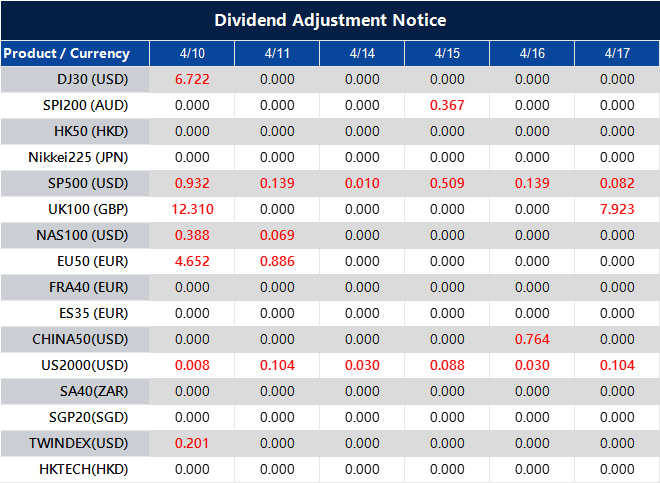
Please note that the dividends of the following products will be adjusted accordingly. Index dividends will be executed separately through a balance statement directly to your trading account, and the comment will be in the following format “Div & Product Name & Net Volume”.
Please refer to the table below for more details:
The above data is for reference only, please refer to the MT4/MT5 software for specific data.
If you’d like more information, please don’t hesitate to contact info@vtmarkets.com.
Discover the Best Trading Platform for UK Day Traders
Day trading has rapidly gained traction in the UK, offering traders the chance to capitalise on short-term market moves. But in such a fast-paced environment, success hinges on the tools you use, starting with the best trading platform for day traders in the UK. In this article, we explain what day trading is, what makes a trading platform ideal, and how to compare the top options available.
What is Day Trading?
Day trading involves opening and closing financial positions within the same trading day, aiming to profit from short-term price movements. This strategy requires a solid understanding of technical indicators, real-time market updates, and most importantly, instant trade execution.
Example: A day trader in London used non-farm payroll (NFP) data to enter a EUR/USD position, closing it 12 minutes later with a £980 gain. Success was only possible with a fast, low-latency day trading platform and tight spreads.
What is a Day Trading Platform?
A day trading platform is the software or application that allows traders to analyse markets, execute trades, and manage risk—all in real-time. It’s your trading cockpit, and it must be optimised for speed, usability, and reliability.
To be considered the best trading platform for day traders, especially in the UK market, it should include:
Instant execution with minimal slippage
Competitive spreads and transparent costs
Powerful charting tools (e.g., MT4/MT5, cTrader)
Multilingual customer support
Access to a wide range of instruments and leverage
How to Find the Best Trading Platform for Day Traders in the UK?
Finding the best trading platform for day traders in the UK isn’t just about signing up with the most well-known provider. It’s about identifying the platform that aligns with your trading goals, preferred strategies, and risk tolerance. Here are the key steps to help you make the right choice:
1. Define Your Trading Goals and Strategy
Before selecting a platform, it’s important to understand how you want to trade. Are you scalping multiple times a day, or making just a few strategic entries? Do you rely on technical analysis or use economic news to guide your trades?
Your trading style should determine the tools you need. For example, scalpers need ultra-fast execution and one-click order placement, while technical traders may prioritise tools like trendlines, oscillators, and multi-timeframe views. News-driven traders, on the other hand, benefit from platforms with economic calendars and headline feeds.
Example: A trader using a 1-minute chart to scalp EUR/USD during overlapping market sessions will need a platform that executes trades in milliseconds, not seconds, to avoid slippage.
Understanding core market concepts is crucial before choosing your platform. Some terms you should be familiar with include:
Volatility:Volatility measures how much and how quickly an asset’s price moves within a specific time frame. For day traders, higher volatility means more frequent opportunities to profit from price swings, but also greater risk. Markets like XAUUSD or GBP/USD are typically volatile during news releases, making them ideal for short-term trades if paired with the right risk management tools.
Liquidity: Liquidity refers to how easily you can enter or exit a position without significantly impacting the asset’s price. Highly liquid markets, such as major forex pairs or stock indices, allow for faster execution and tighter spreads, crucial for day traders who rely on quick decisions. A good platform should connect to deep liquidity pools to minimise slippage.
Volume: Volume indicates how actively an asset is being traded and helps confirm the strength of a price move. High volume during breakouts or trend continuations suggests genuine interest and conviction in the market. Platforms that display real-time volume data allow traders to better time entries and avoid false signals.
A platform that offers volume analysis, economic calendars, and volatility indicators will better prepare you for real-time trading decisions.
3. Choose the Right Markets to Day Trade
The best trading platforms give you access to multiple asset classes, allowing flexibility across trading styles and conditions. Here’s a breakdown of the core markets day traders often focus on:
Forex:Forex trading is one of the popular markets for day trading, offering high liquidity, 24/5 access, and tight spreads. Traders typically focus on the major currency pairs, which include the most traded forex pairs like EUR/USD, GBP/USD, and USD/JPY. These pairs are ideal for strategies based on momentum, scalping, or news reactions.
Indices: Represent the performance of a basket of stocks and provide exposure to broader market movements. Indices such as the FTSE 100, S&P 500, and NASDAQ 100 are known for sharp intraday moves during market opens or economic data releases, perfect for trend or breakout traders.
Commodities: Include physical assets like gold (XAUUSD), crude oil, and silver. These markets are highly sensitive to geopolitical events and economic releases, often showing clean, tradeable patterns on technical charts.
Stocks: Offer targeted exposure to individual companies. UK and US equities are often traded around earnings reports or corporate announcements. Stock CFDs enable both long and short positions without owning the actual shares.
A good day trading platform should also offer access to a wider range of financial instruments. VT Markets provides not only major asset classes but also ETFs, bonds, and others, giving traders greater flexibility to diversify and adapt to evolving market opportunities—all within one powerful, integrated platform.
4. Compare Platform Costs and Trading Fees
Day trading involves frequent position entries and exits, which means trading costs can quickly add up and eat into your profits. That’s why it’s essential to understand the different types of fees associated with each platform before committing. Here’s what to look for:
Spreads: The spread is the difference between the bid (sell) and ask (buy) price of an asset. Even a 0.1 pip difference can make a big impact when placing multiple trades per session. Platforms offering tight or raw spreads are better suited for active traders. Platforms that offer raw or tight spreads are ideal for scalpers or short-term traders who rely on precision entries.
Commissions: Some trading accounts operate on a commission model, where you’re charged a fixed fee per lot traded. This is often paired with lower spreads and can benefit high-volume traders looking for transparent, predictable pricing. Be sure to compare commission rates across brokers and assess how they align with your trade size and frequency.
Swap/ Overnight fees: If you hold a position past the market close, you may incur a swap or rollover fee. While most day traders close before end-of-day, knowing the potential charge helps in case a trade needs to be left open unexpectedly. Depending on the instrument, these can either be a cost or a credit.
5. Evaluate Platform Features and Tools
The quality and reliability of a trading platform’s tools can directly impact your results, especially for day traders who rely on speed, precision, and real-time insights. Here are the essential features to look out for:
Fast Execution: Instant order placement is crucial when reacting to intraday price movements. Delays during high volatility can cause slippage and missed opportunities, so platforms with low-latency infrastructure are a must.
Advanced Charting: Access to multiple chart types, timeframes, and technical indicators (like RSI, MACD, and moving averages) helps traders analyse trends, spot entry/exit points, and manage trades with confidence.
Risk Management Settings: Tools such as stop-loss, take-profit, and margin alerts are essential for controlling exposure and protecting your capital. These features should be easy to customise and execute within the platform.
Auto-Analysis Tools: Integrations like Trading Central or Autochartist offer automated pattern recognition, market insights, and actionable trade signals, helpful for traders who want data-backed setups without manual scanning.
Mobile Trading: In today’s market, flexibility is key. A well-optimised mobile app that syncs seamlessly with desktop or web platforms ensures you can monitor positions, adjust orders, and react to breaking news on the go.
VT Markets supports both MetaTrader 4 and MetaTrader 5, giving traders access to professional-grade tools that support technical analysis, automation, and flexibility across platforms.
6. Check Deposit and Withdrawal Options
Efficient deposit and withdrawal processes help ensure your capital is available when needed and that your profits can be accessed without unnecessary delays. Here are the key factors to consider:
Multiple Funding Methods: A good platform supports a variety of payment channels, such as credit cards, bank transfers, and e-wallets. This allows traders to choose the most convenient option based on their location and preferences.
Processing Speed: Deposits should be nearly instant, especially when using cards or digital wallets. Withdrawals should be processed within one to two business days to ensure timely access to funds.
No Unexpected Fees: Some platforms charge fees for withdrawals or have hidden conditions. Make sure the broker outlines all transaction costs clearly to avoid surprises.
VT Markets offers various deposit channels, a low minimum deposit of $50, with instant deposit options and free withdrawals depending on the method.
7. Review Customer Support Availability
In fast-moving markets, delays in getting help can lead to missed opportunities or unresolved issues. A strong support system is essential for day traders who need quick, accurate responses. Look for the following:
Customer Support: Ensure the broker offers reliable support, including 24/5 access via live chat, email, and phone, to assist during key trading hours and unexpected market events.
Multilingual support: Helpful for traders in different regions, particularly during peak UK and European market hours.
Educational resources: Includes a dedicated help centre, platform walkthroughs, FAQs, and video tutorials to support onboarding and self-guided learning.
8. Test the Platform Before Going Live
Before trading with real capital, it’s important to explore the platform in a risk-free environment. A robust demo account allows you to gain experience without financial risk. Here’s how:
Get familiar with the platform: Explore every part of the trading interface, including charting tools, order types, and account settings. This helps reduce the risk of operational errors when you begin live trading.
Practice your trading strategy: Use the demo environment to test different trading strategies and techniques under various market scenarios. Whether you’re developing a scalping approach or responding to economic news, it’s the ideal space to refine your methods.
Build confidence through repetition: Trading in real time, even with virtual funds, helps you practise discipline, improve timing, and manage emotions. Once you’re confident in your strategy and execution, switching to a live account becomes a more comfortable and informed transition.
VT Markets provides a free demo account with $100,000 in virtual funds, offering real-time pricing and functionality that closely mirrors live market conditions.
Comparison: Top Day Trading Platforms in the UK
To help you evaluate which is the best trading platform for day traders in the UK, here’s a detailed breakdown across key categories:
Choosing the best trading platform for day traders in the UK depends on aligning platform features with your trading goals, strategy, and preferred markets.
A high-quality day trading platform should offer fast execution, competitive costs, advanced charting, and strong risk management tools.
Look for access to a diverse range of financial instruments, including forex, indices, commodities, stocks, ETFs, bonds, and share CFDs.
Evaluate platform costs carefully, including spreads, commissions, and swap fees, as these can directly impact your trading performance.
Ensure the platform provides multiple deposit and withdrawal options, fast processing, and no hidden fees to maintain smooth capital management.
Reliable customer support and access to a comprehensive help centre with educational resources are essential for long-term trading success.
Practising with a demo account is a crucial step before going live, allowing you to build confidence, refine your strategy, and get familiar with the platform.
Start Day Trading with VT Markets Today!
Ready to take your day trading to the next level? VT Markets offers a professional-grade trading environment built for speed, flexibility, and performance. Whether you’re focused on forex, commodities, indices, or expanding into ETFs and bonds, our platform is designed to meet the needs of active traders.
With access to MetaTrader 4 and MetaTrader 5, ultra-fast execution, tight spreads from 0.0 pips, and a feature-rich demo environment to refine your strategy, VT Markets empowers day traders at every stage of their journey.
Open a VT Markets live account now and experience the edge of intelligent day trading today.
Frequently Asked Questions (FAQs)
1. What is the best trading platform for day traders in the UK?
The best trading platform for day traders in the UK offers fast execution, low spreads, access to key markets, and tools tailored to short-term strategies. VT Markets is a popular choice among day traders for its speed, precision, and range of instruments.
2. Can beginners use day trading platforms?
Yes, many platforms offer demo accounts and educational resources to help beginners learn. It’s recommended to start with a risk-free demo account to practise strategies and understand platform tools before trading live.
3. How important is execution speed for day trading?
Execution speed is critical. Day traders rely on entering and exiting positions quickly to capture small price movements. Platforms with ultra-low latency can help minimise slippage and maximise efficiency.
4. Can I day trade stocks and commodities on VT Markets?
Yes. VT Markets allows day trading across a wide range of CFDs, including stocks, indices, commodities like gold and oil, and other instruments such as ETFs and bonds.
5. How do I know if a trading platform is suitable for day trading?
Look for fast execution, access to volatile markets, advanced charting tools, and low trading costs. A free demo account is a great way to test a platform’s suitability before going live.
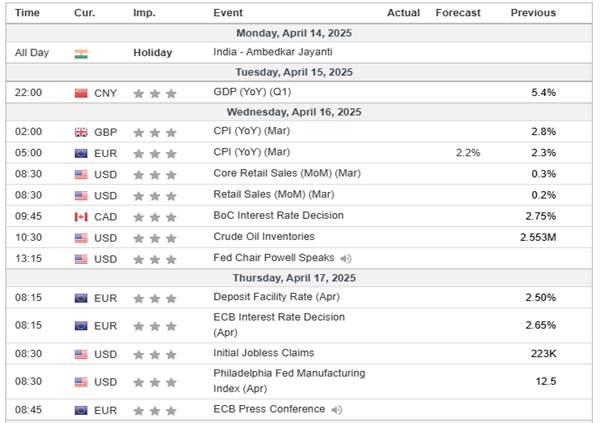
From 14 to 18 April 2025, key economic events are set to shape market dynamics. US–China trade tensions, evolving tariffs, and inflation data will drive investor sentiment. Central banks’ policy responses to these developments, along with growth forecasts, are also under scrutiny as markets adjust to potential risks and opportunities.
KEY INDICATORS
Policy developments: US–China tensions & global tariff manoeuvres
China’s 2025 National Export Control Meeting emphasised strengthening export control enforcement, improving regulations, and boosting multilateral cooperation in response to growing global complexities.
The EU softens its stance by pausing retaliatory tariffs on the US for 90 days. President Ursula von der Leyen warned, however, that strong measures—possibly targeting US tech giants—will be deployed if talks fail.
The US Treasury reports March net tariff revenue at USD 8.2 billion, the highest since September 2022, driven by recent tariff hikes.
The EU and China begin negotiations on setting a minimum price for Chinese electric vehicles (EVs), potentially replacing previously imposed EU tariffs.
Macro data: Inflation, budget, and policy signals
US inflation unexpectedly cools: March CPI fell 0.1% month-on-month (first drop since May 2020), while core CPI rose 2.8% year-on-year—the smallest gain since March 2021.
The federal budget deficit shrinks to USD 161 billion in March, down 32% year-on-year, driven by a calendar adjustment in spending and rising tax revenues.
Markets are now pricing in 100 basis points of Fed rate cuts in 2025, but Fed officials remain cautious amid inflation uncertainty and trade-related risks.
Germany slashes its 2025 GDP growth forecast from 0.8% to 0.1%, citing trade policy impacts and weak domestic demand.
The EIA cuts its global oil demand forecast and oil price outlook: Brent crude is now expected to average USD 67.87 per barrel in 2025, down from USD 74.22.
Market reaction & capital flows: Risk-off sentiment returns
US equities retreat as trade tensions weigh heavily on sentiment despite temporary tariff postponements.
Emerging markets see a USD 17.1 billion capital outflow in March, the largest since August 2023, driven by tariff fears and global uncertainty.
The RMB exchange rate remains flexible, with SAFE highlighting China’s resilient FX market and capacity for self-correction.
BoE and RBA officials express uncertainty over the full impact of US tariffs on domestic inflation and monetary policy paths.
MARKET MOVERS
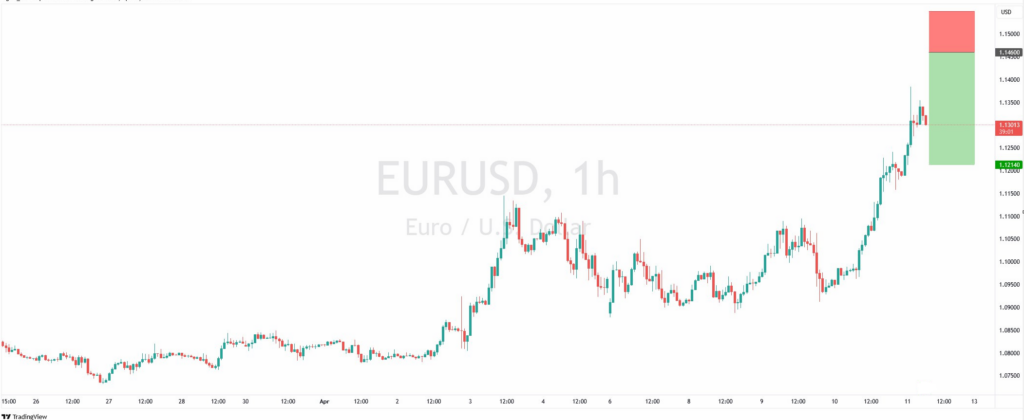
EUR/USD
The pair extended its upward momentum from 1.0913, closing with solid net gains yesterday.
The previous resistance level at 1.1214 has been decisively breached.
A corrective pattern has emerged on the intraday chart, signalling potential short-term exhaustion.
Current price action is trading in overbought territory.
Selling into rallies presents a favourable risk/reward opportunity.
US dollar drops sharply, safe-haven currencies gain
US dollar saw a sharp sell-off, with the Dollar Index dropping 1.92 points (-1.87%) to 100.98, marking its largest single-day decline since 2022.
Safe-haven currencies, Japanese yen and Swiss franc, extended their gains against the greenback.
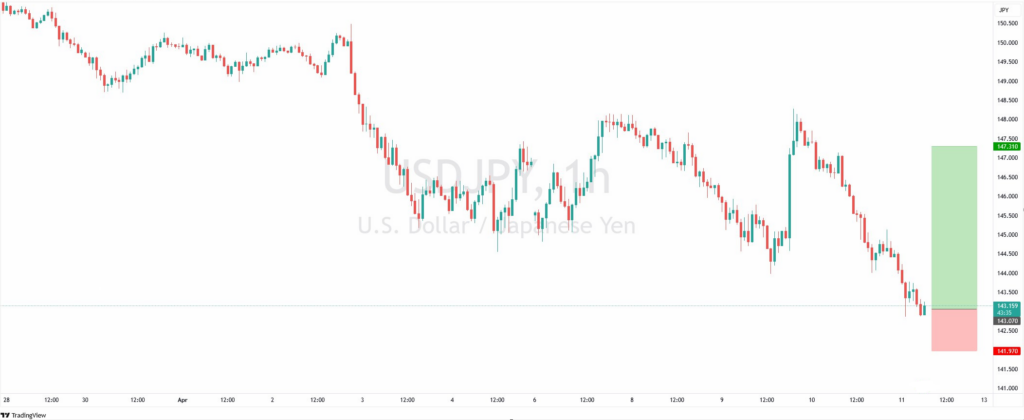
USD/JPY fell 333 pips (-2.26%) to 144.44.
USD/CHF dropped 339 pips (-3.96%) to 0.8237, its lowest level in a decade.
EUR/USD rose 251 pips (+2.30%) to 1.1200.
GBP/USD climbed 140 pips (+1.09%) to 1.2954.
AUD/USD advanced 68 pips (+1.11%) to 0.6219.
USD/CAD slipped 93 pips to 1.3991.
US equities retreat as tech stocks lead the decline
US equities surrendered some of Wednesday’s gains, with the Dow Jones Industrial Average falling 1,014 points (-2.50%) to 39,593, S&P 500 dropping 188 points (-3.46%) to 5,268, and Nasdaq 100 losing 801 points (-4.19%) to close at 18,343.
US inflation slowed to 2.4% YoY in March, down from 2.8% in February, but failed to sustain bullish momentum.
The 10-year Treasury yield edged higher by 2.9 basis points to 4.425%.
Mega-cap tech stocks retreated: Tesla (TSLA) -7.27%, Meta Platforms (META) -6.74%, Nvidia (NVDA) -5.91%, Apple (AAPL) -4.24%.
US Steel (X) plunged 9.46% after Donald Trump opposed its proposed sale to a Japanese buyer.
Ford Motor (F) declined 3.79% after Goldman Sachs downgraded its rating to “Neutral.”
Cruise-line stocks hit hard after Morgan Stanley cut price targets: Carnival (CCL) -10.25%, Norwegian Cruise Line (NCLH) -9.24%, Royal Caribbean (RCL) -8.11%.
European markets rebounded strongly from prior losses: DAX 40 +4.53%, CAC 40 +3.83%, FTSE 100 +3.04%.
Commodities mixed: WTI crude oil fell USD 2.28 (-3.66%) to USD 60.07 per barrel, and gold surged over 3% to reach a record high of USD 3,176.
Gold extends rally while USD/JPY weakens in Asian session
Crude oil prices are feeling the pressure again as global economic concerns take centre stage. With tensions flaring between the US and China, traders are growing more cautious about future demand. The mood across energy markets has shifted, as signs of slowing growth and trade disruptions raise doubts about whether oil consumption can hold steady in the months ahead.
Crude oil prices continued to fall on Friday, closing out a second consecutive week of declines.
The renewed trade conflict between the US and China has sparked fresh concerns over a global economic slowdown, potentially leading to reduced demand for oil.
US-China trade tensions escalated again Thursday, sparking a new slide in stocks, bonds, the dollar and oil: Here’s your Evening Briefing https://t.co/Yo4Nc4wVQa
West Texas Intermediate (WTI) slipped by 0.6% to USD 59.71, while Brent crude dropped 0.5% to USD 63.02.
These losses followed a sharp downturn on Thursday, where both benchmarks shed more than USD 2 per barrel, deepening an overall 11% decline seen over the past two weeks.
Oil demand in question as global growth falters
Mounting worries about slowing global growth are fuelling fears of demand destruction. Daniel Hynes from ANZ highlighted that if global GDP growth dips below 3%, oil demand could contract by 1% — a scenario that now seems increasingly likely due to heightened tariff actions.
The US Energy Information Administration (EIA) has also downgraded its oil consumption forecasts for both domestic and global markets, citing worsening economic conditions.
Adding to the bearish sentiment, President Trump has imposed 145% tariffs on Chinese imports, while China has retaliated with an 84% levy on US goods.
These escalations between the world’s top two oil consumers are dampening trade volumes and destabilising supply chains, causing traders to price in a sustained drop in demand rather than immediate supply concerns.
Technical signals confirm bearish outlook
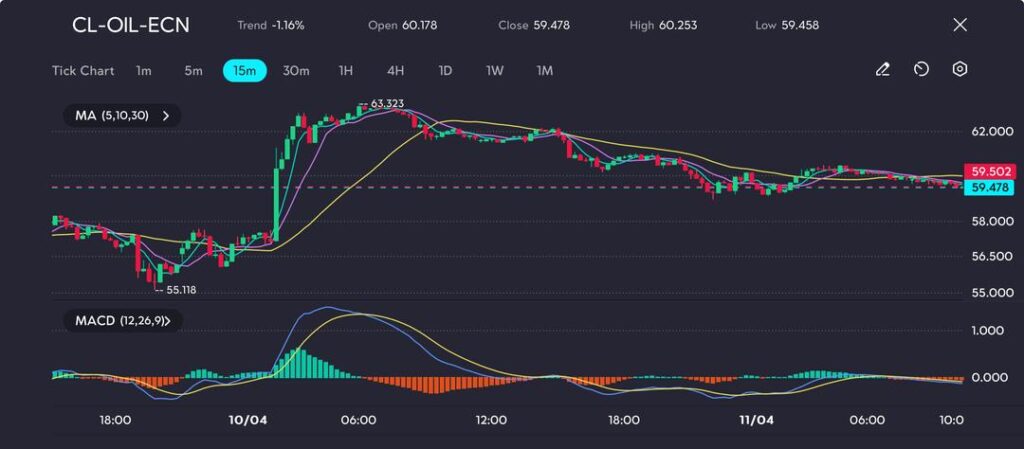
On the technical front, WTI crude (CL-OIL-ECN) has reversed sharply after peaking at USD 63.32, with sustained downward momentum now taking hold.
Crude pulls back from session highs, eyeing support at USD 59. MACD shows momentum is fading fast, as seen on the VT Markets app.
The MACD (12,26,9) has turned negative, and prices are trading below key moving averages (5, 10, and 30-day), reinforcing the bearish structure.
The recent high of USD 63.32 now serves as firm resistance. Prices are currently hovering around USD 59.48, with potential for a further drop toward the USD 58.00–55.00 support zone.
The MACD histogram remains in negative territory, signalling continued weakness and a lack of reversal signals.
Looking ahead, markets will closely watch OPEC+ statements, Chinese industrial production figures, and refinery data from the US.
Unless macroeconomic conditions improve significantly, crude oil is likely to remain under pressure, with limited potential for a strong recovery in the near term.
Seventy-eight days into Donald Trump’s second term, global markets are already rattled by his aggressive trade stance. From day one, the US has imposed a wave of tariffs, triggering a fresh and unpredictable trade war.
The financial world is now grappling with sharp asset declines, unusual alliances among major economies like Japan, China, and South Korea, and a surge in market volatility.
Traders face one of the most uncertain environments in recent memory. So, how do you navigate this tariff-fuelled chaos?
In this guide, we’ll break down how Trump’s tariffs are reshaping trading strategies, explore potential recession risks, and examine whether assets like Bitcoin might rebound. Let’s dive into what traders should watch — and how they can stay ahead.
Is it a good time to short US stocks and bonds?
US stocks: Market conditions and risks
As of April 2025, US equities are under heavy pressure. The S&P 500 has dropped by 21.3%, while the Nasdaq Composite is down 25.6% — both firmly in bear market territory.
While these levels often indicate recession, there have been exceptions (e.g. 1962, 1987, 2022). Still, the spike in the VIX — Wall Street’s volatility index — is sounding alarm bells.
On 7 April, the VIX hit 60.13 and closed at 46.93 the next day — levels not seen since the 2008 and 2020 crashes. This signals extreme market fear, typically observed near bottoms.
Yet history shows that while VIX spikes above 50 can lead to short-term rebounds, they don’t always prevent deeper declines. In 2008 and 2020, markets kept falling even after fear peaked.
Should traders short stocks now?
There could still be room for further downside. If recession fears escalate or corporate earnings disappoint, markets may slip lower. However, much of the negativity appears to be priced in already.
For traders, timing is everything — it’s wise to watch for signs of economic stabilisation or shifts in policy before holding onto short positions too long.
US bonds: A changing narrative
The outlook for US Treasuries has shifted, with the 10-year yield falling to around 4.0% — its lowest since October 2024.
This drop reflects a classic “flight to safety” amid growing recession fears. The yield curve remains inverted, with short-term yields above long-term ones — a pattern that has reliably preceded past recessions.
Should traders short bonds?
Shorting bonds looks increasingly risky. With investors flocking to safe assets, bond prices are rising and yields could fall even more. Unless inflation unexpectedly surges, the environment now favours long bond positions.
The likelihood of additional Fed rate cuts and moderate inflation expectations further reduce the appeal of bond shorts. A cautious, defensive bond strategy appears more suitable for current conditions.
Will there be a recession?
The risk of a US recession continues to climb, with several leading indicators flashing warning signs.
Key recession indicators:
Yield curve inversion: The 3-month Treasury yield has remained above the 10-year yield for months, with the gap widening to -50 basis points — a historically reliable recession signal.
Leading Economic Index (LEI): The LEI declined by 0.3% in January 2025, continuing a downward trajectory that suggests weakening economic momentum.
Unemployment: The US jobless rate has risen from 3.5% in 2023 to 4.1% — a significant increase that often precedes economic downturns.
Investment banks are raising their recession probabilities: Goldman Sachs now sees a 45% chance, while J.P. Morgan puts it at 60%. If trade tensions escalate further, those odds could increase.
Conclusion on recession
Although the data points to higher recession risk, a soft landing remains possible. Traders should monitor economic releases closely as we move through Q2 2025. While a shallow recession may be on the horizon, successfully navigating it will require agility and close attention to market signals.
Will Bitcoin recover to USD 100k?
Bitcoin’s recent price performance
In April 2025, Bitcoin (BTC) opened near USD 85,227 but slipped 13% to a low of USD 74,496. It has since rebounded slightly, trading around USD 80,858.
These moves are occurring against a backdrop of broad market uncertainty, and Bitcoin continues to show a strong correlation with traditional indices like the S&P 500.
Fundamentals and sentiment
Despite recent volatility, Bitcoin futures open interest remains robust, suggesting institutional players are still active.
Meanwhile, the M2 money supply is expanding, and stablecoin market capitalisation is on the rise — both signs of increasing liquidity. A growing supply of stablecoins may provide support for crypto assets going forward.
However, Bitcoin is still subject to macroeconomic trends, such as global risk appetite and economic policy shifts. While short-term pressure remains, the medium-term outlook could improve if liquidity continues to grow and risk sentiment stabilises.
Conclusion on Bitcoin recovery
Bitcoin’s path back to USD 100k may not be straightforward, but it remains plausible. As liquidity increases and global markets adjust to the new economic regime, there could be room for recovery.
Traders should track macro factors such as inflation, rate policy, and market volatility to assess when bullish momentum may return.
Final thoughts: Navigating tariffs and market volatility
Trump’s tariffs have reignited a global trade war and sparked exceptional market turbulence. Whether you’re trading stocks, bonds, or Bitcoin, the key is staying agile and informed.
Shorting may still offer opportunities — especially if recession risks deepen — but the landscape demands caution. With economic signals shifting and sentiment fragile, traders must manage risk wisely and avoid overexposure.
At VT Markets, we equip you with the tools, analysis, and support to navigate volatile markets confidently. Stay informed, stay prepared, and trade smarter — even in uncertain times.
Ready to take control of your strategy? Open a live account with VT Markets today and unlock smarter trading in volatile times.
Please note that the dividends of the following products will be adjusted accordingly. Index dividends will be executed separately through a balance statement directly to your trading account, and the comment will be in the following format “Div & Product Name & Net Volume”.
Please refer to the table below for more details:
The above data is for reference only, please refer to the MT4/MT5 software for specific data.
If you’d like more information, please don’t hesitate to contact info@vtmarkets.com.
How to Become a Day Trader: Your Guide to Starting Day Trading
In this article, we’ll cover everything you need to know about how to become a day trader, from building a strong knowledge base and understanding the markets to developing a trading plan and implementing effective risk management strategies. We’ll also explore the types of markets you can trade, popular strategies for day trading, and key tips to help you get started with confidence.
What is Day Trading?
Day trading is the practice of buying and selling financial instruments like stocks, currencies, or commodities within the same trading day. Unlike traditional investing, where traders hold positions for the long term, day trading aims to capitalize on short-term price movements. The goal is to make quick profits by executing multiple trades in a single day.
Day trading is especially popular in markets with high volatility, where traders can benefit from small price fluctuations. This practice has gained popularity due to the accessibility of online trading platforms and the potential for significant returns. However, it also comes with higher risks and requires a sharp understanding of the market and quick decision-making skills.
How to Become a Day Trader?
Becoming a day trader involves more than just opening a trading account. To succeed, it requires acquiring the right tools, building knowledge, and developing a well-thought-out strategy. Below are the steps you can follow to start your journey as a day trader.
1. Build Your Knowledge Base
A strong foundation in both technical and fundamental analysis is essential. Technical analysis involves studying price charts, patterns, and various indicators to predict future price movements. Fundamental analysis, on the other hand, includes monitoring economic news, financial reports, and global events that can impact market prices.
Educating yourself through books, online courses, and trading seminars can significantly boost your understanding. Many day traders also read trading blogs and participate in forums to learn from the experiences of others.
2. Understand the Markets
Before diving into day trading, it’s crucial to understand the markets you wish to trade in. This includes knowing the assets, such as stocks, forex, or commodities, and their price movements. Popular choices include the FTSE 100 index, major forex pairs like GBP/USD, and commodities like oil and gold. Each market has its own trading hours and level of volatility, which can greatly impact your strategy.
Understanding market conditions will help you better decide when to trade, which assets to focus on, and the types of movements that present profitable opportunities.
3. Develop a Trading Plan
A trading plan is crucial for guiding your decisions and maintaining discipline. It outlines your trading strategy, risk management rules, and goals. Your plan should include the assets you want to trade, your risk-to-reward ratio, and specific entry and exit strategies.
Your trading plan should also account for your daily routine and trading schedule, helping you avoid impulsive trades. Having a plan reduces emotional decision-making, which is one of the most common pitfalls in day trading.
4. Choose a Reliable Trading Platform
Selecting the right trading platform is one of the most important decisions you will make as a day trader. Look for a platform that provides fast execution times, real-time data, and a user-friendly interface.
In the UK, traders often choose platforms like VT Markets, which offer access to a wide range of markets, low latency, advanced charting tools, and responsive customer support. A reliable platform allows you to make quick decisions and execute trades without delay, which is crucial in the fast-paced world of day trading.
5. Fund Your Trading Account
Once you’ve chosen a platform, you’ll need to fund your trading account. Day trading can be done with a relatively small initial investment, but it’s essential to fund your account sufficiently to allow you to manage risk and execute your strategy effectively. Many brokers, including VT Markets, offer various funding options such as bank transfers, credit/debit cards, and e-wallets.
It’s recommended to start with a small amount and gradually increase your trading size as you gain experience. Avoid using more capital than you can afford to lose, especially when starting out.
6. Implement Risk Management Strategies
Day trading involves substantial risk, which is why risk management is critical. The use of stop-loss orders, position sizing, and the risk-to-reward ratio can help protect your capital and prevent significant losses.
Successful traders know when to cut their losses and preserve capital for the next trade. Setting a daily loss limit is another way to manage your risk and avoid emotional trading after losing streaks.
7. Monitor and Stay Informed
The key to successful day trading is staying informed. Keep up with the latest market news, economic data, and global events that could impact your trades. Many day traders follow financial news platforms like Bloomberg, Reuters, and TradingView for real-time updates.
Staying informed and adapting your strategies to market conditions will help you make better, more informed decisions, giving you a better chance to profit from price fluctuations.
Types of Markets You Can Day Trade
As a day trader, you can choose from several markets, each offering unique opportunities and risks. Here are the most popular markets for day trading:
1. Stock Market
Stocks represent ownership in a company, and their prices fluctuate based on earnings, news, and market sentiment. In the UK, indices like the FTSE 100 provide numerous opportunities for day traders to profit from price movements within a single day.
2. Forex Market
The forex market is the world’s largest and operates 24 hours a day, making it ideal for day traders. Most traded currency pairs, such as GBP/USD and EUR/USD, are frequently traded in the UK. The forex market offers high liquidity and ample opportunities for short-term price movements.
3. Commodities Market
Commodities such as gold, oil, and natural gas are highly traded, with significant price movements driven by supply, demand, and global events. Traders often focus on liquid commodities like Brent Crude oil and gold, which offer opportunities for quick profits in volatile conditions.
4. Indices Market
Stock indices, like the FTSE 100 or the S&P 500, track the performance of a group of stocks. Day traders take advantage of short-term price changes in these indices, using technical analysis to predict market movements. Indices tend to be less volatile than individual stocks, offering steady trading opportunities.
Types of Day Trading Strategies
1. Scalping
Scalping is one of the fastest-paced strategies in day trading, where traders aim to profit from small price changes over a very short period. Traders will open and close positions in a matter of minutes, sometimes even seconds, to capture tiny profits that add up over the course of the day.
2. Momentum Trading
Momentum traders focus on stocks or assets that are moving significantly in one direction, either up or down. They try to enter positions at the start of a trend and ride it until the momentum slows. This strategy requires quick execution and close attention to market developments.
3. Breakout Trading
Breakout trading involves identifying key support or resistance levels and then entering a trade when the price breaks out of these levels. Traders using this strategy believe that the price will continue to move in the breakout direction.
4. Swing Trading
Swing trading involves holding positions for several hours to days to capitalize on short- to medium-term price movements. Unlike day trading, which focuses on intraday price movements, swing traders aim to profit from price “swings” within a trend. This strategy requires traders to have a keen eye on market patterns, as they look to enter positions at the optimal point of the swing and exit before the trend loses momentum.
Tips on How to Become a Day Trader
Start with a Demo Account
If you’re wondering how can I start day trading, the best way is to practice first. Many brokers, including VT Markets, offer demo accounts where you can simulate real trading conditions without risking your money. This helps you get comfortable with the trading platform and develop a feel for the market.
Set Realistic Expectations
Day trading is not a get-rich-quick venture. Successful traders understand that consistency is key. It’s important to manage your expectations and understand that losses are part of the journey. Start small and gradually increase your trading size as you gain experience.
Stick to Your Strategy
One of the most common mistakes among beginners is overtrading. Having a clear strategy and sticking to it helps you avoid making impulsive decisions driven by emotions. Whether it’s scalping or momentum trading, define your entry and exit points and follow through.
Risk management is essential in day trading. Use tools like stop-loss orders to protect your capital and set a maximum daily loss limit to avoid significant losses. Many successful day traders use a risk-to-reward ratio to ensure that their potential profits outweigh the risks.
Conclusion
Day trading requires a strong foundation in both technical and fundamental analysis, a clear trading plan, and effective risk management strategies. Understanding the markets you trade in and developing a disciplined approach are key to success. By using reliable tools, setting realistic goals, and practicing sound risk management, you’ll be better equipped to navigate the challenges of day trading.
Become a Day Trader and Start Trading Today with VT Markets
VT Markets offers comprehensive educational resources, access to a reliable trading platform, and tools like MetaTrader 4 and MetaTrader 5 for seamless trading. With competitive spreads and fast execution, you’ll be able to make the most of every trade. Additionally, you can practice your skills with a demo account before committing real capital. With these tools and resources, you can confidently start your day trading journey and take advantage of a wide range of markets.
Start trading today with VT Markets and begin your journey to becoming a successful day trader.
Frequently Asked Questions (FAQs)
1. What is day trading?
Day trading involves buying and selling financial instruments like stocks, forex, or commodities within the same trading day to profit from short-term price movements.
2. How do I become a day trader?
Build your knowledge base
Understand the markets
Develop a trading plan
Choose a reliable trading platform like VT Markets
Fund your trading account
Implement risk management strategies
Monitor and stay informed
3. How can I start day trading?
You can start by opening a trading account with a reputable broker, funding it, and familiarizing yourself with the markets you wish to trade. Starting small and using a demo account will help you gain experience before live trading.
4. What is the best strategy for day trading?
The best strategy depends on your trading style, but popular day trading strategies include scalping, momentum trading, and breakout trading. Each strategy requires careful analysis and quick decision-making.
5. Is day trading risky?
Yes, day trading is risky because of the fast pace and volatility of the markets. However, with proper risk management, education, and discipline, you can mitigate some of these risks.
6. How can I manage risk in day trading?
Risk management strategies include setting stop-loss orders, limiting the size of each trade, and maintaining a favorable risk-to-reward ratio. It’s also crucial to avoid emotional trading and stick to your trading plan.
7. How can I improve my day trading skills?
To improve your day trading skills, you should educate yourself continuously, practice on a demo account, follow experienced traders, and regularly analyze your performance to identify areas for improvement.
Global markets jumped on signs of easing trade tensions, but the mood didn’t last in US tech stocks. Optimism gave way to caution as investors weighed the credibility of shifting policy signals and the persistence of inflation. While Asian and European markets held onto gains, Wall Street lost steam—highlighting the fragile confidence driving recent price action.
Nasdaq 100 slips despite global rally as tech sentiment sours
Global equity markets surged overnight, yet the Nasdaq 100 struggled to maintain early momentum, closing Thursday’s session 1.26% lower at 18,924.20.
The index briefly touched 19,244.60 earlier in the day but later reversed gains as US tech sentiment weakened.
Investors grew cautious amid concerns over the durability of policy relief and its ability to support long-term growth in the tech sector.
US tariff policy sparks doubt despite initial optimism
Markets initially welcomed President Donald Trump’s decision to delay most new tariffs for 90 days, fuelling a strong relief rally across Asia and Europe.
However, optimism faded quickly as investors assessed the fine print—tariffs on Chinese goods were hiked to 125%, and a blanket 10% tariff remains on all other imports.
The limited scope of the pause reignited concerns about policy clarity and leadership direction.
Commentators noted the erratic nature of White House decisions during a time of elevated market stress.
Martin Whetton from Westpac described the reaction as markets watching on “with horror,” as policy pivots were accompanied by distractions like executive orders on water pressure.
While Japan’s Nikkei 225 soared by 8% and European futures jumped similarly, US tech stocks failed to follow suit.
A growing “sell America” trend appears to be taking hold, with capital flows shifting towards traditional safe havens such as the yen, Swiss franc, and gold, rather than the US dollar or equity indices.
Bond yields ease but core risks persist
Following a sharp sell-off in the bond market, US 10-year Treasury yields moderated to 4.2774%, down from a recent high of 4.5150% that had sparked fears of another “dash for cash.”
Despite this easing, structural concerns remain. Analysts at LPL Financial highlighted persistent inflation, reduced global demand, hedge fund deleveraging, and market illiquidity as ongoing threats to stability.
Minutes from the Federal Reserve’s latest meeting confirmed policymakers remain focused on taming inflation, showing little urgency to cut rates.
Market expectations for rate cuts by year-end have adjusted accordingly, now pricing in 80 basis points of easing, down from 100 earlier this week.
From the recent low at 16,633.95, the Nasdaq 100 has staged a strong V-shaped recovery, with price action shifting decisively from lower lows to higher highs.
Buyers dominate the second leg as resistance at 19244.6 briefly caps the move, as seen on the VT Markets app.
Momentum indicators remain supportive—the MACD crossed bullishly well below the zero line, with growing green histogram bars suggesting underlying strength.
Moving averages across the 5, 10, and 30-period windows are stacked in a bullish formation, reinforcing the upward trend.
The index has cleared multiple resistance levels, including the psychological 18,000 mark, and peaked near 19,244.60.
However, it has since entered sideways consolidation just below this zone, with the 18,600–18,800 region now acting as key support.
A move above 19,250 could signal renewed upside and pave the way for a test of earlier highs.
However, traders should watch for a MACD rollover or a breakdown in the moving average stack, which may suggest fading momentum.
Outlook: Caution prevails amid policy and inflation risks
The Nasdaq 100’s inability to sustain gains—despite widespread global optimism—signals growing scepticism around the effectiveness of recent policy moves.
Escalating tariffs on Chinese goods and a resolute Federal Reserve suggest that pressure on corporate margins may persist, particularly in the tech sector.
Unless upcoming CPI and PPI data show an unexpected softening in inflation, volatility is likely to remain elevated.
Support for the Nasdaq 100 lies around the 18,500 level; a drop below that may open the door to a deeper retracement towards 16,600. On the upside, resistance remains firm at 19,250.
Please note that the dividends of the following products will be adjusted accordingly. Index dividends will be executed separately through a balance statement directly to your trading account, and the comment will be in the following format “Div & Product Name & Net Volume”.
Please refer to the table below for more details:
The above data is for reference only, please refer to the MT4/MT5 software for specific data.
If you’d like more information, please don’t hesitate to contact info@vtmarkets.com.
The yuan is back in the spotlight as fresh US–China trade tensions rattle markets and raise questions about Beijing’s next move. With pressure mounting on China’s currency, investors are weighing the risk of further declines and watching closely for signs of official intervention. Here’s what the latest shift means for the offshore yuan and broader market sentiment.
Offshore yuan hits record low amid escalating US-China trade tensions
The offshore Chinese yuan (USDCNH) fell to a record low of 7.4288 against the US dollar on 9 April, as intensifying trade tensions between the US and China heightened investor uncertainty.
The currency later recovered slightly during the Asian trading session, climbing 0.62% to 7.3833.
This notable depreciation followed the United States’ announcement of a 104% tariff on Chinese imports, prompting concerns over the yuan’s stability and the broader consequences of the growing trade dispute.
Chinese state banks act to stabilise the yuan
In response to the rapid decline, Chinese state-owned banks intervened by selling US dollars in the forex market to slow the yuan’s fall.
The PBoC remains active in managing the yuan’s trajectory. Although a weaker yuan can enhance export competitiveness, sustained depreciation may result in capital outflows and undermine financial market stability, making intervention necessary.
Technical analysis: bearish signals emerge for USDCNH
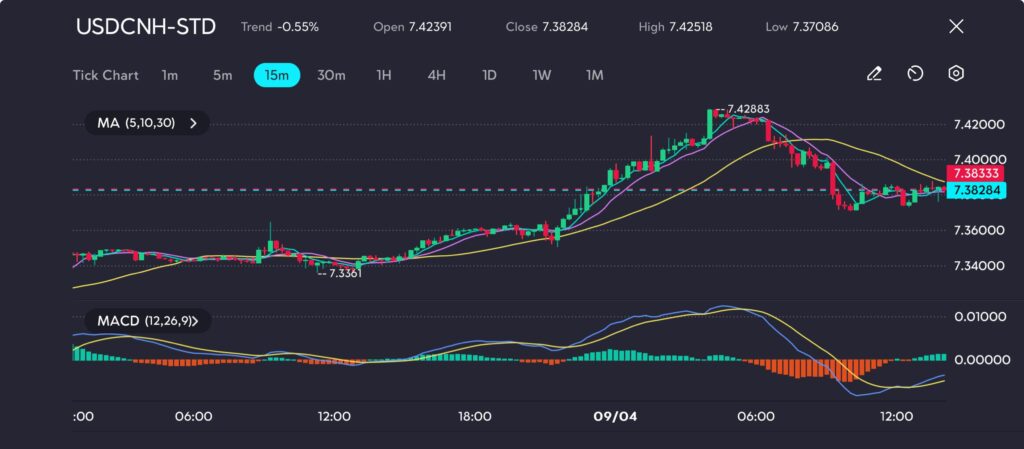
The USDCNH pair declined by 0.55%, ending the session at 7.3828 after peaking at 7.4288. While the pair opened higher, it reversed gains as selling pressure intensified.
USDCNH retraces from resistance at 7.42883, testing support at 7.3361, as seen on the VT Markets app.
From a technical standpoint, the moving averages (5, 10, and 30) point to a bearish trend, with shorter-term averages crossing below longer-term ones.
The MACD indicator (12, 26, 9) also confirms this sentiment, displaying a negative histogram and a MACD line positioned beneath the signal line.
The key technical levels to monitor are resistance at 7.4288 and support at 7.3361. A break below support may suggest further downside, while a move above resistance could signal the start of a rebound.
Outlook: yuan volatility likely to persist amid trade tensions
As the US–China trade dispute drags on with no clear resolution in sight, the offshore yuan is expected to remain under pressure. The intensifying rhetoric and policy moves from both sides have amplified market uncertainty, prompting traders to adopt a more cautious stance.
While a weaker yuan could offer short-term support to China’s export sector, prolonged depreciation risks triggering capital outflows and undermining investor confidence.
Going forward, the direction of the yuan will likely hinge on the outcome of trade negotiations, any escalation in tariffs, and the extent of intervention from the People’s Bank of China (PBoC).
Market participants will also be watching global risk sentiment, economic data from China and the US, and signals from central banks. In the absence of a diplomatic breakthrough, currency volatility is likely to remain elevated, leaving the yuan exposed to further swings in the near term.