What Is Swing Trading and How Does It Work?

What Is Swing Trading? Learn How It Works for Traders

Swing trading is a popular approach for traders who aim to capture short to medium-term price movements without being tied to their screens all day. It offers a balance between the fast pace of day trading and the patience required for long-term investing. If you’re curious about how swing trading works and why it appeals to so many traders, this article will walk you through the fundamentals. We’ll explore what swing trading is, highlight the popular swing trading strategies, and explain how traders use this method to take advantage of market momentum and short-lived trends.

What Is Swing Trading?

Swing trading is a trading approach that focuses on capturing gains from short to medium-term price movements, typically lasting from a few days to a few weeks. Unlike day trading, which requires entering and exiting positions within the same day, swing trading allows traders to hold positions longer, giving the market time to develop a clearer direction. This strategy revolves around identifying “swings” in market momentum—whether it’s a short-term uptrend or a temporary dip—and entering trades at points where a price reversal or continuation is likely. Because of its flexibility and moderate time commitment, swing trading is often favoured by part-time traders and those looking to balance analysis with actionable opportunities.

How Does Swing Trading Work?

Swing trading works by leveraging technical analysis to find entry and exit points within trending markets. A swing trader typically looks for patterns, candlestick patterns, and momentum indicators like the RSI or MACD to forecast short-term movements. Unlike scalpers or intraday traders, swing traders hold positions overnight or even across several weeks, aiming to benefit from predictable market corrections or breakouts.

Example: If the S&P 500 pulls back to a key support level during an uptrend, a swing trader may enter a long position, aiming to ride the next leg upward. They typically place trades with predefined stop-loss and take-profit levels to manage risk and lock in potential gains.

Popular Swing Trading Strategies

Successful swing trading strategy selection depends on the asset and timeframe, but here are the most common approaches:

Breakout Trading

Breakout trading strategy involves entering a trade when the price breaks above a resistance level or below a support level, often followed by a surge in volatility.

Example: A trader spots the EUR/USD breaking above 1.0900 after several failed attempts. Once the breakout occurs on high volume, they enter a long position, targeting the next resistance zone.

RSI-Based Trading

The Relative Strength Index (RSI) helps traders identify potential reversals by highlighting overbought or oversold conditions. Readings below 30 suggest oversold levels, while readings above 70 suggest overbought.

Example: A trader notices Amazon (AMZN) with an RSI of 28 during a market dip. Once the RSI starts climbing, they initiate a buy, aiming to ride the recovery over the next few days.

Moving Average Crossover

This method uses two moving averages—a short-term and a long-term one. A bullish signal occurs when the short-term MA crosses above the long-term MA, and vice versa for a bearish signal.

Example: On the S&P 500 ETF (SPY), the 20-day moving average crosses above the 50-day, indicating bullish momentum. The trader enters a swing trade anticipating a continued uptrend.

Momentum-Based Trading

This strategy focuses on entering trades when price momentum is strong, often supported by indicators like MACD or sudden volume spikes.

Example: A trader sees a surge in trading volume on Tesla (TSLA) with the MACD turning positive. Believing the rally has strength, they enter a long trade to capture the ongoing price acceleration.

How to Swing Trade

To implement an effective swing trading strategy, follow these practical steps:

Step 1: Understand How Swing Trading Works

Start by learning the core principles of swing trading. Know how it operates, what timeframes it uses, and how it differs from other trading styles.

Step 2: Choose a Market to Swing Trade

Select the asset class you want to focus on, whether it’s forex, stocks, indices, or commodities. Different markets suit different strategies and risk levels.

Step 3: Choose a Broker

Select a reliable and regulated broker that offers fast execution, low spreads, and access to trading platforms like MT4 or MT5. A good broker makes a big difference in execution and costs.

Step 4: Create and Fund Your Trading Account

Create a live trading account with your selected broker. Deposit capital into your trading account based on your trading plan. Be sure the funds match your risk tolerance and strategy size.

Step 5: Identify a Tradable Setup

Use technical analysis to spot potential trade setups based on your swing trading strategy, such as breakouts or RSI signals.

Step 6: Time Your Entry

Refine your entry point by confirming momentum or volume conditions. This helps reduce the chance of entering on false signals.

Step 7: Implement Risk Management Strategies

Plan your exit before you enter the trade. Use key risk management strategies by setting clear stop-loss and take-profit levels based on market structure and volatility.

Step 8: Monitor and Adjust

Keep an eye on your active trades. If the trade moves favourably, consider trailing your stop-loss to protect profits while allowing room for growth.

Step 9: Review Your Performance

After each trade, note the setup, outcome, and what you learned. A trading journal is an essential tool for long-term growth and strategy refinement.

Swing Trading vs Day Trading: What’s the Difference?

CriteriaSwing TradingDay Trading
Holding TimeDays to weeksIntraday only
Time CommitmentModerateHigh
Strategy TypeTrend following, technical setupsQuick momentum scalps
Capital NeedsFlexibleOften higher due to frequent trades
Stress LevelLowerHigher due to rapid decisions

Swing trading provides greater flexibility, allowing traders to hold positions for days or weeks without needing to monitor charts constantly. This makes it more suitable for those with full-time jobs or other commitments. On the other hand, day trading demands intense focus and quick decision-making, as trades are opened and closed within the same day, often in minutes or hours. While day traders seek rapid, small gains, swing traders aim to capture larger moves over time with fewer transactions.

Advantages and Disadvantages of Swing Trading

Like any trading style, swing trading comes with its own set of strengths and limitations. Understanding both the advantages and disadvantages can help you decide whether this approach suits your trading goals, risk tolerance, and lifestyle.

Advantages of Swing Trading:

Flexible time commitment

You don’t need to watch the markets every minute. Swing trading allows you to analyse charts after market hours and manage trades with less screen time.

Captures meaningful price movements

Unlike scalping or day trading, swing trades aim to ride larger price swings, which can lead to higher profit potential per trade.

Lower transaction costs

Fewer trades mean fewer fees. Since positions are held longer, you’re not paying commissions multiple times a day.

Clearer trade setups

Swing trading often uses higher timeframes like 4-hour or daily charts, reducing noise and making technical patterns easier to identify.

Disadvantages of Swing Trading:

Overnight and weekend risk

Holding trades for several days exposes you to market gaps or unexpected news events outside regular trading hours.

Requires strong technical skills

Since the strategy relies heavily on chart analysis, traders need to be confident in identifying patterns, trends, and support/resistance zones.

Patience is required

Swing trading doesn’t offer instant results. You may need to hold a position for days while resisting the urge to exit early.

False signals can still occur

Even with strong setups, markets can reverse unexpectedly. Without proper risk management, one bad trade can wipe out multiple gains.

Swing Trading on Different Asset Classes

Swing trading is versatile and can be applied across various instruments:

Stocks: Swing trading is highly effective in the stock market, especially with blue-chip stocks. These companies tend to have stable fundamentals and predictable earnings cycles, making them attractive for traders looking to capitalise on short-term price movements tied to quarterly reports, sector rotation, or macroeconomic sentiment.

Forex: The forex market is a favourite for swing traders due to its high liquidity and 24-hour access. Many focus on the most traded currency pairs like EUR/USD, GBP/USD, and USD/JPY, which offer smoother trends and lower spreads. These major currency pairs respond well to technical setups and are often driven by economic news such as central bank decisions or employment data.

Indices: Swing trading indices through ETFs or futures lets traders capture broad market sentiment. Instruments like the S&P 500 or NASDAQ Composite are ideal for trend-following strategies during earnings seasons or macro news cycles.

Commodities: Commodities like crude oil, silver, and XAUUSD (gold) are well-suited for swing trades, especially when inflation or geopolitical events drive momentum. Their volatility creates short-term trading windows that experienced swing traders can exploit.

Conclusion

Swing trading offers a balanced approach for traders who want to capture meaningful price movements without the pressure of constant monitoring. It combines the structure of technical analysis with the flexibility to trade across various markets, including stocks, forex, indices, and commodities. With the right swing trading strategy, effective risk management, and a disciplined mindset, traders can navigate market swings with greater confidence. Whether you’re new to trading or looking to refine your approach, swing trading can be a valuable tool to help you make the most of short-term trends.

Swing Trade Today with VT Markets

Ready to put your swing trading strategy into action? VT Markets provides everything you need to get started, including a free demo account that lets you practise in real market conditions without risking real capital. Whether you’re testing new trading strategies or fine-tuning your entries, the demo account is the perfect place to build confidence.

When you’re ready to go live, enjoy access to advanced platforms like MetaTrader 4 (MT4) and MetaTrader 5 (MT5), competitive spreads, and lightning-fast execution. Trade forex, indices, stocks, and commodities—all in one seamless, secure environment.

Start your swing trading journey today with VT Markets—where performance meets precision.

Frequently Asked Questions (FAQs)

1. What is swing trading in simple terms?

Swing trading is a trading style where positions are held for a few days to several weeks, aiming to profit from short-term price movements or market swings.

2. How does swing trading work?

Swing traders use technical analysis to identify entry and exit points, aiming to catch a portion of a market trend. They manage risk with stop-loss and take-profit levels and don’t need to monitor the market all day.

3. Is swing trading risky?

Like any trading style, swing trading involves risk, but proper stop-loss use and trade planning help manage it.

4. Is swing trading suitable for part-time traders?

Yes, swing trading is ideal for part-time traders as it doesn’t require constant monitoring. Most analysis can be done after market hours.

5. What markets can I swing trade?

You can swing trade a variety of assets, including stocks, forex, indices, and commodities. Each market offers different opportunities depending on volatility and liquidity.

6. What are the main risks in swing trading?

Overnight and weekend market gaps, false signals, and emotional decision-making are key risks. Using a clear strategy and proper risk management helps reduce exposure.

7. How do I manage risk in swing trading?

Set predefined stop-loss and take-profit levels, calculate appropriate position sizes, and avoid overtrading. This helps you stay disciplined and protects your capital.

8. Can I practise swing trading without using real money?

Yes, you can open a demo account to practise strategies in a risk-free environment. It’s a great way to gain confidence before trading with real funds.
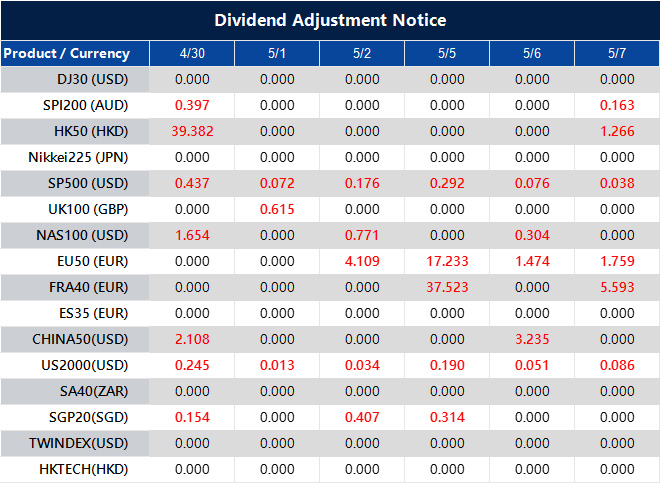

Dividend Adjustment Notice – Apr 30 ,2025

Dear Client,

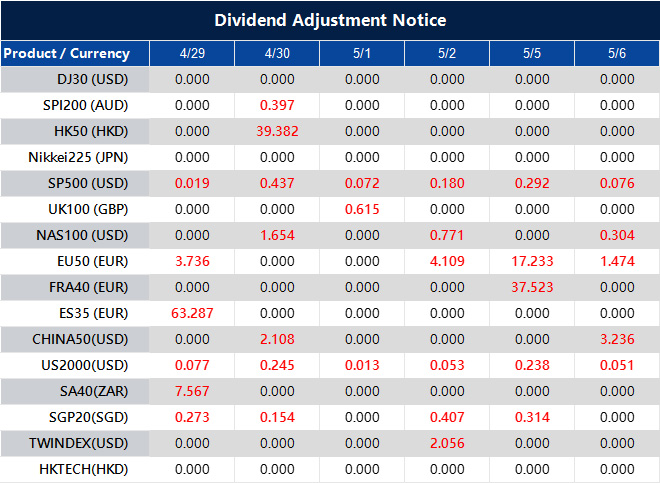
Please note that the dividends of the following products will be adjusted accordingly. Index dividends will be executed separately through a balance statement directly to your trading account, and the comment will be in the following format “Div & Product Name & Net Volume”.

Please refer to the table below for more details:

Dividend Adjustment Notice

The above data is for reference only, please refer to the MT4/MT5 software for specific data.

If you’d like more information, please don’t hesitate to contact info@vtmarkets.com.

Notification of Trading Adjustment in Holiday – Apr 30 ,2025

Dear Client,

Affected by international holidays, the trading hours of some VT Markets products will be adjusted. Please check the following link for the affected products:

Notification of Trading Adjustment in Holiday

Note: The dash sign (-) indicates normal trading hours.

Friendly Reminder:
The above data is for reference only, please refer to the MT4/MT5 software for specific data.

If you’d like more information, please don’t hesitate to contact info@vtmarkets.com

Forex market analysis: 29 April 2025

Gold prices are under pressure as global investors shift focus away from safe-haven assets, responding to signs of easing geopolitical risks and improved trade prospects. With fresh optimism in the air and a stronger US dollar offering an alternative refuge, market sentiment is tilting towards risk-taking, prompting a short-term pullback in gold demand.

Gold price dips as safe-haven demand softens

Gold prices edged lower on Monday as appetite for safe-haven assets declined following a shift in global trade sentiment.

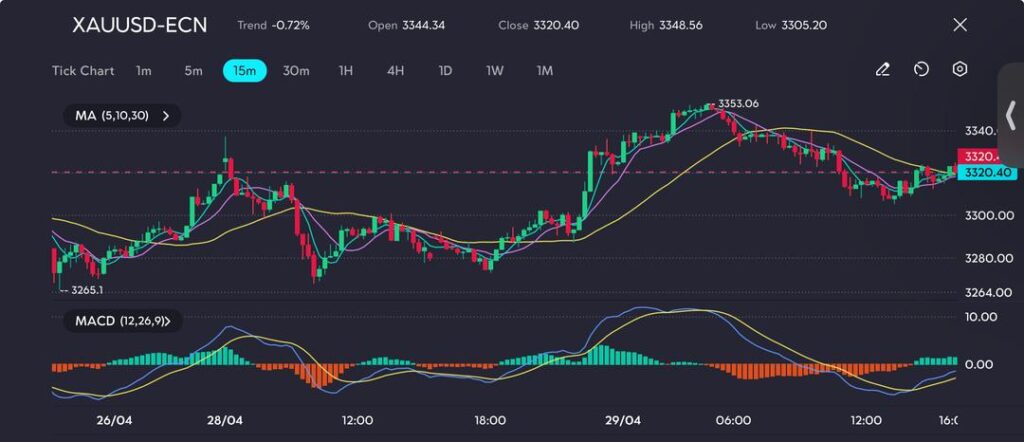
Spot gold (XAU/USD) fell by approximately 0.5%, settling near USD 3,320 after reaching an intraday high of USD 3,348.56.

The decline follows fresh optimism surrounding United States trade talks—not with China, but with 17 other international partners.

Analysts at ING suggest that China’s absence from the negotiation table may temporarily reduce market tensions and increase risk appetite, drawing capital away from traditionally defensive assets such as gold.

Adding to the pressure, the strengthening US dollar has made gold more expensive for overseas investors, further curbing demand.

As the dollar gains favour as a competing safe-haven, gold’s appeal may continue to wane in the near term.

Technical analysis: Short-term bias remains bearish for XAU/USD

Gold is currently under renewed downside pressure, with XAU/USD slipping from a recent peak of 3,353.06 to around 3,320.40.

Gold extends losses below short-term averages as downside pressure lingers, as seen on the VT Markets app.

Short-term moving averages (5, 10, 30) are trending lower, forming a bearish crossover that suggests sellers maintain control.

Momentum indicators such as the MACD show a widening negative histogram, though recent bars indicate that the selling momentum may be slowing.

If the support zone near 3,305.20 holds, a temporary rebound is possible. However, failure to defend this level could open the door to a further pullback toward the 3,280–3,265 range.

While the immediate trend remains bearish, the 15-minute chart suggests that gold may be entering slightly oversold conditions, hinting at a potential pause in the sell-off.

Outlook: Long-term fundamentals still support gold

Despite the recent decline, gold prices remain over 25% higher year-to-date, buoyed by persistent macroeconomic uncertainty and unpredictable shifts in US policy.

ING notes that continued inflows into gold-backed ETFs and rising central bank gold reserves underpin strong long-term demand.

Extended concerns over US-China trade relations and broader economic fragility are expected to reinforce gold’s role as a long-term hedge against volatility.

While short-term weakness may persist, the broader uptrend in gold remains intact.

Click here to open account and start trading.

Dividend Adjustment Notice – Apr 29 ,2025

Dear Client,

Please note that the dividends of the following products will be adjusted accordingly. Index dividends will be executed separately through a balance statement directly to your trading account, and the comment will be in the following format “Div & Product Name & Net Volume”.

Please refer to the table below for more details:

Dividend Adjustment Notice

The above data is for reference only, please refer to the MT4/MT5 software for specific data.

If you’d like more information, please don’t hesitate to contact info@vtmarkets.com.

Forex market analysis: 28 April 2025

The euro has been moving within a narrow range as traders look ahead to a week of important economic data and US earnings reports. Key events like eurozone inflation and GDP figures, along with potential shifts in US stocks, could influence the currency’s next move.

Euro remains stuck in narrow range ahead of busy week

The euro remained firmly within a narrow trading range on Monday as currency traders prepared for a week filled with significant macroeconomic data and corporate earnings reports.

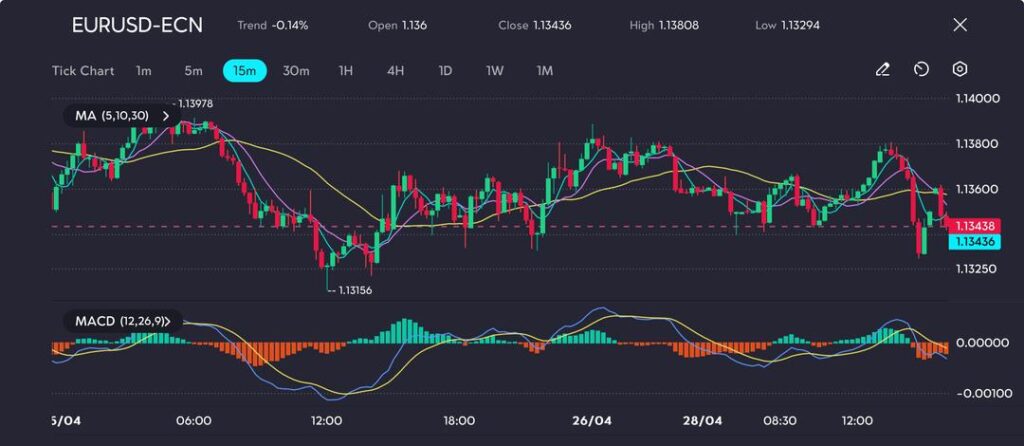
The EUR/USD pair dipped to USD 1.1344, continuing to hover around crucial technical levels without displaying a clear directional trend.

Chris Turner from ING highlighted that the European Central Bank’s upcoming inflation expectation survey, set to be released on Tuesday, could indicate easing price pressures.

However, the core inflation figures for April, due on Friday, may show a slight increase, which could complicate the outlook for monetary policy.

Adding to the cautious sentiment, the first-quarter GDP figures for the eurozone are expected on Wednesday. These numbers will provide a crucial insight into the region’s economic resilience amid growing global uncertainties.

In addition to the European data, earnings reports from major US corporations will take centre stage. High-profile companies like Amazon, Microsoft, Apple, and Meta are all scheduled to announce their results, and significant movements in the stock market could impact the foreign exchange markets.

Turner noted that US equities and the dollar have been positively correlated in recent times, meaning strong tech earnings could lead to a stronger dollar, even if it comes at the euro’s expense.

Technical analysis: EUR/USD shows limited movement

The EUR/USD pair has remained range-bound, trading between 1.13808 and 1.13156 in recent sessions.

Currently, it is hovering around 1.13436, following a sharp drop towards the lower end of the range.

The MACD momentum indicator is shifting into bearish territory, while the 5, 10, and 30-period moving averages are all pointing downward, signalling increasing downside pressure.

EUR/USD struggles to hold ground as downside pressure builds, with sellers testing key range support, as seen on the VT Markets app.

Despite several attempts to break higher, sellers have remained active around the 1.1380 level.

The inability to sustain gains, combined with steady compression near the middle of the range, suggests that a breakout could be imminent.

If the support at 1.1315 is breached, the pair may quickly test the 1.1290 level.

For the short term, the bias is neutral to bearish, unless buyers can reclaim the 1.1360 level with strong upward momentum.

Click here to open account and start trading.

Dividend Adjustment Notice – Apr 28 ,2025

Dear Client,

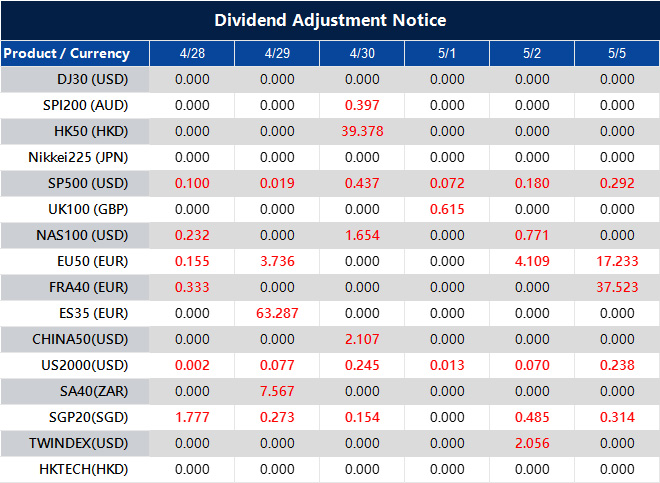
Please note that the dividends of the following products will be adjusted accordingly. Index dividends will be executed separately through a balance statement directly to your trading account, and the comment will be in the following format “Div & Product Name & Net Volume”.

Please refer to the table below for more details:

Dividend Adjustment Notice

The above data is for reference only, please refer to the MT4/MT5 software for specific data.

If you’d like more information, please don’t hesitate to contact info@vtmarkets.com.

Stock Market Opening and Closing Times Globally

Stock Market Trading Hours Around the World: Opening and Closing Times

In today’s fast-paced trading environment, understanding stock market trading hours is essential for maximizing trading opportunities. With exchanges operating across various time zones, traders have nearly constant access to markets. However, knowing the opening and closing hours of stock markets, especially in UK time (GMT), is crucial for planning trades effectively and optimizing results.

Imagine a London-based trader adjusting their positions at 2:30 PM GMT, just as the New York Stock Exchange (NYSE) opens, or an early riser catching key movements in Hong Kong before breakfast. Timing might not be everything, but it’s often the deciding factor between profitable trades and missed opportunities.

What Time Does the Stock Market Open and Close?

Here’s a detailed look at the stock market open times for the world’s 10 largest stock exchanges, all converted to UK time (GMT) for your convenience:

Stock ExchangeMarket Cap (Approximately)Local Trading HoursUK Time (GMT)Major Stock Indices 
London Stock Exchange (LSE)$4.1 trillion8:00 AM – 4:30 PM GMT8:00 AM – 4:30 PMFTSE 100, FTSE 250
New York Stock Exchange (NYSE)$30 trillion9:30 AM – 4:00 PM ET2:30 PM – 9:00 PMDow Jones Industrial Average (DJIA), S&P 500
NASDAQ$20 trillion9:30 AM – 4:00 PM ET2:30 PM – 9:00 PMNasdaq Composite, Nasdaq-100
Shanghai Stock Exchange (SSE)$7 trillion9:30 AM – 3:00 PM CST1:30 AM – 7:00 AMSSE Composite Index, SSE 50 Index
Euronext (Paris, Amsterdam, Brussels)$6.5 trillion9:00 AM – 5:30 PM CET8:00 AM – 4:30 PMCAC 40 (France), AEX (Netherlands), BEL 20 (Belgium)
Hong Kong Stock Exchange (HKEX)$5.7 trillion9:30 AM – 4:00 PM HKT1:30 AM – 8:00 AMHang Seng Index (HSI)
Tokyo Stock Exchange (TSE)$5.6 trillion9:00 AM – 3:00 PM JST12:00 AM – 6:00 AMNikkei 225, TOPIX
Shenzhen Stock Exchange (SZSE)$5 trillion9:30 AM – 3:00 PM CST1:30 AM – 7:00 AMSZSE Component Index, ChiNext Index
Bombay Stock Exchange (BSE)$3.8 trillion9:15 AM – 3:30 PM IST3:45 AM – 10:00 AMBSE Sensex (S&P BSE SENSEX)
National Stock Exchange of India (NSE)$3.7 trillion9:15 AM – 3:30 PM IST3:45 AM – 10:00 AMNIFTY 50

Global Stock Market Trading Hours: A Regional Breakdown

Understanding the trading hours of global stock exchanges is crucial for traders who want to stay ahead of the market. By knowing the trading hours in North America, Europe, Asia-Pacific, and South Asia, you can strategically plan your trades and optimize your market participation. Below, we break down the key stock market trading hours for the most prominent stock exchanges across these regions, helping you navigate global markets with confidence.

Trading Hours in North America

North America is home to some of the most influential stock exchanges in the world, including the New York Stock Exchange (NYSE) and NASDAQ, both located in the United States. The NYSA opening hours are from 9:30 AM to 4:00 PM ET (2:30 PM to 9:00 PM GMT), Monday through Friday. The NASDAQ opening hours are identical, providing a combined window of opportunity for traders looking to execute trades on either platform.

Both exchanges also offer extended hours trading between 4:00 PM and 8:00 PM ET (9:00 PM to 1:00 AM GMT), giving traders the chance to continue executing orders even after the official closing bell. However, trading outside regular hours comes with added risks, as lower market participation can result in decreased liquidity and potentially less favorable prices. After-hours trading on both exchanges primarily relies on automated systems to match buyers and sellers.

These exchanges close for public holidays, including significant dates like Thanksgiving (fourth Thursday of November), New Year’s Day (1 January), Independence Day (4 July), and President’s Day (third Monday of February), which can impact global trading volumes.

Trading Hours in Europe

Europe boasts two major stock exchanges: the London Stock Exchange (LSE) and Euronext, which operates across several countries including France, the Netherlands, and Belgium. The London Stock Exchange opening hours are from 8:00 AM to 4:30 PM GMT, providing a key trading window for European investors.

The Euronext opening hours are similar, operating from 9:00 AM to 5:30 PM CET (8:00 AM to 4:30 PM GMT). This exchange includes multiple countries, with Paris, Amsterdam, and Brussels being among the most prominent locations for European trading.

Public holidays like Christmas and New Year’s Day will see these exchanges close, along with Good Friday and Labour Day in many European countries, affecting liquidity and market movement.

Both exchanges provide ample opportunity for traders, with active periods during the day often seeing the highest trading volumes, especially between 8:00 AM and 10:00 AM GMT for the LSE, when traders react to global news and economic data.

Trading Hours in Asia-Pacific

The Asia-Pacific region is home to many important stock exchanges, including the Shanghai Stock Exchange (SSE), Hong Kong Stock Exchange (HKEX), Tokyo Stock Exchange (TSE), and Shenzhen Stock Exchange (SZSE). Each of these exchanges operates according to its local timezone but offers overlapping trading hours for a window of global market engagement.

The SSE opening hours are from 9:30 AM to 3:00 PM CST (1:30 AM to 7:00 AM GMT), with a break for lunch. HKEX trading hours are 9:30 AM to 4:00 PM HKT (1:30 AM to 8:00 AM GMT), providing key access to Chinese and Asian stocks, including well-known companies like Tencent and Alibaba.

Meanwhile, the TSE opening hours run from 9:00 AM to 3:00 PM JST (12:00 AM to 6:00 AM GMT), allowing access to major Japanese companies such as Toyota and Sony. Like the others in the region, SZSE operates from 9:30 AM to 3:00 PM CST (1:30 AM to 7:00 AM GMT).

Although markets in Asia close on public holidays like Chinese New Year and Obon in Japan, the region remains active and continues to play a crucial role in global market dynamics. Trading often peaks in the morning session before a lunch break, with lower activity resuming in the afternoon.

Trading Hours in South Asia

South Asia is represented by two major stock exchanges in India: the Bombay Stock Exchange (BSE) and the National Stock Exchange of India (NSE). Both exchanges offer trading from 9:15 AM to 3:30 PM IST (3:45 AM to 10:00 AM GMT), giving investors in India ample time to trade.

The BSE Sensex and NIFTY 50 are two key indices that reflect the performance of the Indian market, and they operate within these hours. Public holidays such as Diwali and Republic Day lead to the closure of these exchanges, often resulting in lower market participation during these periods.

How to Trade in the Stock Market

Once you know the opening times of stock market sessions worldwide, you can start planning your trading strategies more effectively. Here’s a simple step-by-step guide:

Step 1: Understand the Stock Market

Before diving into stock market trading, it’s important to have a solid understanding of how the market works. Familiarize yourself with concepts like stock prices, market indices, trading hours, and economic factors that influence the market.

Step 2: Choose a Reliable Broker

Selecting a trusted broker is key to successful trading. Ensure the broker offers the tools, platforms, and resources you need to trade confidently. Look for competitive spreads, low fees, and strong customer support.

Step 3: Open a Trading Account

Once you’ve chosen a broker, you’ll need to open a trading account. This involves providing personal details and financial information. Most brokers offer easy-to-use platforms for both beginners and experienced traders.

Step 4: Pick a Suitable Time and Strategy

Timing and strategy are critical in the stock market. Choose the right time based on market hours and liquidity. Develop a trading strategy that suits your risk tolerance, whether it’s day trading, swing trading, or long-term investing.

Step 5: Implement Risk Management Tools

To protect your investments, always use risk management tools such as stop-loss orders and take-profit levels. This helps limit potential losses and lock in profits, allowing for more controlled risk exposure.

Step 6: Stay Informed and Focused

Stay updated on market news, economic events, and the performance of your chosen stocks. Keeping informed will help you make timely decisions. Additionally, stay focused and disciplined to avoid emotional trading mistakes.

New to trading? Discover how to start trading for beginners.

Conclusion

Having a clear understanding of global stock market trading hours is essential for traders looking to maximize opportunities and minimize risks. By knowing the opening and closing hours of major exchanges across North America, Europe, Asia-Pacific, and South Asia, you can plan your trades more effectively and take advantage of high-liquidity periods. 

Whether you’re navigating the bustling markets of New York or Tokyo, or aligning your trading strategies with the trading hours in London or Mumbai, timing is a critical factor in your trading success. By staying informed and adjusting your approach according to regional market hours, you can ensure that you’re always one step ahead in the dynamic world of global trading.

Start Trading at the Right Time with VT Markets

At VT Markets, we provide traders with the tools they need to maximize stock market trading hours. Our platform ensures that you stay updated with the opening hours of stock markets worldwide. Whether you focus on the London Stock Exchange opening hours or plan your trades based on the New York Stock Exchange closing hours, we offer the flexibility and insights to help you succeed.

With access to real-time market data, fast execution, and competitive spreads, VT Markets empowers you to execute your trades during the most active and liquid times of the day. Whether you use MetaTrader 4 or MetaTrader 5, our platform ensures that your strategy thrives during key market hours, giving you a competitive edge.

Start trading with VT Markets today and take a smarter approach to navigating stock market opening and closing times, because timing is everything in trading.

Frequently Asked Questions (FAQs)

1. What time does the London Stock Exchange open?

The London Stock Exchange (LSE) opens at 8:00 AM GMT and closes at 4:30 PM GMT on weekdays.

2. What time does the NASDAQ Stock Exchange open?

The NASDAQ Stock Exchange opens at 9:30 AM ET, which is 2:30 PM GMT, and closes at 4:00 PM ET (9:00 PM GMT).

3. What time does the New York Stock Exchange open?

The New York Stock Exchange (NYSE) opens at 9:30 AM ET, or 2:30 PM GMT, and closes at 4:00 PM ET (9:00 PM GMT).

4. What time does the Hong Kong Stock Exchange (HKEX) open?

The Hong Kong Stock Exchange (HKEX) opens at 9:30 AM HKT, or 1:30 AM GMT, and closes at 4:00 PM HKT (8:00 AM GMT).

5. Can I trade after the market closes?

Yes, many exchanges offer after-hours trading. For instance, the NYSE and NASDAQ provide extended hours trading from 4:00 PM to 8:00 PM ET (9:00 PM to 1:00 AM GMT), but with reduced liquidity and potential risks.

6. How do market holidays affect trading hours?

Stock markets are closed on public holidays, such as Christmas, New Year’s Day, and Thanksgiving. This can lead to lower trading volumes and less market activity, affecting overall liquidity.

Week ahead: Market brace for Fed’s rate shakeup

During the week of 28 April to 2 May 2025, several key economic indicators and events are anticipated to influence financial markets, including crucial data on US labour market conditions, inflation, and GDP growth. Central bank decisions and global trade developments are also expected to drive volatility, with market participants closely monitoring policy shifts and economic outlooks from both the Federal Reserve and the European Central Bank.

KEY INDICATORS

Global trade and tariff developments

  • US media report that Trump is considering a tiered tariff system on China, according to CCTV.
  • The White House says Trump’s stance on China tariffs remains unchanged.
  • South Korea’s finance minister says a consensus has been reached with the US on tariffs, non-tariff barriers, economic security, investment cooperation, and monetary policy.
  • The White House NEC director says top-level tax negotiators are scheduled to meet next week.

Central bank signals and economic outlooks

  • Fed’s Harker says the central bank may cut rates in June if economic data become clearer.
  • Fed’s Waller says clarity on the economic impact of tariffs may emerge by July and rate cuts could follow if unemployment rises.
  • Atlanta Fed GDPNow estimates Q1 US GDP growth at -2.5%.
  • Fed’s Kashkari says constant announcements from Washington pose challenges for both policymakers and the public.
  • ECB Governing Council member Rehn says the central bank should not rule out the possibility of deeper rate cuts.
  • The ECB will hold a strategy meeting on 6–7 May to discuss a potential shift towards more flexible policies.

Economic data from the US and Germany

  • US initial jobless claims for the week ending 19 April were 222,000, in line with expectations.
  • US durable goods orders rose 9.2% month-on-month in March, the largest increase since July 2024.
  • The German government now forecasts 0% economic growth in 2025, down from a previous projection of +0.3%.
  • Germany’s inflation is projected to fall to 2.0% in 2025 and 1.9% in 2026.

MARKET MOVERS

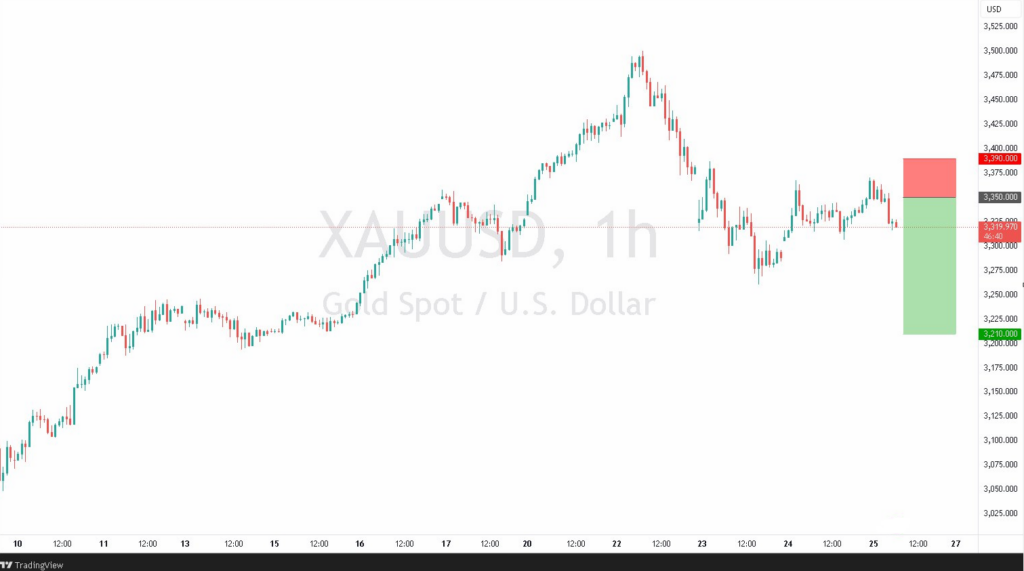
XAU/USD

  • Although the bulls are in control, the stalling positive momentum indicates a turnaround is possible.
  • While the bulls maintain control, fading upside momentum suggests a potential reversal.
  • A corrective move lower is anticipated.
  • A short-term bounce may occur before the next leg down.
  • Our preferred strategy is to sell into strength.
  • Key resistance is identified at 3,350.0.

Trade opportunity: Target 1: 3,210 / Target 2: 3,200.

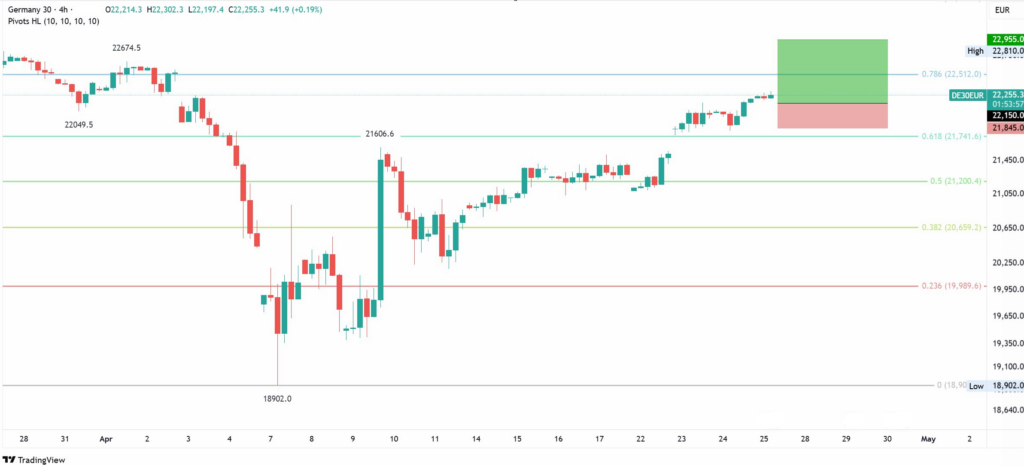
DAX40

  • Short-term bias has shifted to the upside.
  • The market has posted four consecutive daily gains.
  • There are no clear signs of exhaustion in the current uptrend.
  • An attractive risk/reward setup for initiating long positions at market.
  • The 20-period 1-hour EMA is currently positioned at 22,150.

Trade opportunity: Target 1: 22,955 / Target 2: 23,055.

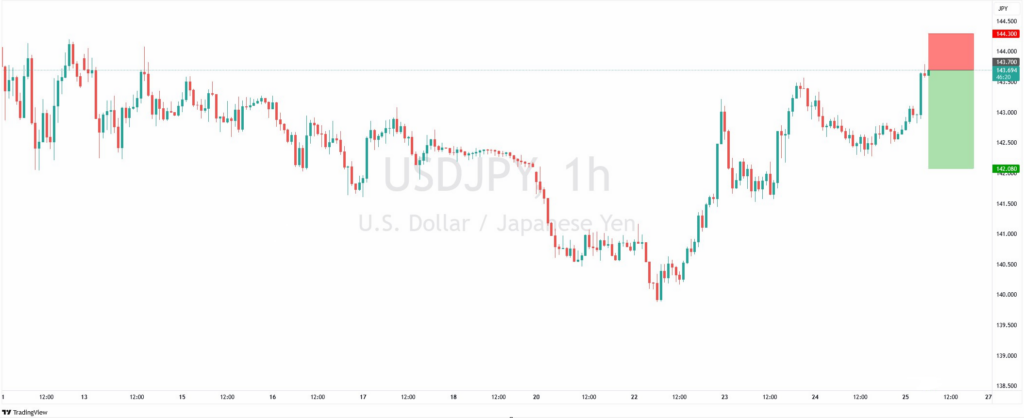
USD/JPY

  • Registered modest daily gains, though price action remained within the prior day’s range — forming an indecisive inside day.
  • Custom resistance is seen at 143.83.
  • The 261.8% Fibonacci extension (from 142.28 to 142.84) aligns at 143.71.
  • While the expected move lower is corrective in nature, it presents a compelling risk/reward opportunity today.
  • Medium-term bias remains neutral.

Trade opportunity: Target 1: 142.08 / Target 2: 141.50.

NEWS HEADLINES

US dollar weakens amid market adjustments

  • The US dollar eased after a two-day rebound, with the Dollar Index retreating to 99.30.
  • EUR/USD gained 80 pips, advancing to 1.1393.
  • USD/JPY declined 87 pips, settling at 142.57.
  • GBP/USD climbed 89 pips to 1.3344.
  • AUD/USD strengthened by 50 pips, reaching 0.6409.
  • USD/CHF edged down 39 pips to 0.8269.
  • USD/CAD slipped 37 pips, trading at 1.3843.

US stocks soar on strong earnings and economic data

  • US stocks rallied for a third consecutive session on Thursday.
  • Dow Jones rose 486 points (+1.23%) to 40,093.
  • S&P 500 gained 108 points (+2.03%) to 5,484.
  • Nasdaq 100 jumped 521 points (+2.79%) to 19,214.
  • Nvidia, Tesla, Microsoft, and Amazon each gained over 3%.
  • Alphabet rose 2.53% and surged over 4% after-hours following strong earnings and a USD 70bn buyback plan.
  • The US 10-year yield fell 7 basis points to 4.313%, continuing its decline.
  • Durable goods orders surged 9.2% in March (vs. +1.7% expected).
  • Existing home sales dropped 5.9% (vs. -1.9% expected), marking the steepest decline since late 2022.
  • European stock indices edged higher: DAX +0.47%, CAC 40 +0.27%, FTSE 100 +0.05%.
  • WTI crude rose USD 0.52 to USD 62.79/bbl.

Market reacts to Japan’s inflation and global moves

  • During the Asian session, USD/JPY rebounded to 142.95 after Tokyo CPI rose 3.5% year-on-year in April (vs. 3.1% expected).
  • EUR/USD pulled back to 1.1347, while GBP/USD slipped to 1.3305.
  • Gold rebounded USD 60 (+1.85%) to USD 3,349/oz, ending a two-day decline and holding steady around USD 3,348.

KEY ECONOMIC EVENTS

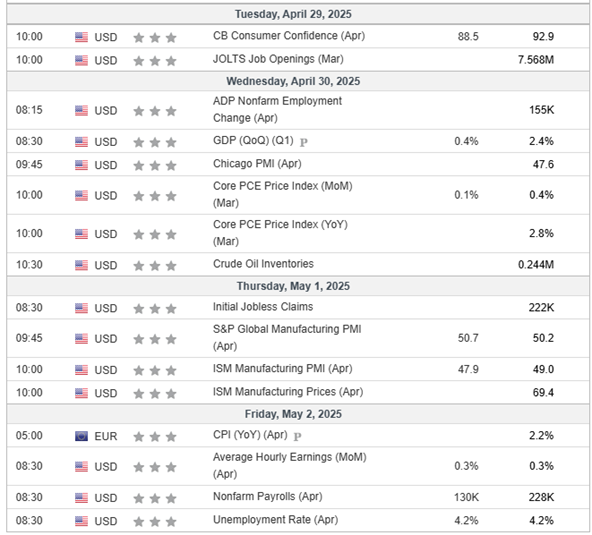
Traders should brace for a data-heavy week ahead, with key releases including US non-farm payrolls, ISM manufacturing and services PMIs, and Eurozone inflation figures—all of which could significantly shape market expectations around central bank policy moves. Stay alert for volatility, especially around labour market and inflation-related surprises.

Tuesday, 29 April

  • German Preliminary CPI (MoM): A critical indicator for assessing inflation trends in the Eurozone’s largest economy.
  • US CB Consumer Confidence: Provides insights into consumer sentiment and potential spending behaviours.

Wednesday, 30 April

  • US ADP Non-Farm Employment change: Offers an early look at private sector employment trends ahead of the official jobs report.
  • US Advance GDP (Q1): Initial estimate of economic growth for the first quarter, influencing market expectations.
  • US Core PCE Price Index (MoM): The Federal Reserve’s preferred inflation measure, critical for monetary policy decisions.
  • Bank of Japan monetary policy meeting (Day 1): Commencement of the BOJ’s two-day policy meeting, with potential implications for global markets.

Thursday, 1 May

  • Bank of Japan interest rate decision: Conclusion of the BOJ’s policy meeting, with announcements on interest rates and economic forecasts.
  • US ISM Manufacturing PMI: Measures manufacturing sector activity, a key indicator of economic health.
  • US Unemployment Claims: Weekly data on jobless claims, providing insights into labour market conditions.
  • Bank holidays: Markets in China, Switzerland, France, Germany, and Italy will be closed, potentially leading to reduced liquidity.

Friday, 2 May

  • US Non-Farm Payrolls (April): The most anticipated labour market report, influencing Federal Reserve policy and market sentiment.
  • US Unemployment Rate: Provides the overall unemployment figure, complementing the NFP data.
  • US Average Hourly Earnings (MoM): Indicates wage growth, a key factor in inflation and consumer spending.
  • Eurozone Flash CPI (YoY): Preliminary inflation data for the Eurozone, essential for ECB policy considerations.
  • Final Manufacturing PMI (Eurozone & UK): Final readings on manufacturing activity, reflecting economic momentum.

Click here to open account and start trading.

Into Tomorrow: VT Markets’ Next Chapter in Trading Innovation

Marking 10 years with exclusive initiatives throughout the year

28 April, 2025 – Sydney, Australia VT Markets, a leading multi-asset brokerage, is proud to celebrate its 10th year in the industry. Over the past decade, VT Markets has redefined the landscape of trading to deliver unmatched value to its customers. Looking to the future, VT Markets embraces the theme “Into Tomorrow,” symbolizing our commitment to the next stage of growth and transformation.

A Decade of Evolution and Growth

Since its inception, VT Markets is driven by a clear vision: to innovate and transform the way people trade. From the pioneering of cutting-edge trading technology to the expansion into global markets, VT Markets has always stayed ahead of the curve. The past decade has been a story of transformation—each milestone has played a pivotal role in shaping the company into its success today.

Into Tomorrow, Together

Looking ahead,  VT Markets is driven by a renewed sense of purpose. The theme “Into Tomorrow” symbolizes a journey toward the future and a commitment to navigating it with boldness, continually innovating, and reimagining what is possible. Over the next 2-3 years, VT Markets is poised for remarkable growth, with plans to expand its global reach, launch new cutting-edge products, and establish its foothold in emerging markets. The company is determined to explore uncharted territories, set new standards, and reshape the trading landscape, all while remaining true to its commitment to delivering exceptional value to its clients and partners.

“As VT Markets celebrates a decade of growth, we take pride in the foundation we’ve built—one rooted in innovation, trust, and a shared vision to transform the trading experience. This anniversary is a powerful reminder of our commitment to not only evolve as a brand, but to continuously set new benchmarks in the industry. Moving forward, we’re focused on expanding our impact, forging new paths, and delivering exceptional value for our clients and partners around the world.”

– Dandelyn Koh, Global Brand and PR Lead, VT Markets

Celebrating with Exclusive Initiatives

VT Markets first unveiled its 10th anniversary festivities to clients and partners during its Gala Dinner, ” A Billionaire’s Odyssey”, held in Bangkok, Thailand. To commemorate this monumental year, VT Markets will be launching a series of exciting initiatives throughout the year that will engage, inspire, and commemorate.

  • Global Trading Competition: An exciting trading competition inviting traders from around the world to showcase their skills and compete for incredible prizes, reinforcing VT Markets’ commitment to empowering traders at every level.
  • Limited-Edition Merchandise: Exclusive line-up of collectibles to celebrate with our community
  • Branded Content and Promotions: Attractive promotions, and exclusive offers for our community to celebrate the customers who have made this journey possible.
  • Commemorative Video: A tribute to VT Markets’ journey, showcasing key milestones and transformations.

These exciting launches will unfold progressively throughout the year, and details of each will be unveiled on vt10.com and VT Markets’ social media channels.

A Call to the Future

As VT Markets looks ahead, our way forward is of bold ambition, exploration, and innovation. Together, VT Markets will continue to push boundaries, reimagine possibilities, and create new opportunities for everyone it works with. Join us as we step boldly “Into Tomorrow.”

About VT Markets

VT Markets is a regulated multi-asset broker with a presence in over 160 countries as of today. It has earned numerous international accolades including Best Online Trading and Fastest Growing Broker. In line with its mission to make trading accessible to all, VT Markets offers comprehensive access to over 1,000 financial instruments and clients benefit from a seamless trading experience via its award-winning mobile application.

For more information, please visit the official VT Markets website or email us at info@vtmarkets.com. Alternatively, follow VT Markets on Facebook, Instagram, or LinkedIn.

For media enquiries and sponsorship opportunities, please email media@vtmarkets.com, or contact:

Dandelyn Koh 

Global Brand & PR Lead

dandelyn.koh@vtmarkets.com  

Brenda Wong 

Assistant Manager, Global PR & Communications

brenda.wong@vtmarkets.com 

Back To Top
server

Hello there 👋

How can I help you?

Chat with our team instantly

Live Chat

Start a live conversation through...

  • Telegram
    hold On hold
  • Coming Soon...

Hello there 👋

How can I help you?

telegram

Scan the QR code with your smartphone to start a chat with us, or click here.

Don’t have the Telegram App or Desktop installed? Use Web Telegram instead.

QR code