Back

Important Forex Terms That Every Trader Should Know

THE WORLD OF FOREX TERMS FOR EVERY TRADER

Embarking on a journey into the world of Forex trading can be both exciting and overwhelming. The key to navigating this dynamic market confidently lies in understanding its unique language. This article demystifies the essential terms every Forex trader should know, paving the way for informed and strategic trading decisions.

1. Pips: Precision in Forex Pricing

A ‘pip’ is the smallest price movement in the currency market and is essential in measuring gains or losses. In most currency pairs, a pip represents a one ten-thousandth movement (0.0001) in the exchange rate. For example, if the EUR/USD pair moves from 1.1050 to 1.1051, that 0.0001 USD rise is one pip.

2. Lot Size: The Building Blocks of Forex

Lot size refers to the number of currency units you’re trading. In Forex, a standard lot represents 100,000 units of the base currency. However, for individual traders, mini (10,000 units) and micro (1,000 units) lots are also commonly used, providing flexibility and risk management options.

3. Leverage: Amplifying Your Trading Power

Leverage in Forex allows traders to gain a larger exposure to the market than what their initial capital would permit. It’s essentially a loan provided by the broker, enabling traders to open larger positions. High leverage can magnify profits but also losses, making it a double-edged sword.

4. Margin: The Key to Leveraged Trading

Margin is the amount of capital required to open and maintain a leveraged position. It’s a fraction of the full value of your trade. Margin trading allows you to make significant trades with a relatively small investment, yet it increases the potential for both profits and losses.

Discover Forex Basics In This Article

5. Spread: The Cost of a Forex Trade

The spread is the difference between the bid (sell) price and the ask (buy) price of a currency pair. It’s essentially the broker’s fee for executing your trade. Narrower spreads usually mean lower trading costs, making them preferable for traders.

6. Bid and Ask: The Two-Way Price Quotes

In Forex, every currency pair has a bid price and an ask price. The bid price is the price at which you can sell the base currency, while the ask is the price at which you can buy it. The difference between these two prices is the spread.

7. Stop-Loss Order: Managing Trading Risks

A stop-loss order is an automatic order to close a trade at a specific price to prevent further losses if the market moves against your position. It’s a crucial risk management tool, helping traders to control potential losses on their positions.

8. Take Profit Order: Locking in Profits

Opposite to the stop-loss, a take profit order automatically closes your trade when it reaches a predetermined profit level. It ensures that a profitable position doesn’t turn into a loss, especially in volatile markets where changes can happen rapidly.

9. Currency Pair: The Foundation of Forex Trading

Currency pairs represent two different currencies, with the value of one currency quoted against the other. The first currency listed (base currency) is the one being bought or sold against the second currency (quote currency), like EUR/USD or USD/JPY.

10. Bull and Bear Markets: Understanding Market Sentiments

Bull Market: This term describes a financial market in which prices are rising or expected to rise. In a bullish Forex market, traders generally buy in anticipation of future price increases.

Bear Market: Conversely, a bear market indicates declining prices. Traders might sell or short-sell currencies expecting further decreases.

11. Fundamental Analysis: Gauging Currency Value

Fundamental analysis involves evaluating a currency’s value by examining related economic, social, and political factors. This includes GDP growth, interest rates, inflation, and political stability, influencing traders’ decisions on currency positions.

Test Your Trading Skills with VT Forex Demo Account

12. Technical Analysis: Predicting Price Movements

Technical analysis is the study of historical market data, primarily price and volume, to forecast future market behavior. Traders use various tools like charts, trend lines, and indicators such as moving averages and Bollinger Bands.

13. Swap: The Cost of Holding a Position Overnight

A swap in Forex is the interest paid or earned for holding a position overnight. This rate varies depending on the currency pair and the difference in interest rates between the two currencies involved.

14. Volatility: The Measure of Market Fluctuations

Volatility refers to the frequency and magnitude of price movements in the Forex market. High volatility means significant price movements within a short time, offering both high-risk and high-reward trading opportunities.

15. Economic Calendar: Tracking Market-Moving Events

The economic calendar lists scheduled financial events such as central bank meetings, economic indicator releases, and government reports. These events can significantly impact currency markets, and traders often plan their strategies around them.

16. Order Book: A Window into Market Activity

An order book is a list showing the number of buy and sell orders for a currency pair at different prices. It provides valuable insights into potential support and resistance levels and overall market depth.

17. Scalping: A Rapid Trading Strategy

Scalping is a trading strategy that involves making numerous trades over a short period, often just a few minutes, aiming to profit from small price changes. This high-intensity approach requires quick decision-making and constant market monitoring.

Learn More About Forex With VT Markets

18. Carry Trade: Profit from Interest Rate Differentials

Carry trade is a strategy where a trader borrows a currency with a low-interest rate and uses it to buy a currency with a higher interest rate. The trader profits from the interest rate differential as long as the exchange rate doesn’t move unfavorably.

19. Hedging: Reducing Risk Exposure

Hedging in Forex is a strategy used to protect one’s position from an adverse move in currency pairs. It involves opening additional positions to offset potential losses.

20. Liquidity: The Ease of Buying and Selling

Liquidity in the Forex market refers to the ability to buy or sell assets without causing a significant price change. Highly liquid markets allow for faster and larger transactions with minimal price impact.

21. Broker: Your Gateway to the Forex Market

A Forex broker is an intermediary between you and the interbank system. Brokers provide platforms and tools for executing trades in the Forex market.

22. Sentiment Analysis: Gauging Market Mood

Sentiment analysis involves assessing the overall attitude of the market participants towards a particular currency pair, helping traders understand potential future movements.

23. Drawdown: Understanding Trading Losses

Drawdown refers to the reduction of one’s trading capital after a series of losing trades. It’s an important metric for assessing risk and trading performance.

Your Forex Journey with VT Markets

Mastering these terms is key to understanding the complexities of Forex trading. With VT Markets, you can apply this knowledge on a platform that offers advanced trading tools, educational resources, and expert insights. Visit VT Markets for a comprehensive trading experience.
S&P 500 Continues Winning Streak, Tech Giants Propel Communication Sector, and Currency Markets Navigate Fed Rate Cut Speculations

The stock market witnessed a persistent upward trend with the S&P 500 maintaining a seven-week winning streak, inching closer to its previous all-time high. While the Dow Jones Industrial Average showed marginal movement, the S&P 500 surged by 0.45%, notably driven by gains in mega-cap tech companies like Meta Platforms and Alphabet. U.S. Steel shares soared by 26% following an acquisition announcement by Japan’s Nippon Steel. December marked robust performance across major indices, spurred by the Federal Reserve’s indication of potential short-term interest rate cuts in 2024 amidst cooling inflation. In the currency market, fluctuations in major pairs like EUR/USD, USD/JPY, Dollar Index, and British Pound were observed, influenced by speculation on rate cuts by central banks and economic indicators impacting their trajectories.

Stock Market Updates

The stock market saw a continuation of its upward trend as the S&P 500 maintained its seven-week winning streak. The Dow Jones Industrial Average experienced marginal movement, edging up by only 0.86 points to 37,306.02, while the S&P 500 climbed by 0.45% to reach 4,740.56, inching closer to its all-time closing high from January 2022, now just 1.2% away. Communication services stood out with a 1.9% increase in the S&P 500, notably driven by gains in mega-cap tech companies like Meta Platforms and Alphabet, which surged nearly 3% and more than 2%, respectively. Additionally, U.S. Steel shares soared by 26% following the announcement of Japan’s Nippon Steel acquiring the company for $14.9 billion.

December showcased robust performance across major indices, with the S&P 500 up by 3.8% for the month, while the Dow and Nasdaq rose by 3.8% and 4.8%, respectively. The positive investor sentiment stemmed from the Federal Reserve’s indication of expecting three short-term interest rate cuts in 2024, given the backdrop of cooling inflation. This sentiment shift led to a drop in Treasury yields, with the 10-year Treasury yield dipping below the 4% mark, further contributing to the market’s positive trajectory.

Data by Bloomberg

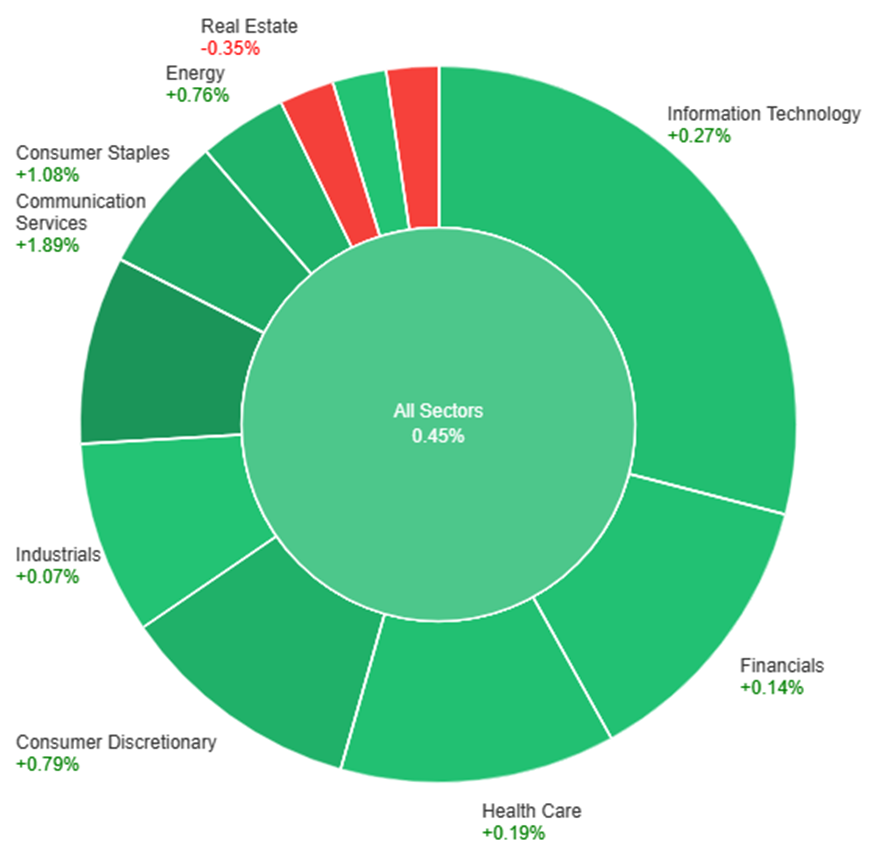
On Monday, the overall market saw a positive trend, with a collective rise of 0.45% across all sectors. Notably, Communication Services performed exceptionally well, soaring by 1.89%, followed by strong gains in Consumer Staples at 1.08% and Consumer Discretionary at 0.79%. Energy and Information Technology also contributed positively with increases of 0.76% and 0.27%, respectively. However, Utilities and Real Estate experienced declines, showing decreases of -0.30% and -0.35%, respectively, marking the only sectors that saw a downturn on that day.

Currency Market Updates

In the recent currency market updates, the focus was primarily on the fluctuations of major currency pairs, notably the EUR/USD and USD/JPY, alongside observations regarding the Dollar Index and the British Pound. The Dollar Index experienced a 0.1% decline amid speculations regarding potential rate cuts by the Fed, ECB, and BoE in 2024. The EUR/USD pair saw a 0.3% rise, influenced by the rebound in Bunds-Treasury yield spreads due to resistance from some ECB policymakers against early 2024 rate cuts. However, the pair faced concerns over German Ifo business sentiment and the risk of a potential recession reading, impacting its trajectory within a specific trading range.

Conversely, USD/JPY observed a 0.5% increase as it continued its recovery from prior plunges, influenced by market uncertainties surrounding aggressive Fed rate cut expectations versus the possibility of a BoJ hike. The broader trend for USD/JPY seemed downward, particularly if the BoJ failed to indicate a move away from negative rates. Meanwhile, the British Pound declined by 0.3%, distancing itself from recent highs following a dovish Fed and hawkish BoE meeting. Focus shifted to the upcoming UK CPI report, while observations noted a bearish divergence from last week’s highs and a strong demand for Sterling at its 200-day moving average, hinting at potential consolidation in the near term.

Picks of the Day Analysis
EUR/USD (4 Hours)

EUR/USD Holds Ground Amidst Dollar Pressure and ECB Speculation

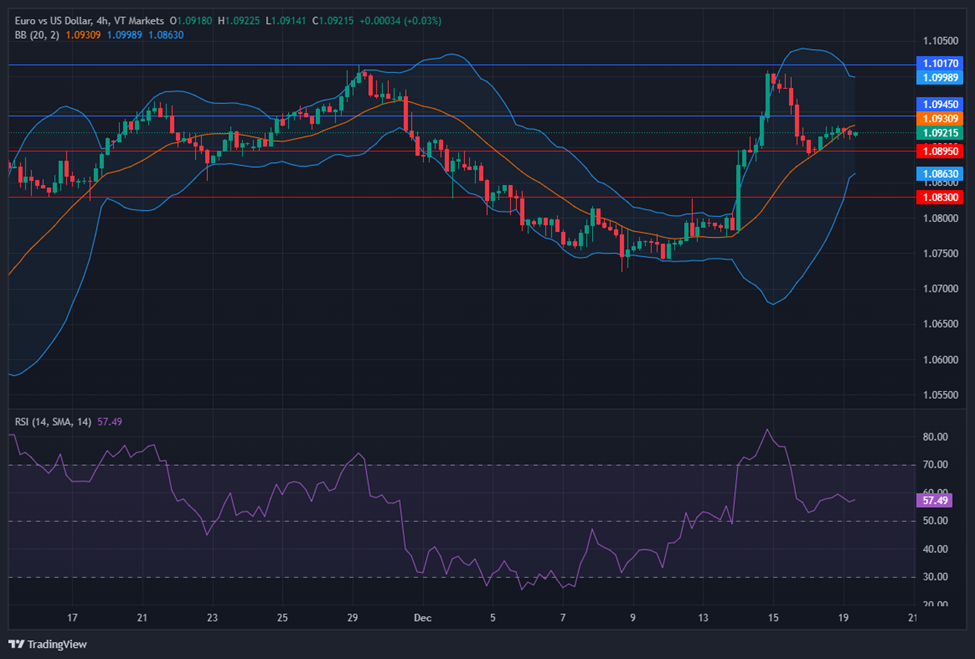
The EUR/USD pair showed resilience, edging up after a recent dip, finding support above the 20-day SMA, and hovering above 1.0900 in a subdued market atmosphere. The US Dollar faced bearish pressures following the Federal Reserve’s dovish tone, although rate cuts seem distant despite initial forecasts. Meanwhile, in the Eurozone, lower-than-expected IFO business survey readings in Germany and steady but moderate inflation figures have raised expectations of potential ECB rate cuts, capping the Euro’s upward momentum below the 1.1030 mark. The market awaits the US Core PCE Price Index report for further cues on the greenback’s trajectory.

Chart EUR/USD by TradingView

On Friday, the EUR/USD moved flat and moved around the middle band of the Bollinger Bands. Currently, the price moving slightly below the middle band, suggesting a potential for another consolidation movement. Notably, the Relative Strength Index (RSI) maintains its position at 57, signaling a neutral but still bullish outlook for this currency pair.

Resistance: 1.0945, 1.1017

Support: 1.0895, 1.0830

XAU/USD (4 Hours)

XAU/USD Maintain Soft Tone Amid Fed’s Stance on Monetary Policy and Market Optimism

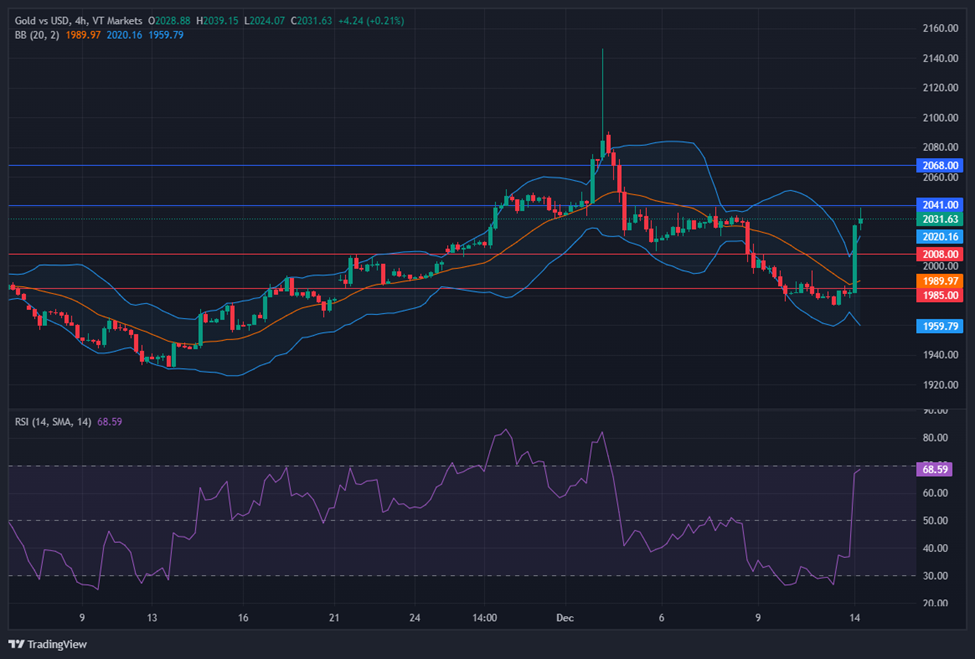
Gold prices for XAU/USD held marginally above Friday’s closure at $2,018.19 per troy ounce despite subdued demand for the US Dollar triggered by softer government bond yields following the Fed’s decision to halt monetary tightening. The Fed’s stance, marking a pivot toward potential rate cuts, caused a retreat in US Treasury yields, notably the 10-year note, which currently stands at 3.95%. Wall Street’s positive performance limited the safe-haven appeal of the Greenback, constraining upward movement for gold. However, as financial markets approach the winter holidays, attention turns to upcoming inflation updates from the UK, Canada, and the Bank of Japan’s monetary policy decision, culminating with the US releasing the Core PCE Price Index, anticipated to show a slight decrease in November’s YoY inflation.

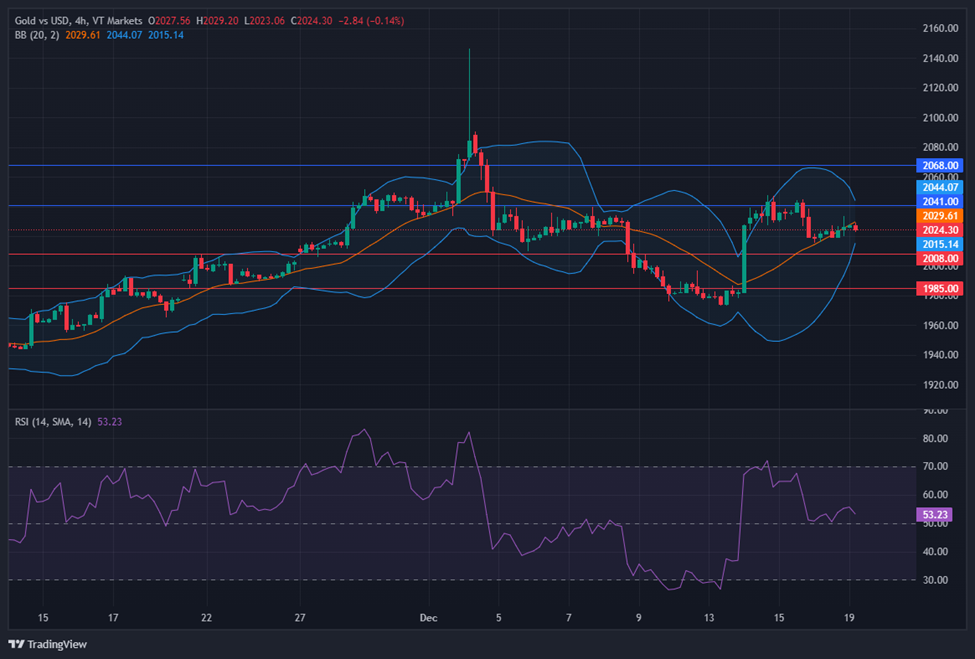
Chart XAU/USD by TradingView

On Friday, XAU/USD moved in consolidation around the middle band of the Bollinger Bands. Currently, the price moving just below the middle band, suggesting a potential consolidation movement. The Relative Strength Index (RSI) stands at 53, signaling a neutral outlook for this pair.

Resistance: $2,041, $2,068

Support: $2,008, $1,985

Economic Data
CurrencyDataTime (GMT + 8)Forecast
JPYBOJ Policy RateTentative 
JPYBOJ Press ConferenceTentative-0.10 (Actual)
CADConsumer Price Index m/m21:30-0.1%

Diversifying Your Portfolio with Gold to Help Spread Risk

Integrating Gold into Your Investment Strategy

Are you looking to make your investment portfolio more robust and resilient in the face of market uncertainties?

If so, consider adding gold to your investment mix. Gold has been a valuable asset for centuries, known for its ability to retain value and act as a hedge against economic downturns.

In this blog post, we’ll explore diversifying your portfolio with gold, and we’ll provide simple examples to help you understand the process.

Why Diversify Your Portfolio

Before we dive into the gold aspect, let’s quickly recap why diversification is crucial. The saying “don’t put all your eggs in one basket” holds true in the world of investments.

By spreading your investments across various asset classes, you can reduce the overall risk in your portfolio. When one asset class underperforms, others may offset the losses, helping you maintain a more stable financial position.

The Role of Gold in Diversification

Gold is often considered a “safe-haven” asset, meaning it tends to perform well when other investments, such as stocks or bonds, are underperforming. This makes gold a valuable addition to your portfolio for risk management.

Let’s say you have a portfolio heavily invested in stocks. If the stock market experiences a significant downturn, the value of your stocks may decrease substantially.

But, if you also hold gold in your portfolio, the price of gold tends to rise during economic crises. This can help offset the losses in your stock investments.

Balancing Your Portfolio with Gold

Now, let’s discuss how to incorporate gold into your portfolio. The key is to find the right balance. You don’t want to allocate all your assets to gold, as that would defeat the purpose of diversification.

Instead, consider allocating a portion of your portfolio to gold, typically around 5% to 10%, depending on your risk tolerance and investment goals.

For instance, if you have a $100,000 investment portfolio, you might allocate $5,000 to $10,000 towards gold investments. This way, you benefit from gold’s stability without overcommitting to a single asset class.

Ways to Invest in Gold

There are several ways to invest in gold, each with its own advantages and considerations. Here are a few common options:

1. Physical Gold:

This includes buying gold coins or bars. While you have the advantage of owning physical gold, you’ll need a safe place to store it, and there may be additional costs associated with purchasing and storing physical gold.

2. Gold ETFs:

Exchange-traded funds (ETFs) that track the price of gold are a convenient way to invest.

Let’s say you want to invest in gold, but you don’t want to store gold bars at home. Instead, you buy shares of a Gold ETF. Each share you buy represents a tiny piece of a big pot of gold owned by the ETF.

So, if the Gold ETF’s price goes up, the value of your shares goes up too. And if the Gold ETF pays out dividends, you get a share of those as well.

It’s like having a piece of gold without needing to keep it in your house or worry about security. Plus, it’s easy to buy and sell Gold ETF shares through your brokerage account, just like trading stocks.

3. Gold Mining Stocks:

Investing in companies engaged in gold mining can provide exposure to the gold market. However, keep in mind that the performance of mining stocks may not always align perfectly with the price of gold itself.

Getting Started with Gold

Now that you understand the basics of diversifying your portfolio with gold, it’s time to take action. Speaking with a financial advisor can help you determine the optimal allocation of gold in your portfolio, aligning with your financial goals and risk tolerance.

A practical next step is to open a demo trading account with a reputable online broker like VT Markets. This allows you to practice trading gold without risking real money, offering a valuable opportunity to understand the dynamics of the gold market before making actual investments.

Week ahead: Markets to focus on Bank of Japan rate decision and UK, Canada inflation data

This week, the market’s focus will primarily revolve around the Bank of Japan’s rate decision. Investors are eagerly anticipating any statements from the bank’s governor Kazuo Ueda, especially after observing the impact of the strong Japanese Yen arising from a weakening US Dollar. In addition to this, consumer price index (CPI) and gross domestic product (GDP) data for various regions will also be released, possibly further affecting the market.

As always, traders are advised to exercise caution as we approach these significant market highlights for the week:

Bank of Japan’s interest rate decision (19 December 2023)

Following its October meeting, the Bank of Japan (BOJ) maintained its key short-term interest rate at -0.1% and held 10-year bond yields steady at approximately 0%.

No changes are expected in the BOJ’s upcoming rate statement, scheduled for release on 19 December.

Canada CPI (19 December 2023)

Canada’s CPI rose by 0.1% month-over-month in October 2023, rebounding from a 0.1% decline in September.

Analysts expect a decrease of 0.2% in the CPI figures for November, scheduled for release on 19 December. 

UK annual CPI (20 December 2023)

The UK’s annual CPI data reflected a decline in the UK’s inflation rate, from 6.7% in August and September 2023 to 4.6% in October 2023.

Analysts expect the UK’s annual CPI to drop further to 4.3% in the next set of updated figures, scheduled for release on 20 December.

US final GDP (21 December 2023)

The US economy saw an annualised expansion of 5.2% in Q3 2023, surpassing a preliminary estimate of 4.9% and marking the strongest growth since Q4 2021.

Analysts expect a 5.2% expansion in the US economy to be confirmed following the release of updated GDP data on 21 December. 

UK retail sales (22 December 2023)

Retail sales in the UK declined by 0.3% month-over-month in October 2023 following a revised 1.1% decrease in September.

Analysts expect a 0.5% increase in the next set of UK retail sales figures, scheduled for release on 22 December.

Canada GDP (22 December 2023)

The Canadian economy grew by 0.1% in September 2023, primarily propelled by a 0.3% increase in goods-producing industries. This also marked its first upturn in six months.

Analysts expect a 0.2% increase in the next set of GDP data for Canada, slated for release on 22 December.

US core PCE price index (22 December 2023)

Core personal consumption expenditure (PCE) prices for the US increased by 0.2% in October 2023, marking a slight easing from the 0.3% rise observed in September.

Analysts expect a 0.2% increase in the core PCE price index for the US following the release of updated data on 22 December.

Top 10 countries with the most forex traders 

The Forex market’s landscape is constantly evolving, with various countries emerging as key players based on the number of active traders. 

In 2023, according to data provided by Forex Broker Report, there’s been a significant global distribution of Forex traders. This spread is largely influenced by the intricate dynamics of advanced financial systems and regulatory frameworks. 

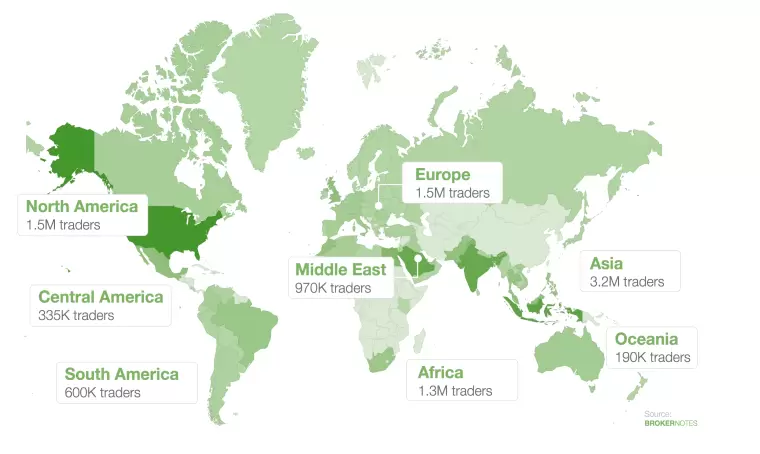
The regional distribution of online Forex traders
Source: Broker Notes

The global distribution of online Forex traders, as highlighted in the ForexBrokers.com report, shows a notable regional variance: Asia leads with 3.2 million online traders, Europe follows with 1.5 million, and Africa with 1.3 million, while the United States also shows a substantial presence in the Forex market. These figures underscore the widespread popularity and varied levels of Forex trading engagement across different regions. 

As we delve into the top 10 countries at the forefront of Forex trading, each presents a unique combination of attributes and challenges within their Forex markets. 

1. United Kingdom (341,000 Traders) 

The UK, especially London, is not just Europe’s but one of the world’s foremost financial hubs. The Financial Conduct Authority (FCA) provides robust regulation, ensuring transparency and trader protection. London’s time zone advantageously positions it to capitalise on both Asian and American market hours, enhancing its Forex trading activity. 

2. United States (335,000 Traders) 

The U.S. boasts a highly developed financial market with extensive Forex trading activity. The regulatory environment, overseen by organisations like the CFTC and NFA, ensures a secure trading platform for a diverse array of traders. The U.S. dollar’s dominance in global finance further amplifies the country’s role in the Forex market. 

3. Japan (223,000 Traders) 

Japan’s Forex market has witnessed exponential growth since retail Forex trading was legalised in 1998. The Japanese yen, a major currency in Forex markets, is often involved in carry trades due to Japan’s low-interest-rate environment. The Financial Services Agency (FSA) maintains a well-regulated trading environment, balancing openness with trader protection. 

4. Singapore (218,000 Traders) 

As a critical financial centre in Asia, Singapore’s strategic location enables significant trading overlap with global markets. The Monetary Authority of Singapore (MAS) is known for its stringent regulatory standards, fostering a secure and efficient trading environment. Singapore’s advanced technological infrastructure also contributes to its robust Forex market. 

5. Hong Kong (200,000 Traders) 

Hong Kong stands as a significant gateway to Asian markets, with a stable economy and a strong regulatory framework. The Hong Kong dollar is a crucial currency in Forex markets, and the region’s proximity to mainland China adds to its strategic trading position. Hong Kong’s sophisticated financial services sector attracts traders globally. 

6. Australia (195,000 Traders) 

Australia’s Forex market is underpinned by its resource-driven economy and political stability. Regulated by the Australian Securities and Investments Commission (ASIC), the market offers a safe environment for traders. The Australian dollar, a commodity currency, is highly influenced by the country’s trade dynamics, particularly with China. 

7. Switzerland (182,000 Traders) 

Switzerland’s reputation for financial stability and banking secrecy makes its Forex market attractive. The Swiss Franc, a safe-haven currency, is a popular choice during global economic uncertainties. Switzerland’s Forex market benefits from its neutrality and the country’s stringent regulatory practices. 

8. France (120,000 Traders) 

France’s Forex market is integral to the Eurozone. The Euro’s strength and stability, combined with France’s significant economic position in Europe, make it a key player in Forex trading. The Autorité des Marchés Financiers (AMF) ensures a well-regulated trading environment. 

9. Germany (109,000 Traders) 

Germany’s robust economy and the Euro’s prominence bolster its Forex market. Germany’s Forex trading is influenced by its strong industrial and export sectors. The Federal Financial Supervisory Authority (BaFin) provides a stringent regulatory framework, ensuring market integrity. 

10. China (105,000 Traders) 

China’s growing Forex market reflects its rising economic power. The Chinese Yuan’s increasing inclusion in global Forex trading symbolises China’s expanding financial influence. However, the market is more regulated and less open than in other major countries, with strict oversight from the People’s Bank of China and SAFE. 

In conclusion, the Forex trading landscape in 2023 highlights the diversity and dynamism of global financial markets. Each of the top 10 countries offers unique advantages and challenges, shaped by their respective economic conditions, regulatory frameworks, and currency strengths. These nations not only provide significant opportunities for Forex traders but also play a crucial role in shaping the future of international finance and trade. 

How to Learn Gold Trading: A Beginner’s Guide

Beginner’s Guide to Gold Trading: Strategies, Markets & Factors Influencing Prices

Gold, a precious metal, continues to capture the attention of traders seeking diversification and potential profits. If you’re interested in gold trading, it’s important to understand the basics and explore the trading opportunities available. 

In this article, we’ll explore the fundamentals of gold trading for beginners. 

Different Ways to Trade Precious Metals

When it comes to trading metals like gold, there are multiple avenues to explore. Each method has its own unique characteristics and appeals to different types of traders. Let’s find out what they are: 

1. Spot Market 

The spot market is the simplest way to trade metals. It involves immediate delivery of purchased assets and is ideal for commodity consumers who need goods for immediate use.  

The spot price, which is the current market price of gold, serves as a reference point for spot market transactions. 

2. Futures and Options 

These options are popular derivatives used by speculators to trade gold without physically owning the metal. Futures contracts involve buying or selling a predetermined amount of gold at a specified price and date in the future.  

Meanwhile, options contracts grant the right, but not the obligation, to buy or sell gold within a specific timeframe.  

Both futures and options prices are influenced by the spot price of gold, providing traders with opportunities to profit from price movements without taking physical delivery of the metal. 

Trading Gold as Forex Pairs

Gold can also be traded as a forex pair, such as XAU/USD (gold against the US dollar). Forex trading allows traders to speculate on the price movement of gold relative to a base currency.  

For example, when trading XAU/USD, buying indicates purchasing gold by selling US dollars, while selling implies buying US dollars in exchange for gold.  

Forex trading of gold offers flexibility and convenience, as it allows traders to participate in the market using margin and take advantage of leverage. 

Factors Driving Gold Prices

To make informed trading decisions, it’s crucial to understand the factors that influence gold prices. Here are some key drivers to consider: 

1. Demand 

Gold demand comes from various sources, including its use in jewelry. Additionally, gold is often seen as a safe-haven asset during economic downturns. 

Investors turn to gold to preserve wealth and hedge against market volatility. 

2. Real Interest Rates 

Gold prices have historically shown a correlation with real interest rates, which are the current interest rates adjusted for inflation.  

When real interest rates are low or negative, alternative investment options offer limited returns, leading investors to consider gold as a way to protect their wealth.  

Conversely, when real interest rates are high, the appeal of holding gold diminishes as cash and bonds become more attractive. 

3. Gold Trading Correlation with the US Dollar 

The relationship between gold and the US dollar is of interest to traders. While gold is priced in US dollars, the correlation between the two assets is not always straightforward.  

Although they often exhibit an inverse correlation, periods of financial stress and market uncertainty can cause both gold and the US dollar to rise simultaneously. In such times, investors see both assets as havens of stability. 

4. Supply Dynamics of Gold 

Understanding the supply dynamics of gold is crucial for assessing its long-term value. Gold is a finite resource, and estimates suggest that all mineable gold may be depleted by 2070.  

However, gold is highly durable, and virtually all the gold ever mined is still in circulation. This characteristic ensures that the available amount of gold continues to increase until supplies are fully exhausted. 

Concluding Insights on Gold Trading

Gold trading offers opportunities for investors seeking portfolio diversification and potential profits.  

By understanding different trading methods, the factors driving gold prices, and the supply dynamics of this precious metal, traders can make informed decisions.  

A solid foundation in education is paramount for anyone venturing into gold trading. Understanding market trends, economic indicators, and technical analysis can significantly enhance your trading strategy and outcomes. VT Markets is committed to empowering traders with a wealth of educational resources tailored to gold trading.

From live webinars and in-depth tutorials to comprehensive guides and market analysis, we provide the tools and knowledge necessary to navigate the gold market successfully. Whether you’re a novice aiming to understand the basics or an experienced trader looking to refine your strategy, our learn forex page is designed to support your growth and help you trade gold with confidence.

VT Markets provides a comprehensive trading platform that empowers traders with the necessary tools and resources to navigate the world of gold trading with confidence. Discover more about gold trading with VT Markets today. 

Decoding the forex dilemma: Manual trading vs. algorithmic trading 

Manual trading vs. algorithmic trading 

source: Forbes

In the fast-paced world of Forex trading, where fortunes can be made or lost in the blink of an eye, the importance of selecting the right trading approach cannot be overstated. 

Today, over 70% of traders rely on algorithmic trading methods, as revealed by the research report “Predictive Assessment of Electronic Trade Dynamics: 2022-2027“. This staggering statistic underscores the prevalence and influence of algorithmic trading in the contemporary financial landscape. 

Understanding the nuances of both manual and algorithmic trading is crucial for non-professional traders to navigate these complexities successfully. Let’s delve into these approaches, exploring their intricacies and uncovering the key considerations that can shape the success of Forex trading. 

Manual Trading: The Art of Hands-On Decision-Making 

Involving a traditional, hands-on approach where traders rely on intuition and market analysis, manual trading provides a unique learning experience and enables the exercise of emotional control. 

This method offers a practical learning environment, allowing traders to engage directly with the market. For instance, envision a trader meticulously analysing historical price charts, identifying key support and resistance levels, and anticipating a trend reversal based on a combination of technical indicators and economic factors. 

Actively participating in decision-making processes, manual trading helps traders develop emotional control – a crucial aspect of success. Consider a scenario where a trader, faced with a sudden market downturn, resists the impulse to panic sell and instead relies on their analysis to make rational decisions, avoiding potentially significant losses. 

However, manual trading has its challenges. The time-intensive nature demands constant attention, making it challenging for traders with busy schedules. Emotional challenges remain prevalent, and the limited capacity for multitasking can hinder a trader’s ability to seize multiple opportunities simultaneously. 

To illustrate, imagine a manual trader who, after studying market conditions, identifies a potential breakout in a currency pair. This trader monitors the charts, patiently waiting for the opportune moment to enter the market. When the anticipated reversal occurs, the trader executes a well-timed trade, capitalising on insights gained through hands-on analysis. 

In essence, manual trading offers a personalised and engaging experience for traders willing to invest time and effort into understanding the intricacies of the Forex market. While it requires discipline and focused attention, the skills acquired through manual trading can be invaluable for those seeking a deep connection with their trading strategies. 

Algorithmic Trading: The Precision of Automated Decision-Making 

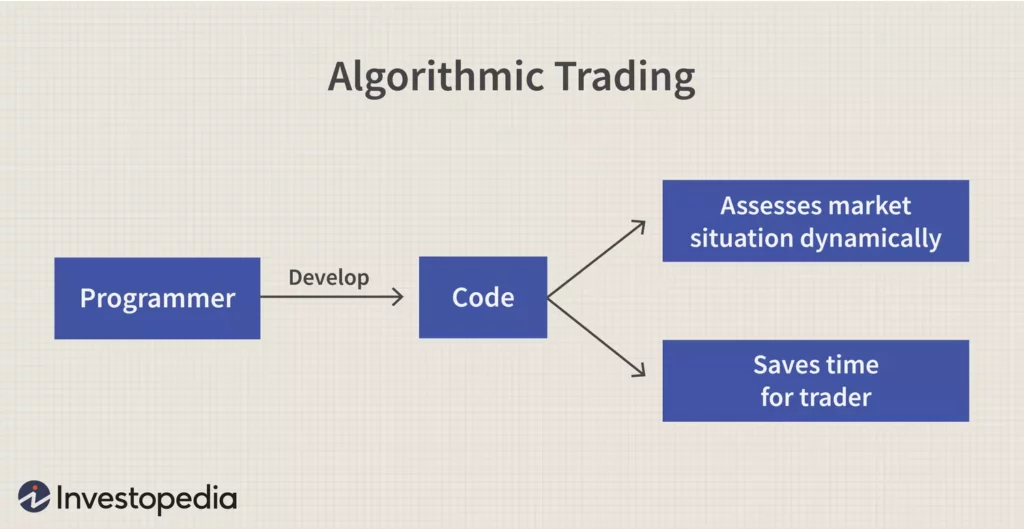
In stark contrast to manual methods, algorithmic trading relies on automated execution and data-driven decisions, emphasising speed, efficiency, and systematic strategy application. 

Algorithmic trading excels in speed and efficiency, processing vast market data in milliseconds. An example is an algorithm identifying and capitalising on price discrepancies across markets, executing trades instantaneously. 

Algorithmic trading model
source: Investopedia

Crucial to algorithmic trading, backtesting validates strategies using historical data, minimising the risk of flawed analysis. Imagine a trader developing an algorithm identifying profitable trends through historical price movements, ensuring viability before live application. 

Despite its advantages, algorithmic trading has complexities. A steep learning curve demands proficiency in programming and data analysis. Over-reliance on historical data poses risks, as strategies may lose effectiveness in rapidly changing markets. 

Consider a trader developing a sophisticated algorithm with machine learning techniques, allowing anticipation of price movements accurately and consistently yielding profits by adapting to evolving market conditions. 

Algorithmic trading comes with risks, including system failures and technical challenges. Traders must be vigilant to address potential issues promptly, as glitches or failures could lead to unintended consequences. 

In essence, algorithmic trading offers an efficient, systematic approach to Forex trading. Despite technical demands and potential risks, a well-designed algorithm has the potential to unlock consistent profits in the ever-evolving financial landscape. 

Factors to Consider: Choosing Between Manual and Algorithmic Trading 

When faced with the decision between manual and algorithmic trading, a careful evaluation of several key factors can significantly impact your trading journey. 

Factor 1. Risk Tolerance: 

  • Manual Trading: Ideal for those comfortable with risk, offering flexibility and adaptability. 
  • Algorithmic Trading: Suited for risk-averse individuals, providing a disciplined and controlled approach. 

Factor 2. Time Commitment: 

  • Manual Trading: Demands constant attention and time investment. 
  • Algorithmic Trading: Offers automation, saving time for exploring opportunities and strategy refinement. 

Factor 3. Skill Level: 

  • Manual Trading: Requires a deep understanding of market dynamics and analysis. 
  • Algorithmic Trading: Involves programming and data analysis skills. 

In summary, align your trading approach with your risk tolerance, time commitments, and skill set to make an informed decision between manual and algorithmic trading. 

For example, a computer science-savvy trader might excel in algorithmic trading, leveraging programming skills. Meanwhile, a trader attuned to market psychology may find success in manual trading. 

Each method has unique benefits, ensuring a strategic fit for your preferences and enhancing your success in Forex trading. 

Combining Manual and Algorithmic Trading: The Power of Hybrid Strategies 

As technology and trading methodologies evolve, the concept of hybrid trading has emerged as a compelling strategy for traders seeking the best of both worlds. By combining manual and algorithmic approaches, traders can capitalise on the strengths of each method, creating a versatile and adaptive trading strategy. 

source: Freepik

Intuitive Decision-Making with Efficiency 

Hybrid trading combines manual intuition with algorithmic efficiency. Traders leverage the strengths of both approaches – making informed decisions based on market understanding while benefiting from the speed and precision of automated execution. 

Risk Management at the Core 

Central to hybrid trading is robust risk management. Traders can swiftly adapt to changing market conditions by switching between manual and algorithmic modes. This dynamic approach enhances risk mitigation, allowing traders to navigate diverse market scenarios with agility. 

A trader, combining economic insight with sentiment analysis algorithms, may switch between manual and algorithmic modes based on market events. This adaptability ensures critical decision-making during unexpected situations. 

Continuous Adaptation and Learning 

Hybrid traders embrace continuous adaptation and learning. The synergy between manual and algorithmic methods enables real-time strategy refinement, crucial in the ever-changing Forex market. 

Optimising Strengths, Minimising Weaknesses 

By combining manual and algorithmic trading, traders aim to optimise strengths while mitigating weaknesses. Manual trading adapts to unique market conditions, while algorithmic trading provides efficiency in executing predefined strategies. 

VT Markets welcomes traders of all styles, whether engaging in manual or algorithmic trading. 

For manual traders, the user-friendly interfaces of MT4, MT5, and WebTrader Plus ensure a seamless and intuitive experience across Forex, indices, commodities, and other assets. Execute trades with precision and efficiency, empowered by real-time data and analytical tools. 

Alternatively, for those who prefer automated strategies, leverage the platform’s compatibility with expert advisors. Implement finely-tuned algorithmic approaches tailored to the nuances of your preferred instrument and aligned with unique trading objectives. 

In conclusion, both manual and algorithmic trading have their merits and drawbacks. Forex traders should explore both approaches, considering factors such as risk tolerance, time commitment, and skill level. Embracing a hybrid strategy and leveraging the tools and opportunities provided by platforms like VT Markets can empower traders to navigate the Forex market successfully. Continuous learning and adaptation are key in this ever-evolving financial landscape. 

Summary: 

  • Manual trading and algorithmic trading are two primary approaches to engaging in financial markets. 
  • Manual trading involves hands-on decision-making but faces challenges like time intensity. 
  • Algorithmic trading relies on automated execution but has a steep learning curve. 
  • Hybrid trading, blending manual intuition with algorithmic efficiency, is gaining popularity. 
  • Consider your risk tolerance, time commitments, and skill set when choosing between manual and algorithmic trading in Forex. 

Stock Market Hits Record Highs: Dow Jones, S&P 500, and Nasdaq Surge Amidst Rate Cut Speculation

The stock market soared to record highs as the Dow Jones Industrial Average closed at 37,248.35 points, marking a 0.43% increase, spurred by a drop in the 10-year Treasury note yield. This surge resonated in the S&P 500 and Nasdaq, both climbing upwards. Investor confidence in a potential soft economic landing for 2024 grew, with speculation about forthcoming rate cuts, especially after the Federal Open Market Committee hinted at possible reductions. Specific sectors, including solar stocks and Moderna, experienced substantial gains. Additionally, sectors like Energy and Real Estate thrived, while Utilities and Consumer Staples saw declines. In the currency market, the dollar index dropped significantly as the Bank of England and the European Central Bank diverged from the Federal Reserve’s dovish stance, influencing currency pairs like EUR/USD and Sterling, while USD/JPY faced downward pressure amidst expectations surrounding major central banks’ policies.

Stock Market Updates

The stock market experienced a positive surge as the Dow Jones Industrial Average hit a record high, closing up by 0.43% at 37,248.35 points, following its previous milestone above 37,000. This increase was mirrored by the S&P 500, which rose by 0.26% to 4,719.55, and the Nasdaq Composite, which gained 0.19% to 14,761.56. These upticks were propelled by the 10-year Treasury note yield dropping below 4%, leading to increased investor confidence in a potential soft economic landing for 2024. This drop in interest rates spurred speculation about potential rate cuts for the upcoming year, with the Federal Open Market Committee indicating the possibility of three rate reductions.

Additionally, specific sectors saw notable movements. Solar stocks, including SunRun and Enphase, surged as the 10-year Treasury yield fell, with the Invesco Solar ETF (TAN) climbing over 8.1%. Moderna’s shares also rose by 9.3% after trial data revealed promising results for its cancer vaccine used in conjunction with Merck’s Keytruda. Looking ahead, the S&P 500 inches closer to its all-time closing record set in January 2022, sitting just 1.6% away, while the Nasdaq remains approximately 8% below its closing record and 9% from its intraday peak.

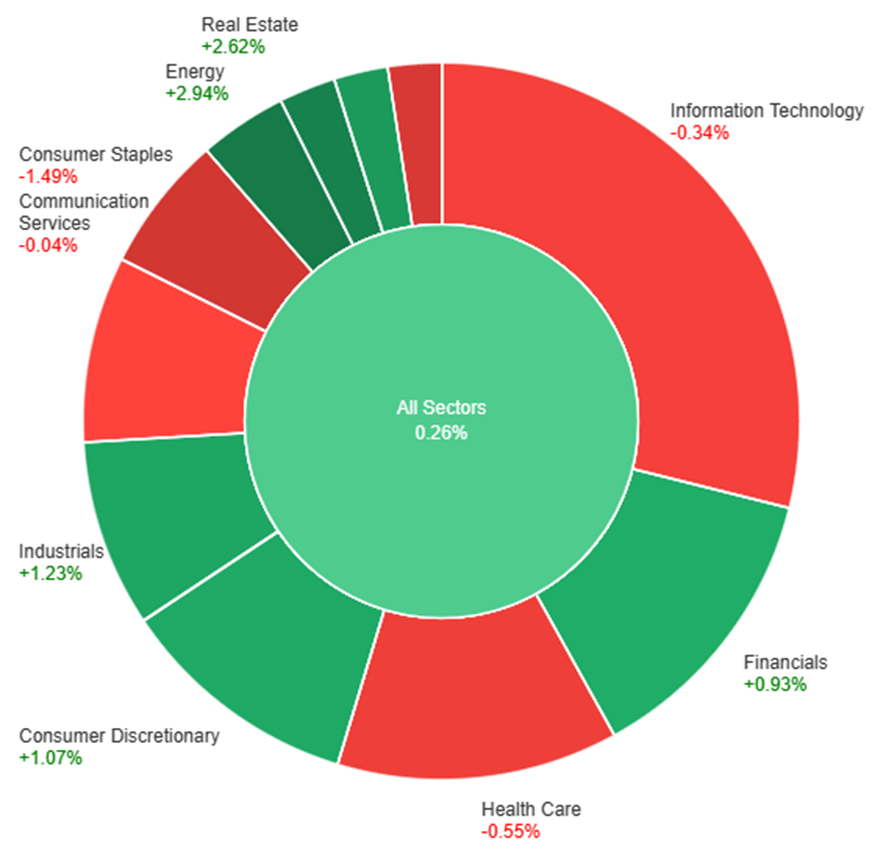
Data by Bloomberg

On Thursday, the overall market showed a positive trend, with a gain of 0.26%. The standout performers were Energy and Real Estate, surging by 2.94% and 2.62%, respectively. Materials and Industrials also experienced notable gains, rising by 1.68% and 1.23%. However, sectors like Utilities and Consumer Staples saw declines, with decreases of 1.28% and 1.49%, respectively. Communication Services remained relatively stable, showing a marginal decrease of 0.04%. Notably, Information Technology and Health Care experienced declines of 0.34% and 0.55%, respectively, contributing to the overall mixed performance across sectors.

Currency Market Updates

In the currency market updates, the dollar index faced a significant decline by 1% after the Bank of England (BoE) and the European Central Bank (ECB) chose not to mirror the Federal Reserve’s dovish stance. This highlighted a trend where the U.S. central bank consistently leads major policy shifts during the pandemic. Despite a brief rebound in the dollar following positive U.S. retail sales and jobless claims, this momentum was overshadowed by the divergence between the Fed’s dovishness and the BoE and ECB’s reluctance to consider easing.

The BoE maintained elevated rates due to UK core inflation at 5.7%, substantially higher than the central bank’s target, while the ECB’s 4% rate remained notably lower compared to the BoE and Fed. Market futures now anticipate the Fed’s first rate cut in March, accumulating to 150 basis points by 2024. On the other hand, the ECB is slightly predicted to cut rates by March, aiming for nearly 150 basis points by year-end. The BoE is expected to cut rates by May, albeit by 106 basis points for 2024. Amidst this, currency pairs like EUR/USD surged by 1%, nearing November’s trend high, while Sterling rose by 1.36%, driven by the BoE’s resistance to rate cut expectations and benefited from risk-on flows.

USD/JPY experienced a decline from November’s peak, reaching 140.95 after the Fed’s pivot and ahead of crucial announcements from the BoE, ECB, and U.S. retail sales. Despite a retracement to 140.71, USD/JPY faced downward pressure, partly attributed to the expectation that the Bank of Japan (BoJ) stands alone among major central banks in considering a hike next year.

Picks of the Day Analysis
EUR/USD (4 Hours)

EUR/USD Soars Amidst Fed and ECB Policy Moves

The EUR/USD pair experienced a surge, hitting 1.1009 before a minor pullback, driven by contrasting central bank actions. The US Dollar faced pressure post-Fed, while the Euro gained ground following the ECB’s decision to maintain rates and continue PEPP reinvestments through H1 2024, with plans to reduce the portfolio by €7.5 billion monthly in H2. Despite expectations of a gradual inflation decline till 2024 and concerns over price pressures, ECB President Christine Lagarde clarified no discussions on rate cuts occurred. Additionally, the Dollar’s slide was compounded by a drop in Treasury yields. While positive US data on Retail Sales and Jobless Claims surpassed expectations, the focus remains on Friday’s release of S&P Global’s preliminary December PMIs for the EU and the US.

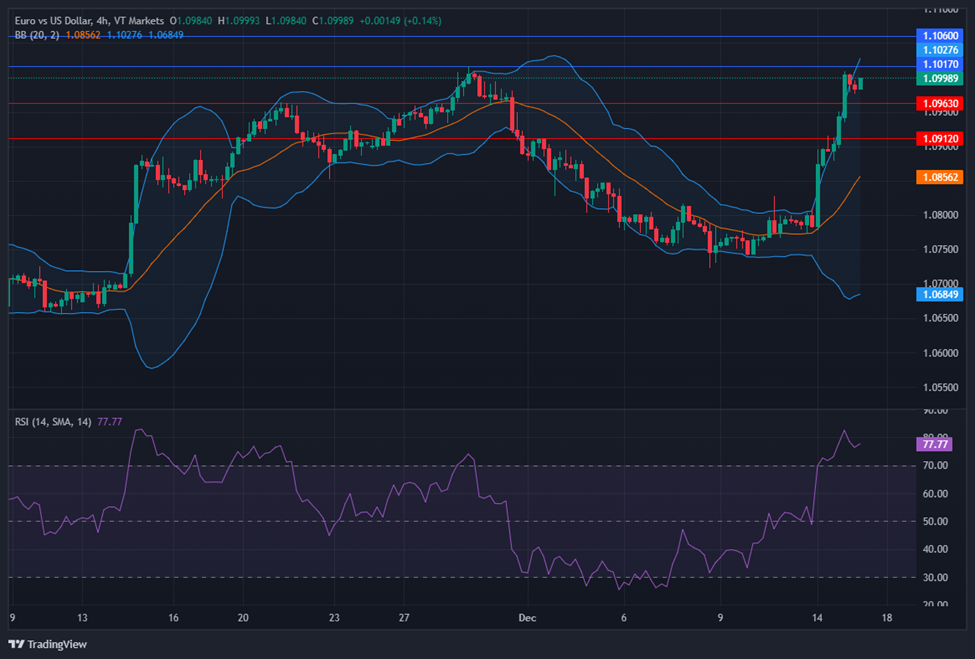
Chart EUR/USD by TradingView

On Thursday, the EUR/USD moved higher and was able to reach the upper band of the Bollinger Bands. Currently, the price moving slightly below the upper band, suggesting a potential continuation movement, potentially reaching the resistance level at 1.1017. Notably, the Relative Strength Index (RSI) maintains its position at 77, signaling a bullish outlook for this currency pair.

Resistance: 1.1017, 1.1060

Support: 1.0963, 1.0912

XAU/USD (4 Hours)

XAU/USD Hold Steady Amidst Dollar Respite and Central Bank Divergence

Gold (XAU/USD) navigates a week of fluctuations, poised for a weekly gain after a retreat from record highs. The Asian market’s influence is marked by the US Dollar’s pause in its decline, propelled by a slight rebound in US Treasury bond yields. Amidst this, the US Dollar finds stability as Asian stocks trim early gains, awaiting pivotal preliminary PMI data from the US and Eurozone, crucial for gauging global economic health. The backdrop is a US Federal Reserve embracing a dovish stance, contrasting with the Bank of England and European Central Bank hinting at potential tightening, revealing a pronounced monetary policy divergence that weighs heavily on the dollar. Despite temporary Dollar recoveries due to unexpected US Retail Sales upticks, the dovish Fed outlook continues to fuel a global risk-on sentiment, supporting Gold prices near recent highs. As the week concludes, the focus remains on the PMI data’s impact and potential profit-taking amid a volatile week dominated by central bank actions.

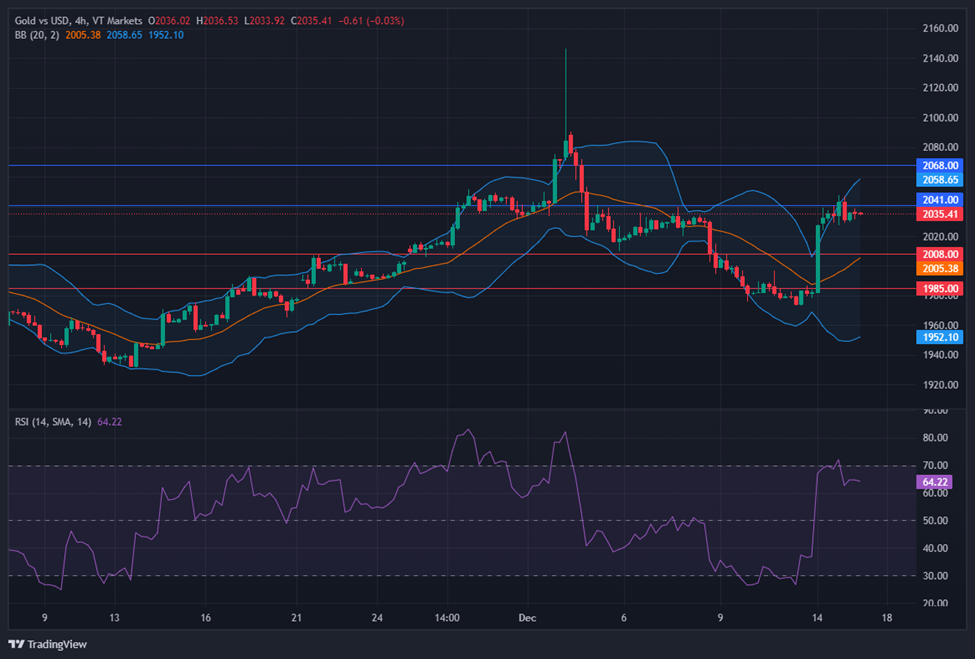
Chart XAU/USD by TradingView

On Thursday, XAU/USD moved in consolidation around the upper band of the Bollinger Bands. Currently, the price moving below the upper band, suggesting a potential continuation movement, potentially reaching the resistance level at $2,041. The Relative Strength Index (RSI) stands at 64, signaling a bullish outlook for this pair.

Resistance: $2,041, $2,068

Support: $2,008, $1,985

Economic Data
CurrencyDataTime (GMT + 8)Forecast
EURFrench Flash Manufacturing PMI16:1543.3
EURFrench Flash Services PMI16:1546.1
EURGerman Flash Manufacturing PMI16:3043.1
EURGerman Flash Services PMI16:3049.9
GBPFlash Manufacturing PMI17:3047.6
GBPFlash Services PMI17:3051.0
USDEmpire State Manufacturing Index21:302.0
USDFlash Manufacturing PMI22:4549.5
USDFlash Services PMI22:4550.7

Fed’s Rate Cut Signals Propel Stock Market to Record Highs

The stock market surged to historic heights as the Dow Jones Industrial Average closed above 37,000 for the first time, fueled by the Federal Reserve’s indication of upcoming rate cuts amidst eased inflation projections. This move drove notable gains across indices and sectors, with banking stocks like Bank of America and Wells Fargo rising significantly, alongside Home Depot, while pushing year-to-date gains for the Dow, S&P 500, and Nasdaq Composite. Simultaneously, the currency market witnessed substantial shifts, marked by the dollar index’s plunge and various currency pairs reacting to the Fed’s revised outlook, while attention turned to potential impacts on retail sales in the evolving landscape.

Stock Market Updates

The stock market soared to new heights, with the Dow Jones Industrial Average reaching a record-breaking close above 37,000 for the first time, spurred by the Federal Reserve’s indication of multiple rate cuts in the coming year. This move comes in response to the Fed’s acknowledgment of eased inflation and a revised forecast for a lower inflation rate of 2.4% in 2024, down from the previously projected 2.6%. Investors welcomed this shift in monetary policy, driving the Dow up by 512.30 points (1.40%), the S&P 500 by 1.37%, and the Nasdaq Composite by 1.38%, all hitting fresh 52-week highs. The market’s positive response was further reinforced by promising inflation data and a decrease in the 10-year Treasury yield to 4.03%, its lowest since August.

The Fed’s decision to signal forthcoming rate cuts boosted specific sectors: banking stocks like Bank of America and Wells Fargo, poised to benefit from a softer monetary policy, surged by 4% and nearly 3%, respectively. Additionally, Home Depot experienced a 3% gain, potentially due to expectations of increased sales driven by a potential housing market revival. This shift in market sentiment, aligning with investors’ desires for a more accommodating Fed stance, has significantly contributed to the Dow’s remarkable 11.9% year-to-date rise, while the S&P 500 and Nasdaq Composite have seen even more substantial gains of 22.6% and 40.8%, respectively, in 2023.

Data by Bloomberg

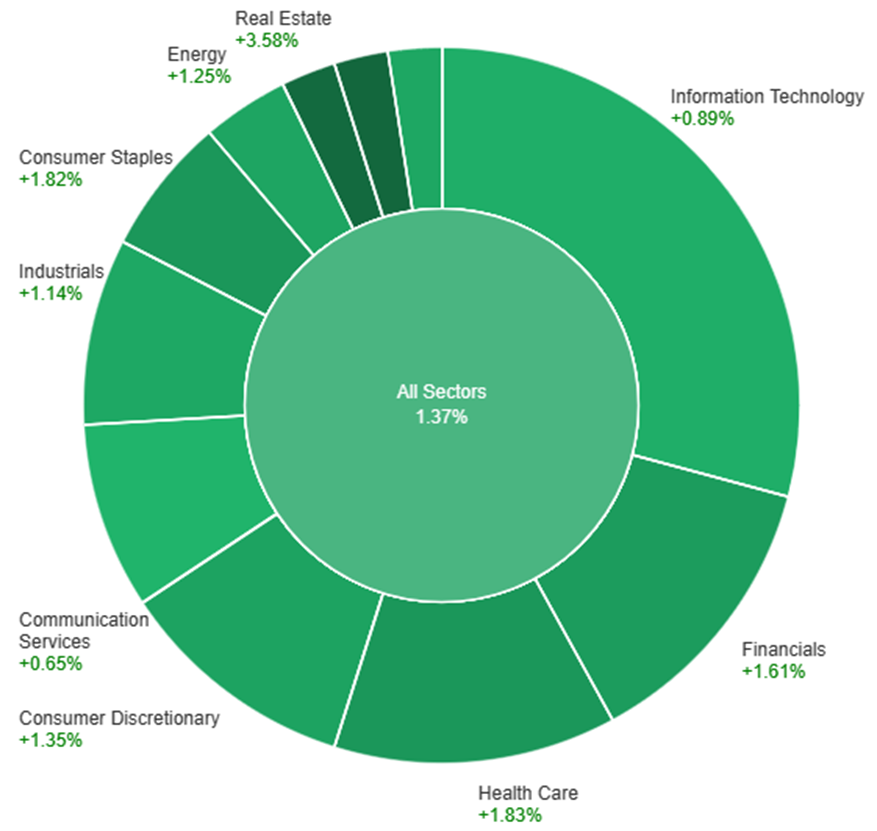
On Wednesday, across all sectors, the market saw a positive trend with a gain of 1.37%. Notably, the Utilities and Real Estate sectors experienced robust growth, rising by 3.72% and 3.58% respectively, outperforming other sectors. Health Care and Consumer Staples also showed healthy gains of 1.83% and 1.82% respectively. Financials, Consumer Discretionary, Energy, Materials, and Industrials followed suit with increases ranging from 1.14% to 1.61%. However, Information Technology and Communication Services had comparatively modest gains, recording 0.89% and 0.65% respectively, contributing to the overall positive market movement.

Currency Market Updates

The currency market witnessed significant shifts following the Federal Reserve’s announcements, causing a plunge in the dollar index by 0.7% during New York afternoon trade. Projections of three rate cuts in 2024, coupled with economic assessments, prompted a drop in two-year Treasury yields and futures pricing, with a notable rise in the probability of a March rate cut to 69%. The Fed’s deviation from previous dot plots, altering the trajectory from expected hikes in 2023 to anticipated cuts in 2024, marked a substantial change in market expectations. Notably, the EUR/USD pair surged by 0.85% following the Fed’s news, hitting a seven-day high, partly attributed to the European Central Bank’s projected rate cuts and the Eurozone’s economic performance lagging behind the US. Meanwhile, sterling experienced a shift from a loss to a gain, with expectations concerning the Bank of England’s stance on rate cuts diverging from the market’s projections.

Additionally, USD/JPY experienced a significant decline of 1.6% post-Fed, contrasting with its 0.2% dip ahead of the announcement. This movement aligned with lower Treasury-JGB yields following the Fed’s update, despite Japan’s positive Tankan survey and the Bank of Japan’s potential divergence as the sole major central bank possibly considering rate hikes next year. The dynamics in the currency market were influenced by oil price movements, with Brent finding support preceding June lows, driven by unexpected drops in WTI inventories and the amplified prospects of easing by major central banks, including the Fed. Looking ahead, the market’s focus shifted toward U.S. retail sales, anticipated to show soft figures, further contributing to the evolving currency landscape.

Picks of the Day Analysis
EUR/USD (4 Hours)

EUR/USD Rallies Amid Fed’s Stance, Eyes on ECB Decision

The EUR/USD pair surged more than 100 pips post the Federal Reserve meeting, breaching the 1.0900 mark on a firmly bullish trajectory driven by the US Dollar’s dip. The Fed’s decision to maintain interest rates and the projection of future rate cuts in 2024 propelled US bond rallies, pushing the 10-year yield to 4% lows and the US Dollar Index down by nearly 1%. Ahead of the European Central Bank’s anticipated decision, expectations loom around unchanged rates, discussions on PEPP reinvestment, and updated projections, foreseeing potential downgrades in growth and inflation forecasts. Market sentiment appears dovish, factoring in a possible rate cut in April, pressuring the Euro. Attention shifts to the ECB’s stance for insights into future market repositioning, with the US Dollar’s decline potentially propelling a rally toward 1.1000, tempered by the ECB decision or Eurozone PMI reports.

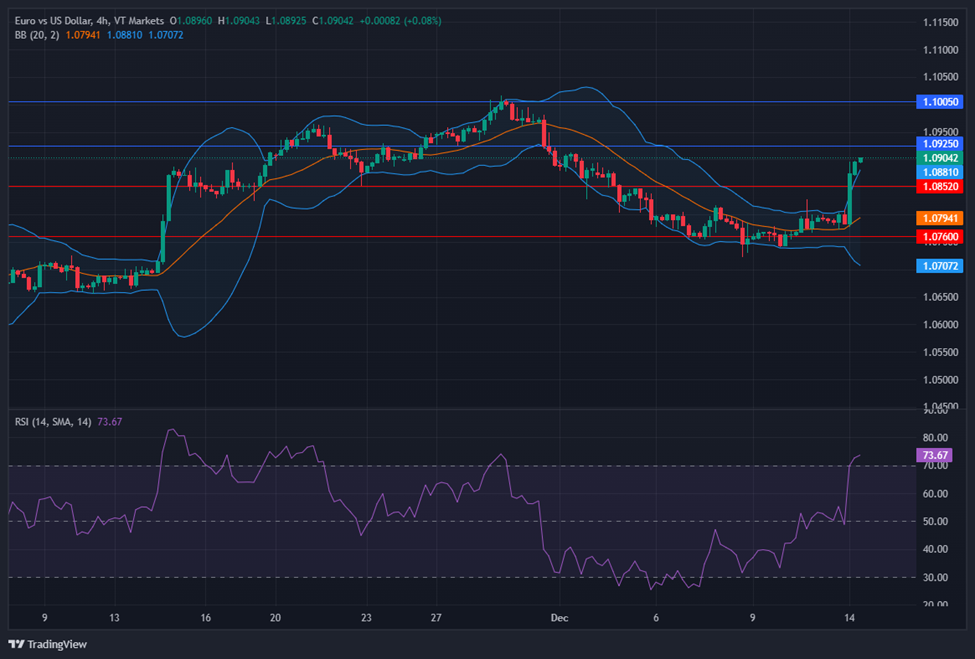
Chart EUR/USD by TradingView

On Wednesday, the EUR/USD moved higher and was able to reach the upper band of the Bollinger Bands. Currently, the price moving slightly above the upper band, suggesting a potential continuation movement, potentially reaching the resistance level at 1.0925. Notably, the Relative Strength Index (RSI) maintains its position at 73, signaling a bullish outlook for this currency pair.

Resistance: 1.0925, 1.1005

Support: 1.0852, 1.0760

XAU/USD (4 Hours)

XAU/USD Surges Above $2,000 as Fed’s Dovish Tone Weakens Dollar and Treasury Yields

Gold (XAU/USD) soared past the $2,000 mark amidst the early Asian session, buoyed by a weaker US Dollar and declining Treasury yields following the Federal Reserve’s meeting. The Fed maintained interest rates unchanged, adopting a dovish stance on monetary policy. Fed Chair Jerome Powell hinted at potential rate cuts, contributing to the Dollar Index’s sharp decline and boosting gold prices. Despite market expectations aligning with the Fed’s decision, the possibility of rate cuts in 2024 exceeded forecasts, intensifying interest in gold. With upcoming US economic reports and Chinese data on the horizon, gold traders anticipate further cues from jobless claims, retail sales figures, and international economic indicators.

Chart XAU/USD by TradingView

On Wednesday, XAU/USD moved higher and was able to reach the upper band of the Bollinger Bands. Currently, the price moving slightly above the upper band, suggesting a potential continuation movement, potentially reaching the resistance level at $2,041. The Relative Strength Index (RSI) stands at 68, signaling a bullish outlook for this pair.

Resistance: $2,041, $2,068

Support: $2,008, $1,985

Economic Data
CurrencyDataTime (GMT + 8)Forecast
CHFSNB Monetary Policy Assessment16:30 
CHFSNB Policy Rate16:301.75%
CHFSNB Press Conference17:00 
GBPMonetary Policy Summary20:00 
GBPMPC Official Bank Rate Votes20:002-0-7
GBPOfficial Bank Rate20:005.25%
EURMain Refinancing Rate21:154.50%
EURMonetary Policy Statement21:15 
USDCore Retail Sales m/m21:30-0.1%
USDRetail Sales m/m21:30-0.1%
USDUnemployment Claims21:30219K
EURECB Press Conference21:45 

Mastering Chart Techniques Like a Pro

Discover the tips and tricks of trading charts in our webinar, ‘Mastering Chart Techniques: The Pro’s Handbook.’ Learn expert advice and practical strategies to navigate markets with confidence. Whether you’re new to trading or want to boost your skills, this session is your roadmap to becoming a chart analysis pro.
Back To Top
server

Hello there 👋

How can I help you?

Chat with our team instantly

Live Chat

Start a live conversation through...

  • Telegram
    hold On hold
  • Coming Soon...

Hello there 👋

How can I help you?

telegram

Scan the QR code with your smartphone to start a chat with us, or click here.

Don’t have the Telegram App or Desktop installed? Use Web Telegram instead.

QR code