Back

How To Register Your Account with VT Markets

FAQ: Register Your Forex Trading Account with VT Markets

Registering for a live trading account with VT Markets is a straightforward process designed to get you up and trading as quickly as possible. Here’s everything you need to know to successfully open your account and start your trading journey.


Step-by-Step Registration Process

1. Start the Process: Begin by clicking on this link to access the registration page.

2. Fill in Your Details: Select your country of residence, enter your email address, choose a password, and, if you have one, include your referrer’s ID (this is optional).

3. Confirm Your Residency: Make sure to tick the box indicating that you are not a US resident.

4. Open Your Account: Click on “Open a live account” to finalize the registration process.


Frequently Asked Questions

Do you accept clients from the US?

Due to regulations by the Commodity Futures Trading Commission (CFTC), VT Markets cannot accept clients based in the US. However, traders from other countries are welcome.

How long does account activation take?

Completing the online forms and submitting the required proof of identity documentation will enable you to start trading within 24 hours.

Are there any fees associated with a live trading account?

No, VT Markets does not charge any account opening or maintenance fees for live trading accounts.

What documents are needed for account creation?

In compliance with Anti-Money Laundering (AML) and CFTC regulations, you must upload your Proof of Identity (POI) and Proof of Address (POA) during registration.

What if I don’t submit my ID and/or POA during registration?

You’ll receive login credentials for the Client Portal but won’t have full access until your documents are uploaded and verified. Depositing is possible immediately after registration, but trading and withdrawals are enabled only after document verification.

How can I resubmit registration documents?

If necessary, log into your Client Portal and navigate to Account > Live accounts > Account Verification to submit your documents.


Acceptable Documentation

Proof of Identity (POI):

A valid government-issued photo ID that clearly displays your name, photo, date of birth, issue date, and expiry date is required. This can be a photo ID or passport.

Proof of Address (POA):

Documents issued within the last 6 months, such as a bank statement, utility bill, tax document, certificate of citizenship, or residency proof, are acceptable. These documents must clearly display your name, issue date, and residential address.

Please note that VT Markets requires full-color, clear copies of these documents, and handwritten or hard-copy documents are not accepted.


Register Your Forex Trading Account with VT Markets

By following these steps and preparing the necessary documents, you can quickly and easily set up your live trading account with VT Markets. Start your trading journey with confidence, knowing you have the support and resources of VT Markets at your disposal.

Learn more about Forex in this page.

Stocks Dip Amid Inflation Data Anticipation, Amazon Joins Dow

On Monday, the stock market experienced a downturn, with the S&P 500, Nasdaq Composite, and Dow Jones Industrial Average all closing lower, moving away from recent record highs. This shift comes as investors brace for a slew of economic data, including a crucial inflation measure and updates on consumer spending, which could impact Federal Reserve policy decisions. The market’s focus is particularly on the upcoming personal consumption expenditures price index, a preferred inflation indicator by the Fed. Additionally, Amazon’s inclusion in the Dow signifies a shift toward tech and consumer retail sectors, despite a slight dip in its shares. With Treasury yields rising and various economic indicators on the horizon, investors remain cautious amid an uncertain longer-term outlook, even as currency markets react to potential monetary policy adjustments in the U.S. and Europe.

Stock Market Updates

On Monday, the S&P 500 saw a decline, moving away from the record high it reached the previous Friday, as the market anticipated upcoming inflation data. The index fell by 0.38% to 5,069.53, while the Nasdaq Composite dropped by 0.13%, ending the day at 15,976.25. The Dow Jones Industrial Average also experienced a downturn, losing 62.30 points, or 0.16%, to close at 39,069.23. Notably, Amazon was added to the Dow, replacing Walgreens Boots Alliance, which is expected to heighten the index’s focus on the tech and consumer retail sectors, even as Amazon’s shares dipped slightly by 0.15%. Additionally, Treasury yields rose, exerting further pressure on the stock market.

The market’s recent performance has been bolstered by strong earnings from companies like Nvidia, propelling the S&P 500 and the Dow to record highs at the end of the previous week. However, investors remain cautious, looking ahead to several economic indicators due to be released, including the personal consumption expenditures price index, a key measure of inflation favored by the Federal Reserve. Meanwhile, new home sales for January fell short of expectations amid high mortgage rates, underscoring the ongoing economic challenges. This week will also see the release of data on durable orders, wholesale inventories, consumer spending, and PCE numbers, all of which could significantly influence market sentiment.

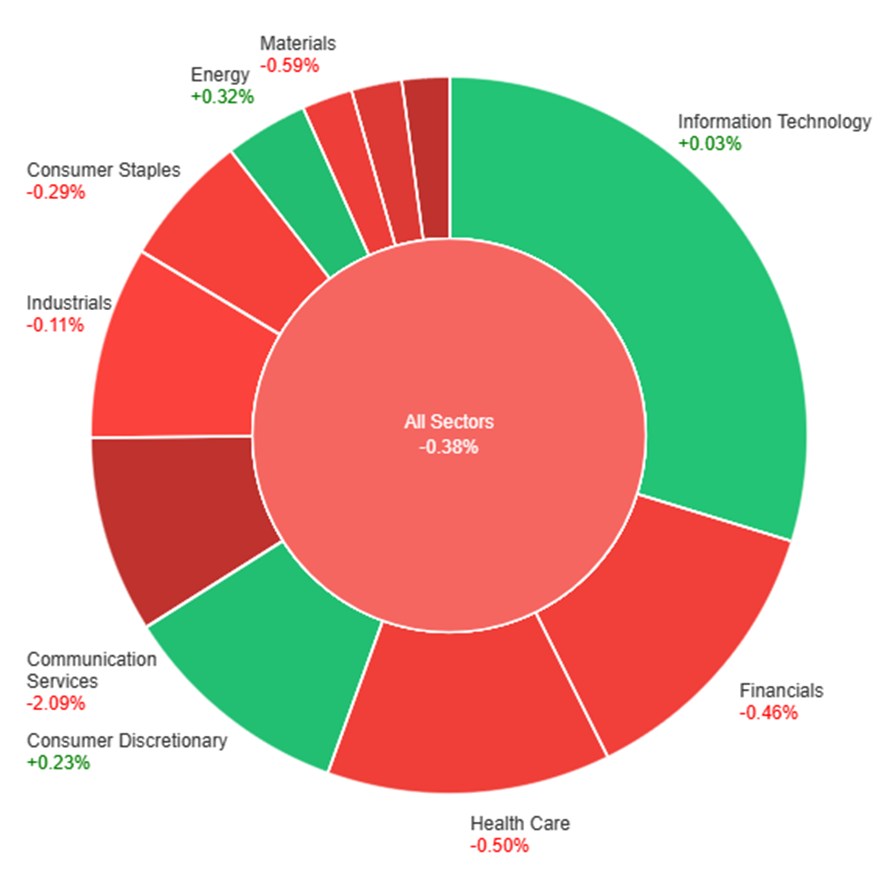
Data by Bloomberg

On Monday, the market showed a mixed performance across various sectors. While the overall sectors declined by 0.38%, Energy (+0.32%), Consumer Discretionary (+0.23%), and Information Technology (+0.03%) sectors experienced gains, indicating some areas of strength in the market. However, most sectors saw declines, with Utilities (-2.10%) and Communication Services (-2.09%) facing the steepest drops, followed by significant downturns in Real Estate (-1.14%), Materials (-0.59%), Health Care (-0.50%), and Financials (-0.46%). Industrials and Consumer Staples also saw modest declines, underscoring a generally bearish sentiment across the broader market.

Currency Market Updates

In recent currency market updates, the dollar index experienced a slight decline of 0.1%, influenced primarily by gains in the EUR/USD pair, as investors awaited crucial inflation data from both the U.S. and the eurozone. This upcoming data is expected to provide insights into the future of the narrowing gap between bund and Treasury yields observed since mid-February. The anticipation around this data release stems from its potential to either confirm or alter the current expectations regarding monetary policy adjustments by the Federal Reserve and the European Central Bank (ECB), especially in light of recent economic indicators. The dollar, meanwhile, saw an uptick against traditionally lower-yielding currencies like the yen, as well as risk-sensitive currencies such as the Australian dollar and the yuan, amidst speculations on the Federal Reserve’s interest rate decisions following a strong U.S. jobs report and inflation figures that surpassed forecasts.

Investor focus is particularly honed in on the upcoming core PCE reading, February ISMs, and the March 8 employment report, with the outcomes likely to influence Federal Reserve policy discussions significantly. Despite the current market pricing, which reflects a cautious stance on the pace and extent of Fed rate cuts, the longer-term economic outlook remains uncertain. This uncertainty is exacerbated by persistent high-interest rates and a stock market buoyed by a limited number of companies, raising concerns over potential underperformance in U.S. economic data relative to expectations. Meanwhile, in Europe, inflation data releases are poised to further clarify the ECB’s stance on interest rates, amidst statements from President Christine Lagarde indicating sustained wage growth. Additionally, Japan’s inflation figures and the potential implications for the Bank of Japan’s policy direction add another layer to the global currency market dynamics, with significant attention also being paid to the British pound’s movements against the backdrop of the Bank of England’s anticipated policy decisions.

Picks of the Day Analysis
EUR/USD (4 Hours)

EUR/USD Gains Amid Speculation of US Interest Rate Cuts and ECB’s Prudent Stance

The EUR/USD pair experienced a rebound, touching the 1.0860 mark as the new trading week began, fueled by a weakening US dollar and speculation about potential Federal Reserve interest rate cuts, possibly starting in June. This speculation has been supported by recent US inflation data and a tight labor market, increasing the odds of monetary easing. Meanwhile, European Central Bank (ECB) official Yannis Stournaras emphasized the need for cautious monetary policy adjustments, aiming for a gradual approach to rate cuts to ensure inflation targets are met. The interplay between anticipated US monetary policy adjustments and the ECB’s prudent stance is likely to continue driving EUR/USD price actions in the near term.

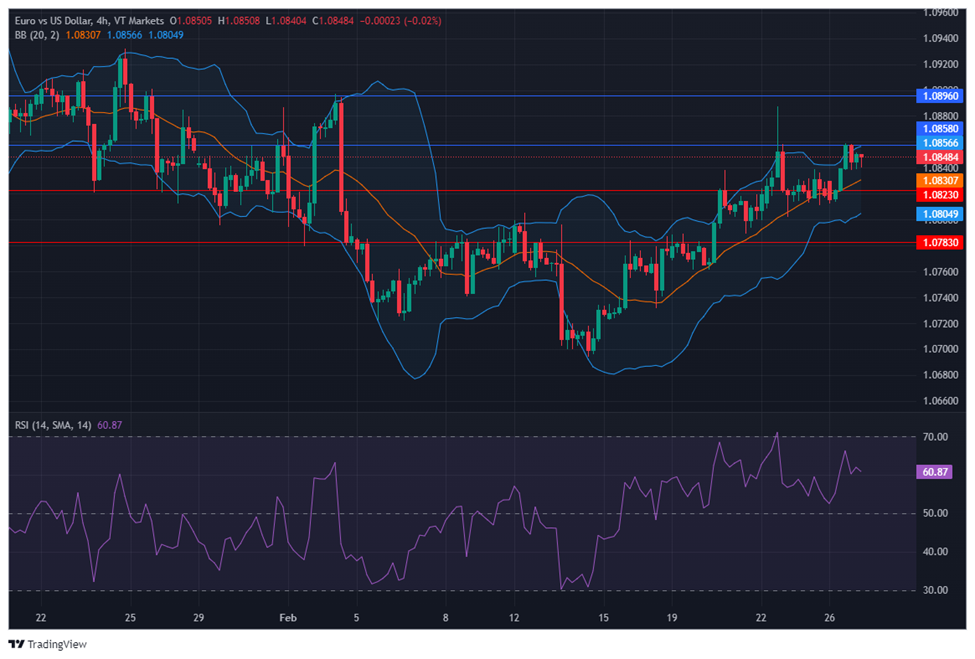
Chart EUR/USD by TradingView

On Monday, the EUR/USD moved higher and was able to reach the upper band of the Bollinger Bands. Currently, the price is moving just below the upper band, suggesting a potential downward movement to reach the middle band. Notably, the Relative Strength Index (RSI) maintains its position at 60, signaling a slightly bullish outlook for this currency pair.

Resistance: 1.0858, 1.0896

Support: 1.0823, 1.0783

XAU/USD (4 Hours)

XAU/USD Retreats Below $2,030 Amid Rising US Treasury Yields and Technical Pressure

Gold experienced a slight downturn, falling below the $2,030 mark during the American trading session on Monday, as it faced technical and fundamental pressures. The recovery of the 10-year US Treasury bond yields toward 4.3% contributed to the decline in the XAU/USD pair, reflecting a dampened appeal for the non-yielding asset. Technical analysis reveals a decrease in buying interest, with a potential for a bearish extension highlighted by the metal’s performance around critical simple moving averages (SMAs) and technical indicators. Meanwhile, the broader market’s cautious stance ahead of significant US economic data releases, including the closely watched US Core Personal Consumption Expenditures (PCE) Price Index, adds to the bearish sentiment surrounding gold.

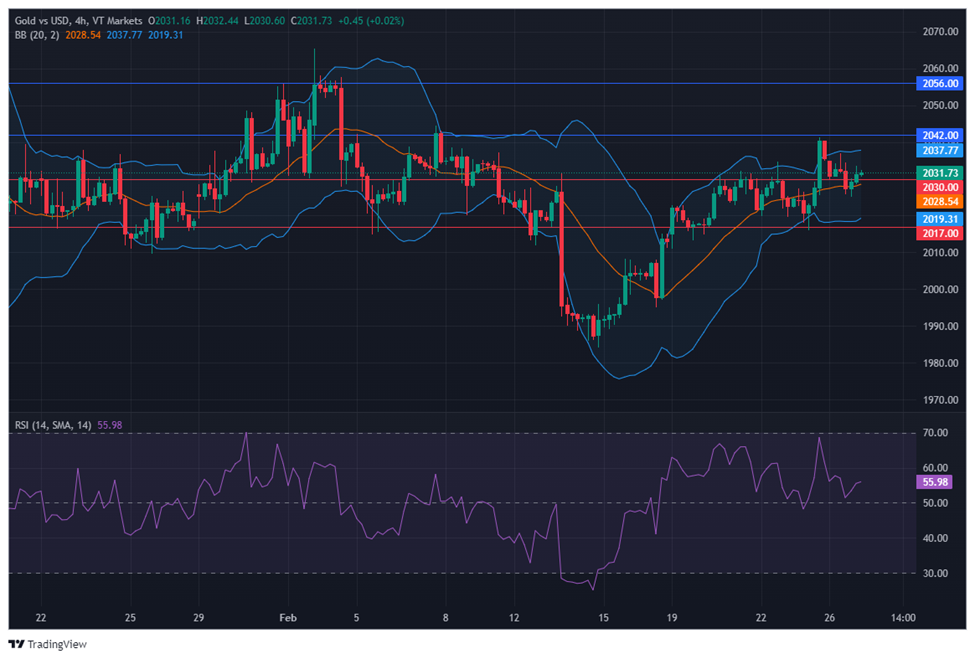
Chart XAU/USD by TradingView

On Monday, XAU/USD moved lower to reach the middle band of the Bollinger Bands. Currently, the price is moving just above the middle band, suggesting a potential consolidation movement. The Relative Strength Index (RSI) stands at 55, signaling a neutral outlook for this pair.

Resistance: $2,042, $2,056

Support: $2,030, $2,017

Economic Data
CurrencyDataTime (GMT + 8)Forecast
USDDurable Goods Orders m/m21:30-4.9%
USDCB Consumer Confidence23:00114.8

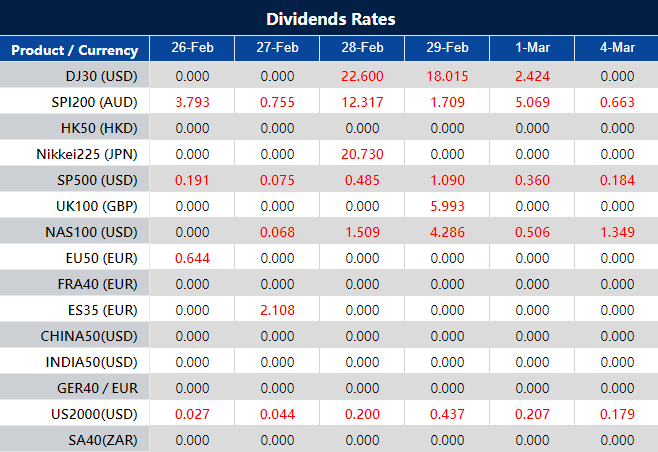
Dividend Adjustment Notice – February 26, 2024

Dear Client,

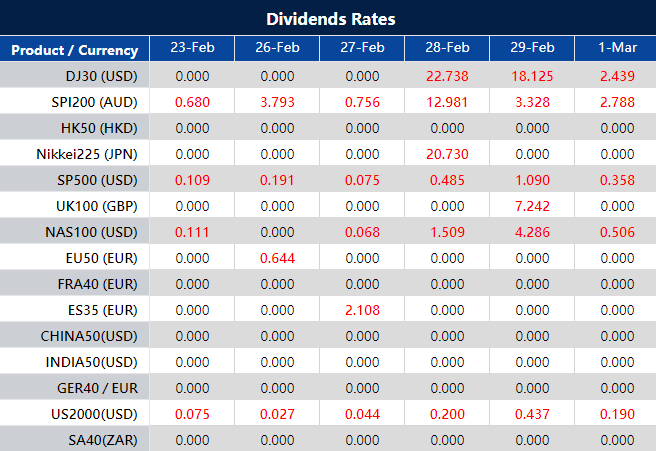
Please note that the dividends of the following products will be adjusted accordingly. Index dividends will be executed separately through a balance statement directly to your trading account, and the comment will be in the following format “Div & Product Name & Net Volume ”.

Please refer to the table below for more details:

The above data is for reference only, please refer to the MT4/MT5 software for specific data.

If you’d like more information, please don’t hesitate to contact info@vtmarkets.com.

Week ahead: RBNZ rate, US economic indicators eyed

As we approach the end of February 2024, the financial world turns its focus towards a series of crucial economic updates slated for release. These reports, spanning from Japan’s inflation rates to the ISM Manufacturing PMI in the United States, are poised to provide fresh insights into the global economic landscape. Among these, the Reserve Bank of New Zealand’s rate statement stands out as a particularly significant event. Here’s what to expect in the week ahead:

February 27, 2024: Japan’s inflation rate 

The annual inflation rate in Japan has seen a decrease, landing at 2.6% in December 2023, down from 2.8% the previous month. This marks the lowest inflation rate since July 2022. Analysts are now eyeing a further drop to 2.1% for January 2024, with the data expected to be unveiled on 27 February. This anticipated decrease could signal easing inflationary pressures within the Japanese economy, offering a glimpse into the country’s current economic health.

February 27, 2024: US durable goods orders

In the United States, new orders for manufactured durable goods showed no significant change in December 2023, a stark contrast to the 5.5% rise observed in November. The forecast for January 2024 is less optimistic, with analysts predicting a 4.5% decline. Set to be released on 27 February, this data could reflect the changing dynamics in U.S. manufacturing and consumer confidence.

February 28, 2024: Australia’s CPI 

Australia’s Consumer Price Index (CPI), a key indicator of inflation, increased by 3.4% in the year to December 2023, a slowdown from the 4.3% climb seen in November. Projections suggest a slight easing to 3.2% for January 2024, with the figures due on 28 February. A moderation in CPI growth may indicate that inflationary pressures are beginning to stabilise in Australia.

February 28, 2024: Reserve Bank of New Zealand’s rate decision

The Reserve Bank of New Zealand (RBNZ) previously held its official cash rate (OCR) steady at 5.5% during its November meeting. This pause, consistent for the fourth consecutive time, met market expectations. Analysts widely anticipate that the RBNZ will maintain the OCR at 5.5% in its upcoming 28 February meeting. The decision is keenly awaited, as it could signal the central bank’s outlook on New Zealand’s economic conditions and inflationary trends.

February 29, 2024: Canada’s GDP 

Canada’s GDP growth for November exceeded expectations, registering a 0.2% increase. This improvement followed three months of stagnant growth. The forecast for December 2023 points to a further rise of 0.3%, with the announcement scheduled for 29 February. A consecutive growth increment would signify a strengthening in the Canadian economy’s recovery momentum.

February 29, 2024: US core PCE price index

The core PCE price index in the US, an important measure of inflation that excludes food and energy costs, experienced a slight uptick of 0.2% in December 2023. Analysts are now expecting a more pronounced increase of 0.4% for January 2024, with data due on 29 February. This anticipated growth could reflect persisting inflationary pressures within the core sectors of the U.S. economy.

March 1, 2024: US ISM manufacturing PMI

The ISM Manufacturing PMI in the United States showed signs of improvement in January 2024, reaching 49.1 from 47.1 in December, marking the highest level since October 2022. The forecast for February remains optimistic, with analysts predicting the index to hold at 49.1. The upcoming release on 1 March will be closely watched as an indicator of the health and direction of the U.S. manufacturing sector.

Dividend Adjustment Notice – February 23, 2024

Dear Client,

Please note that the dividends of the following products will be adjusted accordingly. Index dividends will be executed separately through a balance statement directly to your trading account, and the comment will be in the following format “Div & Product Name & Net Volume ”.

Please refer to the table below for more details:

The above data is for reference only, please refer to the MT4/MT5 software for specific data.

If you’d like more information, please don’t hesitate to contact info@vtmarkets.com.

BullfyConecta

Find us at the Grand Visual Booth at BullfyConecta.

Bullfy, the pioneering web 3.0 Social Network for Finance, introduces ‘BullfyConecta’ in Asturias, Spain. Join enthusiasts, professionals, and pioneers in crypto, blockchain, finance, and marketing and immerse yourself in three days of trend exploration, innovative investment strategies, and entrepreneurial opportunities.

How to Use Market Sentiment to Buy or Sell Gold Today

Mastering Gold Trading with Market Sentiment Analysis

If you’re interested in trading gold, you may wonder how to predict future price movements. One of the tools that can help you is market sentiment analysis. Let’s read further to know what market sentiment is, how it affects the gold price, and how you can use it to make better trading decisions. 

What is market sentiment?

Market sentiment reflects the collective attitude, feelings, and expectations of traders and investors towards a specific market or asset. It reflects their expectations, emotions, and opinions about future market or asset performance. Market sentiment can be bullish, bearish, or neutral. 

A bullish sentiment means that most traders and investors are optimistic and expect the price to rise. On the contrary, a bearish sentiment means that most traders and investors are pessimistic and expect the price to fall. Neutral sentiment implies that there is no clear consensus or direction in the market. 

The role of market sentiment in gold price

The gold price is influenced by many factors, such as supply and demand, inflation, interest rates, geopolitical events, and so on. However, market sentiment can also play a significant role in driving the gold price up or down. Generally, gold is considered a safe-haven asset. It means it performs well when there is uncertainty, fear, or risk in the market.  

When traders and investors are worried about the global economy, political instability, or other threats, they tend to buy gold as a hedge against volatility and losses. This increases the demand and price of gold.  On the other hand, when traders and investors are confident and optimistic about the market outlook, they tend to sell gold and invest in other assets that offer higher returns. This decreases the demand and price of gold. 

Therefore, you can use market sentiment as a contrarian indicator to trade gold. When there is a strong bullish sentiment in the market, it might signal that the gold price is overbought and due for correction.  When there is a strong bearish sentiment in the market, it might signal that the gold price is oversold and due for a rebound. 

How to use market sentiment analysis to trade gold?

There are several ways to measure and analyze market sentiment for gold trading. Some of the common methods are: 

#1. Gold futures and options:

You can look at the open interest and volume of gold futures and options contracts traded on exchanges such as COMEX. Open interest is the number of contracts that are open and not settled.  

Volume is the number of contracts that are traded in a given period. High open interest and volume indicate strong market liquidity and activity.  

The put/call ratio, comparing the volume of put options to call options on gold, serves as a sentiment indicator. A higher ratio suggests bearish sentiment, while a lower ratio signals bullish sentiment.

A high put/call ratio indicates a bearish sentiment, while a low put/call ratio indicates a bullish sentiment. 

#2. Gold ETFs:

You can look at the inflows and outflows of gold exchange-traded funds (ETFs), such as SPDR Gold Shares (GLD) or iShares Gold Trust (IAU).  

These are funds that track the price of gold by holding physical gold or gold derivatives. The inflows and outflows of these funds reflect the demand and supply of gold in the market. A high inflow indicates a bullish sentiment, while a high outflow indicates a bearish sentiment. 

Read more about “How To Trade Gold” in this article

#3. Gold surveys:

You can look at the results of various surveys conducted by reputable organizations or websites that ask traders and investors about their views on the gold price direction.  

For example, Kitco News conducts a weekly survey of experts and retail investors on their gold outlook for the next week.  

The results show the percentage of bullish, bearish, and neutral respondents. A high percentage of bullish respondents indicates a bullish sentiment, while a high percentage of bearish respondents indicates a bearish sentiment. 

#4. Gold technical indicators:

You can look at various technical indicators that are based on historical price data and mathematical calculations to identify trends, patterns, support and resistance levels, momentum, and so on. Some of the popular technical indicators for gold trading are moving averages, trend lines, Fibonacci retracements, Bollinger bands, RSI, MACD, stochastic oscillator, etc.  

These indicators can help you determine whether the gold price is in an uptrend or downtrend, whether it is overbought or oversold, whether it is likely to break out or reverse direction, etc. By using these methods, you can get a better understanding of how the market feels about gold and what might happen next. However, you should not rely solely on market sentiment analysis to trade gold.  

You should also consider other fundamental and technical factors that affect the gold price. Moreover, you should always use risk management techniques such as stop-loss orders, position sizing, diversification, etc., to protect your capital and limit your losses. 

Elevate Your Gold Trading Strategy

Refine your gold trading strategies risk-free with our demo account. Trade using virtual funds, access real-time data, charts, and tools, and sharpen your skills in a simulated environment. Elevate your trading journey — open a demo account with us today.

Practicing with our demo account not only allows you to refine your trading strategies risk-free but also gives you the opportunity to apply market sentiment analysis in real-time scenarios. Elevate your Gold trading journey and gain a competitive edge by opening a demo account with VT Markets today.

Netflix Inc. – A Streaming Giant’s Journey to the Top 

Netflix in 2024: An Unparalleled Leader in Streaming

Netflix Inc. (NASDAQ: NFLX) stands as a colossus in the streaming domain, having redefined entertainment consumption globally. Its role in shaping media trends and market dynamics is profound and continues to evolve.

A Closer Look at Netflix’s Performance in 2024:

Overview:

Founded in 1997 by Reed Hastings and Marc Randolph, Netflix transitioned from a DVD-by-mail service to a premier streaming platform. As of now, it boasts over 200 million paid memberships across more than 190 countries, offering a rich mix of TV series, documentaries, and films in various genres and languages. A testament to its content caliber, Netflix secured 11 Academy Awards in 2023, a nod to its pioneering original programming.

Financial Health:

Netflix’s financial trajectory has been remarkable. In Q3 2023, it reported a revenue boost of 16% year-over-year, reaching $7.5 billion. Operating income soared by 31% to $1.9 billion, while net income climbed 25% to $1.5 billion. A significant turnaround was seen in its free cash flow, which improved to $1.2 billion from a previous year deficit of -$1.3 billion. With a gross margin of 39.5% and an operating margin of 25.5%, Netflix’s profitability metrics are impressive.

Investment Insights:

Netflix’s unique position in the streaming landscape is underpinned by its extensive content library and innovative originals. Its global footprint and consistently expanding subscriber base present a compelling growth narrative. The leadership’s strategic focus on content and technological advancements has fortified Netflix’s financial stature, marked by robust margins and a positive cash flow trajectory.

Navigating Risks:

However, potential investors should be mindful of the competitive pressures within the streaming industry, with formidable players like Disney+, Amazon Prime Video, and HBO Max vying for market share. Content acquisition costs remain a financial burden, possibly necessitating future price adjustments to sustain profitability. Additionally, Netflix’s stock exhibits volatility, influenced by broader market fluctuations. A thorough due diligence process and a strategy that includes portfolio diversification are advisable for those considering Netflix as an investment.

Embracing the Future: Netflix’s Strategic Path Forward

Netflix’s journey from a DVD rental service to a streaming behemoth reflects its adaptability and innovative spirit. Despite the competitive landscape and financial challenges, its commitment to content quality, as evidenced by its numerous awards and global presence, sets a solid foundation for future growth. Investors and analysts alike will be watching closely as Netflix navigates the evolving entertainment industry, continuing to make strategic investments in content and technology to maintain its leadership position.

Ready to leverage the dynamic world of streaming stocks? Start trading US Shares CFDs with VT Markets today and capitalize on the opportunities Netflix and other leading companies offer.

Nvidia’s stellar earnings propel S&P 500 and Nasdaq to new highs amidst broad market optimism

On Thursday, the S&P 500 and Nasdaq Composite reached impressive new heights, largely driven by Nvidia’s remarkable quarterly earnings report. The S&P 500 surged by 2.11%, its best performance since January 2023, while the Nasdaq Composite soared by 2.96%, flirting with its all-time high, thanks to Nvidia’s 16.4% share price jump after reporting a 265% revenue increase from its thriving AI business. This surge highlighted Nvidia’s growing dominance in the tech sector and boosted confidence across the broader market, particularly in Big Tech stocks like Meta, Amazon, Microsoft, and Netflix. Concurrently, the U.S. economy showed signs of robust health with a significant drop in jobless claims and a surge in existing home sales, further fueling market optimism. Meanwhile, currency markets adjusted to the mixed global economic indicators and policy expectations, with the dollar stabilizing and the USD/JPY pair experiencing an uptick, reflecting the complex interplay of global economic trends and monetary policy anticipations.

Stock Market Updates

On Thursday, the S&P 500 reached new heights, propelled by Nvidia’s unexpectedly strong quarterly earnings, which not only boosted the broader market but also significantly lifted the tech sector. The S&P 500 climbed 2.11% to close at 5,087.03, marking its most impressive performance since January 2023, while the Nasdaq Composite soared 2.96% to end the day at 16,041.62, nearing its all-time closing high. Meanwhile, the Dow Jones Industrial Average experienced a notable surge of 456.87 points or 1.18%, surpassing the 39,000 mark for the first time and closing at a new record of 39,069.11, reflecting widespread optimism in the financial markets.

Nvidia, a leading chipmaker, saw its shares jump 16.4% to an all-time high after announcing a staggering 265% increase in total revenue from the previous year, primarily fueled by its booming artificial intelligence business. This growth has positioned Nvidia as one of the largest U.S. companies by market capitalization, with expectations for continued revenue growth in the coming quarter. The enthusiasm around AI and Nvidia’s extraordinary performance has significantly influenced the rally in Big Tech stocks, including notable gains in shares of Meta, Amazon, Microsoft, and Netflix, thereby bolstering confidence in the tech space, and benefiting the broader stock market.

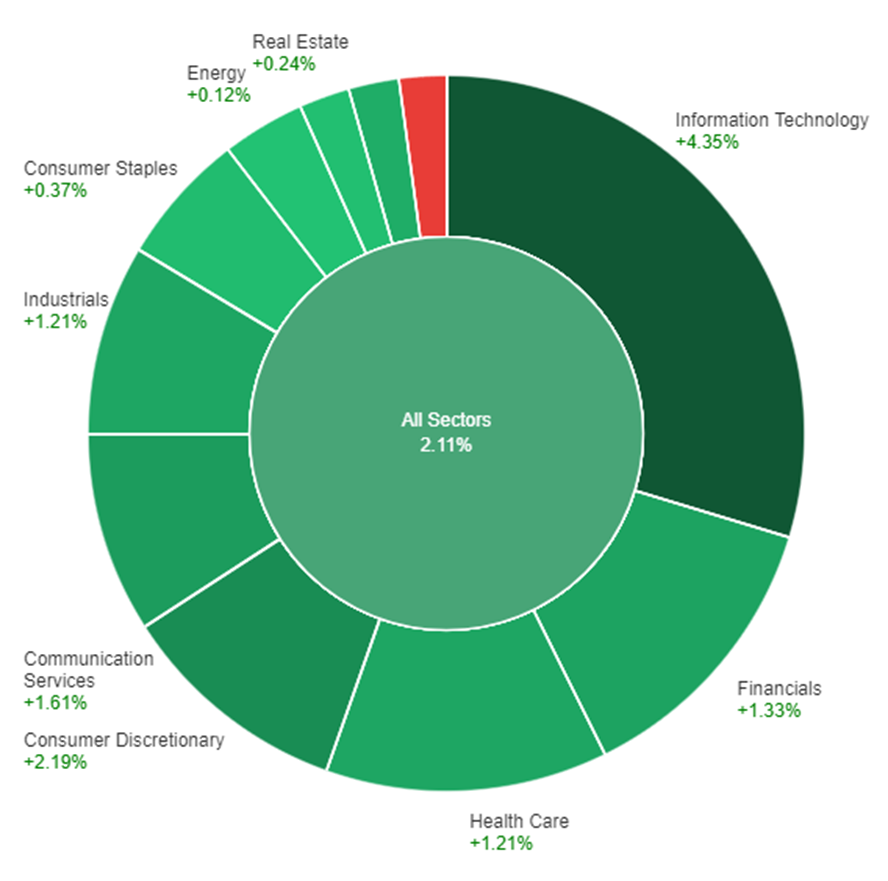
Data by Bloomberg

On Thursday, the stock market witnessed a positive trend across most sectors, with the overall sector experiencing a 2.11% increase in price. Information Technology led the gains with a significant rise of 4.35%, followed by Consumer Discretionary and Communication Services, which saw increases of 2.19% and 1.61%, respectively. Financial, Industrials and Health Care sectors also enjoyed gains, each increasing by over 1%. Materials, Consumer Staples, and Real Estate sectors saw modest rises, with Energy experiencing a slight increase of 0.12%. In contrast, Utilities were the only sector to decline, dropping by 0.77%.

Currency Market Updates

The currency market has seen a notable shift as the dollar index stabilized from a three-week low, propelled by an unexpected drop in U.S. jobless claims which overshadowed the mixed performance in flash PMIs across major economies. Despite the composite PMI readings from the eurozone and the UK slightly surpassing forecasts, and a contraction in the U.S. figures, the market’s attention gravitated towards the robust U.S. jobless claims data, showcasing the lowest levels since before 2018 and comparable to figures last seen in 1969. Additionally, the U.S. housing market demonstrated resilience with existing home sales in January surging by 3.1%, marking the highest point since the previous August, suggesting a sensitivity to fluctuating mortgage rates. This economic optimism was further buoyed by stellar quarterly results from Nvidia, which underscored the rapid expansion of AI usage, influencing global equity markets positively.

Amid these developments, currency pairs reacted to the broader economic indicators and policy expectations. The Euro dipped to a flat position against the dollar, reflective of Germany’s PMI contraction and aligning with anticipations of the ECB’s rate cuts preceding those of the Federal Reserve. Meanwhile, the Sterling showed modest gains against the dollar, buoyed by promising UK PMIs, despite being significantly off its recent high. The USD/JPY pair experienced an uptick, driven by the widening yield spreads between U.S. Treasury and Japanese government bonds, and a general shift towards risk-off flows that placed more pressure on the yen. As the market anticipates upcoming U.S. economic reports, including the core PCE inflation data, income, and consumption figures, the currency landscape remains poised for further adjustments, with special attention to the potential impacts on USD/JPY’s trajectory toward its yearly highs and the looming possibility of Japanese intervention amidst speculations of policy normalization by the Bank of Japan.

Picks of the Day Analysis
EUR/USD (4 Hours)

EUR/USD Retreats from Three-Week High Amid Mixed US Economic Signals and ECB Caution

EUR/USD experienced a decline from its three-week peak around 1.0900, settling near 1.0820 after an initial surge, influenced by positive US job data and varied bond yield performances amidst speculation of future Federal Reserve (Fed) interest rate cuts. The possibility of the Fed easing monetary policy has been bolstered by strong US inflation figures, though the likelihood of a May rate cut seems diminished, with a greater chance anticipated for June. Conversely, the European Central Bank (ECB) maintains a cautious stance against early rate reductions, despite expectations of a downward inflation forecast revision in March. This cautious approach is echoed by ECB officials, emphasizing the premature nature of financial market relaxation, and highlighting ongoing concerns over wage pressures and the labour market’s tightness, suggesting a potential delay in the ECB’s monetary easing.

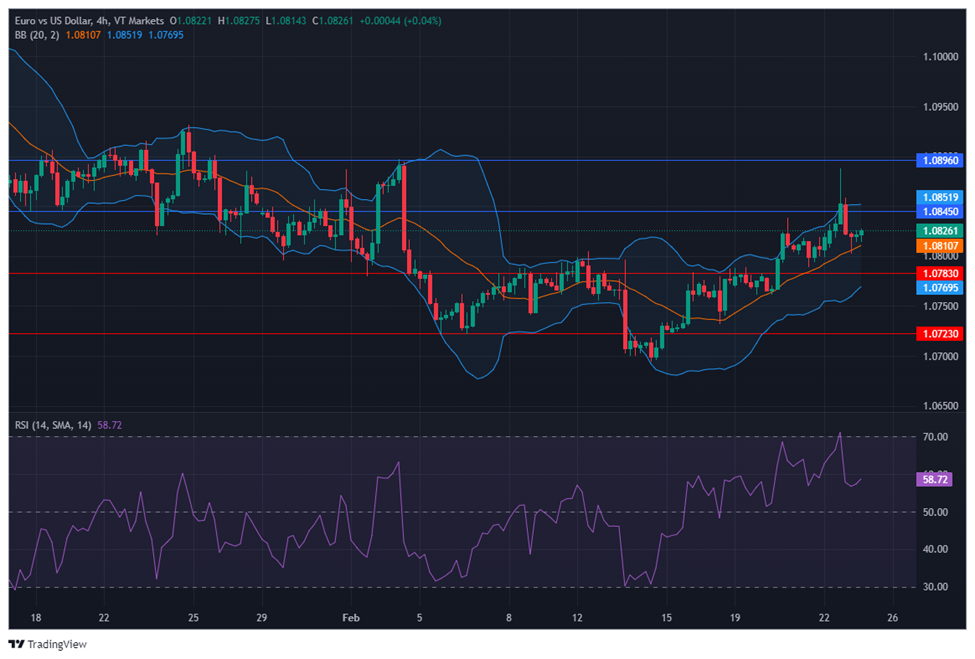
Chart EUR/USD by TradingView

On Thursday, the EUR/USD moved higher and reached the upper band of the Bollinger Bands. Currently, the price is moving just above the middle band, suggesting a potential upward movement to reach back to the upper band. Notably, the Relative Strength Index (RSI) maintains its position at 58, signaling a neutral outlook for this currency pair.

Resistance: 1.0845, 1.0896

Support: 1.0783, 1.0723

XAU/USD (4 Hours)

XAU/USD Retreats from Peak as US Dollar Recovers Amid Positive Economic Indicators

Spot Gold receded from its recent high of $2,034.86 as the US Dollar regained strength following positive US economic data and increased government bond yields. Despite the Dollar’s initial drop amid a tech-led stock market rally in Asia and Europe, it rebounded before the US markets opened, influenced by less-than-expected growth in Initial Jobless Claims and a surge in February’s PMI figures, indicating a robust expansion in manufacturing and a slight contraction in services. Meanwhile, the 10-year Treasury note yields touched multi-week highs, driven by the Federal Open Market Committee’s minutes, which suggested a cautious approach towards rate cuts, awaiting further inflation progress.

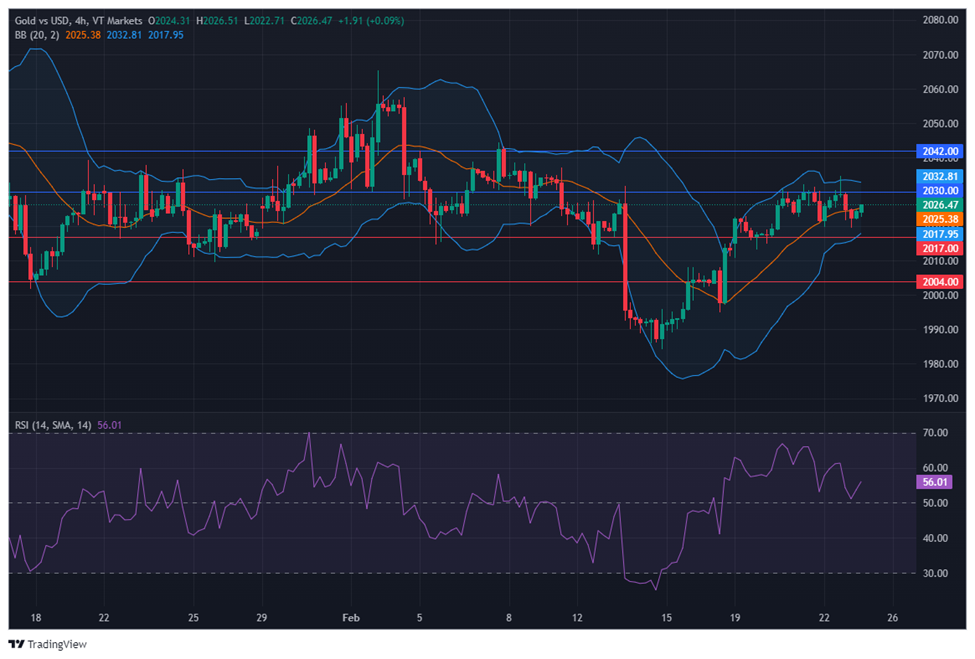
Chart XAU/USD by TradingView

On Thursday, XAU/USD moved lower to reach below the middle band after reaching the upper band of the Bollinger Bands. Currently, the price is moving just around the middle band, suggesting a potential consolidation movement as the bands are squeezing. The Relative Strength Index (RSI) stands at 56, signaling a neutral outlook for this pair.

Resistance: $2,030, $2,042

Support: $2,017, $2,004

Diversifying investments through ETF trading 

ETFs, or Exchange-Traded Funds, are gaining popularity among investors for their simplicity and versatility. They provide an easy way to invest in a range of assets, making them accessible for non-professional traders. 

Imagine being able to invest in a diverse basket of stocks or bonds without the complexity of managing individual assets—that’s the power of ETFs. 

In this article, we’ll explore why ETFs matter for forex traders, covering their basics, advantages, popular categories, and practical trading tips. 

Understanding ETFs 

ETFs are investment funds traded on stock exchanges, similar to individual stocks. However, they’re different from mutual funds and individual stocks in a couple of ways. 

  • Firstly, ETFs are like mutual funds because they pool investors’ money to invest in various assets like stocks, bonds, or commodities. But, unlike mutual funds traded at the end of the day, ETFs are traded on stock exchanges throughout the day at market prices, just like stocks. 
  • Secondly, ETFs differ from individual stocks because they represent ownership in a mix of assets, not just one company. So, when you invest in an ETF, you’re actually buying a share of a fund holding a bunch of different securities. 

ETFs track specific benchmarks like the S&P 500 for stocks or the Barclays Capital Aggregate Bond Index for bonds, aiming to mirror their performance by holding similar assets. 

For forex traders, ETFs offer diversification by investing in a variety of securities within one investment. This spreads risk, ideal for those with limited capital or seeking a diverse portfolio without buying multiple securities. 

ETFs provide liquidity since they trade on stock exchanges throughout the day at market prices. This allows easy buying and selling, unlike mutual funds which trade once a day. 

Furthermore, ETFs offer transparency by disclosing their holdings daily, giving investors clear visibility into their investments. 

Popular ETF categories 

ETFs come in various categories, each offering unique investment opportunities for forex traders. Here is a breakdown of the most common types

1. Equity ETFs 

These ETFs invest in stocks, providing exposure to a particular market, industry, or region. They offer diversification across multiple companies within a single investment. 

For example, the SPDR S&P 500 ETF (SPY) tracks the performance of the S&P 500 Index, offering broad exposure to large-cap US stocks. 

2. Bond ETFs 

Bond ETFs invest in fixed-income securities such as government bonds, corporate bonds, or municipal bonds. They offer income generation and diversification, with varying levels of risk depending on the underlying bonds. 

An example is the iShares Core US Aggregate Bond ETF (AGG), which tracks the performance of the US investment-grade bond market. 

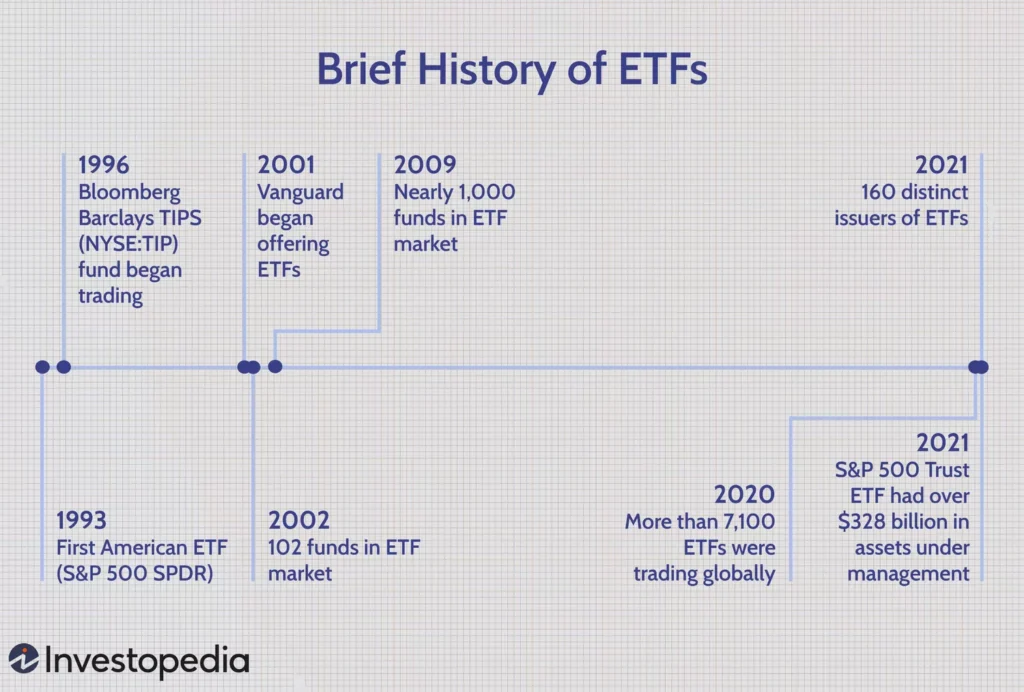
Brief history of ETFs
source: Investopedia

3. Commodity ETFs 

These ETFs track the performance of commodities like gold, silver, oil, or agricultural products. They provide exposure to commodity prices without the need for direct commodity ownership. 

The SPDR Gold Shares ETF (GLD) is a popular example, offering exposure to the price of gold. 

4. Sector ETFs 

Sector ETFs focus on specific sectors or industries, such as technology, healthcare, or energy. They allow investors to target areas of the market they believe will outperform or diversify their portfolio. 

For instance, the Technology Select Sector SPDR Fund (XLK) invests in technology companies within the S&P 500 Index. 

Each category of ETFs has its own characteristics and potential benefits, catering to different investment objectives and risk tolerances. 

Advantages of trading ETF CFDs 

Trading ETFs through CFDs (Contracts for Difference) involves entering into a contract with a broker to speculate on the price movement of the ETF without owning the underlying asset. 

When it comes to ETF CFDs trading, there are several advantages worth considering: 

  • Flexibility and leverage: CFDs offer traders the flexibility to control larger positions with a smaller amount of capital, potentially amplifying gains or losses compared to traditional investing. 
  • Long and short positions: CFD trading allows traders to take both long (buy) and short (sell) positions on ETFs, enabling them to profit from both rising and falling markets. 

In summary, trading ETFs through CFDs provides forex traders with flexibility, leverage, and the opportunity to profit from both upward and downward price movements in the market. 

Tips for successful ETF trading 

By following these tips, you can enhance your chances of success in ETF trading while managing risks effectively: 

  • Have a well-defined trading plan: It’s crucial to establish a clear trading plan outlining your goals, risk tolerance, and strategies. Stick to your plan and avoid making impulsive decisions based on emotions or market fluctuations. 
  • Stay informed about market trends: Keep yourself updated on market trends and news that could affect ETF prices. This includes economic indicators, geopolitical events, and industry-specific developments. Being informed allows you to make informed decisions and adapt your trading strategy accordingly. 
  • Diversify your investments: Spread your risk by diversifying across multiple ETFs representing different sectors or asset classes. This helps mitigate the impact of volatility in any single investment and allows you to capture opportunities in various market segments. 

In conclusion, ETFs serve as versatile investment vehicles for forex traders, offering exposure to various asset classes like stocks, bonds, and commodities. Trading ETFs through CFDs provides flexibility, leverage, and profit opportunities. It’s essential to have a well-defined trading plan, stay informed about market trends, and practice responsible trading strategies. By implementing these principles, traders can navigate the market confidently and responsibly, maximising their potential for success. 

Back To Top
server

Hello there 👋

How can I help you?

Chat with our team instantly

Live Chat

Start a live conversation through...

  • Telegram
    hold On hold
  • Coming Soon...

Hello there 👋

How can I help you?

telegram

Scan the QR code with your smartphone to start a chat with us, or click here.

Don’t have the Telegram App or Desktop installed? Use Web Telegram instead.

QR code