As we approach the week starting February 12, 2024, the financial community is on high alert, gearing up for a series of pivotal economic updates. These reports are crucial as they could significantly influence central bank decisions in the near term, particularly those of the Federal Reserve and the Bank of England. With the backdrop of ongoing global economic adjustments, the forthcoming data releases are set to provide critical insights into the current economic landscape.
The spotlight this week is on the US and UK, with both nations poised to release vital inflation and GDP figures. For the US, the Consumer Price Index (CPI) data stands out as a key indicator, offering fresh insights into inflation trends and potentially guiding the Federal Reserve’s rate cut expectations. Market participants are keenly awaiting this update, especially after recent labor market data suggested a more robust economic stance than anticipated.
In the UK, the focus shifts to a comprehensive economic update, including Q4 GDP figures, January inflation data, and labor market statistics. These releases are especially significant as they could hint at whether the UK economy is edging towards a recession, a scenario that would have profound implications for monetary policy and market sentiment.
Additionally, the Eurozone is not to be overlooked, with its own set of economic indicators due for release. Employment and industrial production figures will be closely watched for signs of economic resilience or weakness, potentially impacting Eurozone GDP revisions and broader market expectations.
For market analysts and forex traders, these developments are of paramount importance. The US CPI data, alongside the UK’s economic updates, not only shed light on the respective economies’ health but also offer valuable cues for currency market dynamics and trading strategies. Understanding these indicators is essential for navigating the complexities of the global financial markets effectively.
Key Highlights for the Week:
US CPI Data: A critical measure of inflation that could influence Federal Reserve rate cut expectations.
UK Economic Updates: Including Q4 GDP, January inflation, and labor market statistics, providing a comprehensive view of the UK’s economic health.
Eurozone Indicators: Employment and industrial production figures could signal economic trends and impact GDP revisions.
As we delve into this significant week, staying informed and agile is crucial for market participants. The upcoming economic indicators and central bank insights will not only enhance understanding of the current economic environment but also assist in refining trading strategies and market approaches.
Stay Ahead with Insightful Analysis: Keep abreast of these developments with our expert commentary and analysis, ensuring you’re well-equipped to make informed decisions in the ever-evolving financial markets.
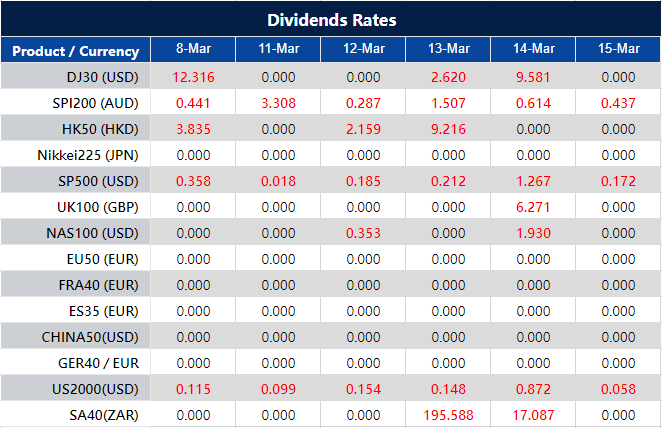
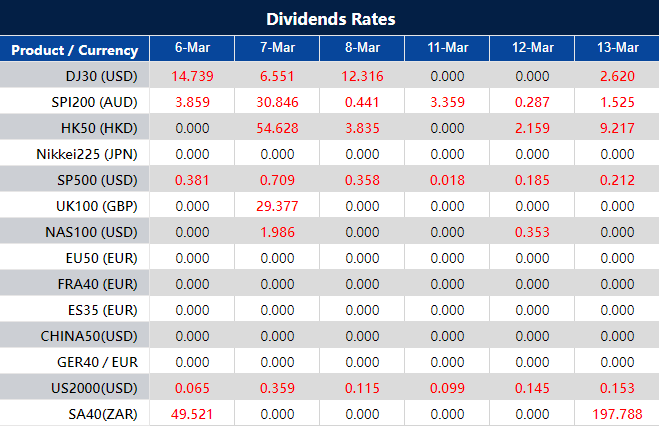
Please note that the dividends of the following products will be adjusted accordingly. Index dividends will be executed separately through a balance statement directly to your trading account, and the comment will be in the following format “Div & Product Name & Net Volume ”.
Please refer to the table below for more details:
The above data is for reference only, please refer to the MT4/MT5 software for specific data.
If you’d like more information, please don’t hesitate to contact info@vtmarkets.com.
1.Via Client Portal: Log in to your Client Portal, select the desired trading account, click on the gear icon, then choose “change password.”
2.On PC MetaTrader Terminal: Navigate to “Tools” > “Option,” select the “Server” tab, then click “Change.”
3. On iOS MT4 App: Access “Settings,” tap on the account tab, select the “⋯” icon next to your account, and choose to change the master password.
4.On Android MT4 App: Tap the menu icon (≡), go to “manage account,” select the “⋯” icon, then opt to change the master password.
If You Forget Your Trading Account Password
Reset your password via the Client Portal by selecting the appropriate trading account, clicking the “lock” icon, choosing “Forgot password,” and following the system’s instructions to receive a reset link in your registered email.
Changing Your Client Portal Password
Log into the Client Portal, navigate to “Profile” > “Change Client Portal Password.”
If You Forget Your Client Portal Password
Click “Forgot password” on the Client Portal login page, input your registration email, and a reset link will be sent to you.
Investor Password (Read-only Password)
The investor password allows viewing access to your MetaTrader account’s trades and history without permitting any trading actions.
Checking Your Investor Password
PC MetaTrader 4/5: Go to “Tools” > “Options,” select “Change” under the “Server” tab, and set a new investor password.
Mobile Devices:
iOS: Navigate to “Settings,” tap the account tab, select the “⋯” icon under “Current Account,” and choose “Change Investor Password.”
Android: Tap “≡,” go to “Manage accounts,” select “Change password,” then “Change investor password.”
Enabling Client Portal Login Alert
Activate login alerts through the Client Portal under “Profile” > “My Profile” to receive email notifications of logins from new locations.
Reactivating an Archived Account
Archived accounts due to prolonged inactivity cannot be reactivated. To trade again, log in with your original email and open an additional account via the Client Portal. Remember, you cannot re-register with the same personal details if you have had a VT Markets live account previously. Instead, open an additional account following the provided steps.
Security Note
To protect your funds, withdrawal functionality is locked for 24 hours after changing your client portal password. Refer to the withdrawal page’s pop-up message in the client portal for details.
This guide is crafted to assist you in managing your VT Markets account effectively, ensuring a secure and seamless trading experience. For more information on your trading account please visit our help centre here.
As part of our commitment to provide the most reliable service to our clients, there will be server maintenance this weekend.
Maintenance Hours :
10th of March 2024 (Sunday) 07:00 – 14:00 (GMT+2)
Please note that the following aspects might be affected during the maintenance:
1. To accommodate the daylight saving time adjustment, upon the completion of this upgrade maintenance, the system time will transition from the original GMT+2 to GMT+3.
2. The price quote and trading management will be temporarily disabled during the maintenance. You will not be able to open new positions, close open positions, or make any adjustments to the trades.
3. There might be a gap between the original price and the price after maintenance. The gaps between Pending Orders, Stop Loss and Take Profit will be filled at the market price once the maintenance is completed. If you don’t want to hold any open positions during the maintenance, it is suggested to close the position in advance.
4. Please refer to MT4/MT5 for the latest update on the completion and market opening time. Our services will be back online once the maintenance is completed.
Thank you for your patience and understanding about this important initiative.
If you’d like more information, please don’t hesitate to contact info@vtmarkets.com
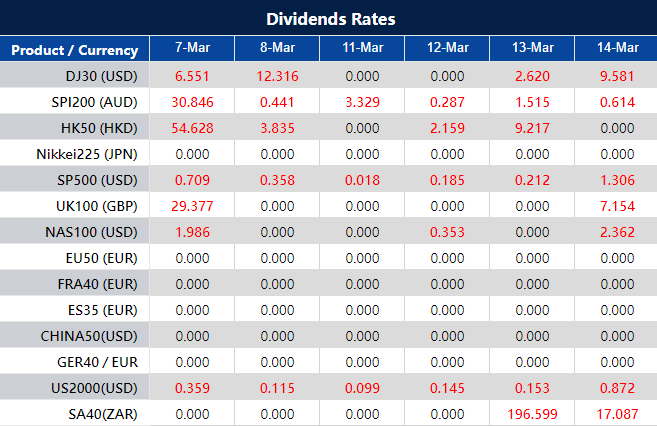
Please note that the dividends of the following products will be adjusted accordingly. Index dividends will be executed separately through a balance statement directly to your trading account, and the comment will be in the following format “Div & Product Name & Net Volume ”.
Please refer to the table below for more details:
The above data is for reference only, please refer to the MT4/MT5 software for specific data.
If you’d like more information, please don’t hesitate to contact info@vtmarkets.com.
Wednesday saw a notable rebound in major U.S. stock indices, with the S&P 500, Nasdaq, and Dow Jones all recording gains, despite mixed performances across sectors and continued concerns over a troubled regional bank. The positive shift in the stock market contrasted with a decline in the U.S. dollar following dovish remarks from Federal Reserve Chair Jerome Powell, who hinted at potential rate cuts later in the year. This news, coupled with movements in the currency markets and Powell’s testimony on Capitol Hill, influenced trader sentiments, leading to fluctuations across a broad spectrum of financial markets, from major currency pairs to commodities like gold and Bitcoin.
Stock Market Updates
Stock markets witnessed a positive shift on Wednesday, rebounding from consecutive losses in prior sessions, with the S&P 500, Nasdaq Composite, and Dow Jones Industrial Average making gains. The S&P 500 climbed by 0.51% to 5,104.76, the Nasdaq increased by 0.58% to 16,031.54, and the Dow rose modestly by 0.2% to 38,661.05, despite a notable drop in Disney shares. This upward movement provided a temporary relief from the recent downturns that had pulled the indexes away from their record highs. However, the gains were somewhat limited due to Apple’s continued decline and growing concerns over a troubled regional bank, impacting the broader market sentiment.
The day also saw mixed performances in the technology sector and fluctuations in regional bank stocks, influenced by New York Community Bancorp’s announcement of a $1 billion capital raise, which initially sent shares plummeting before recovering to close 7.5% higher. Attention was also focused on Capitol Hill, where Federal Reserve Chair Jerome Powell indicated a potential lowering of interest rates later in the year, citing the current peak of the tightening cycle. Powell’s remarks came during his testimony before the House Financial Services Committee, ahead of a scheduled appearance before the Senate Banking Committee, signaling a cautious yet optimistic outlook for future monetary policy adjustments.
Currency Market Updates
The currency market experienced significant movements as recent economic data and comments from Federal Reserve Chair Jerome Powell influenced trader sentiments. The USD index saw a decline of 0.46% after disappointing ADP and JOLTS reports suggested that previous Federal Reserve rate hikes were beginning to impact the U.S. economy, hinting at a potential slowdown that could help steer inflation towards the Fed’s 2% target. Powell’s semi-annual monetary policy testimony further pressured the dollar as he hinted at the possibility of easing monetary restraint later in the year, acknowledging the progress towards achieving the 2% inflation target. These developments led to a dip in U.S. Treasury yields and bolstered expectations for rate cuts in 2024, overall weighing down on the dollar across the board.
In response to the dovish outlook presented by the Federal Reserve, major currency pairs saw notable movements. The EUR/USD pair rose by 0.42%, benefiting from the narrowing yield differentials between U.S. and European bonds, which encouraged investors to add to their long positions in the Euro. Similarly, the USD/JPY pair declined by 0.5% as the prospect of lower Fed rates and speculation about the Bank of Japan normalizing rates led to a reduction in USD/JPY long positions. The GBP/USD pair also gained, moving to a session high, driven by expectations that the Bank of England might maintain higher interest rates compared to the U.S. for a longer period. Commodity currencies like the AUD benefited from the dovish Fed stance, with the AUD/USD rallying by more than 1%. Additionally, Bitcoin and gold prices surged, benefiting from the lower interest rate environment, with gold reaching a new all-time high, highlighting the broad impact of Fed policies on financial markets.
Picks of the Day Analysis
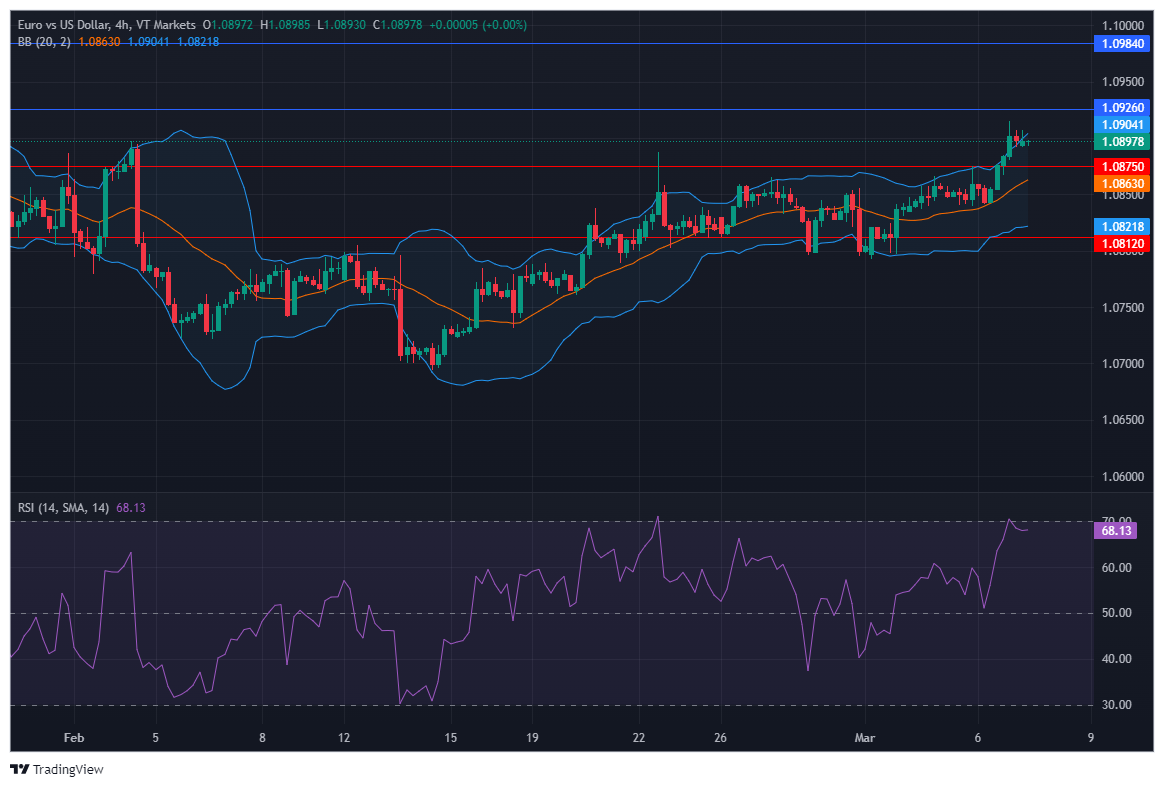
EUR/USD (4 Hours)
EUR/USD Surges Past 1.0900 Amid Dollar Weakness and Interest Rate Speculations
EUR/USD experienced a notable surge, breaking through the critical 1.0900 mark to reach multi-week highs, driven by a weakened US Dollar in response to disappointing ADP report outcomes and an uneventful testimony from Fed Chair Powell. Concurrently, the US Dollar Index (DXY) saw a decline for the fourth consecutive session, reaching five-week lows, amid anticipations of a potential Fed rate cut in June and declining US yields. Despite the downward trend in global yields, Germany’s 10-year bund yields showed slight increases, indicating caution ahead of an upcoming ECB event. With the Fed hinting at possible rate cuts within the year contingent on inflation trends, and the ECB projected to commence its easing cycle soon, the short-term outlook suggests a potentially stronger Dollar, especially if both central banks initiate easing measures around the same time. However, this scenario posits a deeper correction for EUR/USD, with an immediate target near its year-to-date low of 1.0700, possibly extending to late 2023 lows in the 1.0500 region.
On Thursday, the EUR/USD moved higher and was able to reach the upper band of the Bollinger Bands. Currently, the price is moving just below the upper band, suggesting a potential upward movement to reach above the next resistance level. Notably, the Relative Strength Index (RSI) maintains its position at 68, signaling a bullish outlook for this currency pair.
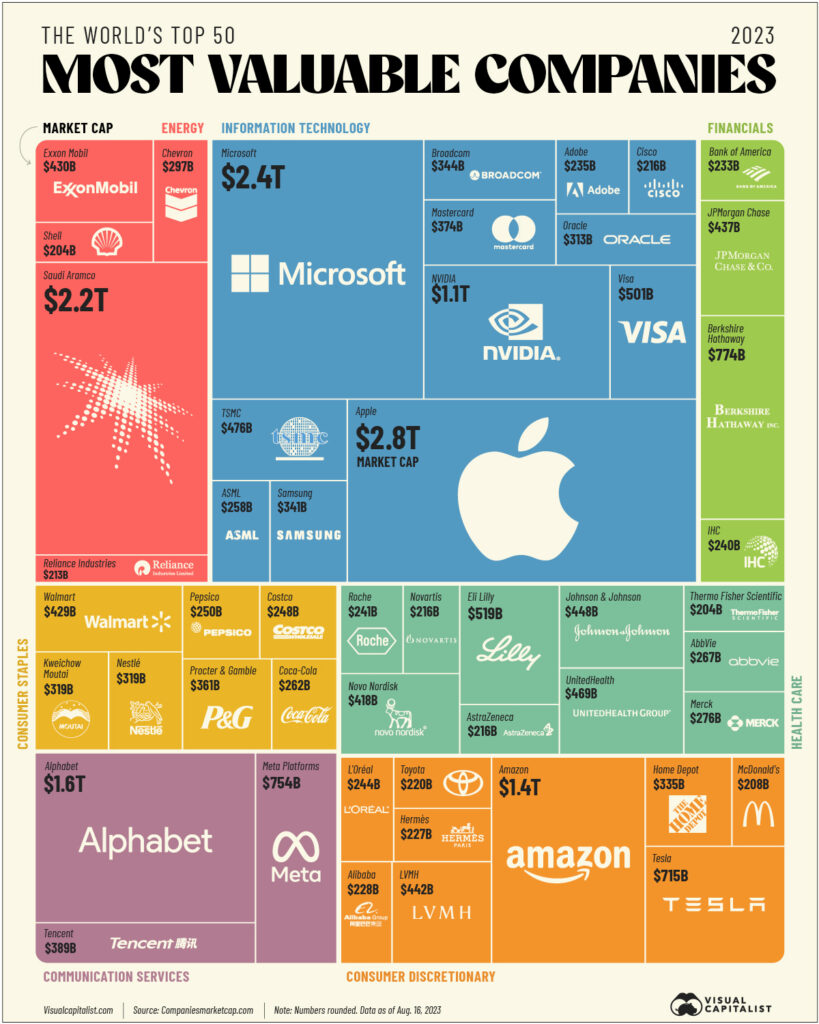
Market capitalisation, frequently referred to as ‘market cap,’ serves as a vital metric for evaluating a company’s value in the stock market, akin to a comprehensive price tag for the entire entity.
New York Stock Exchange source: ABC News
Understanding market capitalisation is pivotal as it offers traders insights into a company’s prominence within the market, thereby influencing their investment choices and risk management approaches.
Unveiling market capitalization
Market capitalisation stands as a fundamental metric in finance, utilised to evaluate a company’s value by encompassing the total worth of all outstanding shares of its stock.
Establishing market capitalisation occurs through an initial public offering (IPO), where an investment bank assesses the company’s value using diverse valuation techniques. This evaluation then determines the number of shares to be made available to the public and their respective pricing.
For example, if a company’s IPO value is set at $150 million, it may opt to issue 15 million shares at $10 each or 30 million shares at $5 each, ultimately resulting in an identical initial market cap of $150 million.
In simpler terms, market cap offers a glimpse into the prospective cost of purchasing all company’s shares at their prevailing market prices.
Understanding market capitalisation empowers investors and traders to evaluate a company’s stature and performance within the stock market.
Calculation methodology for market capitalisation
The computation of market capitalisation is straightforward, entailing the utilisation of a basic formula:
Market Cap = Current Stock Price × Total Outstanding Shares
Market capitalisation materialises through multiplying a company’s prevailing stock price by its aggregate outstanding shares. Here, the stock price signifies the value of an individual share in the company, while the total outstanding shares denote the available shares to the public.
Consider a hypothetical scenario involving XYZ Inc., with a current stock price of $50 per share and a total outstanding shares count of 10 million:
Thus, the market capitalisation of XYZ Inc. stands at $500 million.
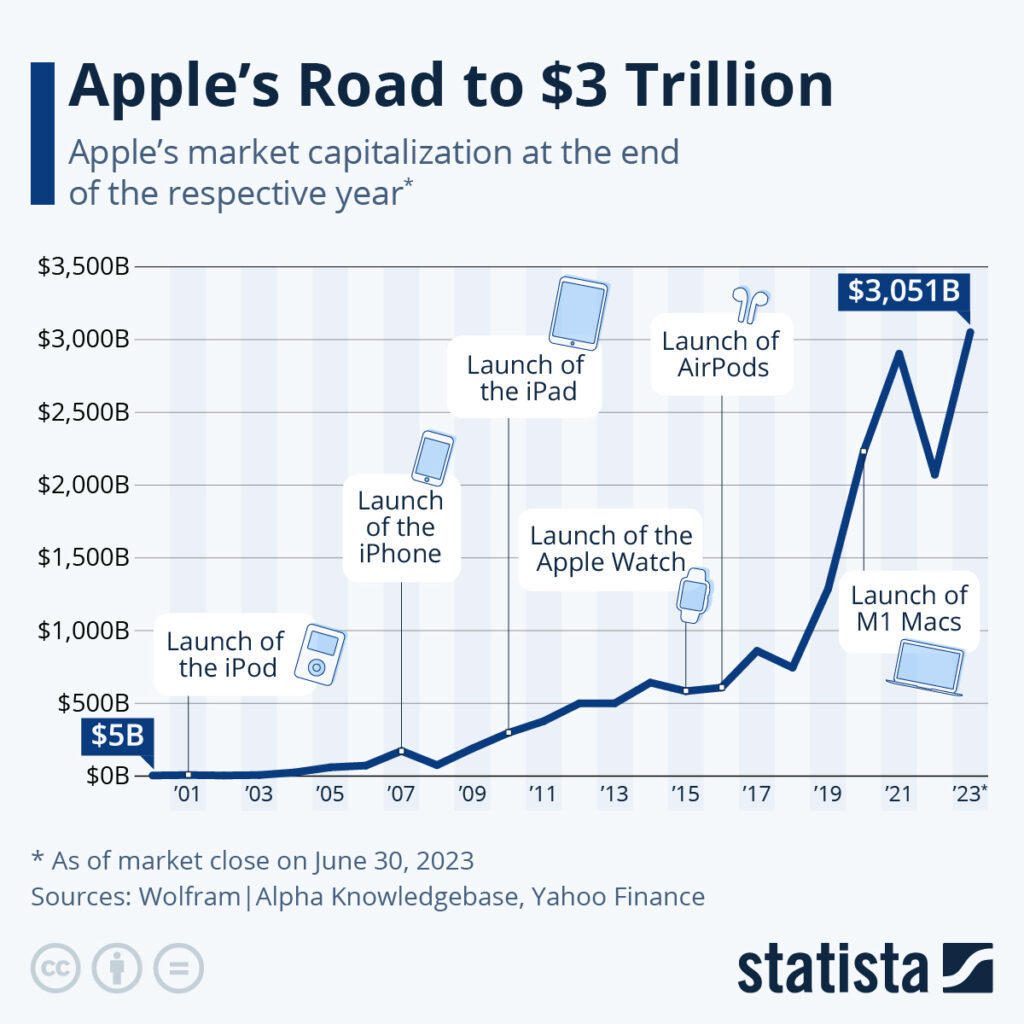
Apple’s road to $3 trillion market cap source: Statista
Delving into diluted market capitalisation
Both in traditional markets and cryptocurrencies, diluted market capitalisation assumes significance in assessing a company or project’s comprehensive value. It accounts for additional shares, such as stock options or tokens earmarked for team members and advisors, which possess the potential to dilute the value of existing shares or tokens.
For instance, revisiting Company A, with a stock price of $50, 10 million outstanding shares, and potential additional shares from stock options equivalent to 1 million shares:
In this instance, Company A’s regular market capitalisation amounts to $500 million, whereas the diluted market capitalisation, factoring in potential additional shares, totals $550 million.
Understanding both formulations facilitates investors in gauging a company’s value more accurately, thus enabling informed investment decisions grounded on the company’s potential future share structure.
Categories of market capitalisation and investment approaches
Grasping market capitalisation necessitates categorising companies based on their magnitude and significance within the stock market. The principal categories encompass:
Large-cap: Characterised by sizable, well-established companies with a market capitalisation typically surpassing $10 billion. Notable examples encompass Apple, Microsoft, and Amazon.
Opting for large-cap companies proffers stability and incremental growth over time. Although short-term gains may be moderate, these companies frequently reward investors with consistent upticks in share value and dependable dividend disbursements.
Mid-cap: Encompassing companies with a market capitalisation ranging between $2 billion and $10 billion. Illustrative instances entail Etsy, Dropbox, and Duolingo.
Positioned between large and small caps, mid-cap companies represent established entities operating within sectors poised for accelerated growth. Despite presenting heightened risk due to their growth phase, mid-caps offer appealing prospects for investors seeking potential growth and expansion opportunities.
Small-cap: Encompassing companies with a market capitalisation below $2 billion, exemplified by Udemy, Getty Images, and Upwork.
Typically, small-cap companies, often younger or niche-focused, offer substantial growth prospects. Nevertheless, they are accompanied by escalated volatility and liquidity concerns, rendering them riskier investments. Nonetheless, their agility and potential for exponential growth render them enticing for investors possessing a higher risk tolerance and a long-term perspective.
The largest global companies by market cap 2023 source: Visual Capitalist
Market capitalisation and market indices
Market capitalisation forms the cornerstone of how market indices, such as the S&P 500, monitor market performance. Indices employ market cap-weighted methodologies, where larger companies wield greater influence, thereby implying that alterations in large-cap stocks significantly impact index movements.
Companies such as Apple, Microsoft, and Amazon, boasting substantial market caps, exert a pronounced influence on indices like the S&P 500. Consequently, if their market caps ascend, the index follows suit, reflecting a buoyant market sentiment.
Factors influencing market capitalisation
Market capitalisation, or market cap, is subject to an array of factors:
Company performance: Robust financial performance bolsters market cap, while undervalued shares may allure investors seeking growth prospects.
Investor sentiment: Positive developments elevate market cap, whereas adverse events can precipitate a downturn.
Industry trends: Flourishing industries tend to exhibit higher market caps, albeit market sentiment can instigate overvaluation or undervaluation of shares within these sectors.
Grasping these factors empowers investors to ascertain whether a company’s market cap accurately mirrors its intrinsic value and whether its shares are presently undervalued or overvalued.
In conclusion, market capitalisation emerges as a pivotal tool for investors and traders in navigating financial markets, furnishing insights into company size, stability, and growth potential, thereby guiding investment decisions and trading strategies. While market cap holds undeniable value, it is imperative to consider additional factors such as company performance and investor sentiment. By comprehending market cap’s significance and associated risks, traders can make well-informed decisions and efficaciously manage their portfolios for sustained success in finance.
Whether you’re a novice or a seasoned trader, this guide is designed to enhance your trading acumen with practical, easy-to-understand examples.
Understanding Moving Averages
Moving averages are a cornerstone in technical analysis, smoothing out price data to create a single flowing line.
This makes it easier to identify the direction of the trend. There are mainly two types: the Simple Moving Average (SMA) and the Exponential Moving Average (EMA).
For instance, a 50-day SMA will average out the closing prices of gold for the last 50 days, offering a clear picture of the trend’s direction.
The Role of Moving Averages
Moving averages serve two primary functions: trend identification and support and resistance levels.
For example, if the price of gold is above its 200-day SMA, it’s generally considered to be in an uptrend.
Conversely, if it’s below, it might be in a downtrend. Moreover, these moving averages often act as support in an uptrend and resistance in a downtrend, guiding traders in their decision-making.
Combining Moving Averages with the Best MT4 Indicator
The synergy between moving averages and the best MT4 indicators can exponentially enhance your trading efficiency. One such revered MT4 indicator is the ‘Golden Line Indicator,’ specifically designed for gold trading.
It offers precise entry and exit points by analyzing moving averages alongside other technical parameters.
This integration allows traders to make well-informed decisions based on comprehensive market analysis.
Practical Example: Trading with Moving Averages
Let’s say you’re observing a 100-day SMA for gold. If the price suddenly starts to rise above the 100-day SMA, it might signal a buying opportunity, suggesting an emerging uptrend.
Conversely, if it falls below this moving average, it could be a signal to sell or short, indicating a potential downtrend.
Advanced Strategies: Using Multiple Moving Averages
For more nuanced analysis, traders often use multiple moving averages, such as combining a short-term and a long-term SMA.
For instance, you might use a 50-day SMA alongside a 200-day SMA. A popular strategy is to look for crossovers.
When the 50-day SMA crosses above the 200-day SMA, it’s known as a “golden cross,” signaling a strong buying opportunity. Conversely, a “death cross” occurs when the 50-day SMA crosses below the 200-day SMA, hinting at a selling or shorting opportunity.
The Importance of Time Frames
The effectiveness of moving averages can vary depending on the time frame used. Shorter time frames, like a 15-day SMA, can be useful for short -term traders looking for quick insights,
Meanwhile, longer time frames, like a 200-day SMA, are preferred by those with a longer-term perspective. It’s crucial to select a time frame that aligns with your trading strategy and risk tolerance.
Integrating Moving Averages with Other Indicators
While moving averages are powerful, they yield the best results when used in conjunction with other indicators.
For gold trading forex, combining them with indicators like the Relative Strength Index (RSI) or Bollinger Bands on the MT4 platform can provide a more robust trading strategy.
Common Pitfalls to Avoid
It’s important to remember that moving averages are lagging indicators. It means they reflect past price movements and can sometimes give delayed signals.
This is why they should be used as part of a comprehensive trading strategy, rather than the sole basis for trading decisions.
Always be aware of market news and events that can cause sudden price swings in gold, as these can often override technical indicators.
Understanding and effectively utilizing moving averages in gold trading forex can significantly enhance your trading strategy, making it more robust and responsive to market changes.
Remember, practice makes perfect. To get hands-on experience without financial risk, consider opening a demo account. This will allow you to apply these concepts in real-time market scenarios using virtual funds, providing a safe space to refine your strategies.
Elevate your gold trading with VT Markets—sign up for a demo account today and refine your strategies risk-free!
Please note that the dividends of the following products will be adjusted accordingly. Index dividends will be executed separately through a balance statement directly to your trading account, and the comment will be in the following format “Div & Product Name & Net Volume ”.
Please refer to the table below for more details:
The above data is for reference only, please refer to the MT4/MT5 software for specific data.
If you’d like more information, please don’t hesitate to contact info@vtmarkets.com.
Welcome to VT Markets ClubBleu, our premier loyalty program designed to enhance your trading experience and reward your dedication. Below, we address some frequently asked questions about the program to help you get started.
What is VT Markets ClubBleu?
VT Markets ClubBleu is a cutting-edge, point-based loyalty program that rewards you for your trading activity. By depositing funds and trading through our Client Portal, you accumulate points that unlock higher membership tiers and grant access to exclusive rewards.
Who is eligible to join VT Markets ClubBleu?
All VT Markets clients, both new and existing, with a trading account are welcome to join ClubBleu. New clients can access the program by making their initial deposit. Ready to embark on your trading journey? Create a live account in just 5 minutes.
What are the benefits of being a VT Markets ClubBleu member?
As a ClubBleu member, you’ll enjoy a variety of exclusive benefits, including profit boosters, loss rescue vouchers, and cash redemptions. Additionally, you’ll have access to advanced trading tools and educational webinars, empowering you to elevate your trading skills.
Before joining the program, what terms and conditions should I be aware of?
We encourage you to review the Terms and Conditions associated with each reward you redeem from the program to ensure full understanding and compliance.
Is there a membership fee for VT Markets ClubBleu?
Joining VT Markets ClubBleu is completely free. There are no membership fees, allowing you to enjoy the rewards and benefits without any financial commitment.
How can I join VT Markets ClubBleu?
Joining is simple. Open a Live Account with VT Markets and make your first deposit to start earning points. Click here to create your live account. Existing clients can access ClubBleu Pass through the Client Portal.
What happens to my points, benefits, or rewards if the program is terminated?
Should the program be terminated, any unused points, benefits, and rewards will become invalid and cannot be used.
Can my ClubBleu membership be suspended or terminated?
Membership may be suspended or terminated due to violations of our terms and conditions. It’s important to familiarize yourself with these to avoid any disruptions to your membership.
What happens to my points, benefits, or rewards if my membership is terminated or suspended?
Upon suspension or termination, you will lose the ability to accumulate or use points associated with your account. VT Markets reserves the right to remove all or part of the unused points or benefits.
Can I terminate my VT Markets ClubBleu membership myself?
If you decide to terminate your ClubBleu membership, please reach out to us at info@vtmarkets.com for assistance.
VT Markets ClubBleu is more than a loyalty program—it’s a testament to our commitment to rewarding our clients’ loyalty and enhancing their trading journey. Join today and unlock the door to a world of exclusive trading benefits and rewards.
For more information about VT Markets, please visit here.