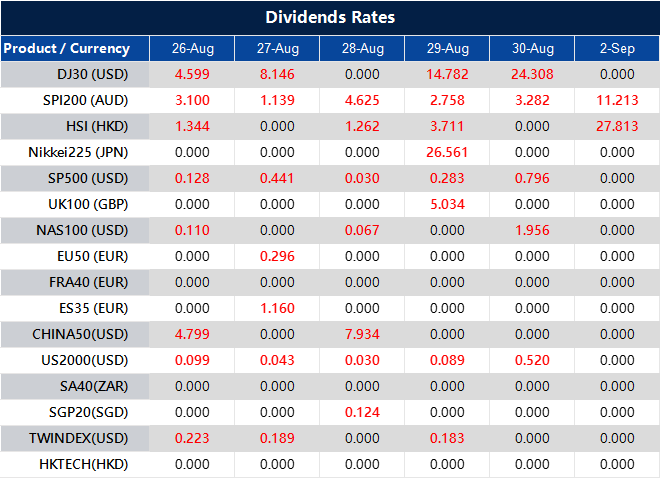
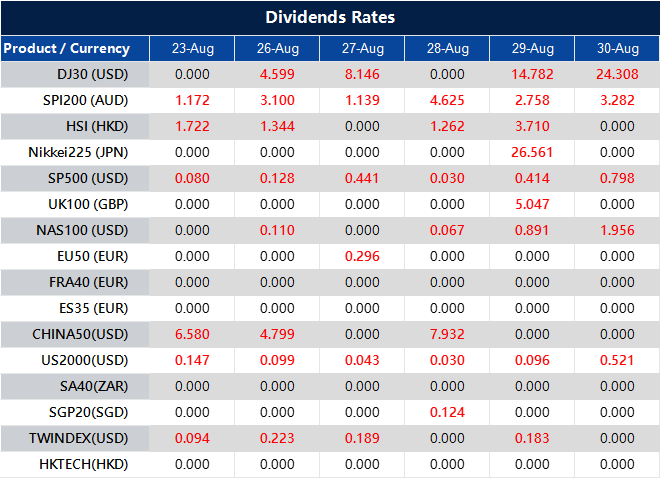
Please note that the dividends of the following products will be adjusted accordingly. Index dividends will be executed separately through a balance statement directly to your trading account, and the comment will be in the following format “Div & Product Name & Net Volume ”.
Please refer to the table below for more details:
The above data is for reference only, please refer to the MT4/MT5 software for specific data.
If you’d like more information, please don’t hesitate to contact info@vtmarkets.com.
As we approach the latter half of August, financial markets are gearing up for another busy week. Investors will have plenty to consider as they navigate the markets.
With the summer winding down, investors will closely monitor these factors to gauge the health of the economy and the potential direction of monetary policy.
KEY ECONOMIC INDICATORS
Jackson Hole symposium starts today – what Fed watchers are looking for:
Central bankers from around the world fly into Jackson Hole, Wyoming, this week to attend what has become the globe’s premier economic gathering, the Kansas City Federal Reserve’s annual symposium in Grand Teton National Park.
The marquee event is Fed Chair Jerome Powell’s speech Friday morning.
Investors hope he will give a clearer steer on whether he feels inflation has cooled enough to justify an interest rate cut next month.
Initial jobless claims:
New applications for unemployment benefits ticked up in the latest week, but appeared to be steadying near a level consistent with a gradual cooling of the labor market
The latest data should continue to allay fears that the labour market is rapidly deteriorating, first raised after a sharper-than-expected slowdown in job growth in July, which also saw the unemployment rate rise to a post-pandemic high of 4.3%.
Core PCE price index (YoY):
The core PCE inflation gauge for the US economy remained at 2.6% in June 2024, the same as in May and above market forecasts of 2.5%.
On a monthly basis, core PCE prices rose by 0.2% in June.
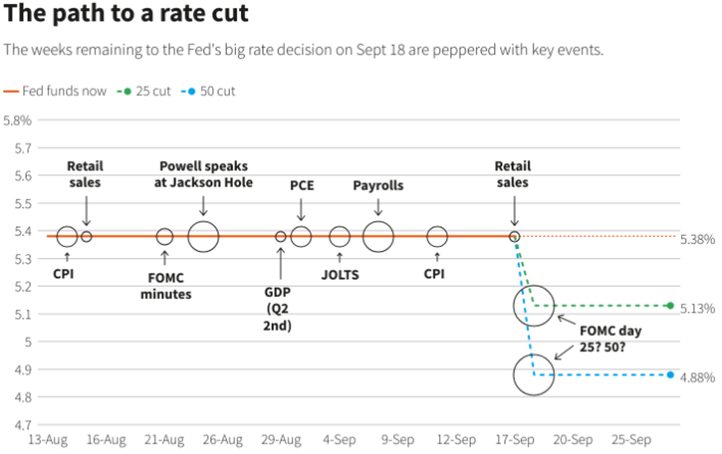
Fed Chair Jerome Powell worries that a rising unemployment rate could make that first reduction in borrowing costs a big one.
Powell has pledged to be data-dependent, and there is lots of economic data before the Fed’s Sept 17-18 meeting.
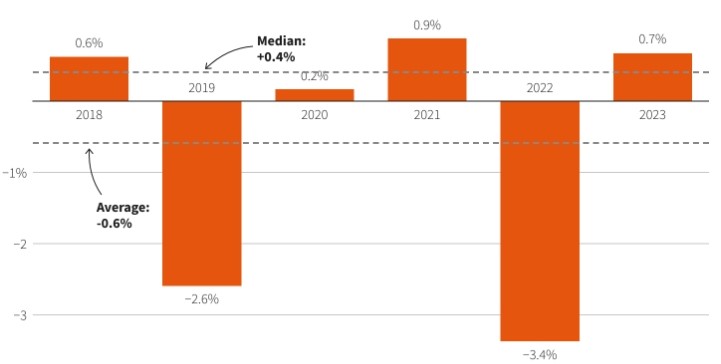
Stocks on Powell’s Jackson Hole speech days.
Stock Movement during and after the Fed Chair Jerome Powell speeches at the Kanas City Fed’s annual Jackson Hole conference.
CURRENCIES
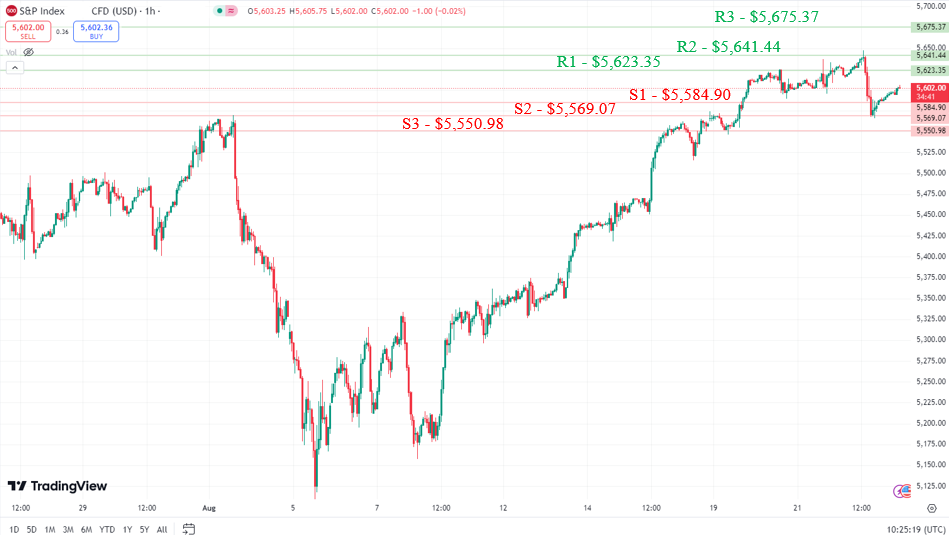
S&P 500 index:
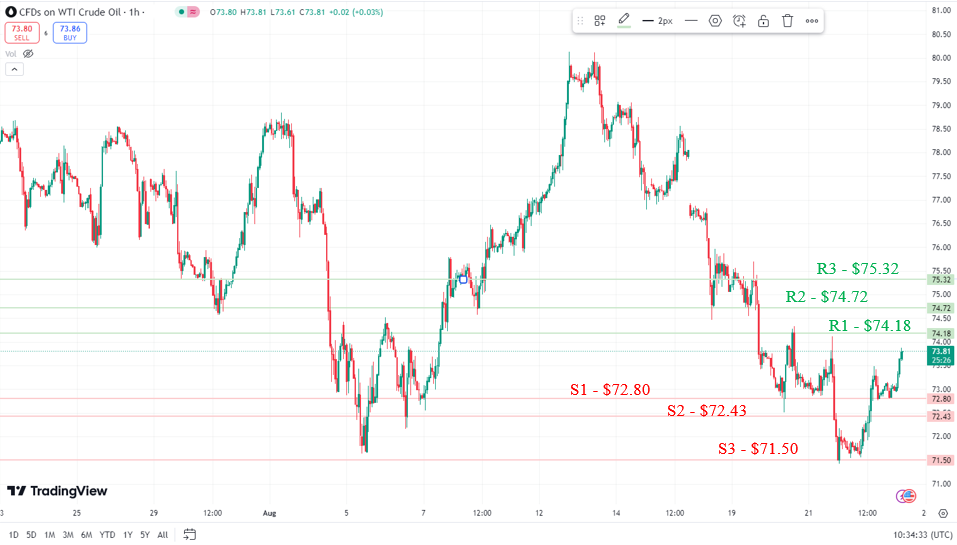
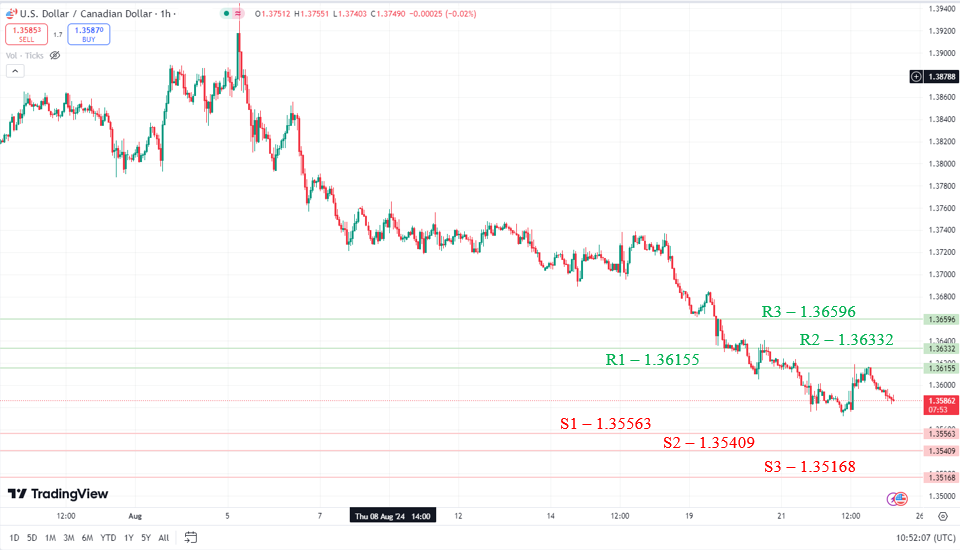
S1-S3 – Means potential Support points. If the market declines further, these are the potential levels it can reach.
R1-R3 – Means potential Resistance points. If the market starts to increase again, these are the potential levels it can reach.
Crude oil inventories expectations:
The Inventory Report will be released this Wednesday, 28 August 2024.
Events since the last release of the inventory report:
Commercial crude oil inventories fell by 4.6 million barrels to 426 million barrels
Oil prices steadied in Asian trade on Friday after rebounding in the prior session amid some bargain buying but were still headed for steep weekly losses amid persistent concerns over slowing demand.
Brent oil futures expiring in October rose 0.1% to $77.26 a barrel, while West Texas Intermediate crude futures rose 0.1% to $72.34 a barrel by 21:06 ET (01:06 GMT).
Previous Report Figures and Forecast Figures for the latest release -4.649M (Barrels of Oil)
Forecast Figures for 28 August 2024 – TBA (To be Announced) (Barrels of oil).
USD/CAD:
USD/JPY outlook: Dollar pushes to 2-week high on solid sales
U.S. crude oil rises to $73 per barrel after erasing most of 2024 gain
At the market open in London, the FTSE 100 Index climbed 0.24%
EUR/GBP is down to 0.84.
The US Dollar Index Futures was down 0,18% at 101.217.
Market instruments to look out for this week:
USD/CAD
GBP/USD
EUR/USD
Nasdaq100
XAU/USD
Crude oil
MARKET NEWS
Gold prices nurse tumble from record highs with Powell, rate cuts in focus:
Spot gold rose 0.4% to $2,495.52 an ounce,
Gold futures expiring in December rose 0.6% to $2,530.70 an ounce by 01:24 ET (05:24 GMT).
Spot prices were down slightly this week after hitting a record high of $2,531.72 an ounce.
U.S. crude oil rises to $73 per barrel after erasing most of 2024 gain:
West Texas Intermediate October contract: $73.01 per barrel, up $1.08, or 1.5%. Year to date, U.S. crude oil has gained 1.9%.
Brent October contract: $77.22 per barrel, up $1.17, or 1.54%. To date, the global benchmark has been marginally up by 0.23%.
RBOB Gasoline September contract: $2.24 per gallon, more than 3 cents higher, or 1.76%. Year to date, gasoline is ahead by 6.7%.
Natural Gas’s September contract was $2.05 per thousand cubic feet, 12 cents lower, or 5.7%. Year to date, gas is down 18.3%.
FTSE 100 and Europe mixed, US stocks up as investors look to Jackson Hole:
The FTSE 100 rose about 0.1% in early trade before ending the day 0.1% lower.
In Germany, the DAX and the CAC were 0.4% higher.
The pan-European STOXX 600 rose 0.2%.
Over in the US, the S&P 500 and the tech-heavy Nasdaq Composite rose about 0.3%
The Dow Jones Industrial Average was just above the flat line.
Click here to open a live account and start trading.
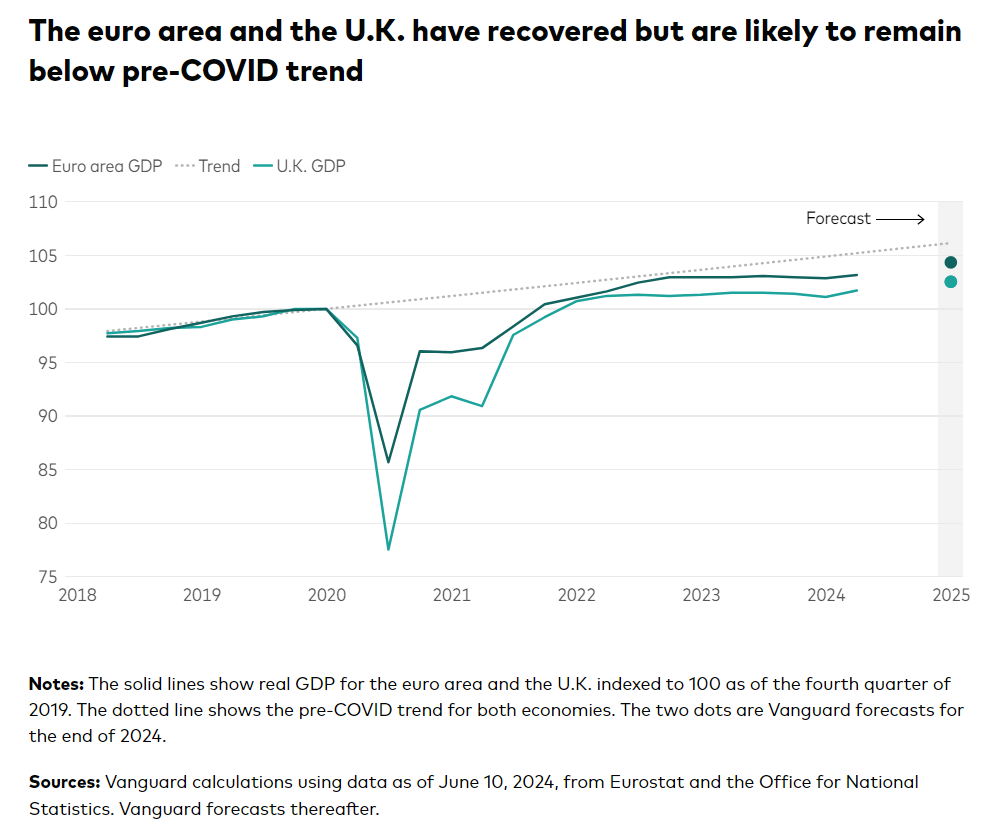
As we navigate through the second half of 2024, the European and UK economies are showing signs of recovery after facing significant challenges in recent years. The aftermath of the pandemic, energy crises, and persistent inflation have tested the resilience of these economies. However, recent data and forecasts suggest a cautiously optimistic outlook for the year ahead.
Economic indicators and stock market outlook
The first half of 2024 has brought mixed news for the European and UK economies.
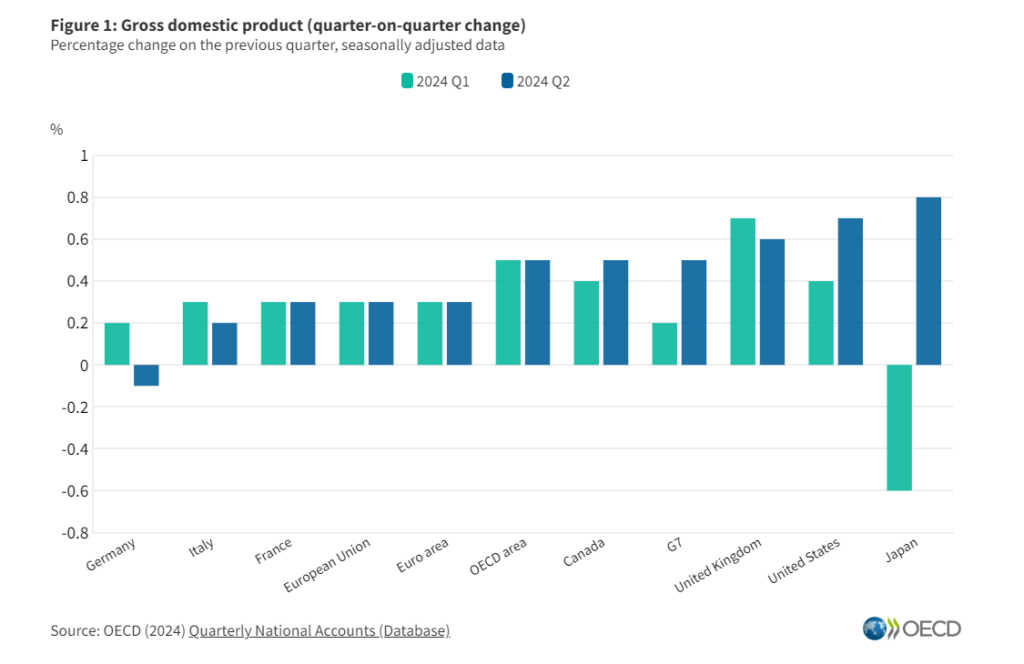
The euro zone economy expanded by 0.3% in both the first and second quarters of 2024, surpassing expectations and marking a clear break from the technical recession experienced in the latter half of 2023.
However, this growth has not been uniformed across the region. Germany, the euro zone’s largest economy, unexpectedly contracted by 0.1% in the second quarter, while countries like Latvia, Sweden, and Hungary also experienced GDP contractions.
The UK economy has shown more robust growth, expanding by 0.7% in the first quarter and 0.6% in the second quarter of 2024. However, growth flattened in June, partly due to heavy rain affecting retail sales and a doctor’s strike impacting healthcare activity.
Looking ahead, the Bank of England has revised its growth forecast for the UK upward to 1.25% for 2024, a significant improvement from the previous 0.5% projection. However, they anticipate slower growth in the latter half of the year, with 0.4% in Q3 and 0.2% in Q4.
For stock market enthusiasts, the outlook remains cautiously positive, with the STOXX 600 expected to reach 540 points by the end of 2024, implying a roughly 5% gain from August 2023 levels. The STOXX50E is projected to rise to 5,038, a 3.4% increase, while Germany’s DAX is forecasted to reach 19,000, representing a 3.1% gain.
Key sectors driving recovery
The recovery continues to be uneven across sectors. While services are crucial to overall economic health, they face ongoing challenges in price normalisation.
Manufacturing, particularly in Germany, shows signs of weakness but has potential for improvement as global conditions enhance.
Several sectors are positioned for growth in 2024. Technology hardware and semiconductors are expected to benefit from ongoing digital transformation trends. The banking and insurance sectors may thrive in an environment of changing interest rates.
Utilities, particularly those focused on renewable energy, are likely to see growth as Europe continues its push towards sustainable energy solutions.
Government and central bank policies
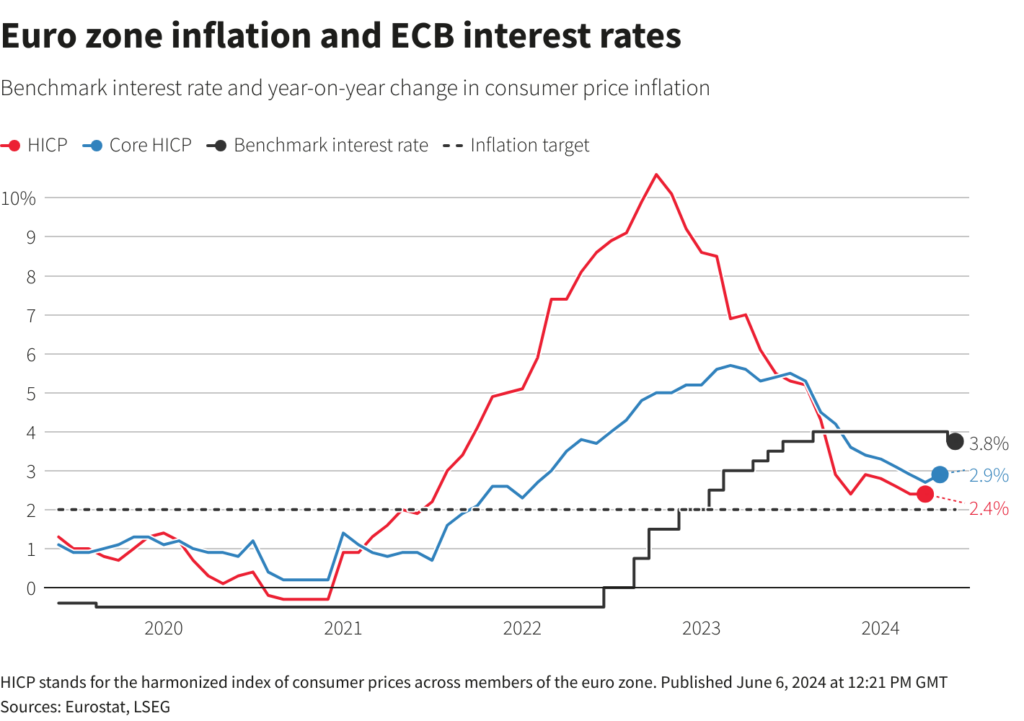
Central bank policies continue to play a crucial role in shaping the economic landscape in 2024, with inflation remaining a key focus prompting careful adjustments to monetary policy.
The European Central Bank (ECB) has already taken action this year, cutting its key interest rate from 4.00% to 3.75% on August 8. While the ECB recently kept rates steady, discussions are ongoing about a potential further cut in September, contingent on economic conditions and inflation trends.
Meanwhile, the Bank of England has been more aggressive in its approach, implementing two rate cuts thus far in 2024. The first reduction brought the rate down from 5.25% to 5.00%, with a second cut anticipated to lower it further to 4.75%. These moves align with the Bank’s revised growth forecasts and demonstrate a careful navigation of economic challenges.
These measured steps by both central banks reflect their delicate balancing act between supporting economic growth and keeping inflation in check. The policies are seen as essential to fostering economic recovery without reigniting inflation.
However, both institutions may continue to adopt a cautious approach due to persistent inflationary pressures, particularly in the services sector.
The possibility of additional adjustments later in the year remains open as central banks continue to closely monitor economic indicators. This ongoing vigilance underscores the complex nature of managing monetary policy in the current economic climate, where supporting growth must be balanced against the risk of overheating the economy.
Challenges and risks
Despite the positive outlook, several challenges and risks remain.
The uneven recovery across euro zone countries, particularly Germany’s contraction, highlights the fragility of the economic rebound.
The UK’s long-term growth figures are concerning, with output per head still 0.8% lower than pre-pandemic levels and overall growth of just 2.3% since Q4 2019.
Business investment in the UK was 1.1% lower in Q2 2024 compared to the previous year, indicating ongoing uncertainties. Productivity issues, exacerbated by Brexit-related challenges, continue to weigh on the UK’s economic performance.
Geopolitical tensions and potential supply chain disruptions continue to pose risks to the recovery. Additionally, the moderation of wage growth, while helpful for inflation control, could impact consumer spending power.
Opportunities for traders
For traders, 2024 presents a landscape of both opportunities and challenges. Sectors benefiting from structural shifts, such as technology and renewable energy, may offer growth potential.
The anticipated rate cuts could lead to broader market gains beyond just large-cap stocks, providing opportunities for diversification.
Traders should consider focusing on companies with strong fundamentals and those positioned to benefit from long-term trends like digital transformation and the transition to green energy.
The varying performance across euro zone countries also suggests opportunities in markets showing stronger growth, such as Ireland.
Seize these prospects by investing in EU and UK stocks with VT Markets, which also provides daily market analysis to help you make informed decisions and optimise your trading strategy.
Conclusion
As 2024 unfolds, the European and UK economies are showing signs of recovery, though progress is gradual and uneven. Economic growth, inflation control, and central bank policies will shape this recovery’s path.
Traders should stay informed and maintain a diversified strategy to navigate the markets effectively. The economic landscape remains complex, with varied performances across the euro zone and challenges in the UK. Continuous learning, careful analysis, and prudent risk management are crucial for success in this evolving environment.
As we navigate through the second half of 2024, the European and UK economies are showing signs of recovery after facing significant challenges in recent years. The aftermath of the pandemic, energy crises, and persistent inflation have tested the resilience of these economies. However, recent data and forecasts suggest a cautiously optimistic outlook for the year ahead.
Economic indicators and stock market outlook
The first half of 2024 has brought mixed news for the European and UK economies.
The euro zone economy expanded by 0.3% in both the first and second quarters of 2024, surpassing expectations and marking a clear break from the technical recession experienced in the latter half of 2023.
However, this growth has not been uniformed across the region. Germany, the euro zone’s largest economy, unexpectedly contracted by 0.1% in the second quarter, while countries like Latvia, Sweden, and Hungary also experienced GDP contractions.
The UK economy has shown more robust growth, expanding by 0.7% in the first quarter and 0.6% in the second quarter of 2024. However, growth flattened in June, partly due to heavy rain affecting retail sales and a doctor’s strike impacting healthcare activity.
Looking ahead, the Bank of England has revised its growth forecast for the UK upward to 1.25% for 2024, a significant improvement from the previous 0.5% projection. However, they anticipate slower growth in the latter half of the year, with 0.4% in Q3 and 0.2% in Q4.
For stock market enthusiasts, the outlook remains cautiously positive, with the STOXX 600 expected to reach 540 points by the end of 2024, implying a roughly 5% gain from August 2023 levels. The STOXX50E is projected to rise to 5,038, a 3.4% increase, while Germany’s DAX is forecasted to reach 19,000, representing a 3.1% gain.
Key sectors driving recovery
The recovery continues to be uneven across sectors. While services are crucial to overall economic health, they face ongoing challenges in price normalisation.
Manufacturing, particularly in Germany, shows signs of weakness but has potential for improvement as global conditions enhance.
Several sectors are positioned for growth in 2024. Technology hardware and semiconductors are expected to benefit from ongoing digital transformation trends. The banking and insurance sectors may thrive in an environment of changing interest rates.
Utilities, particularly those focused on renewable energy, are likely to see growth as Europe continues its push towards sustainable energy solutions.
Government and central bank policies
Central bank policies continue to play a crucial role in shaping the economic landscape in 2024, with inflation remaining a key focus prompting careful adjustments to monetary policy.
The European Central Bank (ECB) has already taken action this year, cutting its key interest rate from 4.00% to 3.75% on August 8. While the ECB recently kept rates steady, discussions are ongoing about a potential further cut in September, contingent on economic conditions and inflation trends.
Meanwhile, the Bank of England has been more aggressive in its approach, implementing two rate cuts thus far in 2024. The first reduction brought the rate down from 5.25% to 5.00%, with a second cut anticipated to lower it further to 4.75%. These moves align with the Bank’s revised growth forecasts and demonstrate a careful navigation of economic challenges.
These measured steps by both central banks reflect their delicate balancing act between supporting economic growth and keeping inflation in check. The policies are seen as essential to fostering economic recovery without reigniting inflation.
However, both institutions may continue to adopt a cautious approach due to persistent inflationary pressures, particularly in the services sector.
The possibility of additional adjustments later in the year remains open as central banks continue to closely monitor economic indicators. This ongoing vigilance underscores the complex nature of managing monetary policy in the current economic climate, where supporting growth must be balanced against the risk of overheating the economy.
Challenges and risks
Despite the positive outlook, several challenges and risks remain.
The uneven recovery across euro zone countries, particularly Germany’s contraction, highlights the fragility of the economic rebound.
The UK’s long-term growth figures are concerning, with output per head still 0.8% lower than pre-pandemic levels and overall growth of just 2.3% since Q4 2019.
Business investment in the UK was 1.1% lower in Q2 2024 compared to the previous year, indicating ongoing uncertainties. Productivity issues, exacerbated by Brexit-related challenges, continue to weigh on the UK’s economic performance.
Geopolitical tensions and potential supply chain disruptions continue to pose risks to the recovery. Additionally, the moderation of wage growth, while helpful for inflation control, could impact consumer spending power.
Opportunities for traders
For traders, 2024 presents a landscape of both opportunities and challenges. Sectors benefiting from structural shifts, such as technology and renewable energy, may offer growth potential.
The anticipated rate cuts could lead to broader market gains beyond just large-cap stocks, providing opportunities for diversification.
Traders should consider focusing on companies with strong fundamentals and those positioned to benefit from long-term trends like digital transformation and the transition to green energy.
The varying performance across euro zone countries also suggests opportunities in markets showing stronger growth, such as Ireland.
Seize these prospects by investing in EU and UK stocks with VT Markets, which also provides daily market analysis to help you make informed decisions and optimise your trading strategy.
Conclusion
As 2024 unfolds, the European and UK economies are showing signs of recovery, though progress is gradual and uneven. Economic growth, inflation control, and central bank policies will shape this recovery’s path.
Traders should stay informed and maintain a diversified strategy to navigate the markets effectively. The economic landscape remains complex, with varied performances across the euro zone and challenges in the UK. Continuous learning, careful analysis, and prudent risk management are crucial for success in this evolving environment.
In the fast-paced world of Forex trading, technology has revolutionised how traders interact with the markets. As we move into 2024, the choice between mobile trading and desktop trading has become increasingly important. Both platforms offer unique advantages, and understanding their differences is crucial for traders aiming to maximise their efficiency and profitability. This guide will explore the pros and cons of both mobile and desktop trading, helping you decide which platform suits your trading style best.
The Rise of Mobile Trading
Forex Mobile trading has gained significant traction in recent years, driven by advancements in smartphone technology and the growing need for flexibility. Traders are no longer confined to their desks and can now manage their portfolios on the go.
Convenience and Flexibility
One of the primary advantages of mobile trading is its convenience. You can monitor the market, execute trades, and manage your portfolio from anywhere—whether you’re travelling, commuting, or simply away from your desk. This flexibility allows traders to respond swiftly to market movements, which is crucial in a market that operates 24/5.
Mobile trading platforms are designed with simplicity in mind. They offer a streamlined interface that makes it easy for both beginners and experienced traders to navigate. Real-time notifications and alerts keep you informed, ensuring you never miss a trading opportunity.
24/7 Market Access
The Forex market operates around the clock, and mobile trading platforms ensure you can access it at any time. Whether it’s late at night or during a lunch break, you can check your positions, analyse market trends, and make informed decisions. This continuous access is particularly beneficial for traders who operate in different time zones or prefer to trade during off-peak hours.
The Stability of Desktop Trading
Despite the rise of mobile trading, desktop platforms remain the go-to choice for many professional traders. The comprehensive tools and features available on desktop platforms provide a more robust trading experience.
Advanced Analysis Tools
Desktop trading platforms are equipped with a wide array of advanced tools and features that cater to in-depth technical analysis. The larger screen real estate allows traders to view multiple charts, indicators, and data feeds simultaneously. This setup is ideal for those who rely heavily on technical analysis to make informed trading decisions.
Additionally, desktop platforms often support a variety of third-party plugins and customisations, allowing traders to tailor their interface to fit their specific needs. Whether you prefer to analyse trends, backtest strategies, or automate trades, desktop platforms provide the necessary tools.
Enhanced Performance
Desktop platforms are generally more stable and less prone to crashes compared to mobile apps. They are designed to handle large volumes of data and execute trades quickly, reducing the risk of slippage. The enhanced processing power of desktops ensures that your trades are executed precisely at the desired price.
Moreover, desktop platforms typically offer better connectivity with trading servers, resulting in faster order execution. This is particularly important for traders who rely on high-frequency trading or scalping strategies, where every millisecond counts.
Mobile Trading vs. Desktop Trading: Pros and Cons
Pros of Mobile Trading:
Convenience: Trade from anywhere, at any time.
Flexibility: Easily monitor and manage trades on the go.
Real-Time Alerts: Instant notifications keep you updated on market movements.
Cons of Mobile Trading:
Limited Features: Less comprehensive analysis tools compared to desktop platforms.
Screen Size: Smaller screen can make detailed analysis challenging.
Connectivity Issues: More prone to connectivity disruptions, especially on mobile networks.
Pros of Desktop Trading:
Advanced Tools: Access to a wide range of technical analysis and charting tools.
Customisation: Tailor your trading environment with multiple monitors and custom layouts.
Stability: More stable performance with fewer crashes and faster execution.
Cons of Desktop Trading:
Lack of Mobility: Tied to a physical location, limiting trading flexibility.
Complexity: May require more time to set up and maintain.
Higher Costs: Desktops and their peripherals can be more expensive than mobile devices.
Choosing the Right Platform
The choice between mobile and desktop trading ultimately depends on your trading style, needs, and preferences. If you value flexibility and the ability to trade on the go, mobile trading may be the best option. On the other hand, if you require advanced analysis tools and prefer a more stable and customisable environment, desktop trading is likely the better choice.
Many traders find that using both platforms in tandem provides the best of both worlds. Mobile trading allows you to stay connected to the market and make quick decisions, while desktop trading offers a more comprehensive toolkit for in-depth analysis and strategy development.
Conclusion: Finding the Right Balance
In 2024, both mobile and desktop trading platforms have their place in a trader’s toolkit. The key is to understand the strengths and limitations of each and choose the platform that best aligns with your trading goals. For many traders, a combination of both mobile and desktop trading offers the flexibility and control needed to succeed in the dynamic world of Forex trading.
FAQ For FX Trading on Mobile VS Desktop
Q: How can I decide between mobile and desktop trading if I’m constantly on the move?
A: If you’re often on the go, mobile trading might be your best option. It offers the flexibility to trade from virtually anywhere. However, for deeper analysis, consider using desktop trading when you have time to sit down and focus.
Q: What unique features do mobile trading platforms offer that desktop platforms don’t?
A: Mobile trading platforms often come with features like push notifications and fingerprint login, enhancing security and convenience. These features ensure you stay connected and responsive to market changes no matter where you are.
Q: Are there any particular types of trades better suited to mobile platforms?
A: Quick trades or scalping can be well-suited to mobile platforms due to their real-time alerts and easy access. However, more complex strategies may benefit from the detailed tools available on desktop platforms.
Q: Can I rely solely on mobile trading, or should I integrate desktop trading into my routine?
A: While mobile trading is convenient, integrating desktop trading into your routine can provide you with advanced tools and a stable environment for in-depth analysis and strategic planning. Balancing both could enhance your overall trading experience.
Q: What should I consider when setting up a dual-platform trading strategy?
A: When using both mobile and desktop platforms, consider syncing your accounts and settings for seamless transitions. Also, ensure that your internet connection is reliable on all devices to avoid disruptions.
Q: How do mobile trading apps handle market volatility compared to desktop platforms?
A: Mobile trading apps are generally efficient during volatile markets, but they might lack the advanced features needed for comprehensive analysis. Desktop platforms usually provide better tools for navigating high volatility.
Q: What’s the best way to ensure security while trading on mobile?
A: Use strong passwords, enable two-factor authentication, and consider using a VPN for an extra layer of security when trading on mobile. Always download apps from trusted sources.
Q: How does trading on multiple devices impact your trading strategy?
A: Trading on multiple devices can offer flexibility and convenience. However, it’s crucial to maintain consistency in your trading strategy across all platforms to avoid confusion and potential errors.
Maximize your trading potential with VT Markets, whether you prefer the flexibility of mobile trading or the advanced tools of desktop platforms. Start with a demo account today and experience the best of both worlds, tailored to your trading style. Trade smarter, trade confidently with VT Markets!
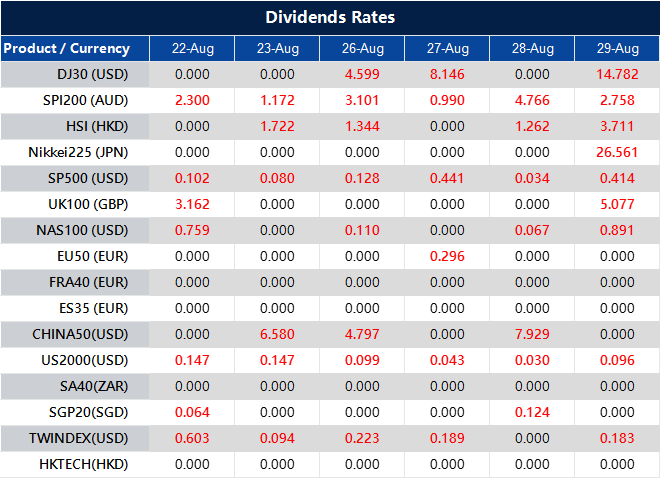
Please note that the dividends of the following products will be adjusted accordingly. Index dividends will be executed separately through a balance statement directly to your trading account, and the comment will be in the following format “Div & Product Name & Net Volume ”.
Please refer to the table below for more details:
The above data is for reference only, please refer to the MT4/MT5 software for specific data.
If you’d like more information, please don’t hesitate to contact info@vtmarkets.com.
As part of our commitment to provide the most reliable service to our clients, there will be MT4 server maintenance this weekend.
MT4 Maintenance Hours:
24th of August 2024 (Saturday) 08:00 – 13:00 (GMT+3)
Please note that the following aspects might be affected during the maintenance:
1. The price quote and trading management will be temporarily disabled during the maintenance. You will not be able to open new positions, close open positions, or make any adjustments to the trades.
2. There might be a gap between the original price and the price after maintenance. The gaps between Pending Orders, Stop Loss and Take Profit will be filled at the market price once the maintenance is completed. It is suggested that you manage the account properly.
Please refer to the MT4 software for the specific maintenance completion and marketing opening time.
Thank you for your patience and understanding about this important initiative.
If you’d like more information, please don’t hesitate to contact info@vtmarkets.com
Please note that the dividends of the following products will be adjusted accordingly. Index dividends will be executed separately through a balance statement directly to your trading account, and the comment will be in the following format “Div & Product Name & Net Volume ”.
Please refer to the table below for more details:
The above data is for reference only, please refer to the MT4/MT5 software for specific data.
If you’d like more information, please don’t hesitate to contact info@vtmarkets.com.
Say what? Is there anything better than cash at all?
Shouldn’t cash be the ultimate equivalent of financial stability?
While having money in the bank can offer a sense of security, clinging to cash will just halter your journey in achieving financial freedom. This is the biggest mistake could cost you the lifestyle you want to live.
By keeping cash and cash only, you are allowing yourself to be robbed. Here is how it happens.
Inflation erosion: Keeping cash is the sure way to lose
The key trigger is no other than inflation, which reduces the purchasing power of cash over time. If the inflation rate is higher than the interest earned on cash savings, the real value of cash holdings diminishes.
To put this into perspective, consider an inflation rate of 3% per year.
USD 1,000 in year 2024 will have the purchasing power of:
(100% – 3%) x USD 1,000 = USD 970 in year 2025
Followed by
(100% – 3%) x USD 970 = USD 940 in year 2026
Followed by
(100% – 3%) x USD 940 = USD 912 in year 2027
So on and so forth.
What that means is inflation robs from everyone if all that is being done is saving cash, and nothing else. Every year, the stash of cash saved automatically evaporates into thin air just by the power of inflation alone. And just like death and taxes, no one escapes inflation.
Can you trust the banks? Really?
What about putting money in the bank to earn some interest rate, you ask? Wouldn’t that help to negate the effects of inflation too?
This depends on the difference between the inflation rate and the interest rate you earn by parking your spare cash in the bank. An extreme example would be Turkey, whereby the interest rate is somewhere around 50%.
“Wow, I’d be rich by parking Turkish lira in the Turkish banks!” One might think.
Not so fast. Wait till you see that the inflation rate of the Turkey is somewhere around 70% every year.
That means you would be netting at:
(100% + 50% – 70%) x TRY 30,000 = TRY 24,000
Despite whooping percentage of interest rate received from the Turkish banks, the cash holder is just receiving a real loss of 20% in cash value. Not a very smart choice.
Having FOMO is good when it comes to beating inflation
Keeping too much cash on hand automatically means you lose out to inflation. By the same token, the benchmark to beat is to make your hard-earned cash work for you in a way faster than inflation erodes your wealth.
There are two ways to go about this.
Passive long-term investments
Asset classes such as stock, indices, bonds and ETFs have outperformed keeping cash in terms of return of investment (ROI). For example, the Nasdaq Composite (Symbol: NAS100) has an annualised return of 20.9% per annum in the last ten (10) years.
With the power of compounding, that gives you a return of 566.7% in the last decade by simply buying in and not doing anything. Sounds awesome?
Active flipping your capital in the financial markets
Yeah, 566.7% in a decade may sound great, but what if your capital is only $1,000?
Making 566.7% is a mere $5,667 worth of profits over 10 years. That is hardly much for ten years. While it does beat inflation, you will not be having the option to resign your job as and when you wish.
When you have a small capital, you need to make your money work harder. And this is made possible by CFD day trading. It is common to hear day traders making 100% gains in a day, sometimes in matter of minutes. Embark on your journey as a forex trader with VT Markets now. With 1000+ assets being offered by VT Markets, there is nothing to stop you from achieving your desired lifestyle.
Stop holding too much cash, let your money work for you
While having some cash on hand is essential for liquidity and emergency purposes, over-relying on cash can lead to missed opportunities for growth and wealth accumulation. Balancing cash reserves with strategic plans allows your money to work for you instead of you having to work hard for them, bringing you to another level of lifestyle that makes you happier.
The above data is for reference only; please refer to the MT4 and MT5 software for specific data.
Friendly reminders:
1. All specifications for Shares CFD stay the same except leverage during the mentioned period.
2. The margin requirement of the trade may be affected by this adjustment. Please make sure the funds in your account are sufficient to hold the position before this adjustment.
If you’d like more information, please don’t hesitate to contact info@vtmarkets.com.