Back

Markets brace for Fed and jobs wave in November

As we enter the first full week of November, markets will be attentive to central bank insights, major economic data releases, and the ongoing earnings season.

This coming week will likely set the tone for the remainder of the year, with investors focusing on inflation trends, interest rate policy, and geopolitical developments.

KEY ECONOMIC INDICATORS

U.S. jobs data and economic indicators:

  • The U.S. will release its monthly employment report, providing crucial insights into labor market conditions and wage growth.
  • Strong or weak numbers could influence the Federal Reserve’s next move on interest rates, adding volatility across equity and bond markets.

Central Bank Commentary:

  • Following recent interest rate decisions, both the U.S. Federal Reserve and the European Central Bank are expected to issue statements or provide commentary.
  • Any signals of future rate hikes or pauses in policy adjustments will likely influence market sentiment, especially in interest-sensitive sectors.

Oil and commodity price movements:

  • Geopolitical developments affecting oil-producing regions, along with updates from OPEC, will keep energy markets on edge.
  • Rising or stabilizing oil prices could have implications for inflation outlooks globally, impacting sectors like transportation and consumer goods.

Nonfarm Payrolls increased by 12,000 in October versus the 113,000 expected:

  • Nonfarm Payrolls (NFP) in the US rose by 12,000 in October, the US Bureau of Labor Statistics (BLS) reported on Friday. This reading followed the 223,000 increase (revised from 254,000) recorded in September and missed the market expectation of 113,000 by a wide margin.
  • Other details of the report showed that the Unemployment Rate remained unchanged at 4.1% as expected. Finally, annual wage inflation, as measured by the change in the Average Hourly Earnings, rose to 4% from 3.9%. 
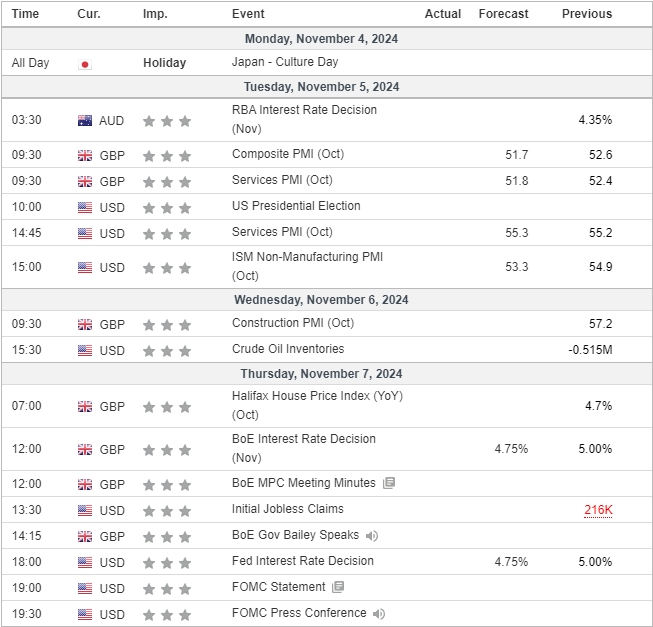
Economic Calendar outlook for the coming week of 4 November 2024 to 8 November 2024, showing some of the most notable Economic Events to come.
    CURRENCIES

    S1-S3 – Means potential Support points. If market declines further, these are the potential levels it can reach.

    R1-R3 – Means potential Resistance points. If the market starts to increase again, these are the potential levels it can reach.

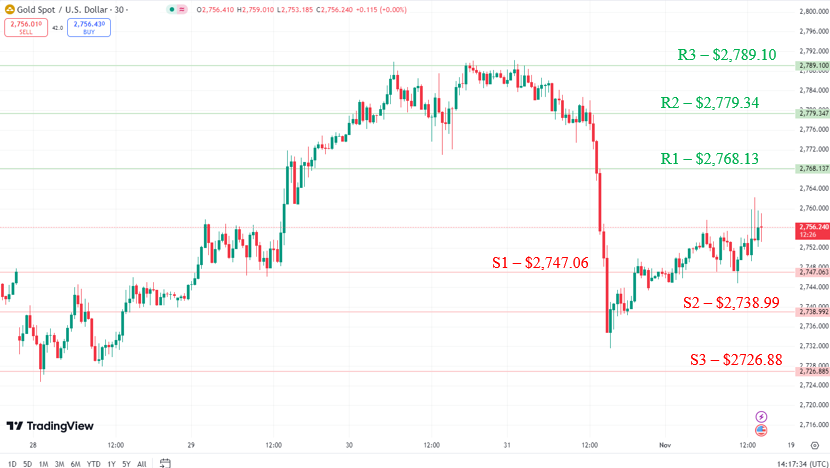
    XAU/USD

    Potential Short preference

    Short positions below 2747.06 with targets at 2738.99 & 2726.88 in extension.

    Alternative scenario

    Above 2768.13 look for further upside with 2779.34 & 2789.10 as targets.

    The upward potential is likely to be limited by the resistance at 2768.13
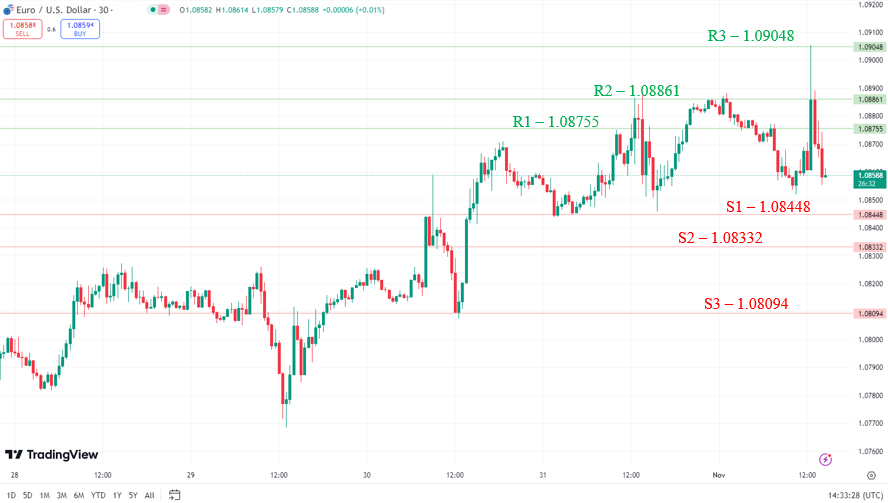
    EUR/USD

    Potential Long preference

    Long positions above 1.08755 with targets at 1.08861 & 1.09048 in extension.

    Alternative scenario

    Below 1.08448 look for further downside with 1.08332 & 1.08094 as targets.

    A break below 1.08332 would trigger a drop towards 1.08094.
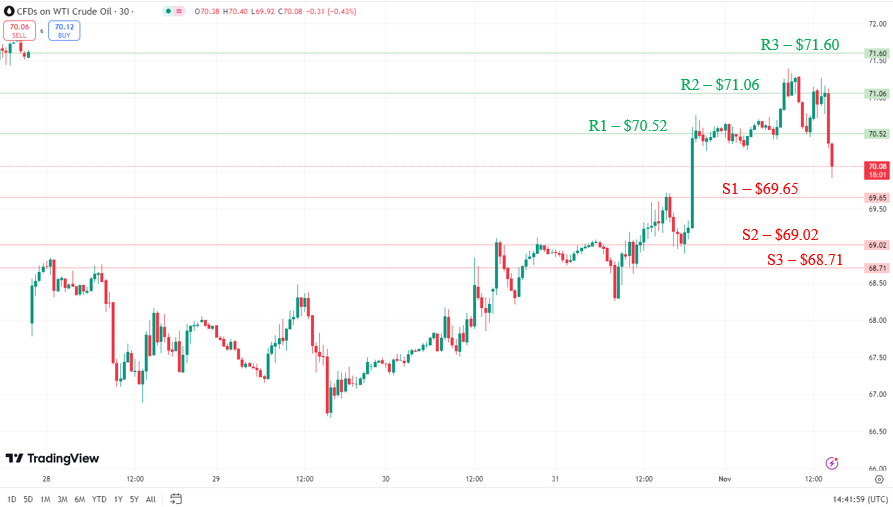
    Crude Oil WTI

    The long preference

    Long positions above 70.52 with targets at 71.06 & 71.60 in extension.

    Alternative scenario

    Below 69.65 look for further downside with 69.02 & 68.71 as targets.

    The RSI is above its neutrality area at 50%.
    Crude oil soars on raised Middle East tensions; OPEC+ output decision eyed

    Oil prices rose strongly Friday, paring some of the week’s losses, on reports that Iran was preparing a retaliatory strike on Israel in the coming days.

    • By 08:25 ET (12.25 GMT), the U.S. crude futures traded 2.6% higher at $71.06 a barrel.
    • The Brent contract climbed 2.4% to $74.59 a barrel.

    Market Instruments to look out for the coming week:

    • EUR/USD
    • GBP/USD
    • Nasdaq100
    • XAU/USD
    • Crude Oil

    MARKETS NEWS

    The US economy added just 12,000 jobs in October, impacted by hurricanes, Boeing strike

    • Nonfarm payrolls increased by 12,000 for the month, down sharply from September and below the Dow Jones estimate of 100,000.
    • The unemployment rate was 4.1%, which was in line with expectations.
    • The BLS noted that the Boeing strike likely subtracted 44,000 jobs in the manufacturing sector, while hurricanes also likely held back the total.

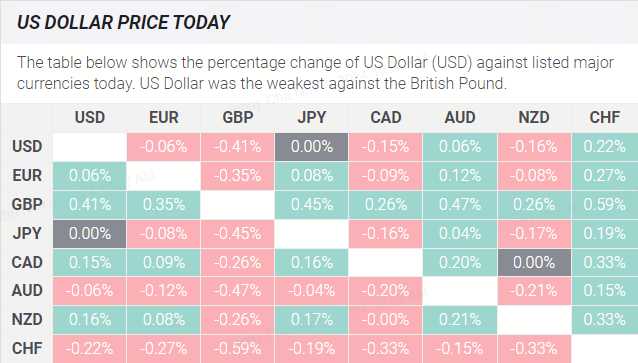
    Dollar dips as investors digest weak jobs data

    • The dollar dipped after fresh data indicated a slowdown in the U.S. labor market.
    • On Friday, the latest U.S. nonfarm payrolls data showed that nonfarm payrolls increased by 12,000 for October, which was significantly lower than the Dow Jones estimate for 100,000, the Bureau of Labor Statistics reported. It was the smallest gain since late 2020.
    • The dollar index, which measures the U.S. currency against six others, was down 0.2% at 103.72.
    • It rose 3.1% last month, the most since September 2022 and looks set to remain firm for now.

    US election and Fed, BoE interest rate calls: Macro week ahead

    • Next week promises to bring a busy period on the macroeconomic front as the knife-edge US election finally arrives and central banks on both sides of the Atlantic make rate calls.
    • Eyes have been glued to the race between Kamala Harris and Donald Trump ahead of the Tuesday, November 5 election, with polls still showing a deadlock between the two.
    • A 25 basis point cut is now widely expected in the US when the Fed meets, following September’s 50 basis point cut.

    Click here to open account and start trading.

    From risk to resilience: How to build a well-diversified portfolio

    In the blink of an eye, the seemingly invincible tech sector transformed from a golden child of investment to a cautionary tale of concentrated risk. The year 2022 saw industry giants like Meta (Facebook) lose over 60% of their stock value, Netflix plummet by nearly 50%, and the entire NASDAQ Composite tumble approximately 33%. Thousands of investors, many of them tech employees with stock-heavy portfolios, watched their wealth evaporate, learning a brutal lesson in the importance of portfolio diversification.

    Portfolio diversification isn’t just a financial buzzword—it’s your strategic shield against market volatility. At its core, diversification is about spreading your investments across various asset classes, sectors, and geographical regions to minimise risk and potentially stabilise returns.

    The tech sector meltdown perfectly illustrates why putting all your financial eggs in one basket can be financially devastating. What seemed like a “can’t-lose” investment strategy quickly unravelled, leaving many investors scrambling to recover lost wealth.

    Understanding diversification

    Think of diversification as your financial safety net. Imagine packing for a British holiday; you wouldn’t bring just a raincoat, but layers, an umbrella, sunscreen, and a waterproof jacket. This approach ensures you are prepared for any weather, just as a well-diversified portfolio prepares you for various market conditions.

    At its core, diversification means spreading your investments across different asset classes to reduce risk. It’s about creating a resilient financial strategy that doesn’t rely on the performance of a single investment or sector. By carefully distributing your funds, you can potentially minimise losses and create a more stable path to long-term financial growth.

    The anatomy of a diversified portfolio

    Modern investors need a sophisticated approach to building a robust investment strategy. Start by considering stocks, which form the growth engine of most portfolios. However, don’t make the mistake of concentrating on a single sector or market. The wisest approach is to create a balanced mix that spans different industries and geographical regions.

    Stocks

    Blend blue-chip companies with emerging market stocks. Balance technology, healthcare, finance, and energy sectors. Mixing domestic and international markets and including a variety of company sizes—from large-cap stable performers to mid-cap and small-cap companies with growth potential—helps protect against sector-specific downturns and provides multiple avenues for potential returns.

    Bonds

    These play a crucial role as the stabilising force in your portfolio. Government bonds offer security, while corporate bonds can provide higher returns. Aim for a mix of short-term and long-term bonds with varying credit ratings to act as shock absorbers during turbulent market conditions.

    Alternative investments

    Don’t overlook alternatives that can add another layer of diversification. Real Estate Investment Trusts (REITs), commodity funds, and index funds can provide additional protection and potential growth. Even a modest allocation to cryptocurrency may be worth considering, though it should represent only a tiny fraction of your overall portfolio due to its inherent volatility.

    Practical strategies for smart diversification

    A traditional approach suggests allocating around 60% to stocks for growth and 40% to bonds for stability. However, this is not a one-size-fits-all solution.

    Your ideal mix depends on your age, risk tolerance, and financial goals. The key is to remain flexible and willing to adjust your strategy as your life circumstances change.

    A trader’s perspective

    For traders, diversification takes on a slightly different meaning. While long-term investors may focus on asset allocation to withstand market downturns, traders often seek to mitigate risk while still capitalising on short-term opportunities. Here are some points to consider:

    • Asset class diversification: Traders should consider diversifying their trades across different asset classes, such as equities, forex, commodities, and indices. This can help reduce exposure to volatility in any single market.
    • Strategy diversification: Implementing various trading strategies—such as day trading, swing trading, or trend following—can create opportunities in different market conditions. This allows traders to adapt their approach based on market dynamics.
    • Risk management: Effective diversification also involves risk management techniques, such as setting stop-loss orders and position sizing. By limiting the amount invested in any single trade, traders can protect their capital against unexpected market movements.
    • Market analysis: Staying informed about global events and market trends can aid in making timely decisions. Traders should diversify their information sources to ensure a well-rounded understanding of the markets they engage with.

    Successful diversification requires more than just initial allocation. Regular portfolio rebalancing is crucial. Practice dollar-cost averaging by consistently investing over time, rather than trying to time the market. Conduct annual reviews of your investments, but avoid making emotional decisions based on short-term market fluctuations.

    Avoiding common diversification pitfalls

    Many investors stumble by concentrating too much of their wealth in a single investment or sector. A golden rule is to limit any single investment to no more than 5-10% of your total portfolio. Emotional investing is another significant trap—decisions should be based on careful research and long-term strategy, not fear or excitement.

    Unlock your investment potential with VT Markets

    VT Markets offers traders a powerful platform to build and manage a diversified investment portfolio. With access to multiple asset classes, advanced analytical tools, and a user-friendly interface, we provide the resources you need to take control of your financial future.

    Don’t let market volatility catch you off guard. Open a live account with VT Markets today and transform your approach to investing. Our platform provides the tools, insights, and opportunities you need to build a robust, diversified portfolio.

    Unlock your trading potential with VT Markets – start diversifying now!

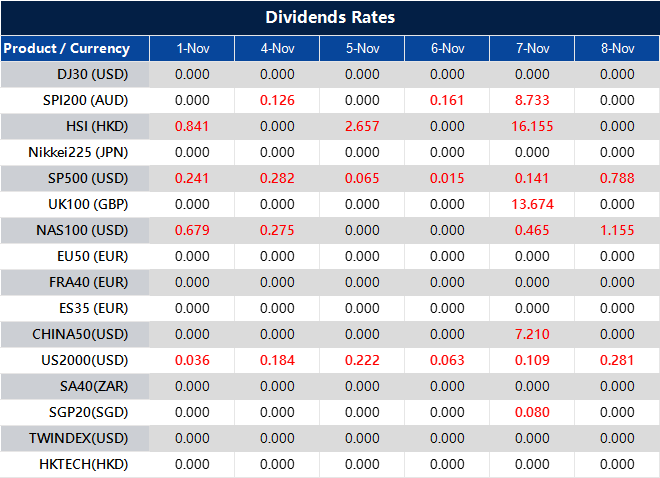
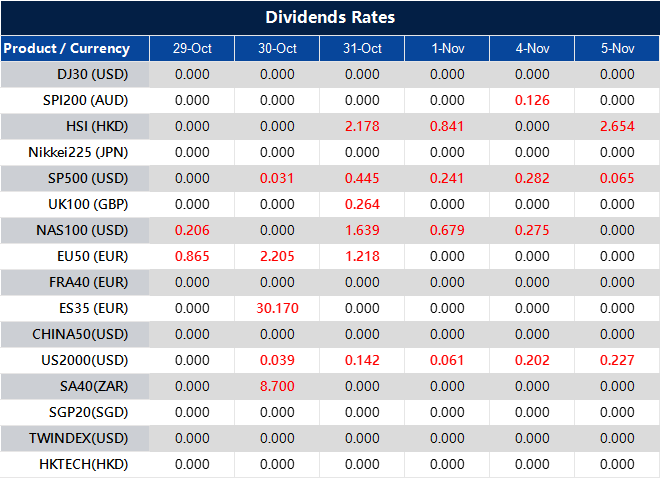
    Dividend Adjustment Notice – Nov 01,2024

    Dear Client,

    Please note that the dividends of the following products will be adjusted accordingly. Index dividends will be executed separately through a balance statement directly to your trading account, and the comment will be in the following format “Div & Product Name & Net Volume ”.

    Please refer to the table below for more details:

    The above data is for reference only, please refer to the MT4/MT5 software for specific data.

    If you’d like more information, please don’t hesitate to contact info@vtmarkets.com.

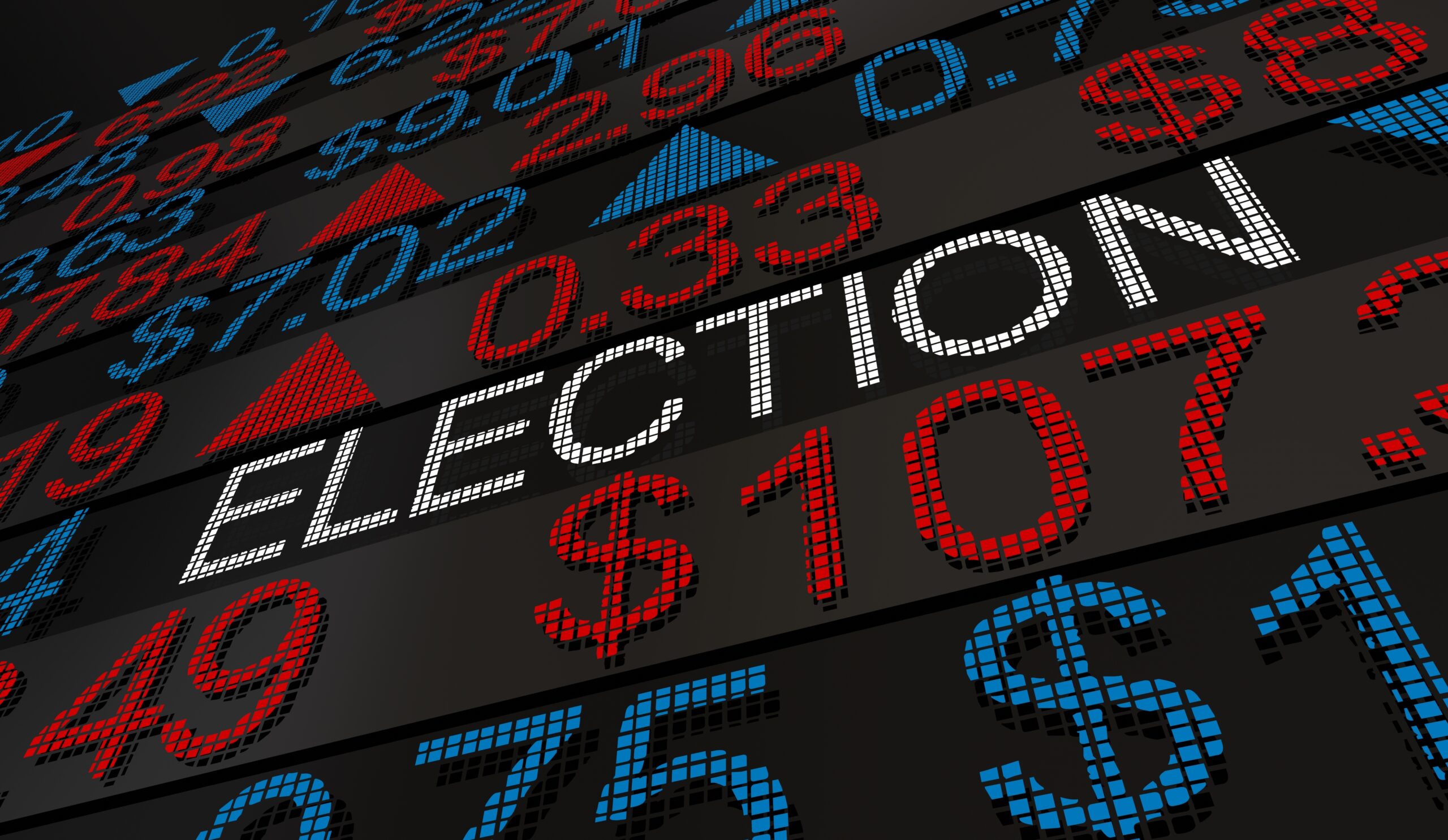
    How to Manage Market Volatility in the US Elections

    We get it. The presidential elections are always the talk of the town when they roll in. The stakes are always high, and markets are already toeing the line with stirring volatility.

    But what is it about a presidential election that gets the world in a tizzy? The United States has had a long history of influence on the global economy, from policies passed to shifting sectors.

    It’s all old hat to the wolves of Wall Street by now, but it’s always good practice to look back at the past to make better decisions for the future.

    Election Volatility and the Market

    The months leading up to U.S. elections have been prime time for market swings.

    The influence of the presidential election is very clearly seen on the VIX (Chicago Board Options Exchange Volatility Index). Colloquially known as the “fear gauge”, the VIX often displays a spike before election season, signalling a surge in hedging and the anticipation of rapid market moves.

    For now, the VIX remains fairly stable ahead of the presidential race, but a contested election or results uncertainties could turn it on its head in a blink.

    Picture: The daily VIX chart, as seen on the VT Markets app

    Let’s take a look at some major volatility highlights from past elections:

    2000 Bush-Gore Election

    The 2000 election between George W. Bush and Al Gore was like a political roller coaster that Americans couldn’t get off of—especially once the results in Florida started swinging back and forth.

    While Gore won the popular vote by a hair’s breadth, the fate of the election came down to Florida’s 25 electoral votes. “Hanging chads” and “butterfly ballots” became household terms as everyone struggled to understand what had gone wrong with the vote-counting process.

    As tensions rose, the S&P 500 slid nearly 5%, and the VIX jumped over 40%.

    After a dramatic 5-4 decision by the Supreme Court in Bush v. Gore, the recount was stopped, essentially handing the presidency to Bush.

    2008 Financial Crisis and Obama-McCain

    When the financial crisis hit in 2008, it was like watching dominoes fall, each one representing jobs, homes, and financial security for millions of Americans. The economy felt like it was teetering on the edge, and people were desperate for a leader who could step up with a vision of stability.

    Image source: The Balance

    The VIX hit 89.53—an all-time high—as markets were gripped by uncertainty over which candidate’s policies would steer the recovery.

    2016 Trump-Clinton Election

    The 2016 election brought America into a whole new kind of campaign, one that was messy, loud, and deeply divided.

    Clinton won the popular vote by nearly 3 million, but Trump clinched the Electoral College in key states like Pennsylvania and Michigan, which were seen as Democrats’ strongholds.

    Trump’s win came out of left field for many, including the markets.

    Dow futures dropping more than 800 points overnight. However, the whiplash rebound saw the S&P 500 ending the year up 9.5%.

    2020 Trump-Biden Election

    The 2020 election was like no other in recent memory, taking place against the backdrop of a global pandemic, economic uncertainty, and heightened racial tensions. Joe Biden, with his “Build Back Better” message, positioned himself as a calm, empathetic counter to President Trump, who was criticised for his handling of COVID-19 and his combative approach to social issues.

    Biden ultimately won both the popular vote by over 7 million and the Electoral College, but the transition was anything but smooth. The VIX surged to 40 as concerns over potential delays or contested results kept traders on edge.

    Picture: The CBOE VIX movement in 2020 as seen on the VT Markets app.

    Why Does the Market Get So Jumpy?

    Like the rest of the world, markets do not like uncertainty. The U.S. Elections deliver it in spades, especially in such closely fought elections as we are seeing at the moment, where the winning candidate is still very much in balance. Predicting which candidate’s policies will come into play, and what they’ll mean for trade, taxes, and industry regulation, makes markets skittish.

    Add in media speculation and poll shifts, and it’s no wonder we see such volatility.

    Policies of each candidate can shake specific sectors differently, like green energy or healthcare, leading traders to hedge their bets or rotate sectors to manage the risk.

    How Traders Hedge Against Election Volatility

    With elections ramping up volatility, traders employ various strategies to protect their portfolios or benefit from market moves:

    Options

    Options are a great tool to let traders hedge against downside risks, with many buying put options on indices like the S&P 500. They can also provide

    The VIX

    The VIX itself is a popular hedge, as it rises during periods of uncertainty.

    Currency Hedges

    U.S. Elections can send shockwaves through global currencies, affecting pairs like USD/JPY or EUR/USD. Traders might shift into other currencies if the dollar weakens, capitalising on global market reactions.

    Sector Rotations

    During election cycles, traders rotate between sectors that may fare better under each candidate. For example, green energy stocks surged in 2020, while healthcare stocks saw volatility due to opposing reform views.

    Safe-Haven Assets

    Gold, U.S. Treasuries, and the Swiss franc (USD/CHF) are classic go-tos when things get rocky, offering a sense of security when markets turn turbulent. This can be seen particularly with the surge in the price of Gold in recent months due to an increase in geopolitical tension and the uncertainty of the US Presidential elections

    Picture: Daily gold chart, as seen on the VT Markets app.

    Turning Volatility into Opportunity

    While some traders play defence, others see volatility as an opportunity for profit. Election-driven price swings can be ideal, especially for short-term trading.

    Swing Trading

    Elections offer ripe conditions for swing traders, who can capitalise on short-term moves driven by breaking news, polls, and debates.

    Technical Analysis

    Key technical indicators such support and resistance levels help traders navigate volatility. Following such technical cues allows traders to adapt to sudden price swings as the market reacts and digests news driven events

    Futures Trading

    Futures contracts, especially on indices, commodities, and currencies, are heavily traded during elections. Contracts on crude oil, gold, and the S&P 500 see considerable action as traders leverage rapid market shifts.

    Post-Election Adjustments

    After the election, markets may reassess the implications of the results, leading to further price swings, creating additional opportunities.

    We know that the markets will tend to perform better in years where the incumbent president is re-elected, as it provides more consistency.

    Likewise, a change in the administration can lead to short term turbulence as the new policies take their time to be adopted and the impacts assessed.

    Navigating the Election Volatility Storm

    With each U.S. election comes a wave of volatility, but traders can navigate it with smart hedging or by riding the price swings.

    Options, safe-haven assets, and sector shifts can provide protection for portfolios, while swing and futures trading can turn uncertainty into opportunity.

    Election-driven volatility brings risk, but for the prepared trader, it also brings potential rewards.

    Open a live account

    Notification of Server Upgrade – Oct 31,2024

    Dear Client,

    As part of our commitment to provide the most reliable service to our clients, there will be MT4 & MT5 server maintenance this weekend.

    MT4 & MT5 Maintenance Hours:
    November 3rd, 2024 (Sunday) 07:00 – 14:00 (GMT+3)

    Please note that the following aspects might be affected during the maintenance:
    1. The price quote and trading management will be temporarily disabled during the maintenance. You will not be able to open new positions, close open positions, or make any adjustments to the trades.
    2. There might be a gap between the original price and the price after maintenance. The gaps between Pending Orders, Stop Loss and Take Profit will be filled at the market price once the maintenance is completed. It is suggested that you manage the account properly.
    3. After server maintenance, server hours will be adjusted from GMT+3 to GMT+2.

    Please refer to the MT4 & MT5 software for the specific maintenance completion and marketing opening time.

    Thank you for your patience and understanding about this important initiative.

    If you’d like more information, please don’t hesitate to contact info@vtmarkets.com

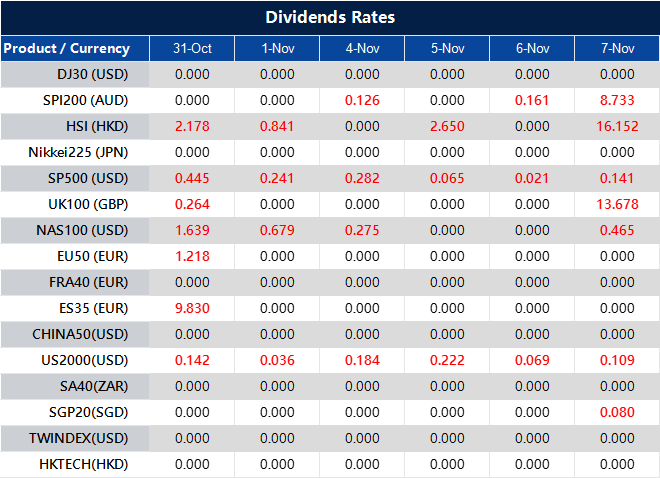
    Dividend Adjustment Notice – Oct 31,2024

    Dear Client,

    Please note that the dividends of the following products will be adjusted accordingly. Index dividends will be executed separately through a balance statement directly to your trading account, and the comment will be in the following format “Div & Product Name & Net Volume ”.

    Please refer to the table below for more details:

    The above data is for reference only, please refer to the MT4/MT5 software for specific data.

    If you’d like more information, please don’t hesitate to contact info@vtmarkets.com.

    Important Notice of Market Risk During US Election – Oct 30,2024

    Dear Client,

    With the upcoming U.S. Election on November 5th, increased market volatility is expected. Our top priority at VT Markets is to protect our clients and ensure a positive trading experience. We would like to remind all investors of the following market risks:

    Spreads:
    During the election period, market spreads may experience more significant fluctuations than usual. Please trade cautiously and manage your positions and funds appropriately.
    Liquidity:
    Due to market sentiment and uncertainty, some liquidity providers and banks may reduce or withdraw their support, which may lead to significant differences between the order execution price and the intended price, increasing the risk of slippage.
    Volatility:
    Frequent news events and market updates may trigger sharp market movements, resulting in extreme market conditions.

    As your trusted broker, VT Markets will implement various risk management measures to effectively address market volatility and ensure trading safety. Specific adjustments may include lowering leverage ratios and increasing margin requirements to double their original level. Please be advised that leverage adjustments may directly lead to higher or lower margin requirements. We recommend that you add funds to your account in advance to ensure sufficient margin coverage.

    If you’d like more information, please don’t hesitate to contact info@vtmarkets.com.

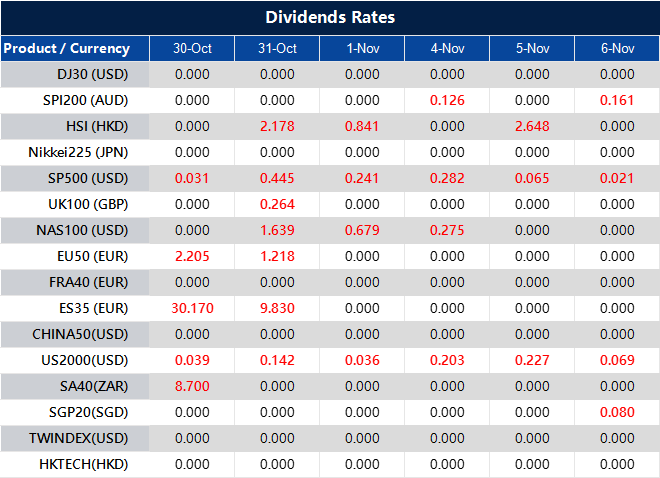
    Dividend Adjustment Notice – Oct 30,2024

    Dear Client,

    Please note that the dividends of the following products will be adjusted accordingly. Index dividends will be executed separately through a balance statement directly to your trading account, and the comment will be in the following format “Div & Product Name & Net Volume ”.

    Please refer to the table below for more details:

    The above data is for reference only, please refer to the MT4/MT5 software for specific data.

    If you’d like more information, please don’t hesitate to contact info@vtmarkets.com.

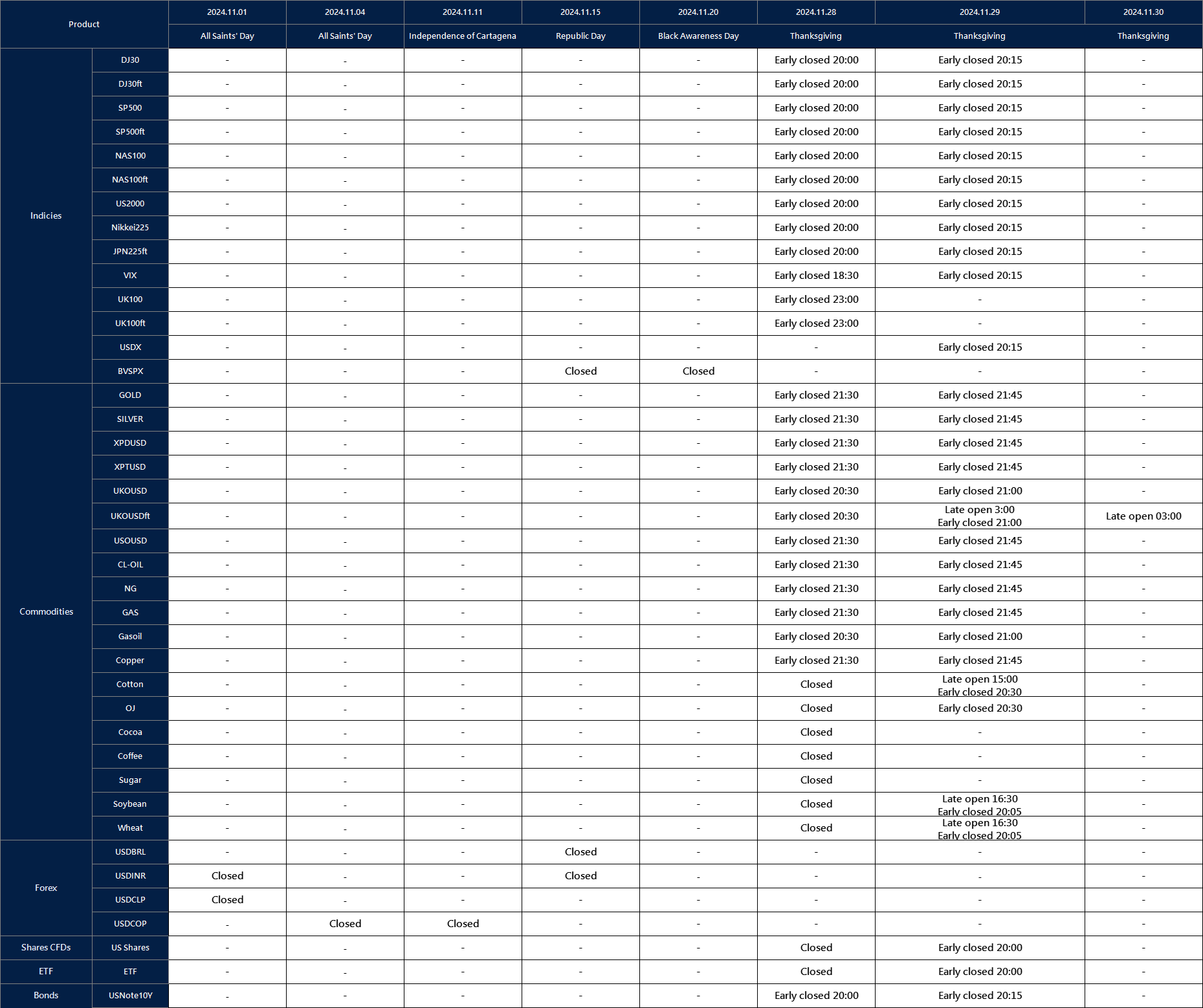
    Notification of Trading Adjustment in Holiday – Oct 30,2024

    Dear Client,

    Affected by international holidays, the trading hours of some VT Markets products will be adjusted.

    Please check the following link for the affected products:

    Notification of Trading Adjustment in Holiday

    Note: The dash sign (-) indicates normal trading hours.

    Friendly Reminder:
    The above data is for reference only, please refer to the MT4/MT5 software for specific data.

    If you’d like more information, please don’t hesitate to contact info@vtmarkets.com.

    Dividend Adjustment Notice – Oct 29,2024

    Dear Client,

    Please note that the dividends of the following products will be adjusted accordingly. Index dividends will be executed separately through a balance statement directly to your trading account, and the comment will be in the following format “Div & Product Name & Net Volume ”.

    Please refer to the table below for more details:

    The above data is for reference only, please refer to the MT4/MT5 software for specific data.

    If you’d like more information, please don’t hesitate to contact info@vtmarkets.com.

    Back To Top
    server

    Hello there 👋

    How can I help you?

    Chat with our team instantly

    Live Chat

    Start a live conversation through...

    • Telegram
      hold On hold
    • Coming Soon...

    Hello there 👋

    How can I help you?

    telegram

    Scan the QR code with your smartphone to start a chat with us, or click here.

    Don’t have the Telegram App or Desktop installed? Use Web Telegram instead.

    QR code