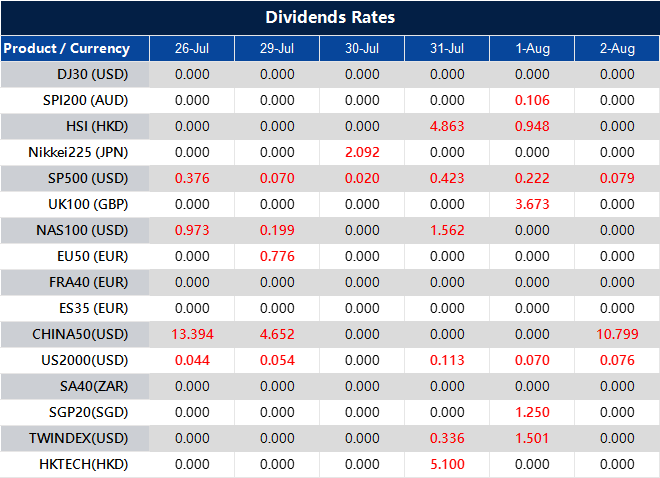
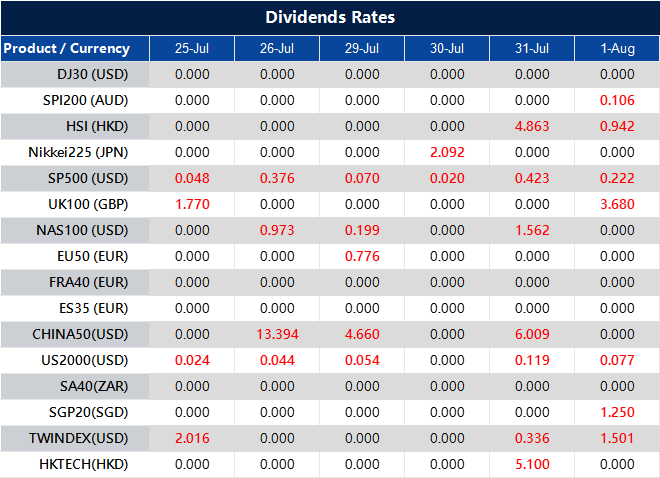
Please note that the dividends of the following products will be adjusted accordingly. Index dividends will be executed separately through a balance statement directly to your trading account, and the comment will be in the following format “Div & Product Name & Net Volume ”.
Please refer to the table below for more details:
The above data is for reference only, please refer to the MT4/MT5 software for specific data.
If you’d like more information, please don’t hesitate to contact info@vtmarkets.com.
PCE Data Impact: Anticipation of the US Personal Consumption Expenditures (PCE) Price Index release is causing marginal declines in gold prices, with potential volatility based on the results.
Long-Term Uptrend: Despite recent dips, gold’s long-term uptrend remains intact, suggesting continued strength as a stable investment.
Geopolitical Uncertainties: Ongoing geopolitical tensions, such as in the Middle East and Ukraine, are boosting gold demand as a safe haven.
FOMC Sentiment: Mixed outlook on future rate cuts from the Federal Open Market Committee creates uncertainty for gold investors, potentially leading to price fluctuations.
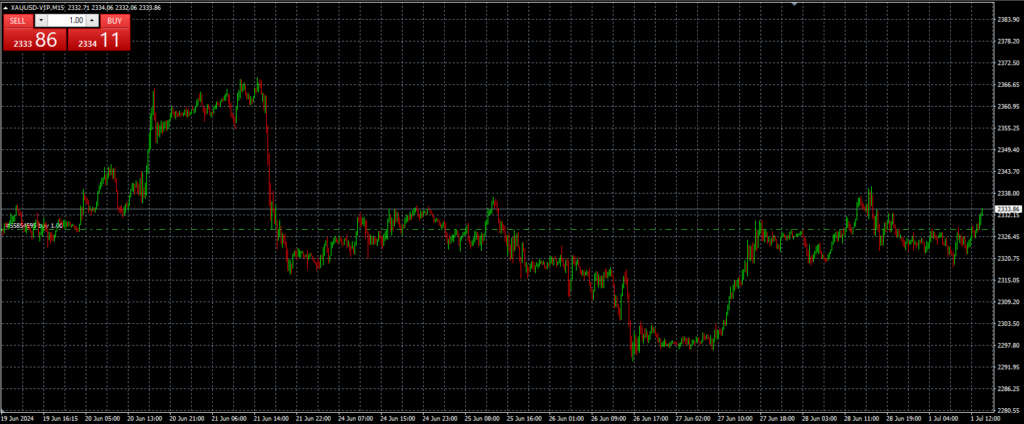
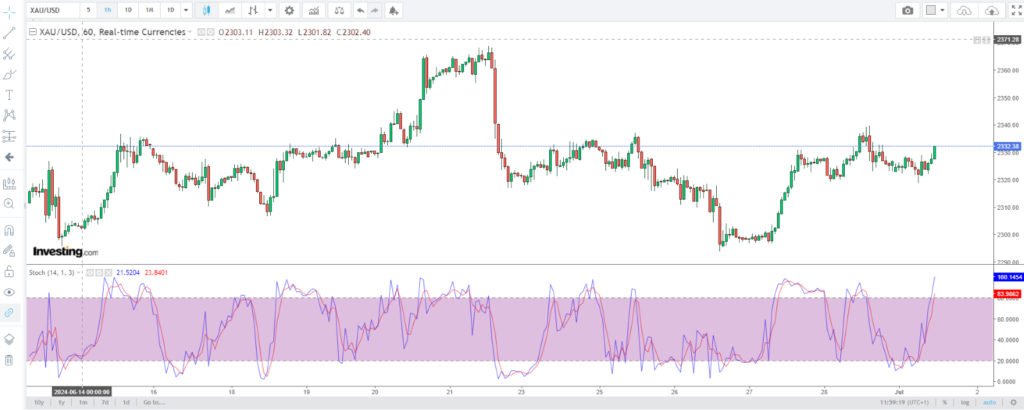
As we anticipate the release of the US Personal Consumption Expenditures (PCE) Price Index for June, gold (XAU/USD) prices edge marginally upper 0.33%, trading in the $2,400. This economic indicator could inject volatility into the market, potentially shaking the recent stability of gold prices.
Daily Digest Market Movers: Gold Price Recovers the $2,400 Figure
Gold traders are focused on the release of key economic data, including Durable Goods Orders, the preliminary Q2 GDP number, and the Core PCE for June. Durable Goods Orders are expected to increase from 0.1% to 0.4% month-over-month (MoM). The Gross Domestic Product (GDP) for Q2 is projected to rise from 1.4% in Q1 2024 to 1.9% quarter-over-quarter (QoQ), indicating that the economy is accelerating as the year progresses. The Fed’s preferred measure of inflation, the Core PCE, is expected to dip from 2.6% to 2.5% year-over-year (YoY). The latest Consumer Price Index (CPI) data revealed a continuation of the disinflation process in the United States (US), boosting gold prices and increasing the likelihood that the Fed will cut interest rates starting in September.
The PCE Data’s Impact on Gold Prices
The PCE data is crucial as it is the Federal Reserve’s preferred inflation gauge. Higher inflation could prompt the Fed to adjust interest rates, impacting gold prices as gold is a non-interest-bearing asset. Stable or rising consumer spending could support a resilient economy, potentially leading to higher interest rates, which might negatively impact gold. Strong business investment would indicate economic health, possibly leading to higher interest rates. A robust GDP report could bolster the case for higher interest rates, affecting gold’s appeal.
FOMC Sentiment and the Mixed Outlook on Rate Cuts
The Federal Open Market Committee (FOMC) has a mixed outlook on future rate cuts. While some members anticipate the need for rate cuts in the near future, others remain cautious, creating an environment of uncertainty for gold investors. This mixed sentiment can lead to fluctuations in gold prices as investors react to the potential changes in monetary policy.
Geopolitical Uncertainties Boost Gold Demand as a Safe Haven
Geopolitical uncertainties continue to significantly influence the demand for gold as a safe haven. Tensions in the Middle East and the ongoing conflict in Ukraine are prime examples. These events create a backdrop of instability, prompting investors to turn to gold to protect their wealth and thereby influencing its price.
Finance and Gold Price Volatility
Financial markets are poised to react strongly to the upcoming PCE data. An inflation rate higher than expected could lead to significant volatility in gold prices, as investors adjust their strategies based on the new economic information.
Experts Weigh in on PCE Data and Potential Rate Cuts
Jim Reid of Deutsche Bank predicts a slight increase in core PCE, which could lower the year-on-year rate to its lowest in over three years. Raphael Bostic, Atlanta Fed President, expects a rate cut in Q4, suggesting a potential series of cuts in 2025. Michelle Bowman, Fed Board of Governors, cautions that the Fed is not yet considering rate cuts.
Regional Factors Shaping Global Gold Demand
The global economic outlook remains mixed, with varying inflation and growth rates across regions influencing gold demand differently.
In the United States, potential volatility around the November election and the Federal Reserve’s interest rate decisions will be significant drivers of gold prices. These political and economic factors create an environment of uncertainty, which can lead to fluctuations in the demand for gold as investors seek safe havens.
In Asia, there is increased gold demand from central banks hedging against currency devaluation. This regional trend highlights the strategic importance of gold as a stable asset amidst economic uncertainties.
In Europe, economic stability and ongoing geopolitical tensions play a crucial role in shaping gold’s appeal. The region’s economic health and political landscape significantly influence investor sentiment towards gold. Understanding these regional dynamics is essential for comprehending the global factors that drive gold demand and influence its price movements.
Investors Prepare for Market Swings as Gold’s Long-Term Stability Shines
Gold prices are poised for potential volatility following the release of the PCE inflation data. While the long-term outlook remains positive, with gold benefiting from geopolitical uncertainties and a possible Fed rate cut, the immediate future may see fluctuations based on economic data and Fed commentary.
Investors should brace for potential market swings and consider the broader economic indicators and geopolitical events that could shape gold’s trajectory in the coming months. Despite short-term volatility, gold’s role as a stable, safe store of value continues to underpin its long-term attractiveness.
Forex trading offers vast opportunities for profits but also attracts significant cyber threats. Protecting your FX trading account is crucial to ensure the safety of your investments. This guide will walk you through essential cybersecurity measures to safeguard your trading account from potential threats.
Understanding Cyber Threats in FX Trading
FX trading accounts are prime targets for cybercriminals due to the financial assets they hold. Therefore, understanding these threats helps in developing effective protection strategies.
Phishing Attacks
Phishing involves fraudulent emails or messages designed to trick you into revealing sensitive information.
Malware
Malware includes viruses, trojans, and spyware that can infiltrate your system and steal your data.
Hacking
Hacking involves unauthorized access to your trading account or personal information through various techniques.
Implementing Strong Password Practices
Passwords are the first line of defense for your trading account. Strong, unique passwords can significantly enhance security.
Create Complex Passwords
Use a combination of uppercase, lowercase letters, numbers, and symbols. For instance, instead of “Password123,” use “^%$UC&yaTRs1^^%1.”
Avoid Reusing Passwords
Never use the same password across multiple accounts. Each account should have a unique password.
Use Password Managers
Password managers store and generate complex passwords securely. They can help you manage multiple passwords without hassle.
Example: Tools like LastPass or Dashlane can securely store your passwords.
Enabling Two-Factor Authentication (2FA)
Two-factor authentication (2FA) adds an extra layer of security by requiring two forms of identification.
Implement 2FA
Enable 2FA on your trading platform, which usually involves a password and a code sent to your mobile device. For example, VT Markets offers 2FA to enhance account security.
Use Authenticator Apps
Authenticator apps like Google Authenticator or Authy provide secure codes that change every few seconds.
Securing Your Devices
Your trading account’s security also depends on the security of your devices.
Update Software Regularly
Ensure your operating system, trading platforms, and antivirus software are up-to-date.
Use Antivirus Software
Antivirus software protects your devices from malware and other threats. Norton and McAfee offer comprehensive antivirus solutions.
Avoid Public Wi-Fi
Public Wi-Fi networks are less secure and can expose your data to hackers. Use a virtual private network (VPN) if you must access your account on public Wi-Fi. NordVPN and ExpressVPN provide secure and encrypted connections.
Protecting Your Personal Information
Be cautious about sharing personal information that could be used to access your trading account.
Limit Information Sharing
Avoid sharing sensitive information like your account details or personal identification online.
Verify Sources
Ensure that communications from your broker or trading platform are legitimate before responding. VT Markets will never ask for your password or sensitive information via email.
Educating Yourself on Cybersecurity
Continuous learning about cybersecurity can help you stay ahead of potential threats.
Take Online Courses
Enroll in cybersecurity courses to enhance your knowledge. Platforms like Coursera and Udemy offer cybersecurity courses.
Stay Updated
Follow cybersecurity news to stay informed about the latest threats and protection strategies.
Using Secure Trading Platforms
Choose trading platforms that prioritize security.
Verify Platform Security
Ensure the trading platform uses encryption and other security measures to protect your data.
Example: VT Markets uses advanced encryption to secure your information.
Read Reviews
Check user reviews to see if other traders have experienced security issues with the platform.
Backing Up Your Data
Regular backups ensure you can recover your data in case of a breach.
Use Cloud Storage
Store backups securely using cloud services like Google Drive or Dropbox.
Keep Offline Backups
Maintain offline backups on external drives for added security.
Example: Backup important documents and account information regularly.
Conclusion for Protecting Your FX Trading Account
Protecting your FX trading account from cyber threats is essential for safeguarding your investments. By implementing strong password practices, enabling 2FA, securing your devices, protecting personal information, and using secure trading platforms, you can significantly reduce the risk of cyber attacks. Continuous learning and regular monitoring further enhance your account’s security.
VT Markets provides a secure trading environment, but your vigilance is crucial. Open a demo account today to practice safe trading strategies with virtual funds.
FAQ
Q: What is two-factor authentication (2FA)?
A: 2FA requires two forms of identification to access your account, enhancing security.
Q: How can I create a strong password?
A: Use a mix of uppercase, lowercase letters, numbers, and symbols. Avoid common words and reuse.
Q: Why is regular software updating important?
A: Updates fix security vulnerabilities, protecting your devices from malware and hackers.
Q: What should I do if I notice suspicious activity on my account?
A: Immediately contact your broker, change your password, and monitor your account closely.
Q: How does a VPN enhance security?
A: A VPN encrypts your internet connection, protecting your data on public Wi-Fi.
Q: Why should I avoid public Wi-Fi for trading?
A: Public Wi-Fi is less secure and can expose your data to hackers.
Q: How can I verify legitimate communications from my broker?
A: Check the sender’s email address, verify through official channels, and avoid sharing sensitive information.
Q: What are the benefits of using a password manager?
A: Password managers store and generate complex passwords securely, reducing the risk of breaches.
Q: How often should I back up my data?
A: Regularly back up important data, ideally weekly, and store backups securely.
Ready to secure your FX trading account? Open a demo account with VT Markets today and start practicing safe trading strategies with virtual funds. Protect your investments and trade with confidence!
Forex trading typically requires a broker to facilitate trades and provide a trading platform. However, some traders wonder if it’s possible to trade forex without a broker. This article explores the concept, outlining potential methods, benefits, and risks associated with trading forex without a broker.
What Is Forex Trading?
Forex trading, also known as foreign exchange trading, involves buying and selling currencies to profit from changes in their exchange rates. The forex market is the largest financial market globally, with a daily trading volume exceeding $6 trillion.
Why Brokers Are Commonly Used
Brokers act as intermediaries between traders and the interbank system, where currency trading occurs. They provide trading platforms, leverage, and access to market data. Brokers earn through spreads, commissions, or both.
Trading Forex Without a Broker
Peer-to-Peer (P2P) Forex Trading
P2P forex trading involves trading directly with other individuals without a broker. Platforms that facilitate P2P trading connect buyers and sellers, allowing them to trade currencies directly.
Example: Imagine two traders, John and Sarah. John wants to exchange USD for EUR, while Sarah wants to exchange EUR for USD. A P2P platform connects them, allowing them to trade currencies directly at an agreed exchange rate.
Benefits of P2P Trading
Lower Costs: No broker fees or commissions.
Direct Negotiations: Traders can negotiate rates directly.
Risks of P2P Trading
Counterparty Risk: The risk that the other party may default on the trade.
Lack of Regulation: P2P platforms may lack regulatory oversight, increasing the risk of fraud.
Forex Trading through Banks
Some traders opt to trade forex through their banks. Banks offer forex services, including spot and forward contracts, but typically cater to large transactions.
Example: A business needing to exchange USD for EUR to pay a European supplier can do so through its bank. The bank provides the exchange rate and facilitates the transaction.
Benefits of Bank Forex Trading
Security: Banks are regulated and offer a higher level of security.
Access to Large Transactions: Suitable for businesses and large transactions.
Risks of Bank Forex Trading
High Costs: Banks often charge higher fees and offer less competitive rates.
Limited Flexibility: Banks may have restrictions on trading hours and transaction sizes.
Using Local Exchanges
Local currency exchanges offer another method for forex trading without brokers. Traders can exchange currencies at local money changers or currency exchange shops.
Example: A traveler exchanging USD for EUR at a local currency exchange shop before a trip to Europe.
Benefits of Using Local Exchanges
Accessibility: Local exchanges are often readily available in urban areas.
Simplicity: The process is straightforward and quick.
Risks of Using Local Exchanges
High Fees: Exchange shops often charge high fees and offer poor exchange rates.
Limited Transaction Sizes: Suitable only for small transactions.
Using Forex Trading Clubs
Forex trading clubs are groups of individuals who pool their resources to trade forex collectively. These clubs can trade directly in the market without brokers.
Example: A group of friends forms a forex trading club. They pool their funds and trade currencies collectively, sharing profits and losses.
Benefits of Forex Trading Clubs
Shared Knowledge: Members can share insights and strategies.
Collective Resources: Pooling funds allows for larger trades.
Risks of Forex Trading Clubs
Disagreements: Conflicts may arise over trading decisions.
Regulatory Issues: Clubs may lack regulatory oversight, posing legal risks.
Forex Trading with Direct Market Access (DMA)
DMA allows traders to place orders directly into the market, bypassing brokers. This method requires access to a trading platform that offers DMA.
Example: An institutional trader uses a DMA platform to place large forex orders directly in the market.
Benefits of DMA
Transparency: Direct access to market prices and orders.
Speed: Faster execution of trades.
Risks of DMA
Complexity: Requires advanced knowledge and experience.
High Costs: Platforms offering DMA may charge higher fees.
Importance of Risk Management
Regardless of the method chosen, risk management is crucial in forex trading. Here are some key risk management strategies:
Diversification
Diversify your trades across different currency pairs to spread risk.
Example: Instead of trading only EUR/USD, consider trading multiple pairs like GBP/USD, AUD/USD, and USD/JPY.
Stop-Loss Orders
Set stop-loss orders to limit potential losses on trades.
Example: If you buy EUR/USD at 1.2000, you can set a stop-loss order at 1.1950 to limit your loss to 50 pips if the market moves against you.
Position Sizing
Use appropriate position sizing to ensure that no single trade can significantly impact your capital.
Example: If your trading account is $10,000, avoid risking more than 1-2% of your capital on a single trade.
Regular Analysis
Regularly analyze market conditions and adjust your trading strategies accordingly.
Example: Keep an eye on economic indicators, geopolitical events, and market sentiment to inform your trading decisions.
Conclusion About Forex Trading Without Broker
Trading forex without a broker is possible through methods like P2P trading, bank forex services, local exchanges, forex trading clubs, and DMA. Each method has its benefits and risks, and traders should carefully consider their options. Proper risk management is essential for successful forex trading. Whether you choose to trade with or without a broker, having a solid trading plan and strategy is crucial.
VT Markets offers a comprehensive trading platform for those who prefer the convenience and security of trading with a regulated broker. Open a demo account today and practice your trading strategies with virtual funds.
FAQ
Q: Is it possible to trade forex without a broker?
A: Yes, methods like P2P trading, bank forex services, and local exchanges can be used to trade forex without a broker.
Q: What are the risks of trading forex without a broker?
A: Risks include counterparty risk, lack of regulation, high costs, and security risks.
Q: How can I manage risks when trading forex?
A: Use risk management strategies like diversification, stop-loss orders, position sizing, and regular market analysis.
Q: Are there benefits to trading forex without a broker?
A: Benefits can include lower costs, direct negotiations, and increased accessibility.
Q: What role do brokers play in forex trading?
A: Brokers provide trading platforms, leverage, market data, and access to the interbank system for currency trading.
Q: What is a forex trading club?
A: A forex trading club is a group of individuals who pool their resources to trade forex collectively, sharing profits and losses.
Q: How does Direct Market Access (DMA) work in forex trading?
A: DMA allows traders to place orders directly into the market, bypassing brokers, offering transparency and faster execution.
Ready to explore forex trading with a trusted broker? Open a demo account with VT Markets today and start practicing your strategies with virtual funds. Dive into the world of forex trading now!
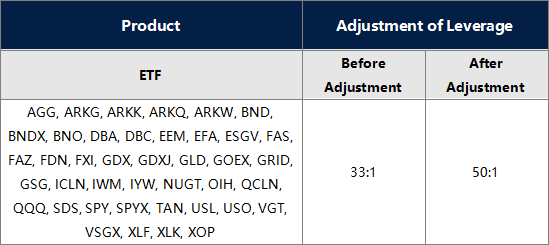
To provide a more favorable trading environment for our clients, VT Markets will have leverage adjustment for certain products on July 29, 2024. Please check the details below:
The above data is for reference only, please refer to the MT5 platforms for the updated data.
Friendly reminders:
1. All product settings stay the same except for the leverage.
2. The margin requirement of the trade may be affected by this adjustment. Please make sure the funds in your account are sufficient to hold the position before this adjustment.
If you’d like more information, please don’t hesitate to contact info@vtmarkets.com.
Please note that the dividends of the following products will be adjusted accordingly. Index dividends will be executed separately through a balance statement directly to your trading account, and the comment will be in the following format “Div & Product Name & Net Volume ”.
Please refer to the table below for more details:
The above data is for reference only, please refer to the MT4/MT5 software for specific data.
If you’d like more information, please don’t hesitate to contact info@vtmarkets.com.
Exchange-traded funds (ETFs) have revolutionised the investment landscape, offering traders a versatile tool to access diverse markets. For traders, ETFs present an opportunity to implement sophisticated risk management strategies once reserved for institutional investors. This article explores how ETFs can be effectively used to manage risk in your trading portfolio.
Understanding ETFs and their risk profile
ETFs are investment funds traded on stock exchanges, much like individual stocks. They typically track an index, sector, commodity, or other assets, but can be bought and sold throughout the day like ordinary stock. Unlike mutual funds, ETFs offer greater flexibility and often come with lower fees.
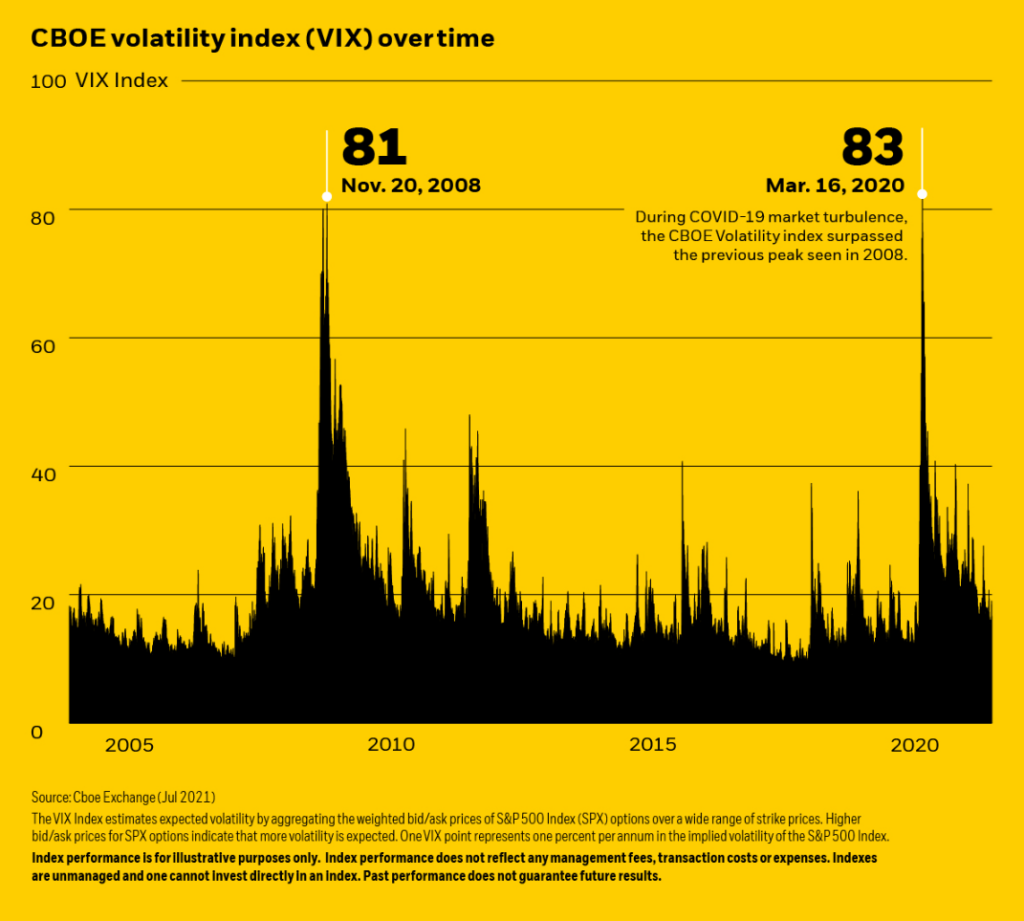
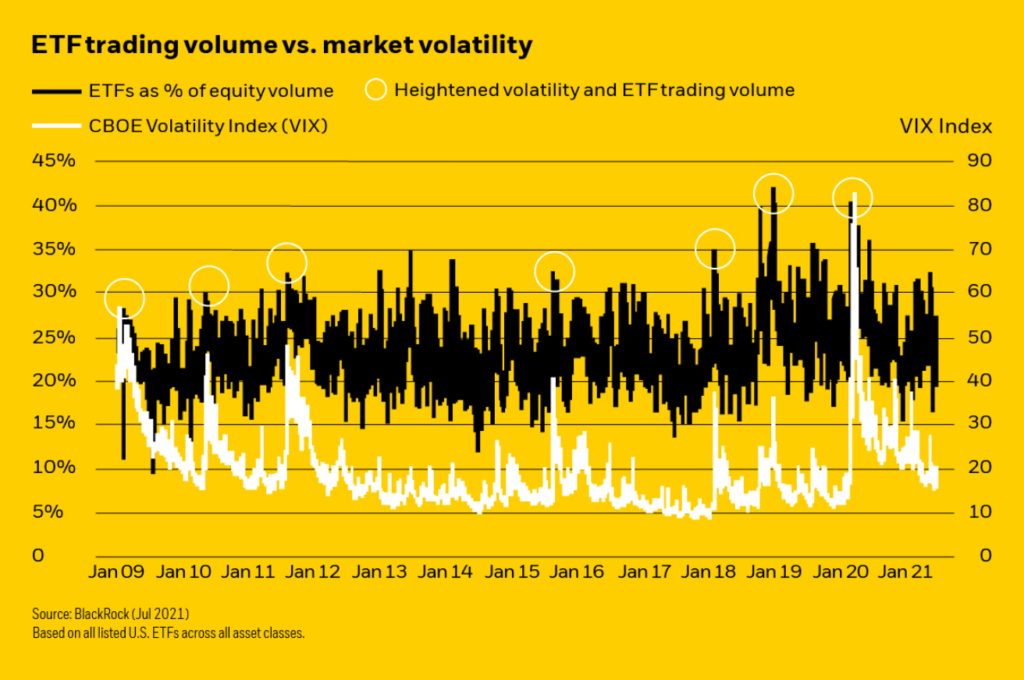
While ETFs can mitigate some risks through diversification, they are not without their own set of risks. Market risk affects all investments, and ETFs are no exception. Tracking error, where an ETF’s performance deviates from its underlying index, is another consideration. Liquidity risk can also be a factor, especially for narrowly focused ETFs.
Diversification: The foundation of risk management
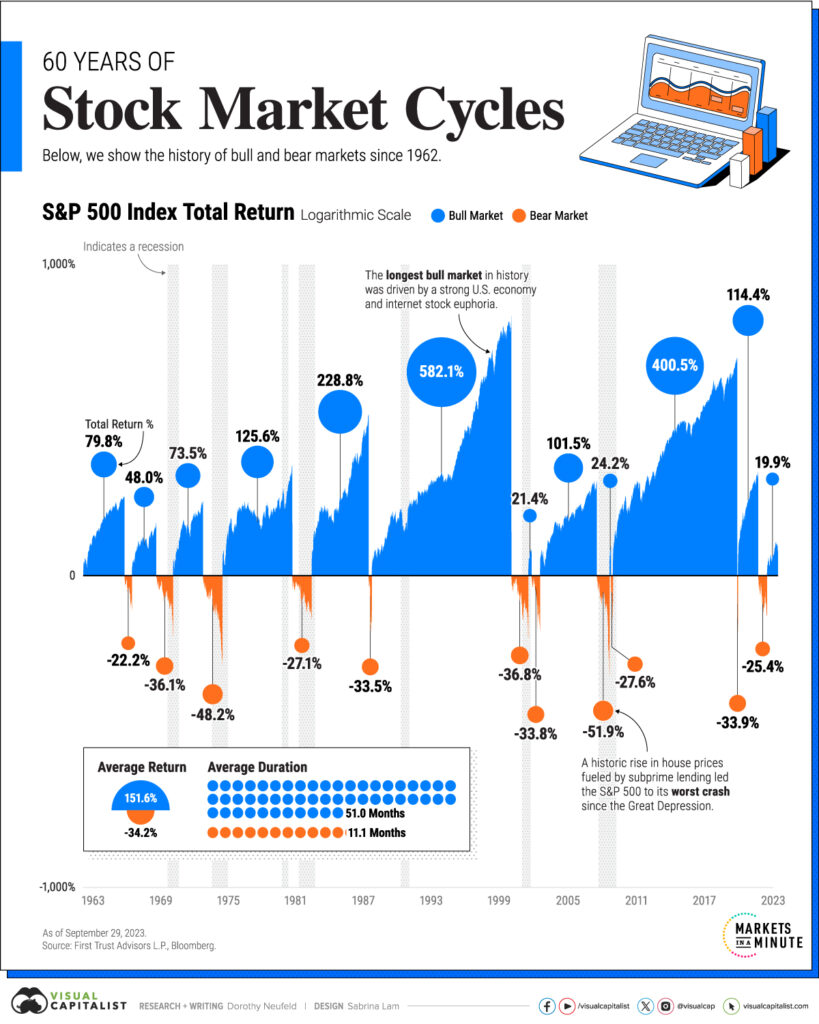
Diversification is a cornerstone of risk management, and ETFs excel at providing instant diversification. By investing in a single ETF, you can gain exposure to hundreds or even thousands of individual securities. This spreads risk across multiple companies, sectors, or even countries.
For maximum diversification, consider broad-market ETFs like those tracking the S&P 500 or total stock market indices. These provide exposure to a wide range of companies across various sectors, reducing the impact of poor performance from any single stock or industry.
Asset allocation with ETFs
Proper asset allocation is crucial for managing risk. ETFs make it easy to build a balanced portfolio across different asset classes. For example, you might use a combination of stock ETFs for growth, bond ETFs for stability, and commodity ETFs for inflation protection.
A simple yet effective allocation for a moderate-risk investor might look like:
– 60% in a total stock market ETF
– 30% in a broad bond market ETF
– 10% in a diversified commodity ETF
This allocation provides a mix of growth potential and stability, which can be easily adjusted based on your risk tolerance and investment goals.
Hedging strategies using ETFs
ETFs offer various hedging strategies to protect your portfolio during market downturns. Inverse ETFs, which move in the opposite direction of their underlying index, can be used to offset potential losses in your long positions. However, use these instruments cautiously, as they’re designed for short-term hedging and can be complex.
For example, consider an investor who holds $10,000 in an S&P 500 index ETF. If they’re concerned about a potential market downturn, they might hedge their position by investing $2,000 in an inverse S&P 500 ETF. If the S&P 500 falls by 5%, their main position would lose $500, but the inverse ETF would gain about $100 (5% of $2,000), reducing the overall loss to $400. This strategy can provide some protection against short-term market volatility.
It’s important to note that leveraged and inverse ETFs can be particularly risky and are generally not suitable for long-term, buy-and-hold investors. Always thoroughly understand these products before incorporating them into your strategy.
Managing sector-specific risks
Overexposure to specific sectors can increase portfolio risk. Sector ETFs allow you to balance your exposure or hedge against sector-specific risks. For instance, if you’re heavily invested in technology stocks, you might consider reducing risk by investing in a healthcare or utilities sector ETF.
Some traders use a sector rotation strategy, shifting investments between different sector ETFs based on the economic cycle. While this can be effective, it requires careful analysis and timely execution.
International diversification with ETFs
Expanding your portfolio internationally can reduce country-specific risks and potentially enhance returns. ETFs make it easy to invest in foreign markets without the complexities of directly owning foreign stocks.
This approach provides exposure to various international markets, potentially reducing risk through geographical diversification. In 2017, when the S&P 500 returned about 21.8%, the MSCI Emerging Markets Index returned 37.3%, demonstrating how international exposure can sometimes outperform domestic markets.
You can use country-specific ETFs to target particular markets or opt for regional ETFs for broader exposure. When investing internationally, be aware of currency risks. Some ETFs hedge currency exposure, while others don’t, affecting your returns as exchange rates fluctuate.
Risk management through regular rebalancing
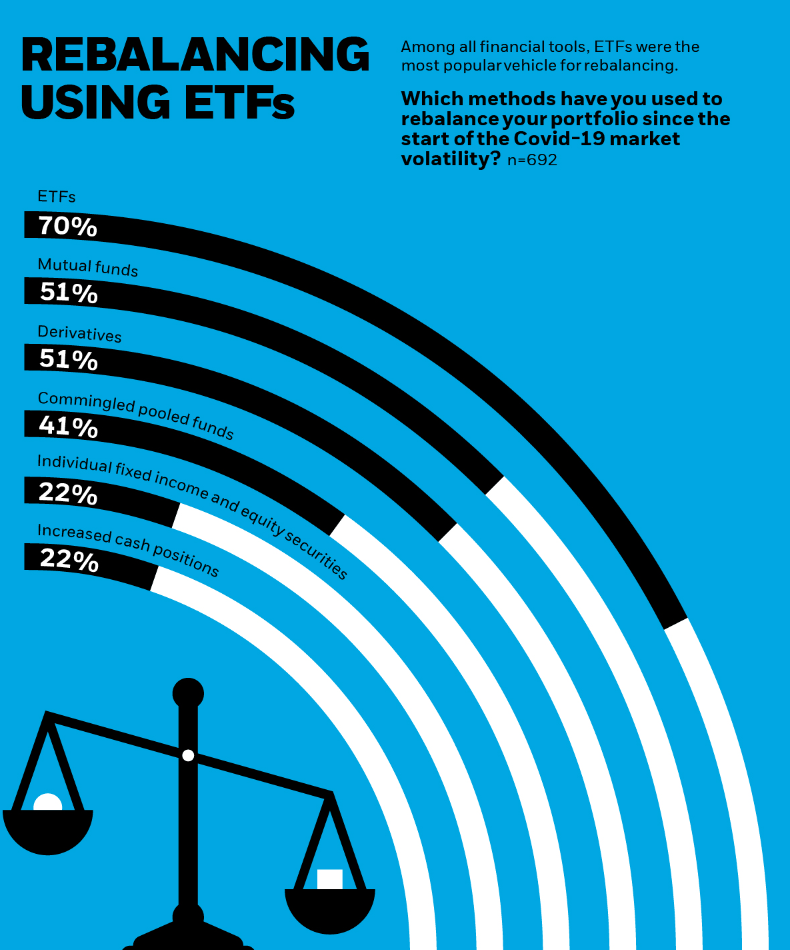
Regular rebalancing is essential to maintain your target asset allocation and manage risk. As different assets perform differently over time, your portfolio can drift from its original allocation, potentially increasing risk.
With ETFs, rebalancing is straightforward. Simply sell ETFs that have become overweighted in your portfolio and buy those that have become underweighted. The frequency of rebalancing depends on your strategy, but many investors rebalance annually or when their allocation drifts beyond predetermined thresholds.
Practical tips for ETF risk management
To effectively manage risk with ETFs:
1. Research thoroughly: Look at an ETF’s expense ratio, tracking error, and liquidity before investing.
2. Use stop-loss orders: These can limit potential losses by automatically selling if an ETF’s price falls below a specified level.
3. Monitor and adjust: Regularly review your portfolio and adjust your strategy as needed.
4. Stay informed: Keep up with market trends and economic news that might affect your ETF investments.
Remember, while ETFs can be powerful risk management tools, they don’t eliminate risk entirely. Always invest within your risk tolerance and consider consulting with a financial adviser for personalised advice.
For those looking to implement these strategies, platforms like VT Markets offer the ability to trade a wide range of ETFs, providing access to diverse markets and risk management tools.
Conclusion
ETFs offer non-professional traders a range of tools for managing risk. From providing easy diversification to enabling sophisticated hedging strategies, ETFs can help you build a resilient portfolio. By understanding how to effectively use ETFs for risk management, you can navigate market uncertainties with greater confidence. As you apply these strategies, remember that successful investing is a journey of continuous learning and adaptation.
Exchange-traded funds (ETFs) have revolutionised the investment landscape, offering traders a versatile tool to access diverse markets. For traders, ETFs present an opportunity to implement sophisticated risk management strategies once reserved for institutional investors. This article explores how ETFs can be effectively used to manage risk in your trading portfolio.
Understanding ETFs and their risk profile
ETFs are investment funds traded on stock exchanges, much like individual stocks. They typically track an index, sector, commodity, or other assets, but can be bought and sold throughout the day like ordinary stock. Unlike mutual funds, ETFs offer greater flexibility and often come with lower fees.
While ETFs can mitigate some risks through diversification, they are not without their own set of risks. Market risk affects all investments, and ETFs are no exception. Tracking error, where an ETF’s performance deviates from its underlying index, is another consideration. Liquidity risk can also be a factor, especially for narrowly focused ETFs.
Diversification: The foundation of risk management
Diversification is a cornerstone of risk management, and ETFs excel at providing instant diversification. By investing in a single ETF, you can gain exposure to hundreds or even thousands of individual securities. This spreads risk across multiple companies, sectors, or even countries.
For maximum diversification, consider broad-market ETFs like those tracking the S&P 500 or total stock market indices. These provide exposure to a wide range of companies across various sectors, reducing the impact of poor performance from any single stock or industry.
Asset allocation with ETFs
Proper asset allocation is crucial for managing risk. ETFs make it easy to build a balanced portfolio across different asset classes. For example, you might use a combination of stock ETFs for growth, bond ETFs for stability, and commodity ETFs for inflation protection.
A simple yet effective allocation for a moderate-risk investor might look like:
– 60% in a total stock market ETF
– 30% in a broad bond market ETF
– 10% in a diversified commodity ETF
This allocation provides a mix of growth potential and stability, which can be easily adjusted based on your risk tolerance and investment goals.
Hedging strategies using ETFs
ETFs offer various hedging strategies to protect your portfolio during market downturns. Inverse ETFs, which move in the opposite direction of their underlying index, can be used to offset potential losses in your long positions. However, use these instruments cautiously, as they’re designed for short-term hedging and can be complex.
For example, consider an investor who holds $10,000 in an S&P 500 index ETF. If they’re concerned about a potential market downturn, they might hedge their position by investing $2,000 in an inverse S&P 500 ETF. If the S&P 500 falls by 5%, their main position would lose $500, but the inverse ETF would gain about $100 (5% of $2,000), reducing the overall loss to $400. This strategy can provide some protection against short-term market volatility.
It’s important to note that leveraged and inverse ETFs can be particularly risky and are generally not suitable for long-term, buy-and-hold investors. Always thoroughly understand these products before incorporating them into your strategy.
Managing sector-specific risks
Overexposure to specific sectors can increase portfolio risk. Sector ETFs allow you to balance your exposure or hedge against sector-specific risks. For instance, if you’re heavily invested in technology stocks, you might consider reducing risk by investing in a healthcare or utilities sector ETF.
Some traders use a sector rotation strategy, shifting investments between different sector ETFs based on the economic cycle. While this can be effective, it requires careful analysis and timely execution.
International diversification with ETFs
Expanding your portfolio internationally can reduce country-specific risks and potentially enhance returns. ETFs make it easy to invest in foreign markets without the complexities of directly owning foreign stocks.
This approach provides exposure to various international markets, potentially reducing risk through geographical diversification. In 2017, when the S&P 500 returned about 21.8%, the MSCI Emerging Markets Index returned 37.3%, demonstrating how international exposure can sometimes outperform domestic markets.
You can use country-specific ETFs to target particular markets or opt for regional ETFs for broader exposure. When investing internationally, be aware of currency risks. Some ETFs hedge currency exposure, while others don’t, affecting your returns as exchange rates fluctuate.
Risk management through regular rebalancing
Regular rebalancing is essential to maintain your target asset allocation and manage risk. As different assets perform differently over time, your portfolio can drift from its original allocation, potentially increasing risk.
With ETFs, rebalancing is straightforward. Simply sell ETFs that have become overweighted in your portfolio and buy those that have become underweighted. The frequency of rebalancing depends on your strategy, but many investors rebalance annually or when their allocation drifts beyond predetermined thresholds.
Practical tips for ETF risk management
To effectively manage risk with ETFs:
1. Research thoroughly: Look at an ETF’s expense ratio, tracking error, and liquidity before investing.
2. Use stop-loss orders: These can limit potential losses by automatically selling if an ETF’s price falls below a specified level.
3. Monitor and adjust: Regularly review your portfolio and adjust your strategy as needed.
4. Stay informed: Keep up with market trends and economic news that might affect your ETF investments.
Remember, while ETFs can be powerful risk management tools, they don’t eliminate risk entirely. Always invest within your risk tolerance and consider consulting with a financial adviser for personalised advice.
For those looking to implement these strategies, platforms like VT Markets offer the ability to trade a wide range of ETFs, providing access to diverse markets and risk management tools.
Conclusion
ETFs offer non-professional traders a range of tools for managing risk. From providing easy diversification to enabling sophisticated hedging strategies, ETFs can help you build a resilient portfolio. By understanding how to effectively use ETFs for risk management, you can navigate market uncertainties with greater confidence. As you apply these strategies, remember that successful investing is a journey of continuous learning and adaptation.
Sydney, Australia, 24 July 2024 – VT Markets, an award-winning brokerage, announces the launch of its ‘Be a Trading Athlete’ campaign, an online trading competition hosted on the VT Markets App with a USD 14,000 prize pool. The competition runs from 24th July to 12th August 2024 and is open to all global users with a Live Account.
This large-scale global competition follows the success of VT Markets’ previous campaign, FIFA 2022, which saw overwhelming participation. The brokerage anticipates attracting up to 8,000 new users by the end of this season.
The competition is divided into four periods, each focusing on a different sport every five days: –
● Shooting: 24 July– 28 July 2024 ● Swimming: 29 July – 2 August 2024 ● Track and Field: 3 August – 7 August 2024 ● Boxing: 8 August– 12 August 2024
Participants are required to complete tasks and earn tickets during each period, including trading, depositing, and checking-in, with up to 21 tasks per period. The top 20 participants with the most tickets will share the USD 14,000 prize pool at the end of each period.
“We are thrilled to bring this competition to our users worldwide during this spirited sports season”, says Kyzer Ong, App Campaign Manager of VT Markets. “As a growing international brand, we continually seek ways to foster inclusion and uphold our belief that trading can be easy. Our goal is to engage our clients through their shared interest in sports and inspire them to apply their competitive spirit to trading. This competition underscores values of resilience, strategy planning, and adaptability in uncertain times. Additionally, we are excited to introduce our highly anticipated Copy Trading feature in Q3 2024”.
The upcoming Copy Trading feature aims to empower investors on their financial journey by offering portfolio diversification. Traders can automatically replicate the portfolios of seasoned professionals and maintain an active portfolio passively, which is suitable for traders of all financial literacy levels.
To participate in the ‘Be a Trading Athlete’ competition, download the VT Markets App, register for a Live Account, and visit the Promotions Page to opt-in.
About VT Markets
VT Markets is a regulated multi-asset broker with a presence in over 160 countries. To date, it has won numerous international accolades including Best Customer Service and Fastest Growing Broker.
In line with its mission to make trading accessible to all, VT Markets currently offers unfettered access to over 1,000 financial instruments and a seamless trading experience via its award-winning mobile app.
The foreign exchange market, or forex, is the world’s largest financial market. Currencies are traded against each other, with trillions of dollars changing hands daily. Forex offers exciting opportunities for potential profits. However, navigating this complex market requires a solid understanding of forex trading fundamentals.
What are Forex Trading Fundamentals?
Forex trading fundamentals involve analyzing economic, political, and social factors that influence currency exchange rates. These factors can be broadly categorized into three main groups:
Economic Factors: Economic data releases like GDP, inflation rates, interest rates, employment figures, and trade balances are crucial. A strong economy with low unemployment and rising interest rates can generally strengthen a country’s currency. Conversely, a weak economy with high inflation and falling interest rates can lead to a weaker currency.
Political Factors: Political stability, government policies, and international relations can impact currency exchange rates. For example, political uncertainty or unrest in a country can weaken its currency. Positive policy changes or strong diplomatic ties can strengthen it.
Social Factors: Consumer confidence, cultural events, and natural disasters also play a role in forex trading. For example, a decline in consumer confidence can indicate a weakening economy and potentially lead to a weaker currency.
Stay Informed with Forex Fundamental News
Keeping updated with the latest forex fundamental news is crucial for making informed trading decisions. Here are some ways to stay informed:
Financial News Websites and Publications: Major financial news websites and publications like Reuters, Bloomberg, and CNBC constantly publish forex-related news and analysis.
Central Bank Websites: Central banks, like the Federal Reserve in the US or the European Central Bank (ECB), publish economic data releases, policy statements, and meeting minutes that can impact forex markets.
Forex Fundamental Analysis Apps: Several mobile applications and online platforms aggregate forex news, economic data, and analysis from various sources, making it easier to stay informed on the go.
How Fundamental News Affects Currency Markets
Let’s assume you’re considering trading the EUR/USD currency pair. You come across news that the European Central Bank (ECB) is planning to raise interest rates to combat rising inflation in the Eurozone. This news event could potentially strengthen the Euro (EUR) against the US Dollar (USD). Higher interest rates make a currency more attractive to investors. Conversely, if the news reported strong job growth and rising wages in the US, the US Dollar (USD) might appreciate against the Euro (EUR).
Forex Fundamental Analysis Apps
While staying informed with forex news is essential, analyzing the impact of this news on currency markets can be complex. Here are a few forex fundamental analysis apps to help you get started:
VT Markets: The VT Markets app offers over 1000 trading assets, including forex, commodities, indices, and US shares. It provides the latest financial market news, available in various languages, with 24/5 live-chat support.
Bloomberg: The Bloomberg app provides access to a wealth of financial news, analysis, and data, including forex-related content.
Remember To Have Risk Management
These forex fundamental analysis apps are educational tools and shouldn’t be solely relied upon for making trading decisions. Forex trading involves inherent risks, and success isn’t guaranteed. Approach the market with caution, manage your risk effectively, and never invest more than you can afford to lose.
Conclusion For Beginners Guide to Forex Fundamentals
Understanding forex trading fundamentals is essential for making informed trading decisions. By analyzing economic, political, and social factors, traders can navigate the complexities of the forex market. Utilizing tools like financial news websites, central bank resources, and analysis apps can enhance your trading strategy and improve your chances of success. Ready to practice? Open a demo account with VT Markets today and start your forex trading journey.
FAQ
Q: How do economic factors affect forex trading?
A: Economic factors like GDP, inflation, and interest rates influence currency values. Strong economies tend to strengthen currencies, while weak economies can weaken them.
Q: Why is political stability important in forex trading?
A: Political stability can lead to a stronger currency, while political unrest or uncertainty can weaken it. Government policies and international relations also play a crucial role.
Q: How can social factors impact forex trading?
A: Social factors such as consumer confidence and cultural events can affect economic conditions and, consequently, currency values. For example, high consumer confidence can indicate a strong economy.
Q: What are some reliable sources for forex fundamental news?
A: Major financial news websites like Reuters, Bloomberg, and CNBC, as well as central bank websites, provide reliable forex news and analysis.
Q: How do forex fundamental analysis apps help traders?
A: These apps aggregate news, data, and analysis, making it easier for traders to stay informed and analyze market trends on the go.
Open a demo account with VT Markets today and start practicing with virtual funds. Gain confidence and refine your strategy with our beginner-friendly tools and resources. Dive into the world of forex trading now!