4 Best Gold Trading Strategies: Tips for Success

4 Best Gold Trading Strategies & Tips for Success

Gold has always held a special place in financial markets. As a safe-haven asset, it provides stability during turbulent times and serves as a hedge against inflation. Understanding the dynamics of gold trading can help traders maximise returns while managing risks effectively. This guide will provide a detailed overview of the best gold trading strategies, key factors affecting prices, and tips to get started.

What is Gold Trading?

Gold trading involves buying and selling gold in various forms to profit from price fluctuations. Unlike investing in physical gold, trading allows participants to speculate on the market price using financial instruments like contracts for difference (CFDs), futures, options, and exchange-traded funds (ETFs).

Why is Gold a Good Asset to Trade?

Gold is an attractive trading asset due to its unique characteristics:

Safe-Haven Asset: During economic downturns or geopolitical uncertainty, gold’s value often rises as investors flock to its stability. This makes it an excellent choice for traders looking to hedge against potential market declines or economic crises. For example, during the 2008 financial crisis, gold prices surged as investors moved away from riskier assets.

Liquidity: Gold is one of the most liquid assets globally, ensuring easy entry and exit points for traders. It’s a universal demand that means traders can quickly convert their positions into cash, regardless of market conditions. This liquidity is particularly beneficial for short-term traders who rely on swift trade executions.

Volatility Opportunities: While gold is considered a stable asset in the long term, short-term price fluctuations create numerous opportunities for traders to profit. These movements are often driven by economic data releases, geopolitical events, or changes in monetary policy, making it ideal for active traders who monitor these factors.

Diversification: Adding gold to your portfolio reduces overall risk since it often moves inversely to other asset classes like equities. This negative correlation helps protect portfolios during stock market downturns, providing a balanced approach to risk management. For instance, gold prices often rise when equity markets face turbulence, ensuring portfolio stability.

Learn how to trade gold for beginners

4 Best Gold Trading Strategies

Here are the 4 best gold trading strategies for gold traders, carefully designed to help you maximise your potential in the gold market:

1. Trend Following

This strategy involves trading in the direction of the prevailing market trend. Tools like moving averages and trendlines help identify uptrends or downtrends and provide clear entry and exit points. For instance, traders might use a 200-day moving average to determine whether the market is in a bullish or bearish trend.

Example: During the gold bull run in 2020, prices stayed consistently above the 200-day moving average, prompting traders to enter long positions and ride the trend upward.

2. Breakout Trading

Breakout trading focuses on entering the market when gold prices break above resistance or fall below support levels. Traders use technical tools like horizontal lines or Fibonacci retracements to identify these key levels, ensuring they capitalise on significant price movements.

Example: In August 2020, gold broke above the psychological resistance of $2,000 per ounce for the first time. This breakout, fuelled by economic uncertainty and monetary policy shifts, created an excellent opportunity for traders to capture the upward momentum.

3. Range Trading

When gold prices trade within a defined range, traders buy near support levels and sell near resistance levels. Indicators like RSI and Bollinger Bands can help confirm overbought or oversold conditions, making this strategy more effective.

Example: During periods of low volatility in 2021, gold often traded between $1,750 and $1,800. Traders employing a range trading strategy could profit by buying at the lower boundary and selling at the upper boundary repeatedly.

4. Scalping

Scalping involves making multiple quick trades throughout the day to capitalise on small price movements. This strategy requires a high level of precision and is best suited for traders who can monitor markets closely. Gold’s intraday volatility provides numerous opportunities for scalping.

Example: On a day with significant economic data releases, such as US Non-Farm Payrolls, gold prices can experience sharp intraday fluctuations. Scalpers often take advantage of these quick price changes by entering and exiting positions rapidly for small but consistent profits.

Discover the gold trading strategies for beginners

Best Indicators for Gold Trading

Using the right technical indicators is crucial when developing a successful gold trading strategy. Here are the top indicators for gold trading:

Relative Strength Index (RSI): Helps identify overbought or oversold conditions by measuring the magnitude of recent price changes. When the RSI is above 70, it indicates overbought conditions, and when below 30, it signals oversold conditions. For example, traders often use RSI during gold price consolidations to anticipate reversals.

Moving Averages: Useful for identifying trends and dynamic support and resistance levels by smoothing out price data over a specific period. For instance, a crossover between the 50-day and 200-day moving averages can signal bullish or bearish trends in the gold market. This tool is especially valuable in volatile markets.

MACD (Moving Average Convergence Divergence): Detects momentum shifts and potential reversals by comparing short-term and long-term moving averages. The MACD line crossing above the signal line indicates a buy signal, while crossing below suggests a sell signal. Traders might use MACD during significant gold price fluctuations following economic announcements.

Fibonacci Retracement: Identifies potential price reversal levels based on historical movements, using ratios such as 38.2%, 50%, and 61.8%. For example, after a strong upward movement, traders may look for gold to retrace to one of these levels before continuing its trend. This tool is particularly effective in predicting pullbacks or extensions in trending markets.

Discover the 18 candlestick patterns that every trader should learn.

What are the Key Factors Influencing Gold Prices?

Gold prices are influenced by a combination of economic, political, and market-specific factors. Understanding these factors is vital to crafting an effective gold trading strategy:

Economic Data: Indicators like Non-Farm Payrolls (NFP), GDP growth, and inflation rates significantly influence gold prices by reflecting the health of the economy. For example, stronger-than-expected NFP results often lead to a decline in gold prices as they bolster the USD and raise expectations of higher interest rates, reducing gold’s appeal.

Interest Rates: Gold typically moves inversely to interest rates because it doesn’t yield any interest. When rates are low, gold becomes more attractive as a store of value. For instance, during the low-interest-rate environment of the COVID-19 pandemic, gold prices soared, reaching over $2,000 per ounce in August 2020.

USD Strength: As gold is priced in USD, its value tends to decline when the dollar strengthens, making it more expensive for buyers using other currencies. Conversely, a weakening dollar boosts gold’s attractiveness. For example, during 2022, fluctuations in the USD index directly impacted gold’s price movements.

Geopolitical Events: Events like wars, trade tensions, or pandemics increase gold’s appeal as a safe-haven asset. For instance, during the Russia-Ukraine conflict in early 2022, gold prices surged as investors sought security amidst rising global uncertainty.

Tips for Gold Trading

Start Small: Begin with smaller positions to gain confidence and understanding of the gold market dynamics. As you gain experience, gradually increase your trades.

Use Risk Management Tools: Set stop-loss and take-profit levels to minimise losses and lock in profits. Effective risk management is key to long-term success.

Stay Updated: Regularly monitor economic data releases, geopolitical events, and market trends to stay informed about factors affecting gold prices.

Diversify Your Portfolio: Avoid putting all your funds into gold trading. Diversify across other asset classes to balance risk and returns.

Leverage Demo Accounts: Practice strategies using demo accounts offered by platforms like VT Markets before trading with real money. This helps in refining your approach without financial risk.

Discover the top 10 beginner tips for gold trading

Key Takeaways

  • Understand the differences between trading gold through spot markets, futures, ETFs, and CFDs to determine the best approach for your goals and market conditions.
  • Gold is a safe-haven asset, highly liquid, offers volatility opportunities, and serves as a diversification tool in your portfolio, especially during economic or geopolitical uncertainty.
  • Explore strategies like trend following, breakout trading, range trading, and scalping to navigate different market scenarios effectively. Each strategy is adaptable to unique price movements.
  • Use tools like RSI for identifying overbought/oversold conditions, moving averages for trend analysis, MACD for momentum shifts, and Fibonacci retracements to spot potential reversal points.
  • Monitor economic data, interest rates, USD strength, and geopolitical events as these significantly impact gold prices and market sentiment.

Why Trade Gold with VT Markets?

Trading gold with VT Markets provides key benefits for traders at all levels. Tight spreads ensure cost-efficient trading, while advanced platforms like MT4 and MT5 offer powerful analysis tools. Flexible leverage options help maximise potential returns, and 24/5 trading ensures you can trade gold CFDs during crucial market hours. Additionally, VT Markets’ educational resources enhance trading knowledge, supporting your growth and success in the gold market.

Trade now with VT Markets and experience a seamless trading environment tailored to your needs. Whether you’re a beginner or a seasoned trader, VT Markets provides the tools and support to help you succeed.

Frequently Asked Questions (FAQs)

1. What is the best strategy for trading gold?

The best strategy for trading gold depends on your trading style and market conditions. Common strategies include trend trading, breakout trading, and position trading. Each strategy involves different methods for entering and exiting positions based on technical and fundamental analysis.

2. How do I trade gold online?

To trade gold online, choose a reputable broker, open a trading account, and select the type of gold trade (e.g., gold CFDs, ETFs, or futures). Use a trading platform like MT4 or MT5 to analyze the market and execute your trades.

3. What factors influence gold prices in trading?

Several factors influence gold prices, including economic data, geopolitical events, inflation, and the strength of the U.S. dollar. Gold is often seen as a safe-haven asset during times of uncertainty.

4. What is the best time to trade gold?

The best time to trade gold is when the market is most active, typically during overlapping trading sessions like the London and New York sessions. These periods provide higher liquidity and more significant price movements.
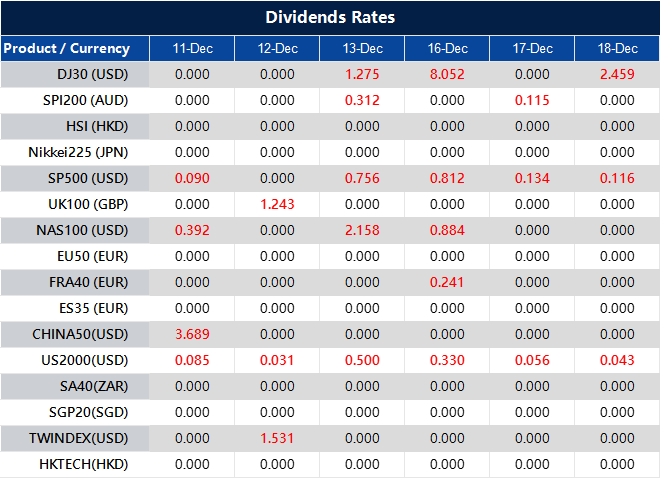

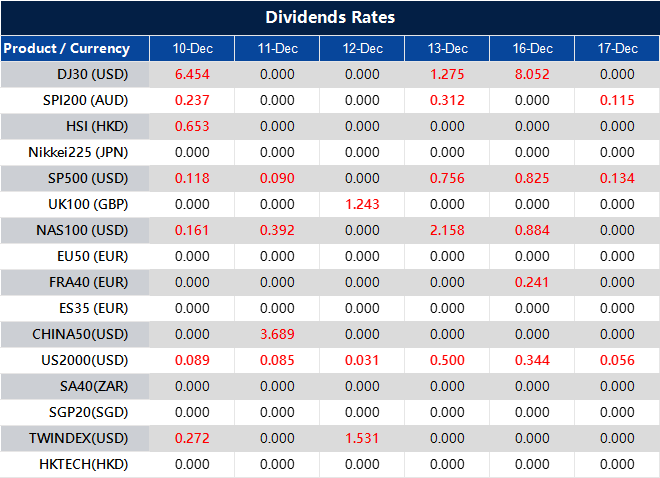
Dividend Adjustment Notice – Dec 11,2024

Dear Client,

Please note that the dividends of the following products will be adjusted accordingly. Index dividends will be executed separately through a balance statement directly to your trading account, and the comment will be in the following format “Div & Product Name & Net Volume ”.

Please refer to the table below for more details:

The above data is for reference only, please refer to the MT4/MT5 software for specific data.

If you’d like more information, please don’t hesitate to contact info@vtmarkets.com.

What is Gold Trading and How to Trade Gold?

What is Gold Trading and How to Trade Gold Effectively

Gold trading has become one of the most popular forms of investment, especially in times of economic uncertainty. This guide will explore everything you need to know about trading gold online, the reasons for its appeal, and how to trade gold effectively.

What is Gold Trading?

Gold trading involves buying and selling gold through financial instruments, aiming to profit from its price movements. Unlike owning physical gold, such as bars or jewelry, traders use contracts like futures, options, or Contracts for Difference (CFDs) to trade gold online. This method removes the need for physical storage while providing flexibility, greater leverage, and access to global markets. Gold trading offers an efficient way to participate in the gold market, capitalizing on its price fluctuations without the complications of physical ownership.

How to Trade Gold

To successfully trade gold, it’s important to follow a systematic approach. Below are the key steps to guide you through the process:

Step 1: Study and Understand the Gold Market

Before diving into trading, it’s crucial to understand the factors influencing gold prices. Key drivers include economic data (like inflation and GDP growth), interest rates set by central banks, and geopolitical events (wars, trade tensions, or political instability). Staying updated on these developments will allow you to predict price movements and make informed decisions. 

Step 2: Choose a Reliable Broker

Select a trusted broker that offers low spreads, fast execution, and reliable customer support. Make sure they are regulated by a recognised authority for added security.

Step 3: Open and Fund Your Trading Account

Once you’ve chosen a broker, open a trading account and choose your account type. Most brokers offer demo accounts, which allow you to practice trading without real money. Once you’re comfortable, fund your account and start with a small amount to minimise risk as you gain experience.

Step 4: Select Your Trading Method

Choose how you want to trade gold, whether through CFDs, futures, ETFs, or physical gold. For beginners, CFDs and ETFs are often the simplest options.

Step 5: Decide to Go Long or Go Short

Decide whether to buy (go long) if you expect prices to rise, or sell (go short) if you expect prices to fall. This decision depends on market analysis and your outlook on gold prices.

Step 6: Implement Risk Management Tools

Risk management is essential when trading gold, as its price can be volatile. Always use stop-loss orders to limit potential losses and take-profit orders to lock in gains. Additionally, calculate your position size carefully to ensure you’re not risking more than you can afford to lose. Use risk-to-reward ratios (e.g., 1:3) to ensure that the potential reward outweighs the risk of each trade.

Learn more about risk management tools for gold trading

Step 7: Constantly Monitor the Market

Gold prices are influenced by many factors, and they can change rapidly. Constantly monitor the market for updates on economic data, central bank policy, and global events that could affect prices. Setting up price alerts can help you stay on top of market changes, so you’re always ready to act when an opportunity arises.

Learn how to trade gold for beginners

Why Trade Gold?

Gold has been a valuable asset for centuries, and its role in modern trading continues to grow. Here are the key reasons why trading gold is appealing:

1. Safe-Haven Asset

Gold is often seen as a safe-haven investment during times of financial turmoil or geopolitical uncertainty. When markets are volatile, due to events like economic crises, wars, or political instability, investors flock to gold as a store of value. Unlike other financial assets, gold’s value doesn’t depend on the performance of a specific economy or company, making it a go-to choice for those seeking stability.

Example: In 2008, during the global financial crisis, gold prices surged by 25% as investors sought refuge from the crashing stock market. This trend has repeated during periods of economic instability, further solidifying gold’s role as a safe-haven asset.

2. Hedge Against Inflation

Gold is a proven hedge against inflation. As the value of fiat currencies declines due to rising inflation, gold tends to maintain its purchasing power. Since gold is a physical asset with a limited supply, it often rises in value when inflation erodes the value of paper money.

Example: In the 1970s, during a period of high inflation in the United States, the price of gold increased by more than 600%. This made gold an essential tool for protecting wealth during inflationary times.

3. Portfolio Diversification

Gold is an excellent tool for diversifying your investment portfolio. Its price movements are often unrelated to the performance of stocks, bonds, or other assets, meaning it can help smooth out volatility in a portfolio. When the stock market is down, gold may rise, offering a counterbalance and reducing overall risk.

Example: Between 2000 and 2011, while global stock markets struggled, the price of gold rose by more than 400%, proving that gold can provide stability and potential profits when other assets underperform.

4. Liquidity and Accessibility

Gold is one of the most liquid commodities in the world. Whether you’re trading physical gold, gold ETFs, or gold CFDs, it’s easy to buy and sell gold in large volumes without affecting the price significantly. The global demand for gold ensures that it’s always easy to enter or exit a position.

Example: Trading gold online through platforms like VT Markets gives you access to a highly liquid market, allowing you to buy or sell gold anytime, even during periods of high volatility.

5. Profit from Price Movements

Gold is known for its price volatility, which offers opportunities for traders to profit from both rising and falling prices. By trading gold through instruments like CFDs or futures, traders can take advantage of market fluctuations in both bullish and bearish conditions.

Example: In 2020, when the global pandemic caused economic uncertainty, gold prices surged by 25% as investors sought safety. Active traders could have capitalised on this movement by going long on gold or using leveraged trading to maximise gains.

Ways to Trade Gold

There are several popular methods to trade gold, each offering different advantages depending on your goals:

Physical Gold: Buying gold in the form of coins, bars, or jewellery. While this gives you ownership of the physical asset, it requires secure storage and insurance.

Gold Futures: These contracts allow you to agree to buy or sell gold at a specified future date and price. It’s a leveraged way to trade, often used by more experienced investors to capitalise on short-term price movements.

Gold ETFs (Exchange-Traded Funds): These funds track the price of gold, allowing you to invest without owning physical gold. They’re an efficient and liquid option for those looking to gain exposure to gold with lower fees than futures.

Gold CFDs (Contracts for Difference): A contract between a trader and a broker to exchange the difference in gold’s price from the time the contract is opened to when it’s closed. CFDs allow traders to profit from both rising and falling gold prices.

Gold Mining Stocks: Instead of buying gold itself, you can invest in stocks of companies that mine gold. These stocks often move in line with gold prices, but may also depend on the company’s performance and operations.

What Impacts the Price of Gold?

The price of gold is influenced by a range of factors that can drive its price up or down:

Economic Data: Key indicators like inflation, unemployment, and GDP growth impact the demand for gold. Strong economic performance typically reduces the need for gold as a hedge, while weak economic conditions or recession can drive demand.

Interest Rates: When interest rates are low, gold becomes more attractive because it doesn’t yield interest. In contrast, higher rates make gold less appealing, as investors can get better returns elsewhere, such as in bonds or savings accounts.

US Dollar Strength: As gold is priced in US dollars, a stronger dollar makes gold more expensive for foreign investors, typically causing prices to fall. A weaker dollar has the opposite effect, often pushing gold prices higher.

Geopolitical Tensions: Events like wars, political instability, or global crises often increase the demand for gold as a safe-haven asset. Investors turn to gold as a store of value when trust in other financial assets declines.

Central Bank Activity: Central banks hold large quantities of gold as part of their reserves. When they increase their holdings, it can signal confidence in gold, pushing prices up. Conversely, selling off reserves can depress gold prices.

Market Sentiment: Gold is heavily influenced by investor sentiment. In times of uncertainty, gold tends to rise as more investors flock to it as a safe store of value.

Advantages of Trading Gold

Safe-Haven Asset: Gold is widely seen as a safe-haven investment, which means its value tends to rise during economic uncertainty, inflation, or geopolitical instability. This makes it a reliable store of value, especially in turbulent times.

Portfolio Diversification: Adding gold to your portfolio can reduce overall risk. Since gold often behaves differently from stocks and bonds, it can act as a hedge, balancing out losses in other parts of your portfolio.

Liquidity: Gold markets are highly liquid, meaning you can easily buy or sell your positions. Whether you’re trading physical gold, ETFs, or gold CFDs, the market’s depth makes it simple to exit a position quickly when needed.

Profit from Volatility: The price of gold fluctuates based on global events, offering opportunities for traders to profit from short-term price movements. By trading through instruments like CFDs, traders can gain from both rising and falling prices.

Accessibility: Thanks to online trading platforms, gold is accessible to everyone. Traders can enter global markets and access 24/5 trading through brokers, giving them flexibility to trade at their convenience.

Disadvantages of Trading Gold

Volatility: While volatility can present opportunities, it also introduces risk. Gold prices can fluctuate significantly, especially during periods of economic uncertainty, making it difficult to predict short-term price movements. Traders can face losses if they misjudge these shifts.

No Yield: Unlike stocks or bonds, gold doesn’t pay dividends or interest. This means it doesn’t generate any income for investors holding it long-term. As such, gold may be less appealing for those seeking passive income from their investments.

Storage and Insurance Costs (Physical Gold): If you choose to buy physical gold, you must factor in the cost of storage and insurance, which can be expensive over time. For example, storing large quantities of gold in a secure vault or insurance policy can erode profits.

Leverage Risk: When trading gold using leverage, you risk amplifying both profits and losses. This makes leveraged trading more suitable for experienced traders, as it can lead to rapid losses if market movements don’t go in your favour.

Market Timing: Gold’s price can be unpredictable, influenced by numerous global factors. Timing gold trades requires an understanding of global economics, central bank policies, and market sentiment, which can be challenging for less experienced traders.

Find out the mistakes to avoid in gold trading.

Conclusion

Gold remains one of the most sought-after assets in the world of finance. Trading gold online provides flexibility and access to a highly liquid market, making it an appealing option for both new and seasoned traders. Understanding the factors that influence gold prices, such as economic events and interest rates, will give you a competitive edge in the market.

Why Trade Gold with VT Markets?

Trading gold with VT Markets offers low spreads, fast execution, and a user-friendly platform, available on MetaTrader 4 and MetaTrader 5, for both new and experienced traders. VT Markets provides 24/7 customer support and ProTrader tools to help you stay ahead in the gold market. Whether you’re trading short-term or seeking long-term investment opportunities, VT Markets gives you the resources to make informed decisions and manage risk effectively. Start trading gold today with VT Markets!

Frequently Asked Questions (FAQs) 

1. What is gold trading?

Gold trading refers to the act of buying and selling gold in various forms to profit from price movements. Traders can engage in gold trading through physical purchases, ETFs, futures contracts, or CFDs.

2. How to trade gold online?

To trade gold online, follow these steps:

  • Step 1: Study and Understand the Gold Market
  • Step 2: Choose a Reliable Broker
  • Step 3: Open and Fund Your Trading Account
  • Step 4: Select Your Trading Method
  • Step 5: Decide to Go Long or Go Short
  • Step 6: Implement Risk Management Tools
  • Step 7: Constantly Monitor the Market

3. What are the benefits of trading gold?

Trading gold offers several advantages, including:

  • Safe-Haven Asset:
  • Portfolio Diversification
  • Liquidity
  • Profit from Volatility
  • Accessibility

4. What are the risks of trading gold?

While trading gold can be profitable, it also comes with risks:

  • Volatility
  • No Yield
  • Storage and Insurance Costs (Physical Gold)
  • Leverage Risk
  • Market Timing

5. What factors influence gold prices?

Several factors affect gold prices, including:

  • Economic Data
  • Interest Rates
  • US Dollar Strength
  • Geopolitical Tensions
  • Central Bank Activity
  • Market Sentiment

Taming Fear, Greed, and Hope in Volatile Markets

Investing is as much about psychology as it is about numbers.

While charts and data may guide strategies, emotions often take the wheel in moments of uncertainty. Emotional investing is one of the greatest risks to your portfolio. Fear, greed, and hope—three forces familiar to every investor—have the power to cloud judgment and drive costly decisions.

Let’s explore how these emotions come into play and how you can manage them to navigate turbulent markets confidently.

FearThe Great Instigator of Panic Selling

Fear is a primal response. Fear triggers the fight or flight instinct, and in markets, it often manifests as a flight reaction.

When assets lose value, the instinct to cut losses and run kicks in. During the COVID-19 crash in March 2020, global equity markets plummeted, with the Dow Jones Industrial Average shedding 37% in just weeks. That’s about 3,000 points.

Many traders sold their positions, crystallising losses, only to see markets rebound sharply over the following months.

The Reality

Fear isn’t the enemy—it’s a signal. It forces you to re-evaluate your exposure and risk. But acting on fear without strategy can lead to regret.

A long-term view and a focus on fundamentals can help you ride out turbulence. Avoid the trap of short-term thinking by revisiting your financial goals.

GreedThe Fuel for Chasing Trends

Greed is the flipside of fear, and it’s just as dangerous. It’s the voice that whispers, “Don’t miss out.” The cryptocurrency frenzy of 2021 saw Bitcoin soar past $60,000, driven by exuberance and speculation.

Traders who chased these highs often found themselves exposed to devastating losses when the market corrected in 2022.

The Reality

Greed is a double-edged sword. While ambition can propel gains, unchecked greed blinds you to risk. Balance is key.

Diversification and pre-set exit strategies keep your decisions grounded, ensuring you’re capitalising on opportunities without exposing yourself to undue risk.

HopeThe Comfort of Holding On

Hope is a quiet but persistent force. It keeps traders anchored to losing positions, believing a turnaround is just around the corner.

Take the case of meme stocks like GameStop in early 2021. Many traders held on well past the initial surge, hoping for another peak, only to see their gains evaporate.

The Reality

Hope is necessary, but it needs structure. Set boundaries with stop-loss orders and regularly reassess your holdings against market conditions. If hope is your only reason for holding, it’s time to re-evaluate.


Practical Steps for Mastering Emotional Discipline

  1. Have a Game Plan (and Stick to It)
    • Start with a clear investment strategy tailored to your goals and risk tolerance. This will act as your anchor during moments of volatility.
  2. Learn to Pause
    • When markets are turbulent, take a breath before reacting. A deliberate pause allows you to make decisions based on strategy, not emotion.
  3. Automate for Consistency
    • Use tools like automated investing or regular rebalancing to maintain objectivity. Automation ensures decisions are driven by logic, not impulse.
  4. Educate Yourself Continuously
    • The more you understand market trends and behavioural finance, the better equipped you’ll be to spot emotional triggers and navigate them.
  5. Lean on Expertise
    • Surround yourself with trusted sources, whether that’s a financial adviser, seasoned traders, or reputable platforms. Objective perspectives can help counterbalance your emotional biases.

Market swings are inevitable, but emotional swings don’t have to be. By recognising how fear, greed, and hope influence your decisions, you can transform these forces into tools rather than obstacles.

Approach investing with clarity, discipline, and a calm perspective, and you’ll find that even in the stormiest markets, you can stay the course.

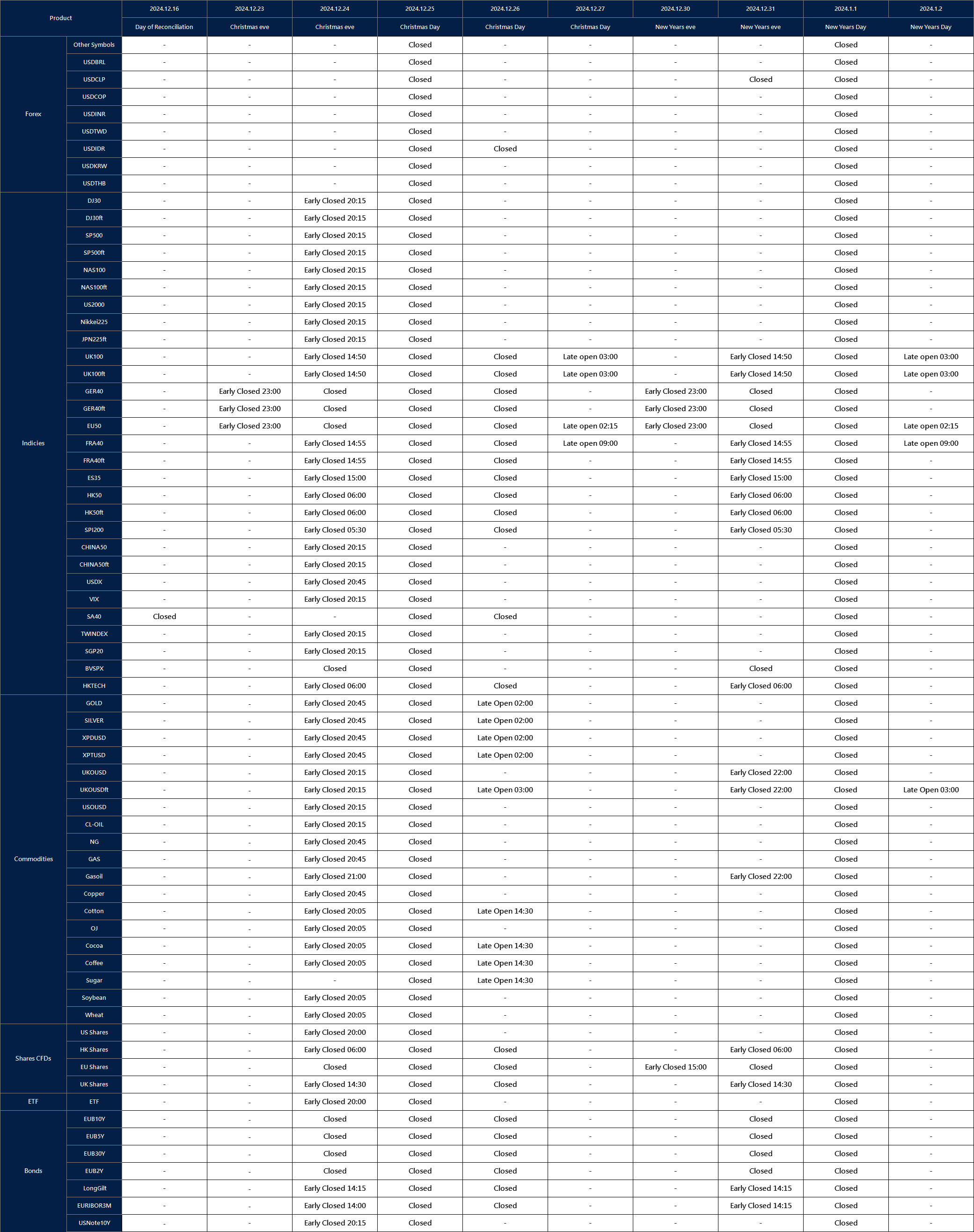
Notification of Trading Adjustment in Holiday – Dec 11,2024

Dear Client,

Affected by international holidays, the trading hours of some VT Markets products will be adjusted.

Please check the following link for the affected products:

Notification of Trading Adjustment in Holiday

Note: The dash sign (-) indicates normal trading hours.

Friendly Reminder:
The above data is for reference only, please refer to the MT4/MT5 software for specific data.

If you’d like more information, please don’t hesitate to contact info@vtmarkets.com.

Dividend Adjustment Notice – Dec 10,2024

Dear Client,

Please note that the dividends of the following products will be adjusted accordingly. Index dividends will be executed separately through a balance statement directly to your trading account, and the comment will be in the following format “Div & Product Name & Net Volume ”.

Please refer to the table below for more details:

The above data is for reference only, please refer to the MT4/MT5 software for specific data.

If you’d like more information, please don’t hesitate to contact info@vtmarkets.com.

What is Margin in Forex Trading?

What Is Margin in Forex Trading and Why Does It Matter

In this article, we will explore what margin in forex trading is, how it functions, and its significance in trading. Margin plays a crucial role in allowing traders to control larger positions with a smaller initial investment. We’ll also cover how margin affects leverage, the risks involved, and why it’s important for successful forex trading strategies. Understanding margin is key to managing both opportunities and risks effectively in the dynamic world of forex trading.

What is Margin in Forex?

Margin is a fundamental concept in forex trading that allows traders to control substantial positions with a relatively small investment. It acts as collateral provided to a broker to open and maintain trades. Unlike a fee or cost, margin is a portion of your account balance temporarily set aside by the broker to cover potential losses. Understanding what margin is in forex is essential for navigating the complexities of leveraged trading and managing risks effectively.

For example, if a trader wants to open a position worth $100,000 with a leverage ratio of 1:100, they only need $1,000 as margin. This ability to amplify exposure without committing large amounts of capital makes margin an attractive feature of forex trading.

Learn what forex trading is and how it works.

How Margin Works in Forex Trading

Margin works closely with leverage to enable traders to control large positions. Leverage multiplies the buying power of your capital, while margin represents the portion of your account balance used as collateral. For instance, with a leverage ratio of 1:100, every $1 in your account allows you to control $100 worth of trading volume.

When a trade is initiated, the broker sets aside a portion of your balance as margin. The remaining funds are known as free margin, which is the amount available for opening new trades or absorbing potential losses. Monitoring free margin in forex is crucial, as insufficient free margin can lead to a margin call, where the broker may require additional funds or liquidate positions to cover losses.

Learn how to trade forex for beginners

Difference Between Margin and Leverage

While margin and leverage are closely related, they are distinct concepts in forex trading that serve different purposes. Understanding their differences is crucial for effective trading.

Margin refers to the amount of money a trader must deposit with a broker to open a position. It acts as collateral to cover potential losses and is expressed as a percentage of the total trade value. For example, if a broker requires a 1% margin to trade $100,000, you need to deposit $1,000 in your account.

Leverage, on the other hand, is a tool that allows traders to control a larger position with a smaller investment. It is expressed as a ratio, such as 1:50 or 1:100, indicating how much market exposure you can gain relative to your margin. For instance, with 1:100 leverage, every $1 in margin allows you to control $100 worth of trading volume.

How to Calculate Margin in Forex Trading

Calculating margin involves a simple formula:

Margin = Position Size / ​Leverage

For example, if a trader opens a 1-lot position in EUR/USD (worth $100,000) with a leverage ratio of 1:100, the margin required is:

Margin = (100,000 / 100) = $1,000

This calculation helps traders understand how much of their balance is allocated as margin, ensuring they don’t overcommit their capital. Learning how to calculate margin is a critical step for managing risks effectively.

Learn how to trade EUR/USD for beginners.

What is Margin Requirement?

The margin requirement is the percentage of a trade’s total value that a broker requires as collateral. For instance, a 1% margin requirement means you need $1,000 to open a $100,000 position.

Margin requirements vary depending on the broker, the currency pair, and market conditions. During periods of high volatility, brokers may increase margin requirements to protect against drastic price movements. Traders should familiarise themselves with these requirements to avoid unexpected margin calls.

Types of Margin in Forex Trading

Margin in forex trading can be divided into two main types, each serving a distinct purpose in managing trading positions:

1. Initial Margin

This is the amount of money required to open a trade. It acts as a deposit that ensures you have sufficient funds to cover potential losses when the trade begins. For example, if a broker requires a 1% initial margin on a $100,000 position, you need to deposit $1,000 to initiate the trade. The initial margin varies based on the broker, currency pair, and leverage offered, making it essential to understand what margin is in forex before entering the market.

2. Maintenance Margin

Once a trade is open, the maintenance margin is the minimum amount required to keep it active. This ensures the broker has enough security to manage the risk associated with your open positions. If your equity falls below the maintenance margin due to losses, you may face a margin call, requiring you to deposit additional funds or close positions. 

For instance, if the maintenance margin for your trade is $500 and your account equity drops to $400, the broker might liquidate the position to prevent further losses. By understanding these types, traders can better manage their accounts, ensuring they always meet the broker’s requirements and avoid forced liquidations. Having a clear grasp of what is margin level in forex and what is free margin in forex further aids in maintaining account stability and trading effectively.

What is Free Margin in Forex Trading?

Free margin in forex is the amount of your account balance available for opening new trades or absorbing losses. It is calculated using the formula:

Free Margin = Equity − Used Margin

For example, if your account equity is $5,000 and your used margin is $1,000, your free margin is $4,000. Maintaining sufficient free margin ensures flexibility in trading and reduces the risk of receiving a margin call. Traders who understand what free margin is in forex can better manage their accounts during periods of market volatility.

What is Margin Level in Forex Trading?

Margin level in forex is a percentage that reflects the relationship between equity and used margin. It is calculated as:

Margin Level = (Equity / Used Margin) × 100

For instance, if your account equity is $5,000 and your used margin is $1,000, the margin level is:

Margin Level =($5,000 / $1,000) × 100 = 500%

Brokers typically set a minimum margin level (e.g., 100%) to ensure accounts remain funded. If your margin level falls below this threshold, your positions may be liquidated to prevent further losses. Knowing what the margin level in forex is is vital for maintaining account stability.

What is Margin Call in Forex Trading?

A margin call in forex trading is a notification from your broker that your account equity has fallen below the required margin level to maintain your open positions. It serves as a warning that your account no longer has enough funds to support existing trades due to losses, and immediate action is required to restore the balance.

Example: You open a $50,000 position with $1,000 as margin. Market losses reduce your account equity to $900, which is below the broker’s margin requirement. The broker sends a margin call, asking you to deposit more funds or close positions. If no action is taken, the broker may forcibly close your trades to prevent further losses, known as a stop-out.

Benefits of Trading on Margin

Margin trading comes with several advantages that make it appealing to forex traders, especially those looking to maximise their market opportunities:

Increased Market Exposure: Margin allows traders to control positions much larger than their initial investment. For example, with $1,000 and a leverage ratio of 1:100, you can control a $100,000 trade. This expanded exposure enables traders to benefit from market movements that would otherwise be inaccessible with their limited capital.

Efficient Use of Funds: By using margin, traders can allocate less of their account balance to individual trades, leaving more capital free for diversification. For instance, instead of committing $10,000 to a single position, a trader could use $1,000 in margin and invest the remaining funds in other trades, spreading the risk across multiple opportunities.

Amplified Returns: The leverage tied to margin magnifies profits when the market moves in your favour. For example, a 1% movement in a $100,000 position results in a $1,000 profit, even though the trader only invested $1,000 as margin. This potential for higher returns is one of the primary attractions of trading on margin.

Drawbacks of Trading on Margin

While trading on margin offers significant advantages, it also carries risks that traders must be cautious about:

Amplified Losses: Margin trading magnifies not only your profits but also your losses. A small adverse market movement can lead to significant losses, potentially exceeding your initial deposit. For instance, if you control a $50,000 position with $1,000 in margin and the market moves 1% against you, you could lose $500, half of your initial investment.

Margin Calls: If your account equity falls below the broker’s required margin level, you may receive a margin call. This often forces traders to either deposit additional funds or have their positions liquidated. Margin calls are especially common during volatile market conditions, where rapid price changes can deplete your free margin quickly.

Psychological Pressure: Margin trading can add stress, particularly during market volatility. The potential for rapid gains and losses may lead to emotional decision-making, such as overtrading or holding onto losing positions longer than necessary.

How to Manage Margin Effectively in Forex Trading

Managing margin in forex trading is simple. Most trading platforms offer tools to track your margin level and free margin in real-time. Here’s a quick guide:

1. Monitor Margin Levels

Your margin level reflects the health of your account. Calculated as a percentage, it shows the relationship between your account equity and the margin you’ve used. If this level falls below your broker’s minimum (often 100%), your positions could be liquidated. Think of the margin level as a warning system. A higher margin level, such as 300%, means you have plenty of buffer. A lower level, like 110%, signals that your account is close to trouble. Regularly check your margin level through your trading platform. Many platforms provide real-time updates, helping you stay informed. Knowing what is margin level is in forex helps you make decisions before reaching critical levels.

2. Use Stop-Loss Orders

Stop-loss orders automatically close trades if the market moves against you, limiting potential losses. For example, if you buy EUR/USD at 1.1200, setting a stop-loss at 1.1150 caps your loss at 50 pips. Stop-loss orders protect your equity, ensuring you maintain sufficient free margin for other trades. By incorporating stop-loss orders into your strategy, you can safeguard your capital and avoid unnecessary margin calls.

Discover the different types of orders in forex trading

3. Choose Appropriate Leverage

Leverage determines how much of a position you can control with your margin. While high leverage offers greater exposure, it also increases risk. Beginners should start with lower leverage, such as 1:20 or 1:50, to minimise the impact of adverse market moves. For instance, with 1:50 leverage, controlling a $50,000 position requires just $1,000 in margin. However, a small market movement of 1% can lead to a $500 gain or loss. Choosing the right leverage helps maintain a balance between opportunity and risk.

4. Maintain a Healthy Free Margin

Free margin is the amount of funds available for opening new trades or absorbing losses. If your free margin drops too low, your broker may issue a margin call, requiring you to deposit more funds or close positions. Keeping a comfortable buffer of free margin ensures flexibility and reduces stress during volatile markets. Understanding what free margin is in forex and monitoring it regularly can keep your account stable and ready for new opportunities.

Conclusion

Margin trading in forex allows traders to control larger positions with smaller capital, offering both opportunities and risks. By understanding what margin is in forex, what margin level is in forex, and what is free margin in forex, traders can manage their accounts effectively, minimise risks, and avoid margin calls. Combining knowledge with discipline is the key to sustainable trading success.

Learn More with VT Markets

VT Markets offers everything you need to enhance your trading journey. Access our online courses to learn forex trading, designed to help traders of all levels build their knowledge and skills. Benefit from 24/7 customer support to address your queries anytime, and utilise advanced ProTrader tools and expert advisors to optimise your trading strategies. Start trading with VT Markets today and empower yourself with the tools and resources for smarter trading.

Frequently Asked Questions (FAQs)

1. What is a margin in forex?

Margin in forex trading is the amount of capital required to open and maintain a leveraged position. It is essentially a security deposit that allows traders to control larger positions than their available capital would allow.

2. What is the margin level in forex?

Margin level is the ratio of your equity to the used margin, expressed as a percentage. It indicates how much of your account balance is tied up in margin. A higher margin level means a healthier account, while a lower level may trigger a margin call.

3. What is a free margin in forex?

Free margin is the amount of capital available in your account for opening new trades. It is the difference between your equity and used margin, and it is crucial for determining how much you can trade without increasing your risk.

4. How does margin trading work?

In margin trading, you borrow funds from your broker to increase your position size. You only need to deposit a small percentage of the total trade value (called the margin). The broker provides the rest, amplifying both potential profits and risks.

5. How is the margin level calculated in forex?

Margin level is calculated using the formula:

Margin = Position Size / ​Leverage

A higher margin level means you’re not using much of your available capital, while a lower margin level means you’re closer to a margin call.

6. How can I manage margin in forex effectively?

To manage margin effectively, you should:

  • Monitor Margin Levels
  • Use Stop-Loss Orders
  • Choose Appropriate Leverage
  • Maintain a Healthy Free Margin

What Is Margin Trading and How It Works?

Margin Trading Explained: What It Is and How It Works

In this article, you’ll discover what margin trading is and how it works, learn the difference between margin and leverage, explore key terms like margin level and margin call, uncover the benefits and drawbacks of trading on margin, and gain insights on how to start margin trading effectively.

What is Margin in Trading?

Margin in trading is the amount of money a trader must deposit to open and maintain a position in the market. Acting as collateral, margin enables traders to leverage their capital, controlling larger trades than their initial deposit. For instance, if the margin requirement is 2%, a $100,000 trade would require only $2,000 as a deposit. Understanding what margin is in trading is essential for traders looking to optimise their resources while managing risks effectively.

What is Margin Trading?

Margin trading is a strategy that allows traders to borrow funds from their broker to increase their trading power. This means traders can control larger positions than they could with their own capital alone. For example, with a margin of $1,000 and leverage of 1:100, a trader can control a $100,000 trade. However, margin trading comes with risks, as losses are magnified alongside profits. Gaining a clear understanding of what margin trading is is crucial for anyone aiming to make informed trading decisions.

How Does Trading on Margin Work?

Margin trading allows traders to control a much larger position with a smaller upfront deposit. Let’s say a trader wants to open a position worth $100,000 in the EUR/USD currency pair. If their broker requires a margin of 2%, the trader must deposit $2,000 as collateral.

Suppose the EUR/USD price moves from 1.2000 to 1.2100, a 100-pip increase. In this case, with a standard lot (100,000 units), each pip is worth $10. A 100-pip movement results in a profit of $1,000. Thanks to margin trading, the trader only needed to invest $2,000 to generate this $1,000 profit—a 50% return on their capital.

However, if the market moved against the trader by 100 pips, their equity would drop by $1,000, leaving them with only $1,000 in the account. If the losses continued and their equity fell below the broker’s margin requirement, the trader would receive a margin call, requiring them to deposit more funds or risk having their position liquidated.

Difference Between Margin and Leverage

Margin and leverage are interconnected concepts, but have distinct meanings. Margin refers to the initial deposit a trader needs to open a position, while leverage indicates the borrowing ratio provided by the broker. For example, a leverage of 1:100 means the trader controls $100 for every $1 of margin deposited. Leverage amplifies trade size and potential returns, but margin ensures the trader has collateral to secure the position. When learning what margin is in trading, it’s important to grasp how leverage plays a role in the overall strategy.

What is a Margin Call?

A margin call occurs when the equity in a trading account falls below the broker’s required margin level. For instance, if a $1,000 margin requirement is not maintained due to losses, the broker may issue a margin call, requesting additional funds or closing positions. Managing your margin trading account carefully is key to avoiding margin calls, which often occur during volatile market movements. Understanding what margin trading is and how margin calls work can help traders manage risks effectively.

What is Margin Level?

Margin level reflects the health of a trading account and is calculated as:

Margin Level = (Equity / Margin) × 100%

For example, if your account equity is $5,000 and your required margin is $1,000, your margin level is 500%. A margin level below 100% signals insufficient funds to maintain open positions and often results in a margin call. Knowing what margin is and how to calculate margin levels ensures traders can monitor their accounts effectively, maintaining sufficient free margin to support their strategies.

How to Trade on Margin

Trading on margin involves borrowing funds from your broker to control a larger position. Follow these steps to start trading on margin:

Step 1: Select a Broker

Choosing the right broker is crucial for successful margin trading. A reliable platform like VT Markets provides transparent margin requirements, competitive spreads, and flexible leverage options to suit different trading strategies. Ensure the broker is regulated and offers tools such as margin calculators, educational resources, and responsive customer support to help you make informed decisions.

Step 2: Open & Fund Your Account

Once you’ve selected a broker, the next step is to open a trading account. Follow the broker’s registration process, which typically involves submitting identification documents for verification. After your account is approved, fund it with an amount that aligns with your trading goals and risk tolerance. Many brokers, including VT Markets, offer multiple deposit methods for convenience, such as bank transfers, credit cards, and e-wallets.

Not ready to trade live yet? Practice risk-free with the VT Markets demo account!

Step 3: Understand Requirements

Before engaging in margin trading, it’s essential to fully understand what margin is in trading, margin levels, and how they impact your account. Familiarise yourself with terms such as initial margin, maintenance margin, and free margin. Study the broker’s policies regarding margin calls and stop-out levels to avoid surprises during volatile market conditions.

Step 4: Start with Small Positions

Beginners should start trading with smaller positions and use lower leverage to minimise risk. Small trades allow traders to test their strategies and understand how margin works without exposing themselves to significant losses.

Step 5: Monitor Your Account

Regularly check your account’s equity, free margin, and margin level to ensure you’re not at risk of a margin call. Use your broker’s trading platform to stay informed about your account health and market conditions. Set up alerts for margin levels or account balance thresholds to take preemptive actions.

Step 6: Use Stop-Loss Orders

A stop-loss order is a critical risk management tool that automatically closes your position if the market moves against you by a specified amount. This helps protect your account from excessive losses and ensures you don’t lose more than you’re willing to risk.

Learn how to start trading for beginners

Benefits & Drawbacks of Margin Trading 

Uncover the benefits and drawbacks of margin trading to navigate its opportunities and risks effectively.

Benefits

1. Amplified Returns

Margin trading allows traders to magnify their exposure to the market, meaning small price movements can lead to higher profits compared to trading without leverage. For instance, if a trader invests $1,000 and achieves a 1% return on a trade, their profit is $10. However, with a margin of $1,000 and leverage of 1:100, the trader controls $100,000, making a 1% price move equivalent to a $1,000 profit.

Example: A trader buying EUR/USD at 1.2000 with 1:100 leverage sees the price increase to 1.2100. The 100-pip move results in a significant profit compared to using only the trader’s initial capital.

Learn what pips are in trading and how they work

2. Capital Efficiency

Margin trading requires traders to deposit only a fraction of the trade’s full value, freeing up capital for other investments or trades. This efficiency allows traders to diversify their portfolios and explore more opportunities simultaneously.

Example: A trader with $5,000 in their account can open positions worth up to $500,000 with 1:100 leverage, leaving additional funds for risk management or other trades.

3. Market Access

Margin trading lowers the barrier to entry, enabling traders with smaller capital to participate in high-value markets like forex. Without margin, significant market exposure might be unaffordable for many individuals.

Example: A new trader with $500 can access positions worth $50,000 using a margin of 1% and leverage of 1:100, providing access to trading opportunities that would otherwise be out of reach.

Learn how to trade forex for beginners

Drawbacks

1. Magnified Losses

While margin trading can amplify returns, it also magnifies losses. If the market moves against a trader’s position, the losses are proportionate to the leveraged amount rather than the initial margin.

Example: Using 1:100 leverage, a 1% adverse move on a $100,000 position ($1,000 margin) results in a $1,000 loss, wiping out the entire margin deposit.

2. Margin Calls

When a trader’s equity falls below the required maintenance margin, brokers issue a margin call, requiring additional funds to maintain open positions. If funds are not added, the broker may close positions to minimise risk.

Example: A trader with $1,000 in equity sees losses reduce their balance to $800 while the required margin remains $1,000. The broker issues a margin call, and the trader must deposit $200 or risk their position being closed.

3. High Stress Levels

Trading on margin requires constant monitoring of market conditions, account equity, and margin levels. The pressure of managing amplified risks can lead to emotional trading, increasing the likelihood of errors.

Example: A trader holding a leveraged position overnight faces unexpected market volatility, reducing their equity and triggering stress as they rush to manage the situation.

Conclusion

Understanding what margin trading is and the mechanics of trading on margin is essential for forex traders. These concepts unlock the potential to magnify returns while also presenting risks that require careful management. By familiarising yourself with margin levels, leverage, and margin calls, you can trade with confidence while protecting your capital.

Trade now with VT Markets

Experience seamless margin trading with VT Markets. Enjoy competitive spreads, flexible leverage options, and ProTrader tools that empower you to capitalise on market opportunities. Open your account today and start your trading journey with VT Markets.

Frequently Asked Questions (FAQs)

1. What is a margin in trading?

Margin in trading refers to the amount of money a trader must deposit with their broker to open and maintain a position. It acts as collateral and allows traders to leverage their capital to control larger positions. 

2. What is margin trading?

Margin trading involves borrowing funds from a broker to trade financial assets, enabling traders to take larger positions than they could with their available capital alone. This practice amplifies both potential profits and losses. 

3. How does margin trading work?

When a trader opens a margin account, they deposit an initial margin, which is a percentage of the total trade value. The broker lends the remaining amount, allowing the trader to control a larger position. The trader must maintain a minimum balance, known as the maintenance margin, to keep the position open.

4. What is a margin call?

A margin call occurs when the value of a trader’s account falls below the broker’s required maintenance margin. The broker will request the trader to deposit additional funds or close positions to bring the account back to the required level. 

5. What are the risks of margin trading?

The primary risks of margin trading include the potential for amplified losses, the possibility of a margin call, and the obligation to repay borrowed funds even if the trade results in a loss. Traders should use margin cautiously and ensure they understand the risks involved. 

6. How can I manage risk in margin trading?

Risk management strategies in margin trading include setting stop-loss orders, using appropriate leverage levels, diversifying positions, and regularly monitoring account balances to avoid margin calls.

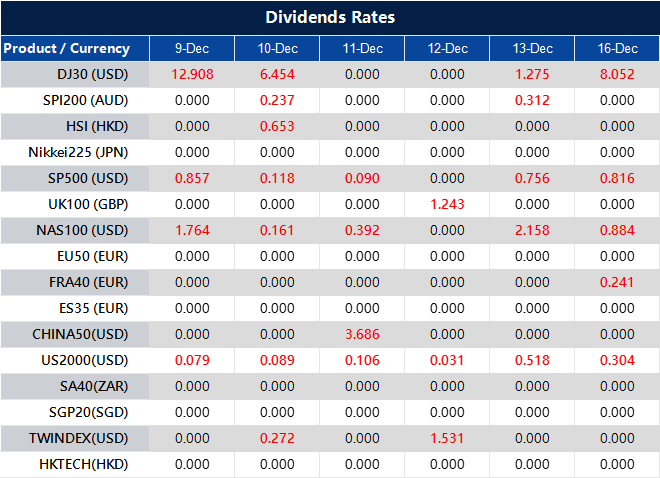
Dividend Adjustment Notice – Dec 09,2024

Dear Client,

Please note that the dividends of the following products will be adjusted accordingly. Index dividends will be executed separately through a balance statement directly to your trading account, and the comment will be in the following format “Div & Product Name & Net Volume ”.

Please refer to the table below for more details:

The above data is for reference only, please refer to the MT4/MT5 software for specific data.

If you’d like more information, please don’t hesitate to contact info@vtmarkets.com.

Nonfarm payrolls preview: will jobs data boost the USD?

As this year steps to an end, the week from Monday, 9 December, to Friday, 13 December 2024, presents several notable opportunities and risks in the forex market, shaped by varying global economic trends, central bank policies, and geopolitical developments.

KEY ECONOMIC INDICATORS

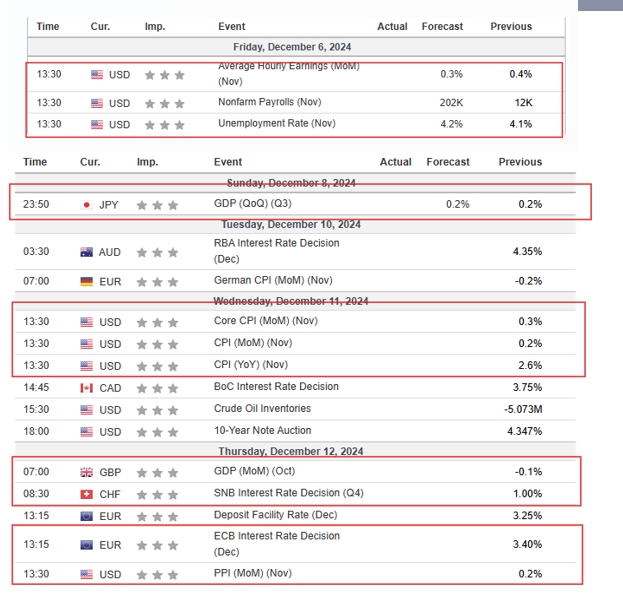
U.S. Nonfarm Payrolls:

  • Resilient job market: Expectations suggest that the U.S. economy added approximately 200,000 jobs in November, recovering from the slower October growth affected by strikes and hurricanes. December’s preliminary numbers show an even more substantial increase of 216,000 jobs, surpassing expectations of 170,000.
  • Impact of Fed’s decision on rate cuts: While the Fed recently held interest rates steady at 4.50%-4.75%, it signalled no imminent reductions until confidence in inflation nears its 2% target. Strong employment growth might support this hawkish outlook, bolstering the U.S. dollar.

Central Bank updates:

  • European Central Bank (ECB): The ECB cut its policy rates by 25bp on 17 October, lowering the rate to 3.40%. We expect a further 25bp cut at December’s governing council meeting and quarterly 25bp cuts throughout 2025 (in March, June, September, and December), for a total of 100bp for the year.
  • The Bank of Canada (BoC): The Bank of Canada cut its key interest rate by 50bps to 3.75% in its October 2024 decision, as expected, signalled that it will continue to lower its rate should the economy develop as expected. The decision increased the pace of rate cuts following three 25bps slashes, aligning with recent data that indicated a sharp slowdown in Canadian inflation. Headline price growth fell to 1.6% in September, below the target of 2% for the first time in three years.

Energy markets and geopolitics:

Crude oil prices remain sensitive to geopolitical developments and potential OPEC production shifts. Any new tensions or supply disruptions could affect energy stocks and broader inflation expectations.

MARKET MOVER

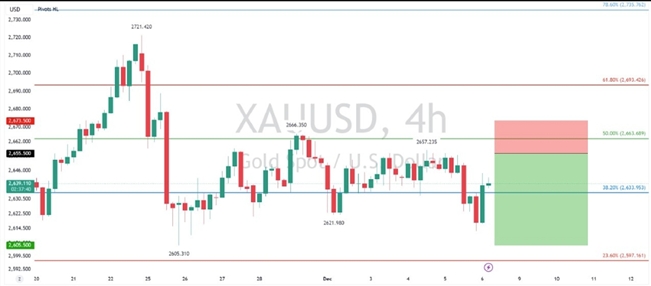
XAU/USD – (bearish outlook)

  • Daily momentum has paused, shifting our bias to neutral.
  • Current levels are at overbought extremes.
  • Market activity has been choppy and volatile.
  • The 2657.3 level has acted as a key pivot.
  • Overnight dips were met with buying interest, leading to sustained upward pressure.

Trade Opportunity: Target 1: 2605.5 // Target 2: 2595.5 // Expires: 07 December 2024

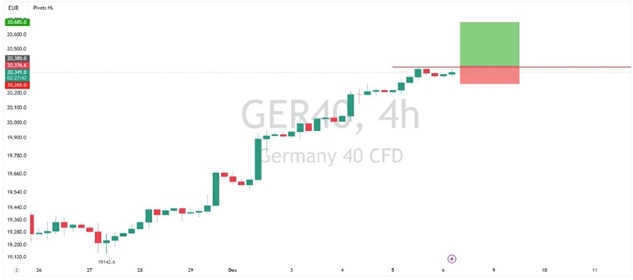
GER40 DAX – (bullish outlook)

  • Price action has pushed to a new all-time high at 20,376.
  • There are no clear signals suggesting the upward momentum is losing steam.
  • A breakout above the recent high of 20,376 could pave the way for further upside.
  • Our outlook remains bullish.
  • We anticipate gains to extend further today.

Trade Opportunity: Target 1: 20685 // Target 2: 20785 // Expires: 07 December 2024

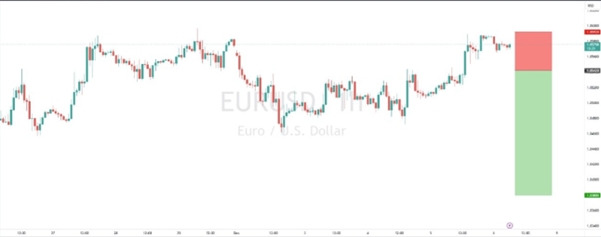
EUR/USD – (bearish outlook)

  • Sustained upward momentum from 1.0472 led the pair to post net daily gains yesterday.
  • While bullish momentum remains intact, the pair has paused near a prior swing high at 1.0597.
  • Upcoming economic data could negatively impact the short-term technical outlook.
  • A Fibonacci confluence zone is identified at 1.0380.
  • A decisive break below 1.0542 is required to confirm continued downward momentum.

Trade Opportunity: Target 1: 1.038 // Target 2: 1.035// Expires: 07 December 2024

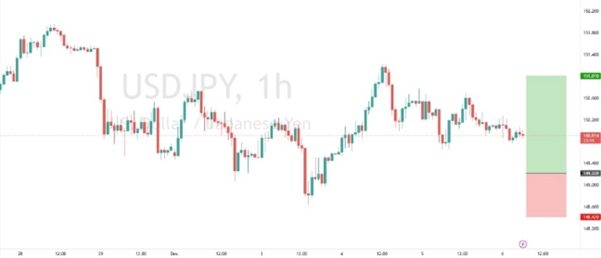
USD/JPY (bullish outlook)

  • A five-wave bullish structure has been completed at 151.23.
  • Selling pressure emerged during the Asian session.
  • The decline has been mixed and volatile, typical of corrective patterns.
  • Overnight gains were met with selling interest, leaving room for further bearish pressure this morning.
  • Economic data releases could negatively impact the short-term technical outlook.

Trade Opportunity: Target 1: 151.01 // Target 2: 151.69 // Expires: 07 December 2024

MARKET NEWS

Foreign exchange

  • The U.S. Dollar Index dropped 0.57% to 105.72 ahead of today’s U.S. nonfarm payrolls report, which is expected to show a 194,000 increase for November.
  • Despite weaker eurozone data, EUR/USD rose 77 pips to 1.0587, retail sales down 0.5% (vs. -0.4% expected) and Germany’s factory orders falling 1.5% (vs. -2.1% forecasted).
  • GBP/USD climbed 55 pips to 1.2757.
  • USD/JPY fell 51 pips to 150.09, and USD/CHF declined 61 pips to 0.8780.
  • AUD/USD gained 23 pips to 0.6451, while USD/CAD slid 53 pips to 1.4020.

Commodities and Stocks

  • U.S. equity markets closed lower on Thursday as investors exercised caution ahead of key jobs data. The S&P 500 fell 11 points (-0.19%) to 6,075, the Dow Jones Industrial Average dropped 248 points (-0.55%) to 44,765, and the Nasdaq 100 declined 67 points (-0.31%) to 21,425.
  • The materials and industrial sectors led the losses, while consumer discretionary and consumer staples outperformed.
  • On the economic front, weekly initial jobless claims rose to 224,000, exceeding the 214,000 forecasts. Later today, nonfarm payrolls are projected to grow by 194,000 in November, with the unemployment rate expected to hold steady at 4.1%.
  • The 10-year U.S. Treasury yield held steady at 4.182%.
  • European equities advanced, with the DAX 40 up 0.63%, the CAC 40 gaining 0.37%, and the FTSE 100 rising 0.16%.
  • In commodities, gold dropped $18 (-0.68%) to $2,632, while WTI crude oil slipped $0.24 (-0.35%) to $68.30 after OPEC+ announced a three-month delay in production increases, now set for April.

Asian Session Updates

  • During Asian trading, EUR/USD and GBP/USD remained steady at 1.0580 and 1.2750, respectively.
  • USD/JPY edged lower to 149.85, as Japan’s household spending declined 1.3% year-on-year in October, beating the expected 2.4% drop.
  • Gold touched an intraday low of $2,641 before recovering to $2,632.

Click here to open account and start trading.

Back To Top
server

Hello there 👋

How can I help you?

Chat with our team instantly

Live Chat

Start a live conversation through...

  • Telegram
    hold On hold
  • Coming Soon...

Hello there 👋

How can I help you?

telegram

Scan the QR code with your smartphone to start a chat with us, or click here.

Don’t have the Telegram App or Desktop installed? Use Web Telegram instead.

QR code