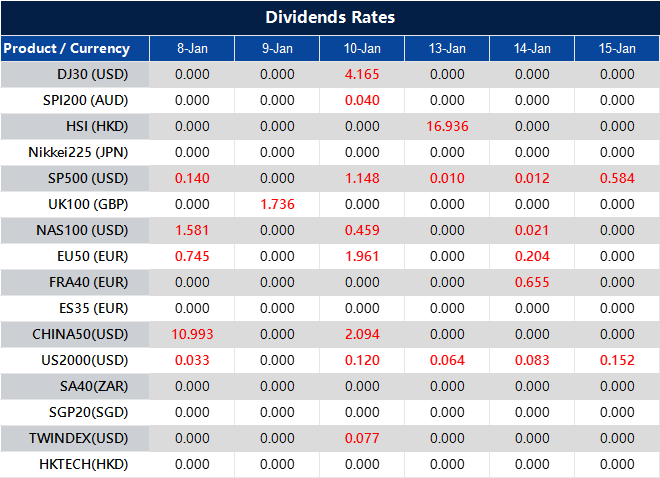
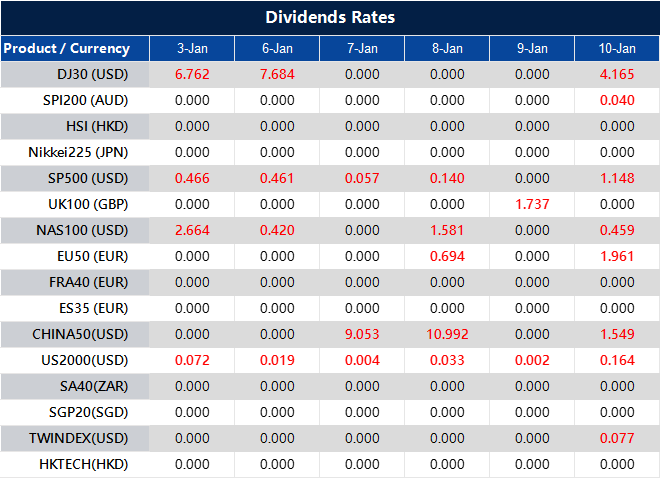
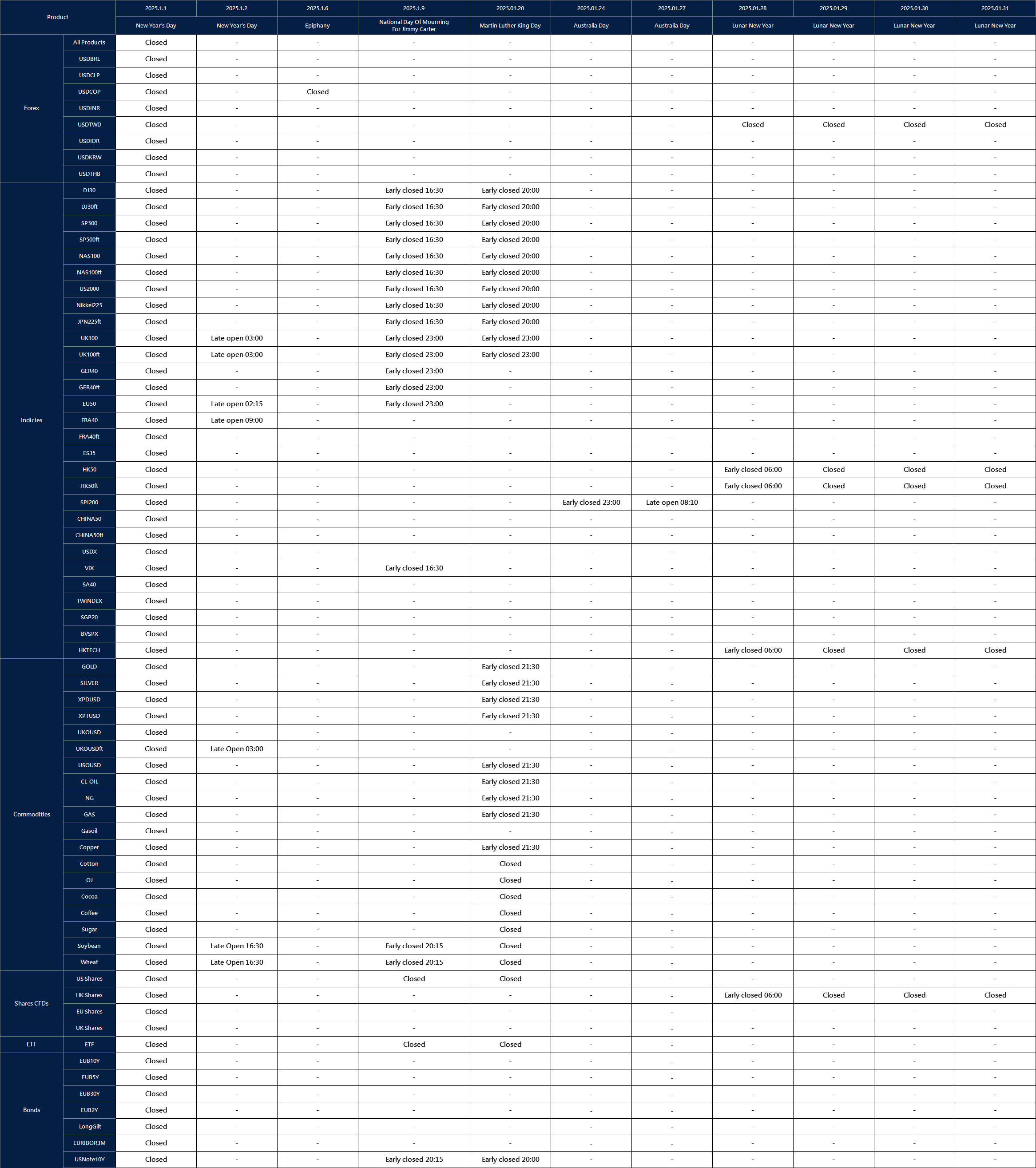
Please note that the dividends of the following products will be adjusted accordingly. Index dividends will be executed separately through a balance statement directly to your trading account, and the comment will be in the following format “Div & Product Name & Net Volume ”.
Please refer to the table below for more details:
The above data is for reference only, please refer to the MT4/MT5 software for specific data.
If you’d like more information, please don’t hesitate to contact info@vtmarkets.com.
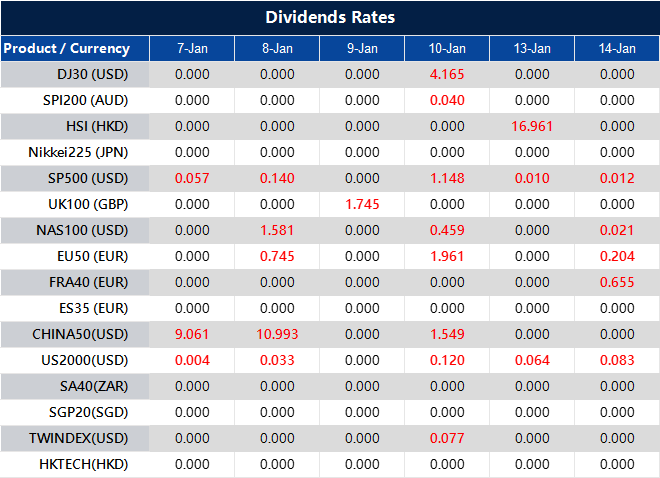
Please note that the dividends of the following products will be adjusted accordingly. Index dividends will be executed separately through a balance statement directly to your trading account, and the comment will be in the following format “Div & Product Name & Net Volume ”.
Please refer to the table below for more details:
The above data is for reference only, please refer to the MT4/MT5 software for specific data.
If you’d like more information, please don’t hesitate to contact info@vtmarkets.com.
Forex vs Stocks: Key Differences Every Trader Should Know
Regarding investing, two of the most popular markets are forex, stocks, and traditional equities. While both provide opportunities to grow wealth, they cater to different types of investors and come with their own set of advantages and challenges. In this article, we will dive deep into the distinctions between forex vs stocks, their respective trading mechanisms, and how to choose the right one for your financial goals.
What is Forex Trading?
Forex trading is the exchange of one currency for another in the global forex market, which operates 24 hours a day, five days a week, with over $6.6 trillion traded daily. Traders profit by speculating on currency pair price movements, such as EUR/USD, driven by factors like economic data and geopolitical events. The forex market offers high liquidity, enabling seamless trading with minimal price slippage, even for large volumes. Its 24-hour accessibility allows traders to engage in the market at any time during global sessions, such as the overlap between London and New York sessions. Additionally, forex provides leverage, enabling traders to control larger positions with minimal capital, amplifying both potential profits and risks.
Stock trading involves buying and selling shares of companies on exchanges like the NYSE or NASDAQ. Investors aim to profit through price appreciation and dividends while participating in a market influenced by company performance and broader economic conditions. Stock trading provides ownership in a company, granting voting rights and access to dividend payments from profitable companies. It is ideal for long-term wealth building, as stocks tend to offer steady growth over decades. Unlike forex, stock prices are generally more predictable, driven by company-specific factors such as earnings reports, product launches, and market sentiment, making it a more stable option for investors.
Forex vs Stocks: Key Differences Between Forex Trading and Stock Trading
Understanding the distinctions between forex vs stocks is essential for choosing the market that aligns with your goals. Below are some of the primary differences:
1. Market Size and Liquidity
Forex: The forex market is the largest financial market in the world, with a daily trading volume exceeding $6.6 trillion. This immense size ensures that there is always a counterparty available for your trade, making it highly liquid. For example, if you’re trading EUR/USD, you can almost always buy or sell instantly without worrying about finding a buyer or seller. High liquidity also means tighter spreads, which lowers transaction costs for traders. This makes forex trading attractive for scalpers and high-frequency traders who rely on quick entries and exits.
Stocks: The stock market, while significant, is much smaller compared to forex. Liquidity in stock trading varies widely depending on the stock being traded. Blue-chip stocks like Apple or Microsoft typically have high liquidity due to their popularity, but smaller-cap stocks may lack the same ease of buying or selling. Low liquidity in certain stocks can lead to wider bid-ask spreads, making it more expensive to trade them.
2. Trading Hours
Forex: The forex market operates 24 hours a day, five days a week, making it accessible to traders across different time zones. It is divided into four main trading sessions: the Sydney session, the Tokyo session, the London session, and the New York session. For instance, when the London and New York sessions overlap, the market sees the highest trading activity and liquidity. This 24-hour cycle means traders can react immediately to news and events affecting currency prices, offering more flexibility for those with varying schedules.
Stocks: Stock markets have fixed trading hours depending on the region. For example, the New York Stock Exchange (NYSE) operates from 9:30 AM to 4:00 PM Eastern Time. Outside of these hours, investors can engage in pre-market or after-hours trading, but liquidity is often lower, and prices can be more volatile. These limited trading hours mean that stock traders might not always be able to react to breaking news or global events until the market reopens, which could lead to significant price gaps.
3. Volatility and Risk
Forex: Forex markets are known for their high volatility, which can create significant profit opportunities but also substantial risks. Currency values fluctuate based on geopolitical events, central bank policies, economic data releases, and market sentiment. For example, an interest rate hike by the Federal Reserve can cause the USD to surge against other currencies. While this volatility is attractive to day traders and scalpers, it also means that sudden market movements can lead to significant losses for the unprepared.
Stocks: Stock prices are generally less volatile than forex pairs, though they can experience sharp movements due to company-specific events like earnings reports, mergers, or new product launches. For example, if a company exceeds earnings expectations, its stock price might skyrocket, while poor performance can cause a sharp decline. This comparatively lower volatility can be beneficial for long-term investors looking for stable growth rather than rapid gains.
4. Leverage
Forex:Leverage is a key feature of forex trading, allowing traders to control large positions with a small amount of capital. For example, a leverage ratio of 1:500 means that with $1,000 in your trading account, you can control a position worth $500,000. This amplifies potential profits but also increases the risk of significant losses. For instance, a 1% price movement in a $500,000 position equates to a $5,000 gain or loss, underscoring the importance of proper risk management.
Stocks: Leverage in stock trading is typically offered through margin accounts, but it is much more limited compared to forex. In the U.S., for instance, brokers may offer a 2:1 leverage ratio for stocks, meaning you can borrow funds equal to your invested capital to increase your buying power. While margin trading can enhance profits, limited leverage means stock traders are less exposed to the high risks associated with the significant leverage offered in forex.
Advantages and Disadvantages of Forex Trading and Stock Trading
Both forex trading and stock trading offer unique opportunities for investors, catering to different trading styles, risk appetites, and financial goals. To choose the right market, it’s essential to understand its respective advantages and challenges.
Advantages of Forex Trading
High Liquidity: The forex market has unparalleled liquidity due to its vast size, with daily trading volumes exceeding $6.6 trillion. This ensures that trades can be executed almost instantly, even for large volumes. High liquidity also leads to tighter bid-ask spreads, reducing trading costs. For example, currency pairs like EUR/USD or USD/JPY typically have spreads as low as 0.1 pips.
24-Hour Trading: Forex markets operate 24 hours a day, five days a week, making it accessible to traders across the globe. This schedule allows traders to react to geopolitical events, economic data, or breaking news at any time. For instance, if a major economic event occurs in Asia, traders in Europe or the Americas can respond immediately, unlike the stock market’s restricted hours.
Leverage Opportunities: Forex brokers offer high leverage ratios, often up to 1:500, allowing traders to control large positions with minimal capital. For instance, with a $1,000 deposit, a trader can open positions worth $500,000. This amplifies profit potential, but it also increases risks, making leverage a double-edged sword.
High Volatility and Risk: The forex market is highly volatile, with currency pairs frequently experiencing significant price swings due to macroeconomic data, geopolitical developments, or central bank interventions. For example, unexpected interest rate hikes can cause sharp moves in the USD or EUR, leading to large gains or losses within minutes.
Steep Learning Curve: Forex trading requires a deep understanding of global economic indicators, technical analysis, and risk management strategies. Beginners may find the complexity daunting, especially when dealing with concepts like leverage, margin calls, and currency correlations.
High Leverage Risks: While leverage increases profit potential, it also amplifies losses. A small adverse move can quickly wipe out a trader’s capital. For example, with 1:500 leverage, a 0.2% unfavorable price movement could result in a 100% loss of the initial investment, emphasizing the importance of careful risk management.
Advantages of Stock Trading
Long-Term Growth Potential: Investing in stocks offers the opportunity for long-term capital appreciation. Historically, indices like the S&P 500 have delivered average annual returns of 7-10% over decades, making stocks an attractive option for building wealth. For instance, an investment in Apple or Amazon a decade ago would have yielded substantial returns.
Ownership in Companies: Stockholders own a portion of the companies they invest in, granting them voting rights and a share in the company’s profits. This provides a sense of participation and the potential for dividends. For example, companies like Coca-Cola or Johnson & Johnson are known for paying consistent dividends, generating passive income for investors.
Stability and Predictability: Stocks tend to exhibit more predictable long-term growth patterns compared to the high volatility of forex. Investors can use fundamental analysis, such as assessing a company’s earnings or industry trends, to make informed decisions.
Disadvantages of Stock Trading
Limited Trading Hours: Stock markets operate during fixed hours, such as 9:30 AM to 4:00 PM Eastern Time for the NYSE. This can be restrictive for traders, as market-moving news outside these hours can lead to price gaps when the market reopens, limiting opportunities to act promptly.
Slower Market Movements: Compared to forex, stocks generally exhibit slower price movements, especially for established companies. This may reduce profit potential for day traders or scalpers who thrive on quick, substantial price swings.
Higher Capital Requirements: Unlike forex, where leverage allows small capital to control large positions, stock trading often requires a more significant upfront investment to achieve meaningful returns. For example, purchasing 10 shares of a $500 stock would require $5,000, which may be inaccessible for some retail traders.
Factors to Consider When Choosing Between Forex and Stocks
When deciding between forex and stocks, several factors come into play. Each market has unique characteristics that align differently with an individual’s risk tolerance, financial goals, and trading style. Below are five key factors to consider, elaborated in detail:
Forex: Forex trading is characterized by high volatility and the use of leverage, making it a suitable choice for traders with a higher risk tolerance. For example, currency pairs like GBP/USD or EUR/USD can experience sharp price movements within minutes, offering both opportunities and risks. Leverage magnifies these risks; a small price move can lead to significant gains or losses.
Stocks: Stock trading tends to be less volatile, especially when investing in blue-chip companies with stable growth. While individual stocks can still experience sharp fluctuations due to earnings reports or market news, the overall risk is generally lower compared to forex. For risk-averse investors, stocks are often the preferred choice for steady growth.
2. Investment Goals
Forex: Forex is typically favored by short-term traders, including day traders and scalpers, who aim to profit from quick price fluctuations. The market’s 24-hour operation and high liquidity make it ideal for frequent trading strategies. However, forex is less suited for long-term investments, as currencies don’t inherently grow in value like stocks.
Stocks: Stocks are well-suited for long-term investors seeking capital appreciation or dividend income. For example, investing in companies like Apple or Johnson & Johnson can provide steady returns over decades. Stockholders also benefit from compounding growth, where reinvested dividends and price appreciation drive significant wealth accumulation.
Forex: Successful forex trading requires a solid understanding of global macroeconomic factors, such as interest rates, GDP data, and geopolitical events. Traders must monitor central bank policies and international news closely, as these can cause rapid market shifts. Beginners may find this overwhelming without proper education and experience.
Stocks: Stock trading involves understanding individual companies, industries, and broader market trends. Fundamental analysis, such as assessing financial statements, and technical analysis are key tools for evaluating stocks. While the learning curve for stocks can also be steep, the focus on company-specific factors may be more accessible for some investors compared to the global scope of forex.
4. Trading Hours
Forex: Forex operates 24/5, with continuous trading across global markets. This provides flexibility for traders in different time zones and allows immediate reactions to market-moving events. For instance, a trader in Asia can capitalize on opportunities during the Tokyo session, while someone in the U.S. can focus on the New York session.
Stocks: Stock trading is limited to the operating hours of exchanges. For example, the NYSE runs from 9:30 AM to 4:00 PM ET, restricting trading opportunities. Although pre-market and after-hours trading are available, these sessions have lower liquidity and higher volatility, making them less favorable for many traders.
5. Capital Requirements
Forex: Forex trading often requires a lower initial capital outlay thanks to leverage. For instance, with a leverage ratio of 1:100, a trader can control a $10,000 position with just $100. This makes forex more accessible to traders with smaller accounts, although it also increases the risk of significant losses.
Stocks: Stocks generally require more upfront capital, especially when investing in high-value shares. For example, buying 10 shares of a $500 stock requires $5,000, which may be beyond the reach of some retail investors. While margin accounts can provide leverage, it is typically much lower than in forex.
Conclusion
When deciding between forex and stock trading, understanding their unique features and aligning them with your financial goals, risk tolerance, and trading style is crucial. Forex trading offers unparalleled liquidity, 24/5 market access, and high leverage, making it suitable for traders seeking short-term opportunities and dynamic market conditions. On the other hand, stock trading provides stability, long-term growth potential, and the ability to earn dividends, making it an excellent choice for those focused on building wealth over time. By analyzing the pros and cons of each market, you can make an informed decision and tailor your trading strategy accordingly.
Start Your Trading Journey with VT Markets
Whether you’re intrigued by the fast-paced world of forex or the stability of stock trading, VT Markets offers the ideal platform to start your journey. With access to MetaTrader 4 (MT4) and MetaTrader 5 (MT5), advanced trading tools, and a user-friendly interface, VT Markets empowers you to trade both markets with confidence and precision.
1. What is the main difference between forex and stocks?
Forex trading involves exchanging currency pairs, while stock trading focuses on buying and selling shares of companies. Each market offers different liquidity, volatility, and trading strategies.
2. Is forex trading riskier than stock trading?
Both markets carry risks. Forex trading tends to have higher leverage and faster price movements, while stock trading can involve company-specific risks and earnings volatility.
3. Which is better for traders: forex or stocks?
It depends on your trading objectives. Forex offers 24-hour trading and high liquidity, while stocks might suit those looking for structured market hours and long-term positions.
4. Can I trade both forex and stocks at the same time?
Yes, many traders choose to diversify by trading both forex and stocks. This approach can balance risk and offer different trading opportunities based on market conditions.
5. How does liquidity differ between forex and stocks?
The forex market is the most liquid financial market in the world, with trillions of dollars traded daily. While stocks can also be liquid, especially large-cap stocks, liquidity levels vary more widely across different shares.
6. Is forex trading more volatile than stock trading?
Forex trading often experiences higher short-term volatility due to economic news, geopolitical events, and central bank policies. Stock trading can also be volatile, especially during earnings season, but forex is generally faster-paced.
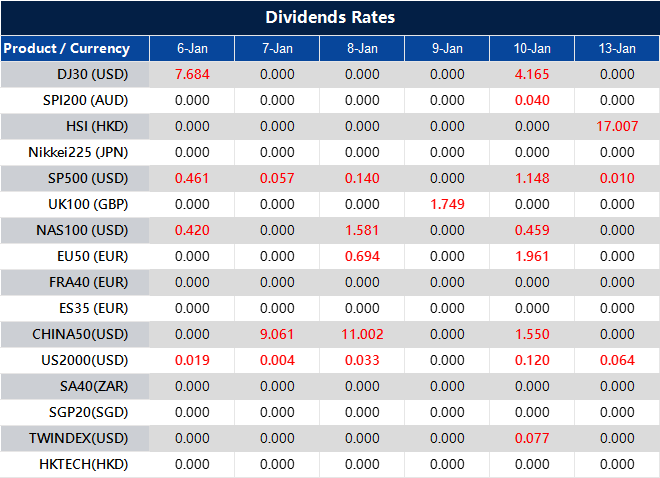
Please note that the dividends of the following products will be adjusted accordingly. Index dividends will be executed separately through a balance statement directly to your trading account, and the comment will be in the following format “Div & Product Name & Net Volume ”.
Please refer to the table below for more details:
The above data is for reference only, please refer to the MT4/MT5 software for specific data.
If you’d like more information, please don’t hesitate to contact info@vtmarkets.com.
Master Forex Market Hours: Know What Time the Forex Market Opens
In this article, we explore the intricacies of forex trading hours, including what time the forex market opens, the dynamics of different trading sessions, and the importance of session overlaps. You’ll also discover the best times to trade forex, key factors to consider when choosing your trading hours, and how to align your strategy for optimal success.
Understanding Forex Market Hours
The forex market operates 24 hours a day, five days a week, making it one of the most accessible financial markets worldwide. However, this continuous trading cycle can be overwhelming for new traders. Understanding the intricacies of foreign exchange trading hours is essential for making informed trading decisions and maximizing opportunities. This guide delves into the forex market’s structure, helping you navigate its complexities effectively.
The forex market operates 24 hours a day, five days a week, across major global financial hubs. It begins with the Sydney session at 10:00 PM GMT on Sunday, marking the start of the trading week. Trading activity rotates seamlessly across the Tokyo, London, and New York sessions before the market closes at 10:00 PM GMT on Friday. This continuous cycle ensures uninterrupted trading opportunities, catering to traders in different time zones worldwide.
However, not all trading hours are equally active. For example, sessions like Sydney and Tokyo tend to have lower volatility, which is ideal for trading currencies like AUD and JPY. Conversely, sessions such as London and New York are marked by high trading volumes and increased price movements, especially during their overlap.
The decentralized structure of the forex market offers traders the flexibility to trade any time of day, but understanding the nuances of foreign exchange trading hours is essential for identifying optimal trading periods.
Forex Trading Sessions
The forex market operates across four primary trading sessions, each associated with a specific financial hub. These sessions reflect regional market activity and influence liquidity, volatility, and the behavior of currency pairs.
Session
Time (GMT)
Sydney Session
10:00 PM to 7:00 AM
Tokyo Session
12:00 AM to 9:00 AM
London Session
8:00 AM to 5:00 PM
New York Session
1:00 PM to 10:00 PM
1. Sydney Session
The trading week begins with the Sydney session, active from 10:00 PM to 7:00 AM GMT. As the first market to open, this session is known for modest liquidity and calmer price movements. It’s particularly suitable for trading AUD and NZD pairs, given their regional relevance.
2. Tokyo Session
Running from 12:00 AM to 9:00 AM GMT, the Tokyo session is the heart of Asian market activity. It focuses on JPY pairs and is characterized by moderate volatility. Traders often look to this session for trends that set the tone for the rest of the trading day.
3. London Session
Operating between 8:00 AM and 5:00 PM GMT, the London session is the busiest and most influential. It accounts for a significant portion of daily trading volume, with EUR, GBP, and CHF pairs in focus. The session’s overlap with Tokyo and New York amplifies its importance, creating heightened liquidity and volatility.
4. New York Session
From 1:00 PM to 10:00 PM GMT, the New York session drives global market activity. It’s marked by substantial trading volume, especially in USD pairs, and high volatility during major US economic announcements like job reports or Federal Reserve statements.
Each session has unique characteristics, and understanding their dynamics can help traders time their entries and exits strategically.
When Do Forex Market Sessions Overlap?
Session overlaps occur when the trading hours of two major markets coincide, creating periods of heightened activity and volatility. These overlaps are significant because they bring together traders from different regions, resulting in increased liquidity and tighter spreads. For traders, overlaps often represent the best times to trade due to the potential for larger price movements and better trading opportunities.
Tokyo-London Overlap (7:00 AM – 8:00 AM GMT)
The Tokyo-London overlap is brief and typically sees limited activity compared to other overlaps. While the Tokyo session is winding down, European traders are just starting their day. As a result, trading volumes are moderate, with some focus on JPY and EUR pairs. This period is less volatile but can offer opportunities for traders who prefer calmer market conditions.
London-New York Overlap (1:00 PM – 5:00 PM GMT)
The London-New York overlap is the most active and influential period in the forex market. As the world’s two largest trading hubs operate simultaneously, there is a significant surge in trading volume and market volatility. This overlap is especially crucial for major currency pairs like EUR/USD, GBP/USD, and USD/JPY, which experience tighter spreads and frequent price movements. It’s also a key period for economic announcements, such as US job reports or European market data, further driving volatility.
Understanding session overlaps is essential for timing your trades effectively, as these periods often provide the best opportunities to capitalize on market movements.
When is the Best Time to Trade Forex?
The best time to trade forex depends on the market session’s liquidity and volatility, both of which vary throughout the day. Among the four major sessions, the London-New York overlap (1:00 PM to 5:00 PM GMT) is the most active. During this period, the combined activity of the two largest financial centers generates high trading volumes, tighter spreads, and significant price movements. Major currency pairs like EUR/USD and GBP/USD experience heightened activity, offering excellent opportunities for short-term traders seeking volatility.
In contrast, sessions like Sydney (10:00 PM to 7:00 AM GMT) are quieter and better suited for traders preferring a steadier market. This period is ideal for analyzing trends or executing long-term strategies, particularly for currency pairs such as AUD/USD and NZD/USD, which are more active during these hours.
Understanding when liquidity and volatility peak in the forex market allows traders to align their strategies with the session most suited to their goals.
Factors to Consider When Choosing Your Trading Hours
Selecting the best foreign exchange trading hours requires careful consideration of several factors to align market conditions with your trading style and goals. Here’s what you should focus on:
1. Your Trading Strategy
Your approach to trading significantly impacts the choice of trading hours.
Day traders: Prefer volatile periods, such as session overlaps like the London-New York overlap, where rapid price movements can create short-term opportunities.
Swing traders: Often opt for calmer sessions, like Sydney or early Tokyo, where steadier market conditions support longer-term trend analysis.
It’s essential to align trading hours with your availability to monitor markets effectively. For example, a trader with a day job may find evening hours during the Sydney or early Tokyo session more convenient. Being alert and focused during your chosen trading hours is crucial for making informed decisions.
4. Economic News Releases
Stay updated with the economic calendar, such as interest rate decisions or employment data, which can cause sharp market movements. For example, US Federal Reserve updates typically affect USD pairs during the New York session. Staying aware of the timing of such releases allows traders to anticipate volatility and adjust their strategies accordingly.
By considering your trading strategy, the activity of your preferred currency pairs, your schedule, and the timing of key news events, you can select optimal trading hours that align with your goals and maximize your opportunities in the forex market.
Understanding forex market hours is essential for developing a winning trading strategy. By focusing on the most active sessions and leveraging session overlaps, traders can maximize opportunities and enhance their performance. Successful trading comes from understanding the market’s rhythm and making well-informed decisions at the right time.
Start trading forex with VT Markets today and elevate your trading experience to the next level!
Frequently Asked Questions (FAQs)
1. What time does the forex market open?
The forex market officially opens at 10:00 PM GMT on Sunday in Sydney, marking the start of the trading week, and runs continuously until Friday at 10:00 PM GMT.
2. What are the major forex currency trading hours?
The major forex trading sessions are Sydney, Tokyo, London, and New York. Each session overlaps slightly, providing different levels of liquidity and volatility.
3. When are the best foreign exchange trading hours for high activity?
The best trading hours occur during market overlaps, especially the London-New York overlap (1:00 PM to 5:00 PM GMT) when trading volumes and volatility are at their highest.
4. How does understanding the forex market hours improve trading?
Knowing when different markets are open helps traders anticipate liquidity surges, manage risk more effectively, and optimise their strategies for major economic announcements.
5. Can I trade forex anytime during forex market hours?
While the market is technically open 24/5, not all trading hours offer the same opportunities. Trading during major session overlaps usually provides better liquidity and tighter spreads.
6. What happens when forex market sessions overlap?
Session overlaps, such as London/New York, create periods of heightened trading activity and liquidity. These overlaps are often considered the best times to trade due to tighter spreads and faster price movements.
7. Can I trade forex outside of major trading sessions?
Technically, you can trade forex at almost any time during forex market hours. However, trading outside of peak session times may result in lower liquidity, wider spreads, and less predictable price movements.
As we embark on the first full trading week of 2025, investors are approaching the markets with a sense of cautious optimism. This week presents a dynamic blend of significant economic data, corporate announcements, and geopolitical developments, all of which are poised to shape market sentiment in the days ahead.
KEY ECONOMIC INDICATOR
Incoming President’s inauguration:
The week of January 6, 2025, is set to feature a significant political event: the inauguration of the newly elected U.S. President.
Policy expectations: Markets will closely analyze the new President’s economic agenda. Plans related to fiscal stimulus, tax policies, infrastructure spending, and climate initiatives could trigger sector-specific movements.
Interest rate speculation: The new administration’s stance on inflation and fiscal spending may influence Federal Reserve policy expectations, particularly if aggressive spending plans are anticipated.
U.S. job market in focus:
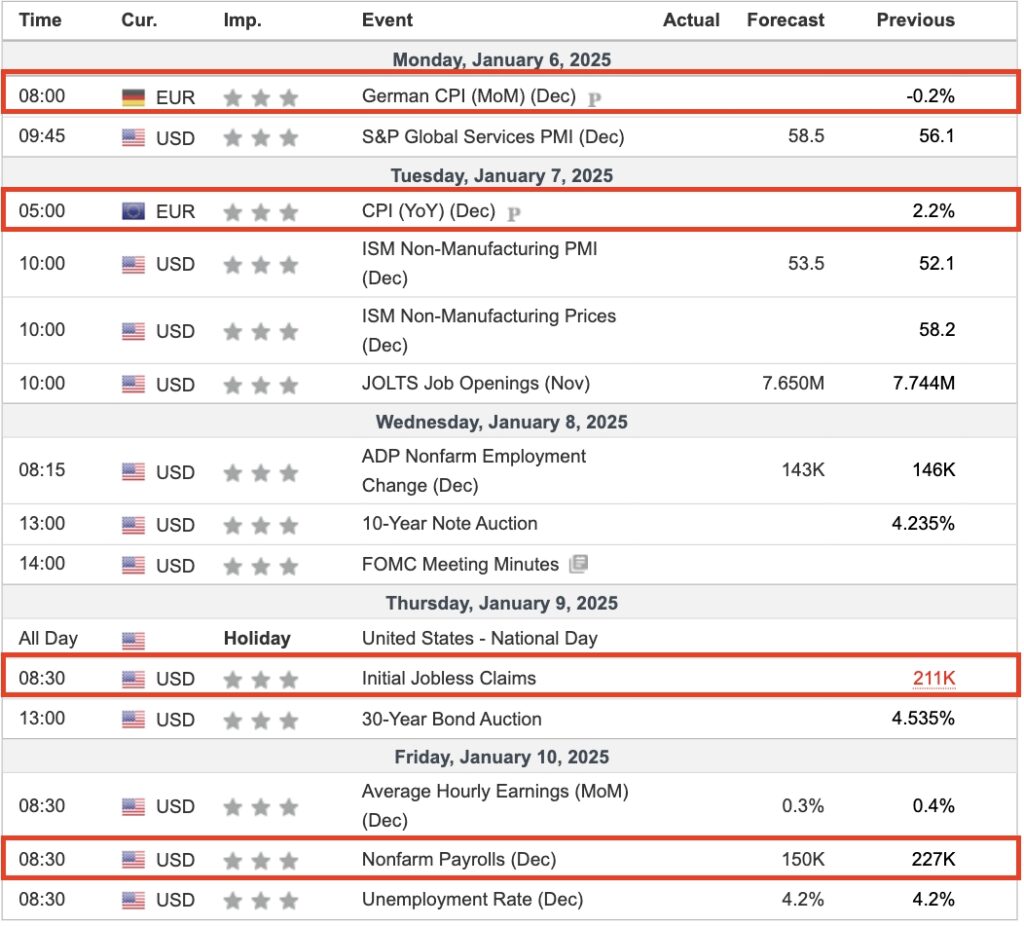
Crude the highlight of the week will be Friday’s U.S. Nonfarm Payrolls (NFP) report for December.
This crucial data will provide insights into the labour market’s health, influencing Federal Reserve policy expectations. Markets are also watching Wednesday’s ADP Employment Change report as a precursor to the NFP release.
Inflation and interest rate speculation:
Inflation remains a hot topic, with markets speculating on whether the Federal Reserve will make any rate adjustments in the coming months.
The consumer credit report, scheduled for Tuesday, could offer clues about consumer spending and borrowing trends, further shaping interest rate outlooks.
There are several economic events happening this coming week, the most notable one being the Inauguration of President-elect Donald J. Trump.
MARKET MOVER
EUR/USD
Preferred short preference
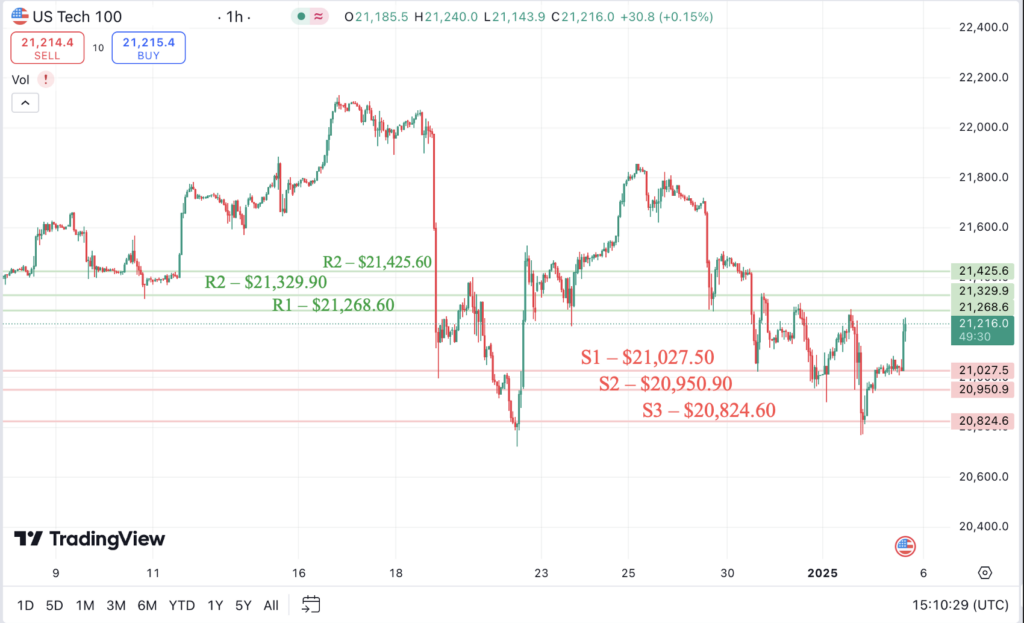
Short positions below 21027.50 with targets at 20950.90 & 20824.60 in extension.
Alternative scenario
Above 21268.60 look for further upside with 21329.90 & 21425.60 as targets.
The index currently faces a challenging resistance area at 21027.50
XAU/USD
Potential long preference
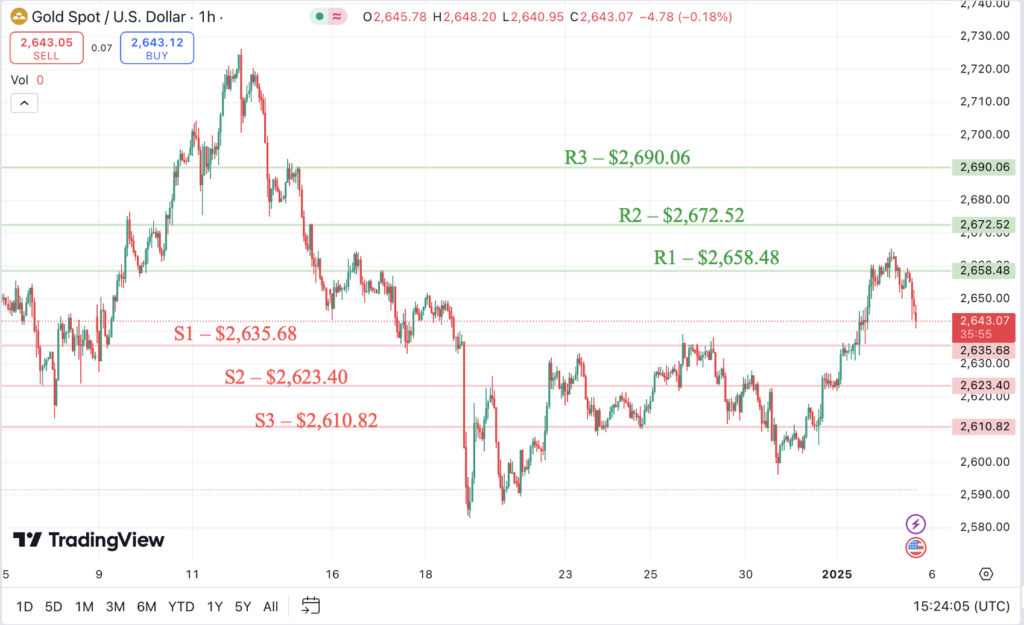
Long positions above 2658.48 with targets at 2672.52 & 2690.06 in extension.
Alternative scenario
Below 2635.68 look for further downside with 2623.40 & 2610.82 as targets.
The RSI is mixed with a bullish bias.
MARKET NEWS
Dollar on track for best week since early November
The dollar dipped on Friday but was on track for its strongest weekly performance since early November on expectations that the U.S. economy will continue to outperform its peers globally this year and that U.S. interest rates will stay relatively higher.
New policies under the incoming Donald Trump administration, including business deregulation, tax cuts, curbs on illegal immigration and tariffs, are also expected to boost growth and add to price pressures.
The dollar index was last down 0.16% on the day 109.04, after hitting a two-year high of 109.54 on Thursday.
It is on track for a weekly gain of 0.94%.
Gold slips from three-week high as strong dollar weighs
Gold prices retreated from a three-week high on Friday, pressured by a robust dollar, while markets braced for potential economic and trade shifts under U.S. President-elect Donald Trump.
Spot gold eased 0.3% to $2,649.29 an ounce after hitting its highest level since Dec. 13.
Bullion is up about 1.1% for the week so far.
U.S. gold futures were down 0.2% at $2,663.70.
Oil set for weekly gains as market eyes U.S. and Chinese policy support
Oil prices changed a little on Friday and were poised for weekly gains after closing at their highest in more than two months in the previous session, underpinned by expectations of further economic stimulus in China and lower U.S. interest rates.
Brent crude futures were down 7 cents at $75.86 a barrel by 0900 GMT after settling at the highest level since Oct. 25 on Thursday.
U.S. West Texas Intermediate crude dipped by 6 cents to $73.07, with Thursday’s close its highest since Oct. 14.
Brent was on track for a 2.2% weekly gain, while WTI was set for a 3.5% increase.
Please note that the dividends of the following products will be adjusted accordingly. Index dividends will be executed separately through a balance statement directly to your trading account, and the comment will be in the following format “Div & Product Name & Net Volume ”.
Please refer to the table below for more details:
The above data is for reference only, please refer to the MT4/MT5 software for specific data.
If you’d like more information, please don’t hesitate to contact info@vtmarkets.com.
Most Traded Currency Pairs: Understand the Most Traded Forex Pairs
In this article, you will discover the top 8 most traded currency pairs, their unique characteristics, the factors behind their popularity, key advantages and challenges, and actionable tips to refine your forex trading strategies.
What are Currency Pairs?
In the forex market, currencies are traded in pairs, representing the exchange rate between two currencies. Each pair consists of a base currency (the first currency) and a quote currency (the second currency). For example, in the EUR/USD pair, the Euro is the base currency, and the US Dollar is the quote currency.
Major Pairs: Major pairs, like EUR/USD and USD/JPY, involve the US Dollar paired with another major currency. They dominate trading volume, offering high liquidity, tight spreads, and moderate volatility. These pairs respond predictably to global economic indicators, making them popular among traders.
Minor Pairs: Minor pairs exclude the US Dollar but involve major currencies, such as EUR/GBP or GBP/JPY. They are slightly less liquid and more volatile, influenced by regional factors, offering opportunities for traders seeking diversification.
Exotic Pairs: Exotic pairs, like USD/TRY, include a major currency paired with one from an emerging market. They are highly volatile and less liquid, with wider spreads. These pairs appeal to experienced traders due to their high-risk, high-reward nature.
List of the Most Traded Currency Pairs
The forex market is dominated by a handful of pairs known for their high liquidity and trading volume. These are the most traded currency pairs:
1. EUR/USD
The EUR/USD pair is the most actively traded in the forex market, accounting for approximately 20–25% of the total trading volume. Its prominence is rooted in the economic strength of both the Eurozone and the United States, which are two of the largest economic regions in the world. This pair is characterized by its high liquidity, which ensures minimal trading costs and efficient price discovery. For traders, the EUR/USD offers predictable price movements, making it a preferred choice for technical analysis and fundamental analysis. The pair is particularly sensitive to macroeconomic events such as monetary policy decisions by the European Central Bank (ECB) and the Federal Reserve. For example, changes in interest rates or employment figures can cause significant fluctuations, providing profit opportunities.
As the second most traded currency pair, USD/JPY represents the dynamic interplay between the US Dollar, the world’s reserve currency, and the Japanese Yen, a key player in global exports. This pair is heavily influenced by monetary policies from the Bank of Japan (BoJ) and the Federal Reserve. The USD/JPY is known for its stability and low spreads, which makes it a favorite among scalpers and day traders. During periods of market uncertainty, the Yen often strengthens, reflecting its status as a safe-haven currency. For example, during global economic turmoil, traders flock to this pair to hedge their portfolios. Its average daily trading volume accounts for about 13–15% of the forex market, cementing its position as one of the most liquid pairs.
3. GBP/USD
The GBP/USD commonly referred to as “Cable” due to the historical transatlantic cable that linked the UK and the US, GBP/USD is one of the most volatile major pairs. This pair attracts traders due to its potential for significant price movements, which can translate into high returns for skilled traders. Its value is heavily influenced by economic data and political developments in the UK, such as Brexit negotiations or Bank of England interest rate changes. Representing approximately 9% of the daily forex trading volume, GBP/USD is often favored by traders who thrive on volatility. For instance, a positive surprise in UK GDP data can trigger sharp upward moves, while geopolitical uncertainties can lead to dramatic sell-offs.
4. AUD/USD
The AUD/USD is a commodity-linked pair, often reflecting the performance of Australia’s export-driven economy. It is closely tied to the prices of iron ore, coal, and gold, which are Australia’s primary exports. This pair is particularly active during the Asian trading session, providing opportunities for traders in that time zone. AUD/USD is sensitive to China’s economic performance due to the strong trade relationship between the two nations. For instance, a surge in demand for iron ore can strengthen the Australian Dollar against the US Dollar. With about 6% of global trading volume, AUD/USD appeals to traders looking to capitalize on commodity price trends and market dynamics.
5. USD/CAD
Known as the “Loonie,” USD/CAD is influenced by the Canadian economy’s reliance on oil exports. The value of this pair is highly correlated with crude oil prices, as Canada is one of the largest oil exporters in the world. When oil prices rise, the Canadian Dollar tends to appreciate against the US Dollar. For instance, during an oil price rally, USD/CAD may see a significant downward move as the Canadian Dollar strengthens. This pair accounts for approximately 5% of forex trading volume and is popular among traders seeking exposure to the energy market.
6. USD/CHF
USD/CHF is a “safe-haven” pair, often traded during times of economic or geopolitical uncertainty. The Swiss Franc is renowned for its stability, and traders turn to it as a store of value during turbulent times. This pair is less volatile than other major pairs but still provides opportunities for strategic trades, especially during central bank policy announcements. The Swiss National Bank (SNB) plays a significant role in influencing this pair through interventions and monetary policy. For example, during the Eurozone debt crisis, USD/CHF saw increased activity as traders sought refuge in the Franc. This pair accounts for around 4% of daily forex volume.
7. NZD/USD
Similar to the AUD/USD, NZD/USD is a commodity-driven pair, reflecting New Zealand’s strong agricultural export sector. The pair is influenced by global dairy prices, as New Zealand is a leading exporter of dairy products. Traders often refer to NZD/USD as a “risk-sensitive” pair because it reacts to shifts in global economic sentiment. For example, during periods of global economic growth, the New Zealand Dollar typically strengthens. Although it represents only about 2% of forex trading volume, its higher volatility appeals to experienced traders who are adept at navigating price swings.
8. EUR/GBP
EUR/GBP is a popular minor pair that reflects the economic and political relationship between the Eurozone and the UK. This pair is moderately volatile, making it suitable for traders who prefer swing trading strategies. EUR/GBP is heavily influenced by developments in Brexit negotiations, trade policies, and economic indicators from both regionsd. For instance, a positive surprise in Eurozone inflation data could strengthen the Euro against the Pound. Although it accounts for only about 2% of global forex trading volume, it is a valuable pair for those focusing on European markets and seeking to hedge risks related to these economies.
Factors Affecting the Popularity of These Currency Pairs
Several factors contribute to the popularity of forex currency pairs:
Economic Stability: Forex pairs like EUR/USD and USD/JPY represent economies with robust financial systems and consistent policies. This stability minimizes extreme volatility, making these pairs attractive for traders seeking reliability and predictability.
Liquidity: Major currency pairs dominate trading volumes, ensuring high liquidity. For instance, EUR/USD alone accounts for a significant portion of global transactions, offering tight spreads and smooth trade execution.
Market Influence: Currencies in these pairs, such as the US Dollar and the Euro, are central to global trade and finance. Their demand remains consistent due to their integral role in international transactions and reserve holdings.
News Sensitivity: Major pairs respond predictably to economic data and news events. Announcements like interest rate changes or employment reports often lead to actionable price movements, enabling traders to plan strategies around these events effectively.
Advantages of Trading the Most Traded Currency Pairs
Trading the most traded forex pairs offers several benefits:
High Liquidity: The most traded currency pairs, such as EUR/USD and USD/JPY, offer unparalleled liquidity due to their massive trading volumes. High liquidity ensures that trades can be executed instantly, even in large quantities, without significant price slippage. This feature is particularly valuable for day traders and scalpers who rely on precise trade execution.
Tight Spreads: Tight spreads are a hallmark of these pairs, reducing the cost of trading. For instance, spreads on EUR/USD are typically lower compared to less popular pairs, allowing traders to maximize profitability by minimizing transaction costs.
Predictable Movements: Major pairs tend to move in response to well-understood economic indicators, such as interest rate announcements or GDP data. This predictability makes it easier for traders to apply technical analysis or fundamental analysis effectively, reducing the guesswork involved in decision-making.
Abundance of Resources: The popularity of these pairs has led to a wealth of educational resources, expert analyses, and trading tools focused on them. Whether you are a beginner or an experienced trader, you’ll find abundant materials to refine your strategies and improve profitability.
Disadvantages of Trading the Most Traded Currency Pairs
Despite their benefits, these pairs come with challenges:
High Competition: The widespread popularity of these pairs attracts a diverse pool of traders, including large institutional players with significant resources. Competing against these entities can be challenging, especially for retail traders.
News-Driven Volatility: While major pairs are often predictable, significant news events, such as unexpected interest rate changes or geopolitical developments, can lead to sudden and sharp price movements. Traders must remain vigilant and adapt quickly to avoid losses during such periods.
Limited Diversity: Focusing solely on the most traded pairs may limit exposure to other profitable opportunities. Exotic or minor pairs can offer higher volatility and unique trading conditions that might be missed if attention is restricted to major pairs.
To excel in trading forex currency pairs, follow these tips:
1. Understand the Market Sessions
Focus on trading during the most active sessions, such as the London and New York overlap, to benefit from increased liquidity and tighter spreads.
2. Use Technical Analysis
Apply technical analysis by studying charts and indicators such as moving averages, RSI, and trendlines to identify patterns, trends, and potential entry or exit points for your trades.
3. Follow Economic Calendars
Utilise economic calendars to track major events like interest rate announcements, GDP releases, and employment reports, helping you anticipate market movements and refine your trading strategy.
4. Utilise Demo Account
Practice your trading strategies using a demo account to simulate real market conditions, build confidence, and refine your skills before transitioning to live trading.
5. Use Risk Management Tools
Protect your investments by implementing risk management strategies, such as setting stop-loss orders, maintaining proper position sizes, and diversifying your trades to minimize potential losses.
The most traded currency pairs are the cornerstone of the forex market, offering high liquidity, predictable price movements, and extensive opportunities for traders. With their global economic significance and responsiveness to key economic indicators, these pairs provide a strong foundation for both new and experienced traders to refine their strategies. While their benefits are substantial, traders should remain mindful of challenges such as news-driven volatility and intense competition. By understanding the market dynamics and leveraging effective strategies, trading these pairs can lead to rewarding outcomes.
Start trading forex currency pairs with VT Markets today and unlock your full trading potential!
Frequently Asked Questions (FAQs)
1. What are the most traded currency pairs in the world?
The most traded currency pairs, also known as major pairs, include:
EUR/USD
USD/JPY
GBP/USD
AUD/USD
USD/CAD
USD/CHF
NZD/USD
EUR/GBP
2. Why are some currency pairs traded more than others?
Currency pairs with high trading volumes usually involve major global economies and stable currencies, which offer tighter spreads, higher liquidity, and better trading opportunities.
3. What is the difference between major, minor, and exotic currency pairs?
Major pairs always include the US dollar and are the most liquid. Minor pairs do not include the USD but involve other major currencies. Exotic pairs consist of a major currency paired with a currency from emerging or smaller economies.
4. How do the most traded currency pairs impact forex trading?
High liquidity in these pairs means lower spreads and more efficient price movements, making them popular for traders looking for tighter costs and smoother execution.
5. Can beginners trade the most traded currency pairs?
Yes, most traded currency pairs are suitable for beginners because of their liquidity, tight spreads, and extensive market information available to help in decision-making.
6. How does economic news affect the most traded currency pairs?
Economic indicators, central bank decisions, and geopolitical events can cause significant volatility in these pairs, presenting both risks and opportunities for traders.
7. What factors should traders consider when choosing currency pairs to trade?
Traders should consider liquidity, volatility, trading hours, spreads, and their familiarity with the currencies’ underlying economies.
In today’s world, investors increasingly want their money to do more than just generate returns. They’re looking to make a positive impact whilst growing their wealth. This shift in mindset has given rise to ESG investing, an approach that’s reshaping the investment landscape. In fact, ESG assets are projected to reach a staggering USD 53 trillion by 2025.
But what exactly is ESG investing, and why should you care? The concept gained prominence with the UN’s 2004 “Who Cares Wins” report, which first linked sustainability to profitability, and has since evolved into a powerful force in modern investing.
Understanding ESG
ESG stands for Environmental, Social, and Governance – three key factors used to evaluate companies’ sustainability and ethical impact. Think of these as different lenses through which to view potential investments.
The Environmental aspect, currently prioritised by 42% of investors, focuses on how companies interact with the natural world. This includes their approach to climate change, pollution, and waste management. For instance, Apple has committed to becoming carbon neutral by 2030, demonstrating strong environmental credentials that could appeal to ESG investors.
The Social component, which 27% of investors now prioritise, examines how companies manage relationships with their employees, suppliers, customers, and communities. This encompasses workplace conditions, diversity initiatives, and human rights practices. Companies with strong social scores often demonstrate better employee retention and customer loyalty.
Governance, valued by 31% of investors, looks at how companies are run. This includes board diversity, executive pay, shareholder rights, and anti-corruption measures. Good governance often translates to better risk management and more sustainable business practices.
The survey findings underline a growing interest in social and governance aspects, even as environmental concerns remain significant, shaping how investors assess sustainability in their portfolios.
The current state of ESG
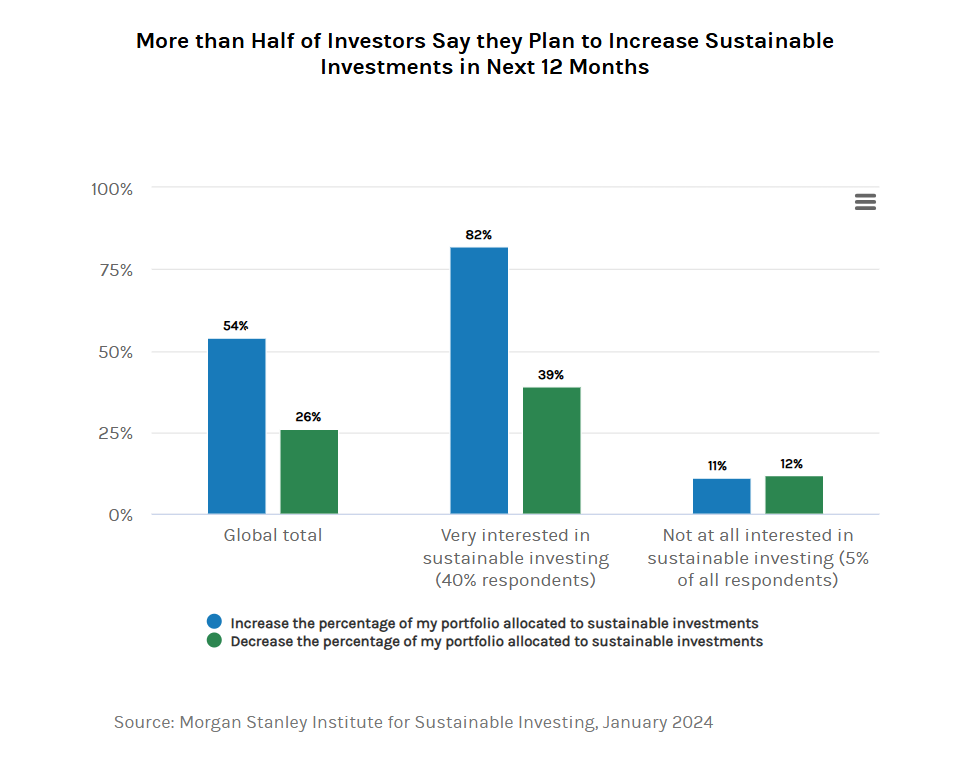
The ESG landscape is evolving rapidly, but it’s important to understand how investors are actually approaching it. Currently, only 7% of investors fully commit their portfolios to ESG principles, while 28% consider ESG factors alongside traditional financial metrics. This suggests a pragmatic approach rather than an all-or-nothing stance.
Regional differences in Europe are noteworthy. Belgian investors are particularly enthusiastic, with 62% planning to increase their ESG investments. Spanish investors show strong optimism about returns, with 40% believing ESG improves financial performance. Meanwhile, German investors tend to be more cautious, with only 20% expecting enhanced returns from ESG investments.
Why consider ESG?
The case for ESG investing goes beyond ethical considerations. While 32% of investors believe ESG factors improve returns (down from 41% in 2022), 41% see it as an effective risk management tool. This perspective is particularly relevant in today’s rapidly changing business environment.
Looking at real-world examples, companies with strong ESG practices often demonstrate resilience and innovation. Cisco, for instance, has achieved 85% renewable energy usage, potentially reducing its exposure to energy price volatility and environmental regulations. Verizon’s successful USD 1 billion green bond initiative shows how companies can fund sustainable projects while attracting investors.
The future of ESG investing appears closely tied to technological advancement and environmental challenges. In the short term, artificial intelligence and digitalisation are expected to drive performance. Longer-term, issues like climate risk and ocean conservation (the Blue Economy) are likely to become increasingly important investment considerations.
Getting started
For those interested in ESG investing, several accessible options exist. Single stocks and Exchange-Traded Funds (ETFs) are the most popular vehicles, offering different levels of diversification and control. ETFs can be particularly useful for beginners, providing exposure to a basket of ESG-screened companies.
However, challenges exist. Only 3% of investors consider themselves advanced in ESG investing, and many struggle with understanding ESG ratings and data. When starting out, consider these practical steps:
Step 1.Decide your priorities within the ESG framework. Think about which of the three ESG pillars—environmental, social, or governance—matters most to you. For example, you might prioritise companies addressing climate change or those fostering workplace diversity.
Step 2.Research ESG-focused funds or companies that align with these priorities. Look into ETFs, mutual funds, or individual companies with strong ESG credentials. Check their sustainability reports and ratings to see how well they align with your values.
Step 3.Understand that ESG ratings can vary between providers. Ratings are not standardised, and different agencies might assess the same company differently. Make sure to explore multiple sources and interpret the data in context.
Step 4.Start small and gradually increase exposure as you become more comfortable. Begin with a modest investment to understand the nuances of ESG investing without taking on excessive risk. As you gain confidence, consider diversifying further.
Step 5.Keep track of both financial and ESG performance. Monitor how your investments perform financially while also evaluating their impact on the ESG metrics you care about. This dual focus will help you make adjustments as needed.
It’s also worth noting that different regions emphasise different aspects of ESG. For example, Italian investors particularly value social factors, while other markets might prioritise environmental or governance considerations. This diversity allows investors to align their portfolios with their specific values and goals.
Conclusion
ESG investing is evolving, influenced by changing regulations, technological progress, and shifting societal priorities. While some scepticism about returns remains, the focus on risk management and long-term sustainability is strong.
For investors, ESG presents an opportunity to align investments with personal values while managing risks and seizing opportunities in a sustainable economy. The key is to maintain clear objectives, realistic expectations, and a long-term perspective.
Whether starting out or adapting your portfolio, understanding ESG factors can help make more informed investment decisions. As the investment landscape evolves, ESG considerations will become increasingly important for all investors.
Start exploring ESG opportunities today by opening a live account with VT Markets and unlocking your investment potential.