Crypto rally cools as Bitcoin and Ethereum consolidate

The crypto market is cooling after its recent rally, with Bitcoin and Ethereum losing some momentum. This shift signals a pause rather than an end to the trend, putting the focus on risk management and smarter positioning over chasing quick gains.

Bitcoin and Ethereum face momentum shift

Bitcoin (BTC) and Ethereum (ETH) are retreating after recent gains, with BTC down around 2% and ETH sliding more than 3% at the time of writing.

This pullback follows a strong rally in previous weeks, suggesting a notable shift in short-term market dynamics.

On broader timeframes, BTC has slipped below its 50-day moving average – a technical sign that the recent uptrend is losing steam.

The next major support zone for BTC sits near $112,000, marked by the 2 August low and the 22 May high.

Profit-taking has been a key driver of this correction, particularly among late entrants chasing record highs.

Risk management becomes a priority

As Bitcoin and Ethereum give back some of their recent advances, traders are shifting focus from chasing upside to protecting gains.

The drop under the 50-day moving average highlights the need for a more defensive stance. Buying protective put options has become a popular hedging strategy, with the Bitcoin put-to-call ratio climbing to 0.75 – its highest level in over a month.

This signals rising demand for downside protection as market participants prepare for the possibility of a deeper pullback towards the $112K support.

At the same time, Ethereum’s implied volatility has spiked, with 30-day at-the-money volatility in ETH options jumping from 50% to 65% in just a few days.

For traders expecting sharp moves but uncertain about direction, strategies like long straddles or strangles could capture potential gains, regardless of whether the next big move is upward or downward.

Opportunities amid consolidation

For traders who view this downturn as a healthy consolidation before another leg higher, selling cash-secured puts near the $112K support could offer an attractive entry point.

This approach allows them to collect option premiums while defining a preferred level to re-accumulate BTC, maintaining confidence in the long-term bullish structure.

The current setup also carries echoes of the summer 2021 cycle, where a sharp multi-week correction followed a strong rally before the market rallied again to new all-time highs.

With open interest levels holding relatively steady, it appears that large positions have not yet been fully unwound.

This suggests that while caution is warranted in the short term, the broader trend may still be intact – with this phase representing consolidation rather than the end of the cycle.

Click here to open account and start trading.

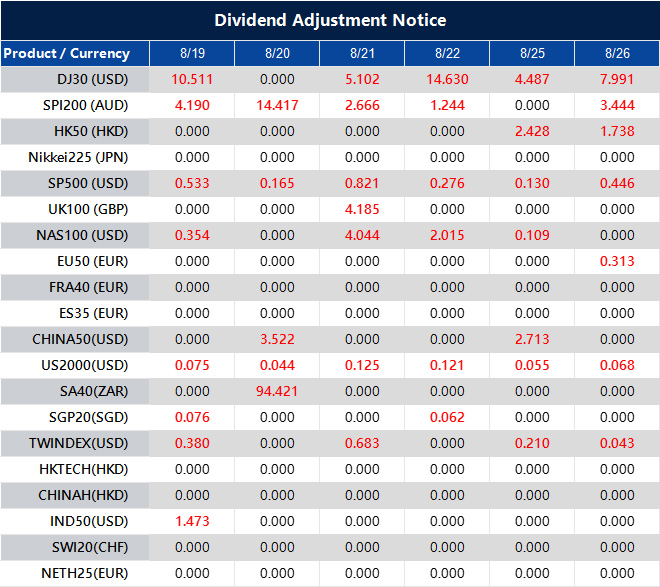
Dividend Adjustment Notice – Aug 19 ,2025

Dear Client,

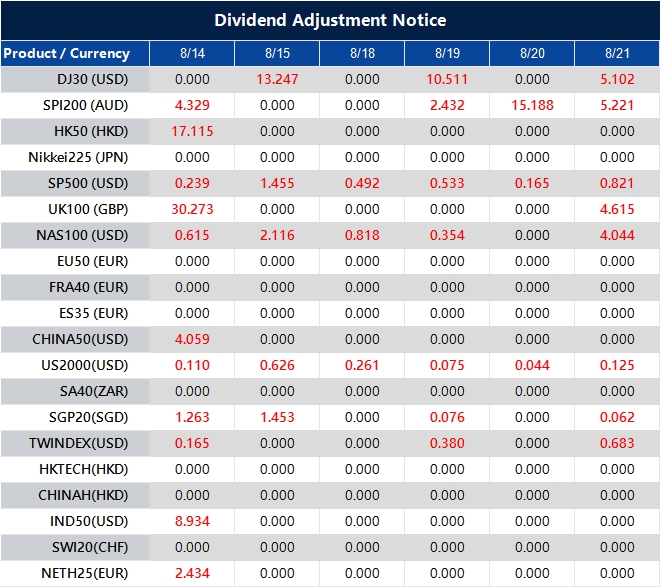
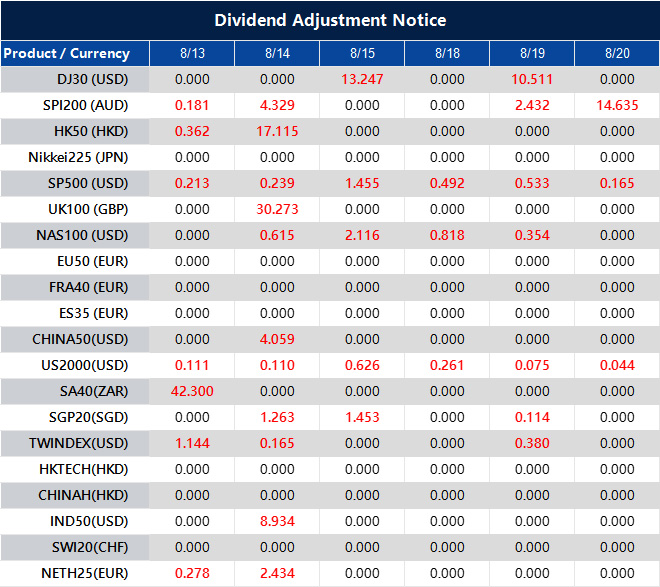
Please note that the dividends of the following products will be adjusted accordingly. Index dividends will be executed separately through a balance statement directly to your trading account, and the comment will be in the following format “Div & Product Name & Net Volume”.

Please refer to the table below for more details:

Dividend Adjustment Notice

The above data is for reference only, please refer to the MT4/MT5 software for specific data.

If you’d like more information, please don’t hesitate to contact info@vtmarkets.com.

Pre-Market and After-Hours Trading: How to Trade Before and After the Bell

Trading doesn’t stop when the closing bell rings. With pre-market and after-hours trading, also known as extended hours trading, investors can buy and sell shares outside regular market hours. These extended hours trading sessions allow traders to react quickly to earnings reports, economic data, or global news that can move prices overnight. Understanding how they work, along with their benefits and risks, is key to using extended hours trading effectively.

What Is Pre-Market and After-Hours Trading?

Stock exchanges such as the New York Stock Exchange (NYSE) and NASDAQ operate on fixed schedules, but trading does not always end when the closing bell rings. Pre-market trading takes place before the exchange officially opens, while after-hours trading occurs after it closes. Together, these extended hours sessions allow traders to buy and sell outside the regular market, offering more flexibility to react to news and global events.

Pre-market trading usually runs from 4:00 a.m. to 9:30 a.m. Eastern Time in the U.S., while after-hours trading begins at 4:00 p.m. and typically lasts until 8:00 p.m. Eastern Time. Some brokers may limit access to 7:00 p.m. or extend trading beyond 8:00 p.m., depending on their policies. These sessions are part of extended hours trading, and their exact timing is determined by the stock exchange.

These trading windows are especially important for reacting to market-moving events. For example, Apple often releases its earnings reports after the NYSE closes, and its stock can swing sharply in after-hours trading before the next day’s opening session.

Discover the 10 largest stock exchanges in the world by market cap.

How Does Pre-Market and After-Hours Trading Work?

Pre-market and after-hours trading work through Electronic Communication Networks (ECNs), which match buyers and sellers directly without relying on a traditional exchange floor. Market makers, who provide liquidity during regular trading hours, are typically less active in after-hours trading, which contributes to wider bid-ask spreads. Because fewer participants are active during these times, liquidity is thinner, and spreads between bid and ask prices tend to be wider.

Most brokers only allow limit orders in extended hours. This means you must set a specific buy or sell price instead of relying on market orders. Accessing pre-market and after-hours trading typically requires a brokerage account that supports these sessions. This helps protect against sudden price swings but may result in orders not being filled if the price is not met.

Trading activity and trade volume are also much lower than in regular hours. For example, while millions of shares of Apple may trade during the main session, only a fraction of that volume is exchanged in pre-market or after-hours. This difference explains why small trades can cause larger price moves.

What Is Pre-Market Trading?

Pre-market trading, also known as trading during pre-market trading hours as defined by the stock exchange, takes place before the stock market officially opens. In the United States, pre-market hours usually run from 4:00 a.m. to 9:30 a.m. Eastern Time.

This trading session allows traders to respond to international market moves and overnight news. Liquidity is usually lower than in the main session, which means price changes can be more volatile. Large-cap companies such as Tesla, Amazon, and Microsoft often see the most activity in pre-market trading because they attract both institutional and retail interest. Pre-market is a distinct trading session with its own characteristics compared to regular and after-hours sessions.

What Is After-Hours Trading?

After-hours trading, also known as the after-hours session, begins once the official market closes and typically lasts from 4:00 p.m. to 8:00 p.m. Eastern Time in the U.S. This is one of the busiest periods for corporate announcements, as many companies release their earnings reports after the closing bell. Significant news or earnings releases during the after-hours session can have an immediate impact on a company’s stock price, as investors react to new information outside of regular trading hours.

For example, Amazon’s 2023 earnings release pushed its stock up more than 12 percent in after-hours trading, allowing active traders to trade after-hours and benefit before the next day’s open. However, these moves can also be sharp in the opposite direction if results disappoint.

Why Traders Use Pre-Market and After-Hours Trading

There are several reasons why traders look to pre-market and after-hours trading as part of their strategy:

1. Reacting quickly to news

Important announcements such as earnings reports, mergers, or unexpected economic data often occur outside of normal trading hours. Extended sessions allow traders to respond immediately instead of waiting until the next day.

2. Global alignment

International events in Asia or Europe frequently influence U.S. markets before the opening bell. Pre-market trading gives investors the chance to adjust positions based on overseas developments.

3. Capturing opportunities

Traders can establish positions before the main session begins, aiming to benefit from sharp moves that may continue into regular hours.

4. Flexibility for active investors

Extended hours provide more time windows to trade, which is particularly useful for those who cannot be active during standard market hours due to work or time zone differences.

Example: In April 2025, Meta Platforms’ stock jumped more than 11% in after-hours trading after reporting strong quarterly earnings and better-than-expected revenue driven by AI investments. Traders who acted quickly were able to capture gains before the market reopened the next day.

What Are the Risks and Challenges of After-Hours Trading?

While extended hours can create valuable opportunities, they also come with several risks that traders must carefully manage:

  • Lower liquidity: Trading volume is much thinner compared to regular sessions. With fewer buyers and sellers, bid-ask spreads often widen, making it harder to get favorable prices. A trader might place an order at one price but only get filled at a much less attractive level. These liquidity challenges are especially pronounced outside regular trading hours and regular market hours.
  • Higher volatility: With fewer participants in the market, even small orders can trigger outsized price swings. A stock that moves 1 percent during normal hours could easily shift 5 percent or more in after-hours trading, and price swings can be more pronounced in any given hour during extended sessions.
  • Limited order types: Most brokers only allow limit orders during extended sessions. Market orders are generally restricted to protect traders from extreme price swings, but this also means execution may be delayed or partially filled. ECNs and other trading systems match buy and sell orders during these extended sessions, which can affect how and when trades are executed.
  • Overreaction to news: Stocks often jump or fall sharply outside normal hours based on headlines or earnings results, only to reverse direction once the broader market opens and more participants enter.
  • Less transparency: Not all price movements in extended hours reflect broader market sentiment. For example, a stock may appear to soar overnight, but the move could be based on very light volume that exaggerates the trend.

Example: In April 2025, Royal Caribbean shares initially rose 3% in reaction to strong earnings but then reversed course and fell 2.6% later in the session, illustrating how early enthusiasm in extended hours (e.g., after-hours trading) can quickly evaporate as more information and liquidity enter the broader market.

How to Trade Pre-Market and After-Hours

Trading outside regular hours requires preparation and awareness, as the process is slightly different from the main market session. To get started, follow these steps:

Step 1: Understand how pre-market and after-hours work

Know the trading hours, how liquidity differs from regular sessions, and the risks involved before you start.

Step 2: Select a reliable broker that offers extended hours

Not all brokers provide access to pre-market and after-hours trading. VT Markets gives traders nearly round-the-clock access to global markets and CFDs, offering flexibility to act on opportunities outside regular hours.

Step 3: Open and fund your trading account

Create an account with your chosen broker, then add funds to ensure you are ready to place trades during pre-market and after-hours sessions.

Step 4: Place your order

Most brokers only allow limit orders in extended hours trading to help you control execution prices.

Step 5: Implement risk management tools

Use tools like stop-loss orders, position sizing, and take-profit levels to manage risk effectively during volatile pre-market and after-hours trading.

Step 6: Stay updated and informed

Monitor earnings announcements, global news, and economic data releases that can impact stock prices outside regular hours.

Discover the best time to buy and sell stocks

Common Mistakes to Avoid When Using Pre-Market and After-Hours Trading

Many new traders fall into avoidable errors when trading outside regular sessions. Here are six of the most common mistakes:

  • Chasing sudden price spikes without checking volume: Price moves can look significant but may be misleading if they are based on very low trading volume. Always confirm liquidity before entering a trade to avoid chasing false signals.
  • Using market orders in illiquid conditions: Bid-ask spreads widen outside regular hours, and market orders can execute at far worse prices than expected. Limit orders provide more control and help protect you from slippage.
  • Taking oversized positions during volatility: Price swings are sharper in extended sessions, and large trades magnify both potential profits and losses. Keeping position sizes small helps manage risk.
  • Ignoring potential reversals at the open: Moves that occur in pre-market or after-hours often fade once regular trading resumes and more participants join. Traders who ignore this risk can see overnight gains vanish quickly.
  • Overreacting to initial news headlines: Earnings announcements or press releases can trigger dramatic moves, but details in the full report may shift market sentiment. Acting without deeper analysis can lead to poor entries.
  • Failing to apply risk management strategies: Skipping stop-losses, ignoring take-profit levels, or neglecting position sizing exposes traders to heavy losses in highly volatile conditions. Disciplined risk management is critical in extended sessions.

In Summary

  • Pre-market trading runs before the opening bell, giving traders a chance to act on overnight or international developments.
  • After-hours trading takes place after the close and is often driven by earnings releases and breaking news.
  • Together, they form pre-market and after-hours trading, also called extended hours trading.
  • These extended hours trading sessions offer flexibility and early opportunities to react to market-moving events but also carry higher risks, such as volatility and lower liquidity.

Start Trading Today with VT Markets

VT Markets offers access to global markets, competitive spreads, and powerful platforms like MetaTrader 4 (MT4) and MetaTrader 5 (MT5). Traders can also explore a VT Markets demo account to practice in real market conditions without risking their real capital. Our Help Centre provides valuable resources and support to improve trading confidence.

Start trading today with VT Markets and take advantage of opportunities in pre-market and after-hours sessions.

Frequently Asked Questions (FAQs)

1. How do pre-market and after-hours trading work?

Pre-market and after-hours trading, also called extended hours trading, allows investors to buy and sell stocks outside the regular market session.

2. What time does pre-market trading start?

In the U.S., pre-trading hours usually begin at 4:00 a.m. Eastern Time and last until the market opens at 9:30 a.m.

3. What is after-hours trading and why is it important?

After-hours trading happens after the market closes, usually between 4:00 p.m. and 8:00 p.m. Eastern Time. It is important because many companies release earnings during this time, creating sharp price movements.

4. Can retail traders participate in pre-market and after-hours trading?

Yes, many brokers allow retail traders to access extended hours, though there may be restrictions.

5. Why are stocks more volatile after-hours?

Because fewer participants are trading, supply and demand imbalances can lead to larger price swings.

6. Can I trade all stocks in pre-market and after-hours sessions?

No. Not every stock is available during extended hours. Larger companies with higher liquidity, such as Apple or Tesla, are usually more active, while smaller-cap stocks may see little to no trading.

7. Do price gaps in extended hours affect the next day’s opening price?

Yes. Sharp moves after-hours can lead to opening gaps the next morning, although prices often adjust once regular session trading volume increases.

8. What type of orders should I use in pre-market or after-hours trading?

Most brokers only accept limit orders during extended hours to protect traders from unexpected price swings. Market orders are generally not allowed.

9. Is extended hours trading suitable for beginners?

While it offers opportunities, pre-market and after-hours trading are riskier due to volatility and low liquidity. Beginners may benefit from practicing first with a demo account before trading live.

10. How does news released outside market hours impact trading?

Earnings reports, press releases, or economic data released after-hours often drive sharp moves. Traders active during these times can react immediately instead of waiting until the next day.


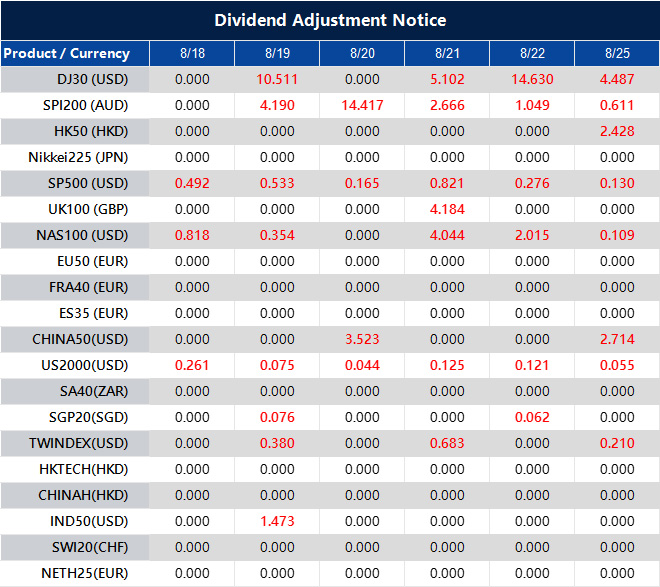
Dividend Adjustment Notice – Aug 18 ,2025

Dear Client,

Please note that the dividends of the following products will be adjusted accordingly. Index dividends will be executed separately through a balance statement directly to your trading account, and the comment will be in the following format “Div & Product Name & Net Volume”.

Please refer to the table below for more details:

Dividend Adjustment Notice

The above data is for reference only, please refer to the MT4/MT5 software for specific data.

If you’d like more information, please don’t hesitate to contact info@vtmarkets.com.

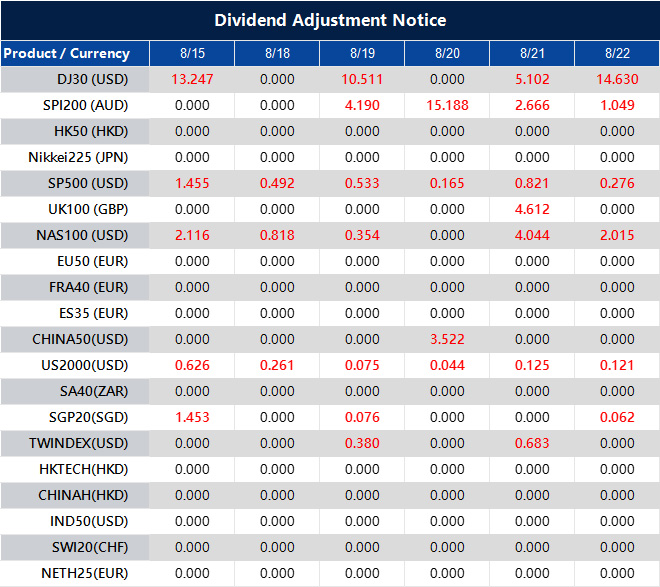
Dividend Adjustment Notice – Aug 15 ,2025

Dear Client,

Please note that the dividends of the following products will be adjusted accordingly. Index dividends will be executed separately through a balance statement directly to your trading account, and the comment will be in the following format “Div & Product Name & Net Volume”.

Please refer to the table below for more details:

Dividend Adjustment Notice

The above data is for reference only, please refer to the MT4/MT5 software for specific data.

If you’d like more information, please don’t hesitate to contact info@vtmarkets.com.

DAX 40 index: What it is and how to trade it

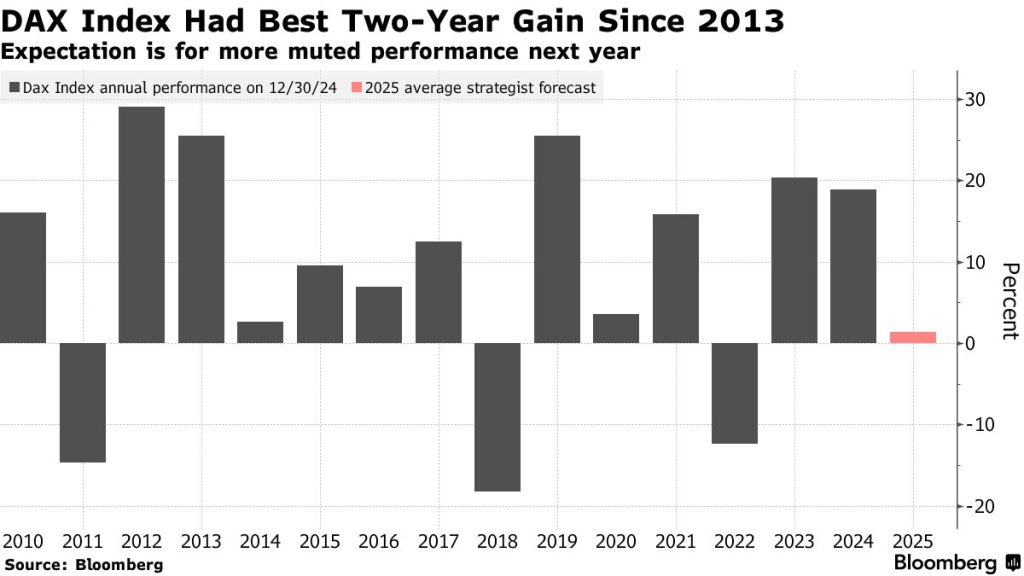
When traders talk about the big names in global stock markets, the DAX 40 is often near the top of the list. Known as Germany’s leading index, it represents the strength of Europe’s largest economy and is closely watched by investors around the world.

Whether you are completely new to trading or already exploring global indices, understanding the DAX 40 can open up exciting opportunities.

What is the DAX 40?

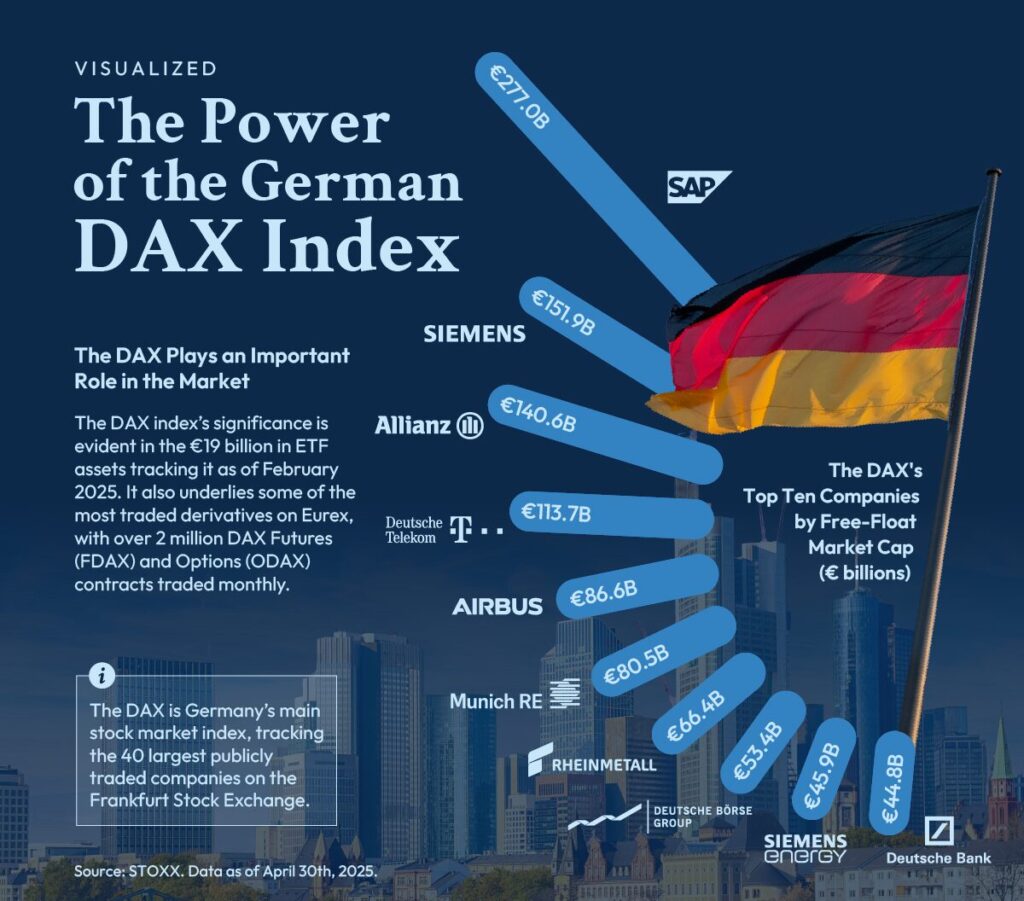
The DAX 40, short for Deutscher Aktienindex, is Germany’s benchmark stock index. It tracks the performance of the 40 largest and most actively traded companies listed on the Frankfurt Stock Exchange.

These companies represent a wide cross-section of industries – from automotive and finance to technology and chemicals.

Household names such as Siemens, BMW, Allianz, and SAP are all part of the DAX. As such, it provides a clear snapshot of how Germany’s corporate giants are performing.

To put the DAX into context, you can think of it as Europe’s equivalent of the S&P 500 in the United States or the FTSE 100 in the United Kingdom. Like those indices, it is not only a measure of economic strength but also a tradable instrument in its own right.

Why traders pay attention to the DAX 40

There are two key reasons why traders worldwide keep a close eye on the DAX: volatility and influence.

Firstly, the DAX is known for its volatility. This means prices can move significantly within a single trading session, creating opportunities for both short- and medium-term traders. Liquidity is also strong, which makes it easier to enter and exit positions without large price slippage.

Secondly, the index reflects more than just German companies. Germany is the largest economy in Europe, so the DAX acts as a proxy for European economic health. It often responds not only to local data but also to global events.

For instance, an interest rate decision by the European Central Bank (ECB) or a policy shift by the US Federal Reserve can send the DAX moving sharply in either direction.

How the DAX 40 is traded

Unlike buying a single company’s stock, trading the DAX means speculating on the overall direction of the index. There are several ways to do this:

  • Contracts for Difference (CFDs): The most accessible route for retail traders. With CFDs, you can go long (buy) if you expect the DAX to rise, or go short (sell) if you expect it to fall.
  • Futures and options: More advanced financial instruments, often used by institutional or experienced traders.
  • Exchange-traded funds (ETFs): A simpler option for longer-term investors who want to track the index without active trading.

For example, imagine that Germany reports stronger-than-expected car manufacturing data, boosting confidence in BMW and Volkswagen. A trader could speculate that the DAX will rise and open a long CFD position. Conversely, if weak industrial output is reported, the same trader might choose to short the index.

Factors influencing the DAX 40

The DAX is sensitive to a wide range of factors. For new traders, understanding what drives its movements is crucial:

  • Economic data: German GDP growth, unemployment figures, and manufacturing PMI reports can all affect the index.
  • European Central Bank policy: Decisions on interest rates or bond-buying programmes often have a direct impact on European equities.
  • Global events: As a highly industrialised economy, Germany is vulnerable to changes in energy prices, trade tensions, and geopolitical risks.
  • Company earnings: Results from large firms such as Siemens, Volkswagen, or SAP can move the index noticeably.

For instance, a sharp rise in oil and gas prices could weigh heavily on energy-dependent German industries, dragging down the DAX overall. On the other hand, positive quarterly results from several leading companies can lift the index, even in the face of broader economic uncertainty.

Practical strategies for trading the DAX 40

When it comes to trading the DAX, beginners should focus on simple, structured strategies that balance opportunity with risk control.

Trend following: Many traders use moving averages, such as the 50-day or 200-day, to identify the overall direction. If the index is trading above a moving average, it may suggest a bullish trend; below it may suggest bearish momentum.

Breakout trading: The DAX often respects clear support and resistance levels. Traders can look for price to “break out” of these ranges, signalling a potential strong move.

News-based trading: Given its sensitivity to announcements, trading around ECB meetings, major corporate earnings, or global economic updates can present opportunities.

Risk management is non-negotiable. Stop-loss orders should always be used to protect against sudden reversals. Position sizes should remain small enough that a single losing trade does not damage your account significantly.

Finally, practising on a demo account before moving to live trading is strongly recommended. It allows beginners to learn how the DAX behaves without putting real money at risk.

Risks and things to keep in mind

The DAX’s volatility makes it exciting, but also risky. Price moves can be sharp and sudden, particularly during economic announcements.

Leverage – a feature of CFDs – can magnify gains but also magnify losses. Traders should therefore use it cautiously.

The index is most active during European and US trading hours, which is when liquidity and volatility are at their peak.

Above all, discipline and emotional control are vital. Sticking to a clear plan helps prevent impulsive decisions.

Conclusion

The DAX 40 is more than just Germany’s leading stock index – it is a powerful reflection of European economic health and a dynamic trading instrument in its own right. For new traders, it offers exposure to multiple sectors, regular price movement, and plenty of opportunities to learn.

The key is to start small, practise diligently, and always manage risk. Ready to put your knowledge into action? Open a live account with VT Markets today and experience trading the DAX 40 with professional tools, competitive spreads, and dedicated support.

Gold slides as investors shift from safe havens

Gold is treading carefully as investors favour equities over safe havens, keeping its momentum in check. This analysis looks at the forces behind gold’s range-bound trade, key technical levels, and the factors that could spark its next decisive move.

Equity markets draw investor attention

Gold eased on Thursday as investors redirected capital towards equities, lifting US stock indices and reducing demand for traditional safe-haven assets.

Fresh US CPI figures showed no change in consumer prices for the month, reinforcing market expectations for a 25-basis-point interest rate cut in September – now fully priced in by traders.

Yet, without a stronger or more sustained dovish tone from the Federal Reserve, gold remains confined to the narrow trading band it has held since April.

According to our research desk, even as US Treasury yields edge lower, the rotation into risk assets has limited bullion’s upside potential.

Earlier-year strength, fuelled by economic uncertainty and elevated inflation fears, has faded as markets turn towards higher-growth opportunities.

Technical analysis

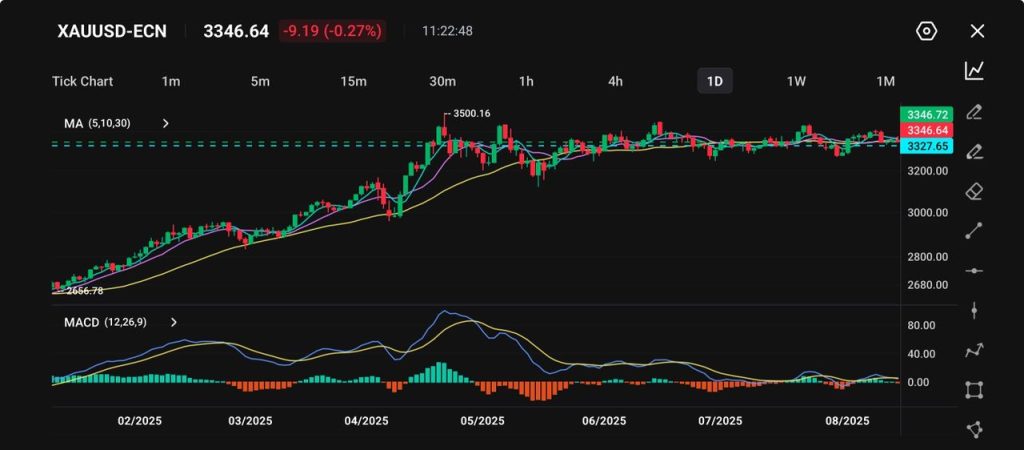
Gold (XAU/USD) remains locked in a sideways range between roughly $3,250 and $3,400, repeatedly testing both support and resistance but showing no decisive breakout.

Picture: XAU/USD trades around 3,346, holding in a tight range after months of sideways movement, shown on the VT Markets app.

Short-term moving averages have flattened, signalling a lack of directional bias, while the MACD remains close to the zero line, underlining market indecision.

In the near term, a sustained close above $3,400 could open the way for a retest of the $3,500 high, while a drop below $3,250 would bring the $3,150 region into focus.

Until either level is breached, gold is likely to continue consolidating, with traders closely tracking US inflation updates and shifts in interest rate expectations for a potential breakout trigger.

Cautious forecast

A decisive break above $3,400 would strengthen the technical case for a move back towards $3,500, particularly if supported by dovish central bank signals or a resurgence in safe-haven demand.

However, without a new macroeconomic driver, gold faces the risk of remaining range-bound or slipping towards the $3,300 mark.

Risk-on sentiment in equities continues to be the primary obstacle to an upside breakout. This is reinforced by investor appetite for higher-yielding opportunities, which reduces the urgency to hold non-yielding assets like gold.

Unless geopolitical tensions flare up or economic data sparks renewed uncertainty, XAU/USD is more likely to drift sideways, with only short-lived rallies emerging on market dips.

Click here to open account and start trading.

Dividend Adjustment Notice – Aug 14 ,2025

Dear Client,

Please note that the dividends of the following products will be adjusted accordingly. Index dividends will be executed separately through a balance statement directly to your trading account, and the comment will be in the following format “Div & Product Name & Net Volume”.

Please refer to the table below for more details:

Dividend Adjustment Notice

The above data is for reference only, please refer to the MT4/MT5 software for specific data.

If you’d like more information, please don’t hesitate to contact info@vtmarkets.com.

Ethereum nears record on ETF surge

Ethereum is back in the spotlight as renewed optimism lifts the cryptocurrency market. Strong institutional interest, upbeat sentiment, and supportive technical trends are fuelling momentum, with traders watching for the next breakout that could shape the weeks ahead.

Market overview

The cryptocurrency market started the week on solid ground, supported by strong capital inflows and a noticeable improvement in investor sentiment.

Spot Ether ETFs recorded an impressive $1.01 billion in daily net inflows, while Ethereum’s total value locked (TVL) climbed past $90 billion – both clear signals of growing institutional interest in ETH. This momentum mirrors a bullish positioning trend across multiple asset classes, reinforcing a risk-on mood.

Bitcoin is trading at $119,335, with high-profile forecasts suggesting a potential year-end target of $150,000.

Given the historical Bitcoin-Ethereum correlation, traders and analysts expect ETH price action to follow suit.

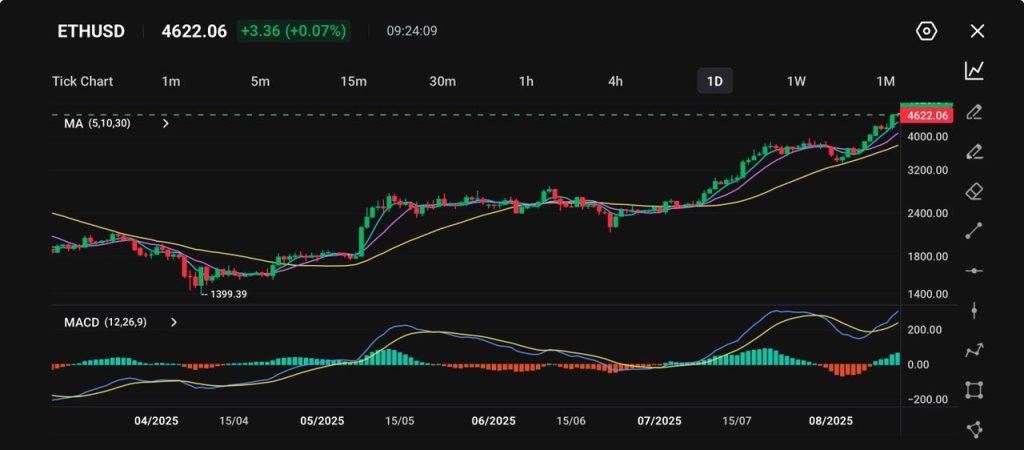
Currently, ETH/USD is steady at $4,622.06, marking a modest daily rise of $3.36 (0.07%) and staying within striking distance of its November 2021 high at $4,878.

This rally builds on the April low of $1,399.39 and gained additional momentum after the early-August breakout above the $4,300 resistance zone.

The bullish narrative was further boosted by news that BitMine Immersion Technologies plans to raise up to $20 billion for Ethereum acquisitions.

Historically, Ethereum’s market capitalisation has averaged 30%–35% of Bitcoin’s during previous crypto bull runs. If Bitcoin reaches the $150,000 mark, that ratio would project ETH towards $8,656.

Even a more conservative 21.7%–30% correlation would still suggest an Ethereum price range of $5,376–$7,420 in the current market cycle.

Technical analysis

Ethereum (ETH/USD) has staged a strong recovery since its April through near $1,399, breaking through multiple resistance levels and recently reaching $4,622.

Picture: ETH/USD holds near 4,622 as bullish momentum builds, shown on the VT Markets app.

The ETH chart shows a pattern of consistent higher highs and higher lows, with price action firmly above both short-term and medium-term moving averages – a classic bullish structure in crypto technical analysis.

The MACD indicator supports this positive trend, with a widening gap between the MACD and signal lines, signalling sustained buying pressure.

In the near term, the $4,620–$4,650 range acts as the immediate resistance zone to watch. A confirmed breakout could pave the way for a test of the psychologically important $5,000 level.

On the downside, initial Ethereum support sits near $4,200, with a stronger support level around $3,800.

Overall, the bias remains bullish as long as ETH price holds above its rising 30-day moving average, maintaining upward momentum in the broader cryptocurrency market.

Cautious forecast

A decisive daily close above $4,878 would likely serve as a strong bullish breakout signal for Ethereum, opening the door to a test of the psychological $5,000 level.

If positive sentiment persists in the cryptocurrency market, Bitcoin price momentum continues towards $150,000, and spot Ether ETF inflows remain solid, ETH/USD could extend its rally into the $5,376–$7,420 range.

This projection aligns with historical Ethereum-to-Bitcoin market capitalisation ratios observed during previous crypto bull cycles.

Sustained institutional demand and increased retail participation could further fuel buying pressure, pushing Ethereum price action closer to a potential all-time high.

However, if ETH fails to reclaim the 2021 peak, the bullish outlook may weaken. A slowdown in ETF inflows, shifting Bitcoin-Ethereum correlation, or a broader risk-off move in global markets could trigger a price correction.

In that case, initial Ethereum support is expected near $4,480, with a stronger technical floor around $4,300.

Such a retracement could be a healthy consolidation phase within the broader uptrend, potentially setting the stage for Ethereum’s next leg higher in the current market cycle.

Click here to open account and start trading.

Dividend Adjustment Notice – Aug 13 ,2025

Dear Client,

Please note that the dividends of the following products will be adjusted accordingly. Index dividends will be executed separately through a balance statement directly to your trading account, and the comment will be in the following format “Div & Product Name & Net Volume”.

Please refer to the table below for more details:

Dividend Adjustment Notice

The above data is for reference only, please refer to the MT4/MT5 software for specific data.

If you’d like more information, please don’t hesitate to contact info@vtmarkets.com.

Back To Top
server

Hello there 👋

How can I help you?

Chat with our team instantly

Live Chat

Start a live conversation through...

  • Telegram
    hold On hold
  • Coming Soon...

Hello there 👋

How can I help you?

telegram

Scan the QR code with your smartphone to start a chat with us, or click here.

Don’t have the Telegram App or Desktop installed? Use Web Telegram instead.

QR code