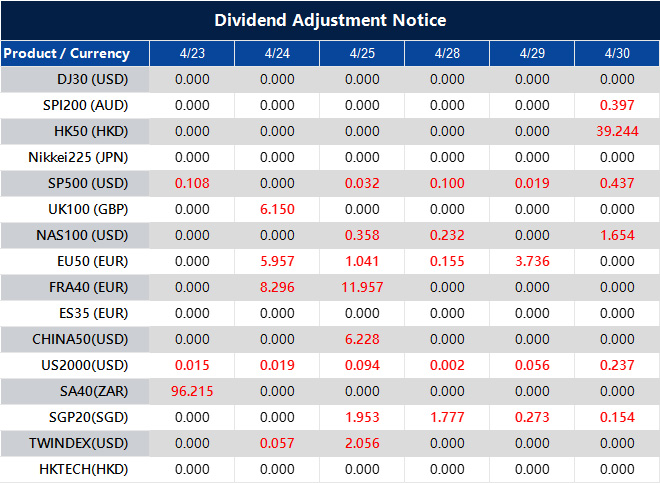
Dividend Adjustment Notice – Apr 23 ,2025

Dear Client,

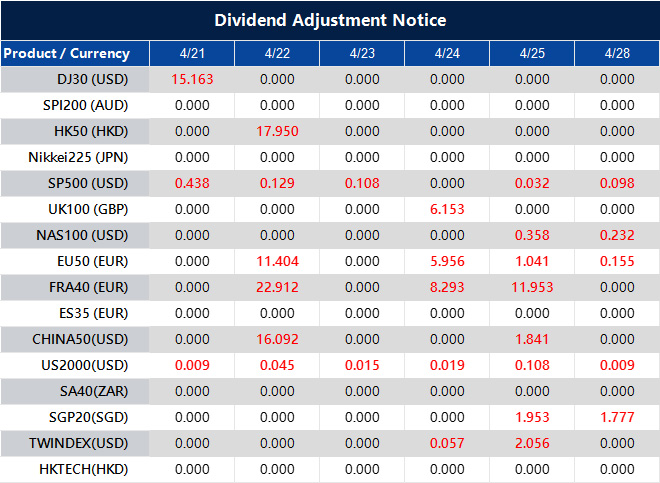
Please note that the dividends of the following products will be adjusted accordingly. Index dividends will be executed separately through a balance statement directly to your trading account, and the comment will be in the following format “Div & Product Name & Net Volume”.

Please refer to the table below for more details:

Dividend Adjustment Notice

The above data is for reference only, please refer to the MT4/MT5 software for specific data.

If you’d like more information, please don’t hesitate to contact info@vtmarkets.com.

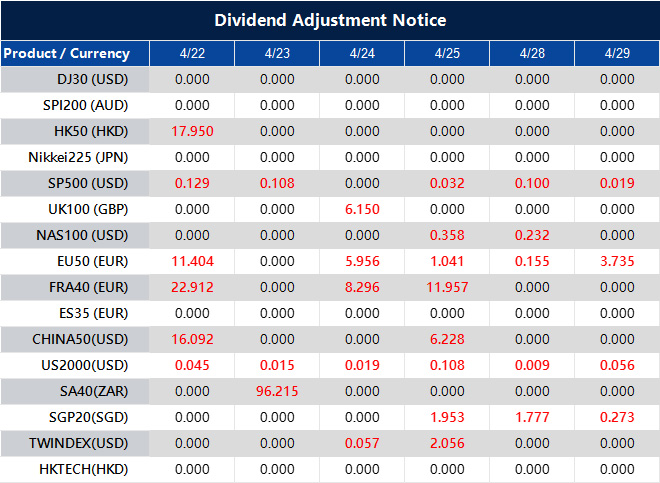
Dividend Adjustment Notice – Apr 22 ,2025

Dear Client,

Please note that the dividends of the following products will be adjusted accordingly. Index dividends will be executed separately through a balance statement directly to your trading account, and the comment will be in the following format “Div & Product Name & Net Volume”.

Please refer to the table below for more details:

Dividend Adjustment Notice

The above data is for reference only, please refer to the MT4/MT5 software for specific data.

If you’d like more information, please don’t hesitate to contact info@vtmarkets.com.

Forex market analysis: 22 April 2025

Oil prices are moving in a tug of war between supply and demand concerns, as market participants weigh geopolitical tensions, central bank signals, and the potential return of Iranian crude. While recent volatility has triggered cautious buying, overall sentiment remains fragile, with traders keeping a close eye on global developments that could sway the market in either direction.

Oil prices rebound modestly amid fragile market sentiment

Crude oil prices saw a modest recovery on Tuesday, with West Texas Intermediate (WTI) June futures rising by 0.7% to USD 62.84 after experiencing a sharp 2% drop in the prior session.

The rebound was primarily driven by short covering, as traders locked in gains on bearish positions amid lingering concerns over global risk appetite.

Market outlook remains cautious, with fears of a potential recession fuelled by tariff tensions and uncertainty surrounding US monetary policy.

Comments from President Trump urging the Federal Reserve to cut interest rates have renewed concerns about the central bank’s independence.

As a result, US equity markets declined, and the dollar index fell to a three-year low, clouding the outlook for energy demand.

Meanwhile, progress in US–Iran nuclear negotiations continues to cap oil’s upside potential. If sanctions are lifted, the return of Iranian crude could increase global supply and weigh on prices.

Reflecting these concerns, Russia has revised its 2025 Brent crude forecast down by 17%, signalling expectations of a supply-heavy market environment.

Technical analysis: key levels in focus

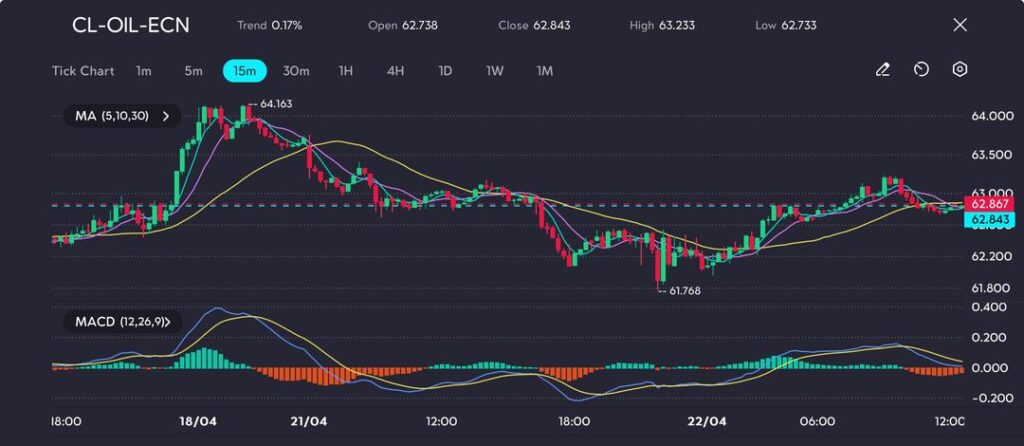
WTI crude surged to a high of USD 64.16 before entering a corrective phase, retreating to a recent low of USD 61.77.

Oil prices consolidate below USD 63 as momentum fades, as seen on the VT Markets app.

The current price action, hovering near USD 62.84, shows a cautious attempt to reclaim lost ground, now testing resistance at key short-term moving averages.

Technical indicators reflect mixed momentum. The MACD shows diminishing bullish strength, with its histogram flattening and signal lines tightening—suggesting possible consolidation or a pause in direction.

Meanwhile, the convergence of 5-, 10-, and 30-day moving averages highlights indecision in the market, awaiting a fresh catalyst.

Key resistance is located at USD 63.23, while support lies between USD 62.00 and 61.77. A decisive move above resistance could revive bullish sentiment, while a breakdown below support might signal further downside.

Oil likely to trade sideways in near term

With WTI crude caught between weakening demand concerns linked to trade policies and supply-side risks from Iran, the market may remain range-bound between USD 61 and USD 64 in the short term.

Traders will closely monitor upcoming EIA and API inventory data, while broader price direction could be influenced by Federal Reserve signals and geopolitical developments.

Click here to open account and start trading.

Shorting Stocks: How to Short a Stock?

Shorting Stocks: Learn How to Short a Stock

In this article, we will provide a comprehensive guide to short selling stocks, a trading strategy that allows traders to profit from a decline in stock prices. Whether you’re a seasoned trader or new to the concept, we’ll break down how short selling works, the risks involved, and the key steps you need to take to start shorting stocks.

What is Short Selling?

Short selling is a trading strategy that allows market participants to profit from the decline in the price of a stock or other asset. Unlike traditional investing, where traders buy stocks with the expectation that their value will rise, short selling works in the opposite direction. The strategy involves borrowing a stock, selling it at the current market price, and then buying it back later at a lower price to return to the lender. If the stock price drops, the trader can repurchase it at a lower price, pocketing the difference as profit. Short selling offers traders the opportunity to capitalize on falling markets, but it comes with its own set of risks and complexities.

What is Shorting a Stock?

Shorting a stock, or short selling, is the act of selling borrowed shares of a stock that the trader does not own. The goal is to buy the shares back at a lower price in the future. Essentially, shorting stocks allows traders to profit from the decline in a stock’s value, which is the opposite of buying or going long on a stock. Traders typically engage in short selling when they believe that a stock’s price will fall based on factors such as negative company news, market trends, or broader economic conditions.

How Does Shorting a Stock Work?

Let’s break down how short selling works with both traditional and CFD approaches:

Traditional Short Selling:

  • Borrow Shares: A trader borrows shares from their broker.
  • Sell the Shares: The borrowed shares are sold in the market at the current price.
  • Wait for the Price to Drop: The trader monitors the stock, hoping the price decreases.
  • Buy Back at a Lower Price: If the price falls, the trader buys back the shares at the reduced price.
  • Return Shares to Broker: The trader returns the borrowed shares and keeps the profit from the price difference.

CFD Short Selling:

With CFD trading, you don’t actually own or borrow the asset. Instead, you enter into an agreement with your broker to settle the difference in price between the time the position is opened and closed.

In a short CFD position, you’re speculating that the asset’s price will fall. If the market moves in your favor, you can close the trade at a lower price, and the broker will pay you the difference as your profit.

Example: If a stock is priced at $100, and you open a short CFD position, expecting the price to drop, the stock falls to $90. You close the position, earning a $10 profit per share, depending on your position size.

How to Short a Stock?

Shorting a stock involves a few key steps that require careful planning and risk management. Here’s a step-by-step guide on how to short a stock:

Step 1: Understand How Shorting a Stock Works

Before diving into short selling, it’s crucial to understand the process. Shorting stocks involves borrowing shares of a stock from a broker, selling them on the market, and then buying them back at a later time, hoping the price will drop. If the stock price falls, you can repurchase it at a lower price, returning the shares to the lender and keeping the difference as profit.

Step 2: Research Stocks to Short

Identify stocks that you believe will decrease in value. Look for overvalued stocks, those with weak fundamentals, or companies facing negative news or market trends. Technical analysis can help spot price patterns that suggest a potential decline. Additionally, keep an eye on any upcoming events like earnings reports or regulatory changes that might affect a stock’s price.

Step 3: Select a Reliable Broker

Choose a reliable broker that supports short selling and offers the necessary tools to manage your trades effectively. Ensure the broker provides margin accounts, as this is required for borrowing shares. Look for a trading platform with competitive fees, fast execution, and access to real-time market data to make informed decisions.

Step 4: Create and Fund Your Trading Account

To begin shorting stocks, you’ll need to open a trading account with your broker. This account allows you to borrow funds or securities to engage in short selling. Ensure your account is funded with enough margin to cover potential losses, and understand the terms and requirements set by your broker before proceeding.

Step 5: Place a Short Sell Order

Once you’ve selected the stock, you can place a short sell order through your broker’s platform. When placing the order, you’ll be borrowing the stock to sell it at the current market price. It’s important to set the right parameters for your order to ensure your position is executed at the desired price.

Step 6: Monitor the Position

After opening the short position, closely monitor the stock’s price movement. Stay updated on market trends, news, and any events that could impact the stock. Depending on the market’s movements, you might need to adjust your strategy or prepare to close the position if the price moves unfavorably.

Step 7: Buy Back the Stock

When the stock price falls to your desired level, it’s time to buy back the shares. This step is known as “covering” the short position. You’ll buy the same number of shares that you borrowed, ideally at a lower price than what you sold them for. Once you purchase the shares, return them to the lender and pocket the profit from the price difference.

The Risk of Shorting a Stock

While short selling can be profitable, it comes with significant risks:

Unlimited Losses: The primary risk of shorting stocks is the potential for unlimited losses. Unlike buying a stock, where your losses are limited to the amount you invested, short selling has no ceiling. If the stock price rises dramatically, your losses can continue to grow.

Discover the difference between trading and investing

Short Squeeze: A short squeeze occurs when a heavily shorted stock suddenly experiences a sharp price increase, forcing short sellers to buy back shares to cover their positions. This can cause the price to rise even further, exacerbating losses.

Margin Calls: Since short selling involves borrowing shares, brokers require that traders maintain a margin in their accounts. If the stock price rises, and the trader’s margin falls below the required threshold, they may receive a margin call, requiring them to deposit more funds or close their position at a loss.

Market Volatility: Short selling in volatile markets can increase the risk of significant losses. In a highly volatile market, stock prices can swing unpredictably, making it more challenging to time the short sale and increasing the likelihood of losses. Rapid price fluctuations could trigger stop-loss orders or force traders to buy back stocks at a higher price than anticipated.

Discover the difference between going long and going short

Conclusion

Shorting stocks is a powerful strategy that allows traders to profit from falling stock prices. By borrowing and selling stocks they don’t own, traders can take advantage of market declines. However, shorting stocks comes with significant risks, including the potential for unlimited losses and short squeezes. It’s essential for traders to fully understand the mechanics of shorting a stock and to use appropriate risk management techniques, such as stop-loss orders, when engaging in this strategy.

Short a Stock Today with VT Markets

At VT Markets, we provide a seamless and efficient platform for shorting stocks with confidence. Our advanced trading tools, including MetaTrader 4 and MetaTrader 5, give you the flexibility to manage your positions with ease. With competitive spreads, fast execution, and real-time market data, you can take advantage of market movements quickly and efficiently. 

Whether you’re new to short selling or an experienced trader, VT Markets offers the resources you need to execute short stock trades effectively. You can also start with a VT Markets demo account to practice shorting stocks risk-free, allowing you to get comfortable with the platform and strategies before trading with real capital.

Start shorting stocks today with VT Markets and utilize our powerful platforms to enhance your trading experience.

Frequently Asked Questions (FAQs)

1. What is short selling in simple terms? 

Short selling is the process of borrowing a stock, selling it, and then buying it back later at a lower price to profit from the stock’s decline.

2. How can I start shorting stocks? 

To start shorting stocks, you’ll need a margin account with a broker that supports short selling. You can then choose a stock, borrow it, sell it, and buy it back when the price drops.

3. What are the risks of shorting stocks? 

The main risks include unlimited losses if the stock price rises, short squeezes, margin calls, and regulatory restrictions.

4. Can I make money shorting stocks? 

Yes, you can make money by shorting stocks if their price falls. However, it’s important to carefully manage risk since there are significant potential losses if the price rises.


Forex market analysis: 21 April 2025

Gold is once again capturing the spotlight as investors seek safety amid rising global uncertainty. Heightened geopolitical tensions, shifting trade policies, and weakening major currencies are fuelling renewed interest in the precious metal. As traditional assets face mounting pressure, gold stands out as a reliable store of value, drawing strong demand from those looking to protect their wealth in turbulent times.

Gold rallies above USD 3,390 amid trade tensions and US dollar weakness

Gold prices surged past USD 3,390 on Monday, climbing more than 1 percent and marking a new all-time high.

The rise was driven by heightened safe-haven demand, as global trade tensions intensified, and the US dollar continued to lose ground.

With uncertainty dominating the economic landscape, gold is becoming an increasingly attractive refuge for investors seeking stability.

Rising trade tensions fuel demand for gold

The latest boost in gold prices followed an announcement by former US President Donald Trump, who launched an investigation into the potential introduction of new tariffs on all critical mineral imports.

This step, viewed as a significant escalation in the ongoing trade friction—especially with China—has added to investor anxiety and reinforced the demand for defensive assets such as gold.

US dollar decline enhances gold’s appeal

The decline of the US dollar, which dropped to a three-year low, has further strengthened gold’s position.

As the value of the greenback falls, gold becomes more affordable to buyers using other currencies, thereby increasing global demand and supporting its role as a hedge against currency depreciation.

ECB rate cut contributes to bullish sentiment

In addition to geopolitical concerns, recent monetary policy actions have also supported gold’s ascent.

The European Central Bank’s decision to cut interest rates has made the low-yield environment even less appealing for traditional investments.

As a result, gold is drawing interest from investors seeking alternative stores of value.

Technical analysis remains bullish

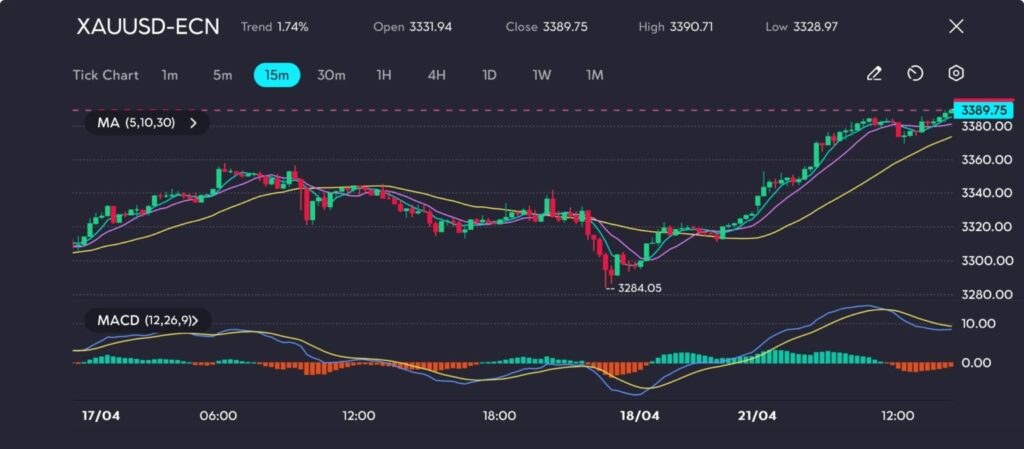
XAU/USD rose by 1.74 percent, ending the day at USD 3,389.75 after opening at USD 3,331.94.

Prices reached a high of USD 3,390.71 before slightly retreating.

The market’s technical structure remains strong, with short-term moving averages rising above longer-term ones, indicating ongoing upward momentum.

The MACD also signals a positive trend, as the MACD line remains above the signal line and the histogram stays in positive territory.

Outlook and levels to watch

With trade-related uncertainty lingering and the US dollar under pressure, gold may continue its upward trajectory.

XAU/USD surges past 3380 to test resistance at 3390.71, as seen on the VT Markets app.

Market participants are keeping a close eye on further developments in the US-China trade relationship and any additional moves from major central banks.

Immediate resistance is found near USD 3,390, and a breakout above this level could pave the way for further gains.

On the downside, support is currently observed around USD 3,320, with any easing in geopolitical tensions potentially triggering a short-term pullback.

Click here to open account and start trading.

Stops Level Adjustment Notice – Apr 21 ,2025

Dear Client,

To provide a better trading environment in accordance with the market conditions, VT Markets will adjust trading setting on April 21, 2025.

Please find the table below for more information:
1. Pending Stop Orders (Buy Stop / Sell Stop): The order price must not be set within the current spread range.
2. Stop Loss (S/L): The stop-loss price must not be set within the current spread range.
3. Pending Limit Orders (Buy Limit / Sell Limit) and Take Profit (T/P): The price is not restricted by the current spread range.

If you’d like more information, please don’t hesitate to contact info@vtmarkets.com.

Week ahead: Markets eye central bank signals

The upcoming week is poised to be pivotal for global financial markets as investors navigate a landscape marked by heightened volatility stemming from recent US tariff implementations.

Key corporate earnings reports, economic indicators, and central bank communications will be in focus as market participants assess the broader economic implications of escalating trade tensions.

KEY INDICATORS

Central bank communications

  • Market participants will closely monitor remarks from Federal Reserve officials for any indications on future monetary policy.
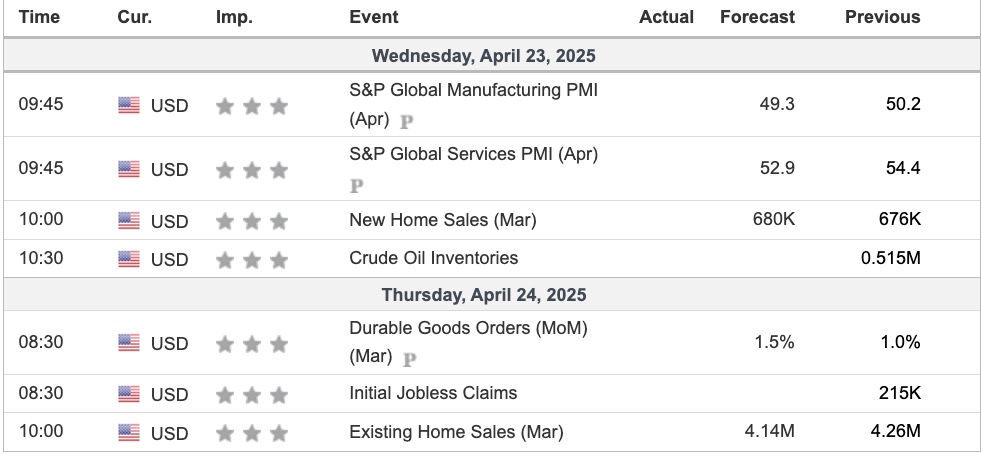
  • The release of the Federal Reserve’s Beige Book on Wednesday will provide a regional economic overview ahead of the upcoming policy meeting.

Wednesday, 23 April

  • US new home sales (March): Providing insights into the housing market’s response to current economic conditions.

Thursday, 24 April

  • US existing home sales (March): Further data on housing market trends.
  • Weekly jobless claims: Offering a snapshot of the labour market’s resilience.

Friday, 25 April

  • US durable goods orders (March): Indicating business investment trends.
  • University of Michigan consumer sentiment index (April final): Assessing consumer confidence amid economic uncertainties.

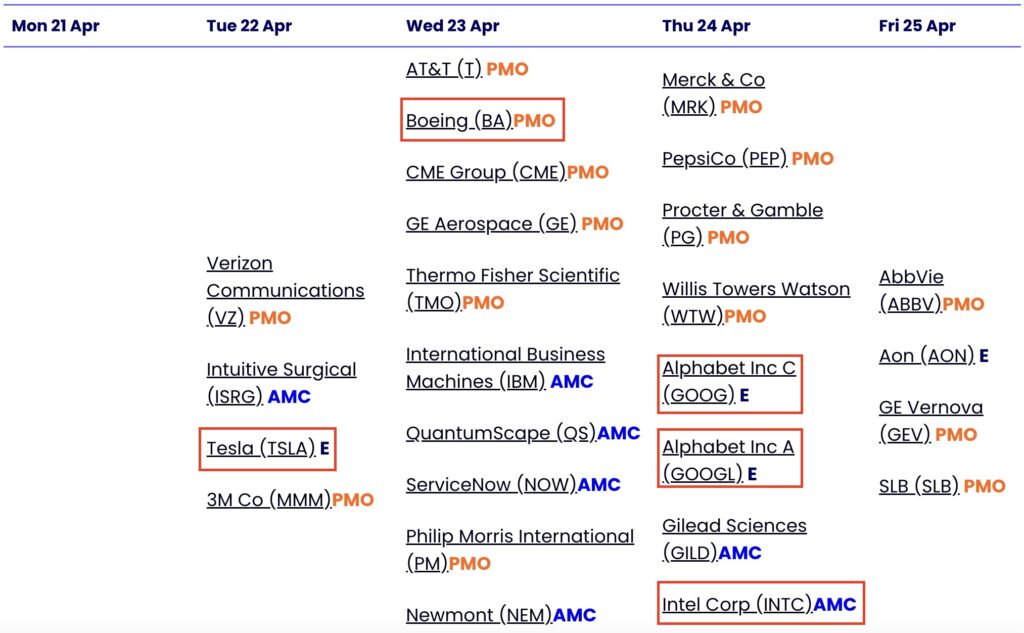
Economic events for the coming week include a slew of major companies set to report earnings, providing insights into how businesses are coping with the current economic climate.

MARKET MOVERS

European stocks pare losses following European Central Bank interest rate cut

European stock markets pared losses to close nearly flat on Thursday following the European Central Bank’s decision to cut interest rates.

  • The pan-European Stoxx 600 index provisionally closed 0.1% lower.
  • Regionally, the UK’s FTSE 100 was little changed for the session.
  • Germany’s DAX and France’s CAC 40 fell by 0.5%.

As widely expected, the European Central Bank trimmed interest rates for the third time this year by 25 basis points amid concerns over the eurozone’s economic growth outlook in a time of uncertainty over global trade and tariffs.

ECB cuts interest rates by 25 basis points

  • The ECB on Thursday cut interest rates by 25 basis points, as was widely expected ahead of the decision.
  • Markets had priced in around a 94% chance of such a cut, and around a 6% chance of a larger, 50 basis point reduction.
  • This takes the central bank’s deposit facility rate, its key rate, to 2.25% — down from highs of 4% in mid-2023.

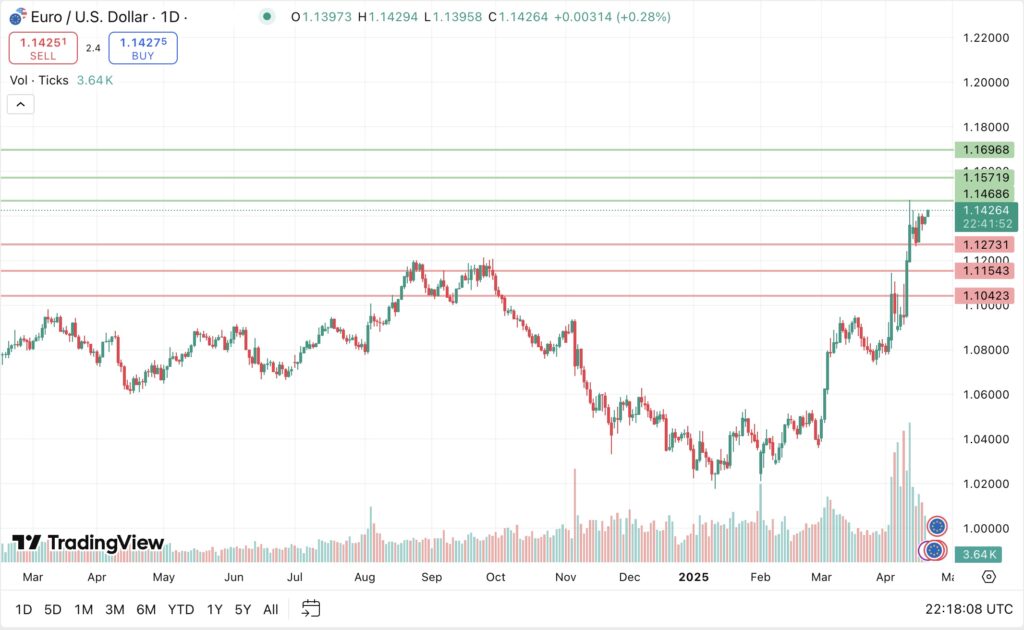
EUR/USD

Preferred long preference

Long positions above 1.14686 with targets at 1.15719 & 1.16963 in extension.

Alternative scenario

Above 1.12731 look for further upside with 1.11543 & 1.10423 as targets.

The RSI is above its neutrality area at 50. The MACD is above its signal line and negative. The MACD must break above its zero level to trigger further gains. Moreover, the price is above its 20 and 50 period moving average.

Earnings report news

First-quarter earnings season is due to begin during the second full week of April, led by banking giants JPMorgan Chase (JPM) and Wells Fargo (WFC).

Analysts at US financial data group FactSet estimate a year-on-year earnings growth rate of 7.3% for the S&P 500 companies, which would mark the seventh consecutive quarter of earnings growth reported by the index.

Companies are beating Q1 earnings estimates so far. Some big results are up next

  • The first-quarter earnings season is off to a softish start by some measures, according to new research, but another quarter of year-on-year growth still looks likely.
  • Based on preliminary results—just 12% of S&P 500 companies have reported so far, according to analysis released late Thursday by FactSet—70% of reporting companies in the benchmark index have come in above Street estimates.
  • Earnings have come in 6.1% above estimates, also below the five- and ten-year averages.
  • The S&P 500’s first-quarter results are still projected to grow for a seventh consecutive quarter.
  • A combination of reported results and estimates for those yet to report indicates growth of 7.2% so far.

Key: PMO = Pre-market open | AMC = After market close | E = Estimated

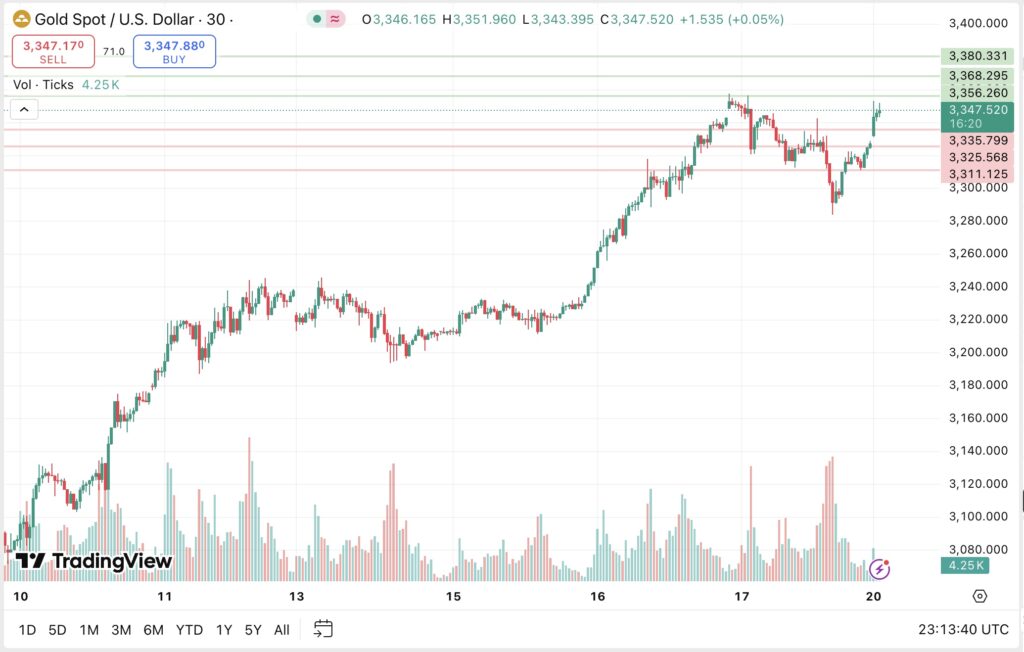
XAU/USD

Potential short preference

Short positions below 3335.79 with targets at 3325.56 & 3311.12 in extension.

Alternative scenario

Above 3356.26 look for further upside with 3368.29 & 3380.33 as targets.

The index currently faces a challenging resistance.

Gold starts coming back to Switzerland from US after exclusion from Trump’s tariffs

  • Gold, which traders had been flying to New York since December as a precaution against the possibility of broad US tariffs hitting bullion imports, is being shipped back to Switzerland, where it originated, official data shows.
  • Swiss customs data on Thursday showed that the country’s gold imports from the US rose to a thirteen-month high of 25.5 metric tonnes in March, from 12.1 tonnes in February.
  • Gold exports from Switzerland to the US fell 32% month-on-month to 103.2 tonnes.
  • Gold, silver, and platinum worth more than USD 80 billion were delivered to Comex warehouses in the December–March period, keeping logistics firms and Swiss refineries busier than usual.
  • Part of what is currently being delivered out of the US gold vaults is returning to Switzerland, the world’s biggest bullion refining and transit hub, said a source at a Swiss refinery.

NEWS HEADLINES

Oil prices slip 1% after progress in US-Iran talks

  • Oil prices fell more than 1% at Monday’s open in Asia after nuclear talks between the United States and Iran progressed, easing supply concerns.
  • Brent crude futures slipped 78 cents, or 1.15%, to USD 67.18 a barrel at 10:12 PM GMT.
  • US West Texas Intermediate crude was at USD 63.91 a barrel, down 77 cents, or 1.19%.
  • The two countries agreed on Saturday to begin drafting a framework for a potential nuclear deal, Iran’s foreign minister said, after talks that a US official described as yielding “very good progress.”

Japan seeks ‘fairness’ in currency talks with US, Prime Minister Ishiba says

  • Japan will emphasise “fairness” in any discussions with the US on exchange rates, Prime Minister Shigeru Ishiba said on Sunday, as bilateral trade talks gain global attention during President Donald Trump’s tariff offensive.
  • Trump has imposed 24% tariffs on Japanese exports to the US, although, like most of Trump’s levies, they have been paused until early July.
  • A 10% universal rate remains in place, as does a 25% duty on cars, a mainstay of Japan’s export-reliant economy.

Stock futures fall after Wall Street posts another losing week

  • Stock futures fell on Sunday evening following yet another negative trading week for Wall Street.
  • S&P 500 futures declined by 0.5%.
  • Nasdaq-100 futures dropped 0.5%.
  • Futures tied to the Dow Jones Industrial Average tumbled 214 points, or 0.5%.
  • These moves come after each of the three major averages logged a third weekly decline in the last four trading weeks.

Click here to open account and start trading.

Dividend Adjustment Notice – Apr 21 ,2025

Dear Client,

Please note that the dividends of the following products will be adjusted accordingly. Index dividends will be executed separately through a balance statement directly to your trading account, and the comment will be in the following format “Div & Product Name & Net Volume”.

Please refer to the table below for more details:

Dividend Adjustment Notice

The above data is for reference only, please refer to the MT4/MT5 software for specific data.

If you’d like more information, please don’t hesitate to contact info@vtmarkets.com.

Forex market analysis: 19 April 2025

The US dollar index (USDX) traded in tight ranges, closing the session near 99.15 as subdued Good Friday volumes capped volatility. Despite holding steady on the day, the greenback remains under pressure near 3-year lows.

Dollar nears three-year lows as trade optimism and Fed discontent collide

President Trump surprised markets with a softer stance on China tariffs, suggesting that not only will he avoid raising duties further, but he may even consider rolling some back. This is a potential pivot that could soothe market anxiety and support risk sentiment next week.

However, his fresh criticism of Federal Reserve Chair Jerome Powell overshadowed the optimism. Trump stated Powell was “too slow” to act and “can’t be removed quickly enough,” escalating the pressure on the Fed just days after Powell reiterated that the central bank is “monitoring data carefully” before adjusting rates.

Markets are now pricing in about 86 basis points of rate cuts for the remainder of 2025.

A drop in U.S. jobless claims to a two-month low underscored a still-resilient labour market, offering some support to the greenback. However, persistent uncertainty around trade policy and renewed pressure on the Fed from Trump have kept traders cautious, leaving the dollar stuck near multi-year lows despite flashes of stability.

Technical analysis for the US Dollar Index

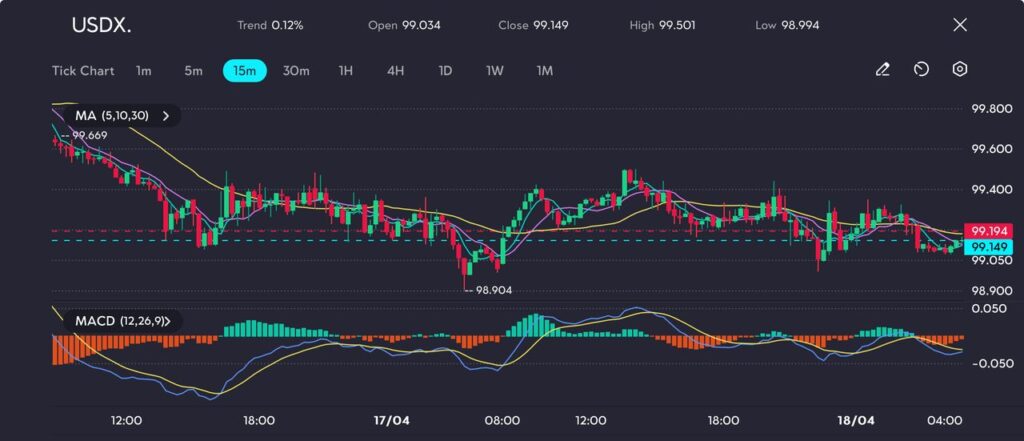
The 15-minute chart of the USDX shows a choppy consolidation phase after the index found short-term support at 98.904. Despite multiple intraday swings, the price remains range-bound, with resistance near 99.50 and support holding above 98.90, signaling uncertainty among dollar bulls and bears.

us-dollar-index-usdx
Dollar bulls struggle to regain ground above 99.20, as seen on the VT Markets app.

The MACD (12,26,9) shows waning bullish momentum as the histogram contracts toward the zero line. The recent bearish crossover and fading histogram strength imply a possible retest of support, especially as the price lingers below the 30-period moving average, capping any upside thrusts. Traders may want to watch for a break above 99.50 for upside continuation, or a clean breach below 98.90 to confirm renewed bearish control.

A sustained move below 98.90 could reopen downside toward 98.50, while upside resistance holds at 99.50. The dollar is likely to remain range-bound in the short term unless next week’s data or Fed communications provide a directional push.

Click here to open account and start trading.

What Is Short Selling and How Does Short Selling Work?

What Is Short Selling and How Does It Work? Everything You Need to Know

In this article, we’ll explore what short selling is, how short selling works, and why it’s a valuable strategy for traders in shifting markets. Whether used to hedge against potential losses or to capitalise on anticipated price drops, short selling offers flexibility across various market conditions.

What Is Short Selling?

Short selling is the act of selling an asset you don’t own with the intention of buying it back later at a lower price. This is typically done by borrowing shares from a broker, selling them on the open market, and then repurchasing them after the price falls, returning the borrowed shares and pocketing the difference.

Alternatively, many traders now use CFDs (Contracts for Difference) to short-sell stocks. With CFDs, you’re not borrowing or owning the actual stock. Instead, you’re trading a contract based on the price movement of the underlying asset, making the process simpler, faster, and more accessible.

Example: Imagine a trader believes Tesla stock will fall from $350 to $300. Instead of borrowing shares, they open a short CFD position. If the stock drops to $300, the trader profits from the $50 difference, minus any trading costs.

How Does Short Selling Work?

Let’s break down how short selling works, including both traditional and CFD short-selling approaches:

Traditional Short Selling:

  • Borrow Shares: A trader borrows shares of a stock from their broker.
  • Sell the Shares: The borrowed shares are sold on the open market at the current market price.
  • Wait for Price Decline: The trader monitors the market, hoping the price drops.
  • Buy Back at Lower Price: If the price drops, the trader repurchases the shares.
  • Return Shares to Broker: The trader returns the original borrowed shares and keeps the difference.

CFD Short Selling:

With a CFD (Contract for Difference), you do not own or borrow the underlying asset. Instead, you enter into an agreement with your broker to exchange the difference in the asset’s price between the time you open the position and when you close it.

When you open a short CFD position, you are essentially speculating that the asset’s value will decrease. If the market moves in your favour and the asset price falls, you can close the trade at a lower price. The broker then pays you the difference between your entry price and the exit price, which becomes your profit.

Example: Imagine a stock is priced at $100. You open a short CFD position at this price, expecting it to decline. The stock drops to $90, and you close your trade. You earn a $10 profit per share, depending on the size of your position.

Which Market Can You Short-Sell?

With VT Markets, you can short-sell across a wide range of global financial markets using CFDs. This allows you to speculate on falling prices without owning or borrowing the asset.

Here are the markets where short selling is available:

The Difference Between a Long and a Short Position

In trading, the terms “long” and “short” refer to the direction of your market expectation. When you take a long position, you’re buying an asset with the belief that its price will rise, allowing you to sell it later at a higher price for a profit. On the other hand, a short position involves selling an asset you don’t own, or speculating on its price falling, with the intention of buying it back later at a lower price. Essentially, going long means you’re bullish on the market, while going short signals a bearish outlook.

Example: If you think Amazon’s price will increase, you go long, buying the stock at its current price and aiming to sell it higher price. But if you believe it’s overvalued and likely to drop, you go short by short-selling Tesla shares. In both cases, your position depends on the direction you expect the market to move.

Why Do Traders Choose to Short-Sell?

Short selling is more than just betting against the market. Traders use it for different strategic purposes depending on their goals and market outlook.

Profit from Bearish Trends

One of the most common reasons to short-sell is to profit when an asset is expected to decline in value. Traders often look for overvalued stocks, weak earnings, or negative market sentiment as signals to go short. For example, if a major tech company is trading at all-time highs but issues a disappointing revenue forecast, short sellers may act quickly to benefit from the expected pullback.

Hedge Existing Positions

Short selling is also an effective hedging tool. Traders who already hold long positions may open short positions to offset potential losses during uncertain market conditions. For instance, if a trader holds a diversified portfolio of U.S. equities but expects a short-term market dip, they might short-sell an index like the S&P 500 to reduce risk exposure without exiting their entire portfolio.

Speculate on Weak Assets

Some traders specialise in identifying underperforming or fundamentally weak assets and shorting them purely for speculative gains. They may use earnings reports, industry news, or technical analysis to spot opportunities. A high-profile example was the wave of institutional short interest in GameStop before its unexpected retail-driven rally. While speculative short selling can be profitable, it also comes with higher volatility and risk.

Conclusion

Short selling is a strategy that allows traders to profit from falling markets by reacting to weak earnings, hedging against volatility, or targeting overvalued assets. Understanding what short selling is and how short selling works is key to using the strategy effectively. While traditional short selling involves borrowing and selling the asset, modern methods like CFDs offer a simpler way to speculate on price drops without owning the asset, making short selling more accessible and flexible for today’s traders.

Short Selling Stocks Today with VT Markets

VT Markets, a regulated and reliable trading platform, gives traders the ability to short-sell a wide range of global stocks through CFDs, all within a single, streamlined platform. Whether you’re trading major names like FAANG companies or spotting short-term opportunities in underperforming sectors, CFD short selling offers the speed and flexibility you need to act with confidence. With seamless integration to MetaTrader 4 and MetaTrader 5, competitive spreads, and fast execution, VT Markets makes it easier to access stocks, indices, forex, and more, all through one account.

Start short selling with VT Markets today and turn market downturns into trading opportunities.

Frequently Asked Questions (FAQs)

1. What is short selling in simple terms?

Short selling is a trading strategy where you borrow and sell a stock now, hoping to buy it back later at a lower price.

2. How does short selling work?

It works by borrowing shares, selling them at the current price, waiting for the price to drop, repurchasing them cheaper, and returning the borrowed shares to make a profit.

3. Is short selling risky?

Yes. Losses in short selling can be unlimited if the stock price rises significantly, which is why stop-loss strategies are critical.

4. What is an example of short selling?

Suppose Tesla shares are trading at $250, and you believe the price will fall. You open a short position by selling the stock (or a CFD) at $250. If the price drops to $230, you buy it back at the lower price, closing the trade with a $20 profit per share. This is a basic example of how a short sell works when the market moves in your favour.

Back To Top
server

Hello there 👋

How can I help you?

Chat with our team instantly

Live Chat

Start a live conversation through...

  • Telegram
    hold On hold
  • Coming Soon...

Hello there 👋

How can I help you?

telegram

Scan the QR code with your smartphone to start a chat with us, or click here.

Don’t have the Telegram App or Desktop installed? Use Web Telegram instead.

QR code