Back

The NZD/USD pair trades near 0.5950, experiencing consolidation while halting its recent gains

NZD/USD is trading around 0.5930, within a consolidation range. The pair targets the range’s upper edge near 0.6000, with initial support at the nine-day Exponential Moving Average (EMA) of 0.5913.

The Relative Strength Index (RSI) suggests a slight bullish tendency, hovering above 50. If NZD/USD breaks above 0.6000, it may aim for a six-month high of 0.6038 reached in November 2024.

Potential Break Below EMA

A break below the nine-day EMA at 0.5913 could weaken momentum, potentially leading to the 50-day EMA at 0.5850. Dropping below this level might push the pair towards 0.5485, a level not seen since March 2020.

Today, the New Zealand Dollar shows varied performance against major currencies. Against the Japanese Yen, it is at its weakest, with a decline of 0.56%.

What’s already laid out points to a market keeping its foot on the brake rather than the pedal. We’re seeing price hover around 0.5930, trapped in a box with the ceiling just shy of 0.6000. That said, the current support is neatly maintained by the nine-day EMA, which tells us buyers are still active, but only just. The picture the RSI paints—nudging slightly above 50—echoes a half-hearted leaning toward upside, not an outright charge.

Now, with the target of 0.6000 close but not quite in hand, the situation invites some short-term probability calls. Price action getting above 0.6000 would force a reassessment, especially with 0.6038 as the next price memory from November. It’s worth remembering that level—tapping it required stronger flows back then, and unless conviction ramps up again, the market might struggle to repeat that.

Market Direction and Reaction

If we slip the other way though, falling under 0.5913 would be more than just a technical formality. The earlier support could flip, handing momentum back to sellers. That would put 0.5850 in focus, sitting near the 50-day EMA. The air gets thinner below that; there’s a lot of uncovered ground down to 0.5485. That zone hasn’t hosted price since the early pandemic panic, and returning there would mark a sharp shift.

Elsewhere, the currency’s not holding up well, particularly against the Yen. A 0.56% drop isn’t mild movement either, showing that appetite for risk-sensitive positions has cooled—possibly a reaction to shifting rate expectations or broader macro forces.

In the coming sessions, we should watch for how the pair handles pressure near the top of this range. No decision has been made by the market yet. Directional conviction hasn’t really stepped in. If that changes—above or below the short-term averages—traders will need to weigh momentum against potential resistance or uncovered downside.

Technical levels are doing more than decorating the chart here—they are, at the moment, containing emotion. Until one of them gives way, any heavy positioning is likely to be met with whiplash. We may want to stay reactive, not predictive. Let price do the talking and engage only when it breaks the script already in play.


Create your live VT Markets account and start trading now.

Around $62.00, WTI Oil trades lower as markets assess Russia-Ukraine peace talks’ impact on supply

WTI oil prices are facing downward pressure, trading around $62.00 per barrel after recent gains. This dip is attributed to potential Russia-Ukraine ceasefire talks, which might increase global oil supply.

A ceasefire could ease sanctions on Russia, potentially boosting oil exports amid an already oversupplied market. US sovereign credit rating downgrade by Moody’s and poor Chinese economic indicators have also added to the bearish outlook.

Impact of Economic Factors on Oil Demand

China’s People’s Bank cut interest rates to record lows to stimulate the economy, which may indirectly impact oil demand. Meanwhile, geopolitical tensions remain due to US-Iran disagreements over nuclear activities.

WTI Oil, or West Texas Intermediate, is a benchmark for oil prices requiring low refining due to its quality. Key factors influencing its price include global demand, geopolitical issues, OPEC decisions, and US Dollar value.

Oil inventory reports from API and EIA can also affect WTI prices, with lower inventories indicating higher demand. OPEC and OPEC+ decisions about production quotas significantly impact supply and, consequently, oil prices.

OPEC plays a vital role, either tightening or increasing supply based on their production quota decisions. Together, these elements shape the global oil market environment and influence WTI pricing dynamics.

Challenges in the Global Oil Market

Recent market signals point to an increasingly fragile backdrop for energy commodities. With WTI hovering near $62.00 per barrel, there’s a perceptible shift in sentiment. A lot of this comes down to the renewed dialogue around a ceasefire between Russia and Ukraine. The market has already started to price in the possibility of easing tensions, which, in practical terms, means a higher likelihood of Russian crude returning more freely to global markets. Increased supply without a matching spike in demand tends to drag prices lower—plain and simple.

From our perspective, the downgrade in the US sovereign credit rating by Moody’s should not be dismissed as an isolated event either. It casts a long shadow over risk assets broadly, pushing up borrowing costs and amplifying broader deflationary pressure. This, in turn, could slow down industrial growth and energy consumption. When the cost of capital rises, investment tends to fall off, and so does fuel usage across sectors like manufacturing and freight.

Moreover, the economic softness out of China adds another layer of concern. With interest rates now at unprecedented lows, it’s clear that the People’s Bank is running short on conventional tools to revive demand. Even with accommodative policy, consumer confidence remains tentative. This is especially relevant when considering China’s massive role as a global importer of crude. If their appetite diminishes, upstream producers will feel the pinch.

Tensions stemming from the unresolved nuclear dispute between the US and Iran aren’t subsiding either. That ongoing friction acts as a wild card. Sometimes it boosts prices through supply fears, other times it just raises uncertainty. But for those of us focusing on price volatility, sustained ambiguity over Middle East exports usually prevents prices from stabilising meaningfully, especially when weighed against bullish expectations that fail to materialise.

For those of us watching derivatives tied to West Texas Intermediate, the balance of evidence is tilting more heavily toward further softness unless prevailing conditions take a sharp turn. In futures trading, timing and positioning become especially sensitive when expectations become disconnected from physical supply changes. This is where weekly stockpile reports come into sharper focus. Any unexpected drawdown in inventories—particularly in the EIA’s Thursday release—may offer some bounce, but it’s worth being sceptical of the duration of any rally unless backed by policy action or supply cuts.

At the moment, the OPEC+ group must weigh its output plans with caution. The quotas they set can rein in overproduction, but it’s a game of discipline. If key members fail to comply or if external producers ramp up exports to fill the gaps, the effectiveness of that strategy quickly starts to erode. That’s why examining compliance levels in combination with announced targets is essential when evaluating forward price curves.

Currency dynamics should not be overlooked either. As the US Dollar strengthens amidst global risk aversion, oil becomes relatively more expensive for holders of other currencies. This often caps buying interest from price-sensitive economies, softening demand indirectly but consistently. The feedback loop between dollar strength and commodity weakness still holds.

All told, positioning in options and calendar spreads should be guided by tangible data and less by headline sentiment. We’ve seen this setup before: fading expectations of upside while the physical market signals a glut, coupled with weak industrial input demand and tentative central bank actions. As it stands, near-term risks appear skewed to the downside unless unexpected geopolitical disruptions tighten flows abruptly.

Create your live VT Markets account and start trading now.

Forex market analysis: 20 May 2025

Oil prices are moving sideways as traders weigh a mix of competing forces—from geopolitical tensions and supply uncertainties to uneven global demand. While Asia shows signs of strength, broader market sentiment remains cautious due to lingering concerns around global growth, especially in light of ongoing negotiations and shifting economic signals from major players like the US and China.

Oil prices steady amid geopolitical risks and demand uncertainty

Crude oil prices remained largely unchanged on Tuesday, with West Texas Intermediate (WTI) July contracts slipping slightly to USD 61.97, while Brent futures hovered near USD 65.35.

The market continues to face a push-pull dynamic driven by complex geopolitical developments, resilient demand from Asia, and lingering concerns over the economic outlook in both China and the United States.

A key point of uncertainty is the status of the US–Iran nuclear negotiations. Iran’s Deputy Foreign Minister cautioned that the talks could stall if the US insists on a full cessation of uranium enrichment—seen as a major obstacle to restoring the 2015 nuclear agreement.

If revived, the deal could unlock 300,000 to 400,000 barrels per day of additional Iranian oil supply, according to StoneX.

Meanwhile, physical demand in Asia remains supportive. Regional refineries are ramping up operations post-maintenance, encouraged by firm profit margins.

In particular, Singapore’s refining margins averaged above USD 6 per barrel in May, significantly higher than April’s USD 4.40, suggesting robust short-term buying interest.

However, upside momentum is limited amid persistent macroeconomic concerns. A recent sovereign credit downgrade by Moody’s has added pressure to sentiment around global growth, especially for the US, the world’s largest oil consumer.

Additionally, China’s weaker-than-expected industrial production and tepid retail sales have raised fresh doubts about the pace of recovery in global oil demand.

According to BMI, Chinese oil consumption is projected to fall 0.3% year-on-year in 2025, even with potential stimulus policies.

Analysts noted that any economic support measures may take time to feed through into stronger fuel demand.

Traders are also monitoring developments in Russia–Ukraine peace negotiations. A breakthrough could lead to a shift in Western sanctions, possibly allowing more Russian crude back into international markets—creating further pressure on supply dynamics, ING noted.

Technical analysis: WTI crude stalls near mid-range resistance

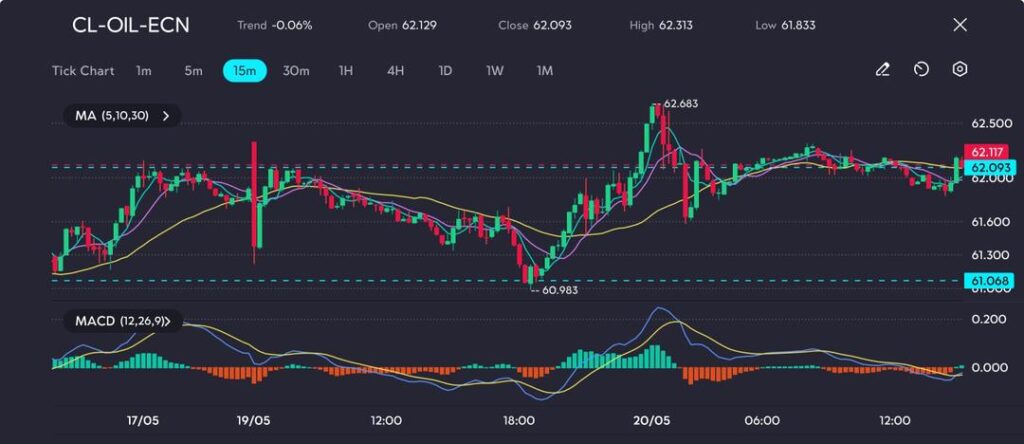
WTI crude oil continues to consolidate, with prices holding within a narrow band after bouncing off support near USD 60.98 and peaking at USD 62.68.

On the 15-minute chart, price movement has flattened, with candles clustering above the 30-period moving average.

Short-term MAs (5 and 10) are converging, signalling a pause in directional momentum.

Oil holds above USD 62 after bounce off USD 61.00; upside capped at USD 62.70 as momentum stalls, as seen on the VT Markets app.

The MACD histogram is showing a weakening bullish trend, with a potential bearish crossover near the zero line—indicating that buyers may be losing control.

Still, the price remains above the key support zone at USD 61.80, offering near-term stability.

Immediate resistance lies between USD 62.30 and USD 62.70, while a drop below USD 61.80 may pave the way toward USD 61.07.

If bulls manage a strong close above USD 62.30, a renewed push higher could follow. Until then, the short-term bias remains neutral to slightly bearish.

Outlook: Wait-and-see mode prevails

With WTI crude stuck between USD 60.98 and USD 62.68, the market remains directionless, awaiting more decisive signals.

Price action is likely to stay range-bound unless there are clear developments in US–Iran talks, Chinese economic policy, or global diplomatic efforts.

Traders are advised to stay flexible and monitor headlines closely for any shift in fundamentals that could trigger a breakout from the current consolidation.

Click here to open account and start trading.

US stocks rose, with Emini S&P surpassing 5890, achieving the predicted targets of 5925/30 and 5950/60

Emini Dow Jones Potential Movement

EUR/USD held above 1.1250 amidst US Dollar weakness. GBP/USD found support and tested 1.3400 amid trade uncertainty. Gold prices held above $3,200 despite intraday losses. Optimism from possible Russia-Ukraine ceasefire buoyed cryptocurrencies, and Chinese economic activities showed mixed results in April due to trade war uncertainties.

We saw equities testing familiar ceilings and retracing into support zones, with most of the action lining up neatly with technical setups. The S&P e-mini, for instance, bumped against that 5960/65 belt again, a range that’s frequently offered resistance. It nudged past 5980 briefly, touching 5993, but pulled back fairly quickly — a sign the buyers lacked commitment at those levels, possibly due to the overbought conditions.

Underneath, the day’s low at 5893 aligned with the previous day’s bottom, forming what seems like a near-term floor. As long as price action continues to hold above 5950 or even 5965, we’re likely to probe back up toward round numbers like 6000 and even push past there depending on momentum. A break and hold below 5950, however, would imply early weakness creeping in, and that could open the downside to retest 5910—or extend lower.

Nasdaq Support Analysis

The Nasdaq offered a textbook reaction. That 21200/21100 region had been on our radar and price bounced precisely off it, making those levels valid again for any retests in the coming sessions. There was well over 400 points to be made from longs off support if executed within risk limits, especially keeping stops sensible below 20950. What must be watched now is how the index behaves if 21100 gives way—20840/820 is the next logical zone to reassess, with 20650/600 becoming relevant only if weakness accelerates meaningfully.

In the Dow e-mini, we moved off that 42470/430 bracket to reach a high close to 42950. This stretch played out in line with expectations and pointed to further upside into the 43100/150 region. That said, slipping back under 42300 could start to pinch, taking the fight back down to 41950/850, and from there traders might begin to shift focus toward risk-adjusting positions, particularly if volatility picks up.

Shifting out of equities, we saw the Euro manage to stay comfortably above 1.1250. That’s not surprising considering the consistent pressure on the Dollar lately. Buying interest hasn’t been aggressive but it’s there, and as long as that base holds, the pair could nudge higher with any Dollar pullback. For Sterling, the 1.3400 touch brought in some activity in light of recent trade policy uncertainty, more so from the UK camp. Positioning around this figure could tighten for now, awaiting further clues from macro headlines or central bank speak.

Gold continues to show resilience. Despite some intraday softness, values remained anchored above $3,200. There’s some sense that holdings remain sticky as investors hedge for broader tensions. While there wasn’t a breakout, we shouldn’t dismiss the staying power, especially with global inflation expectations still unresolved in markets.

Digital assets found support through geopolitical peace murmurs, most notably regarding Russia and Ukraine. That, combined with softer remarks from Fed officials recently, fed into a mild reprieve. In Asia, mixed output data from China is leaving regional trade outlooks uneven. The numbers don’t reflect full-scale reacceleration, which traders with an eye on commodities may want to factor in when weighing long-term exposure across cyclicals.

In the days ahead, the technical patterns suggest re-engagement in moderate ranges rather than sharp breaks. Support and resistance zones continue to offer livable trade structure. How these levels hold or fail will shape trade setups, and recognising when to stay directional versus reverting to range strategies may prove the difference—especially if external headlines remain in play.

Create your live VT Markets account and start trading now.

Consolidating near 100.35, the US Dollar Index hovers close to a week’s low

The US Dollar struggles to gain traction as expectations for further Federal Reserve interest rate cuts in 2025 weigh it down. This follows recent softer US CPI and PPI releases, alongside lacklustre US Retail Sales data.

The US Dollar Index sees limited movement around the 100.35 area, remaining near a recent low. A disappointing credit rating downgrade for the US adds pressure on the dollar.

Factors Affecting The US Dollar

US-China tariff reductions have eased recession fears, limiting aggressive bearish USD positions. Hawkish remarks from FOMC members also provide some support to the dollar.

No major economic data is scheduled for release on Tuesday. Focus is on upcoming speeches by FOMC members to influence USD movements.

In currency dynamics, the USD has shown mixed performance, with the strongest gain against the Australian Dollar. The heat map illustrates percentage changes of major currencies against each other on a given day.

Understanding how to navigate market risks and the volatile nature of currency exchange remains crucial, with careful research advised for any investment decisions.

The initial section outlines a rather muted period for the US Dollar, largely shaped by shifting expectations around the trajectory of interest rates in the United States. Recent inflation readings – both consumer and producer – have come in softer than anticipated. This soft tone in pricing data, coupled with weaker-than-expected retail spending figures, has dampened enthusiasm for the dollar, especially with markets increasingly leaning toward the likelihood that the Federal Reserve will cut rates further next year.

This sentiment has found a clear expression in the US Dollar Index, which is treading water near the 100.35 mark – an area it has struggled to move away from. Importantly, that’s close to its recent lows, suggesting a lack of upward impetus. It’s not helped by external factors either. The US recently received a downgrade in its national credit rating, which hasn’t gone unnoticed by global markets. This sort of development tends to dent investor confidence in a country’s fiscal strength – and, by extension, its currency’s appeal.

That said, there are counterweights. Fresh signs of easing on US-China tariffs appear to have calmed global recession anxieties to some extent. As such, traders aren’t piling into aggressively bearish positions just yet. Additionally, recent statements from Federal Open Market Committee figures have struck a more hawkish tone – hinting at a reluctance to cut rates too soon or too deeply. This seems to be keeping the dollar from sliding further, at least for now.

Monitoring Market Developments

There’s nothing major on the economic calendar for Tuesday, which shifts the spotlight to upcoming speeches from Fed officials. When the data front is quiet, these public appearances often pack more market-moving potential than usual. We’ve seen that before.

Elsewhere, when comparing the dollar to its peers, the picture is mixed. It’s gained the most ground against the Australian dollar – perhaps unsurprising given recent weakness in commodities and China-driven demand. A heat map analysis highlights these differences, reflecting how major currencies shift against one another during the day. These visuals help frame currency performance in relative terms, which can aid tactical positioning over short-term horizons.

For our part, the recent pattern is one that demands a calibrated approach. With fewer extremes in either direction and the dollar in a narrow range, markets appear somewhat undecided. We’re looking at swings that are likely to be linked more to messaging from monetary authorities than the data itself in the immediate term. That tends to make short-term price action less predictable by conventional measures and more sensitive to nuance.

As it stands, any bets without clear momentum carry higher risks of reversion, not just in USD pairs broadly, but particularly in those where rate differentials are in flux. Understanding that central banks aren’t retreating from forward guidance makes their speeches even more relevant in shaping expectations. Traders will need to stay nimble.

Create your live VT Markets account and start trading now.

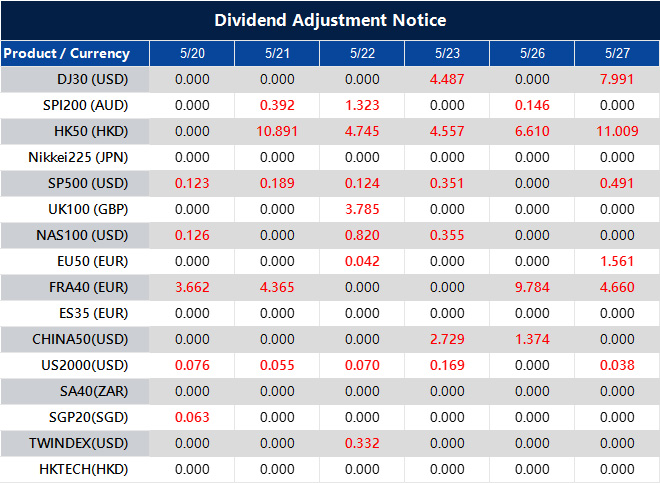
Dividend Adjustment Notice – May 20 ,2025

Dear Client,

Please note that the dividends of the following products will be adjusted accordingly. Index dividends will be executed separately through a balance statement directly to your trading account, and the comment will be in the following format “Div & Product Name & Net Volume”.

Please refer to the table below for more details:

Dividend Adjustment Notice

The above data is for reference only, please refer to the MT4/MT5 software for specific data.

If you’d like more information, please don’t hesitate to contact info@vtmarkets.com.

Following the May policy announcement, Governor Bullock of the RBA indicated potential future adjustments

The Reserve Bank of Australia reduced the benchmark interest rate by 25 basis points to 3.85% from 4.1%. This decision aims to manage inflation and comes amidst discussions on rate adjustments and market stability concerns.

The Australian Dollar has reacted to this announcement, with the AUD/USD pair trading lower around 0.6430, a decrease of 0.39% for the day. The decision was reached through consensus, showing deliberations on different rate cut options.

Factors Influencing The Australian Dollar

Key factors influencing the Australian Dollar include the interest rates set by the RBA, iron ore prices, and the health of the Chinese economy. Positive economic indicators, such as higher iron ore prices or a strong trade balance, support the AUD.

Changes in the Chinese economy can directly impact Australia’s currency value. Strong Chinese growth fuels demand for Australian exports, benefiting the AUD. Conversely, slower Chinese growth can negatively affect the currency.

Iron ore, Australia’s largest export, significantly affects the AUD. Higher iron ore prices typically boost the AUD, aligning with a positive trade balance. A positive trade balance implies greater demand for Australian exports, strengthening the national currency.

The Reserve Bank’s move to trim rates by 25 basis points to 3.85% signals a shift towards easing financial conditions, with the aim of taming inflation that remains above target. By reducing the cost of borrowing, they attempt to support economic activity without letting price pressures spiral. Inflation data has been running hot, but forward indicators, especially regarding labour market slack and retail spending softening, likely gave enough reason to take a more dovish step.

Market Reactions and Expectations

Market pricing into the decision already hinted at easing expectations, suggesting some of this was already baked into rates markets. Nevertheless, the Australian Dollar’s dip post-announcement showed that traders had perhaps underestimated the immediate scale or timing of the change. With AUD/USD slipping below 0.6450, the move suggests interest rate differentials are weighing more heavily now, particularly as other central banks continue on a diverging policy path—most notably the US Federal Reserve maintaining a tighter stance for longer, creating further downside pressure on the carry appeal of the Australian currency.

What we can interpret from this is that the broad sensitivity of the AUD to commodity cycles and Chinese demand remains intact. We’re not just watching iron ore prices rise and fall anymore—they now serve as an amplified signal of current and future demand conditions. China’s GDP growth targets, factory output, and construction data are playing a more outsized role in driving the AUD’s day-to-day behaviour, especially as policy easing in China has remained cautious so far.

With iron ore still acting as a reliable barometer for Australia’s export strength, and with global risk sentiment appearing less stable amid continued geopolitical uncertainty, it’s reasonable for us to lean toward setups that favour tactically short positioning during negative news cycles, especially when Chinese demand data underperforms expectations. However, one must act carefully if iron ore prices begin to show resilience despite soft economic prints elsewhere—this decoupling, while rare, can create false signals.

Traders in derivatives are already noticing implied volatility hovering near its recent highs, suggesting that uncertainty around upcoming data releases—particularly Chinese PMI prints, inflation reports, and supply chain bottlenecks—will invite sharper re-pricings. If we see implied vols begin to fall without a fundamental improvement in trade data or commodity flows, then that should be interpreted as overly optimistic sentiment, not structural improvement.

With the RBA’s rate decision now behind us, forward expectations quickly become the more tradable element. Risk reversals in AUD options are already beginning to reflect a bias toward further downside, meaning there is both positioning opportunity and caution baked into current markets. We should be prepared to adjust short-term strategies as even minor economic surprises, particularly from China or commodity exporters, have the ability to trigger sharp intraday moves with volumes concentrated around key support zones below 0.6400.

In this context, any fresh buyers stepping into AUD positions will likely be relying on either a stabilisation in Chinese data or another coordinated response from Australian policymakers—in essence, we are in a phase where tactical positioning can outperform long-term directional trades. Be mindful of liquidity pockets and calendar spreads around key global macro data, as these are becoming more erratic and prone to short-term dislocations, especially heading into the next few weeks of trade balance and employment figures being released.

Create your live VT Markets account and start trading now.

Near 93.00, selling pressure mounts on AUD/JPY as the RBA’s interest rate decision unfolds

Speculation On BoJ Interest Rate Hikes

The AUD/JPY is trading around 93.00, down by 0.55% during Tuesday’s Asian session. This follows the Reserve Bank of Australia’s (RBA) decision to cut the Official Cash Rate by 25 basis points to 3.85% at its May meeting.

The Australian Dollar sees a decline as attention turns to RBA Governor Michele Bullock’s press conference. The RBA views the escalation of global trade conflicts as a risk to the economy, with a downgraded global growth outlook due to US tariff policies.

Speculation is rising around the Bank of Japan’s potential interest rate hikes this year, offering support to the Japanese Yen. BoJ Deputy Governor Shinichi Uchida expressed expectations for Japan’s inflation to pick up, suggesting continued rate increases if the economy and prices improve.

The RBA manages monetary policy with the aim of maintaining price stability and supporting economic welfare, with interest rate manipulation as its primary tool. High interest rates often strengthen the Australian Dollar, and QE and QT are additional tools for managing economic conditions.

Macroeconomic indicators like GDP and employment figures can impact currency value, with a robust economy typically favouring higher interest rates. While higher inflation traditionally weakens a currency, it can now attract capital and strengthen it by prompting interest rate increases.

RBA’s Impact On AUD/JPY Trades

With the AUD/JPY pair drifting lower near the 93.00 handle, there’s an obvious loss of momentum that can’t be separated from the Reserve Bank of Australia’s latest move. Lowering the Official Cash Rate to 3.85%, the central bank stepped away from the trend seen in recent quarters, introducing a more dovish bias amid external uncertainties. This is not only a shift in rates but a signal. Markets don’t like uncertainty, and we’ve begun to see this reflected in the Aussie’s tapering strength.

As speculation brews, it isn’t just about what the RBA did—but what they might do next. The mention of global trade tensions, sparked largely by the US tariff path, adds turbulence to the macro picture. Policy response, from our point of view, appears slightly defensive. Investors will be closely monitoring any signs of further easing. Bullock’s tone in the press conference suggests the board sees more external threats than local drivers. If those concerns don’t ease, it’s fair to expect limited rate increases from this side anytime soon, possibly even hints at a longer rate pause.

Switching to Japan, inflation expectations are taking a clearer shape. Uchida’s comments provide a broader direction for the Bank of Japan, which hasn’t traditionally been quick to act. If price pressures build further, we’ll probably start to see policy normalisation step up decisively. With rising inflation likely to stay above 2%, and markets expecting a change in BoJ’s approach, capital could continue favouring the Yen in the months ahead. Market pricing suggests that even cautious hikes are being taken seriously now.

Given this, we found it best to reassess directional bias in carry trades. The shrinking yield gap between the Aussie and Yen isn’t theoretical anymore—it’s in motion. Australian rates trending lower or flat, alongside a potential shift in Japanese policy, reduces long positions’ appeal across both leveraged and institutional strategies. The reward for risk in these trades could vanish quickly if the BoJ acts more quickly than the market currently expects.

We should also focus more on reading employment data and inflation gauges for better positioning. In recent cycles, inflation accelerating past expectations has led markets to reprice entire forward curves within days. This alone creates volatility, which short-dated options traders can use when pricing premium. But in directional terms, known macro catalysts—like Australia’s job numbers or Japan’s wage growth—will act as the next ignition points. Misses or surprises here won’t just move spot rates; they’ll distort implied vols and skew positioning on both sides.

What’s clear is that the traditional relationships between rates, inflation, and currency strength are shifting—quickly. Policy makers are responding to post-pandemic economic dynamics: higher inflation no longer implies weakness, at least not by old standards. Now, a surprise on CPI can imply a tightening bias instead of a real wage squeeze. This rewires how we assess fundamentals.

In this context, we’ve started adjusting term structure assumptions. Particularly on the Aussie side, traders should weigh premium build-up in long-dated options against rates compression. A flatter curve may make longer expiry options more attractive as reaction trades. On the Yen side, any hint at a rate hike or balance sheet tightening may inject sharp front-end volatility—a short gamma profile here can be costly without solid protection layers in place.

Practically, this means recalibrating strategy away from static long AUD/JPY trades held purely for carry. Momentum trades attempting to ride yield differential must now contend with political risks, macro downgrades, and unexpected policy noise—all of which heighten short-term risk. We’ve already begun rebalancing exposure to more dynamic setups, including spreads designed to profit from realised versus implied volatility mismatches. Skew is becoming more informative than spot.

Traders aligned to mid-term outcomes should keep their eyes on the next BoJ policy remarks. To stay adaptive, it’s wiser not to lean too heavily on parallel moves between these two currencies. Both central banks are now beginning to follow diverging paths after months of alignment. That divergence—if clear enough—could present some opportunity, but only for those positioned with flexibility and a firm handle on rate expectations.

Create your live VT Markets account and start trading now.

The RBA’s interest rate decision aligned with expectations at 3.85% in Australia

The Reserve Bank of Australia announced its interest rate decision, keeping it steady at 3.85%. This figure met prior forecasts, serving as a stable indicator for economic projections.

The EUR/USD currency pair advanced beyond 1.1250 in the European session. This movement is linked to a weakened US Dollar amid economic uncertainties and changes in US tariffs.

Gbp Usd And Stability

In another market, GBP/USD maintained its position above 1.3350 despite the underperforming USD. This stability is observed amidst global trade uncertainties and anticipation around economic data releases.

Gold prices experienced slight intraday losses but remained above $3,200. Investor hope for a Russia-Ukraine ceasefire contributes positively to this steady position amidst an optimistic trade environment.

Solana (SOL) demonstrated recovery after the introduction of the Alpenglow consensus protocol. This protocol aims to replace the existing Proof-of-History and TowerBFT mechanisms.

In China, the April economic data reflected a slowdown tied to trade war anxieties. However, the manufacturing sector showed resilience against these trends, preventing a more substantial contraction.

Short Term Economic Direction

With the Reserve Bank holding rates at 3.85%, the anticipated pause has helped reinforce expectations around short-term economic direction. What this tells us is that inflation pressure may not have warranted further tightening just yet, but underlying caution remains. Sticking to forecasts grants us a firmer footing when calculating hedging costs or adjusting forward rate agreements portfolio-wide. For now, yield curve sensitivity to minor inflation revisions looks subdued, though could shift quickly if labour or housing indicators swing harder than forecast.

Hoffman’s recent movement in the EUR/USD pair offers useful hints—largely driven not by shifts in the European bloc itself, but by mounting fragility in US economic outlook. Tariff adjustments paired with fiscal hesitations leave the Greenback under pressure. We should expect a retest around the 1.1280-1.1300 zone if additional US data misses occur, particularly if services figures soften or nonfarm job growth slows. Options pricing already reflects an increased premium on top-side calls, suggesting that buyers are guarding against a broader EUR breakout. If momentum steadies near 1.1250, constructing short-volatility positions below strike thresholds may offer value in the week ahead.

The steadiness in the Sterling-Dollar rhythm, so far holding above 1.3350, appears to reinforce the pattern of confidence in the pound that we’ve seen since Q1. While the US side isn’t offering much resistance due to softening demand-side indicators, the UK still contends with domestic price stickiness. Markets seem split between expecting a Bank of England hold and a mild hike, so implied volatility around key economic announcements remains high. Directional exposure here has to be closely tied to rate expectations—any hawkish remarks from Broadbent could nudge the cross above 1.3450 without much volume.

Gold sustaining above $3,200 despite fading daily demand and temporary losses is partly reassurance, partly warning. On one hand, the war premium from Eastern Europe appears muted for now. On the other, we know well how quickly safety flows return with renewed volatility. Physical buyers aren’t back in scale, but ETF flows have stabilised. If this medium-range stability holds, we’d be wary of volatility sellers getting over-confident—especially ahead of any sudden macro switch. Keeping duration short on Gold-linked derivatives seems logical under these conditions.

The surge in Solana after rollout of its Alpenglow protocol signals that technical innovation alone still carries weight, particularly in how traders assess efficiency. It doesn’t yet correct for network reliability concerns but indicates a shift in public valuation metrics. Derivatives linked to decentralised assets will need tighter stop orders short-term—the correlation with broader tech indices has been loosening. Given how sudden volume spikes can trigger cascading adjustments, any leveraged trades on DeFi product derivatives should keep slippage risk sharply in focus.

Turning to China, April’s softer numbers added drag but didn’t fully unwind momentum; manufacturing managed to hold up in the face of tariff weight. This points to selective resilience rather than system-wide endurance. As traders, this narrower strength tells us more about individual sector health than macro stability. If material costs drop further while demand holds up even modestly, there’s a case for re-assessing short positions on commodities tied directly to Chinese output, particularly base metals. Futures on copper, for example, may now have stronger support near recent lows if upstream industrial stocks continue to signal persistent factory activity.

What we see developing across these markets is less systemic reaction and more tactical rebalancing. Timing entries and exits around data calendar releases remains essential while volatility remains within the current range-bound framework.

Create your live VT Markets account and start trading now.

After the PBoC cut rates, NZD/USD hovers around 0.5900, experiencing downward pressure in trading

NZD/USD experienced losses after the People’s Bank of China cut its one-year Loan Prime Rate to 3.00% from 3.10%. The pair trades around 0.5920 during Tuesday’s Asian session, pressured by China’s latest interest rate decision.

China cut its Loan Prime Rates, with the one-year LPR now at 3.00% and the five-year LPR at 3.50%. These changes often affect the New Zealand Dollar due to the close trade relationship between New Zealand and China.

April Economic Data In China

In China, April’s mixed economic data were analysed. Industrial production exceeded forecasts despite a slowdown, while retail sales rose less than expected. New Zealand faced inflationary pressures, with Q1 data showing the largest rise in producer prices in nearly three years.

Attention turns to the Reserve Bank of Australia’s rate decision later today, with a 25 basis point cut anticipated despite positive employment data. The US Dollar weakened following a downgrade of the US credit rating by Moody’s from Aaa to Aa1 amid concerns over rising debt and fiscal challenges.

The New Zealand Dollar was weakest against the British Pound in the currency market today. Changes in currency values were shown in a detailed heat map, indicating various movements between major currencies.

We’ve seen a retreat in the New Zealand Dollar against the US Dollar, mostly sparked by Beijing’s latest easing move. The People’s Bank of China trimmed both its one-year and five-year Loan Prime Rates, pulling the Kiwi lower in early Tuesday trades in Asia. This adjustment, especially the drop in the one-year LPR from 3.10% to 3.00%, tends to cascade beyond domestic markets, particularly across countries with deep trade links to China.

With China taking steps towards lower borrowing costs, it signals continued concerns from policymakers about the sustainability of their growth – even as some macro indicators surprise to the upside. April’s factory output in China surpassed expectations, indicating momentum in industrial sectors. Yet, the concurrent disappointment in retail consumption softens the headline, suggesting that domestic demand still lags, which could further dampen external partners like New Zealand that rely heavily on export-driven revenue from raw materials and dairy.

New Zealand Inflationary Pressures

On our end, New Zealand saw a notable quarterly increase in producer prices – a development not matched since nearly 2021. That shift heightens near-term cost pressures for businesses, potentially feeding into inflation expectations, even if consumer-facing inflation remains somewhat contained. These dynamics open the way for policy conversations to become more complicated, as rate-sensitive instruments may start to diverge in response to supply-led expenses.

Across the Tasman, Australia is poised for a potential rate move, with markets leaning towards a 25 basis point cut. What’s striking here is that the employment figures have been relatively robust of late, so a pivot towards easing in that context shows how inflation targets might be given heavier weight by the central bank. Depending on the eventual verdict, derivatives tied to Aussie rates and currency volatility may need reassessment — particularly for those who were positioning for another hold.

Stateside, Moody’s recent downgrade of the United States’ credit rating has already sent ripple effects through the dollar. Though the downgrade to Aa1 from Aaa does not reclassify the dollar as anything less than investment-grade, it draws more attention to the sheer size of the federal deficit and related governance questions. This has introduced skittishness in pricing US risk – a move we’ve noticed in Treasury yields, which have baked in a slightly different mix of terminal rates and inflation expectations since the decision.

For positioning, with the New Zealand Dollar falling hardest against Sterling, we’re watching the GBP/NZD rate closely. The Pound’s resilience here could reflect a rebalancing of flows towards perceived stability — which, when overlaid with MPC policy stances, may impact volatility structures and implied interest rate differentials. The heat map highlights how cross-pairs are diverging more sharply, meaning spread trades and relative rate strategies may become more sensitive to second-tier data.

Monitor yield spreads across key duration buckets, particularly between antipodean nations and their counterparts in Europe and North America over the next fortnight. Short interest spikes tell us positioning is far from uniform — and that creates space for targeted repricing based on regional data surprises. Keep in mind the role of liquidity pockets heading into month-end, especially as fund hedging channels begin to adjust quarterly footing.

Create your live VT Markets account and start trading now.

Back To Top
server

Hello there 👋

How can I help you?

Chat with our team instantly

Live Chat

Start a live conversation through...

  • Telegram
    hold On hold
  • Coming Soon...

Hello there 👋

How can I help you?

telegram

Scan the QR code with your smartphone to start a chat with us, or click here.

Don’t have the Telegram App or Desktop installed? Use Web Telegram instead.

QR code