Back

A Complete Guide to the Best Hedging Strategies with ETFs

The Best Hedging Strategies for ETFs Trading

If you are an investor looking to reduce risk in a volatile market, consider hedging strategies with ETFs. Hedging protects your portfolio from adverse price movements by taking an opposite position in another asset.

ETFs, or exchange-traded funds, are collections of securities that track an index, sector, commodity, or theme. They offer low-cost, diversified, and liquid exposure to various markets. Let’s explore what hedging strategies with ETFs are, how they work, and some of the best strategies to protect your portfolio. We will also provide examples to illustrate how they can reduce risk and enhance returns.

What are Hedging Strategies with ETFs?

Hedging strategies with ETFs involve using ETFs to offset the risk of another investment. For example, if you own a portfolio of stocks sensitive to the US economy, you might hedge against a possible recession by buying an ETF that tracks US Treasury bonds. If the stock market declines due to a recession, the bond ETF should rise in value, cushioning your losses.

Hedging strategies with ETFs can be classified into two types: passive and active.

Passive Hedging

Passive hedging strategies involve buying and holding an ETF that has a negative correlation with your portfolio. This means the ETF tends to move in the opposite direction of your portfolio. For example, if you own a portfolio of technology stocks, you might buy an ETF that tracks gold, a safe-haven asset during uncertainty.

Active Hedging

Active hedging strategies involve adjusting your exposure to an ETF based on your market outlook and risk tolerance. You can increase or decrease the size of your hedge depending on your confidence in your portfolio. For example, if you own a portfolio of emerging market stocks, you might buy an ETF that tracks the US dollar, which tends to appreciate when emerging markets face challenges. You can reduce your exposure to the dollar ETF when you expect emerging markets to recover.

How Does It Work?

Hedging strategies with ETFs work by balancing your portfolio and the ETF used as a hedge. The goal is to reduce overall volatility and risk without sacrificing too much potential return. To achieve this, consider three factors: correlation, beta, and hedge ratio.

Correlation

Correlation measures how closely two assets move together. It ranges from -1 to 1:

  • -1: Perfect negative correlation (move in opposite directions)
  • 0: No correlation (move independently)
  • 1: Perfect positive correlation (move in the same direction)

Ideally, use an ETF with a negative correlation to your portfolio as a hedge.

Beta

Beta measures how sensitive an asset is to movements of another asset. It is calculated by dividing the covariance between the two assets by the variance of the other asset. For example, if an ETF has a beta of 0.5 relative to your portfolio, it moves 0.5% for every 1% movement in your portfolio. Use an ETF with a low beta relative to your portfolio as a hedge.

Hedge Ratio

Hedge ratio is the proportion of your portfolio you want to hedge with an ETF. It is calculated by multiplying the beta of the ETF by the value of your portfolio and dividing by the value of the ETF. For example, if you have a $10,000 portfolio with a beta of 1 relative to an ETF worth $100 with a beta of 0.5, your hedge ratio would be (0.5 x 10,000) / 100 = 50%. This means you need to buy 50 shares of the ETF to hedge 50% of your portfolio.

Best Hedging Strategies with ETFs

Here are some of the best hedging strategies with ETFs to consider:

Hedging Against Inflation

Inflation erodes the purchasing power of money and reduces the real value of your investments. To hedge against inflation, use ETFs that track commodities like gold, silver, oil, or agricultural products. These ETFs rise in value when inflation increases. Alternatively, use ETFs that track inflation-protected securities like Treasury Inflation-Protected Securities (TIPS).

Hedging Against Interest Rate Risk

Interest rate risk affects the value of bonds and other fixed-income securities. When interest rates rise, bond prices fall. Hedge against this risk using ETFs that track inverse or short-term bonds like ProShares Short 20+ Year Treasury ETF (TBF) or iShares 1-3 Year Treasury Bond ETF (SHY).

Hedging Against Currency Risk

Currency risk affects the value of foreign investments and earnings due to changes in exchange rates. When the US dollar weakens, foreign investments become more valuable in dollar terms. Hedge against currency risk using ETFs that track foreign currencies like Invesco CurrencyShares Euro Trust (FXE) or WisdomTree Japanese Yen Strategy Fund (JYF).

Hedging Against Market Risk

Market risk involves losing money due to changes in market conditions. Hedge against market risk using ETFs that track inverse or alternative assets like ProShares Short S&P500 ETF (SH) or Amplify BlackSwan Growth & Treasury Core ETF (SWAN).

Hedging Strategies Examples

To illustrate how hedging strategies with ETFs work, let’s look at two examples:

Example 1:
You have a $10,000 portfolio of US stocks with a beta of 1 relative to the S&P 500 index. You want to hedge 50% of your portfolio against a market downturn using an inverse S&P 500 ETF worth $50 with a beta of -1. Your hedge ratio would be (-1 x 10,000) / 50 = -200%. You need to buy 200 shares of the inverse S&P 500 ETF to hedge 50% of your portfolio. If the S&P 500 index drops by 10%, your portfolio loses $1,000, but your hedge gains $1,000, resulting in a net loss of $0.

Example 2:
You have a $10,000 investment in a European company paying dividends in euros. You want to hedge 100% of your investment against a US dollar appreciation using a euro ETF worth $100 with a beta of 1 relative to the euro/US dollar exchange rate. Your hedge ratio would be (1 x 10,000) / 100 = 100%. You need to buy 100 shares of the euro ETF to hedge 100% of your investment. If the euro/US dollar exchange rate drops by 10%, your investment loses $1,000, but your hedge gains $1,000, resulting in a net loss of $0.

Conclusion

Hedging strategies with ETFs provide a practical way to protect your portfolio from market volatility. By understanding and implementing these strategies, you can reduce risk and enhance returns. Consider your investment goals, risk tolerance, and market outlook when choosing the best hedging strategies for your needs.

FAQ

Q: What are the benefits of hedging with ETFs?

A: Hedging with ETFs offers diversification, liquidity, and cost-efficiency. It helps reduce portfolio risk and manage market volatility effectively.

Q: Can beginners use hedging strategies with ETFs?

A: Yes, beginners can use hedging strategies with ETFs. Start with simple strategies and gradually explore more complex ones as you gain experience.

Q: How do I choose the right ETF for hedging?

A: Choose an ETF that has a negative correlation or low beta relative to your portfolio. Consider the ETF’s performance, fees, and market conditions.

Q: Are there any risks associated with hedging with ETFs?

A: Yes, hedging with ETFs involves risks such as tracking errors, market risk, and potential costs. It’s essential to understand these risks and manage them effectively.

Q: How often should I review my hedging strategy?

A: Regularly review your hedging strategy, especially during market changes or when your investment goals shift. Adjust your hedges as needed to align with your objectives.

Q: What is the difference between passive and active hedging?

A: Passive hedging involves holding an ETF with a negative correlation to your portfolio, while active hedging adjusts ETF exposure based on market outlook and risk tolerance.

Q: Can I hedge against multiple risks with ETFs?

A: Yes, you can hedge against various risks such as inflation, interest rate, currency, and market risk using different ETFs tailored to each risk type.

Q: How do I calculate the hedge ratio?

A: Calculate the hedge ratio by multiplying the ETF’s beta by the value of your portfolio and dividing it by the value of the ETF.

Ready to explore hedging strategies with ETFs? Find out more on our ETFs Trading page. Visit VT Markets for information on FX Trading and more.
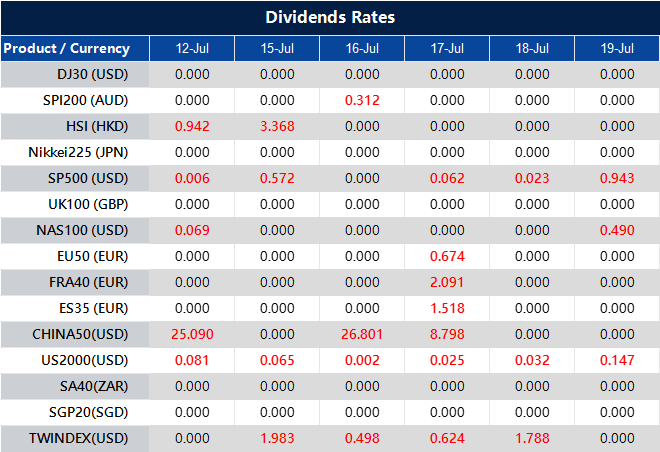
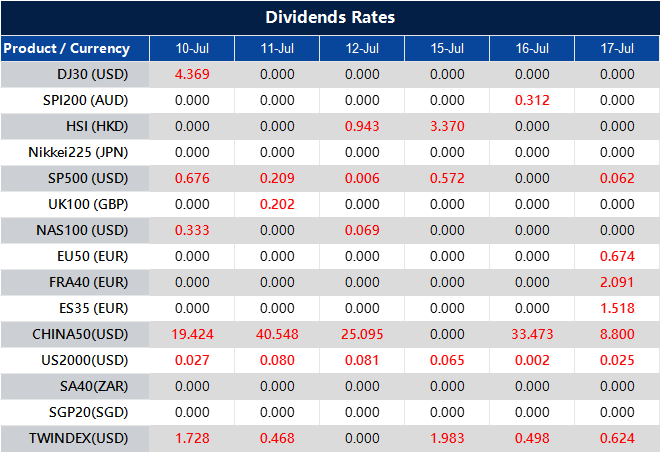
Dividend Adjustment Notice – July 12,2024

Dear Client,

Please note that the dividends of the following products will be adjusted accordingly. Index dividends will be executed separately through a balance statement directly to your trading account, and the comment will be in the following format “Div & Product Name & Net Volume ”.

Please refer to the table below for more details:

The above data is for reference only, please refer to the MT4/MT5 software for specific data.

If you’d like more information, please don’t hesitate to contact info@vtmarkets.com.

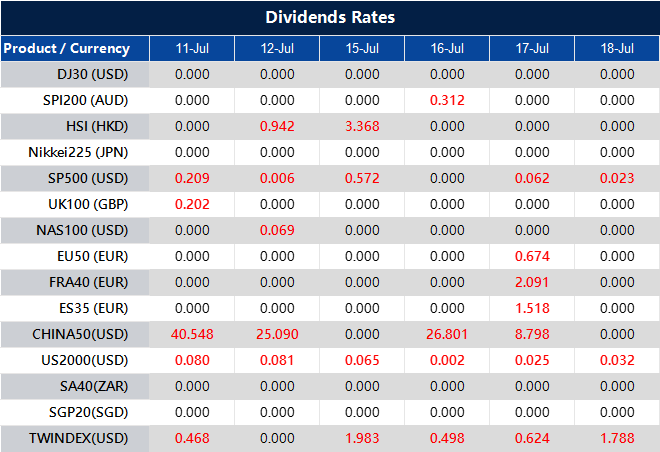
Dividend Adjustment Notice – July 11,2024

Dear Client,

Please note that the dividends of the following products will be adjusted accordingly. Index dividends will be executed separately through a balance statement directly to your trading account, and the comment will be in the following format “Div & Product Name & Net Volume ”.

Please refer to the table below for more details:

The above data is for reference only, please refer to the MT4/MT5 software for specific data.

If you’d like more information, please don’t hesitate to contact info@vtmarkets.com.

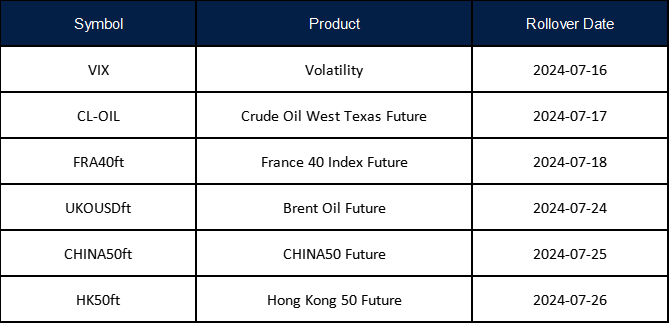
July Futures Rollover Announcement – July 10,2024

Dear Client,

New contracts will automatically be rolled over as follows:

Please note:

• The rollover will be automatic, and any existing open positions will remain open.

• Positions that are open on the expiration date will be adjusted via a rollover charge or credit to reflect the price difference between the expiring and new contracts.

• To avoid CFD rollovers, clients can choose to close any open CFD positions prior to the expiration date.

• Please ensure that all take-profit and stop-loss settings are adjusted before the rollover occurs.

• All internal transfers for accounts under the same name will be prohibited during the first and last 30 minutes of the trading hours on the rollover dates.

If you’d like more information, please don’t hesitate to contact info@vtmarkets.com.

Dividend Adjustment Notice – July 10,2024

Dear Client,

Please note that the dividends of the following products will be adjusted accordingly. Index dividends will be executed separately through a balance statement directly to your trading account, and the comment will be in the following format “Div & Product Name & Net Volume ”.

Please refer to the table below for more details:

The above data is for reference only, please refer to the MT4/MT5 software for specific data.

If you’d like more information, please don’t hesitate to contact info@vtmarkets.com.

A Complete Guide to the Different Kinds of Forex Charts

A Guide To Different Kinds Of Forex Charts

Forex trading requires the right tools for success. One of these essential tools is the forex chart. A forex chart displays the price movements of currency pairs over time. Understanding different types of forex charts can significantly enhance your trading strategy.

Line Charts

Line charts are the simplest form of forex charts. They connect closing prices of a currency pair over a specific period with a continuous line. Traders use line charts to identify general price trends. The simplicity of line charts makes them easy to understand, especially for beginners. However, they do not provide detailed information like opening, high, or low prices.

Advantages of Line Charts

  • Easy to understand
  • Ideal for identifying trends
  • Less cluttered, providing a clear view

Disadvantages of Line Charts

  • Lack of detailed price information
  • Less useful for short-term trading

Bar Charts

Bar charts are more complex than line charts. They provide more detailed information about price movements. Each bar represents one period (such as one day or one hour) and shows the opening, high, low, and closing prices. This chart type helps traders understand price fluctuations within a period.

Advantages of Bar Charts

  • Detailed price information
  • Useful for both short-term and long-term analysis
  • Helps identify volatility

Disadvantages of Bar Charts

  • More complex to read
  • Can become cluttered with too much data

Candlestick Charts

Candlestick charts are the most popular type of forex chart. They originated in Japan and provide comprehensive price information. Each candlestick shows the opening, high, low, and closing prices for a period. The body of the candlestick represents the price range between the opening and closing prices. The wicks (or shadows) show the high and low prices.

Candlestick charts are valuable for identifying market sentiment and potential reversals. They come in various patterns that traders use to predict future price movements.

Advantages of Candlestick Charts

  • Comprehensive price information
  • Visual appeal and easy to interpret
  • Useful for identifying market sentiment and trends

Disadvantages of Candlestick Charts

  • Can be complex for beginners
  • Requires understanding of various candlestick patterns

Renko Charts

Renko charts are based on price movement rather than time. They consist of bricks that move up or down at a fixed price interval. This chart type helps traders eliminate noise and focus on significant price movements.

Advantages of Renko Charts

  • Reduces market noise
  • Helps identify trends more clearly
  • Simple to read

Disadvantages of Renko Charts

  • Lack of time information
  • May not show all price activity

Point and Figure Charts

Point and figure charts are also based on price movement and ignore time. They use Xs and Os to represent price changes. Xs indicate rising prices, while Os indicate falling prices. This chart type helps traders identify support and resistance levels.

Advantages of Point and Figure Charts

  • Focuses on significant price movements
  • Helps identify trends and breakouts
  • Clear support and resistance levels

Disadvantages of Point and Figure Charts

  • No time element
  • Can be complex for beginners

Heikin-Ashi Charts

Heikin-Ashi charts are a variation of candlestick charts. They use average price data to create smoother, more visually appealing charts. This type helps traders identify trends and potential reversals more easily.

Advantages of Heikin-Ashi Charts

  • Smooths out price fluctuations
  • Easy to identify trends
  • Reduces noise and false signals

Disadvantages of Heikin-Ashi Charts

  • Delayed signals due to averaging
  • May miss important price details

Kagi Charts

Kagi charts are another type of chart that focuses on price movement. They use vertical lines to illustrate price changes. The thickness of the lines changes based on price direction, helping traders identify trends and reversals.

Advantages of Kagi Charts

  • Emphasizes price movement
  • Helps identify trends and reversals
  • Simple to interpret

Disadvantages of Kagi Charts

  • Lack of time information
  • Can be difficult to understand for beginners

Comparing Different Forex Charts

Choosing the right forex chart depends on your trading style and goals. Here’s a quick comparison:

  • Line Charts: Best for beginners and identifying general trends.
  • Bar Charts: Provides detailed price information, suitable for short-term and long-term analysis.
  • Candlestick Charts: Comprehensive and popular, ideal for identifying market sentiment and trends.
  • Renko Charts: Focuses on significant price movements, reducing market noise.
  • Point and Figure Charts: Highlights support and resistance levels, useful for trend identification.
  • Heikin-Ashi Charts: Smooths out fluctuations, best for trend identification.
  • Kagi Charts: Emphasizes price movement and trends, with changing line thickness.

Understanding these different types of forex charts can enhance your trading strategy. It’s essential to choose the chart type that aligns with your trading goals and style.

Tips for Using Forex Charts

  • Learn the Basics: Understand the fundamental concepts of each chart type.
  • Practice: Use demo accounts to practice reading different charts.
  • Stay Informed: Keep up with market news and trends to make informed decisions.
  • Combine Charts: Use multiple chart types to get a comprehensive view of the market.
  • Develop a Strategy: Create a trading strategy based on the charts that work best for you.

Conclusion For Different Forex Charts

Forex charts are essential tools for traders. Understanding the different types can help you make informed trading decisions. Whether you prefer the simplicity of line charts or the detailed information of candlestick charts, there’s a chart type that suits your needs. By mastering these charts, you can enhance your trading strategy and increase your chances of success in the forex market.

FAQs

What is the best type of forex chart for beginners?

Line charts are the best for beginners due to their simplicity and ease of understanding.

How can I identify trends using forex charts?

Candlestick charts and Heikin-Ashi charts are excellent for identifying trends due to their visual appeal and comprehensive price information.

Are Renko charts better than candlestick charts?

Renko charts and candlestick charts serve different purposes. Renko charts reduce noise and focus on significant price movements, while candlestick charts provide detailed price information.

Can I use multiple types of charts in my trading strategy?

Yes, combining different chart types can provide a more comprehensive view of the market and enhance your trading strategy.

How do I choose the right forex chart?

Consider your trading style, goals, and the level of detail you need. Practice with different charts to see which one works best for you.

What are the advantages of Heikin-Ashi charts?

Heikin-Ashi charts smooth out price fluctuations, making it easier to identify trends and reduce noise.

Do forex charts provide real-time data?

Yes, most forex charts provide real-time data, helping traders make timely and informed decisions.

Can I customize my forex charts?

Most trading platforms allow you to customize forex charts by changing time frames, adding indicators, and adjusting settings to suit your preferences.

How often should I review forex charts?

Review forex charts regularly, especially before making trading decisions, to stay informed about market trends and price movements.

What tools can I use alongside forex charts?

Use technical indicators, news feeds, and economic calendars alongside forex charts to enhance your analysis and trading decisions.

Ready to Master Forex Charts with VT Markets?

Unlock your FX trading potential by mastering forex charts with VT Markets. Join us today for access to comprehensive educational resources, advanced tools, and expert support. Make informed decisions and seize profitable opportunities with confidence.

Sign up now and elevate your FX trading experience with VT Markets!

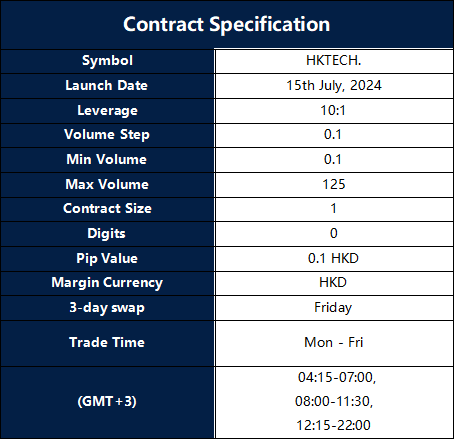
New Products Launch – July 10,2024

Dear Client,

To provide you with more diverse trading options, VT Markets will launch a new product on 15th July 2024.

The above data is for reference only, please refer to the MT4 and MT5 platforms for the updated data.

Friendly reminders:

1. Please refer to the MT4 and MT5 platforms for the specific swap rate.

If you’d like more information, please don’t hesitate to contact  info@vtmarkets.com.

A Complete Review for Goldman Sachs Group in 2024

Goldman Sachs Group Inc Shares in 2024

Goldman Sachs Group, a titan in the financial industry, is a stock that demands attention. Its influence on the market and potential for growth make it a compelling choice for investors seeking to diversify their portfolios.

Company Snapshot

Goldman Sachs Group, Inc. (NYSE: GS) is a leading global investment banking, securities, and investment management firm. It has a rich history dating back to the 19th century. The company serves a wide range of clients, including corporations, governments, institutions, and individuals. It operates in four segments: Investment Banking, Global Markets, Asset Management, and Consumer & Wealth Management.

In 2023, the company achieved significant milestones. Net revenues reached $46.25 billion, and net earnings were $8.52 billion. These accomplishments highlight Goldman Sachs’ commitment to excellence and shareholder value.

Financial Performance

In 2023, Goldman Sachs reported strong financial results. Net revenues were $46.25 billion, and net earnings were $8.52 billion. Despite facing challenges, the company maintained a solid financial position. The diluted earnings per common share (EPS) was $22.87 for 2023.

Investment Opportunity

Goldman Sachs offers a promising investment opportunity in 2024. The company’s clear and simplified strategy, along with its strong financial performance in 2023, provides a robust platform for future growth. Goldman Sachs’ dedication to serving clients with excellence and strengthening its client franchise makes it a unique investment proposition.

Risks and Considerations

Investing in Goldman Sachs, like any stock, comes with potential risks. Market volatility, industry-specific challenges, and the company’s strategic decisions can impact stock performance. The firm faces intense competition from other financial institutions, regulatory scrutiny, and legal challenges. Moreover, Goldman Sachs operates in a volatile environment where market conditions and consumer preferences can change rapidly. Investors should consider these factors and conduct thorough research before investing.

Conclusion For Goldman Sachs Group in 2024

Goldman Sachs Group stands out as a leading player in the financial sector. Its robust financial performance and strategic focus make it an attractive option for investors. However, potential risks should be carefully considered. For those looking to diversify their portfolios, Goldman Sachs presents a compelling opportunity with the promise of future growth.

FAQ

Q: Is Goldman Sachs a good investment for beginners?

A: Goldman Sachs can be a good investment for beginners who are looking for exposure to a well-established financial institution. However, it’s essential to understand the risks involved and consider starting with a diversified portfolio.

Q: What factors affect Goldman Sachs’ stock price?

A: The stock price is influenced by various factors, including market conditions, economic data, regulatory changes, and the company’s financial performance.

Q: How does Goldman Sachs compare to other financial institutions?

A: Goldman Sachs is known for its strong market presence and robust financial performance. However, it faces competition from other major financial institutions like JPMorgan Chase, Morgan Stanley, and Bank of America.

Q: What are the main risks of investing in Goldman Sachs?

A: Key risks include market volatility, regulatory challenges, intense competition, and the potential for economic downturns impacting the financial sector.

Q: Does Goldman Sachs pay dividends?

A: Yes, Goldman Sachs pays dividends. The dividend yield can vary, so it’s important to check the latest figures for accurate information.

Q: What are the growth prospects for Goldman Sachs in 2024?

A: Goldman Sachs has a solid growth outlook for 2024, driven by its strategic focus on investment banking, asset management, and global markets.

Q: How can I invest in Goldman Sachs?

A: You can invest in Goldman Sachs by purchasing shares through a brokerage account. It’s advisable to conduct thorough research or consult with a financial advisor before making any investment decisions.

Q: What makes Goldman Sachs a unique investment?

A: Goldman Sachs’ long history, strong financial performance, and strategic initiatives in investment banking and asset management make it a unique and potentially rewarding investment.

Q: How does Goldman Sachs handle market volatility?

A: Goldman Sachs employs risk management strategies to navigate market volatility. However, investors should be aware that external factors can still impact performance.

Ready to explore investment opportunities with Goldman Sachs? Learn more on our Shares CFD Trading page. Visit VT Markets for information on FX Trading and more.
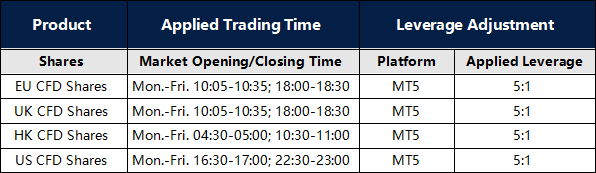
Modification on Leverage for All Shares – July 9,2024

Dear Client,

To provide a favorable trading environment to our clients, VT Markets will modify the trading setting of all share CFDs on July 15, 2024:

1. All US Shares products leverage will be adjusted to 20:1.

2. MT5 All Shares products: New positions opened within 30 minutes before market closing and after market opening will start with leverage of 5:1. After the mentioned period, the leverage will be resumed to original leverage and will not be adjusted back to 5:1.

MT4 will not be affected.

The above data is for reference only; please refer to the MT4 and MT5 software for specific data.

Friendly reminders:

1. All specifications for Shares CFD stay the same except leverage during the mentioned period.

2. The margin requirement of the trade may be affected by this adjustment. Please make sure the funds in your account are sufficient to hold the position before this adjustment.

If you’d like more information, please don’t hesitate to contact info@vtmarkets.com.

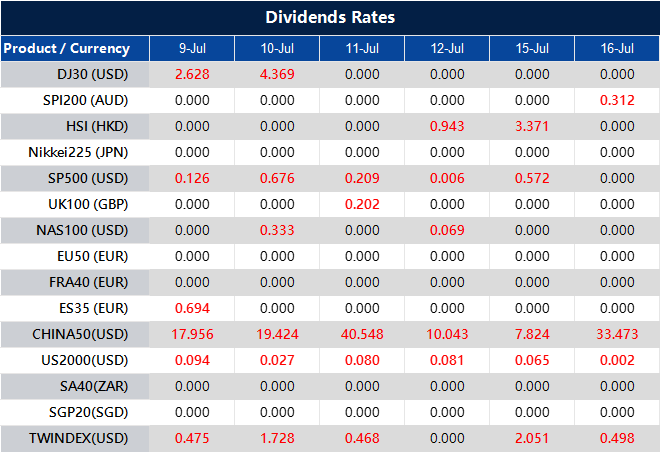
Dividend Adjustment Notice – July 9,2024

Dear Client,

Please note that the dividends of the following products will be adjusted accordingly. Index dividends will be executed separately through a balance statement directly to your trading account, and the comment will be in the following format “Div & Product Name & Net Volume ”.

Please refer to the table below for more details:

The above data is for reference only, please refer to the MT4/MT5 software for specific data.

If you’d like more information, please don’t hesitate to contact info@vtmarkets.com.

Back To Top
server

Hello there 👋

How can I help you?

Chat with our team instantly

Live Chat

Start a live conversation through...

  • Telegram
    hold On hold
  • Coming Soon...

Hello there 👋

How can I help you?

telegram

Scan the QR code with your smartphone to start a chat with us, or click here.

Don’t have the Telegram App or Desktop installed? Use Web Telegram instead.

QR code