Back

New Products Launch – Jan 31,2025

Dear Client,

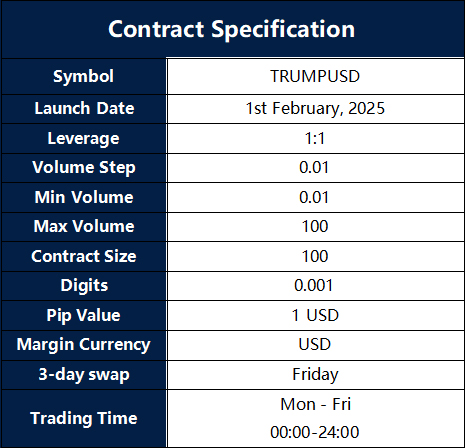
To provide you with more diverse trading options, VT Markets will launch 1 new product on 1st February 2025.

You can trade the world’s popular products on MetaTrader 4 and 5 with the following specifications:

The above data is for reference only, please refer to the MT4 and MT5 platforms for the updated data.

Friendly reminders:
1. Please refer to the MT4 and MT5 platforms for the specific swap rate.

If you’d like more information, please don’t hesitate to contact info@vtmarkets.com.

AI’s new chapter: How DeepSeek and Trump’s Stargate plan are reshaping tech investment

The tech world was stunned when Nvidia, the leading AI chip manufacturer, lost an unprecedented USD 600 billion in market value in a single day—the largest one-day loss in US stock market history.

This seismic shift was triggered by the emergence of DeepSeek, a Chinese AI company, alongside former President Donald Trump’s announcement of a massive USD 500 billion AI infrastructure project called Stargate.

The Nasdaq Composite dropped 612 points (3%), while the S&P 500 fell 1.5%, highlighting the broad impact of these developments on the technology sector.

Understanding the DeepSeek phenomenon

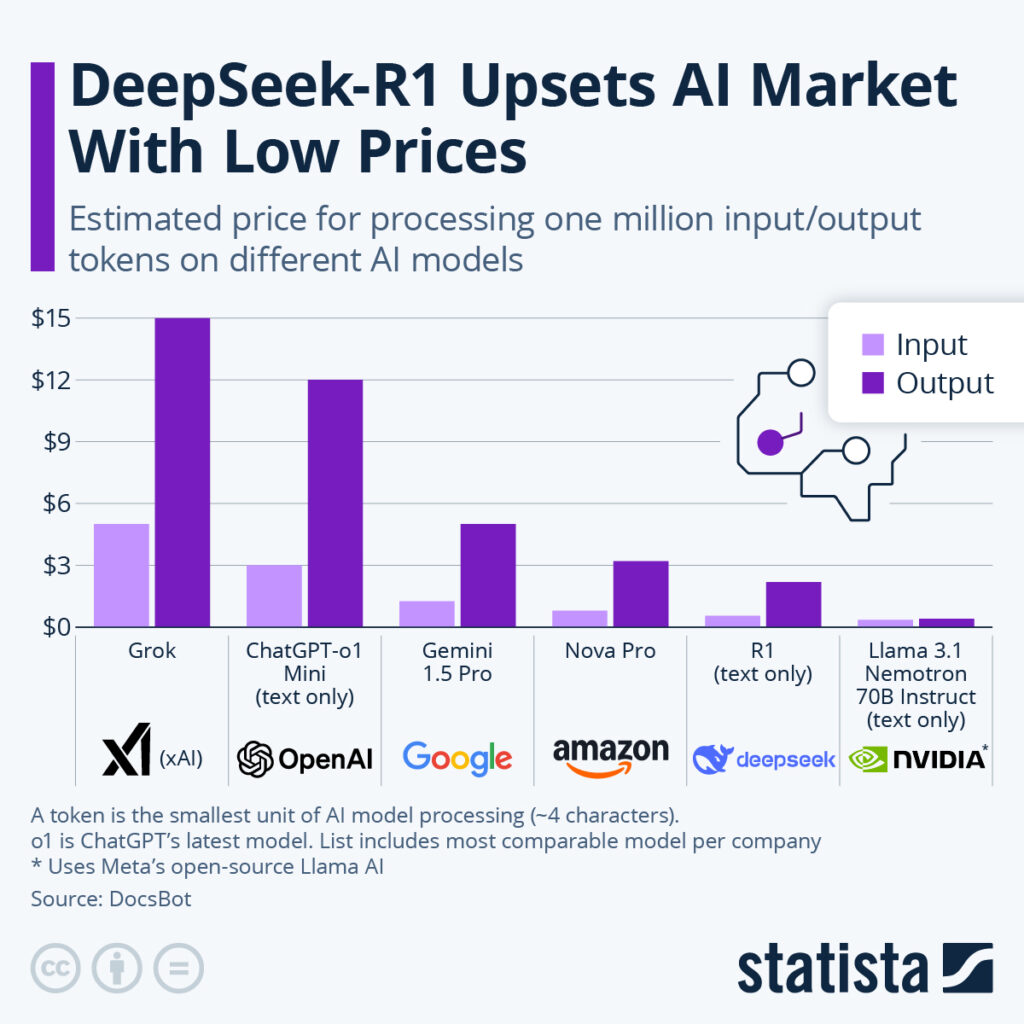
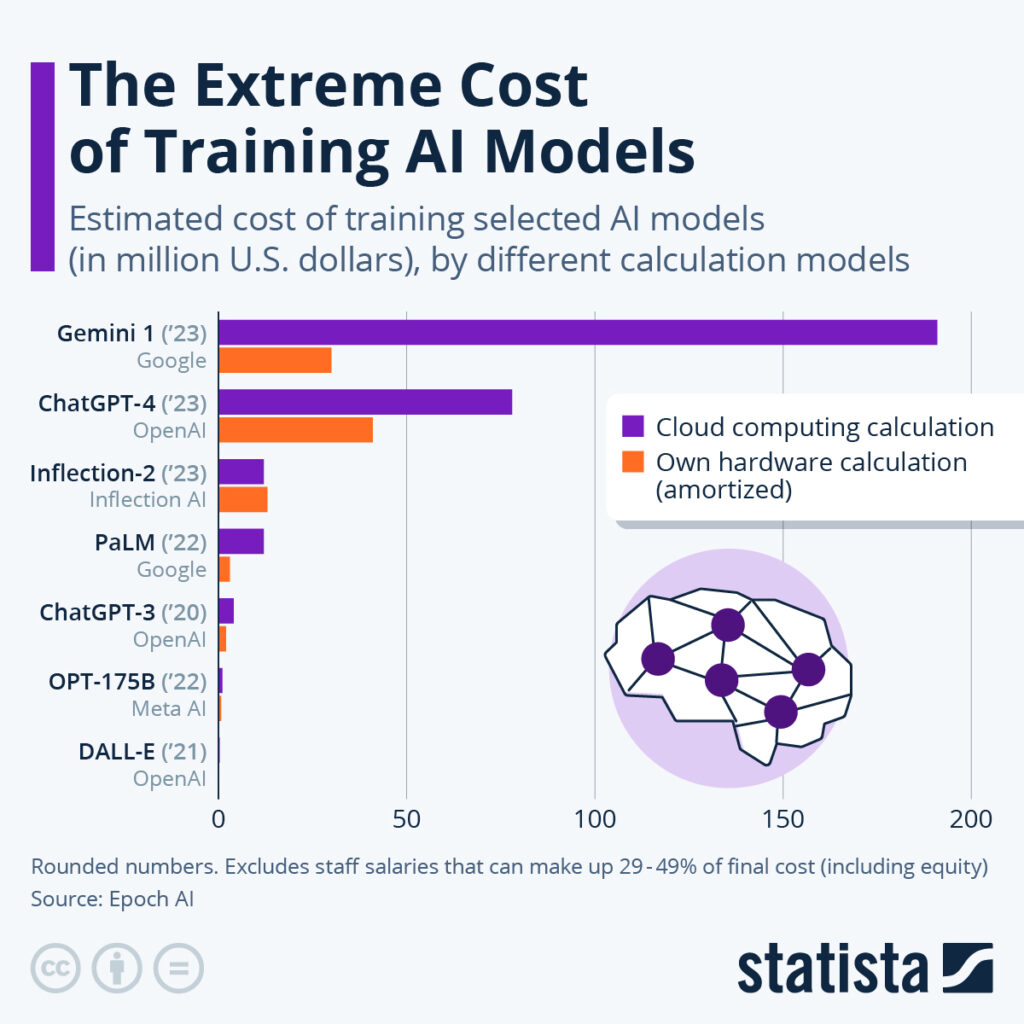
DeepSeek burst onto the scene by becoming the most downloaded free app on Apple’s US App Store, but its impact goes far beyond app rankings. The company claims to have developed its AI model for just USD 6 million, compared to the estimated USD 100 million to USD 1 billion spent by competitors like Anthropic.

This dramatic cost difference sent shockwaves through the market, pushing Nvidia’s value from USD 3.5 trillion to USD 2.9 trillion, dropping it to third place behind Apple and Microsoft.

However, industry experts urge caution about these cost claims. Elon Musk suggests DeepSeek likely has access to substantial resources, including an estimated 50,000 Nvidia chips acquired before export restrictions.

The company’s founder, Liang Wenfeng, manages an USD 8 billion hedge fund called High-Flyer, indicating deeper financial resources than initially reported. DeepSeek operates with a lean team of fewer than 140 people, primarily recruiting PhD students from elite Chinese universities rather than experienced engineers.

The immediate market reaction affected multiple sectors. Beyond Nvidia’s decline, ASML fell 6%, Broadcom dropped 17%, and energy companies like GE Vernova and Vistra saw declines of 21% and 28% respectively. Even Japanese AI-related firms weren’t spared, with the Nikkei 225 index falling 1.4%.

Trump’s Stargate project: A new direction

The Stargate project represents America’s response to these challenges, with an initial USD 100 billion investment scaling up to USD 500 billion.

The initiative brings together tech giants OpenAI, Oracle, and SoftBank, focusing on building massive AI infrastructure. The centrepiece includes a million-square-foot facility in Texas, marking the beginning of a nationwide data centre network.

Beyond job creation (100,000 new positions), the project addresses critical infrastructure needs. Industry leaders have highlighted the increasing demand for data centres, chips, electricity, and water resources to sustain AI growth. Sam Altman, OpenAI’s CEO, has described Stargate as the “most important project of this era.”

Investment landscape changes

For investors, these developments signal several key shifts in the technology sector:

1. AI development costs: DeepSeek claims to use just 2,000 specialised chips compared to an estimated 16,000 chips for leading US models, challenging traditional cost assumptions.

2. Semiconductor industry: While Nvidia remains dominant, concerns have emerged about chip supply. SK Hynix, a crucial supplier of high-bandwidth memory chips, has raised concerns about demand trends, while Taiwan Semiconductor expects to double its AI-related revenue.

3. Infrastructure players: KeyBanc has adjusted Nvidia’s 2026 data centre revenue target to USD 185 billion from USD 200 billion, reflecting changing market dynamics.

4. Cloud computing: Microsoft’s significant role as 13% of Nvidia’s fiscal Q1 revenue highlights the interconnected nature of the AI ecosystem.

Risks and challenges

Investors should consider several risk factors:

  • Geopolitical tensions: New US regulations limit AI chip exports to 50,000 per country, with stricter controls for orders exceeding 1,700 chips.
  • Technical uncertainties: Manufacturing yield issues are limiting shipments of Nvidia’s next-generation Blackwell chips.
  • Regulatory environment: China’s State Administration for Market Regulation is investigating Nvidia for potential antitrust violations.
  • Market valuation concerns: Oracle executive Ken Glueck estimates that export restrictions could reduce the global market for US chip companies by 80%.

Tech sector outlook 2025: AI’s ripple effect

The AI revolution is reshaping the broader technology sector in several significant ways:

1. Shifting power dynamics: The traditional dominance of US tech giants is being challenged by efficient, low-cost competitors. Companies like DeepSeek demonstrate that innovation can come from unexpected places, forcing established players to rethink their strategies.

2. Infrastructure revolution: Data centre development is becoming as crucial as software development. The industry is seeing a massive shift towards sustainable, energy-efficient infrastructure solutions, particularly as AI power consumption concerns grow. UBS analysts predict this will create new opportunities in green tech and energy management systems.

3. Democratisation of AI: Lower development costs are making AI more accessible to smaller companies and startups. This trend could lead to:

  • Increased competition in previously consolidated markets.
  • More specialised AI applications for specific industries.
  • Growing demand for AI integration services.
  • New opportunities in AI training and deployment tools.

4. Market restructuring: The tech sector is moving away from pure software plays toward integrated hardware-software solutions. Companies that can offer complete AI implementation packages, from chips to applications, are likely to gain advantages.

5. Talent market changes: With companies like DeepSeek successfully operating with smaller, specialised teams, the industry is seeing a shift in hiring practices. The focus is moving towards highly skilled specialists rather than large development teams.

Practical takeaways for investors

For investors, several strategies merit consideration:

1. Diversification: Look beyond chip manufacturers to include companies throughout the AI value chain, including infrastructure providers and energy companies.

2. Timeline management: UBS analysts predict strong Q4 and fiscal Q1 results for the sector, but suggest monitoring Blackwell chip yields and revenue growth.

3. Risk assessment: Consider the impact of potential tariff increases (2-5% per month) and regulatory changes on international tech investments.

4. Market indicators: Watch data centre construction rates, chip shipments (particularly the transition to Blackwell chips), and energy consumption patterns in tech hubs.

These developments suggest we are entering a new phase in AI investment, where efficiency and infrastructure take centre stage. Investors should maintain a balanced approach, considering both the opportunities and risks in this rapidly evolving sector.

To capitalise on emerging trends in AI and beyond, open a live account with VT Markets today and access a world of investment opportunities.

AI’s new chapter: How DeepSeek and Trump’s Stargate plan are reshaping tech investment

The tech world was stunned when Nvidia, the leading AI chip manufacturer, lost an unprecedented USD 600 billion in market value in a single day—the largest one-day loss in US stock market history.

This seismic shift was triggered by the emergence of DeepSeek, a Chinese AI company, alongside former President Donald Trump’s announcement of a massive USD 500 billion AI infrastructure project called Stargate.

The Nasdaq Composite dropped 612 points (3%), while the S&P 500 fell 1.5%, highlighting the broad impact of these developments on the technology sector.

Understanding the DeepSeek phenomenon

DeepSeek burst onto the scene by becoming the most downloaded free app on Apple’s US App Store, but its impact goes far beyond app rankings. The company claims to have developed its AI model for just USD 6 million, compared to the estimated USD 100 million to USD 1 billion spent by competitors like Anthropic.

This dramatic cost difference sent shockwaves through the market, pushing Nvidia’s value from USD 3.5 trillion to USD 2.9 trillion, dropping it to third place behind Apple and Microsoft.

However, industry experts urge caution about these cost claims. Elon Musk suggests DeepSeek likely has access to substantial resources, including an estimated 50,000 Nvidia chips acquired before export restrictions.

The company’s founder, Liang Wenfeng, manages an USD 8 billion hedge fund called High-Flyer, indicating deeper financial resources than initially reported. DeepSeek operates with a lean team of fewer than 140 people, primarily recruiting PhD students from elite Chinese universities rather than experienced engineers.

The immediate market reaction affected multiple sectors. Beyond Nvidia’s decline, ASML fell 6%, Broadcom dropped 17%, and energy companies like GE Vernova and Vistra saw declines of 21% and 28% respectively. Even Japanese AI-related firms weren’t spared, with the Nikkei 225 index falling 1.4%.

Trump’s Stargate project: A new direction

The Stargate project represents America’s response to these challenges, with an initial USD 100 billion investment scaling up to USD 500 billion.

The initiative brings together tech giants OpenAI, Oracle, and SoftBank, focusing on building massive AI infrastructure. The centrepiece includes a million-square-foot facility in Texas, marking the beginning of a nationwide data centre network.

Beyond job creation (100,000 new positions), the project addresses critical infrastructure needs. Industry leaders have highlighted the increasing demand for data centres, chips, electricity, and water resources to sustain AI growth. Sam Altman, OpenAI’s CEO, has described Stargate as the “most important project of this era.”

Investment landscape changes

For investors, these developments signal several key shifts in the technology sector:

1. AI development costs: DeepSeek claims to use just 2,000 specialised chips compared to an estimated 16,000 chips for leading US models, challenging traditional cost assumptions.

2. Semiconductor industry: While Nvidia remains dominant, concerns have emerged about chip supply. SK Hynix, a crucial supplier of high-bandwidth memory chips, has raised concerns about demand trends, while Taiwan Semiconductor expects to double its AI-related revenue.

3. Infrastructure players: KeyBanc has adjusted Nvidia’s 2026 data centre revenue target to USD 185 billion from USD 200 billion, reflecting changing market dynamics.

4. Cloud computing: Microsoft’s significant role as 13% of Nvidia’s fiscal Q1 revenue highlights the interconnected nature of the AI ecosystem.

Risks and challenges

Investors should consider several risk factors:

  • Geopolitical tensions: New US regulations limit AI chip exports to 50,000 per country, with stricter controls for orders exceeding 1,700 chips.
  • Technical uncertainties: Manufacturing yield issues are limiting shipments of Nvidia’s next-generation Blackwell chips.
  • Regulatory environment: China’s State Administration for Market Regulation is investigating Nvidia for potential antitrust violations.
  • Market valuation concerns: Oracle executive Ken Glueck estimates that export restrictions could reduce the global market for US chip companies by 80%.

Tech sector outlook 2025: AI’s ripple effect

The AI revolution is reshaping the broader technology sector in several significant ways:

1. Shifting power dynamics: The traditional dominance of US tech giants is being challenged by efficient, low-cost competitors. Companies like DeepSeek demonstrate that innovation can come from unexpected places, forcing established players to rethink their strategies.

2. Infrastructure revolution: Data centre development is becoming as crucial as software development. The industry is seeing a massive shift towards sustainable, energy-efficient infrastructure solutions, particularly as AI power consumption concerns grow. UBS analysts predict this will create new opportunities in green tech and energy management systems.

3. Democratisation of AI: Lower development costs are making AI more accessible to smaller companies and startups. This trend could lead to:

  • Increased competition in previously consolidated markets.
  • More specialised AI applications for specific industries.
  • Growing demand for AI integration services.
  • New opportunities in AI training and deployment tools.

4. Market restructuring: The tech sector is moving away from pure software plays toward integrated hardware-software solutions. Companies that can offer complete AI implementation packages, from chips to applications, are likely to gain advantages.

5. Talent market changes: With companies like DeepSeek successfully operating with smaller, specialised teams, the industry is seeing a shift in hiring practices. The focus is moving towards highly skilled specialists rather than large development teams.

Practical takeaways for investors

For investors, several strategies merit consideration:

1. Diversification: Look beyond chip manufacturers to include companies throughout the AI value chain, including infrastructure providers and energy companies.

2. Timeline management: UBS analysts predict strong Q4 and fiscal Q1 results for the sector, but suggest monitoring Blackwell chip yields and revenue growth.

3. Risk assessment: Consider the impact of potential tariff increases (2-5% per month) and regulatory changes on international tech investments.

4. Market indicators: Watch data centre construction rates, chip shipments (particularly the transition to Blackwell chips), and energy consumption patterns in tech hubs.

These developments suggest we are entering a new phase in AI investment, where efficiency and infrastructure take centre stage. Investors should maintain a balanced approach, considering both the opportunities and risks in this rapidly evolving sector.

To capitalise on emerging trends in AI and beyond, open a live account with VT Markets today and access a world of investment opportunities.

VT Markets Celebrates Groundbreaking 2024

Sets the stage for Greater Success in 2025

January 27, 2025 – Sydney, Australia – VT Markets celebrates an exhilarating year of record-breaking growth and high-impact achievements in 2024. From a remarkable jump in trading volume to groundbreaking partnerships, this year has marked a transformative year for the global brokerage leader.

VT Markets was celebrated for its excellence over 30 global and regional accolades, and prestigious industry appearances, further solidifying its position as a trailblazer in the trading world. The firm also earned the coveted Approved Broker Member status from the Financial Commission, a prestigious recognition of its trustworthiness and transparency in the industry.

2024: A Year of Unprecedented Growth

  • Global Workforce Explosion: VT Markets soared to over 600 employees across 27 offices worldwide, scaling operations and bringing unparalleled support to traders across the globe.
  • Record-Breaking Trading Volume: The firm’s trading volume reached an astonishing 150% year-on-year growth, demonstrating the trust and momentum VT Markets has garnered within the trading community.
  • Skyrocketing Client Engagement: With a two-fold growth in gross deposits and first-time trades respectively VT Markets has seen its customer base and trading activity grow to new heights. The numbers speak for themselves – traders are flocking to VT Markets in record numbers, fueling its expansion and global success.

Trailblazing Achievements & Partnerships

2024 saw VT Markets continue to build on its legacy with some of the most exciting and high-profile achievements in the company’s history:

  • Partnership with Maserati MSG Racing: VT Markets raced ahead with its continued partnership with Maserati MSG Racing for Season 11 of the Formula E World Championship, linking high-performance motorsport with the world of trading. A dynamic collaboration that champions innovation and speed, it embodies the core values of VT Markets.
  • Strategic Partnership with Newcastle United: In an exciting move that amplified its global presence, VT Markets teamed up with Newcastle United in August, marking a major milestone in the brand’s commitment to world-class sports partnerships.
  • Client Fund Protection: Taking security to the next level, VT Markets introduced client fund insurance up to $1M, offering traders an unparalleled sense of safety and trust in the platform.
  • “Built for Winners” Brand Campaign: VT Markets launched the captivating “Built for Winners” campaign, highlighting the parallels between navigating volatile markets and racing on the high-speed track. This bold creative campaign struck a chord with traders, positioning VT Markets as the firm that helps individuals and institutions thrive in challenging environments.
  • “Trading Can Be Easy” Ad Campaign:  VT Markets launched its first hyper-localised ad campaign tailored specifically for South Asia, showcasing how easy trading can be and how it can transform lives in India. The campaign resonated deeply with local audiences, changing the narrative on what is possible in trading.

The Road Ahead: VT Markets’ Vision for 2025

Building on the tremendous success of 2024, VT Markets is primed for greater expansion in 2025, with bold plans to continue setting new standards in the brokerage industry including doubling down in key regions like Southeast Asia and Central Asia for rapid growth and further establishing its global leadership. As we look ahead, we are optimistic about the outlook for forex and trading, with a market poised for both opportunities and challenges. By leveraging our advanced technology, global reach, and customer-centric approach, VT Markets is confident to navigate these evolving market dynamics and ride the wave of success together with our valued clients and partners.

About VT Markets

VT Markets is a regulated multi-asset broker with a presence in over 160 countries as of today. It has earned numerous international accolades including Best Online Trading and Fastest Growing Broker. In line with its mission to make trading accessible to all, VT Markets offers comprehensive access to over 1,000 financial instruments and clients benefit from a seamless trading experience via its award-winning mobile application.

For more information, please visit the official VT Markets website or email us at info@vtmarkets.com. Alternatively, follow VT Markets on Facebook, Instagram, or LinkedIn.

For media enquiries and sponsorship opportunities, please email media@vtmarkets.com, or contact:

Dandelyn Koh

Global Brand & PR Lead

dandelyn.koh@vtmarkets.com

Brenda Wong

Assistant Manager, Global PR & Communications

brenda.wong@vtmarkets.com

Futures vs Options: Learn the Key Differences

What Are the Differences Between Futures and Options?

In this article, we’ll explore the key differences between futures and options, helping you understand their unique features, benefits, and risks. Whether you’re looking to hedge market exposure or capitalize on price movements, this guide will provide the insights you need to choose the right trading strategy with confidence.

What Are Futures?

Futures are standardized financial contracts that require the buyer to purchase, or the seller to deliver, an underlying asset at a predetermined price on a specified future date. These contracts are widely used in financial markets to hedge against price fluctuations, speculate on price movements, and gain exposure to various asset classes such as commodities, indices, currencies, and interest rates.

Unlike options, futures involve an obligation for both parties to fulfill the contract upon expiration. Whether the market moves in their favor or not, traders are bound by the terms of the contract. This binding nature makes futures an essential tool for industries that require price certainty, such as energy, agriculture, and financial sectors.

For example, an airline company might use crude oil futures to lock in fuel prices, reducing the risk of fluctuating oil costs and ensuring stable operational expenses. 

Key Characteristics of Futures Contracts

Standardized Terms: Futures have fixed contract sizes, expiration dates, and pricing terms, making them easy to trade across global exchanges.

  • Leverage and Margin: Traders can control large positions with a small upfront margin, amplifying both potential gains and risks.
  • Daily Settlement: Positions are marked-to-market daily, with gains or losses reflected in the trader’s account balance.
  • Physical vs. Cash Settlement: Some futures settle with the physical delivery of the asset, while others are cash-settled based on market price.
  • Exchange-Traded: Futures contracts are traded on regulated exchanges, ensuring transparency and liquidity.

What Are Options?

Options are financial derivatives that grant the buyer the right, but not the obligation, to buy (call option) or sell (put option) an underlying asset at a predetermined price within a specified period. These contracts are widely used in various asset classes, including stocks, commodities, indices, and currencies, offering traders and investors flexibility in managing risk or speculating on price movements.

Unlike futures contracts, where both parties are legally bound to fulfill the agreement, options provide a unique advantage: the holder can choose whether to exercise the contract based on market conditions. This flexibility allows options traders to limit potential losses to the upfront premium paid while maintaining the possibility of substantial gains.

For instance, if an investor anticipates that a stock’s price will increase, they might buy a call option, which allows them to purchase the stock at a fixed price before the contract expires. If the stock’s price rises above the strike price, they can exercise the option and profit, or they may choose to sell the option at a higher price in the market. Conversely, a put option provides the right to sell an asset, which can be useful as protection against falling prices.

Key Characteristics of Options

Right Without Obligation: Buyers have the choice to execute the contract, while sellers are obligated to fulfill it if exercised.

  • Call and Put Options: Call options allow the purchase of an asset at a set price, while put options allow the sale of an asset at a set price.
  • Premium Payment: Buyers pay an upfront premium to acquire the option, which represents the maximum potential loss.
  • Limited Risk, Unlimited Potential: Buyers’ losses are capped at the premium paid, while potential profits can be substantial.
  • Expiration Date: Options have a defined expiration period, after which they become worthless if not exercised.

What Are the Key Differences Between Futures and Options?

The difference between futures and options lies in their obligations, risk levels, and flexibility.

FeatureFuturesOptions
ObligationMandatory to fulfillNo obligation to execute
RiskUnlimited riskLimited to premium paid
CostMargin-basedPremium payment required
FlexibilityFixed expiration and termsFlexible execution before expiration
ApplicationCommon for hedging and speculationOften used for risk management

1. Obligation

Futures: Traders who enter into a futures contract are legally obligated to fulfill the contract upon expiration. This means the buyer must purchase, and the seller must deliver the underlying asset at the agreed price, regardless of market conditions. The lack of flexibility can expose traders to potential losses if the market moves against them.

Options: In contrast, options provide the buyer with the right but not the obligation to execute the contract. The buyer can choose to exercise the option only if it is favorable, offering greater flexibility. If market conditions are unfavorable, the option holder can simply let the contract expire, limiting their loss to the premium paid.

2. Risk

Futures: Futures trading involves unlimited risk, as losses can exceed the initial margin if the market moves significantly against the position. Traders may face margin calls, requiring them to deposit additional funds to maintain their positions. The leveraged nature of futures amplifies both potential gains and losses.

Options: With options, the buyer’s risk is limited to the premium paid, providing a defined downside. No matter how much the market moves against the option, the maximum loss remains the initial investment in the premium, making it a safer choice for risk-averse traders. However, option sellers (writers) carry higher risks as they are obligated to fulfill the contract if exercised.

3. Cost

Futures: Futures trading typically involves margin-based costs, where traders must deposit an initial margin (a percentage of the contract value) to enter a position. While this allows for leverage, it also increases the risk of margin calls if the market moves against the position. Futures do not involve upfront premium payments but may require additional funds to maintain positions over time.

Options: In contrast, options require an upfront premium payment to acquire the contract. This cost is influenced by factors such as time to expiration, volatility, and the strike price. If the option expires worthless, the trader loses the premium, but there are no further financial obligations beyond this initial cost.

4. Flexibility

Futures: Futures contracts come with fixed expiration dates and terms, meaning they must be honored as agreed. Traders looking to extend their positions must rollover contracts to the next expiry date, incurring additional costs. The fixed nature of futures provides certainty but limits flexibility in responding to changing market conditions.

Options: Options offer greater flexibility, allowing traders to exit their positions at any time before expiration. This flexibility provides opportunities to lock in profits, minimize losses, or adjust strategies based on market movements. Additionally, various option strategies (e.g., covered calls, spreads) allow traders to customize their approach to market conditions.

5. Application

Futures: Futures contracts are commonly used for hedging and speculation, especially in markets like commodities, indices, and currencies. Businesses use futures to hedge against price volatility in raw materials or currency fluctuations, while traders use them to speculate on price movements with high leverage.

Options: Options are primarily used for risk management, portfolio diversification, and strategic speculation. They provide traders with a way to hedge against downside risks while maintaining upside potential. Options strategies are also used to generate passive income through techniques such as covered calls and cash-secured puts.

Benefits of Futures Trading

  • Futures trading offers high liquidity, allowing traders to enter and exit positions easily with minimal price impact.
  • It is cost-effective as traders only need to deposit a margin instead of paying an upfront premium.
  • Futures are commonly used for hedging, helping businesses protect against price fluctuations in commodities and currencies.
  • Leverage in futures trading enables traders to control large positions with a relatively small capital investment, potentially increasing profits.

Disadvantages of Futures Trading

  • Futures carry high-risk exposure, as losses can exceed the initial investment due to leverage.
  • Futures contracts lack flexibility, requiring traders to fulfill the contract terms regardless of market conditions.
  • Futures prices can be highly volatile and sensitive to external factors such as economic events and geopolitical developments.

Benefits of Options Trading

  • Options trading provides limited risk, as losses are capped at the premium paid, making it a safer choice for risk-averse traders.
  • Options offer flexibility, allowing traders to use various strategies for hedging, speculation, or income generation.
  • Options provide leverage opportunities, enabling traders to gain exposure to larger market movements with a smaller capital outlay.
  • Options can yield substantial returns if market conditions move favorably.

Disadvantages of Options Trading

  • Options can be costly due to the upfront premium payments, which may be expensive in volatile markets.
  • Options trading is complex and requires knowledge of factors like strike prices, expiration dates, and implied volatility.
  • The value of options decreases over time due to time decay, potentially resulting in losses if the market does not move as expected.

When to Choose Futures vs Options?

Deciding between futures vs options depends on your trading goals, risk tolerance, and market strategy.

Choose futures if:

  • You seek higher liquidity and lower transaction costs.
  • You are comfortable with margin requirements and contract obligations.
  • You want to hedge against price fluctuations with fixed costs and predictable exposure.

Choose options if:

  • You prefer flexible strategies with limited downside risks.
  • You are willing to pay premiums for potential future opportunities.
  • You seek speculative strategies with controlled risk exposure and defined losses.

By understanding your trading style and risk tolerance, you can determine whether futures or options align better with your financial goals. VT Markets offers an advanced platform for both futures and options trading, providing the tools and support you need to navigate the markets effectively.

Conclusion

Choosing between futures vs options depends on your trading goals, risk appetite, and market strategy. Futures are ideal for traders looking for high liquidity, lower costs, and direct exposure to asset price movements, but they come with higher risks and obligations. On the other hand, options provide flexibility, limited downside risk, and a wide range of strategic opportunities, making them suitable for traders who prefer a more controlled risk approach. Understanding these key differences can help you make informed trading decisions that align with your financial objectives.

Start Trading Futures and Options with VT Markets

Whether you are looking to trade futures or options, VT Markets offers a robust and user-friendly platform to meet your trading needs. With advanced trading tools, real-time market analysis, and competitive pricing, VT Markets empowers traders to capitalize on opportunities across various asset classes. Benefit from industry-leading educational resources, expert insights, and a supportive trading environment to enhance your market participation.

Start trading with VT Markets today and take advantage of a seamless trading experience with access to futures and options across global markets.

Frequently Asked Questions (FAQs)

1. What is the main difference between futures and options?

The primary difference is that futures contracts require the buyer and seller to fulfill the agreement, whereas options provide the right but not the obligation to execute the trade.

2. Are futures riskier than options?

Futures generally carry higher risks due to their margin requirements and potential for unlimited losses, while options limit losses to the premium paid.

3. Can I trade both futures and options with VT Markets?

Yes, VT Markets provides access to both futures and options trading with a range of instruments across different asset classes. 

4. What factors should I consider before choosing futures or options?

Consider factors like risk tolerance, investment goals, market volatility, and liquidity before deciding on futures or options trading.

5. How do margin requirements differ for futures and options?

Futures require maintaining a margin throughout the contract’s duration, while options only require an initial premium payment.

6. What is a margin call?

A margin call occurs when the equity in your trading account falls below the required margin level to maintain your open positions. This happens when market movements go against your trades, and the broker requires you to deposit additional funds or close positions to bring your account back to the required margin level. Margin calls are common in leveraged trading, such as futures, and highlight the importance of proper risk management.

Notification of Trading Adjustment in Holiday (Update) – Jan 27,2025

Dear Client,

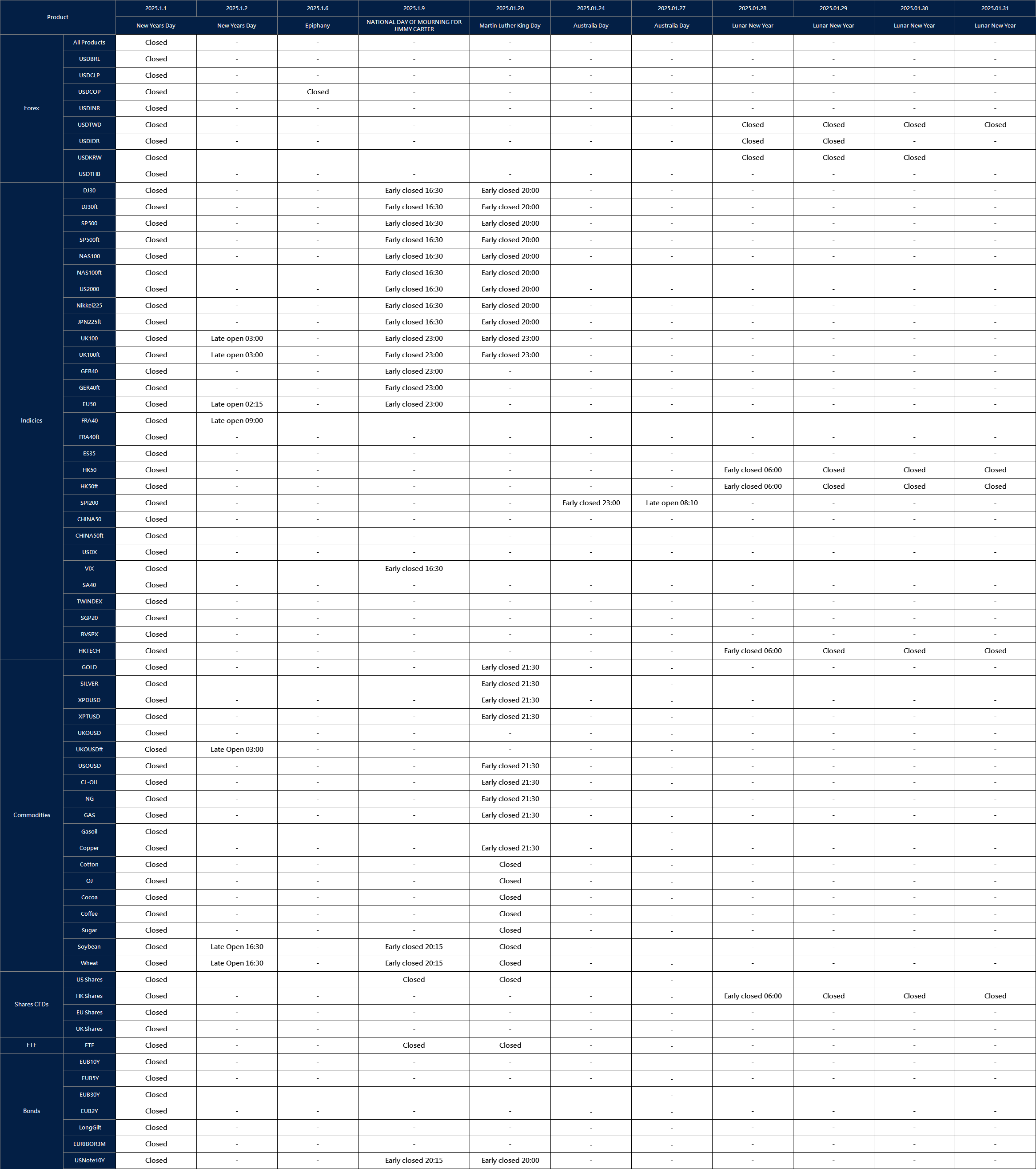
Affected by international holidays, the trading hours of some VT Markets products will be adjusted.

Please check the following link for the affected products:

Notification of Trading Adjustment in Holiday (Update)

Note: The dash sign (-) indicates normal trading hours.

Friendly Reminder:
The above data is for reference only, please refer to the MT4/MT5 software for specific data.

If you’d like more information, please don’t hesitate to contact info@vtmarkets.com

What is the Best Time to Trade Forex?

Best Time to Trade Forex: A Comprehensive Guide

In this article, you’ll discover the best time to trade forex, exploring how different trading sessions influence market liquidity, volatility, and trading opportunities. Whether you’re a scalper seeking fast price movements or a long-term trader focusing on broader trends, this guide will help you identify the most favorable trading hours.

Understand Forex Trading

The forex market operates 24 hours a day, five days a week, offering global traders the flexibility to trade at their convenience. However, understanding the market’s structure and identifying the best hours to trade forex can significantly impact a trader’s success. The forex market consists of different trading sessions, each offering unique levels of liquidity and volatility.

Learn how to trade forex for beginners

Forex Market Operations

The forex market consists of four major trading sessions:

Trading SessionMarket Hours (GMT)Volatility LevelBest Pairs to TradeKey Characteristics
New York Session1 PM – 10 PMHigh – USD/CAD

– EUR/USD

– USD/JPY
– The second most active session

– Driven by economic releases and stock market influence

– Overlaps with London for peak movement
London Session8 AM – 5 PMHigh – EUR/USD

– GBP/USD

– USD/CHF
– The most liquid session

– Large institutional orders

– Overlaps with the New York session
Sydney Session10 PM – 7 AMLow – AUD/USD

– NZD/USD

– AUD/JPY
– The first session to open

– Ideal for early trend analysis
Tokyo Session12 AM – 9 AMModerate – USD/JPY

– EUR/JPY

– GBP/JPY
– Focus on Asian economic news

– Often leads to breakouts before the  London session

1. New York Session (1 PM – 10 PM GMT)

The New York session sees high volatility, particularly for USD pairs, driven by major economic releases such as NFP and GDP data. The overlap with London provides the highest liquidity, while US stock market activity further influences currency movements. Traders should expect sharp price swings and adjust strategies accordingly.

Best Pairs to Trade: USD/CAD, EUR/USD, USD/JPY

Trading Tip: Monitor economic releases closely to capitalize on market reactions.

2. London Session (8 AM – 5 PM GMT)

The London session is the most liquid and volatile, attracting major market participants. Economic releases from the UK and Eurozone, such as inflation and employment reports, create sharp price movements. The overlap with New York increases trading opportunities, making it the most popular trading period.

Best Pairs to Trade: EUR/USD, GBP/USD, USD/CHF

Trading Tip: Optimal for short-term and long-term traders due to high liquidity.

3. Sydney Session (10 PM – 7 AM GMT)

The Sydney session marks the start of the forex trading week with relatively low liquidity, making it ideal for analyzing early market trends. Price movements are usually steady, influenced by economic releases from Australia and New Zealand, such as employment data and interest rate decisions. The session overlaps with the late New York hours, providing some volatility for AUD and NZD pairs.

Best Pairs to Trade: AUD/USD, NZD/USD, AUD/JPY

Trading Tip: Ideal for position traders and those seeking early trend formation.

4. Tokyo Session (12 AM – 9 AM GMT)

Also known as the Asian session, Tokyo accounts for around 20% of daily forex turnover. This session is characterized by moderate volatility, suitable for range trading strategies. Economic data from Japan and China, such as GDP and central bank policies, drive price movements, especially for JPY pairs. The session’s close overlaps with the London open, often leading to breakouts.

Best Pairs to Trade: USD/JPY, EUR/JPY, GBP/JPY

Trading Tip: Focus on yen pairs for consistent liquidity and stable price action.

Discover the forex market hours

Best Time to Trade Forex

The best time to trade forex is when the market experiences the highest liquidity and volatility, which typically occurs during major session overlaps, such as the London-New York overlap. These periods provide tighter spreads, faster execution, and greater price movements, creating more trading opportunities. Understanding the most active sessions, key economic events, and how different time zones impact the market can help traders optimize their strategies and maximize their profits.

The Overlap Time: London-New York (1 PM – 5 PM GMT)

The London-New York overlap is considered the most active and liquid period in the forex market. During this time, two of the world’s largest financial centers operate simultaneously, leading to increased market participation and tighter spreads. This overlap accounts for the highest trading volume, making it the best time to trade forex for major currency pairs such as EUR/USD, GBP/USD, and USD/JPY. Volatility is at its peak, offering lucrative opportunities for traders who thrive in fast-moving markets. Key economic data from both regions, such as US Non-Farm Payroll (NFP) and UK employment reports, can lead to significant price movements.

Trading Forex During the London Session

The London session is known for its high liquidity and substantial price movements, making it one of the most favorable times to trade forex. As major banks and financial institutions begin their trading day, large volumes of orders flow into the market. This session is often characterized by strong trends and breakouts, particularly in currency pairs involving the euro and British pound. Traders can expect sharp moves during economic releases such as European Central Bank (ECB) meetings and inflation reports. The London session sets the tone for the rest of the day, as many global traders take their cues from early price action.

Trading Forex During the New York Session

The New York session is the second most active trading period and overlaps with London during its first few hours, creating the most volatile period of the day. As the US financial markets open, traders react to key economic releases, such as interest rate decisions and employment data, which heavily impact USD pairs. The New York session is heavily influenced by US stock market activity, and traders should be mindful of correlations between forex and equities. Price action during this session can be dynamic, with quick reversals and strong momentum moves, making it a prime opportunity for experienced traders.

Trading Forex During the Tokyo Session 

The Tokyo session, also known as the Asian session, is known for its relatively lower volatility compared to London and New York. However, it presents unique opportunities for traders focusing on JPY-related pairs. Market participants primarily react to economic data from Japan and China, including industrial production and trade balance figures. Due to the low liquidity, price movements tend to be more predictable, making it a preferred session for range traders. Additionally, the session can set the tone for later sessions, as traders assess Asian market sentiment.

Find out the 10 most volatile forex pairs.

Choosing the Best Time to Trade Forex Based on Trading Style

Each trader has a unique approach to the market, and finding the best hours to trade forex depends on the chosen strategy:

1. Scalpers

Scalping involves making multiple quick trades within short time frames to capture small price movements. Scalpers thrive during the London-New York overlap, when the market is most volatile and liquid, allowing for fast price changes and tight spreads. The high trading volume during this period ensures rapid order execution, minimizing slippage and providing ample opportunities to profit from short-term fluctuations in major currency pairs such as EUR/USD and GBP/USD.

2. Day Traders

Day traders seek to capitalize on intraday price movements and typically prefer trading during sessions with high liquidity and steady volatility. The London session provides the highest trading volume, followed closely by the New York session, both of which allow traders to open and close positions within the same day without exposure to overnight risk. These sessions feature critical economic announcements and trend-setting price action that day traders can exploit for consistent gains.

Discover the difference between scalping vs day trading

3. Swing Traders

Swing traders hold positions for several days or weeks, aiming to profit from broader market trends rather than short-term fluctuations. Unlike scalpers and day traders, swing traders analyze multiple trading sessions to identify optimal entry and exit points based on technical and fundamental analysis. They often monitor price action during the Tokyo session for trend consolidation, the London session for breakout opportunities, and the New York session for market reactions to economic events.

Discover the 9 best forex trading strategies and techniques

Conclusion

Choosing the best time to trade forex is crucial for maximizing trading opportunities and improving overall performance. Each trading session offers unique characteristics in terms of liquidity, volatility, and market activity. To succeed in the forex market, it’s essential to stay informed about market conditions and leverage the right tools to navigate market volatility effectively.

Why Trade Forex with VT Markets

VT Markets offers optimal trading conditions with tight spreads, ultra-fast execution, and daily market analysis to help traders seize opportunities and boost profits. Whether you’re a scalper or a long-term trader, VT Markets provides advanced trading tools and 24/5 customer support to elevate your trading experience during peak liquidity hours. Sign up today and trade with confidence!

Frequently Asked Questions (FAQs) 

1. What is the best time to trade forex?

The best time to trade forex is during the London-New York overlap (1 PM – 5 PM GMT) when market liquidity and volatility are at their highest. This period offers the most trading opportunities due to increased participation from institutional and retail traders, leading to tighter spreads and more significant price movements.

2. What time does the New York session open?

The New York forex session opens at 1 PM GMT and closes at 10 PM GMT. This session is known for high volatility, particularly for USD pairs, as it coincides with major economic releases and overlaps with the London session, creating the most active trading hours.

3. What time does the London session open?

The London forex session opens at 8 AM GMT and closes at 5 PM GMT. It is the most liquid session, attracting a high number of market participants and large institutional trades. The London session often sets the market trend for the day and overlaps with the New York session for increased trading activity.

4. What time does the Sydney session open?

The Sydney forex session opens at 10 PM GMT and closes at 7 AM GMT. It marks the start of the forex trading week and is ideal for traders looking to analyze early market trends. Although liquidity is relatively low, this session provides opportunities for trading AUD and NZD pairs.

5. What time does the Tokyo session open?

The Tokyo forex session opens at 12 AM GMT and closes at 9 AM GMT. As the first major Asian market to open, it focuses on JPY pairs and often sets the tone for the Asian trading day. The session overlaps with Sydney and precedes the London session, creating potential breakout opportunities.

Oil price forecast for 2025: Key factors that could shape the market

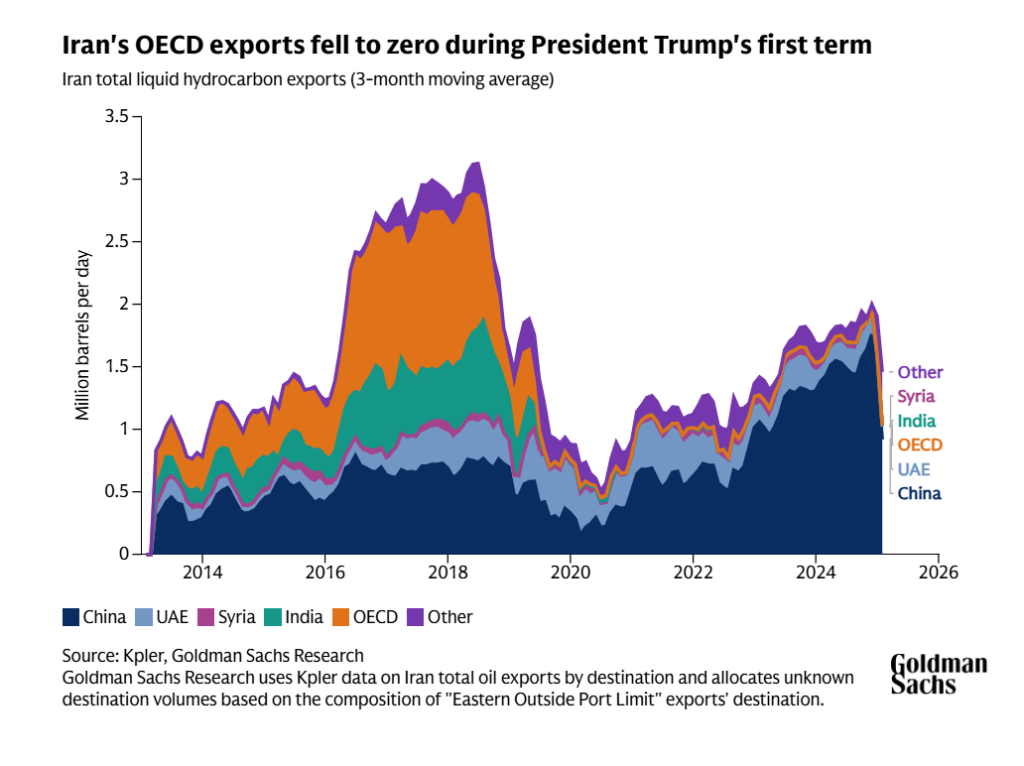
When Donald Trump assumed the presidency, the oil markets immediately felt the tremors of his bold energy policies. Within days of his inauguration, oil prices tumbled, with Brent crude plummeting 1.1% to USD 79.29 per barrel and WTI futures dropping 2.6% to USD 75.89.

Trump’s declaration of a national energy emergency and aggressive stance on maximising US oil production signalled a fundamental shift in global energy dynamics.

This historical snapshot illustrates the volatile nature of oil markets, where geopolitical decisions, economic policies, and global tensions can dramatically impact prices.

As we look ahead to 2025, understanding the key factors influencing oil prices becomes crucial for traders and investors seeking to navigate this complex landscape.

Global demand dynamics: A shifting landscape

The global oil demand landscape is experiencing significant transformations.

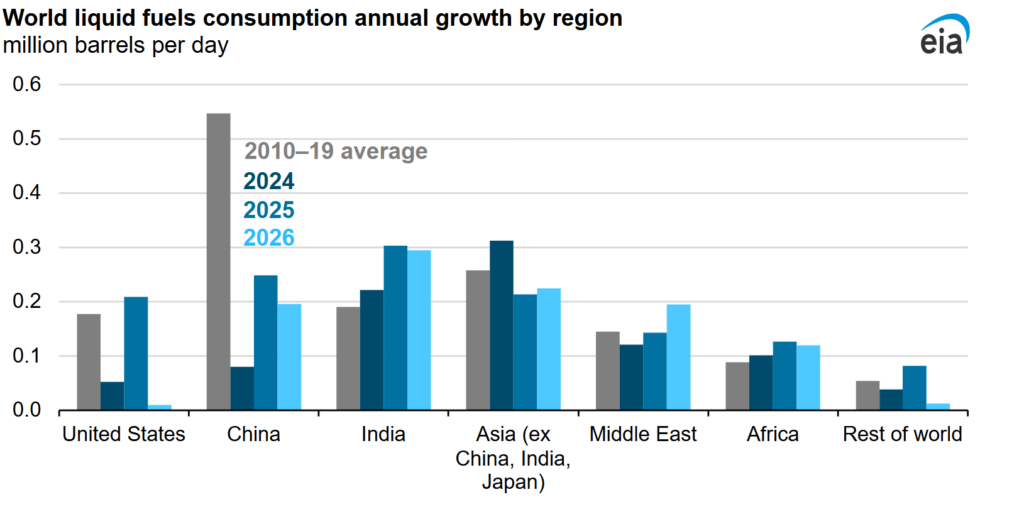
According to the International Energy Agency (IEA), global oil demand is expected to grow by 1.05 million barrels per day in 2025, reaching total consumption of 104 million barrels daily. This growth, while substantial, represents a moderation compared to historical trends.

Emerging markets are driving this expansion, with a fascinating geographic shift in energy consumption. India stands out as a particularly critical player, with its rapidly growing economy and increasing energy needs. While China’s oil demand is anticipated to peak between 2025 and 2027, India’s consumption continues to rise dramatically.

The Chinese National Petroleum Corporation (CNPC) predicts peak oil demand in 2025, attributed to increasing electric vehicle adoption and growth in liquefied natural gas (LNG) truck usage.

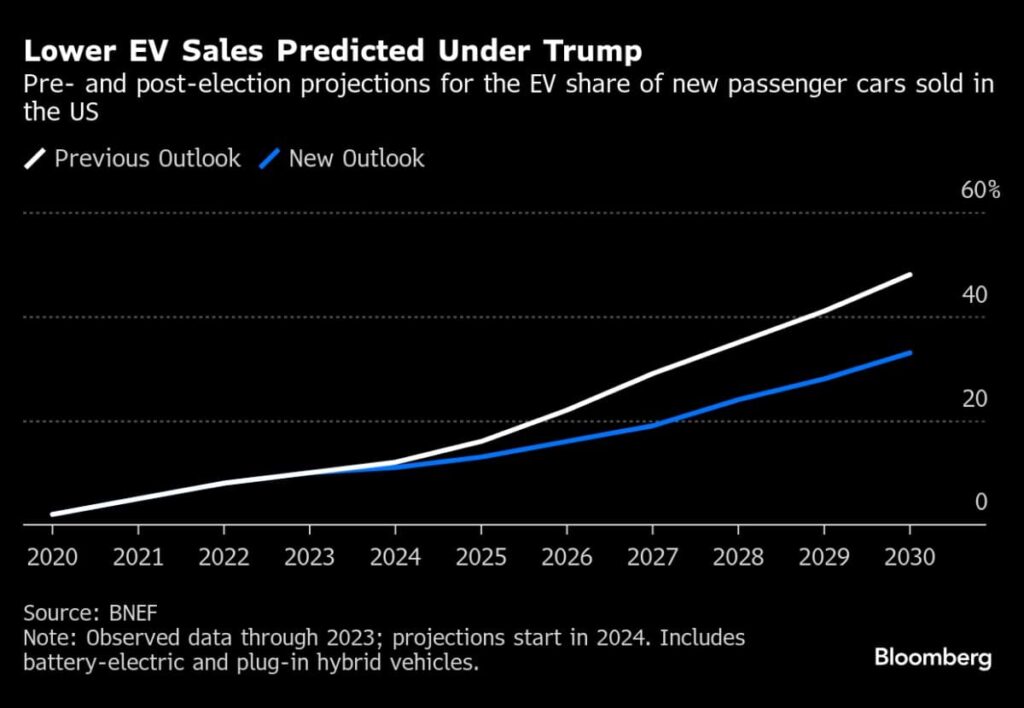
The electric vehicle (EV) market plays a pivotal role in these demand projections. Goldman Sachs research suggests that global EV sales will increase from 11 million in 2024 to 17 million in 2026, potentially reducing oil demand by nearly 0.6 million barrels per day by 2026. This transition underscores the growing impact of green technologies on traditional energy markets.

Price forecast: A multifaceted outlook

The 2025 oil price landscape presents a nuanced picture, with leading financial institutions offering varied perspectives.

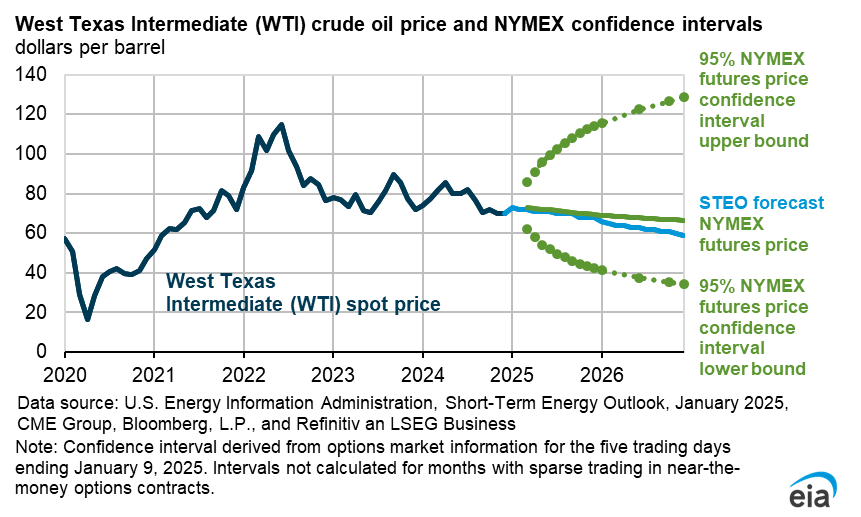
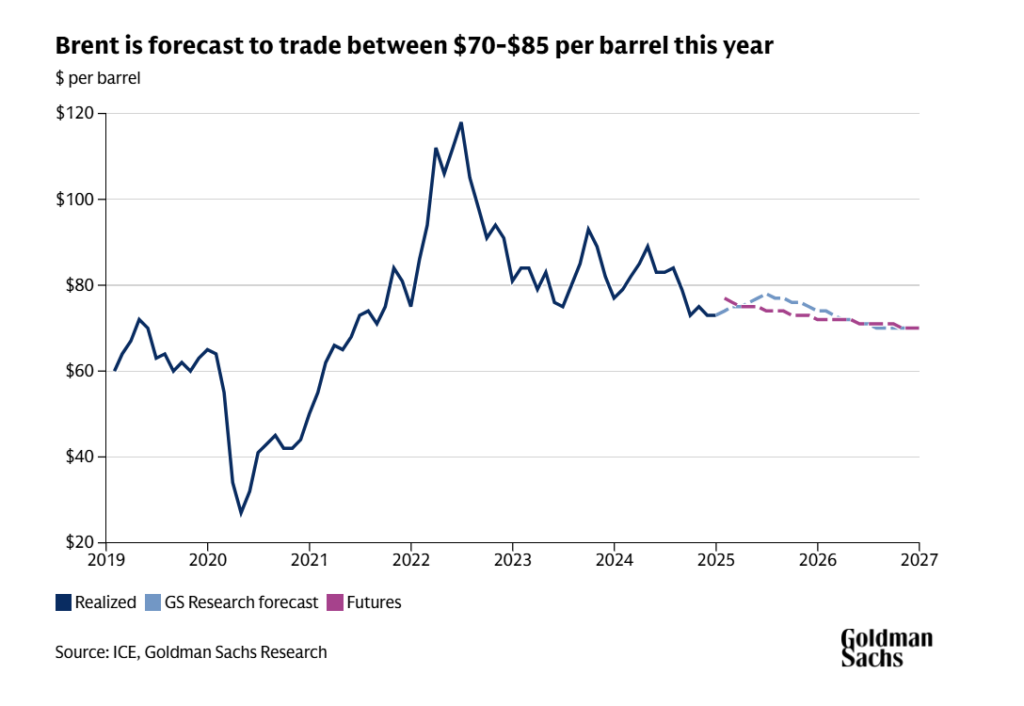
The U.S. Energy Information Administration (EIA) forecasts Brent crude at USD 74 per barrel in 2025, with a potential decline to USD 66 in 2026.

Citi Research provides a more optimistic view, raising its Brent crude projection to USD 67 per barrel and suggesting quarterly variations from USD 75 in the first quarter to USD 60 by year-end.

Goldman Sachs takes a broader approach, anticipating Brent crude trading between USD 70 and USD 85 per barrel, with an average of USD 76.

The International Energy Agency adds depth to these projections, highlighting a global oil demand increase of 1.05 million barrels per day, pushing total consumption to 104 million barrels daily.

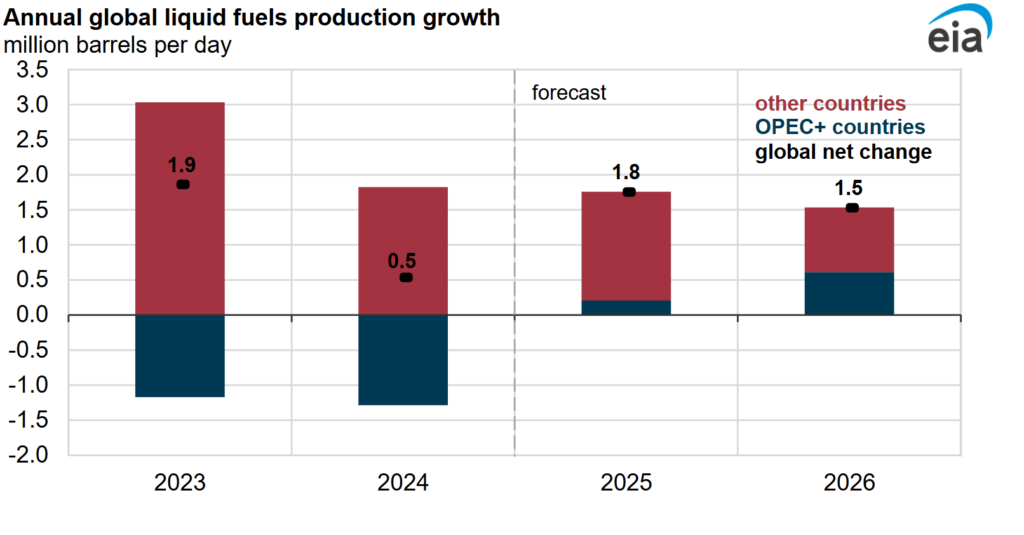
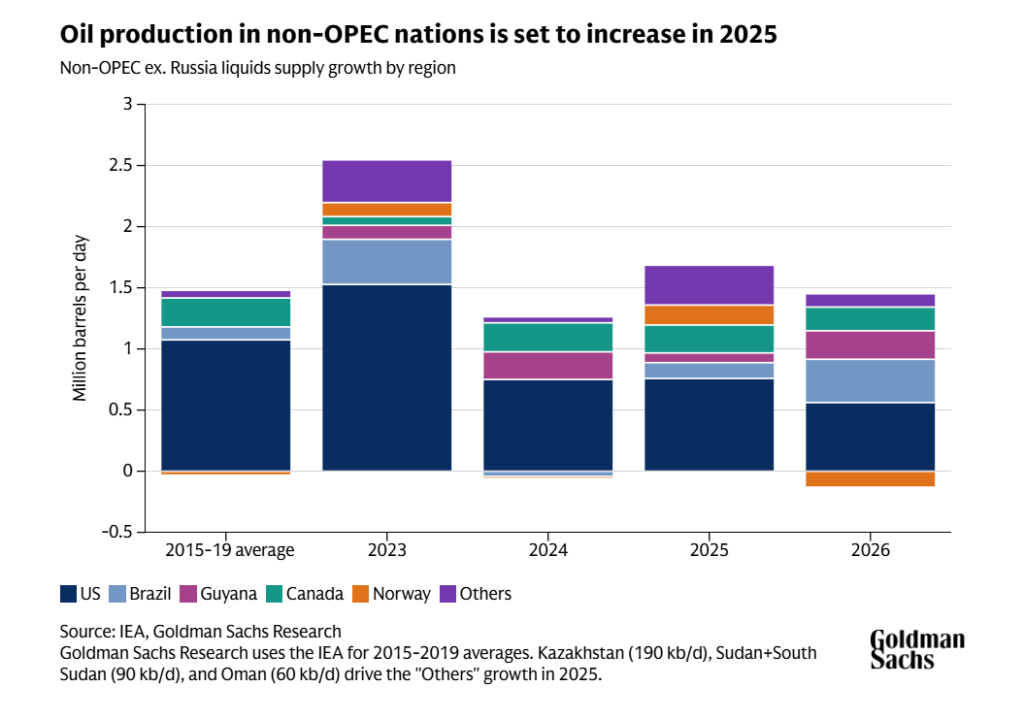
These forecasts are underpinned by complex market dynamics. A modest oil surplus of 0.4 million barrels per day is anticipated, with non-OPEC production expected to grow by 1.7 million barrels per day.

The rising electric vehicle market could reduce oil demand by 0.6 million barrels per day by 2026, adding another layer of complexity to price predictions.

Supply-side considerations: A delicate balance

The supply landscape is equally intricate. The US Energy Information Administration (EIA) forecasts US crude oil production to reach 13.5 million barrels per day in 2025, with modest growth expected in 2026.

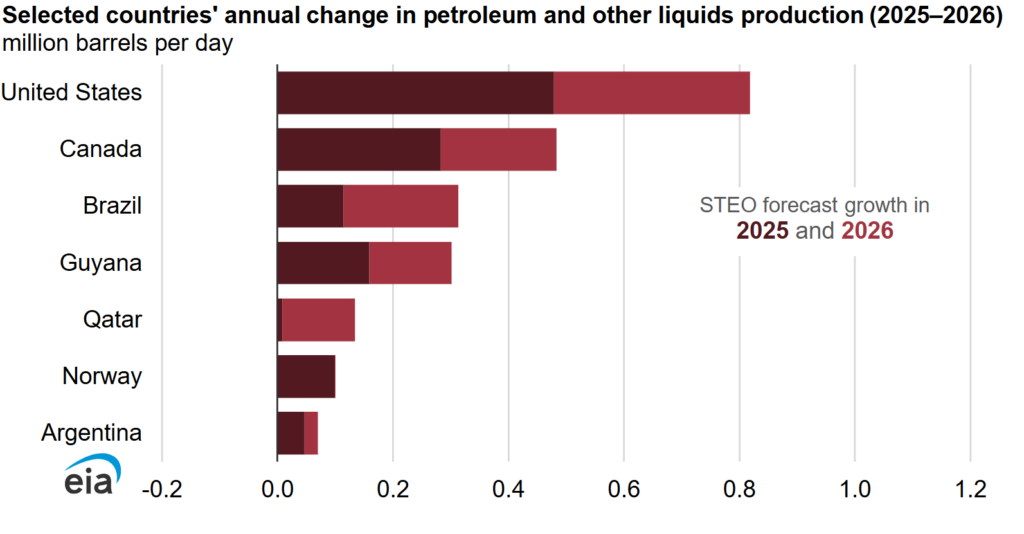
Non-OPEC production is predicted to grow by 1.7 million barrels per day, with substantial contributions from the United States, Canada, Brazil, and Guyana.

OPEC+ remains a critical player in maintaining market stability. The organisation has implemented multiple production cuts since April 2023, strategically managing global supply.

Despite these efforts, prices have continued to decline, falling from USD 85 per barrel in April 2023 to around USD 74 per barrel by December 2024.

The organisation’s spare capacity provides a crucial buffer against potential market disruptions. This strategic approach allows OPEC+ to prevent extreme price fluctuations while managing global supply dynamics.

The group’s ability to adjust production quickly gives them significant market influence, acting as a stabilising force in an otherwise volatile market.

Technological innovations and supply chain developments

Technological advancements are transforming oil production, especially with hydraulic fracturing and horizontal drilling unlocking previously inaccessible reserves.

In the US, the Permian Basin produces nearly 5 million bpd, making up around 40% of US output. Over the last decade, drilling costs in the basin have dropped by 30%, thanks to more efficient techniques like extended laterals and multi-stage fracking.

Seismic imaging and AI-driven optimisation have improved reserve identification and output by 10-15%, reducing exploration costs. On the supply side, pipeline expansions like Cactus II, which transports oil from the Permian to the Gulf Coast, have alleviated bottlenecks, cutting transport costs by up to 5 USD per barrel. These innovations are enhancing production efficiency and stabilising oil prices.

Geopolitical risks and potential disruptions

Geopolitical tensions continue to cast a long shadow over oil markets. The ongoing Russia-Ukraine conflict, potential Middle Eastern instabilities, and complex US-China trade dynamics create an environment of significant uncertainty.

The United States has introduced new sanctions targeting Russian oil producers, specifically targeting over 100 Russian tankers and oil producers. These sanctions, introduced in January 2025, have the potential to disrupt global oil supply chains and create additional market volatility.

The Red Sea shipping disruptions further complicate the global oil transportation landscape. Tensions involving Yemen’s Houthis and potential limitations on vessel movements introduce additional risk factors that traders must carefully monitor.

Conclusion

The oil market in 2025 promises to be a complex ecosystem shaped by technological innovations, geopolitical tensions, and evolving energy consumption patterns. Successful traders will need to remain flexible, well-informed, and adaptable.

The interplay between fossil fuel markets, green technologies, and geopolitical uncertainties creates a challenging yet potentially lucrative trading environment. Understanding these dynamics is key to informed investment decisions.

Ready to capitalise on oil market insights? Open a live trading account with VT Markets today and put your newfound knowledge into action. With competitive spreads and advanced trading tools, VT Markets empowers you to navigate the dynamic world of oil trading with confidence.

Oil price forecast for 2025: Key factors that could shape the market

When Donald Trump assumed the presidency, the oil markets immediately felt the tremors of his bold energy policies. Within days of his inauguration, oil prices tumbled, with Brent crude plummeting 1.1% to USD 79.29 per barrel and WTI futures dropping 2.6% to USD 75.89.

Trump’s declaration of a national energy emergency and aggressive stance on maximising US oil production signalled a fundamental shift in global energy dynamics.

This historical snapshot illustrates the volatile nature of oil markets, where geopolitical decisions, economic policies, and global tensions can dramatically impact prices.

As we look ahead to 2025, understanding the key factors influencing oil prices becomes crucial for traders and investors seeking to navigate this complex landscape.

Global demand dynamics: A shifting landscape

The global oil demand landscape is experiencing significant transformations.

According to the International Energy Agency (IEA), global oil demand is expected to grow by 1.05 million barrels per day in 2025, reaching total consumption of 104 million barrels daily. This growth, while substantial, represents a moderation compared to historical trends.

Emerging markets are driving this expansion, with a fascinating geographic shift in energy consumption. India stands out as a particularly critical player, with its rapidly growing economy and increasing energy needs. While China’s oil demand is anticipated to peak between 2025 and 2027, India’s consumption continues to rise dramatically.

The Chinese National Petroleum Corporation (CNPC) predicts peak oil demand in 2025, attributed to increasing electric vehicle adoption and growth in liquefied natural gas (LNG) truck usage.

The electric vehicle (EV) market plays a pivotal role in these demand projections. Goldman Sachs research suggests that global EV sales will increase from 11 million in 2024 to 17 million in 2026, potentially reducing oil demand by nearly 0.6 million barrels per day by 2026. This transition underscores the growing impact of green technologies on traditional energy markets.

Price forecast: A multifaceted outlook

The 2025 oil price landscape presents a nuanced picture, with leading financial institutions offering varied perspectives.

The U.S. Energy Information Administration (EIA) forecasts Brent crude at USD 74 per barrel in 2025, with a potential decline to USD 66 in 2026.

Citi Research provides a more optimistic view, raising its Brent crude projection to USD 67 per barrel and suggesting quarterly variations from USD 75 in the first quarter to USD 60 by year-end.

Goldman Sachs takes a broader approach, anticipating Brent crude trading between USD 70 and USD 85 per barrel, with an average of USD 76.

The International Energy Agency adds depth to these projections, highlighting a global oil demand increase of 1.05 million barrels per day, pushing total consumption to 104 million barrels daily.

These forecasts are underpinned by complex market dynamics. A modest oil surplus of 0.4 million barrels per day is anticipated, with non-OPEC production expected to grow by 1.7 million barrels per day.

The rising electric vehicle market could reduce oil demand by 0.6 million barrels per day by 2026, adding another layer of complexity to price predictions.

Supply-side considerations: A delicate balance

The supply landscape is equally intricate. The US Energy Information Administration (EIA) forecasts US crude oil production to reach 13.5 million barrels per day in 2025, with modest growth expected in 2026.

Non-OPEC production is predicted to grow by 1.7 million barrels per day, with substantial contributions from the United States, Canada, Brazil, and Guyana.

OPEC+ remains a critical player in maintaining market stability. The organisation has implemented multiple production cuts since April 2023, strategically managing global supply.

Despite these efforts, prices have continued to decline, falling from USD 85 per barrel in April 2023 to around USD 74 per barrel by December 2024.

The organisation’s spare capacity provides a crucial buffer against potential market disruptions. This strategic approach allows OPEC+ to prevent extreme price fluctuations while managing global supply dynamics.

The group’s ability to adjust production quickly gives them significant market influence, acting as a stabilising force in an otherwise volatile market.

Technological innovations and supply chain developments

Technological advancements are transforming oil production, especially with hydraulic fracturing and horizontal drilling unlocking previously inaccessible reserves.

In the US, the Permian Basin produces nearly 5 million bpd, making up around 40% of US output. Over the last decade, drilling costs in the basin have dropped by 30%, thanks to more efficient techniques like extended laterals and multi-stage fracking.

Seismic imaging and AI-driven optimisation have improved reserve identification and output by 10-15%, reducing exploration costs. On the supply side, pipeline expansions like Cactus II, which transports oil from the Permian to the Gulf Coast, have alleviated bottlenecks, cutting transport costs by up to 5 USD per barrel. These innovations are enhancing production efficiency and stabilising oil prices.

Geopolitical risks and potential disruptions

Geopolitical tensions continue to cast a long shadow over oil markets. The ongoing Russia-Ukraine conflict, potential Middle Eastern instabilities, and complex US-China trade dynamics create an environment of significant uncertainty.

The United States has introduced new sanctions targeting Russian oil producers, specifically targeting over 100 Russian tankers and oil producers. These sanctions, introduced in January 2025, have the potential to disrupt global oil supply chains and create additional market volatility.

The Red Sea shipping disruptions further complicate the global oil transportation landscape. Tensions involving Yemen’s Houthis and potential limitations on vessel movements introduce additional risk factors that traders must carefully monitor.

Conclusion

The oil market in 2025 promises to be a complex ecosystem shaped by technological innovations, geopolitical tensions, and evolving energy consumption patterns. Successful traders will need to remain flexible, well-informed, and adaptable.

The interplay between fossil fuel markets, green technologies, and geopolitical uncertainties creates a challenging yet potentially lucrative trading environment. Understanding these dynamics is key to informed investment decisions.

Ready to capitalise on oil market insights? Open a live trading account with VT Markets today and put your newfound knowledge into action. With competitive spreads and advanced trading tools, VT Markets empowers you to navigate the dynamic world of oil trading with confidence.

What Are ETFs & How to Trade ETFs Effectively?

Understand Exchange-Traded Funds (ETFs) & Trade Them Effectively 

This article explores what ETFs are, how they function, and the key steps to trading them successfully. We’ll explore different types of ETFs, their key benefits, and why they are a popular choice among traders. Whether you’re a beginner or an experienced trader, you’ll discover how ETFs can diversify your portfolio and how VT Markets can provide the ideal platform for your trading journey.

What Are Exchange-Traded Funds (ETFs)?

Exchange-traded funds (ETFs) are investment funds that trade on stock exchanges, much like individual stocks. They are designed to track the performance of an underlying index, commodity, sector, or asset class, offering traders and investors a cost-effective way to diversify their portfolios. ETFs may include a variety of assets, such as stocks, bonds, commodities, or a combination of these asset classes.

One of the key reasons ETFs have gained popularity is their flexibility, allowing market participants to buy and sell shares throughout the trading day at market prices. Understanding what ETFs are and their benefits can help traders make informed decisions when diversifying their portfolios.

How Do ETFs Work?

To understand how ETFs work, it’s essential to know their structure. An ETF provider creates a fund that holds a basket of assets, such as stocks, commodities, or bonds. Shares of the ETF are then issued and traded on an exchange. Unlike mutual funds, which are only priced once a day, ETFs can be bought and sold at any time during market hours.

Discover the difference between ETFs and Mutual Funds

ETFs allow traders to buy and sell shares like stocks, ensuring liquidity and price transparency throughout the trading day. They can be either passively managed, tracking a specific index to replicate its performance, or actively managed, where fund managers aim to outperform the market through strategic asset selection. Additionally, some ETFs provide dividend payments to investors based on the underlying assets they hold. For instance, the SPDR S&P 500 ETF (SPY) is a widely recognized ETF that mirrors the performance of the S&P 500 index, making it a popular choice among traders.

Types of ETFs

There are several types of ETFs that cater to different investment goals and risk appetites:

1. Equity ETFs

Equity ETFs are designed to track the performance of a specific stock index, such as the S&P 500 or NASDAQ. These ETFs provide diversified exposure to a broad range of companies, allowing traders to invest in entire markets rather than individual stocks.

Example: The SPDR S&P 500 ETF (SPY) is one of the most popular equity ETFs, tracking the S&P 500 Index, which includes 500 of the largest publicly traded companies in the US. Investors use SPY to gain exposure to leading companies like Apple, Microsoft, and Amazon without buying individual shares.

2. Bond ETFs 

Bond ETFs provide exposure to fixed-income securities such as government, municipal, and corporate bonds. These ETFs are popular among investors looking for regular income and lower risk compared to equities.

Example: The iShares Core US Aggregate Bond ETF (AGG) tracks the Bloomberg US Aggregate Bond Index, which includes a mix of government and corporate bonds. It offers diversification and stability, making it ideal for conservative investors.

3. Commodity ETFs 

Commodity ETFs track the price of physical commodities such as crude oil, natural gas, and precious metals like XAUUSD (gold). These ETFs allow traders to invest in commodities without dealing with the complexities of physical ownership.

Example: The SPDR Gold Shares ETF (GLD) tracks the price of gold (XAUUSD), providing an easy way for investors to hedge against inflation and economic uncertainties.

4. Sector ETFs

Sector ETFs focus on specific industries or economic sectors such as technology, healthcare, energy, or finance. These ETFs allow investors to target high-growth sectors or defensive industries depending on market conditions.

Example: The Health Care Select Sector SPDR Fund (XLV) tracks companies in the healthcare industry, including pharmaceuticals, biotechnology, and medical devices.

5. Thematic ETFs 

Thematic ETFs are designed to follow investment themes such as environmental, social, and governance (ESG), artificial intelligence, or renewable energy. These ETFs focus on specific megatrends and disruptive innovations.

Example: The iShares Global Clean Energy ETF (ICLN) invests in companies involved in renewable energy production, making it ideal for environmentally conscious investors.

6. Inverse ETFs 

Inverse ETFs are designed to generate profits when the value of an underlying index or asset declines. They achieve this by using derivatives such as futures contracts to produce opposite returns to the market they track. These ETFs are commonly used by traders to hedge their portfolios against downturns or to take advantage of bearish market conditions.

Example: The ProShares Short S&P 500 (SH) is an inverse ETF that moves in the opposite direction of the S&P 500 index. If the S&P 500 falls by 1%, SH is designed to rise by approximately 1%.

7. Leveraged ETFs

Leveraged ETFs aim to magnify the returns of an underlying index by using financial derivatives and debt instruments. These ETFs are designed to provide multiples of the daily performance of a specific benchmark, often 2x or 3x the movement. Leveraged ETFs are primarily used for short-term trading to capitalize on market momentum.

Example: The Direxion Daily S&P 500 Bull 3x Shares (SPXL) seeks to deliver three times the daily return of the S&P 500 index, making it suitable for aggressive traders looking to amplify their exposure.

Choosing the right ETF depends on your trading goals and market outlook. Understanding how ETFs work across different asset classes is crucial for selecting the best fit for your strategy.

How to Trade ETFs

Learning how to trade ETFs requires a strategic approach to understanding the market and making informed decisions. Follow these steps to start trading ETFs successfully:

1. Understand the Market

Before diving into ETF trading, it’s essential to grasp how the broader financial markets operate, including economic factors that influence ETF prices, such as interest rates, inflation, and market trends.

2. Analyze the Market

Use fundamental and technical analysis to identify potential ETF opportunities. Fundamental analysis looks at economic indicators and financial statements, while technical analysis focuses on price movements and trends.

3. Select the Right ETF

Research and compare ETFs based on expense ratios, liquidity, tracking error, and performance history to ensure they align with your investment goals and risk tolerance.

4. Open and Fund Your Account with VT Markets

VT Markets provides a seamless platform to start trading ETFs, offering access to a range of ETFs with competitive trading conditions and robust analytical tools.

5. Choose Your Order Type

Decide whether to use market orders for immediate execution, limit orders to buy/sell at a specific price, or stop-loss orders to manage risk effectively.

6. Monitor and Adjust

Regularly review your ETF portfolio’s performance and make necessary adjustments based on market conditions and your financial goals.

Benefits of Trading ETFs

Trading ETFs comes with several advantages, making them a popular choice among traders:

Diversification: ETFs allow traders to spread their investments across multiple assets within a single trade, reducing risk and enhancing portfolio balance. For example, an S&P 500 ETF offers exposure to 500 companies, providing instant diversification.

Cost-Effectiveness: With lower expense ratios compared to mutual funds, ETFs are a cost-efficient investment option. They generally have fewer fees and no sales loads, making them an attractive choice for budget-conscious traders.

Liquidity: ETFs trade on exchanges like stocks, allowing traders to buy and sell throughout the day at market prices. High liquidity ensures tight spreads and quick trade execution, especially with popular ETFs like SPY.

Transparency: ETFs disclose their holdings daily, providing traders with clear insights into their investments. Real-time price tracking on platforms like VT Markets allows for informed decision-making and quick market response.

Risk Management: ETFs help manage risk by providing diversification and hedging options. Traders can use inverse ETFs to benefit from market downturns or commodity ETFs like XAUUSD to hedge against inflation.

Popular ETFs to Watch

Some of the most traded ETFs globally include:

  • SPDR S&P 500 ETF (SPY): Tracks the S&P 500 index, offering exposure to large-cap US stocks.
  • iShares MSCI Emerging Markets ETF (EEM): Focuses on emerging markets such as China and India.
  • Vanguard Total Stock Market ETF (VTI): Offers comprehensive exposure to the entire U.S. stock market.
  • Invesco QQQ (QQQ): Tracks the NASDAQ-100 Index, featuring leading technology companies.
  • iShares Gold Trust (IAU): Offers exposure to XAUUSD, allowing traders to invest in gold without holding the physical asset.

Conclusion

ETFs are a versatile and cost-effective way to access a wide range of markets, offering diversification, liquidity, and transparency. Whether you’re looking to invest in equities, bonds, or commodities like XAUUSD, ETFs can help you achieve your financial goals with flexibility and lower costs. Understanding what ETFs are, how ETFs work, and how to trade ETFs strategically can empower traders to make informed decisions. With the right approach and reliable trading platform, ETFs can be a valuable addition to any trading portfolio.

Why Trade ETFs with VT Markets

VT Markets offers an exceptional trading experience for ETFs, offering competitive spreads, cutting-edge trading platforms such as MetaTrader 4 (MT4) and MetaTrader 5 (MT5), and dedicated customer support. Traders can benefit from a user-friendly interface, daily market analysis, and a wide selection of ETFs covering various asset classes. Whether you’re new to ETFs or an experienced trader, VT Markets equips you with the tools and resources needed to make informed trading decisions.

Start trading ETFs today with VT Markets and take advantage of global investment opportunities!

Frequently Asked Questions (FAQs)

1. What are ETFs?

ETFs (Exchange-Traded Funds) are investment funds that hold a basket of assets like stocks, bonds, or commodities. They trade on stock exchanges and allow investors to diversify their portfolios.

2. How do ETFs work?

ETFs work by pooling funds from investors to buy a collection of assets. The fund’s value fluctuates with the performance of the underlying assets, and shares of the ETF are traded on exchanges like stocks.

3. How do I trade ETFs?

To trade ETFs effectively, follow the step-by-step guide below:

  • Step 1: Understand the Market
  • Step 2: Analyze the Market
  • Step 3: Select the Right ETF
  • Step 4: Open and Fund Your Account with VT Markets
  • Step 5: Choose Your Order Type
  • Step 6: Monitor and Adjust

4. What are the advantages of ETFs?

ETFs offer several advantages, including low fees, diversification, and flexibility. They provide exposure to various markets and sectors while allowing investors to trade throughout the day on stock exchanges.

5. What is the difference between ETFs and mutual funds?

Unlike mutual funds, which are typically managed actively and can only be bought or sold at the end of the trading day, ETFs trade on exchanges throughout the day like stocks. Additionally, ETFs generally have lower management fees than mutual funds.


Back To Top
server

Hello there 👋

How can I help you?

Chat with our team instantly

Live Chat

Start a live conversation through...

  • Telegram
    hold On hold
  • Coming Soon...

Hello there 👋

How can I help you?

telegram

Scan the QR code with your smartphone to start a chat with us, or click here.

Don’t have the Telegram App or Desktop installed? Use Web Telegram instead.

QR code