Back

Today, the PBOC established the yuan midpoint at 7.2073, lower than the predicted figure

The People’s Bank of China (PBOC), the nation’s central bank, is tasked with setting the yuan’s daily midpoint. Within a managed floating exchange rate system, the yuan’s value can fluctuate within a band around this central reference rate, currently at +/- 2%.

Today, the midpoint is set at 7.2073, which is lower than the previous estimate of 7.2385. The prior closing rate was 7.2250.

Reverse Repurchase Agreement

Furthermore, the PBOC has introduced 158.6 billion yuan through a 7-day reverse repurchase agreement at a rate of 1.4%. There are no maturities today, making the net injection 158.6 billion yuan.

The People’s Bank of China (PBOC) has set the yuan’s midpoint weaker today, down to 7.2073 from a previous reference of 7.2385. This adjustment narrows the gap with the prior closing rate of 7.2250. It’s a subtle signal, but deliberate. The central bank appears interested in tempering the yuan’s depreciation pressures without creating sudden volatility, likely in response to both external capital trends and internal liquidity needs. Since the midpoint acts as a baseline around which the yuan is allowed to fluctuate in a controlled band, a lower fixing helps guide market expectations in a slightly stronger direction than the previous day’s close would imply.

Alongside the currency move, we’ve also seen another liquidity operation from the PBOC. The injection—158.6 billion yuan via 7-day reverse repos—is the kind of targeted short-term support we would expect around times of quarter-end settlement or tax payments. It’s deployed at a rate of 1.4%, and the absence of maturing instruments today makes this a full net addition. The scale and method tell us quite a bit. There is a clear preference for shorter-term mechanics rather than longer-term funding commitments, suggesting that authorities believe the squeeze is temporary rather than structural.

For those assessing FX volatility risk through swap points or considering directional trades via USD/CNH, these signals—particularly when looked at together—indicate measured control rather than any urgent intervention. It doesn’t scream panic; it suggests confidence.

Guidance Points

From our point of view, the directionality in the fix combined with increased liquidity via repo actions favours a modestly firm tone in the yuan over the week, all other variables constant. However, without supportive real money flow or a shift in macroeconomic data, traders running leveraged offshore positions should carefully monitor upcoming U.S. data releases and China’s own medium-term funding tools for any tightening signs.

Further out along the curve, there’s scope for increased two-way price action—particularly in the interest rate derivative space—should PBOC tighten the pace or scale of its daily operations. That being said, today’s volume and maturity show little appetite for abrupt tightening. It’s a balancing act being performed with precision. What stands out is where that balance is being struck; close enough to parity to dampen speculative downside, but not so strong as to halt export flow competitiveness.

What we read here are guidance points—small, intentional markers. Each one matters. Temporary positioning adjustments now could make a notable difference by month-end, especially with funding rates stable and forward points not pricing in any sharp directional tilt. Timing entries will be more effective if attention is paid, not only to exchange fixes and injection sizes, but also to the tone of yields across the offshore curve.

Make no mistake, none of today’s data points were accidental—nor should they be treated as routine. Every figure, from the fix to the liquidity measure, points to a maintained caution with clear conviction.

Create your live VT Markets account and start trading now.

Forex market analysis: 8 May 2025

Market uncertainty and shifting trade headlines have put the Japanese yen back in the spotlight. As investors look for safer places to park their money, the yen is gaining strength—driven by both global tensions and signals from central banks. In this analysis, we break down what’s behind the recent moves in USD/JPY and what could come next for traders.

Yen strengthens on safe-haven demand, trade tensions

The Japanese yen appreciated to 143.60 against the US dollar on Thursday, recovering earlier losses as rising geopolitical uncertainty fuelled renewed appetite for safe-haven currencies.

The rebound followed remarks by former President Donald Trump, who announced an upcoming press conference to unveil a trade agreement with a “major” nation—widely believed to be the United Kingdom.

Although the announcement slightly improved overall market risk sentiment, the yen gained strength after Trump reiterated that existing tariffs on Chinese goods would remain during initial trade discussions.

His firm trade stance introduced a sense of caution among investors ahead of this weekend’s US-China talks in Switzerland.

On the domestic front, the Bank of Japan’s meeting minutes revealed a mildly hawkish tilt. Some policymakers indicated willingness to raise interest rates, provided inflation and economic growth projections stay on track.

However, others urged prudence, pointing to potential risks from ongoing shifts in US trade policy.

Meanwhile, renewed focus on US-Japan trade negotiations has emerged, with Japan aiming to finalise a preliminary framework by June.

Such an agreement could influence Japan’s export-reliant economy and impact the Bank of Japan’s policy outlook.

USD/JPY technical analysis: Bulls watch 144.00 barrier

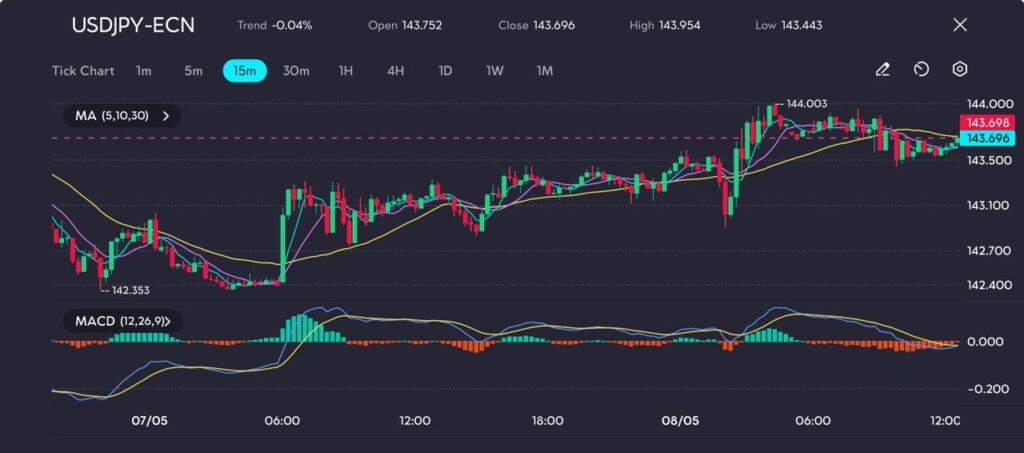
USD/JPY extended its recovery after bouncing from the 142.35 support level, briefly touching 144.00 before entering consolidation.

USD/JPY rebounds from 142.35 and taps 144.00, but momentum cools as price stalls beneath resistance, as seen on the VT Markets app.

Short-term bullish momentum remains intact, with the 5- and 10-period EMAs crossing above the 30-period moving average during the Asian session.

However, MACD histogram bars are shrinking, and signal lines are starting to turn downward, indicating fading momentum near the key 144.00 resistance.

As long as price remains above the 30-MA and holds support around 143.45, a bullish breakout attempt remains likely.

On the flip side, a decisive drop below 143.45 could spark a corrective move toward the 143.10–142.85 region.

Market outlook: Cautious tone remains

The yen may continue to benefit from safe-haven flows if global trade tensions and geopolitical risks remain elevated, particularly as markets assess developments in US-China and US-Japan negotiations.

Heightened uncertainty often prompts investors to seek refuge in lower-yielding but stable assets like the Japanese yen, which could drive USD/JPY back toward the 143.00 level.

However, this upward pressure on the yen could be limited if the Bank of Japan signals continued caution or leans dovish in future communications.

Additionally, signs of resilience in US economic indicators—such as strong labour market data or robust consumer spending—may support the dollar and counteract yen appreciation.

A confirmed move above the psychological 144.00 resistance would indicate renewed bullish momentum for USD/JPY, potentially opening the door to further gains toward the 145.20 region.

On the other hand, a sustained break below 143.00 could trigger increased yen buying, setting the stage for a deeper correction toward 142.50 or lower in the near term.

Click here to open account and start trading.

The GBP/USD pair trades around 1.3340, recovering following recent declines amid Trump trade policy speculation

The GBP/USD pair saw a rebound, trading around 1.3340, driven by speculation of a forthcoming US-UK trade agreement. Reports suggested that US President Donald Trump might announce the deal, potentially boosting the Pound Sterling.

On Wednesday, GBP/USD dropped by 0.6% as markets leaned towards the US Dollar. The Bank of England was anticipated to announce a rate reduction, following the Federal Reserve’s decision to hold interest rates steady.

Impact Of Trade Tariffs

Federal Reserve Chair Jerome Powell indicated that trade tariffs could hinder objectives for inflation and employment. Despite the impact of tariffs on sentiment, the absence of severe economic data makes immediate rate changes challenging for the Fed.

The pair further fell by over 0.2%, trading near 1.3331, amid increased focus on Powell’s press conference. The Federal Reserve maintained interest rates at 4.25%–4.50% and highlighted concerns over rising inflation and unemployment risks.

What we observed in recent trading sessions is a brief uptick in the British Pound, driven largely by speculation rather than confirmed fundamentals. The suggestion that a trade agreement between the US and the UK could be forthcoming gave the Pound a bit of momentum, with GBP/USD moving toward 1.3340. This was short-lived, however, as downward pressure quickly resumed once sentiment shifted back toward the Dollar.

Wednesday’s 0.6% fall confirmed what many had anticipated: the market continues to favour the Dollar in environments where uncertainty lingers and interest rate paths are unclear. The Bank of England was expected to follow the Federal Reserve’s recent decision to hold rates, although with a softer tone due to more sluggish UK economic indicators.

Powell’s remarks – specifically about tariffs harming both inflation and employment targets – caused a stir. There was a moment of reflection across Dollar assets. But that reaction proved restrained because US data, while not exactly shining, hasn’t provided enough weakness to justify immediate action. That leaves rate traders in holding patterns, hesitant to position too strongly in either direction until stronger cues emerge from economic prints.

Market Pricing And Economic Indicators

As soon as Powell took the podium for his post-decision remarks, the Pound saw renewed weakness. GBP/USD dipped lower to around 1.3331, and this tells us something: markets are still weighing the risks more aggressively on the Dollar side. The US central bank kept rates steady at 4.25% to 4.50% and stressed concerns about inflation holding firm while job market risks bubble beneath the surface. It’s these layered trade-offs — cooling price pressures contrasted with labour market vulnerabilities — that we think create a tricky environment for directional trades.

In the days to come, market pricing in rates and even shorter-term option contracts may continue leaning towards USD strength, especially as policy divergence remains less pronounced but still relevant. For now, it’s the absence of forceful data more than any shocking development that limits further movement. Timing is everything, particularly when rate paths on both sides of the Atlantic are not providing enough daylight for conviction.

Derivatives markets should expect thinner conviction until inflation data on either side surprises or employment readings force central bankers’ hands. In the absence of that, we might see implied volatility remain constrained across short maturity tenors. Options skew has loosened slightly in favour of downside GBP exposure, which fits with sentiment but may not invite large positioning unless catalysts appear.

We’re watching UK macro data closely here — wage growth figures or changes in household spending can push expectations one way or another. Any deviation could prolong pricing inefficiencies across short-dated futures and swaps, offering fleeting opportunities for yield-sensitive strategies.

For now, it’s patience and positioning over prediction. Stay anchored to confirmed data, especially around inflation and employment risk premiums. Trust less in headlines about policy speculation and more in the yield expectations underlying futures and forward curves.

Create your live VT Markets account and start trading now.

A bill to create a Bitcoin reserve fund has been approved by Arizona’s governor, Hobbs

Arizona has enacted legislation to create a Bitcoin and Digital Assets Reserve Fund. This fund will manage digital assets while restricting Bitcoin from being used for general fund transfers.

The adoption of this law follows the state’s prior rejection of other cryptocurrency legislation. By this action, Arizona aligns with New Hampshire in incorporating Bitcoin into its financial framework.

Arizona’s Digital Asset Strategy

Governor Hobbs has approved the bill, indicating progression in the state’s approach to cryptocurrency. This development represents a notable moment in Arizona’s digital asset strategy.

What this change signals is a deliberate strategy by the state to separate Bitcoin’s function as a reserve asset from its usability in day-to-day budgetary operations. While on the surface it may appear restrictive—excluding Bitcoin from general fund transactions—it actually opens up an avenue for the state to treat Bitcoin more like a long-term store of value, akin to gold or strategic commodities, rather than a spendable currency. By doing so, the fund is insulated from exchange rate volatility affecting public spending while still preserving upside potential.

The fact that lawmakers moved ahead with this model, following earlier failures to push other digital currency-related policies, shows an altered risk appetite among decision-makers. Their change in stance can largely be traced to recent shifts in fiscal policy preferences, combined with broader institutional interest in alternative reserves. The reserve fund becomes one more layer in an overall asset allocation strategy, rather than a tool for disbursement.

Hobbs’ signature, effectively making the bill law, represents forward motion and signals intent rather than finality. We read it as evidence that certain states are now willing to experiment with fiscal reserves in digital form—not to challenge federal currency powers, but to stabilise a portion of their balance sheets in assets that do not fluctuate on the same drivers as fiat-based revenue.

Potential Impact and Observations

The similarities between this move and earlier steps taken in New Hampshire suggest we could be seeing an informal pattern of alignment across states with particular preferences for minimal intervention in financial innovation. It hints at a recognition among some legislatures that, if well-governed, digital reserves might offer efficiencies or diversification benefits—without, however, jumping headfirst into cryptocurrency as a general medium of exchange for public finance.

From where we stand, what matters in the next few weeks is not the legislation itself—which is mostly symbolic while in its early phase—but how stakeholders position themselves around this shift. Those whose positions depend on longer timeframes may interpret Arizona’s move as a soft validation of digital reserves in the context of state finance. Contrast that with the constraints on Bitcoin’s use in general fund transfers, which appears designed to avoid introducing liquidity risks into budgeting.

Markets linked to derivatives may absorb this information with little immediate directional impact. However, one should keep an eye on whether similar reserve funds are proposed in other jurisdictions, particularly where there is current debate around hard asset diversification. In that scenario, hedging strategies may need to adjust not because of one law, but because of broader indications that public entities are willing to treat Bitcoin as a component of treasury strategy.

It’s also worth noting that the character of this fund—effectively passive and disconnected from operational spending—may support pricing stability in contexts where active selloffs tend to trigger downstream effects. We would characterise the weeks ahead as a time to monitor legislative activity in adjacent states, liquidity inflows into existing Bitcoin funds, and whether models of public endorsement translate into material changes in allocation by state-level institutions.

Create your live VT Markets account and start trading now.

During the Asian session, buying interest in silver rises, pushing prices towards the $33.20 mark

Silver’s Appeal In Diversification

Silver (XAG/USD) experiences renewed buying interest during the Asian session, reversing a large portion of the previous day’s decline from a one-week high. The metal reaches the $33.00 range and seems set for further appreciation.

Technical analysis suggests a bullish flag pattern, with oscillators on daily and hourly charts reflecting a positive outlook. However, a breakout above the $33.20 trend-channel resistance is needed for further gains.

Should this occur, Silver may target the $33.70 level and potentially reclaim $34.00, offering new opportunities for buyers. Support is expected around the $32.50-$32.45 area, with the next significant support near $31.60-$31.55.

Silver, less popular than Gold, is valued as a diversification tool, hedge during inflation, or investment in various forms. Silver prices are influenced by geopolitical tension, recession fears, interest rates, and the US Dollar’s performance.

Factors like investment demand, mining supply, and recycling rates impact prices. Silver’s industrial applications, especially in electronics and solar energy, also affect its valuation. It often moves closely with Gold, with the Gold/Silver ratio influencing market perception of value between these metals.

Momentum Indicators and Resistance

A notable observation can be drawn from the relative behaviour of the oscillators that track momentum and price strength. Both daily and intraday indicators signal ongoing positive pressure, which supports further upside moves. However, until silver convincingly crosses the $33.20 resistance level—formed by the upper edge of the current descending channel—we maintain a cautious view on chasing upside. Resistance zones like this often act as temporary ceilings, where price reacts before selecting its next move.

Should $33.20 be breached with volume and confirmation, then targets begin to widen. The $33.70 marker is in view first, which coincides with where the price encountered supply last month. Clear-through that range opens the door for a potential return to $34.00, a psychological area and past structural high that may attract attention. These levels may offer setups, but only with well-defined risk.

Support remains fairly well-defined as well. The $32.50 down to $32.45 band appears to be providing some footing. We’ll be monitoring that region closely if the price weakens, as breakouts often experience retests. A more substantial test of resolve would come near $31.60–$31.55, where previous positions could unwind and force hands.

From a broader perspective, white metals continue to reflect a mixed story. Fears around stagflation and slower global industrial activity would normally weigh on sentiment here due to silver’s dual role as both a monetary metal and an industrial input. But that has been offset in part by inflation hedging behaviour during times of falling purchasing power and political instability. Elevated tensions globally and uncertainty in currency markets may prolong this bid, especially when real yields adjust.

Fed commentary and rate trajectories remain central to directional swings in the Dollar, to which silver is inversely sensitive. A softer greenback, particularly when driven by shifting forward guidance, often lends support here. This correlation is quite intact and adds weight to timing around macro releases and speeches. Even minor shifts in narrative have fast-tracked price swings in recent weeks.

We can’t ignore that supply chains and mining output numbers haven’t returned to full throttle just yet. Primary silver production, especially in Latin American nations, continues to encounter spotty disruptions. That’s fed a basic supply imbalance, which adds a layer of support beneath prices, especially when inventory restocking or speculative demand quietly builds.

Industrial usage, especially in green energy and electronics, is another factor that quietly anchors silver. Recent developments in photovoltaic demand are worth tracking. Any announcement or policy nudge on climate subsidies tends to indirectly strengthen the industrial case. Meanwhile, the Gold/Silver ratio is trading near levels consistent with relative undervaluation. When that ratio compresses, it often reflects stronger flows into silver or shifting preferences among allocators.

With several technical and macro variables aligning—or in some cases, conflicting—traders must remain decisive and short-term oriented while being aware of broader structures. Timing and position size will carry more weight in pace-driven trades. Each resistance break should be measured not just by price, but by follow-through intent. Misjudging that can be costly in thin trading conditions.

For those adjusting exposure or recalibrating macro bias, Friday’s PCE data and US rate expectations will likely serve as the next primary catalyst. From there, we’ll reassess.

Create your live VT Markets account and start trading now.

Support for Ueda’s normalisation was expressed by former BOJ Governor Kuroda, urging calm amidst turmoil

Former Bank of Japan Governor Kuroda suggested a calm approach to Trump’s tariffs, advising that Japan should “sit down and respond” to U.S. policy changes. He critiqued the tariffs, suggesting they could escalate inflation to 4–5% by early autumn, negatively impacting U.S. consumption and growth.

Kuroda pointed out that U.S. policy uncertainty is already deterring U.S. business investment, which could affect long-term U.S. growth. He mentioned that Japan might gain from shifts in demand toward Japanese exports if U.S.-China tariffs persist. Kuroda dismissed any current talks of a second Plaza Accord and weakening the dollar, in spite of market unpredictability.

Bank of Japan Policy and Global Uncertainties

Regarding Bank of Japan policy, Kuroda supported Governor Ueda’s moves toward normalisation, considering the shift away from deflation as “appropriate”. However, he warned that potential rate hikes might be delayed due to global uncertainties.

Kuroda’s remarks serve as a calculated reminder that measured responses can often yield more durable outcomes than abrupt ones. His take on tariffs, particularly those introduced by the former U.S. administration, implies that while they are branded as necessary for domestic protection, they may carry heavier downstream effects. According to him, a rise in inflation to anywhere between four and five percent could tighten household budgets and reduce purchasing power, all while making it more expensive for businesses to borrow and invest. In that context, consumption slows down, expansion weakens, and uncertainty seeps deeper into markets.

By referencing a slowdown in U.S. business investment, Kuroda subtly points to hesitation in boardrooms that weigh future returns against a backdrop of inconsistent signals. This hesitation is not small—it could weigh on productivity gains and soften hiring plans. Over time, rather than driving innovation, firms may wait. This kind of pause adds pressure to monetary policymakers and clouds forward guidance.

We understand that shifting trade routes and supply chains may offer opportunities—morally neutral but economically advantageous for some exporters. If tariffs remain between two large economies, then others can find space to meet demand gaps. He implies Japan could benefit through redirected trade flows, benefiting from the dislocation rather than being caught directly in the policy shifts. However, we should be cautious not to see this silver lining as free upside. With each tariff decision, there are consequences that eventually interact with currency markets and capital allocation.

Monetary Policy Decisions and Global Dependencies

On the matter of monetary policy, Kuroda’s support for Ueda’s steps shows continuity but also invites patience. He sees the normalisation process as justified following decades of below-target inflation. The exit from persistent deflation has taken long years of stimulus and communication, so abrupt course changes would not be welcome. Still, he is mindful of external variables.

We interpret his caution over rate increases as a reflection of how exposed Japan’s monetary plans still are to what happens abroad. Global supply chains, energy prices, and investment flows could delay domestic decisions. The idea isn’t that a rate hike is off the table—but rather, that its timing cannot be assumed based on domestic indicators alone.

In the weeks ahead, it will be essential to monitor inflation prints in the U.S. and Japan closely. Policymakers are watching services, wages, and underlying price pressures. Any pickup in volatility might not come from expected sources.

Strategic engagement should follow economic signals, not political headlines. Option structures might lean toward longer expiries in response to uncertainty around rate paths or trade tensions. Any hedging related to dollar-yen should consider historical responses to trade disruption, not hypothetical accords.

Kuroda has made it clear: don’t expect coordinated currency agreements. Those looking for policy symmetry should instead focus on fiscal-monetary divergence and capital movement trends.

We’re reminded that every pricing decision is, in part, a judgement on stability.

Create your live VT Markets account and start trading now.

Speculation about a US-UK trade deal boosts GBP/USD, with the pair rising to around 1.3350

GBP/USD rises to near 1.3350 as speculation grows over a potential US-UK trade deal under President Trump’s administration. The US Dollar may gain momentum with the Federal Reserve’s cautious stance on monetary policy.

During the Asian session, GBP/USD recovers from recent declines, trading near 1.3340. The anticipation of the trade deal announcement fuels the Pound Sterling’s recovery.

Trade Agreement Speculation

US President Trump is expected to reveal the trade agreement, though this has yet to be confirmed. Meanwhile, the US Dollar Index, measuring the Dollar against six major currencies, stands around 99.70.

The Federal Reserve’s latest meeting kept interest rates at 4.25%–4.50% due to inflation and unemployment worries. Fed Chair Jerome Powell acknowledged trade tariffs could hinder inflation and employment goals in 2025.

The Pound Sterling is the world’s oldest currency and ranks fourth in global trading, accounting for 12% of foreign exchange transactions. The Bank of England’s interest rate decisions, influenced by inflation and economic data, directly affect the currency’s value.

Economic indicators like GDP, PMIs, and employment figures significantly influence the Pound. A country’s Trade Balance also affects currency strength, with positive balances generally enhancing currency value.

Currency Market Dynamics

With GBP/USD hovering near 1.3350, the pair has clearly responded to fresh speculation around a potential trade agreement between the United Kingdom and the United States under the administration of President Trump. While formal confirmation remains absent, pricing in of forward-looking news has historically been a catalyst for shifts in currency valuations, and evidently, traders are tilting their exposure in anticipation. The speculation—combined with the possibility of more favourable terms for UK exports—has lent short-term support to the Pound.

From our perspective, the modest recovery seen during the Asian session, with GBP/USD bouncing back from earlier declines into the 1.3340 range, reflects renewed interest from buyers who may be seeking to capitalise on perceived political tailwinds. However, the UK currency remains fundamentally tied to economic data and policy decisions, meaning macro indicators must still be monitored closely in the week ahead.

On the other side of the pair, the Dollar has been showing limited directional strength in the past few sessions, trading in a relatively tight range against a basket of currencies. With the US Dollar Index sitting around 99.70, it seems the market is taking a balanced view. The cautious tone adopted by the Federal Reserve appears to be keeping a cap on aggressive Dollar buying. Their decision to leave interest rates on hold at 4.25%–4.50%, outlined in their latest meeting, reflects ongoing reservations about inflation control and labour market sustainability.

Powell’s comments, where he highlighted the challenges posed by trade tariffs to inflation targets and employment prospects by 2025, are noteworthy. This gives us an insight into the Fed’s internal recalibration—less willingness to act aggressively in the near term unless data forces their hand. For interest-rate sensitive instruments, this points to reduced volatility forecasts unless headline figures deviate meaningfully from expectations.

Meanwhile, the Pound’s identity as a top actively traded global currency, supported in part by its 12% share in global FX turnover, lends the pair its typical liquidity. Even so, strength in the currency frequently tracks closely with the Bank of England’s interest rate trajectory. We must therefore keep a close watch on incoming price, employment, and GDP data, particularly in sectors disproportionately affected by trade developments.

Currently, the trade balance trend has leaned less favourable for the UK, but any resurgence in exports—suggested as a possible outcome of a new deal—could shift sentiment. Whether the Bank of England will interpret this as medium-term inflationary or a win for broader economic activity remains to be seen. Markets with high forward rate sensitivity, such as short-term Sterling contracts, could react quickly.

Until more tangible policy action or economic print emerges, we are watching short-term support and resistance levels closely. Momentum traders may view the 1.3350 handle as a short-term inflection point, while others may adopt a wait-and-see approach depending on signals from either central bank or further political developments. Respecting scheduled economic data remains essential. Holding positions through volatility tied to headline risk—particularly unconfirmed political announcements—requires tight risk parameters.

Create your live VT Markets account and start trading now.

Plans for a U.S. sovereign wealth fund are being drafted by Treasury and Commerce departments

The U.S. Treasury and Commerce departments are working on plans for a sovereign wealth fund. The White House has not finalised any decisions.

Initiated by Trump in February, the aim is to use government-held assets to benefit the public and enhance economic security. A potential component involves using tariff revenues as a primary funding source.

Sovereign Wealth Fund Models

Treasury Secretary Scott Bessent is exploring how to utilise both liquid reserves and domestic assets. The proposed fund could integrate investment and development functions, similar to models used by other countries.

The White House stated that this proposal is part of a larger strategy. The goal is to use all available resources to protect U.S. national and economic security.

What we’re seeing here is an early-stage policy initiative exploring whether to structure a government-controlled investment vehicle. The suggestion is to create something similar to sovereign wealth funds in other nations – think of Singapore’s GIC or Norway’s Government Pension Fund. While the administration hasn’t committed to one design, the direction is relatively clear: gather up certain public assets and find a way to turn them into something that earns. Preferably, it should earn consistently, over time, and in a way that also reinforces control over economic levers.

Bessent has been tasked with exploring the practicalities – what exactly could be pooled, how liquid those holdings really are, and under what laws they can be deployed. By using both short-term reserves and longer-term holdings, the idea seems to lean into dual objectives: generate yield while also supporting targeted sectors more strategically. It’s been implied that tariff income may serve as the initial inflow, at least partly. That has implications that aren’t negligible – we may see more dependence on import levies precisely because they could feed this fund.

Potential Market Impacts

For those of us watching volatility and yield shifts over short durations, this hints at a different state dynamic entering the financial system. State-directed capital tends to move on political cycles more than market ones. If this fund gets traction, the transmission mechanisms could change. If tariff flows are routed through it, that might mean less liquidity returning via standard Treasury operations. Repo markets could feel it almost immediately – auctions and IBs will have to discount a broader political risk spectrum.

We should also consider the policy sequencing here. With Bessent front-footing reserve strategy, and the Commerce Department aligning on development goals, there could be a longer-dated change to how the U.S. thinks about public capital. What matters more for us, though, is this: the fund, if confirmed, will likely become a tool for policy implementation, not just balance-sheet performance. It could shift correlations, particularly in rate futures and inflation-linked products, as it channels money based on domestic priorities rather than market signals.

Meanwhile, decisions remain unconfirmed, and that’s important. Not because they won’t happen but because timelines will remain in flux. What markets hate more than an unfriendly policy is one that’s half-shaped. For the next few weeks, any hint from Treasury officials or committee chairs should be weighed more heavily than usual. Bond desk chatter will likely start moving before official updates do. There’s no downside to watching flow data with a tighter lens.

Lastly, the reference to national and economic security isn’t accidental. This effort is not being framed as just another fiscal experiment. It’s been placed squarely under strategic interests. That should be taken to mean these funds, if they emerge, are not just targeting return – they’ll be deployed with intentional direction. Which sectors, which regions, and at what pace – all those choices will carry policy meaning. In fast-moving rate environments, that kind of directional bias matters for how spreads widen or tighten, and how volatility is priced. Keep that close.

Create your live VT Markets account and start trading now.

According to a prominent Chinese media source, Beijing is set to maintain its trade principles without tariff reductions

Beijing is unlikely to lower tariffs before talks in Switzerland. A spokesperson for the Chinese Embassy stated that China opposes US tariff policies and plans to defend its interests.

Currently, the US Dollar Index is down 0.25%, while the Australian Dollar sees a 0.54% rise against the US Dollar, trading near 0.6460. Tensions remain from the US-China trade war, which began in 2018, with Donald Trump’s tariffs on China leading to retaliation.

Us China Trade Tensions

Despite the Phase One trade deal in 2020 aimed at stabilising relations, tariffs remain under President Joe Biden. The return of Trump to presidency reignited US-China trade tensions with plans for additional tariffs, affecting global supply chains and inflation.

In currency movements, the GBP/USD pair rebounds, trading near 1.3340, as speculation grows about a US-UK trade agreement. The EUR/USD shows slight gains above 1.1300 amid USD selling and trade uncertainties. Gold prices continue their upward challenge, eyeing a price of $3,435.

The recent Federal Open Market Committee meeting concluded with no change to the federal funds rate, maintaining the target range at 4.25%-4.50%. Meanwhile, the altcoin market faces complexity with fragmented narratives and liquidity issues.

What we’re watching unfold is a tense juncture in broader trade relations, where past policy choices are still echoing and shaping present economic behaviour. Beijing’s reluctance to reduce tariffs ahead of the upcoming Swiss discussions points towards a strategy that values leverage over compromise. A spokesperson has already clarified their position, stating their intent to defend economic interests rather than yield to Washington’s pressure. That alone sets a high bar for diplomatic progress in the near term—particularly as both sides hold firm to their longstanding principles.

The decline in the US Dollar Index, now down 0.25%, reflects both investor caution and increased supply pressure as capital moves toward risk-aligned assets. The Australian Dollar, rising 0.54% and now hovering around the 0.6460 level, benefits from this tilt. This adjusted outlook suggests traders are positioning for continued weakness in US fiscal diplomacy and potential reactions from Asia-Pacific policy hubs. We can expect these themes to remain influential in commodities as well, where gold is already climbing, testing resistance close to the $3,435 mark. Safe-haven flows appear unrelenting.

Global Economic Trends

Looking to the currency space, the GBP/USD bounce near 1.3340 is being shaped by new airflow surrounding a potential bilateral trade agreement. That momentum has lifted sterling beyond its recent base, and participants will likely continue to price in optimism until further clarity emerges. Across the Channel, the euro is provisionally stronger too—trading a shade above 1.1300. This subtle uptick is less about eurozone fundamentals and more a consequence of dollar softness, triggered by fiscal uncertainty and tangled supply dynamics.

As for rates, the most recent FOMC decision to hold borrowing costs steady within the 4.25%–4.50% target range sends a signal. Policymakers seem prepared to wait, to give previously enacted rate hikes time to unwind their effects. This patience from the Fed has generally tempered expectations for short-term volatility, although it also suggests relative calm could be disturbed by any rotation in inflation forecasts or labour data surprises in the US.

We also note how these macro layers are influencing low-liquidity corners of the market—particularly digital assets. The altcoin market continues to stagger under scattered sentiment and unclear catalysts. What’s keeping participation patchy is the widespread thinning of order books and the hesitation among major holders to build new positions in the face of inconsistent regulation and murmurs of tighter oversight.

Over the coming sessions, expect rates, currency pairs, and volatility pricing to respond heavily to progress—or the lack of it—in upcoming global trade discussions. For those tracking derivatives, it’s worth accounting for headline sensitivity across all FX crosses, as well as sector-specific commodity reaction tied to trade posturing. We’re also factoring in potential asymmetric risks: where modest political developments may produce outsized market swings, particularly where macro positioning is already skewed. Carefully structured option strategies may be the more efficient vehicles here, especially where implied volatility remains off recent highs.

Create your live VT Markets account and start trading now.

What is Paper Trading and How Does It Work?

Paper Trading: What is It and How Does It Work?

If you’re new to trading or want to refine your skills without risking real money, paper trading is the perfect solution. But what exactly is paper trading, and how does it work? Simply put, it allows traders to practice strategies using virtual funds in a risk-free environment. Whether you’re testing new strategies or learning the ropes, paper trading provides hands-on experience. In this article, we’ll explain what paper trading is, how it works, its benefits and drawbacks, and how to get started today.

What is Paper Trading?

Paper trading refers to the process of simulating trading in the financial markets using virtual money. It allows traders to practice their skills without risking real capital. The concept originated from the early days of trading when individuals would write down their trades on paper to track their performance. Today, trading platforms make paper trading possible, offering traders a risk-free environment to test strategies and learn how to navigate the markets.

This practice is essential for beginners and seasoned traders alike. By using simulated funds, traders can get a feel for real-time market conditions and improve their skills without the pressure of losing actual money.

How Does Paper Trading Work?

Paper trading works by allowing traders to place trades on a simulated platform with virtual money. The trades are based on real market prices, so the experience mirrors that of live trading. Most trading platforms, including VT Markets, offer a demo account that simulates live trading conditions using virtual funds. These accounts allow you to practice placing orders, managing trades, and navigating the platform, all while observing how strategies perform in real-time market conditions.

Traders can monitor their paper trade results, analyze them, and adjust strategies based on the simulated outcomes. This has the major advantage of allowing traders to get comfortable with the trading platform and market conditions without any financial risk.

Paper Trading vs Live Trading

Paper trading and live trading are both essential for testing and developing trading strategies, but they differ significantly in terms of experience and execution.

Paper trading allows traders to simulate trades using virtual funds, providing a risk-free environment to practice strategies. It mirrors live market conditions in real-time, but with no financial consequences. This makes it an excellent tool for beginners to build confidence, learn platform features, and test strategies. However, paper trading lacks the emotional intensity of live trading, as there’s no real money at stake. Traders may act more impulsively or take risks they wouldn’t take in live trading.

In contrast, live trading involves real money, making every trade carry actual financial risk. It provides real-time feedback on how strategies perform under live market conditions, including the emotional pressure of managing risk, dealing with losses, and handling market volatility. The experience is much more dynamic and requires traders to make quick decisions under stress. The emotional aspect of live trading plays a crucial role in decision-making, which paper trading cannot replicate.

While paper trading is a valuable tool for practice, live trading offers the full experience of managing real financial stakes and adapting to real market conditions. The emotional pressure and decision-making involved in live trading are key factors that paper trading cannot simulate.

Paper Trading vs Backtesting

Backtesting and paper trading are both methods used to test trading strategies, but they differ in how they simulate market conditions.

Backtesting applies a strategy to historical data to evaluate its performance. This method helps traders understand how a strategy would have performed in the past under specific market conditions. However, backtesting only provides a static view, as it doesn’t account for the real-time unpredictability of the market, and there’s no feedback on how the strategy adapts to current market dynamics.

On the other hand, paper trading allows traders to test strategies in real-time with live market data but without risking actual money. It simulates current market conditions and provides the trader with immediate results from their trades, helping them practice order execution and adjust strategies on the fly. However, paper trading lacks the psychological pressure of real trading, as no real capital is involved.

The primary difference between the two is that backtesting uses historical data for strategy evaluation, while paper trading simulates the execution of a strategy in real-time, providing a more interactive and realistic testing environment.

Both are essential tools, but paper trading offers a more realistic, hands-on experience, while backtesting gives insights into long-term viability.

Advantages and Disadvantages of Paper Trading

Paper trading offers a risk-free way to practice, but it has both advantages and limitations. While it helps you build confidence and test strategies, it doesn’t replicate the emotional challenges of live trading. Let’s take a look at both the benefits and drawbacks of paper trading.

Advantages

Risk-Free Learning: The most obvious advantage is the ability to practice without the fear of losing real money. This makes it an ideal tool for beginners to learn the basics of trading.

Testing Strategies: Traders can test various trading strategies, such as scalping, day trading, or trend-following, to see what works best in different market conditions.

Platform Familiarity: Paper trading helps users become comfortable with the features and tools of a trading platform, making the transition to real trading smoother.

Building Confidence: With no financial risk involved, traders can gain confidence in their decisions, helping them build discipline and consistency.

Disadvantages

Lack of Emotional Engagement: Without real money at stake, traders often don’t experience the emotional pressure that comes with live trading. This can result in overconfidence and poor decision-making when transitioning to a real account.

Unrealistic Market Conditions: Since no actual funds are involved, paper trading can fail to simulate the psychological stress and fast decision-making required in live markets.

No Real-Time Market Impact: Trades in a paper trade environment do not affect the market, meaning there is no real slippage or order execution delay. It also doesn’t reflect how market volatility and liquidity can impact trades in a live market.

When Should You Use Paper Trading?

Paper trading is beneficial in several situations:

Beginners: If you’re new to trading, using a demo account is an excellent way to familiarize yourself with the market without risking real money.

Testing Strategies: If you’re developing or refining a trading strategy, paper trading allows you to experiment and adjust your approach without financial consequences.

Learning New Markets: If you’re looking to expand into new markets, such as stocks, forex, indices, precious metals, ETFs, soft commodities, energies, and more, paper trade first to understand how each market operates.

Refining Skills: Even experienced traders can benefit from paper trading to practice risk management and decision-making.

How to Start Paper Trading

Starting paper trading is simple. Most trading platforms offer a paper trading option where you can open a demo account. Here’s a quick guide:

Step 1: Learn How Trading Works

Understand the basics of trading and explore the different asset classes (stocks, forex, commodities, etc.).

Step 2: Open a Demo Account with VT Markets

Sign up with VT Markets, which offers paper trading, and open a demo account to get started.

Step 3: Analyze the Market

Use technical and fundamental analysis to review the market and identify trading opportunities.

Step 4: Choose Your Trade Direction

Decide whether to go long or short, and input your position size.

Step 5: Manage Your Risk

Set up risk management tools like stop-loss and take-profit to protect your trades.

Step 6: Start Trading

Execute your trades in the demo account as you would in a live market environment.

Step 7: Monitor and Adjust

Keep track of your trades, assess your performance, and adjust your strategy as needed.

It’s crucial to treat paper trading seriously—track your trades, reflect on your results, and make adjustments just as you would if real money were involved.

Conclusion

Paper trading is a valuable tool for traders of all levels. Whether you’re a beginner looking to learn the basics or an experienced trader refining your approach, a demo account allows you to practice without financial risk. However, keep in mind that the emotional experience of live trading is something paper trading can’t replicate. Once you feel confident, transitioning to a live account can help you apply your skills under real market conditions.

Start Paper Trading with VT Markets Today

Ready to begin your trading journey? Start paper trading with a VT Markets demo account today using MetaTrader 4 or MetaTrader 5, two of the most powerful trading platforms available. Practice with virtual funds and explore the advanced trading tools and resources we provide to help you refine your skills. Once you’re confident in your strategies, transition to live trading with VT Markets, where you’ll enjoy competitive spreads and advanced tools that every trader needs to succeed.

Frequently Asked Questions (FAQs)

1. What is paper trading?

Paper trading refers to simulated trading, where you practice buying and selling assets using virtual funds without any financial risk.

2. How does paper trading work?

You place real-time trades on a trading platform using simulated capital. The platform mirrors market conditions, but with no real money at stake.

3. Can paper trading help me become a better trader?

Yes, it allows you to test strategies, familiarize yourself with trading platforms, and build confidence without the fear of losing real money.

4. How do I transition from paper trading to real trading?

Start with small amounts of real money, stick to strategies that have worked in paper trading, and focus on managing your emotions effectively.

5. Can I paper trade on VT Markets?

Yes, VT Markets offers paper trading through a demo account, where you can practice with virtual funds and gain hands-on experience in real-time market conditions, all with no financial risk.

6. What’s the difference between paper trading and live trading?

While paper trading allows you to practice without financial risk, live trading involves real money and the emotional pressure that comes with it. Live trading provides real-time market feedback, while paper trading is mainly for learning and testing strategies.

7. Is paper trading the same as backtesting?

No, paper trading involves simulating trades in real-time with live market data, while backtesting applies a strategy to historical data to see how it would have performed in the past. Paper trading gives you a more realistic, real-time experience.

8. Can I trade any asset using a demo account?

Yes! With VT Markets, you can trade a wide range of assets, including stocks, forex, indices, commodities, and ETFs in your demo account, giving you the flexibility to practice across various markets.


Back To Top
server

Hello there 👋

How can I help you?

Chat with our team instantly

Live Chat

Start a live conversation through...

  • Telegram
    hold On hold
  • Coming Soon...

Hello there 👋

How can I help you?

telegram

Scan the QR code with your smartphone to start a chat with us, or click here.

Don’t have the Telegram App or Desktop installed? Use Web Telegram instead.

QR code