
Back

On the day, notable FX option expiries include EUR/USD at 1.1250 and USD/JPY at 145.65

FX option expiries are noted for 12 May at 10 AM, New York time. For EUR/USD, the 1.1250 level is noteworthy. While it has no technical links, the expiries are close to the gap closure level as the pair opened with a gap down.

Positive US-China talks have strengthened the dollar. However, today’s expiries might not be very impactful due to other factors. Market players are waiting for a joint statement from the US and China about their future steps.

Market Impact of FX Options

For USD/JPY, the $145.65 level is also noted but lacks technical relevance. The overall impact of these expiries could be minimal, with the dollar and risk sentiment being larger influences on price movements. Headline risks still play a central role in guiding market behaviour.

The overall risk mood is optimistic as equities climb higher, but dollar gains remain modest. There’s a difference in terms of current exuberance levels. It remains to be seen which side is correct by day’s end, as the markets will adjust accordingly to the unfolding events.

Reading over the earlier content, we can infer several layers worth unpacking. Today’s FX options expiries, though specified with particular strikes on EUR/USD and USD/JPY, appear unlikely to steer the market in the immediate term. The EUR/USD expiry near 1.1250, albeit technically insignificant, lines up with the area where a weekend gap might close. So while options flow near that region could add some gravity, price action will likely respond more fervently to wider macro signals or intraday momentum.

There’s been a mild dollar bid, nudged along by encouraging tones from diplomatic channels between the United States and China. The fact that both countries are edging toward a public declaration of coordination on trade and broader economic fronts introduces tailwinds for risk sentiment, even as exact statements remain pending. We, as observers and participants, should recognise that the dollar’s moves are tethered at present less to one-off options flow and more to the broader mood surrounding geopolitical cooperation. Equity markets are hinting at a preference for optimism, even as FX treads more carefully.

Role of Expiries and Market Sentiment

Looking at USD/JPY, there’s a listed expiry around 145.65, and once again, it sits without technical framing. These kinds of levels, lacking chart-based context or recent volume confluence, tend not to drive action by themselves. Expiries like these can still slow price motion temporarily if order books thin out close by, but it’s unlikely in this instance. The overriding dynamic remains tethered to sentiment around risk appetite and the dollar’s shifting performance.

Headline-driven sessions, particularly those without major economic releases, tend to exaggerate reactions at times. We’re seeing that today. Equities continue pressing higher, which usually points to a friendlier global risk tone, yet the dollar’s strength remains unusually persistent. It’s this divergence between equity enthusiasm and FX caution that may be telling us something about positioning. Perhaps it’s reflecting hedging rather than outright buying.

Given that, the importance today lies less in following any arbitrary number on the board and more in staying attuned to the alignment—or misalignment—between cross-asset clues. Traders who are positioned in options or those monitoring implied volatility should be anchored less to expiry pricing itself and more to the timing of statements or scheduled speakers. If we do see movement, it’s likely that it will come from news flow and not from the gravity of expiring strike prices.

This kind of atmosphere typically introduces short bursts of activity, interspersed with quieter patches while the market waits for direction. That creates traps for the over-eager and opportunities for those who wait. As usual, correlation between cross assets remains one of the most reliable temp checks on which way positioning might lean next.

By late afternoon into early Asia, it should become clearer whether this current round of optimism carries broader commitment. In the meantime, staying reactive and watching how price reacts when it gets close to these labelled expiry levels will tell us whether they’re worth tracking further tomorrow—or whether they were simply background noise.

Create your live VT Markets account and start trading now.

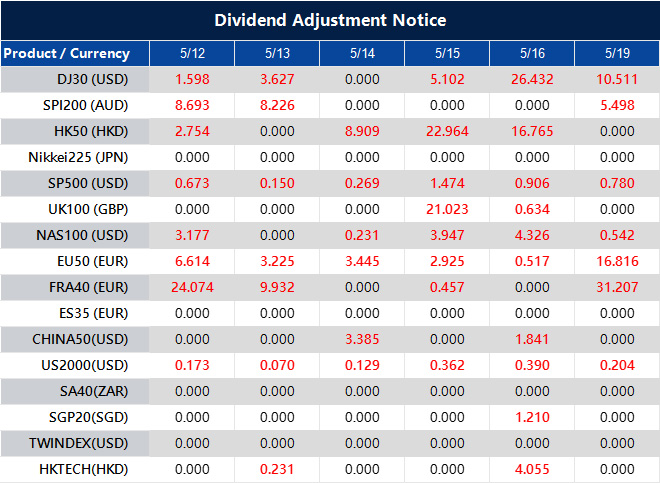
Dividend Adjustment Notice – May 12 ,2025

Dear Client,

Please note that the dividends of the following products will be adjusted accordingly. Index dividends will be executed separately through a balance statement directly to your trading account, and the comment will be in the following format “Div & Product Name & Net Volume”.

Please refer to the table below for more details:

Dividend Adjustment Notice

The above data is for reference only, please refer to the MT4/MT5 software for specific data.

If you’d like more information, please don’t hesitate to contact info@vtmarkets.com.

In India, gold prices declined today based on recent data collected by analysts

Gold prices in India experienced a decline on Monday. The per gram price fell to 8,918.24 Indian Rupees (INR), from 9,045.35 INR on Friday.

Additionally, the price per tola dropped to 104,020.50 INR, down from 105,503.20 INR at the end of last week. Other gold price measurements include 89,182.50 INR for ten grams and 277,380.30 INR per Troy Ounce.

Gold Price Dynamics

Gold prices in India are updated daily and reflect international prices adjusted for the local currency using the exchange rate. The prices are intended for reference, and actual rates might vary.

Gold is regarded as a store of value and a hedge against inflation and currency depreciation. Central banks, particularly from emerging economies, are the largest gold buyers, with 1,136 tonnes added to reserves in 2022.

Gold’s price is influenced by several factors, including geopolitical stability and interest rates. It has an inverse relationship with the US Dollar and Treasuries. Its price tends to rise in times of decreased interest rates or increased geopolitical tensions, while a strong US Dollar can suppress the price.

That decline in Indian gold prices—from ₹9,045.35 to ₹8,918.24 per gram—carries a message that goes beyond local supply or festive demand. It’s mirroring wider movements in global macroeconomic expectations and dollar strength, translated into rupee terms through the exchange rates. A similar downward move shows up in the tola and ounce-based quotes. These translated prices serve more as signals than execution levels, but the takeaway is clear.

This shift is part of a larger adjustment in sentiment as investors respond to mixed signals from Western economies. Recent firmness in the US Dollar is making it less attractive to hold unyielding assets like gold. As traders, we’re not just watching bullion tickers—we’re observing how the bond market is pricing in future rate paths. Yields on Treasuries have been inching higher, and that directly reduces the opportunity cost of holding gold. It matters because it shifts flows in and out of physical assets—sentiment doesn’t need to be negative, just slightly less enthusiastic, and that alone applies downward pressure.

Liquidity and Market Sentiment

Reference buyers from prior periods, such as central banks in regions like Southeast Asia and Latin America, have provided baseline demand. But their net positions don’t always move with market fluidity. They respond to multi-quarter policy outlooks. So, extrapolating future floor support from historic purchases may misguide shorter-term positioning.

There’s liquidity moving into higher-yielding exposures. This has added weight to gold’s pullback, even if only measured in small increments. And we can’t ignore the role of data surprises. Just a couple of unexpected payroll or inflation prints could steer the Federal Reserve’s tone, impacting liquidity preferences before quarter-end.

Bassett from ING pointed out last week that the inverse correlation between bullion and the US Dollar remains intact—for now. Powell’s latest remarks were carefully non-committal, which leaves the market delicately balanced. A sustained gold rebound in the short term would likely require a firm dovish turn or a geopolitical headline sharp enough to stir fear-based buying. Neither has materialised in the past fortnight.

From our side, all of this generates a more data-sensitive environment, where implied volatility across rate instruments remains elevated, and short-term directional bias may be fleeting. It’s not the season to lean heavily on directional conviction but to calmly assess how major currency fluctuations or bond auctions ripple into the metal’s pricing.

For further refinement, we should be measuring movement not only in gold spot prices but also in term structures of futures and options—what implied probabilities tell us about December’s pricing conditions may have more predictive strength than any single central bank headline.

Create your live VT Markets account and start trading now.

Goldman Sachs anticipates the yuan will strengthen, predicting USD/CNY to reach 7.20, 7.10, and 7 in upcoming months

Goldman Sachs has adjusted its forecast for China’s yuan exchange rate. The bank anticipates USD/CNY will fall to 7.20 in the next three months, 7.10 in six months, and will reach 7 over the coming year.

The bank suggests China’s exports will stay robust due to the currency’s undervaluation on a real trade-weighted basis, particularly compared to the dollar. These undervalued levels could lead to a stronger onshore yuan, potentially offsetting tariff reductions.

Forecast Update Reported

This forecast update was reported in a Bloomberg article referencing a Goldman Sachs note from last Friday.

What Goldman have done here is revise how they see the yuan moving against the dollar over the coming months. They now expect it to strengthen steadily, from where it is today, down to 7.20 in three months’ time, then 7.10 in six months, and finally settling at 7.00 over the course of the year. This is not a wholesale shift in thinking; it’s more like a fine-tuning of their expectations based on recent trade dynamics and economic indicators.

They’re making this call because they believe the yuan is trading too cheaply when you look at it through the lens of a trade-weighted index. That kind of measurement compares the yuan not just to the dollar but to a basket of other currencies used in China’s global trade. By that reading, the currency is still undervalued, so any sustained strength in exports—especially if global demand holds—could give the yuan room to climb. It’s a relatively mechanical relationship: strong exports mean steady demand for the currency, and that pushes it up.

Short Term Positioning

Now, what we need to consider is what this means for short-term positioning. If this view holds water, there’s a clear signal for the pricing of yuan-related derivatives. Anything structured on future expectations of depreciation might see repricing pressure. For example, implied volatility on USD/CNY could be moving too high if the currency’s appreciation path turns out to be smoother than some assume. Calendar spreads where the forward curve bakes in too much pessimism could begin to unwind.

In our view, the trade-weighted comment hints that the pressure isn’t necessarily coming from inside China—capital flight, policy missteps, or anything of the sort—but rather from a stubbornly strong dollar and weak peers. If the dollar starts to give ground, the mechanics around the yuan shift quickly. We’d likely see fewer intervention whispers and more organic moves in one direction. That should affect not just directional trades but also carry models and negative carry trades that rely on yuan stability to hold ground.

A possible readjustment of hedging strategies might now be on the table too. Forwards priced off short-term depreciation assumptions may be misaligned against the momentum Goldman sees building. This doesn’t mean abandoning protection entirely, but it does suggest running a fresh sensitivity check on exposure, particularly where non-deliverable forwards are concerned.

Tariffs were also mentioned, but almost in passing. That makes sense—the point seems to be that even if external pressure from tariffs fades, the internal strength of the currency could still take hold. In that case, policy fine-tuning by the central bank becomes less disruptive, and the exchange rate trades with more reflectiveness of trade demand and flow imbalances, not policy shadows.

One ought to watch how the short-end of the curve responds. If there’s appetite for yuan-denominated assets and reserves continue to hold, then front-month contracts could begin to show some narrowing. We would also keep an eye on option skew. If traders start expecting fewer topside emergencies, you might see lower demand for protection above 7.30 or so, making those calls cheaper.

It’s not a vacuum though—this view sets up a clear framework for divergence. If the broader macro narrative sours, especially with the Fed dragging its feet on rate cuts, this expected appreciation might stall. But if things hold, or if the dollar softens enough, as we suspect could be the case, the valuation gap Goldman referenced won’t last indefinitely.

Ultimately, the line they’re drawing is not about policy announcements or shock events—it’s about how pricing may have drifted too far from fundamentals. That’s not usually exciting at first glance, but in FX derivatives, it’s often where the steadier money is made.

Create your live VT Markets account and start trading now.

In Malaysia, gold prices dropped today based on compiled data from various sources

Gold prices in Malaysia decreased on Monday, with the cost per gram dropping to 453.06 Malaysian Ringgits (MYR), down from MYR 459.30 on Friday. The price per tola decreased to MYR 5,284.39 from MYR 5,357.15.

Gold is considered a valuable asset historically used as a store of value and medium of exchange. It is also seen as a safe-haven asset during uncertain times, and a hedge against inflation and currency depreciation.

Central Bank Influence

Central banks are the largest buyers of gold, holding it to diversify reserves and strengthen economic perceptions. In 2022, central banks added 1,136 tonnes of gold, valued at approximately $70 billion, marking the largest annual purchase recorded.

Gold has an inverse correlation with the US Dollar and US Treasuries. When the Dollar weakens, Gold prices tend to rise, while stronger dollars often suppress Gold prices. Geopolitical instability and economic recessions can cause Gold prices to escalate. Lower interest rates can raise the gold price, as it is a yield-less asset.

Gold prices are influenced primarily by the performance of the USD, as they are priced in dollars. A weaker Dollar usually results in increased Gold prices.

The recent drop in local gold prices—from MYR 459.30 per gram last week to MYR 453.06 now—reflects broader shifts in global expectations. A similar move was noted in the price per tola, which fell by over MYR 70 during the same period. This decline seems in step with a firmer US Dollar and growing talk around interest rate guidance, particularly in the US Treasury yields space.

As we’ve often found, gold behaves in direct contrast to the dollar. When the greenback strengthens, the precious metal feels the weight. That’s perhaps what we’re seeing here. Investors tend to shift towards dollar-based or interest-bearing assets when rates rise or when the economic outlook implies stability in monetary tightening cycles. In essence, when yields on US Treasuries get more attractive, gold—with no yield of its own—loses some appeal.

At the same time, macroeconomic signals have been relatively steady. There hasn’t been a fresh wave of geopolitical breakdowns or unexpected inflation surges, both of which usually send gold higher. In that sense, the safe-haven demand appears to have taken a pause. Without clear headlines driving fear or currency instability, we may see gold stay within a narrower band in the near term.

Future Projections and Strategies

That said, it’s important to watch the central bank footprint. Over the past year, their role has become more assertive. With over 1,100 tonnes bought in 2022 alone, demand from institutional coffers has kept undercurrents of support beneath prices, even during speculative pullbacks. So, while lower prices could make for attractive entry levels, the momentum will depend largely on Dollar flows and rate commentary.

We should be watching upcoming FOMC releases closely. If dovish tones start to surface again, gold could find a leg up. However, don’t expect explosive moves unless there’s a sudden economic data miss or liquidity event. Those signals usually push short-term hedgers toward commodities.

From a derivatives perspective, short-term positioning should reflect that gold tends to retrace quite quickly. Use tightening stops on any bullish exposure and allow room for potential mean-reversion if overreaction to macro news appears in the market. For those structuring options, implied volatility might remain low unless newsflow brings new uncertainty. In that event, long-vol strategies can become more attractive by comparison.

We’re also paying attention to correlations—it’s not just the Dollar, but correlations to equity indices and even energy markets can drive price swings. Of note lately, oil softness has corresponded with slight gold weakness. This could extend if broader commodity buckets lose strength, which would remove one layer of tail-risk demand from gold.

Ultimately, while the recent decline in Malaysian gold pricing offers a local-context update, the drivers remain globally pegged. Traders should operate with that in mind, structuring risk around inflation neutral scenarios, range-bound rates, and a Dollar that could still whipsaw on shifting sentiment.

Create your live VT Markets account and start trading now.

Officials from the US and China expressed optimism about trade discussions after initial talks in Geneva

Trade discussions between the US and China concluded in Geneva, with both nations expressing optimism. A mechanism for future talks has been established, and a joint statement is expected soon, indicating progress in their trade relationship.

US equity futures rose significantly with the reopening of markets, maintaining a steady climb with hopes for detailed improvements in trade relations. Currency markets reacted with USD/JPY rising and partially retracing, while EUR/USD lowered and fully reversed. Oil prices also increased before stabilising, and gold experienced a dip as Federal Reserve rate cut expectations reduced slightly.

The Impact Of US Policy Moves

In related news, President Trump plans to sign an executive order reducing US prescription drug prices by up to 80%, aiming to match international lows. This significant move may face legal challenges. Meanwhile, Japan’s Prime Minister Ishiba insisted on including auto tariffs in any trade agreement with the US, showing firm negotiation intentions.

The existing content outlines a few distinct themes that have shaped trading behaviour recently. Optimism surrounding US-China bilateral discussions has given participants room to reassess risk premiums and consider more constructive positioning. The announcement of a forthcoming joint statement helps anchor that sentiment, suggesting diplomatic traction rather than delay. Although not all aspects are resolved, the framework for continued talks removes some of the haze that had been weighing on forward-looking strategies.

Price action in US equity futures reflects this repricing in relatively linear fashion. That said, the absence of a volatility expansion suggests the move is driven more by relief than by an extrapolation of further immediate upside. Temporary pricing strength in the dollar-yen pair followed that view, only to fade as regional positioning and rate differentials recalibrated. The euro-dollar’s intra-session round trip underscores there is still caution among cross-asset flows, especially with rate-cut projections being quietly nudged lower.

Commodity Market Insights

On the commodities front, an early rally in oil was at first a natural reaction to marginally higher growth expectations, but soon encountered supply-side constraints that offset follow-through gains. Gold’s pullback reinforces this directional theme, pressured by a combination of lesser hedging needs and fading conviction of near-term easing from the Federal Reserve.

Further down the headlines, Trump’s intended executive order on drug pricing signals an abrupt reordering of sectoral priorities, which if enacted swiftly could affect healthcare equities and related derivative exposures. Nevertheless, the potential for legal contests introduces a layer of duration risk. We should view this more as a policy placeholder than a near-certainty in the current legislative environment. Separately, Ishiba’s push on auto tariffs signals a more assertive counterparty stance. This presents a likely point of friction, especially for those with exposure to industries sensitive to import costs.

Looking at how best to approach the next few weeks, a close eye on rate volatility remains warranted, particularly if inflation prints begin to pick up. Key is how markets internalise the tone of the joint statement when it’s released. Hedging strategies positioned short volatility may need rebalancing as macro clarity improves. Meanwhile, directional bets should focus not on binary trade outcomes, but on incremental shifts in base-case assumptions that lead into policy rhythm.

That also means tightening watch over central bank communication in both the US and Europe. Any deviation in tone, particularly surrounding employment expectations or energy inputs, is likely to ripple across rate products and terminals. With derivative pricing still adjusting to evolving drivers around global demand and policy, moves are likely to remain tide-driven rather than trend-laden for now. Active position management will be necessary to avoid riding too closely to errant optimism or dismissive pessimism.

We now find ourselves in the stage where sentiment indicators are more telling than trailing data, and timing sensitivity grows more acute across all risk-bearing instruments. Spreads have not yet reflected full confidence; this is not a detriment, but rather an opportunity to observe. Those willing to read closely beneath headline movements can act with greater asymmetry.

Create your live VT Markets account and start trading now.

Currently, the US Dollar Index is hovering around 100.60, remaining under the channel’s upper limit

The US Dollar Index (DXY) may revisit the upper boundary of its rising channel at approximately 100.80. A confirmed break above the 50 mark is necessary to signal a shift towards bullish momentum. Current trading positions the DXY near 100.60, indicating a second consecutive session of decline.

Technical analysis on the daily chart highlights a bullish trend, with the index maintaining its position within an ascending channel. The DXY’s hold above the nine-day Exponential Moving Average (EMA) suggests strengthening short-term momentum. However, the 14-day Relative Strength Index (RSI) remains below 50, suggesting bearish tendencies.

Key Levels To Watch

To rise further, the index needs to breach the current channel ceiling, targeting the 50-day EMA at 101.81. Surpassing this level could boost medium-term momentum, approaching the two-month high of 104.37. Conversely, immediate support lies at the nine-day EMA of 100.10. A decline below could weaken the index towards 99.50, potentially leading to the area around 97.91.

The heat map illustrates the US Dollar’s performance against other major currencies, revealing it weakened most against the Japanese Yen. For example, the USD depreciated by 0.34% against the JPY. Please conduct detailed research before making financial decisions.

The earlier section walks through a focused technical breakdown of the US Dollar Index — referred to as “DXY” — using a few essential tools like moving averages and RSI (Relative Strength Index) to gauge the market tone. As things stand, the index remains inside a positively sloped channel, which is typically read as constructive if the price continues upward within its bounds. However, right now, there’s a pullback happening — two sessions in a row of downward movement — showing the upward structure might be stalling, or at least pausing for breath.

From where we stand, the path to sustained strength would need to pass through a few milestones. First, that would include a clean move above the 100.80 top of the current rising channel. That level’s importance lies in its role as both a psychological and technical lid — unless price can move cleanly past, momentum will likely remain fragmented. Beyond that, the 50-day EMA becomes the next layer of resistance at 101.81, which if breached, can act as a slingshot toward April’s highs just below 104.40. The move would imply short-term positioning is giving way to something broader, though getting there isn’t guaranteed.

Momentum Conflict

Momentum-wise, there’s plenty of conflict. On one side, the nine-day EMA — a faster-moving average used to track immediate price reactions — is still holding beneath the index. That tends to serve as a soft floor during trend-following periods. And yet, when we bring in the RSI — currently holding below 50 — it reflects subdued underlying demand. This lag in relative strength is typically a red flag for follow-through on any rallies.

The nearest buffer zone on the downside sits around 100.10. That’s where the nine-day EMA rests, and if we dip below it with conviction, the next staging point falls to 99.50. Dive past that, and attention may have to shift toward 97.91, a level not seen since early March. It would be especially telling if such a move happened amid broader de-risking or inflation repricing, both of which would skew expectations around rate differentials.

The comparison against peers shows us where demand is bleeding most. According to the heat map, the US Dollar lost most ground versus the Japanese Yen, with a 0.34% drop in a single session. That performance gap isn’t just one data point; it adds weight to market sentiment leaning away from carry trades and more towards safer havens. Any extension of this relationship would point towards multiple actors rotating out of dollar-denominated exposure into JPY-based balances — often connected to macro unease or yield compression.

Looking forward, attention should remain locked on the reaction to the upper boundary of the current trading channel. If price remains suppressed beneath 100.80, tactical long positioning feels less appealing. Watching RSI to either push above 50 or falter again will add another layer to the directional call. Equally, keep an eye on whether the 99.50 zone brings in willing buyers or fails, as scope for continued moderation in rate pricing could pull the index even lower.

As participants with exposure riding on these price shifts, we’re focused on whether momentum tools start to sync up — instead of conflicting as they are now. Until then, daily closes carry more weight than intraday moves, while short-term setups need to be scrutinised for whipsaw risk.

Create your live VT Markets account and start trading now.

This year, IBIT has experienced the longest net inflow streak among spot bitcoin ETFs, exceeding $5 billion

BlackRock’s spot bitcoin ETF, IBIT, has recorded net inflows for the last 20 trading days. This marks the longest streak for any spot bitcoin ETF this year.

Goldman Sachs has become the largest shareholder in IBIT with a 28% increase in its holdings in the first quarter of 2025. During these 20 days, IBIT received over $5 billion in investments.

The ongoing inflows into IBIT are contributing to the support of bitcoin’s price.

The recent data on IBIT reveals a pattern worth noting. BlackRock’s spot bitcoin ETF has seen uninterrupted net inflows across 20 consecutive trading sessions, the most extended streak observed among its peers for this calendar year. This momentum, combined with mounting investment from institutional actors, underscores increased involvement from traditional finance.

Goldman Sachs, in particular, expanded its holdings by 28% over the first quarter of 2025, now positioning itself as the leading shareholder in the fund. These developments have coincided with over $5 billion in cumulative flows entering IBIT during the same period. The scale of this movement has not only acted as a clear display of appetite for the instrument but also appears to have lent consistent support to bitcoin’s market price.

What we’re seeing, then, is a fusion between tracked investment activity and corresponding price stability. These inflows are more than numbers on a page—they indicate committed capital from institutions that tend not to chase performance, but rather to allocate based on strategic outlooks. When movements of this size occur without visible profit-taking, it suggests an underlying conviction that prices can sustain or even rise from here.

With bitcoin’s price increasingly being linked to ETF volume, monitoring primary holders and fund flows has become far more informative than it was during periods where retail action dominated. As buy-side volume accumulates through structured vehicles like IBIT, the typical playbook must adjust. Rising open interest in related futures markets further hints at recalibrated hedging activity downstream.

Traders who concentrate on volatility in derivative products can take from this that larger, consistent flows into a product like IBIT serve as a dampener against drastic downside shocks. The discipline shown during these inflow sessions partially removes the chance of sharp, sudden unwinding. However, it also means any upside might be less explosive, unless new flows accelerate even further.

One has to be more attentive to options activity clustering around round-number strikes. Where hedging volumes increase, we often find reduced implied volatility once funding stabilises. The predictable inflow rhythm promotes order over disorder—for those attuned to delta or gamma sensitivity, this matters. We’ve noticed this affect short-dated contracts especially, which remain susceptible to even muted underlying moves under such a backdrop.

In recent weeks, the shift in buyer profiles presents a shift in directionality across expiry periods. Where once short-cycle traders led, we are now seeing a pattern where positioning tilts toward longer holds. This shift, when extrapolated through the options chain, softens premium decay and marks a change for those reliant on fast turnover.

It may be worthwhile to re-price future risk not purely based on historical volatility figures, but in closer relation to the consistency of net capital flowing through instruments like IBIT. That can offer a frame to anticipate when premiums are mismatched relative to on-chain or off-chain exposures.

Volume is meaningful when it doesn’t reverse—as we’re witnessing.

Due to trade optimism, the US Dollar rose, causing GBP to lose ground against it

The Pound Sterling saw losses against the US Dollar after the GBP/USD pair dropped below the 1.3290 support level. As the US Dollar regained strength, the GBP/USD pair showed a negative trend, trading around 1.3280-1.3275, a decrease of 0.20%.

The US announced a trade deal with China, reducing concerns about a US recession. The Federal Reserve’s hawkish pause further enhanced the Dollar’s strength, impacting the GBP/USD pair.

Euro And Gold Market Update

In the broader market, the EUR/USD remained below 1.1250 amid US-China trade deal optimism. Gold prices also struggled near a one-week low due to the same agreement lessening US recession fears.

Elsewhere, Bitcoin awaited catalysts to move beyond $109,000 despite trade deals involving the US and UK. The UK-US trade deal reduced tariffs for Britain without affecting future UK-EU negotiations.

Trading currencies on margin involves high risk. Before trading, consider objectives and risks; losses can exceed initial investments. Be aware of trading risks and seek professional financial advice if needed.

The recent weakening of the Pound against the Dollar reflects broader cross-currency pressure rather than an isolated move in Sterling alone. As GBP/USD fell through the 1.3290 threshold, it confirmed what had been building in sentiment—renewed Dollar resilience anchored in solid economic signals from across the Atlantic.

A key factor here was the announcement of a trade accord between the US and China. This development cut through past doubts about potential contraction in the American economy. Fewer recession worries have traditionally pulled support away from safe-haven assets, which explains why metals like gold are under pressure. The Fed’s decision to hold rates—without softening the accompanying language—effectively strengthened the Greenback further. It wasn’t so much about rates being unchanged as it was about the persistent suggestion of tight policy continuing longer than many had priced in.

Currency Derivative Strategies And Market Trends

For derivative strategies focused on currency movements, the Dollar’s firm momentum needs to be respected. From where we stand, the current mood in the market adds to the likelihood of continued Dollar strength. It’s not just GBP—EUR/USD has failed to crack 1.1250 under similar pressures. That price action across majors reinforces the trend.

Meanwhile, we note that Bitcoin remains subdued as it seems stuck just beneath $110,000 despite trade deals gaining attention. These agreements, especially the UK-US arrangement lowering tariffs, show little immediate feedback in price behaviour of digital or fiat assets. The practical outcomes might still take time to work through pricing mechanisms, especially in FX pairs that don’t respond sharply to broad trade shifts unless tied to tariffs or liquidity changes.

In the coming weeks, traders should be attentive to the way central bank positioning translates into real yield differences. US yields remain robust, and that feeds through directly into Dollar performance. With the Fed holding firm and economic expectations shifting upward, rate-sensitive markets could still be in for readjustments.

Risk management should remain tight. We’ve seen small data surprises drive large short-term moves, particularly when liquidity is thin or sentiment lopsided. Any positions with short Sterling exposure will need careful monitoring if UK inflation or labour data starts to deviate materially from trend expectations. Also worth watching—how markets digest Bank of England commentary, even if policy rates remain on hold.

Our framework continues to give weight to two clear themes: sustained Dollar strength and limited upside for Sterling unless fundamental data provides fresh signals. In that environment, leveraged positions need clear levels for protection and response. Dynamic hedging might be preferable for those already exposed, as directional conviction requires continual re-evaluation.

Ultimately, we’re in a phase where rates, spreads, and perceived asymmetries in economic momentum are doing the talking. That’s where focus needs to stay.

Create your live VT Markets account and start trading now.

Amidst US-China trade discussions, USD/CAD stabilises around 1.3940, buoyed by US Dollar strength

USD/CAD is steady around 1.3940, supported by a stronger US Dollar following US-China trade talks in Switzerland. Details from these talks suggested tariffs remain high, with China facing US tariffs of 145% and the US facing Beijing’s 125% tariffs.

Despite recession worries, data points to a slowdown in the US economy rather than a full contraction, with declining inflation rates. Yet, concerns persist over potential stagflation, as increased tariffs could harm supply chains, growth, and employment.

Drivers for the Canadian Dollar

The Canadian Dollar faces pressure from mixed labour data and uncertain Bank of Canada policies. Although jobs rose by 7,400 in April, unemployment reached 6.9%, indicating weaknesses, especially in manufacturing.

Key drivers for the CAD include Bank of Canada’s interest rates, Oil prices, economic health, inflation, and trade balance. Higher interest rates generally support the CAD, while Oil price shifts also greatly influence its value.

Macroeconomic indicators impact CAD by reflecting economic health; strong data attracts foreign investment and could prompt higher interest rates. Weak economic data, however, typically results in a weaker CAD.

What we’re seeing here is a relatively consistent USD/CAD pair, holding steady near the 1.3940 level. This stability is mainly thanks to a Greenback that continues to gain strength — lifted most recently by the headlines from the US-China trade discussions in Switzerland. From these talks, we learned that tariffs remain extremely high between the two nations, with the US still applying a 145% rate on Chinese goods, and China responding with a 125% rate of its own. For now, the market appears to view these numbers as sticky, not likely to fade quickly, and their effect is clear: they introduce fresh complications for global supply chains.

While some investors remain cautious about the possibility of a recession in the US, data emerging over the past few weeks does not suggest a full-blown economic contraction. Rather, what we’ve noticed is a cooling — inflation is clearly coming down, albeit slowly. But even with that trend in place, the market remains watchful for stagflation. Rising tariffs can push up input costs, which eventually filter through to consumer prices, just as growth and new job creation lose pace. Pair that with stubbornly higher interest rates, and you get an environment where equities may soften and risk assets struggle.

In contrast, the Canadian side of the equation feels messy. April’s employment change came in at just over 7,000 newly added roles — not bad on the surface — but this was overshadowed by a jump in the unemployment rate to 6.9%. The split is clear. Jobs are being created, but not in the areas where strength is most needed, notably manufacturing. That sector continues to weaken, which tends to hit the CAD harder than other currencies tied to commodity production.

Impact of Oil and Bank Policy

The central bank’s hesitancy adds another layer. While there has been increasing speculation around whether the Bank of Canada might cut rates later this year, policymakers haven’t yet offered the clarity that markets are looking for. Until they do, the Loonie may continue to drift or trade range-bound, depending more heavily on other variables like crude oil markets.

We know oil matters deeply here. Brent and WTI prices heavily influence Canadian trade flows. When oil is in demand globally, producers feel confident, and export volume rises. That usually drives income up and supports the Canadian Dollar. But with global growth forecasts being trimmed in Europe and parts of Asia, the oil outlook isn’t as strong as it was just a few months ago.

In practice, exchange rates work on expectations — and any clarity from data or central bank commentary can quickly adjust positioning. That’s exactly where macroeconomic indicators become vital. When Canadian GDP prints stronger than forecast, or inflation edges higher than expected, it feeds into foreign capital flows. If the probability of rate hikes rises, the CAD tends to gain as yield-seeking investors rotate into Canada. On the other hand, if spending weakens or wages stall, the entire narrative can turn quickly, favouring more defensive trades and weighing down on the Loonie.

Watching the spread between Canadian and US yields will also remain important. Any widening in favour of the US makes the Dollar more attractive for carry trades at the expense of Canada’s currency. Positioned alongside the recent movement in commodity prices, those rate differential cues can be used to reassess net exposure.

From our side, keeping a close eye on weekly jobless claims, CPI releases, and oil inventory levels over the next two weeks makes sense. These instruments aren’t only reactive — they offer signals you can act on well before a trend becomes obvious. It’s during these moments, when positioning is speculative and conviction is shaky, that well-timed entries and exits become most valuable. Manage exposure, track option flows for shifts in sentiment, and pick your levels with discipline. That’s the best way forward right now.

Create your live VT Markets account and start trading now.

Back To Top
server

Hello there 👋

How can I help you?

Chat with our team instantly

Live Chat

Start a live conversation through...

  • Telegram
    hold On hold
  • Coming Soon...

Hello there 👋

How can I help you?

telegram

Scan the QR code with your smartphone to start a chat with us, or click here.

Don’t have the Telegram App or Desktop installed? Use Web Telegram instead.

QR code