Back

Bilateral discussions between the US and China reportedly occurred during the APEC conference involving trade representatives

A meeting took place on the sidelines involving US trade representative, Jamieson Greer, and China’s trade envoy, Li Chenggang. Both were attending the Asia-Pacific Economic Cooperation (APEC) conference.

No additional information has been provided about the discussion. Since it is described as a brief conversation, it may not yield substantial outcomes.

The Implications of the Exchange

That short exchange, though probably unintended to be the main event, offers a sliver of insight into how backchannel diplomacy may still function between the two largest economies on the planet. Greer and Li speaking, even briefly, tells us something—not through what was said, but that it happened at all. The fact it took place during APEC, a setting loaded with commercial focus rather than political theatre, adds weight to the implication. These moments are not fixed parts of protocol; they are rarely accidental.

What it suggests, to us, is that informal contact persists, despite headlines often telling another story. We typically see friction between Washington and Beijing being reported in layers of tariffs, export controls, and technology bans. But these quieter instances—hushed words rather than formal communiqués—may indicate that decision-makers haven’t entirely closed the door. They still prefer, where possible, to feel the temperature before acting.

For us, monitoring the subtle activity around these summits can help map the mood more accurately than statements crafted for public reaction. In markets where perception can shape price direction, undercurrents in diplomacy are not something to be brushed aside.

Market Implications

Now, what this means in the current context is fairly direct. While the conversation was short, the timing and positioning matter. Commodities and macro-sensitive contracts need to be viewed through the lens of broader policy signals—not just data points or quarterly output. A casual chat has the capacity to dent expectations around, say, stimulus negotiations or export restrictions which can shift pricing in commodity-linked contracts or currency hedging strategies.

This is why we cannot afford to focus only on headline moves. Thinly-veiled policy shifts and offhand remarks—especially in forums that fly under the radar—offer more clarity than one might assume. The next few weeks are not about chasing after new yield curves or recalculating based purely on CPI. They are about watching for any further contact, intentional or otherwise, between key representatives with either commercial or regulatory sway.

Pricing behaviour in short-dated vol instruments might start to reflect an assumption that talks aren’t completely frozen, and policy risk is being reweighted. We’ve already begun to see subtle flattening in idiosyncratic risk premiums between Asian FX pairs and USD swaps, mirroring a reduction in perceived geopolitical volatility over the trading horizon.

Traders leaning too far into a single bias on the back of hawkish rhetoric alone should conduct immediate rebalancing. The truth rarely arrives in a press release; it’s the soft gestures in a corridor near a summit stage that often move the chains.

Those trading directional risk would be wise to limit exposure on open-ended macro bets. Focus instead on finely tuned plays tied to technicals that can trigger regardless of binary event outcomes. If these off-the-record talks do gain traction, we should expect changes to begin softly—through delivery volumes, PC component restrictions adjustments, or strategic reserve tap-ins rather than high-decibel government announcements.

There’s a narrow window now where vol strategies can be built around periods of calm that others may misread as stability. It’s not. It’s merely quiet—sort of like a pair of trade envoys crossing paths and choosing to speak, even if only for a moment.


Create your live VT Markets account and start trading now.

Support is expected to remain for EUR/USD as it holds above 1.11, according to Chris Turner

EUR/USD Range Projection

EUR/USD is projected to trade within a 1.11-1.15 range in the coming weeks and months, with intra-day resistance around 1.1265. Upcoming US data, including PPI and Retail Sales, could impact currency dynamics, as could comments from Fed Chair Powell.

The foreign exchange market involves substantial risks, including potential total loss of investment. It is essential for traders to conduct thorough research and understand the associated risks before making investment decisions.

EUR/USD appears to be taking a breather just below the 1.11 handle, with buyers stepping in around this level and suppressing any deeper downside attempts. This range-bound behaviour mirrors the muted tone in eurozone releases, especially with only final GDP figures on the docket this week. Investors aren’t necessarily reacting to domestic European data right now; instead, much of the movement is hinging on what’s coming out of the United States, both from official releases and policy signals.

Market Sentiment and Influence

The March Balance of Payments figures will be watched closely following the solid equity inflows in February. If we see this trend sustain, it would not only strengthen the case for favourable sentiment towards European assets but may also provide some tailwinds to the single currency. Any confirmation of sustained foreign investment would likely tie in with earlier survey data suggesting that capital flows are beginning to favour eurozone markets again. However, we’ll want multiple months of such evidence to consider the shift durable.

Price action seems to respect a medium-term band between 1.11 and 1.15, with intraday hurdles near 1.1265 – a level that could repeatedly cap upside attempts unless momentum broadens. This resistance level comes into sharp relief on days when US releases exceed consensus, especially on key inputs such as Producer Prices or Retail Sales. Those upcoming data points could add an edge to the greenback if inflationary pressures appear sticky or consumer demand remains robust, feeding into the idea that the Federal Reserve may remain cautious on cutting rates.

Powell’s upcoming appearance will also be closely monitored. Markets have become increasingly sensitive to any shift in tone, particularly regarding labour market tightness and price stability. Should Powell echo recent remarks about the Fed’s patience, or implicitly endorse higher-for-longer rate assumptions, traders could see dollar strength re-emerge, dragging EUR/USD towards the lower bound of its range.

From our seat, short-term positioning matters more in times of tight ranges. A single surprise print or slightly hawkish tone can trigger sharp but temporary moves, often exaggerated by the lack of strong conviction either way. As volatility stays muted, probabilities tilt towards range trading strategies, rather than directional bets. Clear technical levels, rather than speculative macro views, are driving entries and exits right now.

Risk appetite will also play a secondary role. Flows into equities, particularly tech-heavy indices in the US, can peel demand away from the dollar as a safe haven. But if US yields continue to grind higher or geopolitical headlines spook global markets, we might see another leg of dollar demand emerge quickly, even without fresh economic data.

The usual caution applies: leverage amplifies changes swiftly in this environment. Staying disciplined around defined stop levels and understanding the macro triggers that could break current ranges are key in the days ahead. For now, we remain alert rather than aggressive, letting price show its hand rather than trying to force a move in either direction.

Create your live VT Markets account and start trading now.

Key FX option expiries include EUR/USD 1.1200, AUD/USD 0.6475, and NZD/USD 0.5880

Overview of FX Option Expiries

The information presented outlines option expirations in major currency pairs, revealing specific price levels tied to contracts that traders may need to settle—either physically or through cash—at a precise time. These expiry levels can often act like magnets, drawing price action toward them, particularly if volumes are large and market momentum is lacking. Options can encourage price stickiness or even limit movements temporarily. The quoted expiry times correspond with the 10am New York cut, a point of maturity every weekday, widely followed due to its consistent sway on short-term positioning.

For the euro-dollar pair, there’s an expiry set at 1.1200. This falls just between two defined technical checkpoints—1.1249 on the upside and 1.1180 below. The proximity of the expiry to current trading levels amplifies its relevance. Volumes around these pricing points can tip the balance and draw in speculative flows or hedging adjustments. If movement pushes above 1.1249, we’d likely see option-related stops release, offering a glimpse of clean space until 1.1280. If markets reverse to breach 1.1180, downside encouragement could emerge, especially in light of data prints due later this week. Position management should remain tight, particularly around European hours.

In the Australian dollar pair, the 0.6475 expiry isn’t underpinned by any large technical relevance, yet it’s currently appearing as a ceiling of sorts. Even as traditional resistance lacks, option placements seem sufficient to discourage breakouts beyond 0.6500. The inability to remain bid above that round figure points to profit-taking and hesitancy among fast-money accounts. When we look further down, 0.6440 has provided decent support on dips. This rangebound trade may persist until fresh triggers—macro or policy-related—dislodge price action.

Analysis of New Zealand Dollar Expiry

For the New Zealand dollar, the situation is slightly different. The expiry sits right at 0.5880, matching the 200-day moving average. When such a confluence arises, we often see inertia; traders, particularly large funds, use these benchmarks to frame medium-term exposure. Prices have drifted into a tighter band, with a soft base near 0.5850. That level proved reliable last week and will likely underpin sentiment unless new developments unsettle early Asia sessions. Broader dollar direction remains the key compass here, with risk sensitivity acting as an echo factor. For now, deviations in volatility are being met with subdued participation, but that can change quickly around US inflation data later in the week.

From our perspective, the market tone over the next few sessions is likely to remain attentive to these expiry levels, not just for settlement but also because they influence hedging flows. We find ourselves favouring shorter tenors until clarity improves. Adjusting deltas carefully around expiries ensures alignment with prevailing narratives while keeping position risk within reasonable thresholds. Timing entries near defined option levels—especially when they cluster with moving averages or recent highs and lows—continues to provide asymmetric opportunities.

Create your live VT Markets account and start trading now.

A poll reveals economists anticipate no rate changes until September due to tariff uncertainties and market expectations

A recent Reuters poll of economists conducted from 7 to 13 May shows that 59 out of 62 economists (95%) predict no change in interest rates during the Bank of Japan’s (BOJ) June meeting. Additionally, 39 out of 58 economists (67%) expect rates to remain stable through the third quarter, up from 36 in the last poll.

Meanwhile, 30 of 58 economists (52%) forecast at least one more rate hike by the end of the year. The median prediction for the interest rate at the end of September has been adjusted to 0.50%, down from 0.75%, while the year-end rate expectation remains at 0.75%. Additionally, 55% of economists approve of Japan’s tariff negotiations with the US.

Market Sentiment And Expectations

In terms of market sentiment, traders currently assign a 98% probability to rates remaining unchanged in June. For the rest of the year, only about 17 basis points are anticipated for the December meeting, supporting the general expectations for rates to hold steady particularly through the third quarter.

The published forecasts from Reuters highlight a broad consensus: most participants seem confident that the Bank of Japan will hold steady in June. A full 95% expect no change, and two-thirds believe this pause in rates could persist through the third quarter. That shift from 36 to 39 economists compared to the last survey might look modest at a glance, but it’s enough to reinforce how firmly the sentiment is taking root.

There’s also an interesting shift in the expected path beyond that. Over half are now predicting at least one more rate hike before the year draws to a close. Notably, though, the bias appears softer—expectations for September were adjusted downwards, from 0.75% to 0.50%, even as the anticipated year-end level stayed put. That reduction suggests a delay, not necessarily a cancellation, in the direction some had mapped prior. The market itself reflects this—pricing in just 17 basis points by December. That’s really not much. So despite what might seem an upward tilt farther out, traders are not racing to front-run it.

With this in mind, we’ve adjusted our bias along the short end of the curve. There is less urgency to price in near-term hikes, especially given how heavily the odds weigh towards a pause next month. The 98% probability tells its own story—almost universal conviction. That narrows the opportunity window, meaning reactions to any deviance in BOJ rhetoric or macro data may come with oversized responses. We’ve scaled back more aggressive positions that leaned on immediate volatility.

Trade Dialogue And Market Alignment

Suzuki’s administration, meanwhile, has gained cautious support for its handling of trade dialogue with Washington. Just over half favoured the way these talks have gone. That figure offers context more than direction, but it feeds partially into the tone surrounding external pressure. There’s little appetite, as it stands, for anything that could force the hand of policymakers at home. That makes surprises—if they come—less likely to originate from an international flashpoint and more from domestic developments.

The downward revision in near-term rate expectations tells us something else too: markets are aligning with patience more than momentum. Technical levels around yen futures have started to reflect this cooling. Option skews have flattened. Call spreads pushing further out into the calendar are being unwound in stages. We’ve seen a similar narrative unfold across interest rate swaps—term premiums are softening, and carry plays leaning into stasis are returning in higher volumes.

The key, then, in our view has not been to chase direction but to manage timing. While the poll shows some expectation of movement by the end of the year, that conviction remains fragile. It’s enough to merit hedging exposure, but too low to justify large positioning.

We’ll be watching BOJ statements closely, but also secondary data—consumer prices, wage growth, and employment signposts—which could exert more pressure than before given how near-term expectations are now priced to deliver so little. Any upside surprise would create a ripple effect where even modest data movement could shift sentiment abruptly and rebuild premium along the OIS strip.

Create your live VT Markets account and start trading now.

Iran’s potential nuclear deal prompts oil price drops, while Australia reports job growth amidst economic uncertainty

Oil prices decreased sharply following comments from an adviser to Iran’s Supreme Leader suggesting willingness to agree on nuclear arms terms for sanction relief. Iran appears ready to sign a deal to eliminate nuclear weapons, reduce uranium stockpiles, and allow inspectors, conditional on lifting sanctions. Media reports indicate this readiness, impacting oil market dynamics.

Australian Employment Data

The Federal Reserve Chair is set to speak, influencing market anticipations. Australian data shows a strong employment rise of 89,000 jobs in April, with the unemployment rate stable at 4.1%. The participation rate reached a high of 67.1%, balancing employment shifts. Despite these positives, the Reserve Bank of Australia expects a 25bp rate cut.

US Treasury yields achieved a monthly high at 4.55%. European and Pacific currency pairs experienced modest increases, while USD/JPY and gold saw declines. Speculation persists regarding US economic growth, debt perspectives, and the impact of tariffs, following recent US tax policy adjustments. Meanwhile, economic uncertainty continues, affecting market predictions and investor behaviour.

That first statement about oil prices shifting due to geopolitical developments points to markets reacting immediately to possible increases in global supply. The suggestion that Iran may accept halting nuclear activity in return for sanction relief could eventually lead to more oil entering the market. That alone would contribute to weaker crude prices since traders anticipate improved supply conditions — not immediately, but over the coming horizon. The oil market tends to be highly forward-looking, pricing in events long before barrels are moved.

From our view, when state-level negotiators signal willingness to rein in enrichment operations, credibility of resupply grows. That becomes a pricing factor. Short-term futures and leveraged long positions in energy become exposed in such moments, which we observed through the sharp dip in crude. That dip was abrupt rather than staggered, which implies a considerable number of positions were crowded on the bullish side beforehand.

Reserve Chair Influence

Next, the Reserve Chair’s upcoming appearance is gaining attention. Despite broader uncertainty in domestic growth figures and shifting Treasury yields, there’s still a robust link between comments from central officials and implied rate expectations. One sharp phrase during remarks, especially if tied to inflation or quantitative tightening, can shift currency pairs quickly. So, even if broader market metrics look steady, it’s always worth remembering that fixed-income desks respond within minutes.

In Australia, the sharper-than-expected job creation figure — nearly 90,000 new positions — should not be ignored. That’s an unusually high figure for a country its size, and would usually point to a tightening labour market. But one would be mistaken to assume that automatically means rates rise. It’s the balance within those employment statistics that matters. The unchanged unemployment rate alongside a strong rise in participation paints a more complex picture. We interpret that as the economy being able to absorb new labour without placing too much stress on wages. That’s likely what informed local rate-setters in forecasting a 25bp easing, despite headline data coming in so strong.

In fixed-income terms, rising US Treasury yields — peaking at their highest in a month — suggest that traders are gradually leaning into recalibrated inflation expectations. There’s movement toward pricing in a higher-for-longer rate environment, though not dramatic. That 4.55% mark becomes a pressure point for yields across the curve. It’s forcing revaluations not only in government paper, but also in credit spreads and funding costs.

Currency pairs across Europe and the Pacific — moves were muted, but directional. The slight strengthening there indicates selective appetite for non-dollar holdings, possibly from macro funds adjusting hedges rather than large directional trades. USD/JPY falling in tandem with gold is suggestive of a controlled flow back into perceived safety assets — yen-based positions being unwound while bullion starts facing profit-taking or rotation into yield-bearing instruments.

The talk around tariffs and fiscal adjustments in the States also feeds into these patterns. More taxes now, or threats of them later, naturally causes bond desks to recalibrate future debt issuance and its associated cost to the Treasury. And that eventually seeps into the pricing of growth equities, sector rotation, and global money flows.

In short, moves we’ve seen are logical, traceable, and largely data-anchored — not noise. There is enough directionality in interest rates, energy futures, and FX pairs to construct reasonable short-tenor trades, particularly via options. Right now, the shape of the yield curve and volatility prices suggest an open opportunity in time-based spreads.

Create your live VT Markets account and start trading now.

Forex market analysis: 15 May 2025

Oil prices are under pressure again as traders react to shifting global dynamics, from renewed nuclear talks with Iran to growing concerns about the health of major economies. After a brief period of optimism, market sentiment has turned cautious, with geopolitical risks and central bank signals now shaping the outlook. This shift has prompted a closer look at both the technical and fundamental landscape driving oil’s next move.

Oil retreats amid nuclear deal speculation and macro headwinds

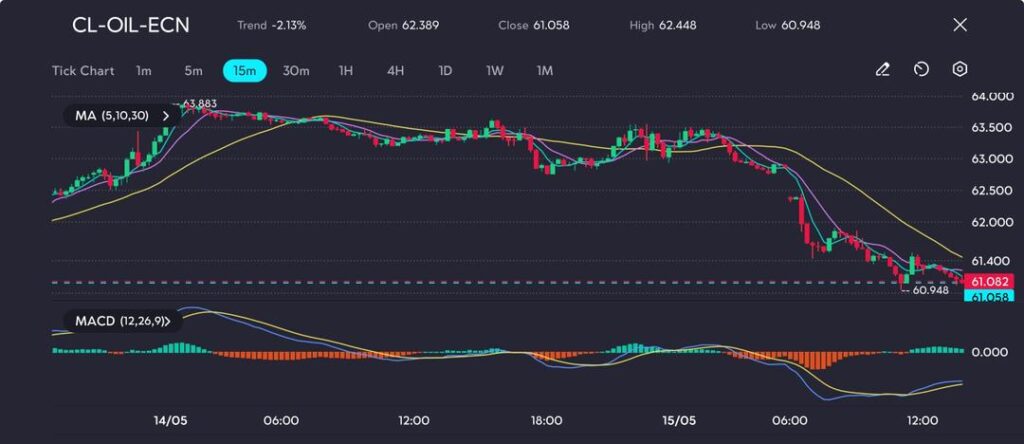
Oil prices tumbled on Thursday, with West Texas Intermediate (WTI) crude shedding 2.13% to settle at USD 61.06 per barrel.

The downturn was largely driven by renewed speculation over a potential nuclear agreement between the United States and Iran, which could pave the way for sanctions on Iranian oil exports to be eased—raising concerns over an increase in global supply.

This latest drop follows a brief rally sparked by a 90-day tariff truce between the US and China, which had initially lifted hopes for a demand recovery. However, that optimism has quickly faded.

According to IG’s Tony Sycamore, the pullback feels like a “hangover after a massive party,” with traders becoming more cautious as broader economic risks come back into focus.

Sentiment was further hit by President Donald Trump’s comments on the US federal budget deficit and growing concerns about the sustainability of the country’s economic expansion.

Meanwhile, the 10-year Treasury yield rose to a one-month high, heightening investor unease about rising borrowing costs and ballooning debt levels.

Equity markets also turned lower, amplifying the risk-off mood. Japan’s Nikkei slipped by 0.85%, and China’s CSI300 fell 0.63%.

European indices followed suit, while US futures pointed to a weaker open ahead of key retail sales figures and Walmart earnings—both considered indicators of consumer confidence and economic momentum.

Technical analysis: Oil under pressure, bearish trend intact

WTI crude continues to trade lower, with CL-OIL-ECN falling from USD 63.88 to a session low of USD 60.95 over the past two days—marking a decline of more than 4.5%.

Technical indicators remain bearish, with prices now firmly below the 5-, 10-, and 30-period moving averages, signalling continued downward momentum.

Selling intensified after breaking below the key support level near USD 62.00, with only modest buying interest seen during minor rebound attempts.

Oil tumbles to USD 60.95 as bearish momentum deepens, with short-term pressure persisting below USD 62 resistance, as seen on the VT Markets app.

The MACD indicator remains in negative territory, although histogram bars are showing signs of stabilisation, suggesting the downward momentum may be easing slightly.

However, without a decisive bullish crossover or a reclaim of the USD 61.50–62.00 zone, further losses remain likely. The path of least resistance still points lower in the near term.

Short-term outlook: Volatility expected as traders eye geopolitical developments

Crude oil is expected to remain volatile as markets digest ongoing geopolitical news and commentary from central banks.

A confirmed breakthrough in US–Iran negotiations could put further pressure on prices, potentially testing the USD 60.00 support zone.

Conversely, if talks stall or the Federal Reserve signals a more dovish stance, a rebound toward the USD 62.50–63.00 range is possible.

Today’s US retail sales data and remarks from Fed Chair Jerome Powell are likely to play a crucial role in shaping the short-term trajectory of oil prices.

Click here to open account and start trading.

Notification of Server Upgrade – May 15 ,2025

Dear Client,

As part of our commitment to provide the most reliable service to our clients, there will be server maintenance and product adjustment this weekend.

Maintenance Details: MT4 / MT5 – 17th of May 2025 (Saturday) 00:00 – 03:00 (GMT+3)

Please note that the following aspects might be affected during the maintenance:
1. During the maintenance hours, Client portal and VT Markets App will be unavailable, including managing trades, Deposit/Withdrawal and all the other functions will be limited.
2. During the maintenance hours, the price quote and trading management will be temporarily disabled during the maintenance. You will not be able to open new positions, close open positions, or make any adjustments to the trades.
3. There might be a gap between the original price and the price after maintenance. The gaps between Pending Orders, Stop Loss and Take Profit will be filled at the market price once the maintenance is completed. If you don’t want to hold any open positions during the maintenance, it is suggested to close the position in advance.
4. Following the maintenance, it is important to note that the latest version will be 4475. If your MT5 version is below 4410, it is suggested that you download the latest version on official website by navigating to “Trading” → “Platforms”→ “MetaTrader 5”.

Check your MT5 software version with the following steps:

※ PC: Open the MT5 software > Help > About;

※ Android: Open the MT5 app > About;

※ iOS: Open the MT5 app > Settings > Settings.

Please refer to MT4/MT5 for the latest update on the completion and market opening time.

Thank you for your patience and understanding about this important initiative.

If you’d like more information, please don’t hesitate to contact info@vtmarkets.com.

Amidst a generally weaker US Dollar, the Japanese Yen soars to a new weekly peak

The Japanese Yen has gained against the US Dollar, reaching a weekly high amid expectations of the Bank of Japan’s interest rate hike in 2025 and potential US-Japan trade deals. These factors, along with a global risk sentiment shift, support the Yen’s strength against the Dollar, pushing the USD/JPY pair below mid-145.00s levels.

Despite easing US-China trade tensions, the Yen remains strong as the Dollar struggles with recession fears and reduced expectations for aggressive Federal Reserve policies. Factors like the US Producer Price Index and Fed Chair Jerome Powell’s speech influence market dynamics, though the trend suggests a depreciating move for the USD/JPY pair.

Japan’s PPI and BoJ Policy Changes

Japan’s PPI highlights price pressures, supporting further BoJ policy changes. Deputy Governor Uchida noted potential rate hikes if economic conditions improve. Economists forecast the BoJ maintaining a 0.5% interest rate through September, possibly increasing it by year-end.

A soft US Consumer Price Index supports the expectation of additional Fed rate cuts, contributing to the Yen’s outperformance for three days. The USD/JPY pair awaits clarity from Fed officials, amid mixed opinions on tariffs and trade. The Yen’s technical trajectory suggests potential further gains, though fluctuating resistance levels pose challenges.

So far, we’ve seen the Yen climb steadily on the back of mounting speculation surrounding future policy adjustments in Tokyo. It’s not simply about a potential rate hike in 2025—that’s priced in, at least partially—but rather how the Bank of Japan is being viewed as transitioning away from ultra-loose policies. Uchida’s remarks offered a nudge; they’re not a trigger, but they reinforce the direction in which Japanese policymakers are headed. What stands out is how the market has reacted pre-emptively, not waiting for formal decisions, but moving instead on hints and forward guidance.

During the same period, the Dollar has wobbled, and not just because of moderating expectations from the Federal Reserve. There’s been genuine concern about US growth momentum. Powell has been more cautious in recent addresses, and this has filtered through the treasury curve, trimming yield appeal. We’ve noticed implied volatility ticking up slightly, yet not dramatically, showing there’s a watchful eye on surprises without a panic-driven bid for longer-dated protection.

USD and Yen Market Dynamics

For those positioned in the short-end of derivatives—with delta exposure around key strike levels—it’s worth noting how the inflation data continues to set the tone. When soft CPI readings come in consecutively, we’re not just looking at relief bids on equities; we see positioning shifts in FX as rate differentials narrow. That’s been echoed in the price action leading up to Friday’s settlement cycles.

On Japan’s side, the domestic producer price index surprised to the upside. Markets tend to underestimate the impact of corporate pricing power in Japan, but this time it landed differently. Policy calls through to September appear unlikely to change meaningfully, but there’s a growing window in Q4 when options pricing could start reflecting a steeper BoJ path. As it stands, breakevens in forward JPY contracts are beginning to compress, especially into year-end.

Risk tone globally is not disorderly, but it has softened. That tilt has helped haven currencies, although it’s been far more visible in the Yen than the Swiss Franc, reflecting the shifting calculus around the next moves by Tokyo’s team. Importantly, it’s not just macro—the technical picture matters too. The USD/JPY pair has tested the 145-handle and failed to recover convincingly. Within options, 145 and above saw heavy defensive flows unwind, and the suppression of upside skew tells us one thing—demand for topside Dollar protection against the Yen just isn’t there right now.

Heading into the next fortnight, with Fed speeches scattered and overlapping key expirations, we need to look at volatility smiles across front-dated exposures. Gaps in liquidity above prior resistance levels—particularly near 147—suggest minimal interest in defending those strikes. The market isn’t fighting for Dollar upside. That tells us where the pressure resides.

Trade talks involving Washington and Tokyo still hover in the background. These headlines tend not to move pricing intraday, but algorithmic books have started tagging keywords more sensitively. If any real structural shifts emerge, it’s going to be through large institutional repositioning in options terms, especially if tariffs are bundled into conversations about inflation expectations.

For now, directional bets are pointing one way, yet the pace isn’t aggressive. There’s room for snapbacks, especially as price touches old breakout zones, but unless we see Fed comments clearly re-anchoring Dollar strength narratives, momentum should favour the current drift. Volume isn’t thin exactly, but it feels patient—like participants are waiting for clearer signals before repositioning hedges.

We’ve moved through the dominant narrative: Japanese rate normalisation versus American policy softening. That relative positioning continues to steer currency derivatives. With the next Japanese interest rate decision past the immediate horizon, attention should shift towards implied ranges into September. Any surprise in upcoming inflation prints—both from Tokyo and Washington—will be the next re-pricing trigger, not trade negotiations alone.

Create your live VT Markets account and start trading now.

The Australian dollar rose slightly following a strong jobs report, despite unchanged unemployment rates

In April 2025, Australia’s unemployment rate was reported at 4.1%, aligning with expectations. Employment figures surged with an addition of 89,000 jobs, marking the most substantial monthly increase in 14 months.

Out of these jobs, 59,500 were full-time positions. Analysts only anticipated 20,000 new positions, so actual numbers surpassed forecasts by over four times. Despite this, the unemployment rate remained steady at 4.1%, close to the five-decade low, partly due to a record-high participation rate of 67.1%.

Impact On Monetary Policy Decisions

This job data influences potential decisions by the Reserve Bank of Australia (RBA), which is set to meet on May 19 and 20, 2025. Expectations for a 25 basis point rate cut were widespread, but this employment report could cause some reconsideration. Additionally, calming market conditions following the US-China trade agreement provide more reasons for the RBA to maintain the current rate.

The Australian dollar saw a slight increase in value following the release of the jobs data; however, this rise did not sustain momentum. Overall, economic indicators suggest a cautious approach towards any immediate policy changes by Australia’s central bank.

What we’re seeing here is a strong performance from the labour market, which creates a slightly more complicated backdrop for monetary policy decisions. The economy added 89,000 jobs in just one month—more than four times what had been predicted. A good portion of these were full-time roles, which implies deeper confidence in longer-term business planning. Yet, despite this large boost, the unemployment rate didn’t move. That’s mainly because more people are now either in work or actively looking for it, as signified by the record-high participation rate.

From a policy perspective, that means things may not be as simple as deciding whether the latest data looks good. When we look at such a sharp rise in employment figures, particularly without a corresponding drop in unemployment, it’s a sign that the labour market is absorbing more people rather than overheating. The stability in the unemployment percentage, combined with a jump in job creation, places pressure on policymakers to weigh short-term economic resilience against longer-term inflation targets.

Market Reactions And Expectations

As a result, those anticipating a rate cut at the next central bank meeting may need to reconsider. The data undermines previous assumptions that the economy needed further loosening right away. Combine that with stabilisation in global trade conditions—mostly due to easing tension between large trading partners—and we’ve got fewer external risks to manage in the short term.

What that spells out for us is a touch more uncertainty in shorter-dated rate products. What previously seemed likely now demands a shift in assumptions. Price actions in swap markets and options linked to short-term rates may need to be revisited, especially ahead of the May decision. Positioning that had leaned into dovish expectations could now need hedging or unwinding if sentiment firms around the idea of a hold.

It’s not just about where yields settle, though; it’s about the pace at which adjustments happen now that previous bets might require reversal. Temporary currency strength might’ve hinted at initial optimism, but its quick retreat reinforces the idea that markets are still sifting through implications. This leaves tighter rate spreads and near-term implied volatility levels as the areas where reactions might be most visible.

We’d suggest watching not only the tone in forward guidance next week but also whether there is a sharp change in reaction to any related data points. Anything linked to household spending, wage growth, or inflation expectations could feed into a shift in pricing. It’s going to be a test of how quickly risk can be adjusted when central bank pathways become less predictable.

Create your live VT Markets account and start trading now.

Navigating global recession fears: What traders need to know

Global markets are on edge. The International Monetary Fund recently slashed its 2025 growth forecast to 2.8%, citing US-China trade tensions and tariff uncertainties. Just last week, Wall Street soared after a temporary tariff truce, only to wobble as fears of a global recession lingered. For traders, this volatility raises a critical question: how do you protect your portfolio in such uncertain times?

In this article, we’ll demystify recessions, assess whether one is looming, and share practical trading strategies to help you navigate the storm—whether you are a beginner or a seasoned retail trader.

What is a recession? A simple explanation

Let’s start with the basics. A recession is a significant decline in economic activity that lasts for several months. It’s often marked by falling gross domestic product (GDP), rising unemployment, and reduced consumer spending.

Economists typically define it as two consecutive quarters of negative GDP growth, but it’s more than just numbers—it affects jobs, businesses, and your investments.

Think of the economy as a car engine. When it’s running smoothly, businesses thrive, and markets climb. But if it sputters and stalls for too long, you are in a recession. Key indicators include weak consumer confidence, slowing industrial output, and job losses.

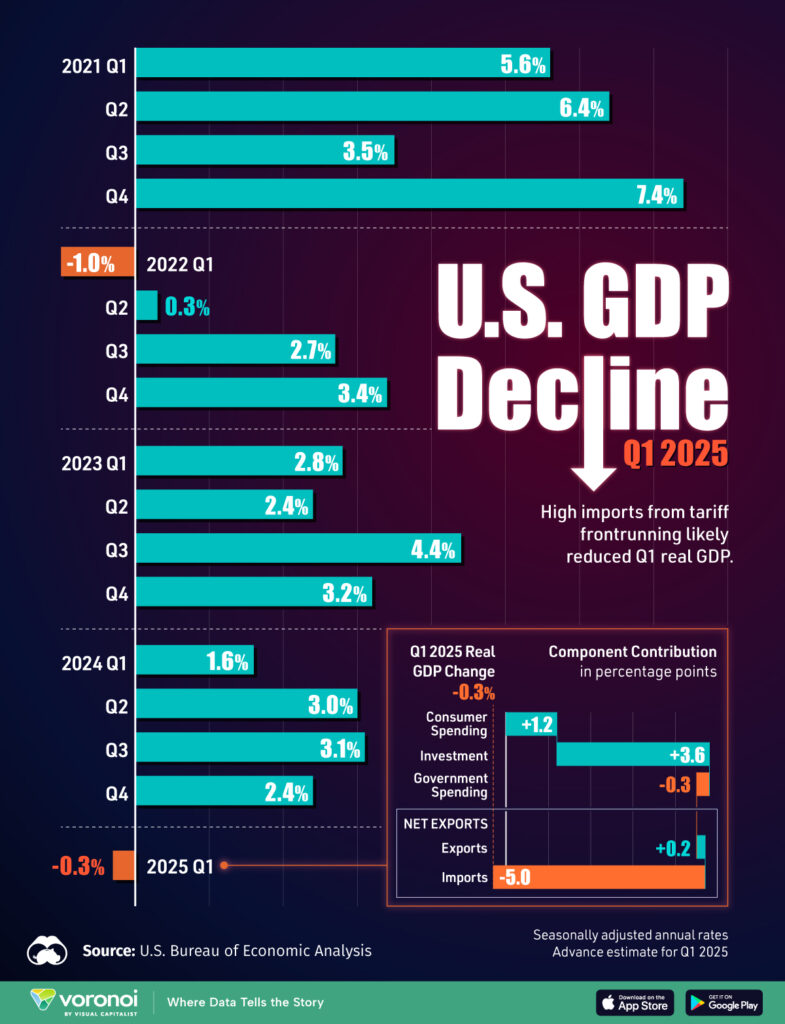
For example, the US reported a GDP contraction of 0.3% in Q1 2025, raising concerns among analysts. Unlike a single bad market day, a recession is a broader, sustained slowdown that can reshape trading opportunities.

Are we in a recession now? The current picture

So, are we in a recession today? The short answer: not yet, but the risks are growing.

Recent data paints a mixed picture. The IMF and World Bank have cut global growth forecasts, warning of trade disruptions from US-China tariff talks. In the US, recession probabilities have climbed to 37–60%, according to the IMF and JPMorgan, fuelled by weak ADP jobs data showing just 62,000 jobs added in April 2025.

Europe isn’t immune either—Germany’s growth forecast was slashed to 0%, and China’s to 4%.

Yet, there are glimmers of hope. US unemployment remains steady at 4.2%, and markets rallied after the US-China tariff truce in May 2025. Gold prices, a classic safe-haven asset, surged to USD 3,400 per ounce as investors hedged against uncertainty, but no major economy is in a confirmed recession.

The takeaway? We are on shaky ground, and traders need to stay vigilant to navigate what’s ahead.

What recession fears mean for traders

Recession fears can send markets into a tailspin, and that’s a big deal for your trading portfolio. When investors get nervous, volatility spikes. The S&P 500, for instance, swung wildly after tariff announcements, reflecting uncertainty.

Certain sectors take a hit—consumer goods and technology stocks often slump as people spend less. Unilever, for example, raised prices in 2025 due to tariff-driven cost inflation, which could dent demand and hurt its stock.

On the flip side, safe-haven assets shine. Gold and US Treasuries rally as investors seek stability, while the US dollar strengthens, pressuring emerging market currencies like the Indian Rupee, which hit 85.87 against the dollar recently.

Defensive sectors like utilities and healthcare tend to hold steady, as people still need electricity and medicine.

The risk for traders is clear: if you are overexposed to volatile assets, recession fears could erode your gains quickly. Understanding these dynamics is key to making smarter trading decisions.

Best trading strategies during recession fears

Now, let’s get practical. How can you trade smarter amid recession fears? Here are six strategies to protect and grow your portfolio, even in turbulent times.

  • Diversify your portfolio: Don’t put all your eggs in one basket. Spread investments across stocks, bonds, and commodities to reduce risk. For example, allocating funds to gold or U.S. Treasuries can balance exposure to volatile tech stocks. In early 2025, investors who shifted a portion of their portfolios to gold mitigated losses when tech stocks fell 5% following tariff-related news.
  • Focus on defensive stocks: Invest in sectors that weather downturns, like utilities or healthcare. Companies like National Grid often remain stable, as demand for electricity persists. In contrast, luxury retailers may struggle as consumers tighten budgets.
  • Use stop-loss orders: Protect against sudden market drops by setting stop-loss orders. For instance, if you buy a stock at USD 100, set a stop-loss at USD 90 to limit losses to 10%. This simple tool can save you from steep declines during volatile periods.
  • Trade safe-haven assets: Consider gold or US dollar-based forex pairs like USD/JPY. Gold’s 20% rise in 2025 shows its appeal during uncertainty. Forex traders might capitalise on the dollar’s strength as investors flock to safety.
  • Stay liquid: Keep some cash on hand to seize opportunities when markets dip. During a market correction, quality stocks often become bargains. For example, investors holding cash reserves in 2025 were able to purchase undervalued utility stocks during a market dip, boosting their potential returns.
  • Monitor news closely: Stay updated on tariff developments and economic data, like US jobs reports or GDP figures. Platforms like VT Markets offer real-time data to help you anticipate market moves. For example, weak jobs data in April 2025 triggered a brief market sell-off, but informed traders acted swiftly.

These strategies aren’t foolproof, but they can help you navigate uncertainty with confidence. The key is to stay disciplined and avoid emotional decisions, even when headlines scream “recession.”

Conclusion

Global recession fears are real, but they are not a certainty. Mixed signals—weak growth forecasts, tariff tensions, and resilient unemployment—mean traders must stay sharp. By understanding what a recession is, recognising its impacts, and using strategies like diversification and stop-loss orders, you can protect your portfolio and even find opportunities in volatility.

VT Markets is here to support you with real-time data, expert analysis, and powerful trading tools to navigate these uncertain times. Ready to take control of your trading journey? Open a live account with VT Markets today and start trading smarter, not harder.

Back To Top
server

Hello there 👋

How can I help you?

Chat with our team instantly

Live Chat

Start a live conversation through...

  • Telegram
    hold On hold
  • Coming Soon...

Hello there 👋

How can I help you?

telegram

Scan the QR code with your smartphone to start a chat with us, or click here.

Don’t have the Telegram App or Desktop installed? Use Web Telegram instead.

QR code