Back

The PBOC’s USD/CNY reference rate stands at 7.1938, injecting 106.5bn yuan through repos

The People’s Bank of China (PBOC) sets a daily midpoint for the yuan, also known as the renminbi or RMB. This is part of a managed floating exchange rate system, permitting the yuan to fluctuate within a set range around this midpoint.

Currently, this fluctuation band is at +/- 2%. The previous close of the yuan was 7.2067.

Recent Liquidity Operations

In recent activities, the PBOC injected 106.5 billion yuan through 7-day reverse repos. The interest rate for these operations stands at 1.40%.

The PBOC, by setting a midpoint each morning, sends a clear message about where it expects the yuan to sit relative to other currencies that day. Though the market is allowed some room to breathe, that 2% fluctuation band limits how far traders can push it in either direction. When the yuan closed recently at 7.2067, it told us something specific—not only about broader FX sentiment, but about how firmly the central bank may be steering expectations under current liquidity conditions.

The liquidity operation involving 106.5 billion yuan through seven-day reverse repos is equally deliberate. At an interest rate of 1.40%, these instruments are not just about making funds available temporarily, but also a tool to fine-tune short-term market rates. When we see the central bank engaging at this scale, it’s an indication of intent to guide cash conditions as well as sentiment.

From our vantage point, what stands out here is the dual signal: one, a firm stance on the permitted trading corridor for the currency; and two, a targeted push to maintain orderly funding markets.

Market Implications

For those positioned in short-term rate derivatives or FX-linked instruments, it becomes especially pertinent to take note of where official tolerance levels appear to be. While the upper bound of the currency band effectively caps dollar gains versus the yuan, it also limits the appreciation path too. That gives a tight arena to operate in, where overnight changes in sentiment can spark only bounded reactions—unless intervention thresholds are subtly adjusted.

Liquidity injections like the one we’re seeing now typically whisper more than they shout. At a 1.40% repo rate, there’s little urgency signalled, but a clear desire to keep conditions smoothly aligned with policy aims. Money markets, as a result, are likely to hover around these posted levels. For short-dated interest rate products, that tells us the ceiling is gentle and the floor moderately sticky.

Recent conduct hints at a comfort level in allowing a stable but narrowly drifting range. So we’re not looking at abrupt changes, but more at small recalibrations from day to day. We should also remain watchful for any patterns in fixings that slightly defy logical models; they can be planted clues if one’s familiar with previous adjustments.

Spread trades, particularly those sensitive to repo rate forecasts or Asia-opening FX moves, might benefit from lighter positioning until clearer direction emerges. There’s no suggestion of an abrupt shift, but subtle recalibrations in liquidity conditions can throw off assumptions about carry dynamics. That can impact implied volatility structures too.

The fix will keep telling us what the central bank is trying to say, even more than what it’s doing. So, it’s worth placing emphasis on the daily reference rate relative to previous closes—noting the tolerance shown, in ticks, against actual bounds.

Ultimately, this setup isn’t built for outsized changes, but for calming skittishness. We operate in a structure where timing precision matters more than trajectory. Subtle cues, repeated over sessions, are forming the base signals. Those reading them closest, and acting quickly, are more likely to hold an edge.

Create your live VT Markets account and start trading now.

In March, Japan’s capacity utilisation fell to -2.4%, compared to the earlier figure of -1.1%

Japan’s capacity utilisation fell by 2.4% in March, down from the previous decrease of 1.1%. This reflects a decline in the efficiency at which resources in the country were utilised during this period.

In other market developments, the EUR/USD showed an uptick nearing 1.1200, attributed to a weakening US Dollar following recent economic data. Similarly, GBP/USD climbed above 1.3300 on the back of positive UK GDP figures and softer US Dollar performance.

Gold Price And Bitcoin Resistance Levels

The gold price experienced a stall in recovery near the 200-period SMA on H4 charts, amid easing global market pressures due to the US-China trade truce. Meanwhile, Bitcoin approached a pivotal resistance level at $105,000, with potential breakthroughs indicating stronger bullish control.

In the UK, economic growth in the first quarter suggested a recovery post-last year’s stagnation, though the accuracy of underlying data remains questioned. A list recommended the best brokers for trading EUR/USD in 2025, taking into account competitive spreads and platform efficiency, catering to both beginners and experts in Forex trading.

Japan’s latest drop in capacity utilisation – down by 2.4% in March, after a 1.1% dip previously – signals a further dip in output efficiency. It suggests fewer inputs are churning out productive results in comparison to earlier periods, which generally corresponds to softer domestic demand or hesitance from manufacturers to ramp up operations. That sort of decline, especially when following consecutive decreases, tends to confirm a broader cooling in industrial activity rather than a one-off fluctuation. For short-term strategy, there’s reason to remain cautious around exposure connected to Japanese output or manufacturing benchmarks, particularly where leveraged positions are concerned in assets tethered to industrial performance.

The movement in EUR/USD approaching the 1.1200 mark owes itself largely to a softening greenback, as recent data out of the United States tempered expectations of any aggressive tightening ahead. The knock-on effect from this sort of currency drift often carries implications for rate-sensitive instruments. The stronger euro moves aren’t propelled by optimism within the single currency bloc as much as they are by dollar retreat, and that distinction matters when mapping potential resistance levels ahead. It’s worth watching short-dated interest rate swaps for directional bias, as these are often among the early-moving risk clues visible before spot responses follow through.

Sterling Gaining Ground Against The Dollar

Sterling gaining ground against the Dollar, rallying past 1.3300, follows upbeat GDP reporting out of the UK. While quarterly expansion supports positioning for cyclical strength, there are still doubts being cast on the base data, which could blunt enthusiasm somewhat. As always, the forward guidance from policymakers may carry more weight than the headline numbers, especially if momentum proves delicate. It helps to pay attention to the spread between gilts and US treasuries when the currency pair shows strength, given how yield differential shifts tend to reinforce or undo such upward runs.

Gold’s price remains stubborn around the 200-period simple moving average on the four-hour chart, unable to break convincingly higher. The metal’s earlier momentum has lost pace, likely tied to a reduction in safe-haven demand as optimism swelled off the back of reduced friction between the US and China. That said, if pressure builds elsewhere – think inflation surprises or central bank rhetoric striking a hawkish chord unexpectedly – price could swing sharply. This level, that SMA cluster, is commonly watched for trend confirmation, so price action near it could determine how risk models reset.

Bitcoin closing in on $105,000 is noteworthy. That level represents a price ceiling that has, at least for now, halted further ambitions temporarily. What’s compelling about these types of compressions just below resistance is the build-up in implied volatility. If we break through cleanly with volume, the probabilities favour a sharp extension. Positions biased long should factor in tighter trailing stops or layered exits at known liquidity pockets above. Leverage exposure in this space has crept up, and that adds short-term fuel if momentum kicks in.

As for trade setups involving euro-dollar movement into 2025, the mention of brokerage platforms offering low spreads and sound execution shouldn’t be overlooked. Efficient infrastructure continues to be a key differentiator, especially when volatility rises and milliseconds make a difference. Making adjustments to systems, ensuring margin efficiency, and filtering out slower platforms are practical moves now, not later.

For us, it’s not just about spotting a breakout or following a trend – keeping discipline in execution and being adaptive to data tone has always made the sharpest difference.

Create your live VT Markets account and start trading now.

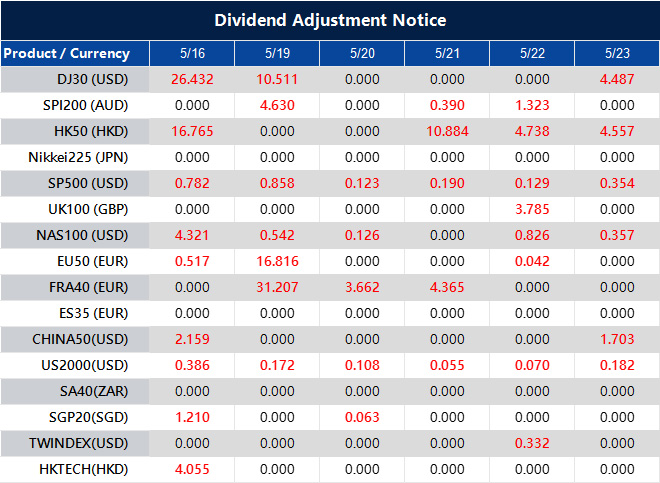
Dividend Adjustment Notice – May 16 ,2025

Dear Client,

Please note that the dividends of the following products will be adjusted accordingly. Index dividends will be executed separately through a balance statement directly to your trading account, and the comment will be in the following format “Div & Product Name & Net Volume”.

Please refer to the table below for more details:

Dividend Adjustment Notice

The above data is for reference only, please refer to the MT4/MT5 software for specific data.

If you’d like more information, please don’t hesitate to contact info@vtmarkets.com.

Analysts at JP Morgan predict Bitcoin will surpass gold’s performance in the upcoming months

JP Morgan analysts forecast that Bitcoin will outperform gold for the remainder of the year. This is attributed to a change in the “debasement trade” strategy, where buying gold and Bitcoin as a hedge against weakening currencies has become a zero-sum game by 2025.

Gold prices had been on the rise while Bitcoin was declining, but this trend reversed in recent months. Since reaching a peak in April, gold prices have fallen, whereas Bitcoin has experienced gains, influenced by funds moving out of gold ETFs and into Bitcoin and crypto funds.

New Legislative Developments

New legislative developments in the US also play a role, with New Hampshire passing a bill allowing up to 10% of public funds to be invested in Bitcoin and precious metals. Similarly, Arizona has enacted comparable legislation. Such state-level decisions to invest in Bitcoin may offer a prolonged positive effect, potentially impacting market dynamics.

What the current data tells us, quite plainly, is that we are observing a rotation of capital rather than the introduction of new liquidity into alternative assets. Gold’s initial rise, followed by a steady drawdown post-April, has taken place alongside a clear uptick in Bitcoin interest, particularly through institutional vehicles rather than retail-driven momentum. This comes amid steady outflows from gold-backed exchange-traded products, with those resources being redirected, in measurable quantities, into cryptocurrency-linked funds.

The analysts at JP Morgan have made it clear: they expect Bitcoin to outperform gold through the end of the year. This isn’t grounded in sentiment or speculation—it’s based on asset flows and changes in macro hedging strategies. The term “debasement trade” sums this up. Investors seeking to shield themselves from inflation or currency dilution historically held gold and, more recently, Bitcoin. But that hedge, once evenly spread across both instruments, appears to be tilting. By 2025, the strategy is expected to reach an inflection point; gains made in one may come at the direct cost of the other.

Shift in State Level Regulation

The shift in US state-level regulation offers more than just symbolism. With New Hampshire and Arizona creating legal frameworks for holding Bitcoin in public funds, the actions—while perhaps initially more cosmetic than impactful—lay the groundwork for longer-horizon allocations. This kind of public-sector exposure, however marginal at first, could change sentiment and pressure other states or institutions to follow. We know from past cycles that legislation adds a form of legitimacy that speculative interest alone cannot provide.

As traders, the most practical way to participate in this early realignment is by monitoring fund flow data on a weekly basis and reviewing relative performance against known macro variables. Gold, while traditionally less volatile than Bitcoin, has now underperformed in a shifting inflationary narrative. That underperformance isn’t playing out in price alone—it is visible in volume declines and lower implied volatility, increasingly making it a less attractive asset to hedge aggressive macro shifts.

Meanwhile, Bitcoin has continued to absorb capital not only from gold but also from other pockets within traditional risk assets. That movement is no longer episodic; it’s part of a broader shift wherein institutions that once viewed gold as a necessary allocation are now willing—or at least preparing—to substitute it. That doesn’t suggest a disappearance or abandonment of gold as an asset class, but it does pose questions around its role going forward, particularly when considering potential correlation to monetary policy paths.

We should also look beyond the headlines and observe how positioning is shaping up across derivatives markets. Open interest in Bitcoin futures has seen steady expansion, while gold’s derivatives market has seen a flattening in net speculative positioning. This divergence gives us a visible signal of intent among sophisticated market participants. It tells us to be alert—not to broad sentiment, but to actual risk placements made by those with longer investment timelines.

There is also a behavioural aspect at play now. Decision-makers from institutions tend to look for permission to act, often in the form of regulatory cover or peer participation. The fact that states are beginning to accept Bitcoin as viable within fund portfolios allows these types of investors to justify changes to their mandates. When we witness institutional entrants buying Bitcoin-linked products in meaningful size concurrently with gold ETF outflows, we’re looking at a recalibration that has clear directionality.

In the coming weeks, it would be practical to avoid overexposure to gold volatility without confirmation of a rebound in both price and institutional demand. At the same time, derivative positioning in Bitcoin—particularly in longer-dated contracts—could present entry points with asymmetrical risk, especially in scenarios where liquidity persists and fiat-hedging themes swell further. That said, price targets matter far less than understanding where capital is willing to commit in size.

Positioning, as always, should reflect asymmetry. We need to adjust not on headlines, but through close reading of flows and market depth. The theme is still developing, but the market conviction reflected in data so far points very clearly in one direction.

Create your live VT Markets account and start trading now.

In March, Japan’s year-on-year industrial production increased to 1%, recovering from -0.3%

Japan’s industrial production saw an increase, marking a year-on-year rise to 1% in March from a previous decline of 0.3%. This change indicates an improvement in industrial output compared to previous figures.

The EUR/USD pair recovered its losses, trading near 1.1200, aided by a weaker US Dollar influenced by recent US economic releases. Similarly, the GBP/USD pair moved higher, around 1.3310, due to softer US Dollar performance and positive UK GDP data.

Gold Market Dynamics

Gold prices struggled to build on recent recovery from a low of $3,120, facing resistance during the Asian session. The US-China trade truce for 90 days relieved some market pressure, impacting the bullion market.

Bitcoin’s price neared a potential breakout level of $105,000, a determinant for future control held by bulls. Meanwhile, Ethereum and Ripple maintained support levels that might influence future price directions.

Confusion surrounds the UK’s first-quarter growth surge, raising questions about the reliability of data reflecting economic conditions. As the Forex market evolves, finding an appropriate broker with competitive offerings is crucial for effective EUR/USD trading in 2025.

Currency Market Analysis

The recent uptick in Japan’s industrial production, moving from a 0.3% annual decline to a 1% rise in March, points to a rebound in factory output. This shift highlights some renewed global demand or improving domestic sentiment, perhaps even both. It’s a shift worth noting not just for exporters in Tokyo, but for those of us watching Asia’s broader manufacturing indicators for positioning.

On the currency front, the Euro regained its footing against the US Dollar, edging back towards the 1.1200 level. It wasn’t so much a Euro surge, but rather a retreat by the Dollar after weaker US economic data. Similarly, Sterling found strength—it hovered near 1.3310 after a pick-up in Britain’s GDP figures. The soft patch in US data created the opening; the UK’s stronger prints did enough to keep the candle lit.

For us tracking macro-sensitive currency pairings, the way the Dollar behaves in response to upcoming inflation reads and labour market numbers will influence not only direction but also how longer-dated options skew. With the Euro and Pound both pushing into upper range territory, those pricing volatility should be preparing for moves outside of recent comfort zones, however briefly they may last.

Meanwhile, gold has struggled to build on its bounce from the $3,120 area. It seemed ready to climb further, but the ascent stalled in the Asian session. The 90-day pause in US-China tariff skirmishes took some of the heat out of the metals market. With reduced demand for safe havens and fewer headlines spurring buying, resistance levels above current trading bands remain intact. This should narrow short-term positioning and reopen a focus on real yield spreads.

Crypto watchers saw Bitcoin drifting close to a potential breakout near $105,000. Price hovered at a level that, if cleared, could shift control to buyers assuming enough volume follows. Ethereum and Ripple didn’t generate similar momentum but held their known support zones. Those supports are not coincidental—they’re anchored to broader network activity and investor positioning, not just spot buyers. Derivatives desks focusing on crypto-indexed instruments may need to watch those lower bands. Volatility tends to spike when those supports crack, not when they’re respected.

The UK’s early-year growth figures sparked more questions than confidence. The speed of the reported rebound doesn’t quite mesh with other concurrent data, and that inconsistency muddies the signal. For now, it’s more useful to lean on leading indicators than to retool models around just one quarter’s print. That said, trading implied volatility on GBP crosses could benefit from this disconnect—uncertainty tends to support premiums on both sides of strike.

In the coming sessions, one thing is clear: reaction to US macro data—whether inflation reads or employment trends—will continue to influence most other pricing. Sharp directional movement can be expected around high-frequency US data points. Model recalibration may need to prioritise those catalysts, particularly if current divergence themes deepen. Risk strategies involving EUR/USD should especially consider forward guidance routes rather than spot relief rallies.

Create your live VT Markets account and start trading now.

In April, Singapore’s exports rose 12.4%, surpassing expectations, yet the outlook appears cautious

Singapore’s non-oil domestic exports grew by 12.4% in April compared to the previous year, exceeding predictions and accelerating from March’s 5.4% increase. Enterprise Singapore released these figures, noting strong growth in both electronic and non-electronic exports.

The increase was much higher than the 4.3% rise predicted by a Reuters poll, driven by demand from key partners like the U.S., Japan, Taiwan, and South Korea. However, exports to China and Malaysia saw a decrease.

Economic Resilience Taskforce

Despite this positive result, the outlook is uncertain due to rising global trade tensions, accentuated by new U.S. tariffs. Singapore’s trade-reliant economy is at risk from a potential global downturn. To address this, the government has established an economic resilience taskforce. The government has revised its GDP growth forecast for the year down to 0% to 2%, from an earlier 1% to 3%.

This latest set of export data points to a notable improvement in overseas demand for goods manufactured or shipped out of Singapore, particularly those tied to the electronics sector. April’s 12.4% increase paints a picture of growing momentum across key product categories, suggesting that manufacturers are finding support from global demand despite mounting international stresses. Compared with March’s 5.4% rise, the quickened pace underlines the extent of this rebound.

Strikingly, the result thrashed prior estimates — the Reuters poll had anticipated a more modest 4.3% increase. This divergence implies that trade activity is recovering faster than expected in select markets, especially in advanced economies like the United States and Japan, where business investment and consumer appetite have remained surprisingly robust. On the other hand, weaker data for shipments to China and Malaysia flags a split in global demand patterns — a split we cannot ignore.

Lim, speaking on behalf of Enterprise Singapore, indicated both electronic and non-electronic segments had delivered strong showings. We see this as consistent with wider trends in semiconductor demand, especially as AI-related hardware orders pick up again. Taiwanese and South Korean buyers, in particular, appear to be increasing their orders in line with downstream assembly and packaging capacity ramping back up.

Global Trade Challenges

However, not everything is heading in a favourable direction. The newly introduced U.S. tariffs — targeting a broad swathe of Chinese goods — are adding friction to global trade. These changes affect pricing and supply chain decisions well beyond the U.S. and China themselves, in effect dragging third-party economies like Singapore into the dispute. While the current export figure provides some reassurance, it doesn’t make the broader situation any less precarious.

The formation of a focussed economic resilience taskforce by the government reflects this. Policymakers appear to be bracing not only for interruptions in trade flows but also possible spillovers into investment and employment channels. The trimmed GDP forecast now ranges from 0% to 2%, down from an earlier 1% to 3%, giving us a clearer idea that downside risks are not just theoretical.

Looking slightly ahead, we should anchor our short-term strategies around tightening liquidity and more volatile cross-border sentiment. With softer prospects ahead for China, and continued friction in East Asia, short gamma positions linked to regional exports may need active management. Hedging through options tied to major partners’ currencies should remain high on the checklist, particularly as shipping volumes loosen their month-to-month correlation with headline growth figures.

In addition, this divergence between strong electronics performance and weaker links to China offers a cue: sector rotation and country-specific exposure need to be watched closely. Small shifts in tariffs or sentiment might swing month-on-month flows rapidly enough to disrupt comfortable directional trades. Patience may prove more valuable than conviction in this environment, where volatility doesn’t always come from the usual places.

Create your live VT Markets account and start trading now.

Following the Q2 RBNZ Inflation Expectations, NZD/USD climbs to approximately 0.5900, ending its decline

NZD/USD has shown an upward trend, approaching 0.5900, following an increase in the RBNZ Inflation Expectations for Q2. Expectations have risen to 2.29%, a jump from the previous 2.06%, reflecting anticipated annual CPI two years ahead.

The New Zealand Dollar has also benefited from reduced global trade tensions, with a US-China preliminary trade deal reached. This agreement includes the US reducing tariffs on Chinese goods from 145% to 30%, and China lowering tariffs on US imports from 125% to 10%.

us economy outlook

The US Dollar remains stable, amidst mixed recent US economic data. While the US Producer Price Index rose by 2.4% in April, this marked a slowdown from March’s 2.7%, and fell short of the projected 2.5%.

Core PPI saw an annual increase of 3.1%, decreasing from the previous 4%. On a monthly scale, headline PPI fell by 0.5%, while core PPI fell by 0.4%.

Initial Jobless Claims maintained at 229,000 for the week ending May 10, matching the previous week’s revised numbers. This data indicates both underlying economic resilience and a potential deceleration in growth momentum.

inflation and trade impacts

The recent strengthening of the New Zealand Dollar reflects a combination of shifting inflation expectations and improving external conditions. In particular, local market forecasts now anticipate consumer price inflation at 2.29% over a two-year horizon, up from 2.06%. This rise is not just a marginal adjustment – it is a material change in forward-looking sentiment and suggests that firms and consumers alike expect higher price pressures in the medium term. As expectations anchor monetary policy outlooks, this adjustment has underpinned NZD buying, driven largely by premises that the Reserve Bank may need to stay vigilant in its stance or, at the very least, avoid signalling an early pivot.

Concurrently, lower tariffs between the United States and China have alleviated some pressure in global trade corridors. Washington’s rollback from 145% to 30%, and Beijing’s trimming from 125% to 10%, moves the needle in terms of global risk appetite. For regions like New Zealand that are tightly linked to export flows and commodity trade, this softening in trade frictions indirectly supports currency strength. Reduced global uncertainty improves investor sentiment and boosts demand for higher-yielding or commodity-linked currencies.

Across the Pacific, however, the US Dollar holds steady amid a mix of data that neither strongly affirms growth nor suggests an outright slowdown. On the inflation front, wholesale prices, measured by the Producer Price Index, climbed 2.4% in April year over year, slipping slightly from March and just under the forecast of 2.5%. This pace – while still elevated – suggests pressures are easing slightly. More pointedly, the core PPI figure, which excludes volatile food and energy items, showed a yearly gain of 3.1%, a full percentage point lower than previously. Monthly figures showed clear deceleration, with headline and core falling 0.5% and 0.4% respectively.

These slowdowns carry weight when mapped onto interest rate expectations. Cooling input cost inflation often means less urgency for central banks to tighten further. That may slow USD demand, especially if upcoming data underperforms.

Hiring data remains flat, with initial jobless filings steady at 229,000 for the second consecutive week. From our perspective, this supports two competing narratives. Steady claims may imply continued labour market strength, which could act as a floor under income-driven spending trends. But it simultaneously indicates that gains have stalled at the margin, and any deterioration from here would shift sentiment quickly.

For positioning, we see scope for continued adjustment in relative monetary policy expectations. The modest rise in long-term New Zealand inflation forecasts raises the odds that policy there remains tight even as other developed markets potentially flirt with easing. This divergence supports moderate NZD outperformance in the near term, particularly against currencies tied to policy recalibration.

On technical setups, upside movement near the 0.5900 level reflects a market testing resistance thresholds. Should next week’s data reinforce the inflation story or confirm a weaker USD backdrop, we could see momentum extend with short-dated options pricing in more pronounced topside risk. Conversely, failure to break convincingly could revert direction quickly, especially with positioning now partially long.

Expect volatility around interim releases – a single downside surprise on jobs or inflation could trigger profit-taking. Accordingly, we favour strategies that hedge against choppy price action rather than commit aggressively to breakout structures. There is opportunity, but entries must be clean, and exits defined.

Create your live VT Markets account and start trading now.

Kato plans to meet Bessent to discuss FX issues, emphasising cooperation and addressing volatility impacts

Japan’s Finance Minister Kato is confident in maintaining a constructive dialogue with Bessent. He plans to keep coordinating with him on economic issues, especially concerning foreign exchange volatility.

In discussions on April 24, Kato and Bessent agreed that excessive forex volatility negatively affects the economy. They intend to continue these discussions to address such concerns.

Future Meetings With Bessent

Further meetings with Bessent will be sought to discuss foreign exchange and other relevant topics. These talks are part of ongoing efforts to stabilise economic conditions.

The USD/JPY rate has slightly decreased following disappointing GDP figures. Japan’s first-quarter GDP fell by 0.2% quarter-on-quarter, compared to an expected decline of 0.1%.

That initial passage outlines the Japanese Finance Minister’s intention to hold ongoing discussions with an influential hedge fund manager to mitigate instability in the currency markets. The core issue being addressed is the effect of abrupt changes in the yen’s value, particularly the kind that might spook investors or cause price swings in sectors that rely heavily on imports or exports. They both acknowledge that large shifts in the foreign exchange rate can filter through to the broader economy with unwanted consequences. Notably, this is not a one-time check-in; it’s part of a steady chain of engagements aimed at preventing disruption.

Now, with Japan’s GDP falling 0.2% in the first quarter—more than economists had expected—we need to be alert. While a tiny miss on paper, the result carries more weight when considered alongside recent inflation figures and trade data, all pointing to uneven domestic demand. The yen weakened earlier in the year, offering some relief to exporters, but this most recent GDP print hints that any tailwind from a lower currency is being offset elsewhere, probably via household spending fatigue or business investment slowing more than forecasted.

Monitoring The USD JPY Rate

The dip in GDP directly affects sentiment around the USD/JPY pair, which has eased downward following the release. This move perhaps also reflects a broader concern about the fragility of Japan’s rebound. From our perspective, a gentle unwinding in the pair is not just about reaction to one data point—it flags nervousness over whether the Bank of Japan will maintain its loose monetary policy for longer, especially if growth remains subdued. Any suggestion of further intervention—or coordinated communication through official channels—can temporarily suppress volatility but won’t entirely alter the broader structural pressures.

For us observing from a derivatives angle, the current tone suggests lighter positioning in near-term yen weakness. The risk-reward for continued short exposure isn’t as attractive after this GDP surprise, particularly if talks like those led by Kato begin influencing sentiment. Options markets are already reflecting this with slightly lower implied volatilities, suggesting traders are beginning to price in a pause or shift. That said, we shouldn’t get complacent—intervention, even verbal, often causes sudden movements, and there’s more room for unexpected turns if upcoming inflation or wage data frustrate forecasts.

The message here isn’t to abandon any bias altogether, but to manage it more tightly. Straddles in particular appear slightly undervalued given the kind of messaging we’re hearing from policymakers. Upside skews on medium-dated yen calls have stabilised, perhaps revealing where institutional hedging interest is building. It’s also worth noting the narrowing 2-year yield spread between the US and Japan, which often correlates with shifts in the JPY sentiment. Any moderation in US economic performance might push this further, feeding another leg of correction in the currency pair.

In short, the best course right now is to stay nimble. Keep a closer eye on data surprises from Tokyo than usual. The messaging from both sides indicates a preference for smoothing disorderly movements, and we may see tools deployed more frequently if the yen resumes its former pace of depreciation. Tightening up stops or using option collars could be ways to prevent the kind of snapbacks we’ve seen during past intervention cycles. As this cycle of discussions progresses, especially if more formal statements emerge, we’ll likely get a clearer signal on threshold levels that might trigger market responses.

Create your live VT Markets account and start trading now.

In the latest survey, the RBNZ reported an increase in New Zealand’s inflation expectations for 2025

New Zealand’s inflation expectations have risen for both the 12-month and two-year forecasts for the second quarter of 2025. The Reserve Bank of New Zealand’s survey indicates two-year inflation expectations increased to 2.29%, up from 2.06% in the previous quarter.

One-year inflation expectations rose to 2.41% from 2.15%. This has impacted the NZD/USD, edging closer to 0.5900 with a rise of 0.35% on the day.

Understanding Inflation

Inflation measures the increase in prices, typically shown as a percentage change. Core inflation, excluding volatile items like food and fuel, is the focus of economists and is the level central banks aim to control, generally around 2%.

The Consumer Price Index (CPI) tracks the price changes of goods and services over time. Core CPI guides central banks and influences interest rate decisions, affecting currency strength. High interest rates usually strengthen a currency in response to higher inflation.

Gold is traditionally a safe investment during periods of inflation but is less attractive when interest rates rise. Lower inflation, conversely, decreases interest rates, making gold a more appealing alternative investment. Various factors, including interest rates, influence the relationship between currency value and inflation levels.

The Reserve Bank of New Zealand (RBNZ) released its latest data showing a marked uptick in inflation expectations over both short and medium-term horizons. Specifically, market participants now anticipate consumer prices to rise more substantially over the next year and two years than previously expected. This upward adjustment in forecasts reflects heightened concerns that inflationary pressures remain more persistent than assumed earlier and are likely to extend beyond immediate conditions.

What we’re seeing in the one-year expectation, now projected at 2.41% from a prior 2.15%, suggests a firmer belief that price pressures are not fading as quickly. The two-year expectation recorded a similar move, nudging up to 2.29% from 2.06%. These figures remain above the midpoint of most central bank targets, including RBNZ’s—providing the Monetary Policy Committee grounds to reconsider the timing or extent of any easing measures thought to be on the horizon.

Market Reaction and Implications

Unsurprisingly, the NZD has responded in kind. Movement in the NZD/USD pair toward 0.5900 appears to reflect repricing in the wake of inflation data that pushes back against rate cut assumptions. With a gain of 0.35% in the session, there is evidence that near-term rate expectations are being adjusted, with markets factoring in a higher-for-longer policy stance.

Conceptually, inflation refers to the general rise in price levels, and central banks, including the RBNZ, scrutinise a more stable measure known as core inflation. By removing volatile elements like food and fuel, core inflation provides a cleaner measure of underlying trends that monetary policymakers use to base their official cash rate decisions on.

The role of the Consumer Price Index (CPI), and specifically its core variant, is to act as a benchmark for how pricing power develops across the economy. A higher CPI, and particularly a stubborn core reading, places pressure on a central bank to wield tighter monetary conditions. Higher interest rates are typically employed to prevent inflation spirals, which in turn can support a country’s currency because of improved returns on capital investments relocating towards that economy.

In the current scenario, persistent inflationary expectation lifts the likelihood that monetary settings in New Zealand remain relatively restrictive. That, in turn, diminishes the appeal of alternatives like gold, which thrives when inflation rises faster than rates. At moments when policy tightening still has room to run, gold tends to lose ground as opportunity cost becomes more distinct.

That said, the linkage between inflation data, interest rate movements, and currency reaction operates with a relatively steady rhythm. Given the RBNZ’s dual objectives of price stability and sustainable employment, any material upward shift in wage expectations or consumer price trajectories could delay policy loosening. Further up the chain, that limits downward mobility for the NZD in the near term and increases implied volatility for related derivatives.

We should be conscious of how these revised inflation forecasts might seep into behavioural shifts across other inflation-linked assets. Interest rate swaps, bond futures, and currency forwards may now exhibit tighter pricing around current policy forecasts, especially if other central banks begin to diverge in response to domestic inflation trajectories. The key is for participants to stay rigorous in positioning, hedging where necessary, and re-evaluating carry trades that rest on a weakening NZD given the directional bias now implied by the data.

Forward curves could begin to reflect this recalibration. Market sentiment will be tested in subsequent economic readings, especially if inflation expectations continue climbing softly but steadily. For those aligned with rate sensitivity in multi-asset strategies, there is wisdom in re-running stress tests under scenarios that now seem more probable.

Create your live VT Markets account and start trading now.

What is a head and shoulders chart pattern? 

Understanding the Head and Shoulders Pattern

In this article, we explain the head and shoulders chart pattern, a popular and trusted formation that helps traders spot reliable trend reversal signals. This pattern indicates when an uptrend may end and a downtrend may begin, or vice versa. Knowing how to identify this pattern aids in making smarter trading decisions and managing risk.

What is a Head and Shoulders Chart Pattern?

A head and shoulders chart pattern is a widely used technical analysis formation that signals a potential reversal in a market trend. It features three peaks: the highest middle peak known as the “head,” flanked by two smaller peaks called the “shoulders.” These peaks form a shape resembling a person’s head and shoulders. The pattern usually appears after an uptrend, indicating that buying momentum is fading and a downtrend may follow.

The key element of this pattern is the “neckline,” which connects the lows between the peaks. When the price breaks below this neckline after forming the right shoulder, it confirms the pattern and suggests a shift in market sentiment from bullish to bearish. This makes the head and shoulders pattern a valuable tool for traders to anticipate trend reversals and make informed trading decisions.

Components of the Head and Shoulders Pattern

Understanding the anatomy of the head and shoulders chart pattern is essential for effective trading:

  • Left Shoulder: The first peak, followed by a price decline.
  • Head: The highest peak in the pattern, representing the climax of the current trend.
  • Right Shoulder: A peak similar in height to the left shoulder, indicating a weakening trend.
  • Neckline: A trendline connecting the lowest points between the shoulders and the head. This acts as a crucial support level.

Traders watch for the price breaking below the neckline after forming the right shoulder, signaling a possible trend reversal.

Types of Head and Shoulder Patterns

There are two primary types of head and shoulder patterns:

Standard Head and Shoulders (Bearish Reversal)

This is the classic form of the head and shoulders pattern that typically appears after a sustained uptrend. It signals that the upward momentum is weakening as buyers fail to push prices higher beyond the “head” peak. The formation of the right shoulder indicates sellers are gaining strength. When the price breaks below the neckline, it often triggers a bearish reversal, suggesting prices may start to decline.

Inverse Head and Shoulders (Bullish Reversal)

The inverse pattern is essentially the mirror image of the standard version and usually forms after a downtrend. It shows that selling pressure is losing momentum, as buyers step in to push prices higher. The “head” is the lowest point, flanked by two higher “shoulders.” Once the price breaks above the neckline, it confirms a bullish reversal, indicating that prices are likely to rise.

For example, in late 2024, a major currency pair formed an inverse head and shoulders pattern, preceding a sustained rally that traders capitalized on.

How to Identify a Head and Shoulders Pattern

Correct identification requires attention to detail:

  • Shoulders are similar in height: The left and right shoulders should be roughly equal in height, showing two similar peaks that indicate weakening momentum.
  • The head is the highest peak: The head stands out as the tallest peak between the shoulders, marking the peak of the current trend before reversal.
  • Volume decreases on the right shoulder: Volume usually drops during the formation of the right shoulder, signaling less buying or selling pressure.
  • The neckline is the breakout point: The neckline connects the lows between peaks; a decisive break below (or above for inverse) confirms the pattern and potential trend reversal.

A false breakout can happen, so combining the pattern with volume analysis and other indicators like RSI or MACD can improve accuracy.

Discover the 18 candlestick patterns every trader should learn

Trading Strategies Using Head and Shoulder Patterns

Once identified, the head and shoulders pattern can guide entry and exit points:

  • Entry point: Traders typically enter a position when the price breaks the neckline after the right shoulder forms. For a standard head and shoulders pattern, this means entering a short position; for an inverse pattern, a long position.
  • Price target: Measure the vertical distance from the head to the neckline. Subtract this distance from the breakout point (standard) or add it (inverse) to estimate the expected price movement.
  • Stop-loss placement: Set a stop-loss just above the right shoulder for a standard pattern or just below the right shoulder for an inverse pattern to limit potential losses.
  • Volume confirmation: Look for increased trading volume during the breakout below or above the neckline to validate the strength of the move.
  • Risk management: Use position sizing and risk-reward ratios to ensure trades align with your overall trading plan.
  • Waiting for confirmation: Avoid premature entries; wait for the price to close beyond the neckline to confirm the pattern.

New to trading? Learn how to start trading for beginners.

Common Mistakes to Avoid When Using the Head and Shoulders Pattern

Below are the common mistakes to avoid when trading the head and shoulders pattern to help improve your accuracy and reduce false signals.

  • Ignoring volume confirmation: Volume plays a crucial role in validating the head and shoulders pattern. A significant increase in volume during the neckline breakout confirms strong market participation, while low volume may indicate a false signal.
  • Premature entry: Entering a trade before the price decisively breaks the neckline can expose traders to false breakouts, leading to potential losses. Waiting for a confirmed close beyond the neckline reduces this risk.
  • Neglecting the broader market context: The head and shoulders pattern is more reliable when analyzed in conjunction with overall market trends and other technical indicators. Ignoring the bigger picture can result in misinterpretation of the pattern’s signal.
  • Over-reliance on symmetry: While symmetrical shoulders are ideal, perfect equality is rare. Traders should focus more on the pattern’s overall shape and breakout rather than expecting perfectly equal shoulders to validate the pattern.

By avoiding these errors, traders can improve their success when applying the head and shoulders pattern.

Conclusion

The head and shoulders chart pattern is a powerful tool for identifying potential trend reversals and making informed trading decisions. Traders can significantly enhance their market analysis by understanding its structure, recognizing the key signals, and applying effective trading strategies while avoiding common mistakes. With careful practice on a demo account and the right approach, this pattern can become an invaluable part of your trading toolkit.

Start Trading with VT Markets Today!

VT Markets offers traders access to advanced trading tools and real-time data to spot patterns like the head and shoulders pattern effectively. With platforms such as MetaTrader 4 and MetaTrader 5, competitive spreads, and fast execution, VT Markets supports traders in executing strategies based on technical analysis confidently. 

Open your account today with VT Markets and take advantage of expert insights and cutting-edge platforms.

Frequently Asked Questions (FAQs)

1. What is a head and shoulders chart pattern?

It is a technical pattern signaling a trend reversal with three peaks — two shoulders and a head — connected by a neckline.

2. How reliable is the head and shoulders pattern?

It is one of the most reliable reversal patterns, but should be used with volume confirmation and other indicators.

3. Can the head and shoulders pattern appear in all markets?

Yes, it can be observed in stocks, forex, precious metals, ETFs, and indices.

4. What is the difference between standard and inverse head and shoulders?

The standard signals a bearish reversal, while the inverse signals a bullish reversal.

5. How long does it take for a head and shoulders pattern to form?

The formation time varies but typically develops over days to weeks, depending on the market and timeframe.


Back To Top
server

Hello there 👋

How can I help you?

Chat with our team instantly

Live Chat

Start a live conversation through...

  • Telegram
    hold On hold
  • Coming Soon...

Hello there 👋

How can I help you?

telegram

Scan the QR code with your smartphone to start a chat with us, or click here.

Don’t have the Telegram App or Desktop installed? Use Web Telegram instead.

QR code