







Key Points
ExxonMobil sits at the centre of one of the biggest market debates: whether traditional oil majors can adapt to a lower-carbon future without sacrificing profitability.
- Exxon is maintaining an oil-first strategy, backed by strong global demand and cash flow
- The company is investing selectively in carbon capture, hydrogen, and low-emission fuels
- For traders, XOM remains closely tied to oil prices, geopolitics, and energy demand cycles
Recent headlines have highlighted a shift in sentiment across the energy sector, with oil majors moving from a period of strong gains into renewed volatility. A key trigger has been the disruption to Exxon’s operations linked to geopolitical tensions in the Middle East.
According to recent reporting, Exxon has seen around 6% of its global output affected due to conflict-related disruptions in the region. At the same time, broader energy markets have started to soften after a strong run, with oil prices pulling back as supply concerns fluctuate and demand expectations adjust.
This combination has created pressure on XOM stock in the short term:
- Production disruptions raise uncertainty around near-term output.
- Oil price volatility directly impacts revenue expectations.
- Shifting market sentiment moves energy stocks from momentum to reassessment.
What makes this particularly important is how quickly the narrative can change. Energy stocks often move in cycles, and the same factors that drove record gains, such as tight supply and geopolitical risk, can also lead to sharp pullbacks when conditions stabilise or expectations shift.
This is where Exxon’s strategy becomes relevant again.
When the market moves from strong gains into uncertainty, investors tend to reassess:
- How resilient are earnings across cycles?
- Whether production growth can offset disruptions.
- How well-positioned are companies for longer-term structural shifts?
In other words, the recent decline is not just about short-term headlines. It is a reminder that Exxon’s performance still sits at the intersection of oil markets, geopolitics, and long-term energy transition dynamics.
The energy transition is often described as a simple shift away from oil. Markets, however, rarely move in simple lines. The real story is more complicated, and ExxonMobil sits right in the middle of it.
XOM still generates the bulk of its earnings from oil and gas. That alone makes it highly sensitive to crude prices, geopolitical risk, and the broader supply-demand balance in global energy markets.
At the same time, the company is also trying to position itself for a lower-carbon future, though on its own terms and in its own chosen areas.
That creates the central tension behind XOM stock. Exxon is not trying to reinvent itself as a renewable energy company. It is trying to remain an oil giant while selectively building businesses that fit the next phase of energy demand.
Exxon’s Strategy: Oil First, Transition Second
Exxon’s strategy stands out because it is more cautious and more selective than that of some of its peers. Rather than making an aggressive public pivot into wind and solar, the company has chosen to keep its core oil and gas engine firmly in place.
That decision reflects the company’s view that the world will continue to need large volumes of hydrocarbons for decades, even as lower-emission technologies gain ground.
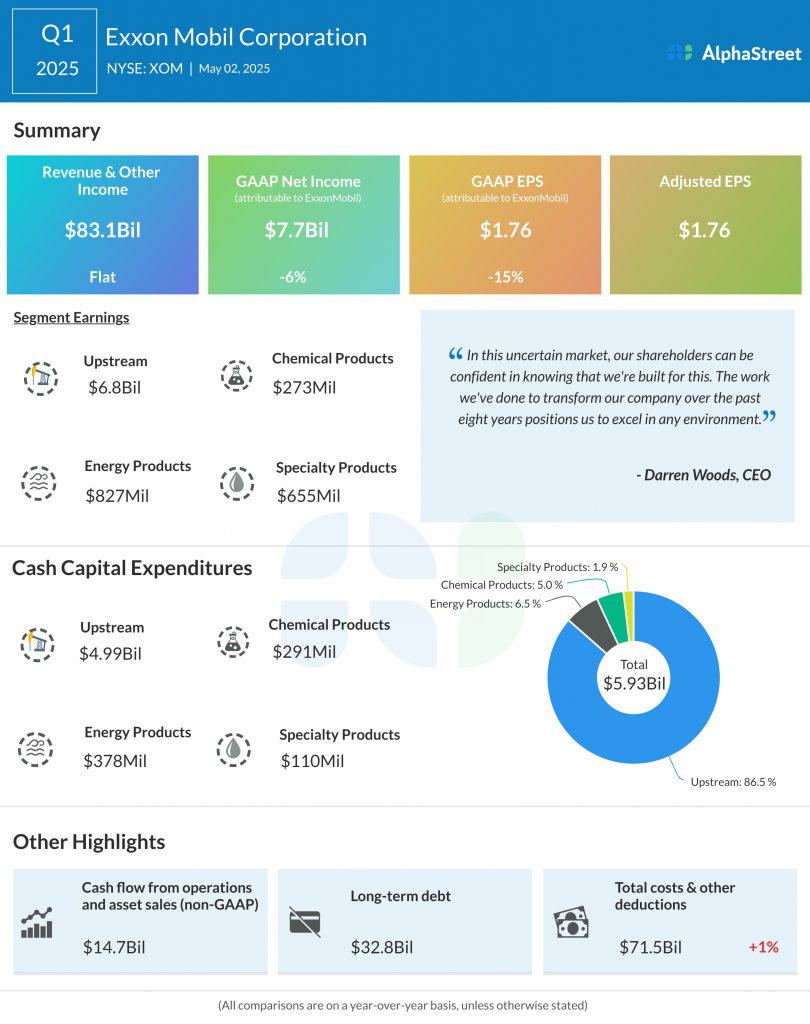
In practice, that means Exxon is still allocating substantial capital toward upstream production, particularly in areas where it believes returns are strongest and project economics remain attractive.
Its expansion in places such as Guyana and the Permian Basin reflects that approach. These are not side projects. They are central to Exxon’s current earnings power and long-term production strategy.
Source: AlphaStreet
This oil-first model gives the company a few important advantages:
- High cash flow during strong energy cycles: When crude prices rise, Exxon’s traditional operations generate the cash needed to support dividends, buybacks, and long-term investment.
- Operational familiarity and scale: The company understands large-scale hydrocarbon production better than almost anyone in the industry.
- Capital discipline: Management can continue investing in areas where returns are visible, rather than chasing growth in unfamiliar markets.
The trade-off, of course, is perception. Exxon can look slower to transition than its peers that market themselves more aggressively around renewables. But the company appears comfortable with that distinction. Its message is clear: remain strong in oil first, then build transition exposure in areas where it believes the returns are commercially durable.
A Different Take on the Energy Transition
That does not mean Exxon is ignoring the energy transition. It means it is approaching it in a different way.
Rather than spreading itself across a broad range of renewable technologies, Exxon has concentrated its lower-emission strategy around a narrower set of industrial opportunities. These are areas where it believes its engineering capability, industrial scale, and energy infrastructure experience can provide a competitive edge.
The company’s transition focus is concentrated in several key areas:
- Carbon capture and storage (CCS): Exxon sees carbon capture as one of the most commercially viable pathways for reducing industrial emissions at scale.
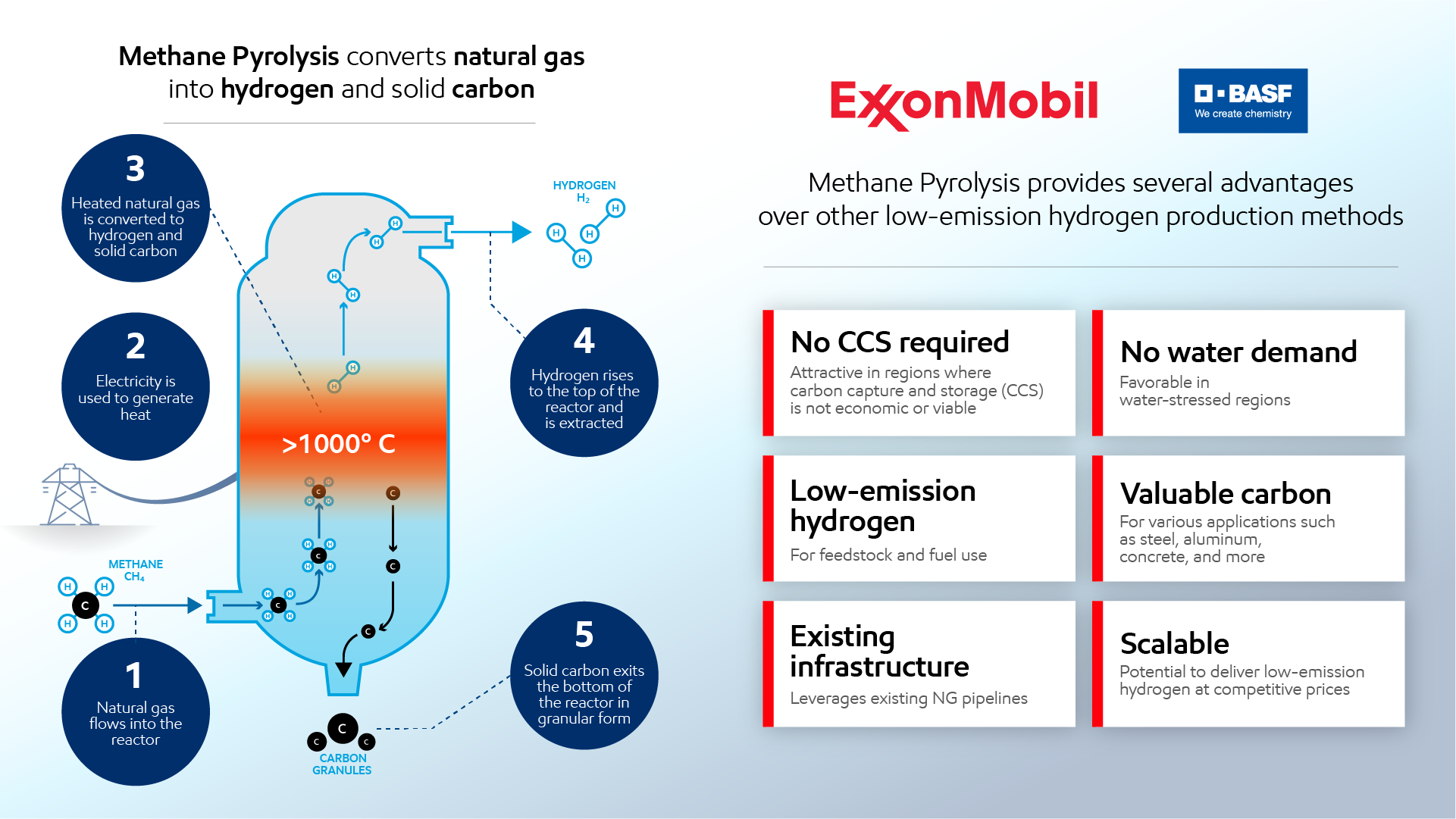
- Hydrogen: The company is building exposure to hydrogen as a fuel source for sectors that are difficult to electrify.
- Low-emission fuels: This includes fuels aimed at industrial and heavy transport use cases where conventional electrification may be less practical.
Source: ExxonMobil
This is an important distinction. Exxon is not trying to win the consumer-facing renewable race. It is targeting industrial decarbonisation, where projects tend to be larger, longer-duration, and more aligned with the company’s existing capabilities.
That selective approach also helps explain why the market remains divided on Exxon’s transition story. Some investors see discipline and realism. Others see hesitation. In truth, the company is making a deliberate bet that the most profitable parts of the transition will not necessarily be the loudest ones.
As Darren Woods, CEO of ExxonMobil, has repeatedly argued, the world still needs a secure energy supply at scale, and reducing emissions must happen in a way that fits industrial reality rather than political slogans alone.
Oil Demand Is Still the Foundation
One of the reasons Exxon can maintain this strategy is that oil demand remains more resilient than many early transition narratives assumed.
Even as cleaner technologies gain market share, large parts of the global economy still depend on hydrocarbons. Aviation, shipping, freight, petrochemicals, and heavy industry continue to rely heavily on oil and gas. Emerging economies also remain major engines of incremental energy demand, particularly where infrastructure for alternatives is still developing.
This means Exxon’s core business still rests on a powerful foundation:
- Global oil demand remains above 100 million barrels per day: That level of consumption continues to support large-scale upstream investment.
- Demand is proving sticky in hard-to-electrify sectors: Industrial transport and heavy manufacturing still rely on traditional fuels.
- Energy security remains politically important: Governments continue to prioritise stable access to oil and gas, especially during periods of geopolitical tension.
This matters for XOM stock because it reinforces the relevance of Exxon’s core earnings engine. The transition may be real, but so is the continued need for hydrocarbons. For now, Exxon is operating in the overlap between those two realities.
Cash Flow Is the Real Advantage
Exxon’s transition strategy only works because its traditional business continues to generate the cash to support it.
That cash flow is arguably the company’s biggest strategic advantage. In stronger oil environments, Exxon has the ability to fund shareholder returns and future-facing projects at the same time. That is a powerful position, particularly when compared with transition strategies that rely more heavily on external capital or lower-margin growth areas.
The company’s financial strength supports several priorities at once:
- Dividend support: XOM remains attractive to income-focused investors because of its long-standing dividend profile.
- Shareholder returns: Buybacks and balance-sheet flexibility are easier to sustain when operating cash flow is strong.
- Transition investment: New spending on carbon capture, hydrogen, and low-emission technologies can be funded internally.
However, this also creates a subtle tension. Strong oil profits give Exxon more flexibility, but they can also reduce the market urgency to diversify. In other words, the better the oil cycle is for Exxon, the easier it becomes to keep the transition on a selective rather than transformative path.
That is why traders need to look beyond the headline cash flow number. The real question is how effectively Exxon uses the strength of its traditional business to prepare for a changing energy mix.
Geopolitics Still Favours Oil
The energy transition is also shaped by geopolitics, and in the short to medium term, geopolitics still tends to favour oil.
Tensions in the Middle East, OPEC production decisions, sanctions, shipping disruptions, and supply shocks all have a direct effect on crude prices. Because Exxon’s earnings remain closely linked to hydrocarbon markets, the company often benefits when supply risks push energy prices higher.
This is one of the reasons EXXON continues to hold macro relevance. It is not just a stock tied to company-specific execution. It is also a market proxy for broader energy security concerns.
Several geopolitical drivers continue to matter:
- Middle East tensions: These can quickly raise supply-risk premiums in oil markets.
- OPEC and producer coordination: Production cuts or discipline can support oil prices and improve earnings visibility for Exxon.
- Sanctions and trade routes: Disruptions to global flows can reinforce the value of established producers with global scale.
From a trading perspective, this means XOM often becomes more attractive when oil volatility rises. Even if the long-term transition story remains a live debate, short-term market conditions can still swing strongly in favour of Exxon’s legacy strengths.
Exxon’s performance remains closely tied to crude oil movements. Traders often monitor XOM alongside broader energy markets and USOil to track shifts in supply and demand.
What Traders Should Watch
For traders, XOM is best understood as a stock where corporate fundamentals and macro conditions are tightly linked.
The first and most obvious variable is oil itself. Exxon’s earnings power still responds directly to crude prices, so any sustained move in WTI or Brent is likely to shape sentiment around the stock.
But the stock is not driven by oil alone. Traders should also watch whether Exxon’s capital allocation supports the case that the company is preparing intelligently for the next phase of the energy market.
A few signals matter most:
- Oil price trends: These remain the strongest short-term driver of earnings expectations.
- Capital expenditure discipline: The market wants to see spending support growth without eroding returns.
- Transition project progress: Carbon capture and hydrogen investments matter more when they start to show commercial traction.
- Dividend durability: Exxon’s appeal for many investors still depends on reliable shareholder returns.
- Geopolitical developments: These can reprice the stock quickly through the oil channel, even before company-specific news arrives.
This is where interpretation matters. A trader looking at XOM is not just analysing an oil major. They are also analysing the shape of the global energy cycle, the durability of oil demand, and whether the market is rewarding traditional profitability over transition ambition.
As energy markets evolve, traders can also explore opportunities across oil, commodities, and global energy stocks through CFD Shares on the VT Markets app.
How XOM Fits Into a Broader Trading Strategy
XOM works well in a broader trading strategy because it can express multiple market views at once.
For some traders, it is primarily a crude oil proxy with equity characteristics.
For others, it is a dividend-backed energy exposure with lower volatility than pure commodity instruments. It can also serve as a way to gain exposure to inflationary or geopolitically driven market environments.
Within portfolio construction, XOM can play several roles:
- Energy exposure with company-specific cash flow support
- A real-asset hedge during inflationary periods
- A more stable complement to commodity-linked trades
- A way to monitor how the market is pricing the tension between oil demand and energy transition policy
It also creates natural links to other tradable assets. Traders following XOM often keep one eye on crude, one eye on broader energy indices, and another on transition-sensitive names across industrials and clean energy. That wider context is what makes the stock useful. It is not just a single-company story. It is a window into how markets are balancing old energy and new energy at the same time.
Bottom Line
For traders and investors, that makes XOM stock a useful name to watch. It remains deeply tied to oil markets, but it also offers insight into how one of the world’s largest energy companies is navigating the shift toward a lower-carbon future without giving up the earnings power of its traditional business.
Create a live VT Markets account today to access our platform features, including market insights and educational content.
FAQs
What is XOM stock?
XOM stock represents shares of Exxon Mobil Corporation, one of the world’s largest oil and gas companies.
Is ExxonMobil investing in clean energy?
Yes. Exxon is investing in carbon capture, hydrogen, and low-emission fuels, although it remains heavily focused on oil and gas.
Why is XOM stock tied to oil prices?
Exxon’s revenue and profits are largely driven by oil and gas production, making its stock highly sensitive to energy prices.
Is XOM a good dividend stock?
XOM is known for its strong dividend, typically offering yields in the 3% to 4% range, supported by cash flow from operations.
Can ExxonMobil adapt to the energy transition?
Exxon is pursuing a selective strategy, focusing on industrial decarbonisation while maintaining its core oil business.
Start trading now – Click here to create your real VT Markets account





