






Key Takeaways:
- Share CFDs track a single company. Index CFDs track a whole market. ETF CFDs track a basket built around a theme, sector, or benchmark.
- The ETF vs Shares vs Index CFDs choice comes down to one thing: how much exposure you want from a single position.
- All three are traded on margin, use leverage, and let you go long or short without owning the underlying asset.
- At VT Markets, all three sit on the same MetaTrader 4 and MetaTrader 5 platforms, so you can switch between them inside one account.
Choosing your first instrument can feel harder than placing your first trade. You open a platform, see thousands of markets, and freeze. The ETF vs Shares vs Index CFDs question sits right at the centre of that decision. Each one gives you a different slice of the market for a different reason.
The numbers show why this is a high priority. Global ETF assets hit a record US$21.91 trillion at the end of April 2026, up from US$19.84 trillion at the end of 2025. Meanwhile, the retail FX/CFD industry passed six million active accounts in Q4 2025 (6.8 million, up from 5.7 million in Q4 2024).
More traders than ever are picking between these instruments. This guide walks you through the ETF vs Shares vs Index CFDs comparison with simple examples and a few quick sums to keep it grounded.
What are ETF, Share, and Index CFDs?
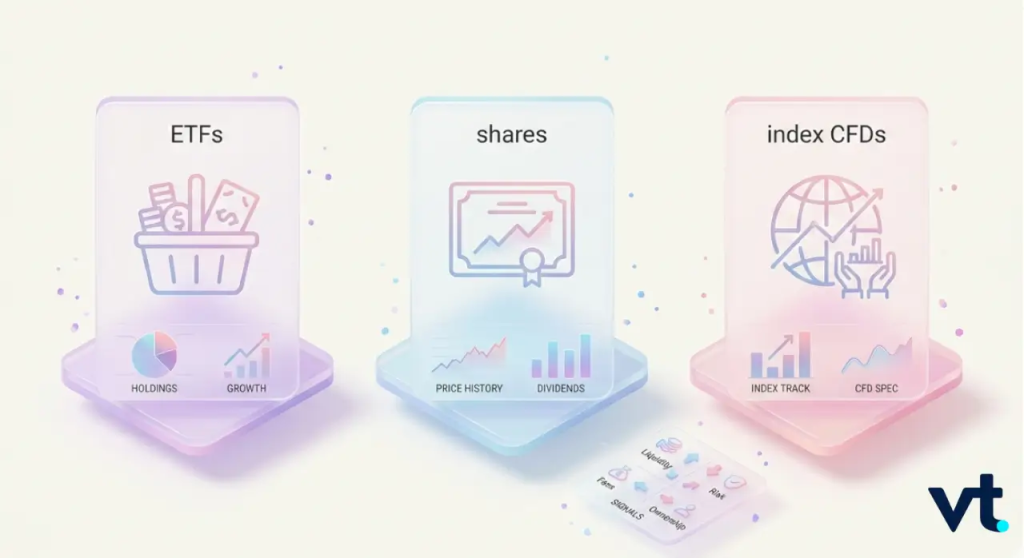
A CFD, or contract for difference, is an agreement to exchange the price difference of an asset between the moment you open a trade and the moment you close it. You never own the share, the index, or the fund. You simply profit or lose based on which way the price moves. The ETF vs Shares vs Index CFDs distinction is really about what sits underneath that contract.
What is a Share CFD?
A Share CFD (also called a stock CFD) tracks the price of one listed company. If you open a long Apple Share CFD, you make money when Apple rises and loses when it falls. You get the price action of the stock without buying it on an exchange, paying full settlement, or holding it in a custody account.
A Share CFD is best understood by what it gives you:
- Concentrated exposure to a single company’s performance.
- The ability to go short, profiting if you expect the price to fall.
- Leverage, so a smaller deposit controls a larger position.
- Dividend adjustments that reflect corporate payouts, credited or debited to your position.
What is an Index CFD?
An Index CFD tracks a whole market benchmark rather than one stock. Think of the S&P 500, the FTSE 100, or Germany’s DAX 40. One trade gives you exposure to hundreds of companies at once. This is where a common question pops up: is the S&P 500 an ETF or CFD? The honest answer is neither on its own.
The S&P 500 is an index of 500 large US companies. You can gain exposure to it through an ETF (such as a fund that tracks it) or through an Index CFD that mirrors its price. The index itself is just the scoreboard; the ETF and the CFD are two different ways to bet on the score.
What is an ETF CFD?
An ETF CFD tracks the price of an exchange-traded fund. An ETF is a ready-made basket of assets, shares, bonds, or commodities, that trades like a single stock. An ETF CFD lets you trade the price of that basket without buying the fund itself.
This is where the are ETFs better than CFDs debate often starts. It is the wrong framing. An ETF is the underlying basket; an ETF CFD is a leveraged contract on that basket. They are tools for different jobs, not rivals.
With global ETF assets reaching a record of US$21.91 trillion at end April 2026, the range of baskets you can trade has never been wider, from broad market funds to clean energy and robotics themes.
How do CFDs work across these Three Instruments?
The mechanics are identical across all three. Only the underlying changes. In every case you:
- Choose a direction buy (long) if you expect a rise, sell (short) if you expect a fall.
- Post margin, a fraction of the full position value, rather than the whole amount.
- Track the difference between your entry and exit price, multiplied by your position size.
- Pay or receive financing if you hold the position overnight.
Quick example:
You open a long CFD worth $10,000 at a 10% margin requirement. You only deposit $1,000. If the price rises 3%, your position gains $300, a 30% return on your $1,000 margin. If it falls 3%, you lose $300, a 30% loss. The instrument underneath, share, index, or ETF, does not change this maths. Only its typical volatility does.
ETF vs Share vs Index CFDs: What’s the Difference?
Now we get to the epicenter of the ETF vs Shares vs Index CFDs comparison. The three differ in one big way: how concentrated your exposure is. This single factor shapes your risk, your potential reward, and how closely you need to watch the news.
How do ETF, Share, and Index CFDs Differ in What you’re Actually Trading?
Picture three circles, from narrow to wide:
- Share CFDone company: Apple, Tesla, BP. Your result depends on that single firm.
- ETF CFDa curated basket: A clean energy ETF might hold 30 to 80 companies in one theme.
- Index CFD a full benchmark: The S&P 500 holds 500 firms across every major sector.
Single-Company Exposure vs Basket Exposure Explained
This is the core of the CFD vs stock vs ETF trade-off. A single-company position is sharp. Good news on that one firm can lift it fast, while a profit warning can sink it just as quickly. Basket exposure is smoother. A weak quarter from one company in an index of 500 barely registers.
A simple illustration:
Let’s say one company in a 500-stock index drops 20% in a day. Its weight in the index might be just 1%. The drag on the index is roughly 0.2%, not 20%. That same 20% fall, held as a Share CFD, hits your position in full. This is concentration risk in one line.
How Diversification Differs across the Three
Diversification is the spread of your risk across many holdings. The three instruments sit on a clear scale:
- Share CFDs: No diversification. One name, one outcome.
- ETF CFDs: Moderate to strong diversification, depending on the basket. A broad fund spreads risk widely; a narrow theme less so.
- Index CFDs: Broad diversification by design, across an entire market or economy.
Remember, diversification reduces single-stock shocks. It does not remove market risk. When an entire market falls, an index and most ETFs fall with it.
A side-by-Side Comparison of ETF, Share, and Index CFDs
The table below puts all three instruments side by side, so the key trade-offs are clear at a glance:
| Feature | Share CFD | Index CFD | ETF CFD |
| What you trade | One company | A whole market benchmark | A basket / theme |
| Diversification | None | Broad | Moderate to strong |
| Typical volatility | High | Lower | Medium |
| Driven by | Company news, earnings | Macro data, sentiment | Sector or theme trends |
| Best for | Stock-specific views | Market-wide views | Theme or sector views |
| Research load | High (per company) | Medium (macro) | Medium (sector) |
How are ETF, Share, and Index CFDs Priced and Traded?
Pricing and trading mechanics shift the way each instrument behaves once a position is open. The same CFD wrapper sits on top of all three. However, the underlying market sets the price feed, the trading window, the cost structure, and the leverage available differently. Knowing how each one works makes it easier to pick the right instrument for a given trade.
How is Each Instrument Priced?
Each CFD price mirrors its underlying market in real time:
- Share CFDs follow the live quote of the listed stock on its home exchange.
- Index CFDs follow a calculated value derived from all the index’s constituents, plus the futures market outside cash hours.
- ETF CFDs follow the fund’s market price, which itself tracks the net asset value of the basket inside it.
What are the Trading Hours for Each?
Trading hours is vital because they decide when you can react to news. Share and ETF CFDs broadly follow their home exchange hours, with some extended-hours access. Major Index CFDs often trade nearly around the clock on weekdays, since they ride on futures markets. If you want to respond to an overnight headline, an Index CFD usually gives you more room than a single US Share CFD waiting for the New York open.
How do Spreads and Overnight Financing Compare?
Two costs shape every CFD trade: the spread you pay to enter and the overnight financing charge you carry for every day a position stays open.
| Cost factor | Share CFD | Index CFD | ETF CFD |
| Typical spread | Medium to wide | Tight on majors | Medium |
| Overnight financing | Yes | Yes | Yes |
| Commission | Often charged | Often spread-only | Often charged |
| Cost note | Varies by stock liquidity | Cheapest on big indices | Varies by fund size |
Worked example:
Hold a $5,000 Index CFD overnight at an annualised financing rate of around 5%. The daily charge is roughly $5,000 × 5% ÷ 365 ≈ $0.68 per night. Over a 30-day swing trade, that is close to $20. Tiny per day, but worth knowing before you hold for weeks.
How does Leverage Work across the Three?
Leverage is the same engine in every case: a small margin controls a larger position. What changes is the sensible
- Index CFDs can usually carry higher leverage, as broad benchmarks move less violently.
- ETF CFDs sit in the middle, depending on the basket’s volatility.
- Share CFDs often carry lower leverage caps, because single stocks can gap hard on news.
What are the Risks of Trading ETF, Share, and Index CFDs?
No honest ETF vs Shares vs Index CFDs guide skips the risks. The main reason is poor risk control, not bad instrument choice. Understanding what can go wrong is the first step to staying in the smaller, more disciplined group.
What are the Main Risks of Share CFDs?
Single-company exposure is the sharpest knife in the drawer:
- Gap risk a stock can open far from its previous close after earnings or news, jumping past your stop.
- Event risk profit warnings, lawsuits, or management changes can move one stock violently.
- Liquidity risk smaller stocks may have wider spreads and thinner volume.
What are the Main Risks of Index CFDs?
Indices are smoother, not safe. Their risks are macro in nature:
- Market-wide drawdowns a recession or rate shock pulls the whole index down at once.
- Overnight gaps geopolitical headlines can move futures while you sleep.
- Correlation risk in a crash, diversification shrinks as most sectors fall together.
What are the Main Risks of ETF CFDs?
ETF CFDs inherit the risks of whatever sits inside the basket:
- Theme concentration a narrow sector ETF can behave almost like a single bet.
- Tracking differences the fund may not perfectly mirror its target index.
- Liquidity differences smaller, niche ETFs can have wider spreads than broad ones.
How does Leverage Amplify Risk across All Three?
Leverage is neutral. It magnifies wins and losses equally. The maths is unforgiving: on 10:1 leverage, a 10% move against you wipes out your entire margin. On a $1,000 margin controlling a $10,000 position, a 10% adverse move is a $1,000 loss, 100% of what you put up. This is why position sizing and stop-losses matter more than instrument choice. The instrument sets the typical speed; leverage sets the stakes.
| Adverse move | 5:1 leverage | 10:1 leverage | 20:1 leverage |
| 2% | -10% of margin | -20% of margin | -40% of margin |
| 5% | -25% of margin | -50% of margin | -100% of margin |
| 10% | -50% of margin | -100% of margin | Margin wiped |
Which CFD Type is Right for You?
The right instrument depends on what you are trying to express, how much concentration risk you are comfortable carrying, and how you prefer to manage volatility. Each type has a natural home in a trading strategy, and understanding where that is saves you from trading the wrong vehicle for a perfectly good idea.
When might Share CFDs Suit your Strategy?
Share CFDs reward conviction on a specific company. They may suit you if:
- You follow individual companies closely and have a view on earnings or product cycles.
- You want to express a sharp, short-term opinion, long or short, on a single name.
- You accept higher volatility in exchange for higher potential reward.
When might Index CFDs Suit your Strategy?
Index CFDs reward a top-down, macro view. They may suit you if:
- You have an opinion on the broad market direction rather than one stock.
- You prefer smoother price action and built-in diversification.
- You want to trade around the clock on a liquid benchmark like the S&P 500. This is also the cleanest way to act on the is the S&P 500 an ETF or CFD question: trade it directly as an Index CFD.
When might ETF CFDs Suit your Strategy?
ETF CFDs reward a thematic or sector view. They may suit you if:
- You believe in a trend, clean energy, AI, robotics, but do not want to pick the single winner.
- You want diversification narrower than a full index but wider than one stock.
- You like the balance between concentration and spread that a basket offers.
How does your Trading Goal Shape the Right Choice?
Map your goal to the instrument with this quick guide:
| Your goal | Likely best fit | Why |
| Bet on one company | Share CFD | Direct, concentrated exposure |
| Trade overall market direction | Index CFD | Broad, diversified, liquid |
| Back a theme or sector | ETF CFD | Basket exposure without stock-picking |
| Lower single-name shocks | Index or ETF CFD | Diversification cushions blows |
| Maximise short-term volatility | Share CFD | Single stocks move fastest |
How to Start Trading ETF, Share, or Index CFDs
Once you understand the differences between instrument types, the next step is putting the right infrastructure in place before your first trade. Getting set up correctly from the start, choosing a regulated broker, a reliable platform, and a clear plan, counts more than which market you open first.
What do You Need before You Start?
A short checklist keeps you grounded:
- A regulated broker offers all three instrument types on one platform, so you can switch as your views change.
- A trading platform you trust. MetaTrader 5 now commands the majority of retail CFD volume after overtaking MetaTrader 4.
- A funded account sized, so a single loss never threatens your capital base.
- A written plan covering entry rules, position size, and where your stop-loss sits before you click buy.
At VT Markets, Share, Index, and ETF CFDs all sit on both and MetaTrader 4, so you can test each instrument type inside one account before committing real conviction.
How to Choose between Them as a Beginner
If you are new, ease in rather than diving into the sharpest tool first:
- Start broad an Index CFD on a major benchmark gives you market exposure with lower single-name shock.
- Add a theme once comfortable, an ETF CFD lets you back a trend without picking one stock.
- Go specific last Share CFDs reward research and discipline, so save concentrated bets for when your process is solid.
- Practise first by using a demo account to rehearse the mechanics before risking real funds.
Pro tip: Risk no more than 1 to 2% of your account on any single trade. On a $2,000 account, that is $20 to $40 of risk per position. This one rule outlasts every clever entry signal.
Frequently Asked Questions (FAQs)
Q1: What is the difference between an ETF CFD and an Index CFD?
An Index CFD tracks a whole market benchmark, such as the S&P 500 or FTSE 100, covering hundreds of companies. An ETF CFD tracks a single fund, which may follow a benchmark but is often built around a sector or theme like clean energy or robotics. In short, an index is the market; an ETF is a chosen basket within it.
Q2: Are Index CFDs less risky than Share CFDs?
Index CFDs are usually less volatile because they spread exposure across many companies, so one bad result barely moves the price. That diversification softens single-stock shocks. But they are not risk-free, a broad market sell-off pulls the whole index down, and leverage still amplifies every move.
Q3: Can you trade ETF CFDs the same way as Share CFDs?
Yes. The mechanics are identical: you go long or short, post margin, and settle the price difference. You can use the same stop-loss and take-profit tools on both. The difference is what you are exposed to, one company versus a basket, which changes the typical volatility, not the way you place the trade.
Q4: Which is better for beginners: ETF, Share, or Index CFDs?
Many beginners find Index or ETF CFDs gentler starting points, because diversification reduces the chance of a single piece of news wiping out a position. Share CFDs reward deeper company research and tend to move faster. A common path is to start broad with an index, add a theme via an ETF, then graduate to single stocks as discipline builds.
Q5: Do ETF, Share, and Index CFDs all use leverage?
Yes. All three are traded on margin and use leverage, letting a smaller deposit control a larger position. Leverage magnifies both gains and losses equally. The sensible amount differs by instrument, indices often allow more, single stocks less, but the principle, and the need for tight risk control, is the same across all three.
Your CFD Journey Starts Here with VT Markets
Whether you want the sharp focus of a Share CFD, the broad sweep of an Index CFD, or the thematic balance of an ETF CFD, the ETF vs Shares vs Index CFDs decision is really a decision about you, your view, your time, and your appetite for risk. There is no single right answer, only the right fit for your strategy today.
The smartest traders do not pick one instrument and stop there. They match the tool to the trade, stay disciplined on position size, and never let leverage outrun their plan. Start broad, build your process, and add concentration as your confidence grows.
With VT Markets, you can trade Share, Index, and ETF CFDs side by side on MetaTrader 4 and MetaTrader 5, with the tools, execution, and education to grow at your own pace. Open a live account, practise on a demo first, and put your view to the test.





