






Key Takeaways
- Chart patterns are visual price formations that help traders predict future market direction across forex, stocks, and crypto – with certain patterns achieving success rates above 70% when confirmed by volume
- The 11 most important patterns fall into three categories: continuation patterns (flags, pennants, triangles), reversal patterns (head and shoulders, double tops/bottoms, wedges), and bilateral patterns (symmetrical triangles)
- Each pattern has a precise price target formula using the “measure rule” — projecting the pattern’s height from the breakout point — which removes guesswork from profit-taking decisions
- Volume confirmation is non-negotiable: a breakout on volume at least 50% above the 20-day average is significantly more reliable than one on thin volume
- Daily and weekly chart patterns produce more reliable signals than intraday patterns because they reflect broader market participation and less random noise
- Strict risk management — capping exposure at 2% of account equity per trade and placing stops at logical technical levels — is what separates consistent pattern traders from those who blow up on false breakouts
- Modern AI tools and automated scanners can screen thousands of assets for patterns simultaneously, but combining technology with manual judgment produces the best results
What Are Chart Patterns?
Chart patterns are recurring price formations on a trading chart that signal the likely next direction of an asset. Traders use over 75 chart patterns, but this article focuses on the most important ones. They emerge when buyers and sellers reach a temporary equilibrium – a consolidation phase – before one side gains control and the price breaks out decisively, signalling either a continuation or a reversal of the current trend.
The reason patterns work is not technical magic. It is human psychology. Fear, greed, hope, and panic cause market participants to react predictably when facing similar price conditions, whether they are trading EUR/USD, Apple shares, or Bitcoin. This universality is what makes chart pattern analysis one of the most transferable skills in trading.
According to research by Thomas Bulkowski in Encyclopedia of Chart Patterns, certain formations achieve historical success rates exceeding 70% when applied with proper volume confirmation. At VT Markets, traders who combine pattern recognition with disciplined risk management consistently produce more systematic results than those relying on instinct or news-driven decisions alone.
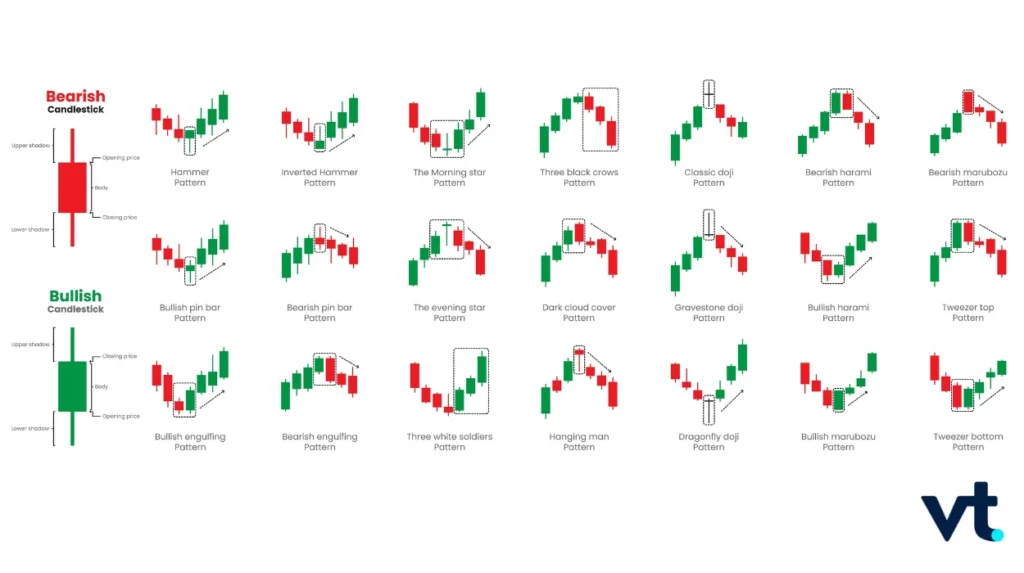
The 11 most common chart patterns fall into three families:
| Category | Examples | Signal |
|---|---|---|
| Continuation | Bull flag, pennant, ascending triangle | Trend resumes after a pause |
| Reversal | Head and shoulders, double top, wedge | Trend changes direction |
| Bilateral | Symmetrical triangle | Could break either way |
1. Head and Shoulders
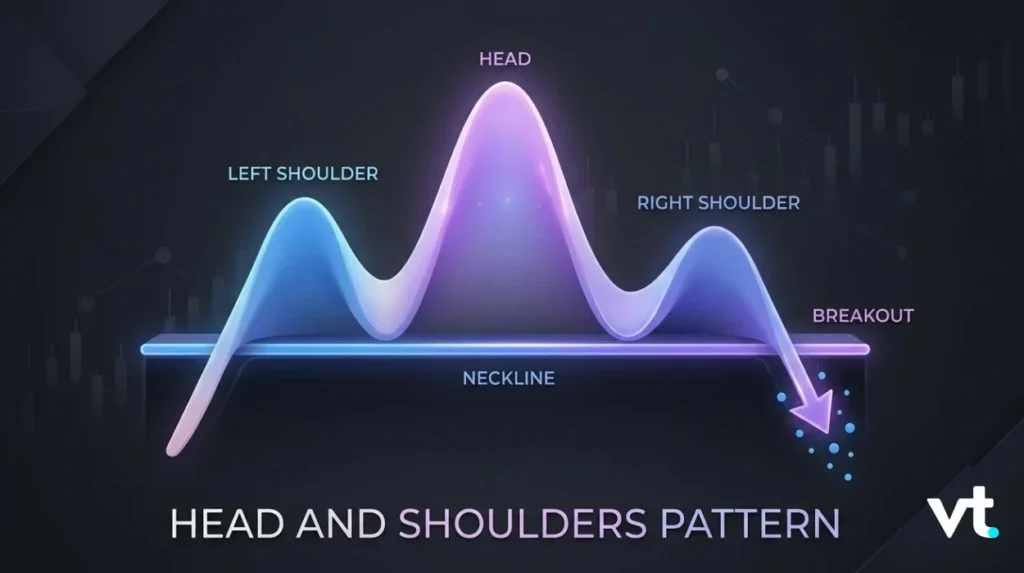
The head and shoulders pattern is a bearish reversal formation and the most reliable reversal signal in technical analysis. It forms at the end of an uptrend when buying momentum visibly weakens.
Three peaks make up the pattern: a left shoulder, a higher middle peak that forms the head, and a right shoulder roughly equal to the left. A neckline drawn across the two intervening troughs at roughly the same support level is the critical trigger level and signals a trend reversal once price breaks it.
Entry: Short when price closes below the neckline with a volume surge. Stop-loss: Above the right shoulder. Price target: Measure the distance from the head to the neckline and project it downward from the breakout. If the head peaks at $50 and the neckline sits at $44, the minimum target is $38.
The inverted head and shoulders — three troughs with the central one lowest — signals a bullish reversal using identical rules applied upward.
2. Double Top and Double Bottom
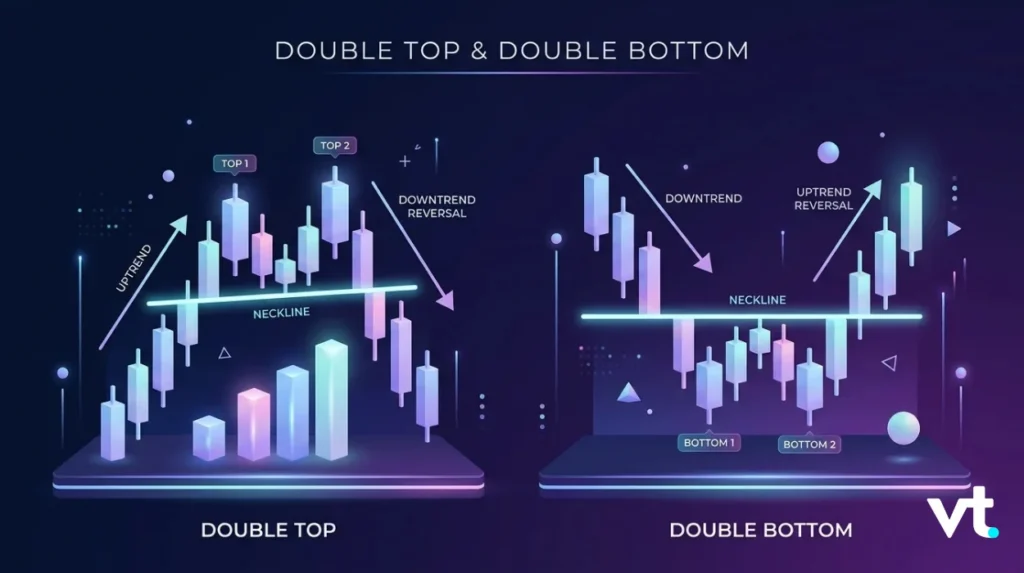
The double top is a bearish “M”-shaped reversal chart pattern, and the double top pattern typically forms after two consecutive peaks at a similar level. Price rallies to a resistance level, retreats to an intermediate trough (the neckline), rallies again to approximately the same high, then breaks below the neckline in a double top formation, often warning of a price decline once confirmed. The double bottom is the mirror “W” shape and signals a bullish reversal after a downtrend, making it a bullish reversal pattern.
How to identify it: Both peaks or troughs should be within 3–5% of each other in price. A minimum 10% separation between the two extremes validates the pattern. Volume typically decreases on the second peak, confirming fading conviction.
Entry: On a confirmed candle close beyond the neckline — not just an intraday wick. Stop-loss: Just beyond the second peak or trough. Price target: The height of the “M” or “W” projected from the neckline breakout.
Key Volume Indicator: A strong volume surge on the neckline break is the most important confirmation signal. Low-volume breaks are a red flag for a false breakout.
3. Ascending Triangle
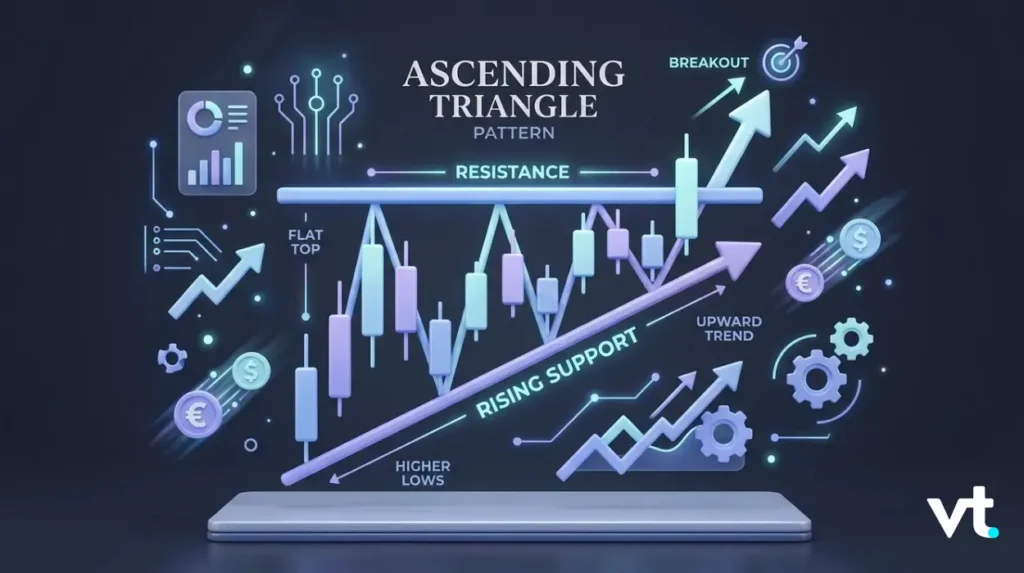
The ascending triangle is a bullish continuation chart pattern formed using two trend lines: the upper boundary acts as one of the key horizontal lines for resistance, while the lower boundary rises. Buyers grow increasingly aggressive — each dip is bought at a higher level — while sellers hold the same resistance line. Eventually, buying pressure wins.
Entry: Long on a breakout above the horizontal resistance with volume at least 50% above the 20-day average, which can provide a clear entry point within the prevailing trend. Breakouts typically occur between 50% and 75% of the way from base to apex. Stop-loss: Below the most recent higher low inside the triangle. Price target: The height of the triangle at its widest point added to the breakout level.
Success rate: 75% as a bullish continuation signal (Bulkowski), and ascending triangles often provide continuation signals when the breakout is confirmed, making it one of the most dependable triangle formations.
4. Descending Triangle
The descending triangle is the bearish counterpart: a flat support base that acts as the key support level and a descending upper trendline. Sellers consistently push price lower from declining highs while buyers attempt to hold flat support — until it eventually breaks. These structures help frame trading decisions only after confirmation.
Entry: Short on a breakdown below horizontal support with volume confirmation; the move confirms the bearish pattern when price closes below support. Always wait for a full candle close below the level, as these breakdowns often define the key market breaks traders look for in descending triangles; false breakdowns are more common here than in ascending ones. Stop-loss: Above the most recent lower high within the triangle. Price target: The height of the triangle projected downward from the breakdown point.
Success rate: 75% as a bearish continuation signal. Note that descending triangles occasionally break upward in strongly bullish conditions against the ongoing trend, so confirmation is always required before entering.

5. Symmetrical Triangle
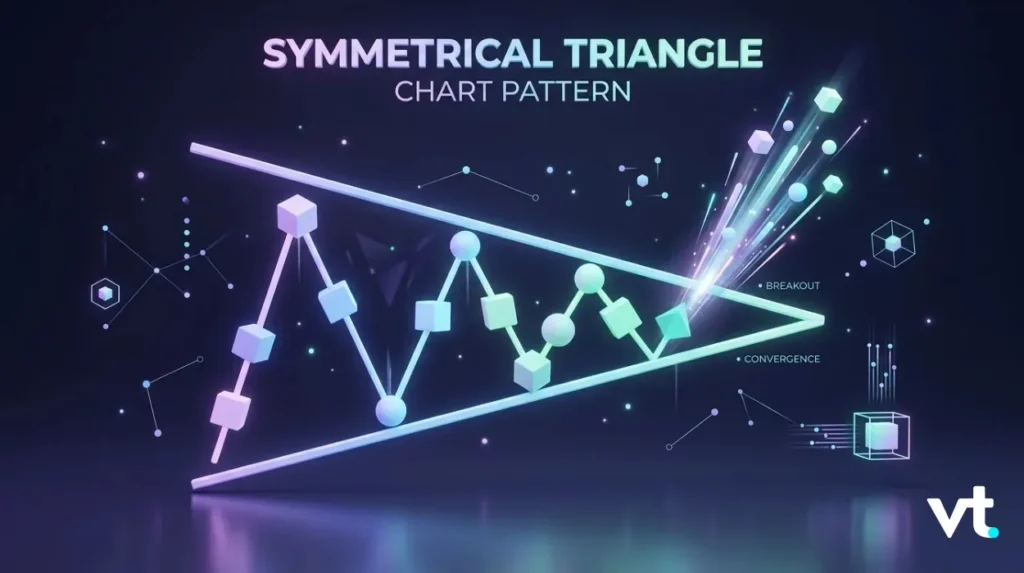
The symmetrical triangle reflects genuine market indecision. The asset’s price makes lower highs and higher lows as it compresses into a tightening range, tracking price movement within converging boundaries as buyers and sellers battle to a standoff. Unlike the ascending or descending triangle, there is no directional bias built into the pattern itself — it is a bilateral setup that often uses support and resistance across the two converging boundaries.
Entry: Wait for the confirmed breakout direction, since the breakout determines the new trend direction. In a broader uptrend, a bullish breakout is statistically more likely; in a downtrend, a bearish breakdown. Enter on a candle close beyond the boundary with volume confirmation. Stop-loss: On the opposite side of the triangle at the breakout candle’s range. Price target: The width of the triangle at its widest point added to or subtracted from the breakout.
Success rate: Approximately 65% — lower than directional triangles, reflecting inherent uncertainty.
6. Bull Flag
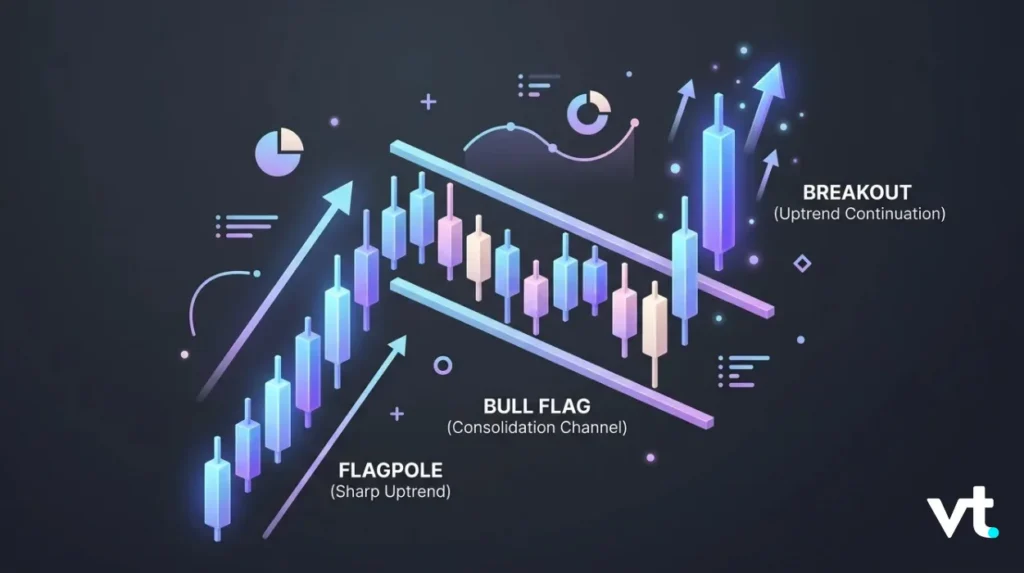
The bull flag is a short-term continuation flag pattern developing after a sharp, near-vertical advance (the flagpole). Price enters a brief, orderly pullback in a slightly downward-sloping parallel channel — the flag — before resuming the upward trend. It is one of the highest-reliability setups available to swing traders.
How to identify it: A steep flagpole move precedes the consolidation, and the pattern forms after that strong move as price pauses before continuation. Volume dries up during the flag and surges on the breakout. The more orderly and well-defined the channel, the more reliable the signal.
Entry: Long on a break above the upper channel boundary, with traders using the breakout as the price breakout confirmation, confirmed by a volume expansion. Stop-loss: Below the lower channel boundary. Price target: The length of the flagpole added to the breakout point.
Success rate: Above 80% when flagpole and volume criteria are met. At VT Markets, this setup is particularly effective on the 4-hour chart when aligned with a bullish daily trend and the current trend.
7. Bear Flag
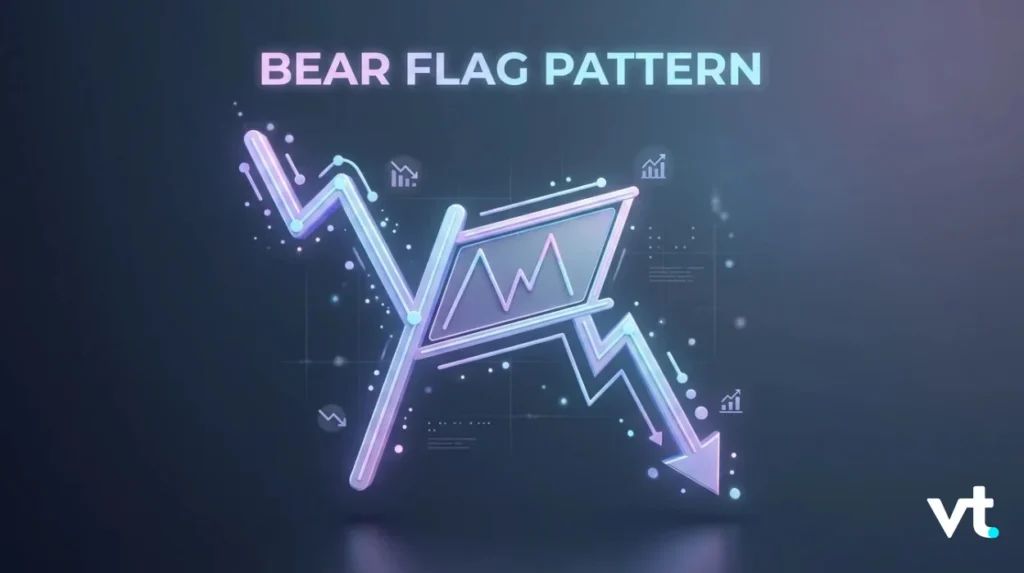
The bear flag mirrors the bull flag exactly but in a downtrend. After a steep decline (the flagpole), price consolidates in a shallow, upward-sloping channel, drifting in the opposite direction of the prior impulse within a temporary consolidation before continuing lower. The slight upward drift during the flag phase looks like a recovery — it is a trap.
Entry: Short on a break below the lower channel boundary with volume confirmation, seeking continuation in the same direction as the prior decline once the break occurs. Stop-loss: Above the upper channel boundary. Price target: The length of the flagpole subtracted from the breakdown point.
Bear flags are particularly effective during risk-off sessions on major forex pairs such as EUR/USD and GBP/USD. Watching the VT Markets Economic Calendar helps identify the macro catalyst that often drives the flagpole move that precedes the flag, and the broader market movement can still reverse if price fails at the upper boundary or nearby resistance.
8. Pennant
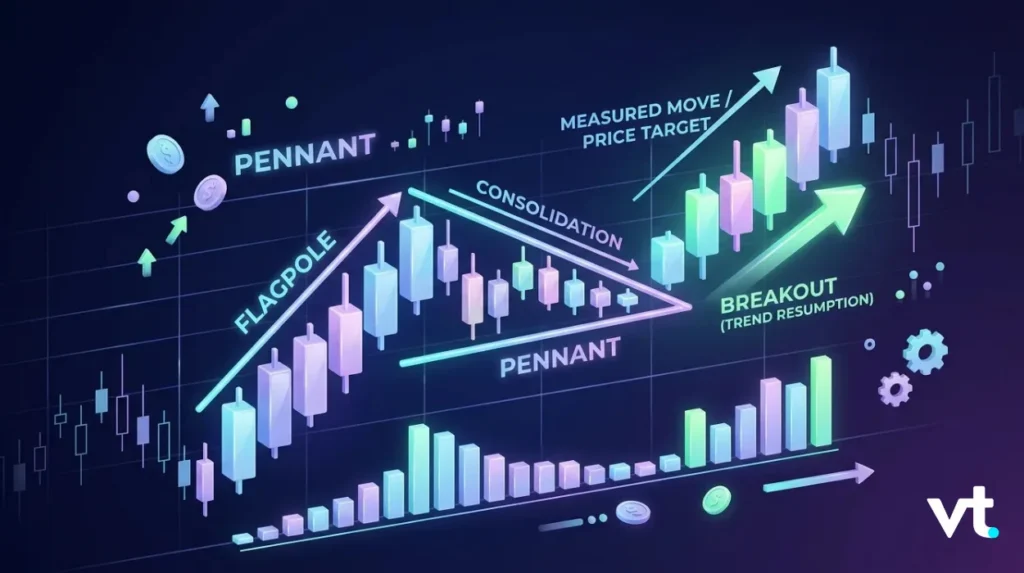
The pennant is a close cousin of the flag but structurally distinct: instead of a parallel channel, the consolidation forms a small symmetrical triangle bounded by converging trend lines. Like the flag, it develops after a sharp flagpole move and is one of the common chart patterns used to spot continuation setups. It typically resolves faster than the flag because the converging lines compress price more aggressively.
Entry: On a breakout from the triangle in the direction of the flagpole, as traders watch for price moves to resume with a confirming volume surge. Stop-loss: Below the pennant low (bull pennant) or above the pennant high (bear pennant). Price target: The length of the flagpole added to the breakout point.
The key distinction from a standalone symmetrical triangle: pennants only count when preceded by a sharp flagpole move in the prevailing trend. Without the flagpole context, the converging triangle is treated as a bilateral setup, not a continuation signal.
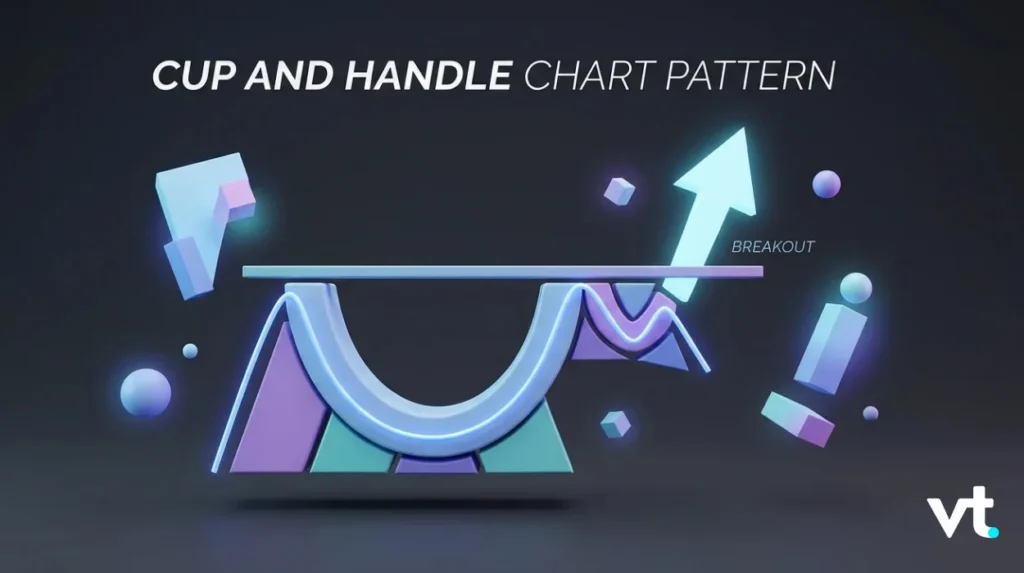
9. Cup and Handle
The cup and handle pattern is a longer-term bullish continuation pattern popularised by investor William O’Neil. It is particularly effective for identifying assets in sustained accumulation patterns before a significant breakout.
How to identify it: The cup forms a smooth, rounded U-shaped bottom over 7 to 65 weeks — gradual accumulation, not a sharp V-reversal, and the pattern develops over weeks or months into the rounded cup shape. The decline from the prior high should be 15–50%. The handle is a brief pullback on the right side of the cup, retracing 10–15% of the cup’s depth and sloping slightly downward. A shallower handle is more bullish. Volume decreases through the cup and handle, then surges on the breakout.
Entry: Long on a close above the handle’s resistance with a strong volume expansion. Stop-loss: Below the lowest point of the handle. Price target: The depth of the cup added to the breakout point, and traders often set a profit target by projecting that cup depth from the breakout.
Because the cup and handle takes weeks to months to develop, traders who spot it early can plan their entry methodically — setting price alerts at the handle’s resistance using VT Markets’ TradingView integration.
10. Rising Wedge
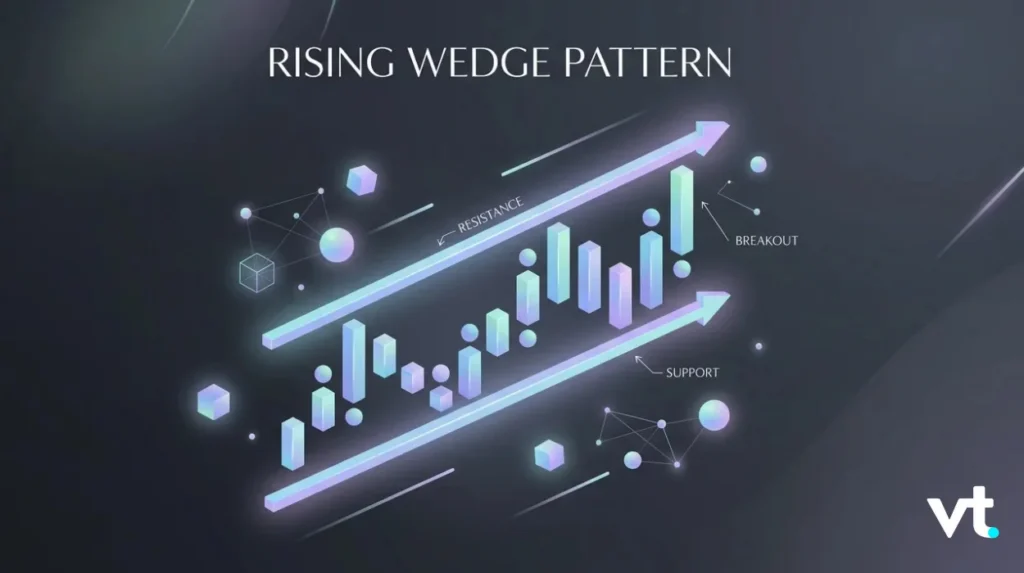
The wedge pattern, specifically the rising wedge, is a bearish reversal pattern where price makes higher highs and higher lows within two upward-sloping, converging trendlines. Despite rising price, the narrowing range signals weakening bullish momentum, and a failed rise can warn of a potential reversal before the breakdown accelerates. When the lower trendline finally breaks, the reversal is often sharp and fast.
How to identify it: Both trendlines slope upward, but the lower one rises more steeply, causing the channel to narrow. Volume decreases throughout, confirming fading conviction. The same pattern can appear as a reversal at the top of an uptrend or as a continuation move during a counter-trend rally within a broader downtrend.
Entry: Short on a breakdown below the lower trendline with a volume expansion, as the lower-trendline break is the key price breakout for confirmation. Stop-loss: Above the most recent high within the wedge. Price target: The height of the wedge at its widest point projected downward from the breakdown.
11. Falling Wedge
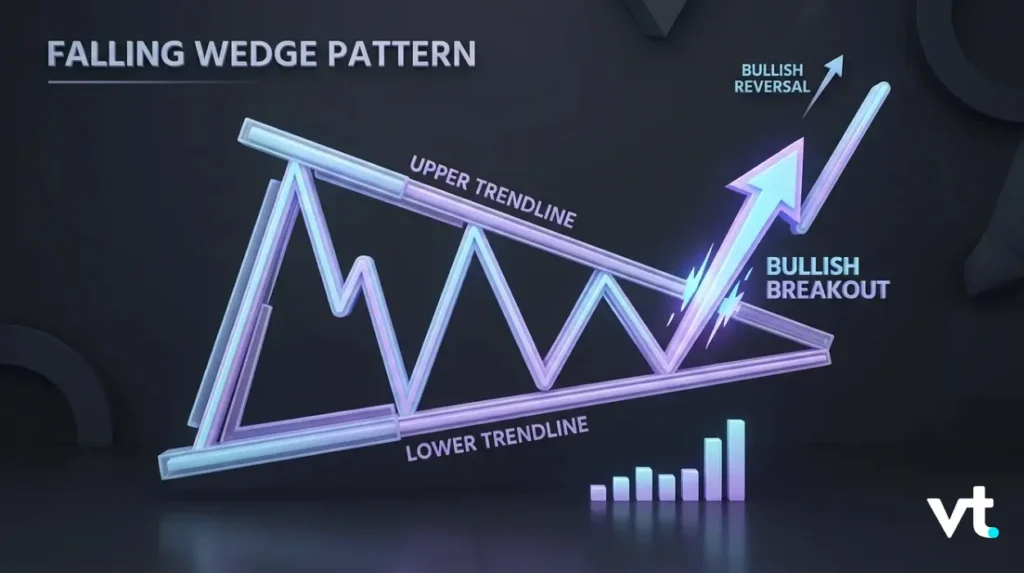
The falling wedge is the bullish counterpart: the asset’s price action forms a wedge pattern with converging trend lines as it makes lower highs and lower lows, and it can mark either a reversal or a continuation. Selling pressure is exhausting itself — the declining range is the tell. The breakout when it comes is typically accompanied by a sharp move higher.
How to identify it: Both trendlines slope downward, but the upper one falls more steeply. Volume contracts throughout. It forms as a reversal at the bottom of a downtrend, or as a continuation during a pullback within a broader uptrend, and it can precede a market break above resistance when buying pressure returns.
Entry: Long on a breakout above the upper trendline with volume confirmation. Stop-loss: Below the most recent low inside the wedge. Price target: The height of the wedge at its widest point projected upward from the breakout.
Falling wedges are deceptive because price keeps declining during formation — they feel bearish even as they set up a bullish breakout. Volume contraction is the signal that the selling is losing its energy. This structure often reflects a shift from bearish pressure to bullish reversal. The breakout often marks a bullish reversal and a change in price movement.
How to Trade Chart Patterns Effectively
Entry Strategies
Breakout Entry: Enter when the price closes beyond the pattern boundary with confirming volume. This breakout level often becomes the trader’s entry point, though it produces a slightly higher entry price relative to the pattern midpoint.
Pullback Entry: After the initial breakout, price often returns to retest the broken trendline from the new side — former resistance becoming support, and vice versa. Waiting for this retest, with support and resistance flips helping confirm the trade location, offers a better entry price and a tighter stop, at the cost of potentially missing the trade if the retest does not occur.
Confirmation Entry: Waiting for two or three candles to close beyond the pattern level before entering provides the highest probability of a genuine breakout, which can improve trading decisions by filtering weaker signals while sacrificing some early entry price for increased reliability.
Risk Management
Proper risk management matters more than pattern selection, entry timing, or target setting, and both technical indicators and chart patterns support disciplined execution. Even a 75% success rate pattern will deplete an account without appropriate controls.
- Risk no more than 2% of total account equity per trade, regardless of pattern conviction
- Place stop-losses at a logical technical level – below the last swing low for long trades and above the last swing high for short trades
- Use position sizing to match your risk amount to the stop distance, not to fill arbitrary lot sizes, and make sure your trading strategy defines stop placement and position sizing before entry
- Exit promptly when a pattern shows clear signs of failure, such as when price fails to hold the breakout or key support level — waiting and hoping is not a strategy
Timeframe Considerations
| Timeframe | Reliability | Best Use Case |
|---|---|---|
| Weekly | Highest | Major trend identification, long-term swing trades |
| Daily | High | Swing trading, position trading, most pattern types |
| 4-Hour | Moderate | Active trading, intraday swing setups |
| 1-Hour | Lower | Short-term day trading; requires higher confirmation threshold |
Pattern reliability increases with timeframe because different chart patterns show broader participation on higher timeframes and tend to produce clearer signals than intraday noise. Most traders prefer candlesticks, but bar charts can show the same formations, and these price patterns generally carry more weight on a weekly chart than on a 15-minute chart.
Pattern Success Rates at a Glance
| Pattern | Type | Success Rate | Key Confirmation |
|---|---|---|---|
| Head and Shoulders | Reversal (bearish) | 74% | Volume surge on neckline break |
| Inverse Head and Shoulders | Reversal (bullish) | 74% | Volume surge on neckline break |
| Double Top | Reversal (bearish) | 72% | Low volume on second peak |
| Double Bottom | Reversal (bullish) | 72% | Volume expansion on breakout |
| Ascending Triangle | Continuation (bullish) | 75% | Volume expansion above resistance |
| Descending Triangle | Continuation (bearish) | 75% | Volume expansion below support |
| Symmetrical Triangle | Bilateral | 65% | Direction confirmed by breakout |
| Bull Flag | Continuation (bullish) | 83% | Volume contraction in flag, expansion on break |
| Bear Flag | Continuation (bearish) | 83% | Volume contraction in flag, expansion on break |
| Cup and Handle | Continuation (bullish) | 71% | Volume surge above handle resistance |
| Rising / Falling Wedge | Reversal | 68% | Volume expansion on trendline break |
Source: Thomas Bulkowski, Encyclopedia of Chart Patterns
Using AI Tools to Enhance Pattern Recognition
Pattern scanning software available through platforms like TradingView can monitor thousands of securities across dozens of markets simultaneously, alerting traders the moment a pattern meets predefined criteria. AI-powered recognition systems go further by training on large historical datasets to identify common price patterns, support chart pattern analysis, and compare different chart patterns more consistently across markets.
At VT Markets, the Market Buzz AI tool provides an additional layer by overlaying real-time market sentiment on price action — helping traders gauge whether a breakout is backed by genuine conviction or is likely to fade back into the range.
The most effective approach combines both: using automated tools for initial screening across a broad watchlist, then applying manual analysis to assess volume behaviour, market context, and higher-timeframe trend alignment before committing to a trade, with scans supporting rather than replacing trading decisions.
Frequently Asked Questions
Q: What is the most reliable chart pattern for forex trading?
Bull flags and bear flags consistently produce the highest success rates — above 80% when the flagpole is steep and volume behaviour is textbook. Among reversal patterns, the head and shoulders and its inverse are the most dependable at approximately 74%, provided the neckline break is confirmed by volume.
Q: How long does a chart pattern take to form?
Formation time varies widely. Flags and pennants typically develop over 1–3 weeks on a daily chart. Triangles often take 3–12 weeks. The cup and handle can develop over 7 weeks to over a year on a weekly chart. Longer formation times generally produce more substantial moves upon breakout.
Q: What is the difference between a flag and a pennant?
Both develop after a sharp flagpole move and signal continuation as a continuation chart-pattern setup. The flag consolidates in a rectangular channel with parallel trendlines. The pennant consolidates in a small symmetrical triangle with converging trendlines. Both carry similar reliability, though pennants tend to resolve slightly faster due to the converging pressure of the triangle structure.
Q: How do I avoid false breakouts?
Three filters reduce false breakout exposure significantly. First, require a candle close beyond the boundary — not just an intraday wick. Second, ensure that the volume on the breakout candle is at least 50% above the 20-day average. Third, confirm that the broader trend on the next higher timeframe aligns with the breakout direction, since sudden price rises can create bull traps when confirmation is weak.
Q: Do chart patterns work in volatile markets?
Yes, with adjustments. Use wider stops to account for larger intraday ranges. Set higher volume thresholds for confirmation because noise-driven spikes are more common in volatile conditions. Bilateral patterns like symmetrical triangles are particularly useful in volatile markets because they let price declare its direction before you commit to a side, though traders should confirm the prevailing trend before acting on continuation signals.
Start Trading Patterns with Confidence
Chart patterns remain one of the most powerful and transferable frameworks in trading because they reflect something that never changes: human psychology. The fear, greed, and momentum that created a head and shoulders pattern decades ago drive identical formations across forex pairs, stock charts, and crypto markets today.
Mastering these 11 patterns — head and shoulders, double top and bottom, ascending and descending triangle, symmetrical triangle, bull and bear flag, pennant, cup and handle, and rising and falling wedge — gives traders a systematic way to read market intention across any asset class and any timeframe, and they are among the most common chart patterns traders study.
Start with the patterns that have the clearest rules and the strongest historical success rates: bull and bear flags, head and shoulders, and the directional triangles. Build a library of annotated historical examples. Practise on past charts before looking for live setups. And above all, apply consistent risk management — because understanding these setups helps traders anticipate future price movement, judge whether a breakout suggests continuation or reversal, and make more structured trading decisions, which is what allows you to stay in the game long enough to capture the winners.
For traders ready to put these patterns into practice, VT Markets provides access to TradingView’s full charting suite with drawing tools, the Market Buzz AI sentiment tool, and a free demo account where you can identify and trade all 11 patterns on live market data – with zero capital at risk while you build your skills.





