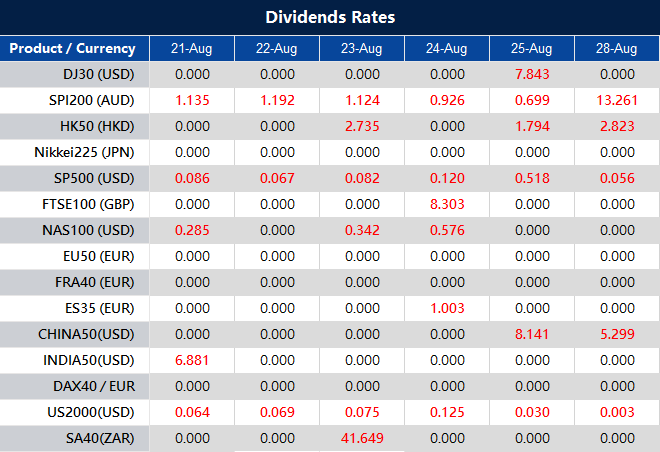
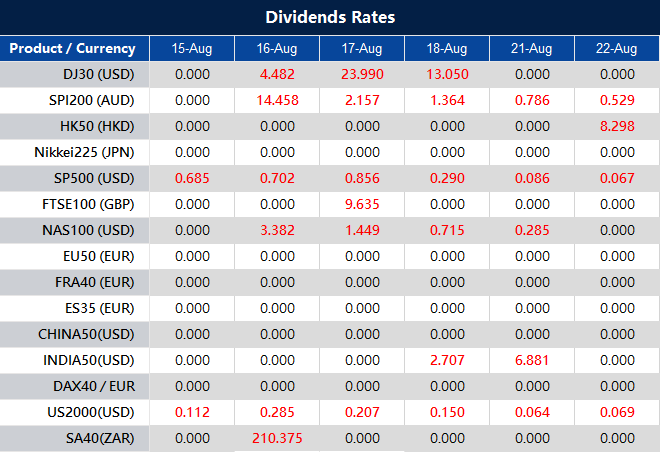
Please note that the dividends of the following products will be adjusted accordingly. Index dividends will be executed separately through a balance statement directly to your trading account, and the comment will be in the following format “Div & Product Name & Net Volume ”.
Please refer to the table below for more details:
The above data is for reference only, please refer to the MT4/MT5 software for specific data.
If you’d like more information, please don’t hesitate to contact info@vtmarkets.com.
This week, key economic players such as Germany, the UK, and the US will publish their flash manufacturing PMI and flash services PMI figures. These releases have the potential to impact market volatility. We advise traders to stay cautious and keep an eye on the latest updates.
Here are some notable highlights for the week:
Flash Manufacturing PMI for Germany, the UK, and the US (23 August 2023)
Germany’s manufacturing PMI declined from 40.6 in June 2023 to 38.8 in July 2023, marking deteriorating business conditions within the country’s manufacturing sector. This figure for July is also the lowest reading since May 2020.
Meanwhile, the UK’s manufacturing PMI for the same period fell from 46.5 to 45.3. In contrast, the US’ manufacturing PMI for the same period increased from 46.3 to 49.
The next set of data will be released on 23 August. Analysts predicted manufacturing PMIs are 38.6 for Germany, 46.2 for the UK, and 49.5 for the US.
Flash Services PMI for Germany, the UK, and the US (23 August 2023)
Germany’s services PMI declined from 54.1 in June 2023 to 52.3 in July 2023, indicating the slowest growth in five months. Similarly, the UK’s services PMI declined from 53.7 to 51.5 during this period, making July the third consecutive month of slowing activity across the country’s service sector. Finally, the US’ services PMI also fell from 54.4 to 52.3 during the same period.
Analysts’ predicted services PMIs for August 2023 are as follows: Germany at 51.5, the UK at 53, and the US at 52.
Germany’s Ifo Business Climate Index (25 August 2023)
Germany’s Ifo Business Climate Index fell for the third consecutive month in July 2023, indicating pessimistic expectations for the coming months. The July figure of 87.3 is also the lowest level since November 2022.
The figure for August 2023 will be released on 25 August, with analysts expecting a reading of 86.9.
Jackson Hole Economic Symposium (25–27 August 2023)
The Jackson Hole Economic Symposium is an annual symposium that focuses on key economic issues affecting the world.
Its participants include prominent financial figures and leading market players from all around the globe. Proceedings from the symposium might hence have an impact on market sentiment and movements.
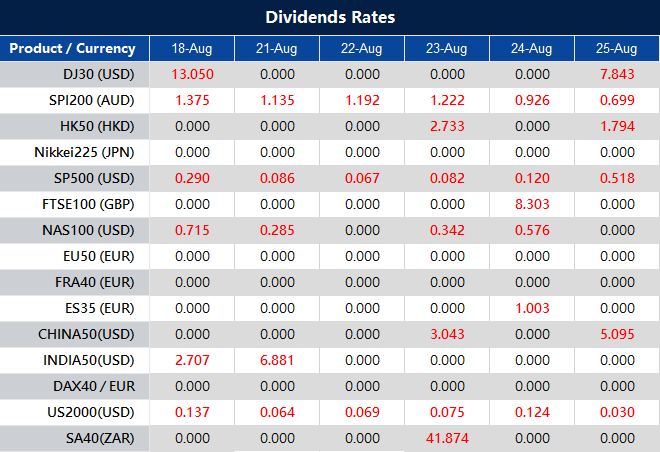
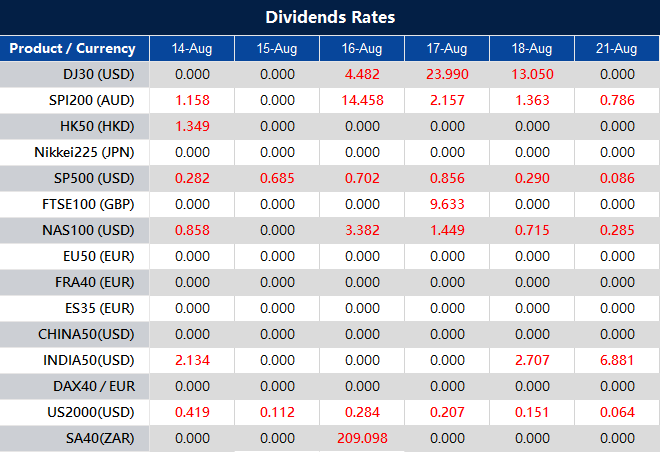
Please note that the dividends of the following products will be adjusted accordingly. Index dividends will be executed separately through a balance statement directly to your trading account, and the comment will be in the following format “Div & Product Name & Net Volume ”.
Please refer to the table below for more details:
The above data is for reference only, please refer to the MT4/MT5 software for specific data.
If you’d like more information, please don’t hesitate to contact info@vtmarkets.com.
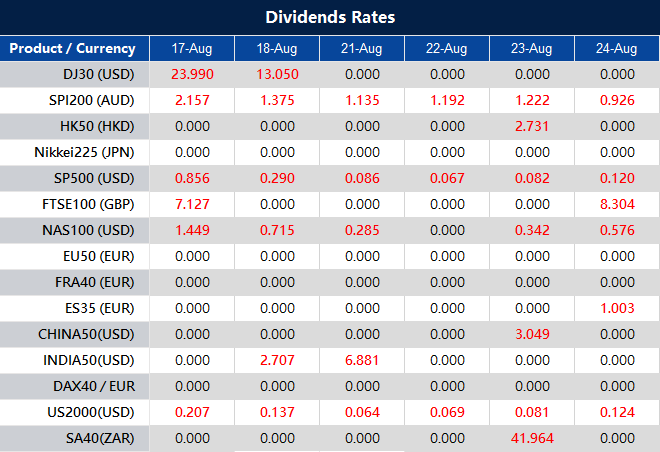
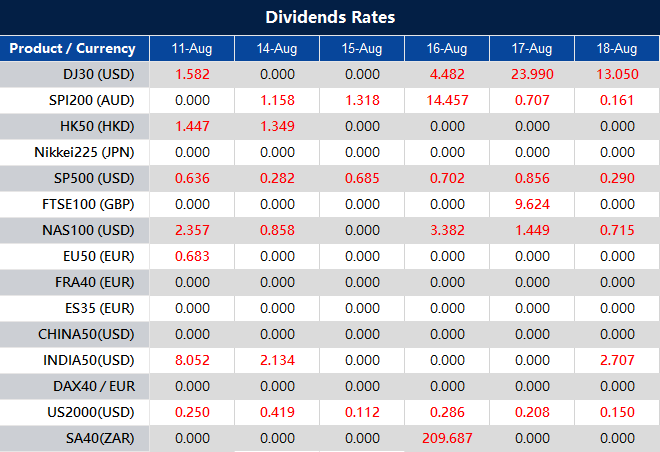
Please note that the dividends of the following products will be adjusted accordingly. Index dividends will be executed separately through a balance statement directly to your trading account, and the comment will be in the following format “Div & Product Name & Net Volume ”.
Please refer to the table below for more details:
The above data is for reference only, please refer to the MT4/MT5 software for specific data.
If you’d like more information, please don’t hesitate to contact info@vtmarkets.com.
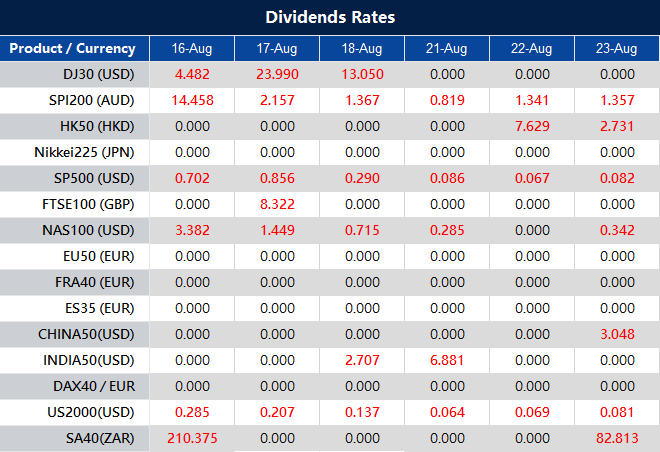
Please note that the dividends of the following products will be adjusted accordingly. Index dividends will be executed separately through a balance statement directly to your trading account, and the comment will be in the following format “Div & Product Name & Net Volume ”.
Please refer to the table below for more details:
The above data is for reference only, please refer to the MT4/MT5 software for specific data.
If you’d like more information, please don’t hesitate to contact info@vtmarkets.com.
Please note that the dividends of the following products will be adjusted accordingly. Index dividends will be executed separately through a balance statement directly to your trading account, and the comment will be in the following format “Div & Product Name & Net Volume ”.
Please refer to the table below for more details:
The above data is for reference only, please refer to the MT4/MT5 software for specific data.
If you’d like more information, please don’t hesitate to contact info@vtmarkets.com.
Please note that the dividends of the following products will be adjusted accordingly. Index dividends will be executed separately through a balance statement directly to your trading account, and the comment will be in the following format “Div & Product Name & Net Volume ”.
Please refer to the table below for more details:
The above data is for reference only, please refer to the MT4/MT5 software for specific data.
If you’d like more information, please don’t hesitate to contact info@vtmarkets.com.
Important economic events will have a significant impact on the forex market this week. Keep an eye out for the Reserve Bank of New Zealand’s (RBNZ) Rate Statement and the US data for retail sales. This information could greatly influence the markets, so it’s crucial for traders to be cautious and stay on top of the latest developments for a successful week of trading.
Here are some notable highlights for the week:
Australia Wage Price Index (15 August 2023)
The seasonally adjusted Wage Price Index in Australia showed that wages increased by 3.7% year-on-year in Q1 2023, following a year-on-year growth of 3.4% in Q4 2022.
Data for Q2 2023 is scheduled for release on 15 August, with analysts anticipating another increase of 3.8%.
Canada Consumer Price Index (15 August 2023)
Canada’s Consumer Price Index (CPI) increased by 0.1% in June 2023 compared to the previous month.
Analysts anticipate a 0.2% increase in the figures for July, which are set to be released on 15 August.
US Retail Sales (15 August 2023)
Retail sales in the US rose by 0.2% month-on-month in June 2023, following a 0.5% increase in May.
Analysts expect a 0.3% growth in the figures for July, scheduled for release on 15 August.
UK Consumer Price Index (16 August 2023)
Consumer price inflation in the UK dropped to 7.9% in June 2023, marking the lowest level since March 2022.
The upcoming CPI figures are expected to show a further decline to 7.4%.
Reserve Bank of New Zealand Rate Statement (16 August 2023)
During its July meeting, the Reserve Bank of New Zealand maintained the official cash rate (OCR) at 5.5%.
Analysts predict that the RBNZ will keep the OCR unchanged at 5.5% following its upcoming meeting on 16 August.
Federal Funds Rate (17 August 2023)
The Federal Reserve raised the target range for the federal funds rate by 25 bps to 5.25–5.5%, in line with market expectations.
Additionally, the central bank also resumed its tightening campaign after a pause in June.
Employment in Australia (17 August 2023)
Employment in Australia surged by 32,600 in June 2023. Meanwhile, the unemployment rate stood at 3.5%, remaining unchanged from May. It continues to hover close to the 50-year lows reached in October 2022.
Analysts anticipate that employment figures for July 2023 will show an increase of 25,100, with the data scheduled for release on 17 August.
Please note that the dividends of the following products will be adjusted accordingly. Index dividends will be executed separately through a balance statement directly to your trading account, and the comment will be in the following format “Div & Product Name & Net Volume ”.
Please refer to the table below for more details:
The above data is for reference only, please refer to the MT4/MT5 software for specific data.
If you’d like more information, please don’t hesitate to contact info@vtmarkets.com.
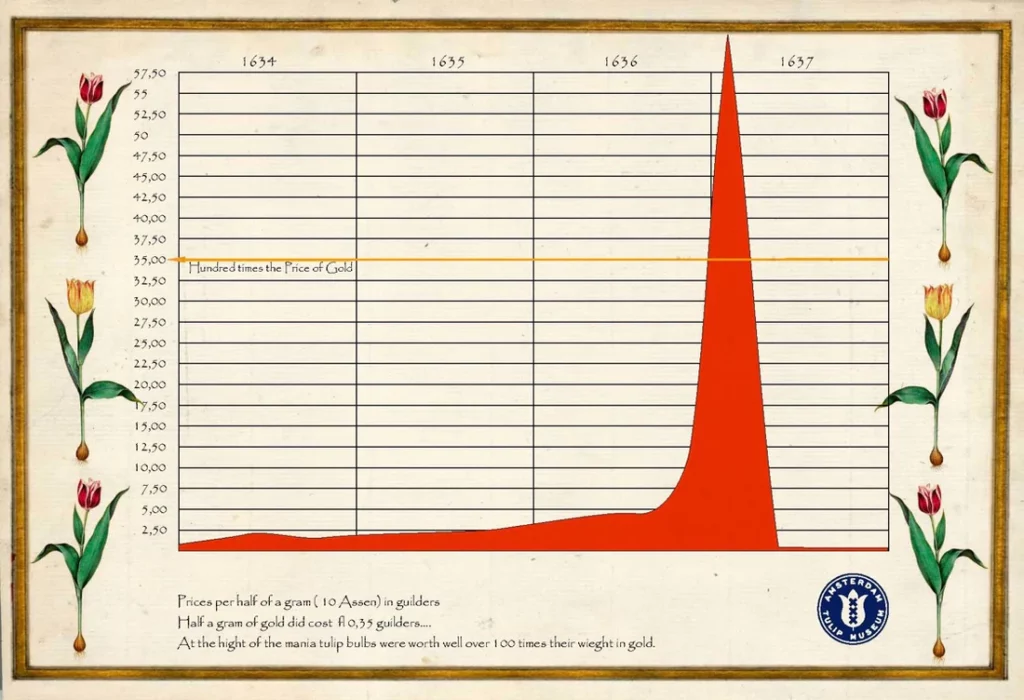
In the 17th-century Dutch Golden Age, a mesmerising phenomenon called “Tulip Mania” took centre stage, forever changing economic history.
Tulips, normally beloved for their beauty, became the focus of an astonishing speculative bubble. Prices soared to unimaginable heights, with a single rare bulb fetching the value of a grand house in Amsterdam.
source: Amsterdam Tulip Museum
Enthusiastic investors rushed into the tulip trade, lured by the promise of untold riches. However, reality intervened, and the bubble burst, leaving many penniless as prices plummeted.
Tulip Mania remains a powerful lesson in speculative trading and the impact of soft commodities on markets and human behaviour. Soft commodities, the backbone of the global economy and vital for human sustenance throughout history, have a longstanding history of trade spanning centuries.
Today, the soft commodities market has evolved into a highly sophisticated arena, surpassing the archaic bartering systems of the past. Its allure lies in the remarkable liquidity and critical significance of these commodities, presenting traders with abundant opportunities to capitalise on profitable ventures in the global markets.
This article aims to provide a comprehensive understanding of soft commodities, elucidating their definition and elucidating the avenues for trading them directly or through financial derivative instruments. Moreover, we will explore the various factors that wield influence over soft commodity prices and delve into effective strategies for managing a diversified portfolio that includes these valuable assets.
Understanding Soft Commodities
Soft commodities refer to natural resources that are cultivated and harnessed for various purposes, including food production, construction, manufacturing consumable goods, and facilitating other human activities.
These products are derived from the earth’s resources but necessitate human effort to be transformed into marketable goods that can be traded. They are commonly referred to as ‘softs’ within the trading industry.
Examples of Soft Commodities
Soft commodities encompass a diverse range of products, originating from various geographical regions worldwide, where optimal conditions favour their production. Despite their distinct origins, these commodities are categorised together due to their indispensable role in human sustenance and their natural composition, which allows for further refining or processing to yield other goods.
Here are some noteworthy examples of soft commodities: Coffee beans, Wheat, Cocoa, Sugar, Rough rice, Palm and kernel oil, Cotton, Hogs, Soybeans, Live cattle, Oats, Corn, Lumber.
Given the global nature of their sourcing, soft commodities are subject to price fluctuations influenced by factors such as weather conditions, disruptions in supply chains, and economic uncertainties. These fluctuations create ample opportunities for traders to speculate on the short and long-term movements of their prices.
What Are Hard Commodities?
To grasp the concept of commodities comprehensively, it is essential to distinguish between hard and soft commodities.
Unlike soft commodities that require cultivation and human intervention, hard commodities are directly extracted or mined from the earth and used in their raw, unprocessed state.
These commodities consist of finite natural resources, including crude oil, natural gas, as well as renewable energies such as solar, hydro, wind, and geothermal power.
Factors Influencing Soft Commodities Prices
The price of soft commodities is subject to the influence of various natural and human-related elements. Some key factors include:
Weather Conditions: Weather plays a crucial role in determining soft commodity prices. Favourable weather is essential for achieving expected harvests and yields to meet supply demands. Conversely, excessively favourable conditions can lead to an oversupply, causing a significant drop in prices.
Consumer Demand: Changes in consumer preferences can impact the popularity of specific soft commodities, affecting their prices. For instance, a rise in foodie culture and increased awareness of different cocoa bean types and flavour profiles can influence cocoa prices.
Political Instability: Political unrest and the threat of conflicts can disrupt soft commodity production and trading, leading to fluctuations in prices. For example, the recent war in Ukraine impacted wheat prices.
source: Financial Times
Supply Chain Disruptions: Issues such as increased transport costs, instability in developing nations, and other supply chain challenges can cause scarcity of soft commodities in the market, driving prices up.
Climate Change: Soft commodities cultivated on land are susceptible to climate change-related problems, such as poor soil quality, natural disasters, changing climate zones, floods, or droughts, impacting prices.
Labor Issues: Labor-related problems in supply countries can significantly influence soft commodity prices. Changes in wages due to new legislation can have a direct effect on the cost of raw materials.
Government Regulations: National governments may impose quotas on commodity production for specific markets. Such regulations or sanctions can disrupt supply and affect prices in other regions.
Seasonality: Soft commodities are influenced by seasonal cycles in their harvesting regions, causing prices to fluctuate accordingly.
Global Development: Rapidly developing regions experiencing population growth create new markets with increasing demands for soft commodities, leading to long-term shifts in supply and demand dynamics.
Exploring the Advantages of Soft Commodity Trading
The soft commodity market presents compelling opportunities for traders worldwide due to the indispensable nature of these commodities in meeting human needs. The market’s inherent unpredictability and vulnerability to various forces offer both heightened risks and substantial rewards.
While not every trader seeks to embrace such risks, those who thrive on navigating volatile markets can capitalise on lucrative prospects through soft commodity trading.
In today’s sophisticated trading landscape, much of the soft commodities trade occurs through futures markets rather than immediate spot transactions. Futures entail binding contracts that establish fixed prices for soft commodities to be executed on a future date, mutually agreed upon by the buyer and seller.
Initially devised to aid farmers and the agricultural industry in securing favourable prices during off-peak periods, futures have evolved into an integral part of a complex trading ecosystem.
Although futures contracts involve eventual asset delivery, many traders opt to offset futures before the delivery date, leveraging the instrument to speculate on anticipated price movements rather than the intrinsic value of the underlying asset itself. This strategic approach enables traders to engage in dynamic and forward-looking soft commodity trading practices.
Navigating Soft Commodity Trading: Strategies and Risk Management
Soft commodity trading via futures involves significant risk and requires careful consideration of leverage. Futures contracts enable traders to invest only a percentage of the asset’s full value, yet profits and losses are calculated based on the total price.
Successful predictions can yield magnified profits when offsetting soft commodity futures. However, sudden unpredictable factors may cause price fluctuations, potentially leading to losses surpassing the initial investment.
To mitigate risk, implementing robust risk management strategies is paramount before commencing soft commodity trading. Utilising tools like stop-loss orders can automatically close positions once they reach an unaffordable level, safeguarding against excessive losses.
Additionally, deciding whether to go long or short while trading soft commodities is crucial in formulating an effective strategy.
To gain practical experience, traders can begin with a demo account before transitioning to real trading with a live trading account. VT Markets simplifies this process by providing access to over a thousand financial instruments within an institutional-grade environment.
It’s important to recognise that each soft commodity possesses unique characteristics, including production methods, supply sources, vulnerabilities, and consumer behaviour. For those interested in specific commodities like coffee, comprehensive guides focusing on these particular markets are available to enhance understanding and proficiency.
In conclusion, soft commodity trading offers a rich history and exciting opportunities. From the historic “Tulip Mania” to today’s sophisticated futures markets, these commodities have a significant impact on global economies.
Traders must navigate risks and employ strategies for successful trading. With diverse soft commodities and their unique market influences, there are abundant chances to capitalise on global dynamics. Embrace the allure of soft commodities, learn from history, and explore the complexities of modern trading. Join this exciting journey and seize remarkable opportunities.