







Key Points
- USD/JPY drops toward 159.00 as easing tensions over Iran and a dovish Fed outlook reduce USD’s safe-haven appeal.
- Rising energy risks from the Strait of Hormuz limit JPY’s potential upside despite USD softness.
- Mixed fundamentals keep USD/JPY range-bound, with geopolitical and inflation data influencing future price movement.
USD/JPY extends Monday’s pullback from the 159.85 area, drifting lower in Tuesday’s Asian session and slipping toward the 159.00 mark. However, losses appear contained amid mixed fundamentals.
Despite stalled US-Iran talks over the weekend, markets remain hopeful that diplomacy is still on the table. US Vice President JD Vance noted that meaningful progress has been made, even without a breakthrough. This optimism weighs on the US Dollar’s safe-haven appeal, adding pressure to USD/JPY.
USD pressured as Fed outlook stays mixed
Adding to this, uncertainty surrounding US inflation trends and the Federal Reserve’s policy path has weighed on the US Dollar, pushing it to its weakest level since early March.
Friday’s data showed inflation accelerating at its fastest pace in nearly four years, reinforcing concerns that price pressures remain sticky and may force the Fed to maintain a restrictive stance for longer than previously expected.
This has led markets to reassess the likelihood of additional rate hikes later this year. However, sentiment remains divided, as some traders continue to price in potential rate cuts, supported by signs of easing geopolitical tensions that could reduce inflationary risks over time.
JPY capped by energy risks, intervention fears
The Japanese Yen may find it difficult to attract sustained buying interest amid rising energy-related economic concerns linked to escalating instability in the Strait of Hormuz.
US President Donald Trump confirmed that a naval blockade of the strategic waterway is underway, escalating geopolitical tensions and warning of potential action against Iranian vessels operating in the region.
In response, Iran issued broad threats targeting shipping routes and ports across the Persian Gulf and the Gulf of Oman, further heightening fears of disruptions to global energy flows.
Given Japan’s heavy reliance on crude oil imports from the Middle East, any prolonged disruption or spike in energy prices could significantly strain the country’s trade balance and economic outlook. This reduces appetite for aggressive bullish positioning on the JPY, as higher import costs and growth concerns tend to undermine currency strength.
As a result, this dynamic may help cushion downside pressure in USD/JPY despite broader dollar softness. That said, growing speculation that Japanese authorities could step in to curb excessive Yen weakness may act as a limiting factor on any sustained upside in the pair, keeping overall price action relatively range-bound.
USDJPY Technical Analysis
USDJPY currently trades near 160.000 key resistance levels and as seen in the chart below, USDJPY ranges between 157.000 to 160.000. It is still unclear currently to decide if USDJPY is going to create a leg up or a huge retracement coming with Japanese government intervention.
The moving averages currently are quite flat, showing neither bullish or bearish momentum is strong at the moment. To see a clear trend, we want to see the moving averages aligned with obvious gap in between to be confident that price will move towards that direction.
MACD’s histogram is starting to turn bearish and the signal line is very close to crossing into the negative region indicating sellers are starting to step into the market and want to push prices lower. However, in the lower region, there is still quite an amount of strong support levels.
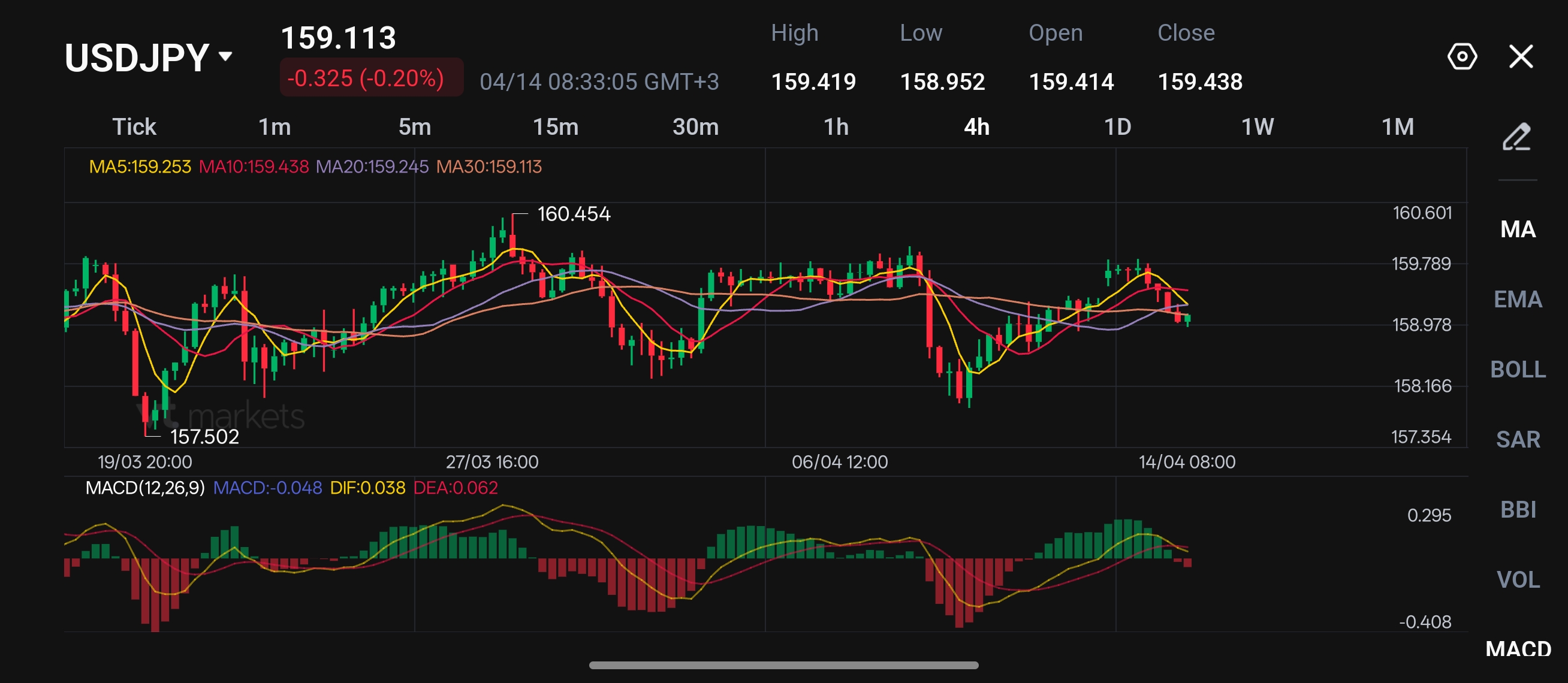
Key Levels To Watch:
- Support: 158.336
- Resistance: 159.805
What to Watch
Going forward, USD/JPY is likely to remain sensitive to incoming US data and shifts in geopolitical headlines. Traders should closely monitor upcoming inflation releases and any signals from the Federal Reserve, as a clearer policy direction could drive the next leg for the US Dollar.
At the same time, developments surrounding the Strait of Hormuz and energy prices will be key for Yen sentiment, particularly given Japan’s import dependency. Any signs of escalation could limit JPY strength, while easing tensions may allow the currency to recover.
In parallel, market participants will stay alert to potential intervention signals from Japanese authorities, especially if USD/JPY approaches recent highs again.
Market Takeaway
USD/JPY remains trapped in a tug-of-war between softening US Dollar sentiment and underlying weakness in the Japanese Yen. While fading safe-haven demand and a mixed Fed outlook are pressuring the pair lower, energy risks and Japan’s import exposure continue to limit JPY strength.
For now, this keeps price action broadly range-bound, with neither side holding a clear directional edge until a stronger macro catalyst emerges.
Learn more about trading Forex Pairs on VT Markets here.
Trader Questions
1) Why is USD/JPY falling today?
The USD/JPY pair is extending its pullback toward the 159.00 level due to a combination of cooling safe-haven demand for the US Dollar and mixed signals regarding Federal Reserve policy. While US-Iran diplomatic talks haven’t reached a breakthrough, recent optimistic comments from US Vice President JD Vance have eased immediate geopolitical fears, reducing the “safety bid” that previously propped up the Greenback.
2) How is US inflation impacting the US Dollar (USD)?
The US Dollar has hit its weakest level since early March. Recent data shows inflation accelerating at its fastest pace in nearly four years. This has created a mixed outlook:
- The Hawkish View: Sticky inflation may force the Fed to keep interest rates higher for longer.
- The Dovish View: Easing geopolitical tensions could eventually lower energy-driven inflation, leading some traders to still bet on potential rate cuts later this year.
3) What is the Strait of Hormuz factor for the Japanese Yen?
The Japanese Yen (JPY) is currently struggling due to Japan’s heavy reliance on Middle Eastern crude oil. With reports of a naval blockade in the Strait of Hormuz and threats from Iran against shipping routes, energy supply risks are surging. High energy prices typically hurt the Yen because they worsen Japan’s trade balance, making the currency less attractive to buyers despite the USD’s weakness.
4) Will the Bank of Japan (BoJ) or Japanese authorities intervene?
Speculation is mounting that Japanese authorities may step in to support the Yen if it weakens too aggressively. Fear of direct intervention (where the government buys JPY to move the market) is currently acting as a ceiling for USD/JPY, preventing the pair from rallying too far past the 159.85 resistance zone.
5) What are the key technical levels to watch for USD/JPY?
Resistance: The recent high near 159.85 remains the primary hurdle for bulls.
Support: Traders are closely watching the 159.00 psychological mark. A sustained break below this level could open the door for a deeper correction toward March lows.
6) How does the Trump administration’s stance affect the pair?
President Trump’s confirmation of naval activity in the Persian Gulf has escalated geopolitical tensions. While this usually strengthens the USD as a safe haven, the simultaneous diplomacy narrative from the administration is creating a tug-of-war in market sentiment, keeping the pair in a volatile, range-bound pattern.
7) Is USD/JPY a “Buy” or a “Sell” right now?
The market is currently characterized by mixed fundamentals. The pair is caught between a softening US Dollar and a Yen that is burdened by energy security risks. Most analysts view the current price action as range-bound, suggesting that traders are waiting for clearer signals from either the Federal Reserve or a resolution to the tensions in the Middle East.
Start trading now – Click here to create your real VT Markets account





