







Key Points
- Nikkei 225 rose 4.96% to 56,078.83 in the morning session, while the broader move in the chart shows 56,222.87, up 2,280.82 (+4.23%).
- A two-week ceasefire and a temporary reopening of the Strait of Hormuz triggered a relief rally across Asia and knocked back crude prices.
- Japan posted a current account surplus of 3.933 trillion yen in February, above the 3.549 trillion yen forecast, with exports up 2.8% and imports up 9.7%.
Japanese equities jumped as traders rushed back into risk after the ceasefire announcement cut the immediate threat to Gulf energy flows. The Nikkei 225 rose 4.96% to 56,078.83 in the morning session, and the broader chart reading at 56,222.87 shows the strength of the rebound.
The move followed a sharp drop in crude after the United States and Iran agreed to a two-week ceasefire tied to safe passage through the Strait of Hormuz.
Lower oil is a direct tailwind for Japan. The country imports most of its energy, so a fall in crude reduces pressure on margins, cools imported inflation, and eases the drag on household spending. That shift supported a broad rally rather than a narrow bounce.
A cautious near-term view still favours follow-through while crude stays off the highs, though the market will keep treating the ceasefire as temporary until shipping flows normalise more clearly.
Exporters, Banks, and Chip Stocks Lead the Charge
The rebound spread across nearly every major cyclical group. Exporters rose as the drop in oil improved the macro backdrop. Financials moved higher as lower energy stress reduced immediate stagflation fears. Chip names and index heavyweights led the sharpest gains as traders rotated back into growth after last week’s risk-off trade.
In the session snapshot, SoftBank Group rose more than 6%, Fast Retailing gained almost 5%, Toyota climbed almost 4%, and Honda added more than 2%.
In technology, Advantest jumped more than 10%, Screen Holdings surged almost 8%, and Tokyo Electron advanced almost 9%. Banks also joined the move, with Sumitomo Mitsui Financial and Mizuho Financial up more than 4%, while Mitsubishi UFJ Financial gained almost 3%.
The laggards made sense too. Energy names slipped because the crude rally broke lower. Inpex fell more than 5%, while shipping stocks such as Mitsui O.S.K. Lines, Kawasaki Kisen Kaisha, and Nippon Yusen moved lower as the oil risk premium started to unwind.
With the Nikkei’s performance increasingly tied to global tech flows, traders may consider tracking key AI and semiconductor stocks available across our CFD Shares offering.
Wall Street Gave the Rally a Solid Base
The overnight lead from the United States also helped. The Nasdaq rose 0.1% to 22,017.85, the S&P 500 edged up 0.1% to 6,616.85, and the Dow slipped 0.2% to 46,584.46. That was not a runaway rally, but it was enough to keep the tone constructive going into the Asian session.
The bigger catalyst still came from the ceasefire and the drop in oil, but the US close removed one more obstacle to aggressive dip-buying.
Across Asia, the move was broad. South Korea and Taiwan surged, while Hong Kong, China, Australia, and New Zealand all traded higher. That regional strength confirmed that traders were buying the same macro theme everywhere: lower oil, lower inflation pressure, and a temporary break in the war premium.
Nikkei 225 Technical Outlook
The Nikkei 225 is trading near 56,223, staging a sharp rebound after the recent pullback that followed the rejection from the 60,077 high.
Price action shows strong bullish momentum returning, with a wide bullish candle breaking out from the recent consolidation range and pushing back above key moving averages.
This move suggests buyers are stepping back in aggressively after the correction phase seen through March.
From a technical standpoint, the structure is shifting back toward bullish. Price has reclaimed the 5-day (54,076) and 10-day (53,259) moving averages, both of which are now turning higher and providing immediate support.
The 20-day (53,338) is also flattening and beginning to slope upward, indicating that downside pressure is fading and momentum is rebuilding. The recent push higher signals a potential trend continuation if price can sustain above current levels.
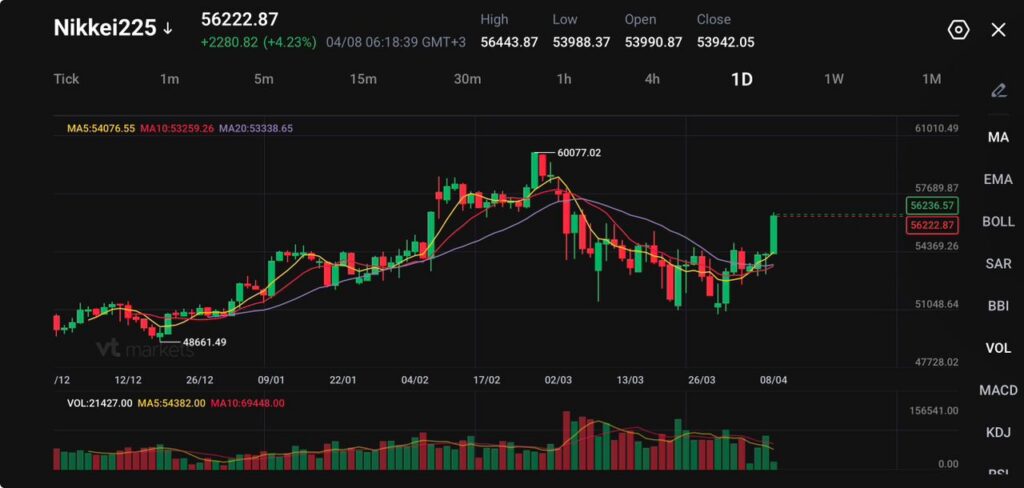
Key levels to watch:
- Support: 54,300 → 53,300 → 51,000
- Resistance: 56,300 → 57,700 → 60,000
The immediate focus is on the 56,300 zone, which price is currently testing as resistance. A sustained break above this level could open the path toward 57,700, with a broader move potentially retesting the 60,000 region if momentum continues to build.
On the downside, 54,300 now acts as first support, aligning with the recent breakout area. A break below this level could signal a loss of short-term momentum and lead to a pullback toward 53,300, though such a move would likely remain corrective within the improving structure.
Overall, the Nikkei is showing strong recovery momentum after its recent dip, with buyers regaining control in the short term. If price can hold above the 54,000–54,300 region, the bias shifts back toward upside continuation, with the market potentially building toward another test of prior highs.
What Traders Should Watch Next
The next move depends on whether the ceasefire turns into stable energy flows rather than another short pause. Lower crude has done most of the heavy lifting so far.
If Hormuz traffic stays open enough to keep oil under control, the Nikkei can keep rebuilding toward the upper 50,000s. If the truce frays and crude reverses higher, the same sectors driving today’s rally could give back ground quickly.
Learn more about trading Indices on VT Markets today.
Trader Questions
Why Did the Nikkei 225 Jump So Sharply?
The rally came after a two-week ceasefire and a temporary reopening of the Strait of Hormuz reduced immediate energy-supply fears. Lower oil prices improved the outlook for Japan, which imports most of its energy, and that helped trigger a broad risk-on move across the region.
Why Does Falling Oil Help Japanese Stocks So Much?
Lower crude prices reduce imported energy costs, ease inflation pressure, and improve the outlook for household spending and corporate margins. That tends to support the Nikkei more than many other major indices because Japan is highly exposed to external energy prices.
Why Did Exporters, Chip Stocks, and Banks Lead the Rally?
Exporters benefited from an improving macro backdrop, chip stocks tracked stronger risk appetite and growth expectations, and banks gained as the market moved away from the worst stagflation fears. The move was broad enough to lift most cyclical sectors together rather than just one narrow theme.
Why Did Energy Stocks Lag the Nikkei?
Energy names weakened because the same drop in oil that helped the broader index reduce earnings support for producers and oil-linked shares. That is why stocks such as Inpex moved the other way while the rest of the market rallied.
What Did the Current Account Data Add to the Story?
Japan posted a 3.933 trillion yen current account surplus in February, above the 3.549 trillion yen forecast. Exports rose 2.8%, imports rose 9.7%, and the trade balance showed a 267.6 billion yen surplus. That data added to the sense that Japan’s external position was holding up better than feared.
Start trading now – Click here to create your real VT Markets account





