







Key Points
- UKOUSD traded at 107.86, up 0.278, or 0.26%, after reaching a session high of 108.368.
- US crude, WTI, climbed about 1% to $99.06 a barrel, while Brent rose 86 cents, or around 0.8%, to $105.07.
- Traders are watching Middle East tensions, US-China talks, API inventory data on Tuesday, and EIA figures on Wednesday.
Oil prices rose on Tuesday as traders rebuilt part of the geopolitical risk premium. Renewed tension in the Middle East kept supply fears alive, while uncertainty around US-China trade and the demand outlook capped the upside.
US crude, WTI, climbed about 1% to $99.06 a barrel. Brent rose 86 cents, or around 0.8%, to $105.07. Brent held near $105.07 and WTI held near $99.06, with fragile US-Iran talks sustaining supply worries around the Strait of Hormuz.
President Donald Trump described the situation as highly volatile and warned that the ceasefire remained fragile. That tone kept traders focused on the risk that the conflict could intensify rather than move toward de-escalation.
The market has already pulled back from earlier highs, when fears over global growth briefly outweighed supply-side risk. Tuesday’s move shows that oil traders are still quick to buy crude when Middle East headlines threaten shipping, exports, or regional output.
Strait Of Hormuz Keeps Supply Risk Alive
The Strait of Hormuz remains the main pressure point for crude. Any threat to flows through the route can quickly lift prices, as the channel handles a large share of global oil and gas trade. Iran’s position on sovereignty over the Strait of Hormuz continues to raise supply risk, with the route carrying around a fifth of global oil and gas.
Escalating rhetoric between Washington and Tehran added fresh pressure. Iran struck a defiant tone, while US warnings about the fragile ceasefire kept the market on alert for another round of disruption.
That backdrop supports Brent and WTI by raising the risk premium. Traders are not only pricing lost barrels. They are also pricing higher shipping costs, delays, insurance premiums, and the risk that Gulf output remains constrained for longer.
US-China Talks Cap The Rally
The oil rally did not run unchecked. Traders are also watching upcoming high-level discussions between Donald Trump and President Xi Jinping in Beijing. Those talks are expected to cover trade, energy security, geopolitical tensions, and other strategic issues.
For oil, the demand signal matters. A smoother US-China tone could support global growth expectations and help crude extend gains. A tougher trade stance could revive fears of weaker consumption across major economies.
That leaves oil caught between two forces. Middle East risk supports the supply side. US-China uncertainty limits demand confidence. Until one side of that trade becomes clearer, crude may stay volatile rather than trend cleanly in one direction.
Inventory Data Moves Into Focus
US inventory data now becomes the next near-term test. The American Petroleum Institute’s weekly report is due later on Tuesday, followed by Energy Information Administration figures on Wednesday.
Traders want to know whether US crude stockpiles continue to decline. A drawdown would point to firm demand and could support another leg higher. A surprise build would strengthen the demand-risk argument and may cap the rebound.
Analysts expected US crude inventories to fall as traders watched the next data release. That keeps inventory trends central for WTI, especially while headline risk still dominates Brent.
OPEC+ Supply Restraint Still Supports Prices
The broader supply backdrop remains tight. OPEC and its allies, led by Russia, have maintained production restraint since last year to stabilise the market.
Seven OPEC+ countries agreed to raise output targets by 188,000 barrels per day in June, marking a third monthly increase since the Hormuz closure. Even so, the increase may offer limited relief if regional disruptions keep exports constrained.
That supply discipline gives crude a floor during demand scares. It does not remove volatility, but it reduces the risk of a deeper sell-off unless demand weakens sharply or geopolitical tensions cool.
Technical Analysis
UKOUSD is consolidating around the 107.80 region after failing to sustain its breakout above 120.31, with the market now attempting to stabilise following a sharp corrective pullback. Despite recent weakness, the broader trend still remains structurally bullish while price holds above the medium-term support zone near 106.50–106.70.
The rally from late February into early May was extremely aggressive, driven by tightening supply expectations and geopolitical risk premiums across the energy market. However, the rejection from the 120 handle triggered a wave of profit-taking, pushing price back toward its key moving averages.
Technically, the market is entering an important transition phase:
- MA5: 106.68
- MA10: 111.58
- MA20: 106.67
Price is now hovering directly around the 5-day and 20-day moving averages, while the 10-day average remains elevated after the sharp prior rally. That compression often signals the market is deciding whether to continue consolidating or begin rebuilding bullish momentum.
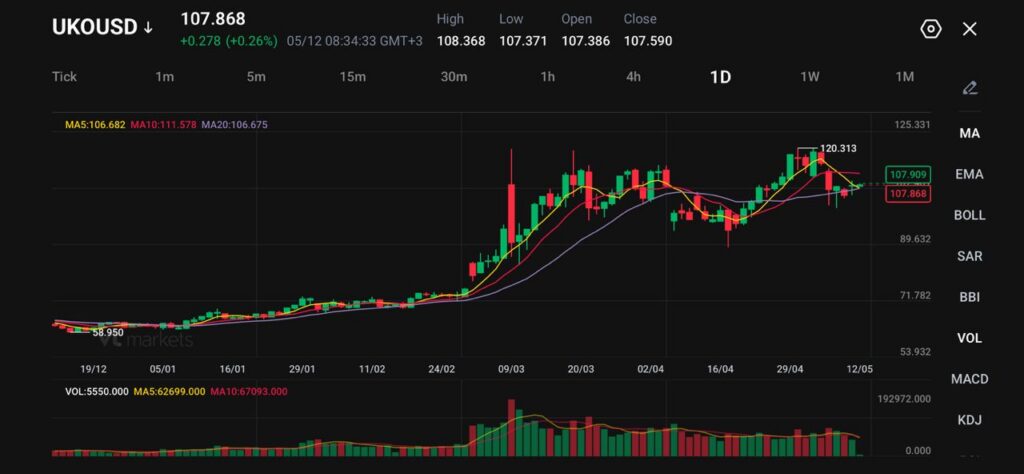
Key levels to watch:
- Immediate support: 106.50 → 102.00
- Major support: 95.00
- Resistance: 110.00 → 120.31
The 106.50 region is especially important because it aligns closely with the rising 20-day average and recent consolidation lows. If buyers continue defending this area, crude may attempt another move back toward 110.00 and eventually retest the broader resistance zone near 120.31.
However, if price breaks decisively below 106, the correction could deepen toward the 102–100 area, where previous breakout support sits.
Momentum has clearly cooled compared with the explosive March rally, but the broader structure still favours medium-term upside while higher lows continue forming above the April base. Volume has also moderated during the pullback phase, which suggests the current move resembles consolidation rather than panic liquidation.
Fundamentally, oil remains sensitive to geopolitical developments, OPEC+ supply policy, and shifting expectations around global growth demand. Traders are also watching Chinese demand indicators closely, as any improvement in industrial activity could quickly reinforce bullish energy sentiment again.
For now, UKOUSD maintains a cautiously bullish medium-term bias, though the market likely needs a sustained move back above 110 to restore stronger upside momentum.
Cautious Forecast
UKOUSD keeps a mildly bullish short-term bias while it holds above 106.682 and 106.675. A move above 108.368 would support a test of 111.578, especially if API and EIA data show another drawdown.
A break below 106.675 would weaken the rebound and shift attention back toward lower support. The strongest upside path needs three signals to align: Middle East risk remains elevated, US inventory data tightens, and US-China talks avoid a demand-negative surprise.
Learn more about trading Energies on VT Markets here.
Trader Questions
Why Are Oil Prices Rising Today?
Oil prices are rising as renewed Middle East tensions rebuild the geopolitical risk premium. Traders are watching the Strait of Hormuz, Iran-related headlines, and the risk of supply disruption across key shipping routes.
US crude, WTI, climbed about 1% to $99.06 a barrel, while Brent rose 86 cents, or around 0.8%, to $105.07.
What Is The Current UKOUSD Price?
UKOUSD traded at 107.86, up 0.278, or 0.26%.
The session high was 108.368, with a low of 107.371, an open at 107.386, and a close at 107.590.
Why Is The Strait Of Hormuz Important For Oil?
The Strait of Hormuz is one of the world’s most important oil transit routes. Any disruption can raise shipping costs, delay exports, tighten supply, and lift Brent and WTI prices.
Traders remain sensitive to any sign that tensions in the Middle East could restrict flows through the strait.
How Are Middle East Tensions Affecting Oil Prices?
Middle East tensions are supporting oil prices by raising fears of supply disruption. Renewed rhetoric between Washington and Tehran has added pressure, while President Donald Trump warned that the ceasefire remained fragile.
Iran also signalled readiness to respond to further pressure, keeping regional instability in focus.
Why Are Oil Gains Being Capped?
Oil gains are being capped by uncertainty over US-China trade and the wider demand outlook. Traders are watching upcoming high-level talks between Donald Trump and President Xi Jinping in Beijing.
A smoother diplomatic tone could support demand expectations. A tougher trade stance could renew concern over weaker consumption in major economies.
Start trading now – Click here to create your real VT Markets account





