






Key Takeaways:
- USD/JPY shows how many Japanese yen one US dollar can buy, and it is one of the most traded forex pairs in the world.
- The pair is shaped mainly by the US-Japan interest rate gap, Federal Reserve and Bank of Japan policy, US Treasury yields, and global risk sentiment.
- The yen has long been treated as a safe-haven currency, which means the pair often moves sharply when markets turn nervous.
- As of mid to late June 2026, USD/JPY trades around 161.2, near multi-year highs (the weakest yen against the dollar since 2024), after the Bank of Japan raised its policy rate to 1.00% on 16 June and the Federal Reserve held its target range at 3.50–3.75% on 17 June.
Few currency pairs capture the mood of global markets quite like USD/JPY. When traders feel calm and confident, money tends to flow into higher-yielding assets. When fear takes over, it often rushes back into the Japanese yen. That is why USD/JPY has earned a reputation as both a carry-trade favourite and a safe-haven barometer.
In this guide, we analyse what the dollar-yen safe-haven dynamic really means for forex traders. You will learn what moves the pair, when to trade it, how much it costs, and how to manage risk sensibly. By the end, you should understand exactly what is USDJPY trading about, and how to approach it with a clear plan.
What is USD/JPY?
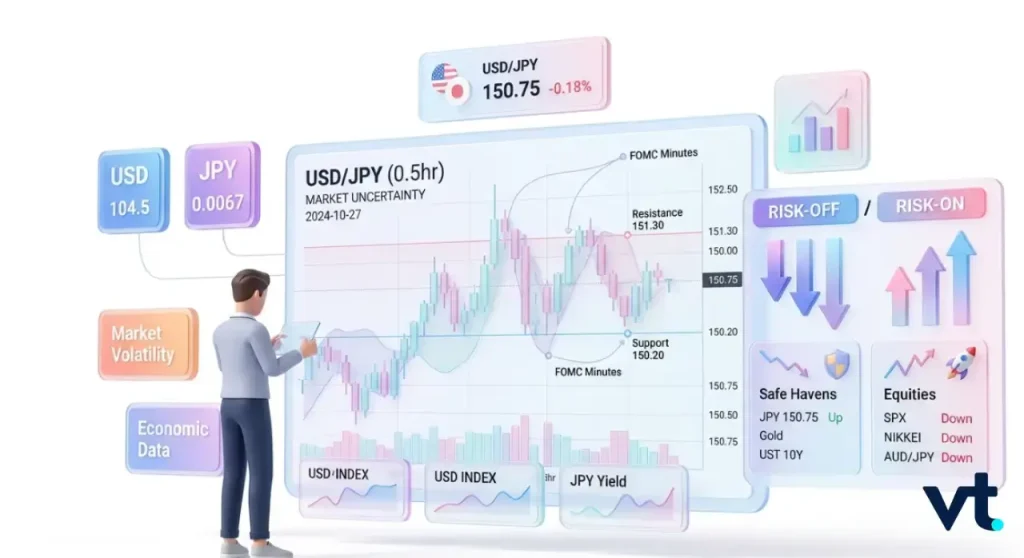
USD/JPY is the shorthand for the US dollar against the Japanese yen. This pair sits among the “majors” ie. the small group of pairs that account for most global forex volume.
What does the USD/JPY Currency Pair Represent?
The dollar-yen pair represents the value of one US dollar measured in Japanese yen. In simple terms, the quote tells you how many yen you need to buy a single dollar.
If the price rises, the dollar is getting stronger against the yen. If it falls, the dollar is weakening and the yen is gaining ground. So a rising chart usually answers the question of whether the yen is strong or weak with a single word: weaker.
Here is the same idea broken down clearly:
- Price goes up: The dollar buys more yen, so the dollar is stronger.
- Price goes down: The dollar buys fewer yen, so the yen is stronger.
- Each trade: You are always buying one currency and selling the other at the same time.
How do you Read a Quote?
A dollar-yen quote is usually shown with two prices: the bid and the ask. The bid is what you receive if you sell, and the ask is what you pay if you buy. The gap between them is the spread.
Suppose the platform shows the pair at 160.85 / 160.88. Reading that quote works like this:
- 160.85 (bid): The price at which you can sell dollars for yen.
- 160.88 (ask): The price at which you can buy dollars for yen.
- 0.03 spread: The 3-pip difference is part of your trading cost.
Why is the Pair Called “The Gopher”?
Traders sometimes call USD/JPY “the gopher.” The nickname is a play on words. GBP/USD is known as “cable,” and “guppy” became the slang for GBP/JPY. From there, “gopher” stuck as an informal name for the dollar-yen pair on trading desks. You do not need a nickname to trade well. Nevertheless, you will hear it in market commentary, so it is handy to recognise.
What is the Base Currency and Quote Currency?
Every forex pair has a base currency and a quote currency. In USD/JPY, the structure is straightforward:
- Base currency – USD: The first currency, always equal to one unit (one dollar).
- Quote currency – JPY: The second currency, showing how many yen equal that one dollar.
- What the number means: A quote of 160.85 means one dollar buys 160.85 yen.
What Drives the USD/JPY Exchange Rate?
The USD/JPY exchange rate is driven by a handful of powerful forces. Most of them trace back to one theme: the difference between US and Japanese monetary policy. Understanding these drivers helps you read the USD/JPY trend instead of guessing at it.
How do US-Japan Interest Rate Differentials Affect USD/JPY?
The single biggest driver of USD/JPY is the interest rate gap between the United States and Japan. When US rates are much higher than Japanese rates, holding dollars pays more than holding yen, so capital tends to flow into the dollar.
As of June 2026, that gap is still wide, and it keeps a firm floor under the pair:
| Central bank | Policy rate (June 2026) | What does it mean for the pair |
| US Federal Reserve | 3.50% – 3.75% | Higher US yields support the dollar |
| Bank of Japan | 1.00% | Highest since 1995, but still well below the US |
| Rate differential | ~2.75% in the dollar’s favour | Wide gap keeps upward pressure on the pair |
Source: The US Federal Reserve; Japan Research Institute
With the dollar paying roughly 2.75% more than the yen, the pair has stayed firm near multi-year highs around 160.8, even after the Bank of Japan began tightening policy.
How does the Federal Reserve Influence the Pair?
The Federal Reserve sets US interest rates, and its decisions ripple straight through the pair. Broadly speaking:
- Rate hikes or hawkish signals: Tend to lift the dollar and push the pair higher.
- Rate cuts or dovish signals: Tend to weaken the dollar and pull the pair lower.
- Forward guidance: The Fed’s words about future policy often move the pair as much as the actual decision.
How does the Bank of Japan Influence the Pair?
The Bank of Japan (BoJ) is the other half of the story. For years it kept rates near zero, which made the yen a cheap funding currency. That has been changing.
In June 2026, the BoJ raised its policy rate by 25 basis points to 1.00% (its highest level since September 1995), continuing a gradual normalisation path that began with the exit from negative rates in March 2024.
Key BoJ levers that move the pair include:
- Rate decisions: Each hike narrows the US-Japan gap and can support the yen.
- Bond purchase plans: Tapering bond buying signals tighter policy ahead.
- Intervention threats: Japanese officials sometimes warn against “excessive” yen weakness, which can spark sharp reversals.
How do US Treasury Yields Move the Pair?
US Treasury yields, especially the 10-year, are tightly linked to the pair. When yields rise, the dollar usually becomes more attractive, and the pair tends to climb. When yields fall, the pair often softens.
A simple way to remember it:
Yields up, dollar tends up; yields down, dollar tends down. Many traders keep a 10-year yield chart open right next to their dollar-yen chart.
How does Risk Sentiment Affect the Pair?
This is where the safe-haven angle comes in. The Japanese yen is treated as a refuge in times of stress, so the pair often behaves like a mood ring for global markets:
- Risk-on (calm, confident markets): Money flows out of the yen into higher-yielding assets, often lifting the pair.
- Risk-off (fear, crisis, sell-offs): Money rushes into the yen for safety, often dragging the pair down quickly.
Pro-tip: When a sudden crisis hits the headlines, watch the pair closely. Safe-haven flows into the yen can move the pair faster than almost any economic report.
When is the Best Time to Trade USD/JPY?
Timing matters in forex. The pair trades 24 hours a day during the week, but liquidity and volatility are not spread evenly. Knowing the busy windows helps you find tighter spreads and cleaner moves.
What are the Most Active Trading Sessions for USD/JPY?
The pair is most active when the markets that care most about it are open. The two standouts are the Tokyo session and the New York session.
| Session | Approx. hours (GMT) | Activity for the pair |
| Tokyo (Asian) | 00:00 – 09:00 | High – home market for the yen |
| London (European) | 08:00 – 17:00 | Moderate to high – large overall volume |
| New York (US) | 13:00 – 22:00 | High – home market for the dollar |
| Tokyo close / NY open overlap | 13:00 – 17:00 | Very high – peak liquidity |
How does the Tokyo Session Affect the Pair?
The Tokyo session is the home turf of the yen. Japanese banks, exporters, and institutions are active, and major BoJ news and Japanese data tend to land during these hours. As a result, the pair often sees its first big moves of the day in Asian trading.
This session can be ideal if you prefer trading the pair when yen-specific news is fresh and liquidity in JPY is at its deepest.
Which Economic Releases Move the Pair the Most?
Certain data points reliably create volatility. Mark these in your economic calendar:
- US Non-Farm Payrolls (NFP): Monthly jobs data that can swing the dollar hard.
- US CPI inflation: Shapes Federal Reserve rate expectations.
- Federal Reserve and BoJ decisions: The headline events for the pair.
- Japanese CPI and GDP: Guide expectations for BoJ policy.
- US 10-year Treasury auctions: Influence yields and, in turn, the dollar.
How does Session Overlap Affect Volatility and Spreads?
The most powerful window for the pair is usually the London-New York overlap, when both major financial centres are open. During this period:
- Volatility rises: More participants mean bigger, faster moves.
- Spreads tighten: Deeper liquidity usually lowers your trading cost.
- News reacts quickly: US data released early in the New York session can trigger sharp swings.
How Do You Trade USD/JPY?
There are several ways to gain exposure to USD/JPY, but most retail traders use contracts for difference (CFDs). CFDs let you speculate on price moves in both directions without owning the underlying currencies.
How do you Trade the Pair as a CFD?
Trading the pair as a CFD is straightforward. You agree to exchange the difference in price between the time you open and close a position. Here is the basic flow with VT Markets:
- Open an account and fund it through your preferred method.
- Choose your platform, such as MetaTrader 4 or MetaTrader 5.
- Decide your direction. Buy (go long) if you expect the pair to rise, or sell (go short) if you expect it to fall.
- Set your size and risk controls, including stop-loss and take-profit levels.
- Monitor and close the trade when your target or stop is reached.
What Strategies Work for the Pair?
No single strategy is best, but some approaches suit the pair’s behaviour well:
- Trend following: The pair often moves in extended directional runs, so riding the USD/JPY trend can be effective.
- Breakout trading: Trading clean breaks of key levels during high-liquidity sessions.
- News trading: Positioning around Fed, BoJ, and US jobs data, with caution for volatility.
- Range trading: Fading the edges of a range during quieter periods.
How do you Read Price Action and Key Levels?
Reading the pair’s price action means watching how the pair behaves around important price zones. Useful tools include:
- Support and resistance: Prices where the pair has previously turned.
- Round numbers: Levels like 160.00 often attract attention and orders.
- Moving averages: The 50-day and 200-day lines help you gauge the broader USD/JPY trend.
- Candlestick patterns: Signals such as pin bars and engulfing candles at key levels.
How do you Manage Risk when Trading the Pair?
Risk management is what keeps you in the market. A disciplined framework looks like this:
- Risk a small percentage per trade, commonly 1-2% of your account.
- Always use a stop-loss to cap the downside to every position.
- Aim for a positive risk-reward ratio, such as 1:2 or better.
- Size positions correctly, so a single loss never threatens your account.
- Avoid over-leveraging, even when the platform allows high leverage.
How does the Carry Trade Work with USD/JPY?
The carry trade is one reason the pair is so closely watched. The idea is simple: borrow in a low-yielding currency (the yen) and invest in a higher-yielding one (the dollar), pocketing the interest rate difference.
A simplified example, using the June 2026 rate gap of about 2.75%:
- You hold a long position in the pair, effectively earning the higher US rate while paying the lower Japanese rate.
- On the rate gap alone, that is roughly a 2.75% annual yield advantage, paid out as daily swap credits.
- The catch: If the yen suddenly strengthens, capital losses on the position can wipe out the interest gains very quickly.
Pro-tip: The carry trade can unwind violently during risk-off events. Never treat swap income as “free money” without a stop-loss in place.
What Costs are Involved in Trading USD/JPY?
Costs eat into profits, so it pays to understand them before you trade USD/JPY. The three main costs are the spread, swap (overnight) fees, and the impact of leverage on your margin.
What is the Typical Spread on USD/JPY?
Since the pair is highly liquid, spreads are generally tight. On a typical account, you might see spreads from around 0.1 to 1.5 pips during active sessions, widening a little in quiet hours or around major news.
Tighter spreads usually mean lower costs, which is why many traders prefer to trade the pair during the London-New York overlap.
How are Pips Calculated for the Pair?
For most pairs, a pip is the fourth decimal place. For the pair, it is the second decimal place, because the yen is quoted differently. Here is a worked example:
- Pip size: 0.01 (the second decimal place).
- Standard lot: 100,000 units.
- Pip value: Roughly $6.20 per pip on a standard lot at a rate near 160.80.
- Example move: A 50-pip gain on one standard lot is about 50 × $6.20 = $310.
Pip value changes slightly as the exchange rate moves, but this gives you a solid working estimate.
What are Swap or Overnight Financing Costs?
If you hold a position overnight, a swap fee or credit is applied, based on the interest rate difference between the two currencies. With US rates above Japanese rates:
- Long USD/JPY: You typically receive a small swap credit, since you hold the higher-yielding dollar.
- Short USD/JPY: You typically pay a swap charge, since you hold the lower-yielding yen.
- Swap-free options: Some accounts remove overnight interest for traders who require it.
How does Leverage Affect your Positions?
Leverage lets you control a large position with a smaller deposit. It magnifies both gains and losses, so it must be handled carefully. A quick comparison:
| Leverage | Margin for 1 standard lot (~$16,080 notional) | Effect |
| 1:30 | ~$536 | Lower risk, smaller swings |
| 1:100 | ~$161 | Moderate risk |
| 1:500 | ~$32 | High risk, large swings |
Pro-tip: High leverage is not the same as a high position size. Use only as much leverage as your risk plan can comfortably absorb.
Is USD/JPY a Good Pair to Trade?
So, is USD/JPY worth trading? For many people, yes, but the right answer depends on your goals, experience, and risk tolerance.
Why is USD/JPY Popular with Traders?
The pair attracts a huge following for several practical reasons:
- High liquidity: One of the most traded pairs, so orders fill smoothly.
- Tight spreads: Deep liquidity keeps costs low.
- Clear drivers: Fed and BoJ policy give the pair a logical story to follow.
- Safe-haven character: The yen’s role makes the pair a useful read on market mood.
How Volatile is the Pair?
The pair offers moderate but meaningful volatility. Over the past year, USD/JPY has traded in a 52-week range of roughly 142.7 to 161.8, a swing of about 19 yen. The yen has weakened by around 10–11% against the dollar over that period, so to the question ‘is the yen strong or weak,’ the recent answer has clearly been weaker.
Is the Pair Suitable for Beginners?
The pair can be a sensible starting point for newer traders, provided they respect risk. Reasons it suits beginners include:
- Predictable cost: Tight spreads make trade costs easy to estimate.
- Plenty of analysis: Commentary and data are widely available.
- Logical drivers: The rate-gap story is easier to grasp than some exotic pairs.
Pro-tip: Beginners can practise on a demo account first, then trade smaller sizes while building a feel for the USD/JPY trend.
How does it Compare with Other Major Pairs?
Here is how the pair stacks up against two other popular majors:
| Pair | Typical character | Best known for |
| USD/JPY | Liquid, trend-friendly, safe-haven sensitive | Carry trade and risk sentiment |
| EUR/USD | Very liquid, often range-bound | Tightest spreads, steady volume |
| GBP/USD | More volatile, news-sensitive | Bigger swings, “cable” moves |
Frequently Asked Questions (FAQs)
Q1: What moves the USD/JPY exchange rate?
The biggest driver is the interest rate gap between the US Federal Reserve and the Bank of Japan, followed by US Treasury yields and global risk sentiment. When US rates sit well above Japanese rates, the dollar tends to strengthen against the yen. During market stress, safe-haven flows into the yen can push the pair sharply lower.
Q2: When is the best time to trade USD/JPY?
The most active window is usually the London-New York overlap, roughly 13:00 to 17:00 GMT, when liquidity is deepest and spreads are tightest. The Tokyo session is also important, since Japanese data and Bank of Japan news land during those hours.
Q3: What is the typical spread on USD/JPY?
Since the pair is highly liquid, spreads are generally tight, often from around 0.1 to 1.5 pips during active sessions. Spreads can widen a little in quiet hours or around major economic releases.
Q4: How does the carry trade work with USD/JPY?
In a carry trade, you borrow in the low-yielding yen and hold the higher-yielding dollar, earning the interest rate difference as a daily swap credit. With the June 2026 rate gap near 2.75%, a long position carries a yield advantage, but a sudden rise in the yen can quickly erase those gains.
Q5: Is USD/JPY good for beginners?
It can be. The pair has tight spreads, plenty of available analysis, and logical drivers, which make it easier to follow than some exotic pairs. Beginners should still practise on a demo account, trade small, and always use a stop-loss.
Start trading USD/JPY with VT Markets
The USD/JPY safe-haven story is one of the most useful concepts in forex. It connects interest rates, central bank policy, and market mood into a single, tradeable pair. Whether you are drawn to the carry trade, the clean trends, or the way the yen reacts to global stress, this pair rewards traders who understand what is moving it.
With the right broker, you can put that knowledge to work. Trade the pair as a CFD on MetaTrader 4 and MetaTrader 5, with competitive spreads, flexible leverage, and fast execution. Practise on a demo account, build your plan, and step into the live USD/JPY trend with confidence.
Open your live account with VT Markets today and start trading the pair the smart way.





