


Key Takeaways:
- The PMI, or Purchasing Managers’ Index, is a monthly survey-based gauge of business activity in the manufacturing and services sectors.
- A reading above 50 signals expansion, below 50 signals contraction, and exactly 50 means no change.
- Forex traders watch the PMI because it is a leading indicator that often moves currencies before slower data like GDP confirms the trend.
- At VT Markets, you can trade the currency reactions to PMI releases on MetaTrader 4 and MetaTrader 5 with fast execution and tight spreads.
Every month, a single number can send the euro, the pound or the dollar swinging within seconds of its release. That number is the PMI. If you have ever wondered what is the PMI and why seasoned traders circle its release date on their economic calendar, you are asking exactly the right question.
The Purchasing Managers’ Index is one of the earliest signals of where an economy is heading. It arrives before official growth figures, which makes it a favourite among forex traders who need to act early. In this guide, we analyse what the PMI is , how it is calculated, how to read the number, and how you can turn that knowledge into smarter trading decisions on a Meta 4 and Meta 5 platform like VT Markets.
What is the PMI?
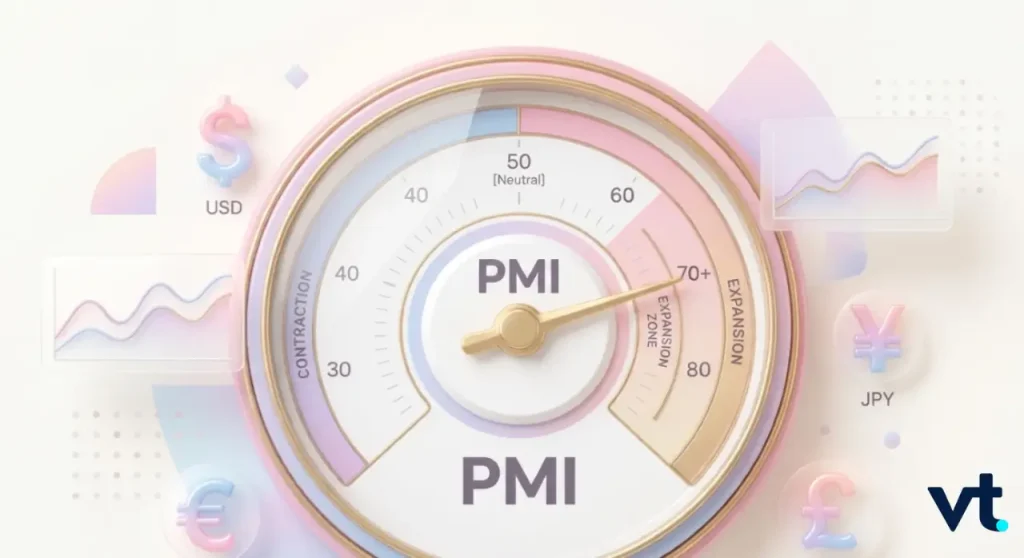
Understanding the PMI starts with a simple idea: ask the people who buy raw materials and supplies for businesses how busy they are. Their answers, gathered each month, form a powerful snapshot of economic health.
What is the Purchasing Managers’ Index in simple terms?
It is a diffusion index built from surveys sent to purchasing managers, the professionals responsible for ordering goods and services that keep companies running.
In plain terms, the what is the meaning of PMI question has a tidy answer: it is a confidence score for the economy. Each month, purchasing managers are asked whether activity is better, worse or the same as the previous month. Those responses are converted into a single number between 0 and 100.
Since purchasing managers order materials before production happens, they often spot changes in demand before anyone else. That early view is exactly what makes the index so valuable.
Who calculates the PMI?
Two organisations dominate PMI reporting:
- The Institute for Supply Management (ISM) produces the closely watched US Manufacturing and Services PMI reports.
- S&P Global compiles PMI data for dozens of economies, including the Eurozone, the UK, Japan and China.
Both gather responses directly from purchasing and supply executives, then publish the results on a fixed monthly schedule.
What does the PMI measure?
The PMI measures the direction and pace of change in business activity. It does not measure the size of the economy in pounds or dollars. Instead, it tracks momentum, whether conditions are improving or deteriorating, across several key areas:
- New orders coming into businesses
- Levels of production and output
- Employment and hiring intentions
- Supplier delivery times
- Inventories and stocks of purchases
How is the PMI Calculated?
Now that you know what is the PMI, the next step is understanding how that single headline number is built. The process is more structured than many traders realise.
What data goes into the PMI?
The PMI is built from survey responses, not hard economic figures. Purchasing managers answer simple questions for each component, choosing one of three options: better, the same, or worse than last month. Each response is treated as a vote on the direction of the economy.
What are the five components of the Manufacturing PMI?
The Manufacturing PMI is a weighted average of five sub-indices. Each one carries a fixed weight in the final calculation:
| Component | Weight | What it tells you |
| New Orders | 30% | Demand for products from customers |
| Output (Production) | 25% | How much businesses are producing |
| Employment | 20% | Hiring or firing across the sector |
| Suppliers’ Delivery Times | 15% | Speed of supply chains (inverted) |
| Stocks of Purchases | 10% | Inventory businesses are holding |
Source: Official S&P Global PMI press releases (pmi.spglobal.com); Trading Economics (tradingeconomics.com/united-states/manufacturing-pmi).
Note: One oddity is worth noting. The Suppliers’ Delivery Times index is inverted before it is added in. Slower deliveries usually indicate high demand, so a slowdown actually pushes the headline figure up.
How is the PMI score weighted?
Each component is first converted into a diffusion index using a standard formula:
Diffusion index = (% reporting better) + (0.5 × % reporting the same)
Let us run a quick example for the New Orders component. Let’s say the survey returns these responses:
- 60% of managers say new orders improved
- 30% say they stayed the same
- 10% say they declined
The diffusion index would be: 60 + (0.5 × 30) = 60 + 15 = 75. A reading of 75 for new orders signals very strong demand.
The five component indices are then multiplied by their weights and summed to produce the headline PMI:
| Component | Index | Weight | Contribution |
| New Orders | 56.8 | 30% | 17.04 |
| Output | 54.3 | 25% | 13.58 |
| Employment | 48.0 | 20% | 9.60 |
| Supplier Deliveries | 52.0 | 15% | 7.80 |
| Stocks of Purchases | 50.0 | 10% | 5.00 |
| Headline PMI | ≈ 53.0 |
Note: This worked example uses figures close to the actual US May 2026 ISM Manufacturing PMI that registered 54.0, its highest level since May 2022 [with sub-indices including New Orders (56.8), Production (54.3), Prices (82.1), Backlog of Orders (52.2), and Employment (48.6)]
What is the PMI survey methodology?
The methodology is consistent and disciplined, which is why markets trust it:
- Surveys go to a fixed panel of purchasing managers across many industries.
- Responses are collected in the second half of the month.
- The sample is weighted to reflect each industry’s share of the economy.
- Seasonal adjustments smooth out predictable monthly patterns.
How Do You Read a PMI Number?
Reading the PMI is refreshingly simple once you know the rules. The figure of 50 is the line that separates growth from decline, and everything revolves around it. Knowing what is a good PMI index for a given economy helps you judge whether a release is bullish or bearish for its currency.
What does a PMI above 50 mean?
A PMI above 50 means the sector is expanding compared with the previous month. The further above 50, the faster the expansion. For example, the US Manufacturing PMI of 54.0 in May 2026 told markets that factory activity was not just growing, but accelerating.
What does a PMI below 50 mean?
A PMI below 50 means the sector is contracting. Activity is shrinking relative to the prior month. A reading of 45, for instance, points to a meaningful slowdown that often pressures the local currency lower.
What does a PMI of exactly 50 mean?
A reading of exactly 50 means no change from the previous month. The sector is flat, neither growing nor shrinking. Traders often call 50 the boom-bust line because crossing it in either direction can shift sentiment quickly.
Is a high PMI good or bad?
A high PMI is generally good news for an economy and its currency. Nevertheless, context matters. So what is a good PMI index? Here is a quick guide:
| PMI Range | Signal | Typical currency reaction |
| 55 and above | Strong expansion | Bullish for currency |
| 50 to 55 | Healthy growth | Mildly supportive |
| 48 to 50 | Mild contraction | Slightly bearish |
| Below 48 | Clear contraction | Bearish for currency |
A very high PMI can occasionally be a double-edged sword. If it stokes fears of inflation and interest rate hikes, the reaction can become more complex.
What are the Different Types of PMI?
The PMI is not a single report. Several versions exist, each covering a different slice of the economy. Knowing which is which keeps you from misreading a release.
What is the Manufacturing PMI?
The Manufacturing PMI tracks factories and goods producers. It is the oldest and most widely followed version. Since manufacturing is sensitive to global demand, this report is a favourite among forex and commodity traders.
What is the Services PMI?
The Services PMI covers the much larger services sector, including finance, retail, hospitality and healthcare. In advanced economies like the UK and US, services make up the bulk of output, so this report can move markets just as forcefully.
What is the Composite PMI?
The Composite PMI blends manufacturing and services into a single number. It offers the broadest view of private-sector activity. Many analysts treat it as the best real-time snapshot of overall economic momentum.
What is the difference between ISM PMI and S&P Global PMI?
Both measure the same idea but differ in coverage and panel:
| Feature | ISM PMI | S&P Global PMI |
| Coverage | United States only | 40-plus economies worldwide |
| Survey panel | ISM member companies | Broad mix of firm sizes |
| Release timing | First business day | Flash mid-month, final later |
| Best for | US-focused traders | Global and cross-market traders |
Sources: Institute for Supply Management (ISM), ISM PMI Reports, and S&P Global, S&P Global PMI and ISM Survey Comparisons and Purchasing Managers’ Index (PMI). Release timings and economy coverage are accurate as of publication and may be subject to change.
Note: Since the two use different panels, their numbers for the same month can diverge. Smart traders watch both.
Why is the PMI Important for Traders and Investors?
Knowing PMI is only useful if you understand why it moves markets. For forex traders especially, the PMI is one of the most tradeable economic releases of the month.
Why do markets react to PMI data?
Markets react because the PMI arrives early and surprises often. It is one of the first major data points each month, and a reading that misses expectations can force traders to reprice their view of the economy in an instant. The reaction is driven by the gap between the actual figure and the forecast, not the number alone.
How does the PMI affect forex?
The PMI affects forex through its link to interest rate expectations. The logic runs like this:
- A strong PMI suggests a growing economy.
- Growth raises the chance of higher interest rates.
- Higher rates attract foreign capital seeking better returns.
- That demand pushes the currency higher.
A weak PMI sets the same chain in reverse.
For instance, a surprise drop in the Eurozone Manufacturing PMI, which fell to 51.6 in May 2026 from April’s near-four-year high of 52.2, can quickly weigh on EUR/USD as traders shift their rate expectations.
How does the PMI affect stock markets?
Equity markets read the PMI as a guide to future corporate earnings. A rising PMI hints at stronger sales and profits, which tends to support share prices. A falling PMI can trigger caution, particularly in cyclical sectors like industrials and materials that are tied closely to the economic cycle.
Is the PMI a leading or lagging indicator?
The PMI is a leading indicator. It tends to signal turning points in the economy before they show up in slower data such as GDP or employment reports. This forward-looking quality is precisely why traders value it so highly.
When is the PMI Released?
Timing is everything in trading. Knowing exactly when the PMI lands lets you prepare your strategy and manage risk around the release.
How often is the PMI published?
The PMI is published monthly. Most countries release a flash estimate around the third week of the month, followed by a final reading at the start of the next month. The flash version often moves markets most because it is the first look at fresh data.
What time is the PMI released?
Release times vary by region but are fixed and predictable. A few key examples:
- US ISM Manufacturing PMI: 10:00 ET on the first business day of the month.
- Eurozone S&P Global PMI: Typically 09:00 CET.
- UK S&P Global PMI: Typically 09:30 BST.
Which PMI reports matter most?
For currency traders, these releases carry the most weight:
- US ISM Manufacturing and Services PMI: This report moves the US dollar.
- Eurozone Composite PMI: This report is a key driver for the euro.
- China Manufacturing PMI: This report influences risk sentiment and commodity currencies such as the Australian dollar.
PMI vs Other Economic Indicators
The PMI does not work in isolation. Comparing it with other data sharpens your read on the economy and helps you avoid false signals.
What is the difference between PMI and GDP?
The difference comes down to timing and detail. GDP is the official measure of total economic output, but it is released quarterly and well after the fact. The PMI is monthly and forward-looking, giving traders a much earlier signal of where GDP is likely to head.
| Feature | PMI | GDP |
| Frequency | Monthly | Quarterly |
| Timing | Leading | Lagging |
| Source | Survey-based | Hard data |
| Trader value | Early signal | Confirmation |
PMI vs CPI: What’s the difference?
The PMI measures activity, while the Consumer Price Index (CPI) measures inflation. They answer different questions. The PMI tells you how fast the economy is moving, and the CPI tells you how fast prices are rising. Traders watch both because central banks weigh growth and inflation together when setting interest rates.
Is the PMI more reliable than other indicators?
No single indicator is perfectly reliable, and the PMI is no exception. Its strength is timeliness, not precision. Because it is survey-based, it captures sentiment that can shift quickly. The best practice is to read the PMI alongside CPI, employment and GDP rather than treating it as the final word.
How to Trade PMI Releases on a Meta 4 and Meta 5 Platform
Understanding the PMI is the foundation. Turning that understanding into action is where a Meta 4 and Meta 5 platform earns its keep. Here are practical, actionable steps to trade PMI data with discipline:
- Check the forecast first: The market reacts to the gap between the actual figure and the consensus forecast, so always know what is expected before the release.
- Mark the calendar: Add PMI release times to your economic calendar and avoid being caught off guard mid-trade.
- Watch the sub-indices: A strong headline with weak new orders can be misleading. Dig one layer deeper.
- Use stop-loss orders: Volatility spikes around releases, so protect every position with a stop-loss on MetaTrader 4 or MetaTrader 5.
- Size positions sensibly: Risk no more than 1 to 2 percent of your account on a single news trade.
- Wait for confirmation: The first spike can reverse quickly. Letting the initial move settle often gives a cleaner entry.
Practising these habits on a demo account before risking real capital is one of the smartest moves a new trader can make. It lets you rehearse PMI-day volatility without financial pressure.
Here is a simple framework for reacting to a PMI surprise:
| PMI vs Forecast | Likely currency move | Possible action |
| Much higher | Currency strengthens | Look for long setups |
| Slightly higher | Mild strength | Trade with caution |
| In line | Limited reaction | Often best to wait |
| Lower | Currency weakens | Look for short setups |
Frequently Asked Questions (FAQs)
Q1: What is PMI?
The PMI, or Purchasing Managers’ Index, is a monthly survey-based indicator that measures the direction of business activity in the manufacturing and services sectors. A reading above 50 signals expansion and below 50 signals contraction.
Q2: What does a PMI above 50 mean?
A PMI above 50 means the sector is expanding compared with the previous month. The higher the number, the faster the growth, which is generally supportive for the local currency.
Q3: Who calculates the PMI?
Two main organisations calculate the PMI. The Institute for Supply Management (ISM) produces the US reports, while S&P Global compiles PMI data for more than 40 economies worldwide, including the Eurozone and the UK.
Q4: What are the five components of the Manufacturing PMI?
The five components are New Orders (30%), Output (25%), Employment (20%), Suppliers’ Delivery Times (15%) and Stocks of Purchases (10%). The supplier deliveries index is inverted before being added to the headline figure.
Q5: Is the PMI a leading or lagging indicator?
The PMI is a leading indicator. It tends to signal changes in economic direction before slower data such as GDP, which makes it especially valuable for forex traders who need an early read on the economy.
Start Trading PMI Moves with VT Markets
By now, the question of what is the PMI should feel far less mysterious. You know it is a leading, survey-based gauge of economic momentum, that 50 is the line between growth and decline, and that forex traders watch it because it moves currencies before slower data catches up.
The next step is putting that knowledge to work. PMI releases create some of the cleanest, most tradeable volatility of the month, and the right platform makes all the difference.
With VT Markets, you can trade the currency reactions to PMI data on both MetaTrader 4 and MetaTrader 5, with fast execution, tight spreads and the risk-management tools you need to trade news with confidence. Trading can be easy when you have the knowledge and the right partner behind you.
Open your live account with VT Markets today and turn economic data into your trading superiority.