






- China hosted Trump and Putin within the same week, turning the U.S.–China trade truce into a wider geopolitical signal.
- The Trump–Xi summit delivered trade-facing commitments on Boeing, agriculture, rare earth concerns, and new bilateral trade forums.
- Putin’s visit days later reinforced China-Russia strategic coordination, with energy and broader cooperation high on the agenda.
- For traders, the sharpest market signals sit in China FX, China tech, energy, rare earths, and September’s next U.S.–China checkpoint.
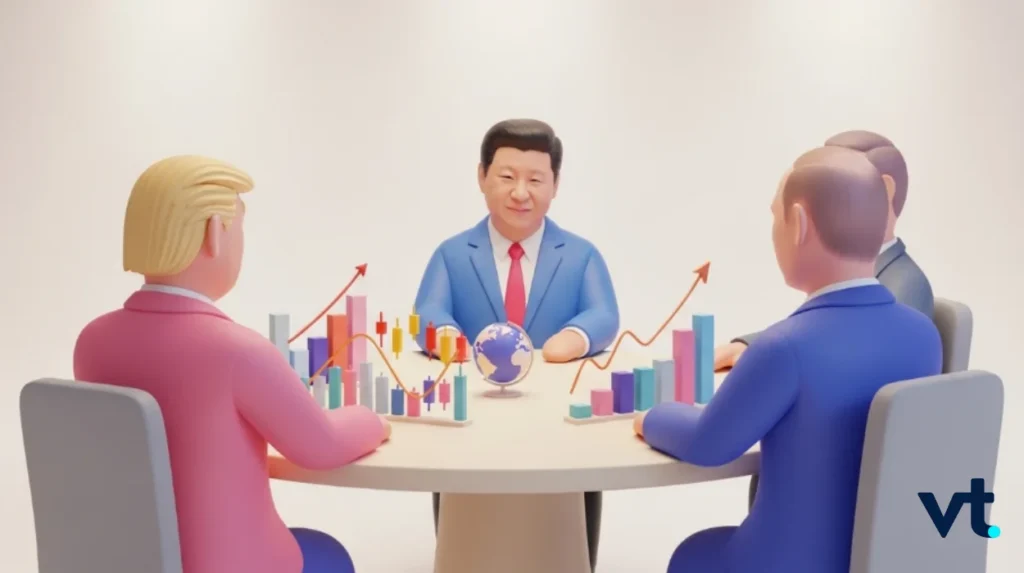
China hosted the leaders of both the United States and Russia within six days.
Trump left Beijing on May 15, Putin arrived on May 19. Neither visit stands alone.
Trump’s visit produced trade-facing deliverables: an initial Chinese commitment to buy 200 Boeing aircraft, at least $17 billion a year in U.S. agricultural purchases through 2028, and two new government-to-government channels — a Board of Trade and a Board of Investment. The White House also said both leaders agreed to build a “constructive relationship of strategic stability.”
Putin’s visit carried a different signal. Xi and Putin signed a joint statement on further strengthening comprehensive strategic coordination and witnessed the signing of several bilateral cooperation documents. China’s Foreign Ministry said it was Putin’s 25th visit to China, underscoring the depth and frequency of the relationship.
Together, they show Beijing’s positioning strategy. China is not choosing between Washington and Moscow. It is keeping both relationships active, using trade talks with the U.S. to reduce pressure while preserving strategic room with Russia.
For markets, the triangle now matters more than either summit on its own.
From Liberation Day to Beijing
The U.S.–China relationship looked very different a year ago.
Trump’s “Liberation Day” tariffs in April 2025 reset the trade landscape and were followed by broader pressure across tariffs, export controls, and strategic supply chains. China answered with its own leverage, including export restrictions on rare earths and critical minerals, which affected industries tied to defence, autos, electronics, and advanced manufacturing. Reuters reported that some heavy rare earth exports remained sharply lower even after the broader trade truce, showing how China could preserve leverage while allowing partial relief.
The first pause came in Busan in October 2025. Trump and Xi met for about 100 minutes, with outcomes including a reduction in fentanyl-linked tariffs, China’s resumption of U.S. soybean purchases, and a one-year easing or deferment of rare earth restrictions.
Beijing in May 2026 followed the same template.
The summit did not end the trade war. It converted escalation into managed friction.
What Trump Got
The U.S.–China deliverables were concrete, but narrow.
Trump secured visible trade wins that can be translated into exports, jobs, and market relief:
- Aviation: China signalled a 200-aircraft Boeing order.
- Agriculture: China committed to larger U.S. farm purchases, including soybeans and other agricultural goods through 2028.
- Tariffs: The U.S. reduced fentanyl-linked tariffs and suspended higher reciprocal tariffs for one year.
- Fentanyl: China tightened controls on precursor chemicals.
- Trade channels: Both sides agreed to new bilateral trade and investment forums.
These outcomes gave both leaders something to claim. China made the larger commercial commitments. The U.S. made the larger reversals of its own earlier tariff policy.
As observed by VT Analyst Nayel from earlier in the week, the limits were clear. Rare earths remained ambiguous. Semiconductors were not resolved. Taiwan stayed outside the trade framework.
Where both governments could agree on transactions, they did. Where the issues touched strategic power, they postponed.
What Putin Got — and What It Signals
Putin’s visit carried a different kind of weight.
Trump’s meeting was about cooling the trade war. Putin’s meeting was about showing that Russia still has a strategic partner with global reach.
The official backdrop was the anniversary of the China–Russia friendship treaty. The substance was broader: energy, technology, trade, and strategic coordination.
The official agenda covered bilateral relations, strategic cooperation, and international issues. Energy was central because Russia is one of the world’s largest oil producers, while China is among the largest buyers of fossil fuels.
The long-delayed Power of Siberia 2 pipeline also returned to focus. CNBC reported that the proposed 2,600km pipeline could carry 50 billion cubic metres of gas annually from Russia’s Yamal fields to China via Mongolia, but pricing, financing, and delivery timelines remained unresolved.
That unresolved pipeline is useful for Beijing.
If China locks in better Russian energy terms, it strengthens supply security. If it delays, it keeps Moscow competing for Chinese demand. Either way, China gains negotiating room.
China Is Keeping Both Doors Open
The signal is simple: China is not choosing between Washington and Moscow. It is using both relationships to strengthen its position.
The U.S. approach still relies on pressure. Tariffs, export controls, Taiwan policy, and sanctions risk remain active tools. China’s response is more flexible: give enough on trade to reduce near-term pressure while keeping strategic options intact.
Putin’s visit sharpened that position. Beijing showed that trade stabilisation with Washington does not require strategic alignment with Washington.
China can discuss aircraft, agriculture, and market access with the U.S. while keeping energy, security, and diplomatic coordination open with Russia. Beijing gave Trump enough trade stability to cool markets, then gave Putin enough diplomatic visibility to show that China’s options remain open.
Unresolved Pressure Points
The summit lowered immediate trade-war risk, but three pressure points remain unresolved.
- Strategic technology supply chains
Rare earths, semiconductors, and AI controls are part of the same conflict. China holds leverage in critical minerals, while the U.S. holds leverage through chip and AI export controls. This keeps China tech, EVs, defence, and semiconductor-linked names sensitive to policy headlines. - Taiwan and security risk
Taiwan remains outside the trade truce. Forbes reported that Xi warned Trump that the Taiwan issue could push the two countries toward “conflict” if mishandled. A Taiwan-related headline can reset sentiment across China-linked equities, regional FX, semiconductor names, and broader risk assets, even if trade talks remain constructive. - Energy and sanctions exposure
Putin’s visit keeps Russia-linked oil, gas, and sanctions risk in view. China can stabilise trade with the U.S. while preserving energy and diplomatic channels with Moscow, which may complicate future U.S. pressure.
The market effect is not constant. It tends to arrive suddenly through defence stocks, China risk assets, regional FX, and semiconductor-linked names.
What to Anticipate
Three tracks are now live simultaneously:
September 2026, Xi is expected to visit Washington. This is the next US-China inflexion point. Three scenarios are plausible:
- Truce holds and deepens. Both sides extend tariff suspensions and begin addressing the tech rivalry. This requires breakthroughs the May meeting deliberately avoided.
- Truce holds but stalls. Both sides claim progress with minimal new deliverables. Managed friction, neither escalating nor resolving.
- Truce breaks. A new export control action, a Taiwan incident, or a unilateral tariff move triggers retaliation. The cycle resumes.
Stay up to date on the latest news on trade and Trump’s involvement with VT Markets.
China-Russia energy deals. Watch for specifics on new oil and gas contracts, particularly around Power of Siberia 2. The terms of any deal will tell you whether China is locking in Russian supply as a hedge against US pressure or using the negotiation to keep both partners competing for its business.
The UNSC dynamic. Within six months, all four other permanent members of the UN Security Council have visited China. Macron in December, Starmer in January, Trump in May, and Putin in May.
Market Implications
The sharpest market moves are likely to come from areas where the trade truce overlaps with strategic leverage: currencies, technology, energy, and critical minerals.
- Yuan and China-linked FX
The yuan is the cleanest barometer of whether markets believe the truce is holding. A calm U.S.–China tone can support sentiment. Renewed tariff threats, sanctions language, or Russia-related pressure can weaken it quickly. - China tech and semiconductor-linked names
The summit did not resolve AI chip controls or semiconductor restrictions. HKTECH, China internet names, and chip-linked suppliers remain sensitive to U.S. export-control updates or China retaliation signals. - Energy markets
Putin’s visit matters most where Russia still has leverage: oil, gas, and pipeline diplomacy. Stronger China-Russia energy coordination would reinforce Beijing’s ability to keep supply options open outside the U.S. orbit. - Rare earths and strategic metals
Rare earths remain China’s clearest supply-chain lever. A tighter export-control signal could move defence, EV, semiconductor, and clean-energy supply chains quickly.
Agriculture and Boeing still matter, but mainly as implementation checks. The larger volatility sits where trade policy meets strategic leverage.
Beijing is positioning itself as the indispensable interlocutor in the current global order. That positioning carries economic weight: it signals to markets that China expects to remain central to every major trade, energy, and security conversation, regardless of which bilateral relationship is in focus.
The Trump–Xi summit gave markets a reason to reduce immediate trade war risk. It did not remove the risks that can bring volatility back. For traders, the truce is tradable but fragile. It works on conditions on both sides to keep the hardest disputes contained. September will tell us whether the truce is becoming a relationship or just a longer pause between escalations in a game that now definitively includes a third player.
Create a live VT Markets account today to access our platform features, including market insights and educational content.
Frequently Asked Questions
Did the Trump-Xi summit end the US-China trade war? No. The summit lowered near-term trade-war risk through commitments on aircraft, agriculture, tariffs and trade forums, but it did not resolve deeper disputes around technology, rare earths, Taiwan or security policy.
Why does Putin’s visit to China matter for the US-China trade truce? Putin’s visit shows that China is keeping Russia close while stabilising trade with the US. That gives Beijing more diplomatic flexibility and makes the US-China truce part of a wider geopolitical triangle.
Which markets are most exposed to this diplomatic shift? The sharpest moves may come from yuan and China-linked FX, China tech stocks, semiconductor-linked names, energy markets, rare earths and strategic metals.
Why are rare earths, semiconductors and AI grouped? They are different layers of the same strategic supply-chain conflict. Rare earths are critical inputs, semiconductors are the production choke point, and AI is the end-use race for computing and industrial power.
What should traders watch next? Traders should watch Xi’s expected Washington visit, China-Russia energy announcements, rare earth policy signals, US chip-control updates, Taiwan headlines and evidence that Boeing and agriculture commitments are being delivered.
Start trading now – Click here to create your real VT Markets account





