



Key Points
- Oracle traded at 189.98, up 4.13, or 2.2%, after reaching a session high of 191.43.
- Wedbush says Oracle’s AI spending is backed by visible demand and long-term customer commitments, not speculative expansion.
- Oracle’s capex-to-remaining performance obligation ratio sits near 9%, well below the peer average of 33.6%.
- AI enthusiasm remains strong across global markets, but hot inflation and higher rate expectations could still cap valuation upside.
Oracle shares moved higher after Wedbush argued that traders may be misreading the company’s AI spending cycle. The stock traded at 189.98, up 4.13, or 2.2%, at 05/13 22:59:58 GMT+3. The session high stood at 191.43, with a low of 185.04, an open at 188.14, and a close at 185.85.
Wedbush framed Oracle’s elevated capital spending as a strategic investment rather than a balance-sheet warning. The firm said Oracle is building a stronger position for the next phase of the AI cycle, where infrastructure, performance, and data access are becoming more important.
Oracle’s capex-to-remaining performance obligation ratio sits at about 9%, against a peer average of 33.6%, which suggests the company is spending against contracted demand rather than chasing uncertain growth.
That gives the stock a clearer bull case. Oracle is not only selling a cloud story. It is trying to prove that its AI infrastructure buildout can convert backlog into revenue, customer retention, and margin expansion.
Backlog Gives Oracle A Stronger AI Argument
Oracle’s remaining performance obligations have become a core part of the investment case. Several recent analyst notes have cited Oracle’s RPO at roughly $553 billion, giving traders a large pool of contracted revenue to track as cloud infrastructure demand scales.
The capex debate now turns on execution. Heavy spending can hurt free cash flow in the short term, but it can also strengthen Oracle’s position if AI workloads keep moving into large cloud contracts.
Wedbush’s call supports the view that Oracle is spending to meet visible customer demand, not to build idle capacity.
Traders will now watch whether that backlog turns into stronger cloud revenue. If Oracle can lift infrastructure growth while keeping margins under control, the market may reward the stock with a higher AI multiple. If capex rises faster than revenue conversion, the same spending that supports the bull case could become a valuation risk.
AI Momentum Supports the Wider Tech Trade
Oracle’s move fits a broader AI-led rally across global equities. Asia-Pacific stocks rose on Thursday as AI enthusiasm lifted chip-linked names, with the MSCI Asia-Pacific index gaining 1.2% and South Korea’s KOSPI rising 1.7%. SK Hynix also moved closer to a $1 trillion market value, showing how strongly traders continue to price AI infrastructure demand.
The US market is also leaning into the same theme. The S&P 500 and Nasdaq closed at record highs on Wednesday, boosted by AI-linked technology and chip stocks. The rally came despite hotter inflation data, which shows that traders are still giving AI earnings power more weight than rate risk for now.
Oracle benefits from that backdrop because the market is rewarding companies that sit close to AI infrastructure spend. NVIDIA, AMD, Oracle, cloud providers, and data-centre names all sit inside the same trade. The winners will need to prove that AI demand is not only strong, but also profitable.
Understanding the markets is the first step toward becoming a more confident trader. In our upcoming webinar, we’ll explore how US Indices work, what moves the market, and how beginners can approach trading with a structured mindset.
Inflation and Fed Risk Still Cap the Upside
The macro backdrop is less clean. US producer prices rose 1.4% last month, the largest increase in four years, driven by oil disruption tied to the Strait of Hormuz. That data reduced hopes for near-term Federal Reserve cuts and raised the risk that rates may stay higher for longer.
Higher rates can pressure long-duration growth stocks, even when earnings momentum remains strong. Oracle’s AI story provides support, but the stock still trades in a market sensitive to bond yields, inflation, and dollar strength.
The Trump-Xi summit also sits in the background. Traders are watching the Beijing talks for signals on trade, technology, and the fragile US-China truce. A calmer tone could support technology shares. A tougher stance on trade or export controls could weigh on AI infrastructure names, especially those tied to chips, cloud capacity, and cross-border demand.
Technical Analysis
Oracle is continuing to recover strongly from its April low near 134.55, with the stock now trading around 189.98 as bullish momentum rebuilds across the AI infrastructure and enterprise cloud space. The broader chart structure has improved materially over the past month, although price is now approaching a key resistance zone just beneath the psychological 200 level.
Technically, Oracle remains in a constructive uptrend:
- MA5: 191.84
- MA10: 185.28
- MA20: 180.12
The short-term moving averages are positively aligned above the 20-day average, while price itself continues to hold above the broader trend structure. That usually reflects sustained buyer control and healthy upside momentum.
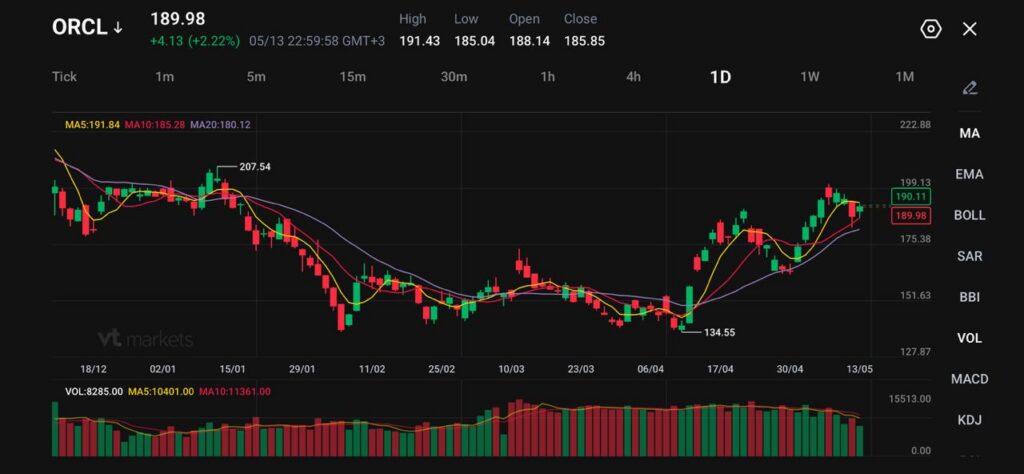
Key levels to watch:
- Immediate support: 185 → 180
- Major support: 175 → 151
- Resistance: 190–199 → 207.54
The current region around 190–199 is important because it marks the upper boundary of Oracle’s recent rebound phase. Price briefly approached this zone earlier in May before pulling back, and the market is now attempting another breakout attempt.
If buyers manage to clear the 199–200 resistance area, Oracle could retest the broader January high near 207.54. A successful move above that level would likely considerably strengthen the longer-term bullish structure.
On the downside, the first meaningful support cluster sits around the rising 10-day and 20-day averages between 180 and 185. As long as the stock continues holding above those trend lines, the broader recovery trend likely remains intact.
The rally also reflects improving investor sentiment around Oracle’s positioning within the AI ecosystem. Markets increasingly view Oracle as a growing infrastructure player benefiting from enterprise AI demand, particularly through its cloud partnerships, data centre expansion, and AI workload hosting capabilities.
Recent market narratives around hyperscaler spending and AI infrastructure investment have helped support the stock alongside the broader semiconductor and enterprise software complex. Traders are also watching whether Oracle can continue translating AI-related demand into stronger cloud revenue growth over the coming quarters.
Volume during the rebound phase has remained relatively steady rather than euphoric, which suggests the current move still resembles institutional accumulation rather than speculative exhaustion.
For now, Oracle maintains a bullish near-term bias while holding above 180, though the market faces an important technical test near the 199–200 resistance region.
Cautious Forecast
Oracle keeps a constructive bias while it holds above 185.28 and 180.12. A close above 191.84 would improve the short-term setup and support a move toward 199.13.
A break above 199.13 would strengthen the case for a retest of 207.54, especially if AI infrastructure sentiment stays firm and traders keep rewarding backlog-backed capex. A drop below 180.12 would weaken the setup and suggest that macro pressure, rate risk, or capex concerns are starting to outweigh the Wedbush-backed AI narrative.
Create a live VT Markets account today to access our platform features, including market insights and educational content.
Trader Questions
Why Is Oracle Stock Rising?
Oracle stock is rising after Wedbush backed the company’s AI spending strategy. The firm argued that Oracle’s heavy capital spending is supported by visible demand and long-term customer commitments, rather than speculative expansion.
ORCL traded at 189.98, up 4.13, or 2.2%, after reaching a session high of 191.43.
What Is The Current Oracle Stock Price?
Oracle traded at 189.98. The session high stood at 191.43, with a low of 185.04, an open at 188.14, and a close at 185.85.
Why Is Oracle’s AI Spending In Focus?
Oracle’s AI spending is in focus because investors are debating whether high capex is a risk or a long-term advantage. Wedbush believes Oracle is building a stronger position for the next phase of the AI cycle, where infrastructure, performance, and data access carry more weight.
Is Oracle’s AI Capex A Risk?
Oracle’s AI capex can pressure free cash flow in the short term, but Wedbush sees the spending as backed by demand. Oracle’s capex-to-remaining performance obligation ratio is about 9%, compared with a peer average of 33.6%.
That lower ratio suggests Oracle is spending against a large backlog, not chasing uncertain demand.
What Does Oracle’s Capex-To-RPO Ratio Mean?
Oracle’s capex-to-RPO ratio compares capital spending with remaining performance obligations. A lower ratio can show that the company has a large contracted revenue base relative to its spending.
Oracle’s ratio of about 9% compares favourably with the peer average of 33.6%, supporting the view that its AI investment is more demand-backed.
Start trading now – Click here to create your real VT Markets account