







Key Points
- GBP/USD traded at 1.35823, down 0.00472, or 0.35%, after touching a session low of 1.3548.
- Fresh US dollar buying capped the pair’s rebound from the 1.3550 to 1.3545 support zone.
- Sterling held some support after the Bank of England signalled that tighter policy may still be needed if inflation stays persistent.
- A sustained break above 1.3635 is needed before traders can treat the wider recovery as back in force.
GBP/USD failed to build on its modest intraday rebound on Monday as fresh US dollar demand kept pressure on sterling. The pair traded at 1.35823, down 0.00472, or 0.35%, after reaching a high of 1.3603 and a low of 1.3548. The session opened at 1.35490, while the previous close stood at 1.36295.
The move reflects a market that is still willing to buy the pound on dips, but not yet willing to chase a stronger breakout. The pair rebounded from the 1.3550 to 1.3545 support zone, but the recovery faded as traders moved back into the dollar.
The dollar’s support came from two main forces: revived Federal Reserve hawkishness and a fresh turn in Middle East risk. Reuters reported that the dollar strengthened for a second day after strong US jobs data showed 115,000 jobs added in April, nearly twice expectations, while renewed Iran uncertainty lifted safe-haven demand. The pound also slipped to around $1.3590 during that dollar rebound.
Iran Risk Keeps The Dollar Bid Alive
Optimism over a potential US-Iran nuclear deal faded after renewed hostilities in the Strait of Hormuz and wider disagreements over Tehran’s nuclear programme. That shift hurt GBP/USD because the dollar often gains when traders seek safety, especially when oil and inflation risks rise together.
President Donald Trump rejected Iran’s latest peace offer and called it unacceptable, which pushed traders back toward defensive positioning. Brent crude also climbed to $105.85 per barrel as the conflict kept energy supply risks active.
This matters for sterling because higher oil can raise inflation pressure and complicate rate decisions on both sides of the Atlantic. If the market believes the Fed may need to stay tighter for longer, the dollar can remain supported even when US-Iran diplomacy stays alive in the background.
The cautious forecast is that GBP/USD may struggle to extend gains while Hormuz risk keeps oil elevated and the dollar supported. A clearer peace framework would likely weaken the dollar and help sterling recover, but the market needs proof rather than headlines.
Bank Of England Signal Limits Sterling Losses
Sterling did not fall sharply because the Bank of England remains cautious on inflation. The BoE held Bank Rate at 3.75% at its April meeting, with the Monetary Policy Committee voting 8 to 1 to keep rates unchanged. One member voted to raise Bank Rate by 0.25 percentage points to 4%.
The BoE’s latest policy page lists the current Bank Rate at 3.75%, current inflation at 3.3%, and the inflation target at 2%. That gap keeps the central bank cautious, especially when energy prices threaten to lift costs again.
Governor Andrew Bailey also said the Middle East conflict had affected the UK inflation outlook, with energy supply disruption driving a sharp rise in global energy prices. He said CPI inflation had risen to 3.3% in March and was likely to be higher later this year.
That gives the pound a floor. If inflation stays persistent, the BoE may need to keep policy tight or consider further rate increases. But this support is limited because the dollar is also gaining from hawkish Fed expectations and geopolitical risk.
UK Politics Eases Some Pressure
Easing concern over Prime Minister Keir Starmer’s political position also helped limit sterling’s downside. Political stability matters for the pound because it reduces the risk premium tied to fiscal policy, investment confidence, and future reforms.
Still, politics is not the main driver today. The larger force remains the dollar. If US rate expectations keep moving higher, GBP/USD may stay capped even if UK domestic risks ease.
For now, sterling’s local support is helping it defend the 1.3550 to 1.3545 area, but not enough to force a clean move above resistance.
Technical Analysis
GBPUSD is trading near 1.3582, holding firm above its key short-term moving averages as sterling continues to stabilise after recovering from the early April low near 1.3159. The pair has gradually shifted into a constructive bullish structure, although momentum has slowed beneath the broader resistance zone around 1.3600–1.3720.
Technically, the setup still leans mildly bullish. Price remains above the 20-day moving average at 1.3539, while the 5-day (1.3578) and 10-day (1.3556) averages are continuing to trend higher. That alignment suggests buyers still retain near-term control, even as upside momentum becomes more measured.
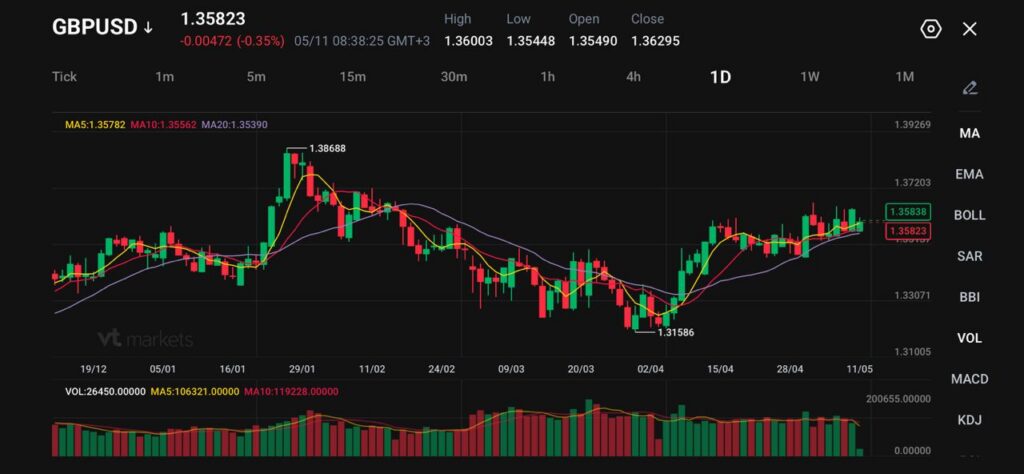
Key levels to watch:
- Support: 1.3550 → 1.3539 → 1.3450
- Resistance: 1.3600 → 1.3720 → 1.3869
The pair is now consolidating just below the 1.3600 psychological barrier, an area that has repeatedly capped recent upside attempts. A clean breakout above this zone could reopen a move toward 1.3720, with the broader January high near 1.3869 remaining the larger upside reference point.
On the downside, the first layer of support sits around the short-term moving averages between 1.3550 and 1.3539. If price slips that cluster below, sterling could retrace toward 1.3450, where previous consolidation support formed during late April.
Momentum indicators implied by price structure suggest the rally is entering a pause phase rather than a reversal phase. Buyers are still defending dips, but upside progress has become more gradual as the market waits for fresh macro catalysts, particularly around Federal Reserve rate expectations and Bank of England policy guidance.
Overall, GBPUSD maintains a cautiously bullish bias while holding above the 1.3530–1.3550 region, though a decisive break above 1.3600 is still needed to strengthen bullish continuation momentum.
Cautious Forecast
GBP/USD keeps a mild short-term bullish edge while it holds above the 1.3538 to 1.3550 support zone. A daily close above 1.3635 would improve the bullish case and could bring 1.37203 into focus.
A break below 1.3538 would weaken the setup and shift attention toward 1.33071, especially if the dollar keeps rising on Fed hawkishness and Iran-linked safe-haven demand. The pair may stay range-bound until traders get clearer signals from US-Iran talks, oil prices, and the next shift in Fed and BoE rate expectations.
Learn more about trading Forex Pairs on VT Markets here.
Trader Questions
Why Is GBP/USD Falling Today?
GBP/USD is falling because fresh US dollar buying has capped sterling’s recovery. The pair traded at 1.35823, down 0.00472, or 0.35%, after reaching a session low of 1.3548.
What Is The Current GBP/USD Price?
GBP/USD traded at 1.35823, with a session high of 1.3603 and a low of 1.3548. The pair opened at 1.35490, while the previous close stood at 1.36295.
Why Is The US Dollar Pressuring The Pound?
The US dollar is pressuring the pound because traders are pricing in renewed Federal Reserve hawkishness and higher safe-haven demand. Renewed hostilities in the Strait of Hormuz and fading optimism around a US-Iran nuclear deal have supported dollar buying.
How Is The Iran Conflict Affecting GBP/USD?
The Iran conflict is affecting GBP/USD by increasing demand for the US dollar and raising oil-linked inflation risks. When geopolitical risk rises, traders often move into the dollar, which can weigh on sterling.
Why Did GBP/USD Fail To Extend Its Rebound?
GBP/USD failed to extend its rebound because buyers could not push the pair above near-term resistance. The pair recovered from the 1.3550 to 1.3545 support zone, but fresh dollar demand capped the move.
Start trading now – Click here to create your real VT Markets account





