



Key Points
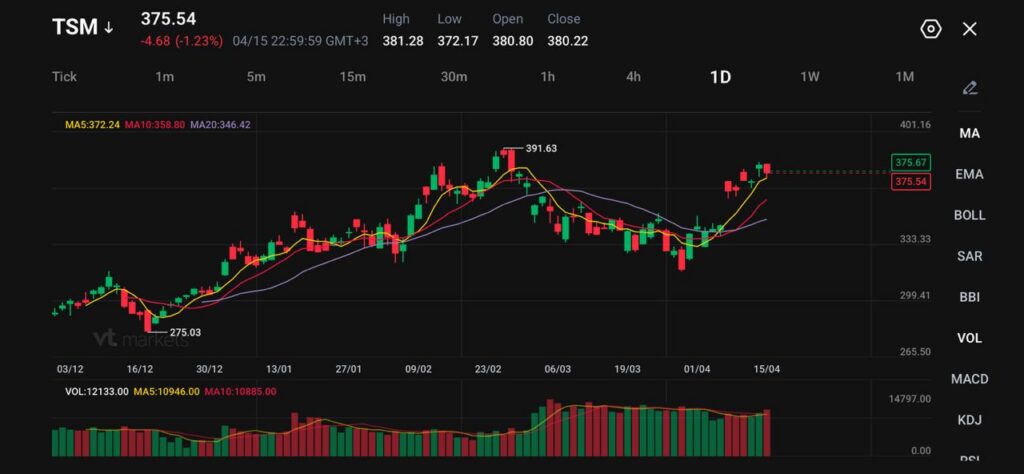
- TSM trades at 375.54, down 4.68 (-1.23%), after hitting 381.28, with price still holding above the key short-term moving averages.
- First-quarter net profit rose 58% to NT$572.5 billion, while revenue climbed 35% to NT$1.134 trillion, both ahead of market expectations.
- AI-related demand for 3-nanometre chips and advanced packaging continues to outstrip current production capacity.
TSMC’s first-quarter numbers showed that AI chip demand remained strong even while energy markets and supply chains absorbed the fallout from the Middle East conflict. Net profit rose 58% to NT$572.5 billion, or about $18.2 billion, while revenue climbed 35% to NT$1.134 trillion.
Both figures beat expectations, with profit clearing the T$543.3 billion SmartEstimate and extending the company’s run of double-digit growth.
That result matters because TSMC sits at the centre of the AI hardware chain. If customers were pulling back hard on advanced chip orders, it would have shown up here early. Instead, the company is still reporting demand that is strong enough to keep pricing, margins, and capacity pressure supportive.
A cautious near-term view still favours the broader AI semiconductor story while TSMC keeps posting this kind of growth.
Nodes and Packaging Drive Strength
The strongest signal inside the quarter is that demand for the most advanced part of the stack is still running ahead of supply. Demand for 3-nanometre production and advanced packaging continues to exceed current capacity. That keeps TSMC in a strong position because it is not just selling wafer volume.
It is selling the highest-value part of the manufacturing chain at a moment when AI customers still need more throughput.
That helps explain why the market has stayed constructive on TSMC even through periods of geopolitical stress. A chipmaker with ordinary cyclical demand would be more exposed to a growth wobble. TSMC still has customers pushing for leading-edge volume and packaging at a pace the company has not fully caught up with yet.
Demand and Risk Now Diverging
The quarter also helps split two questions that had been bundled together. One question was whether the war-related energy shock would weaken AI capex quickly. The other was whether TSMC could still deliver strong earnings before those risks showed up in operations. For now, the answer is that demand has held up and the numbers are still strong.
That does not remove the geopolitical risk. TSMC still runs energy-intensive fabrication in a region heavily dependent on imported fuel, and any sustained rise in electricity or materials costs can feed into margins and operational planning.
Helium has also become part of the conversation because chip production uses it as a coolant, and earlier disruption in Qatar has already tightened part of that supply chain. The market is treating those as emerging risks rather than current demand killers.
A cautious forecast still assumes TSMC can manage the first wave of these disruptions, but a longer energy or materials shock would be harder to ignore in later quarters.
TSM Technical Outlook
TSM is trading near 375.54, easing slightly after a strong rebound from the early April lows, with price now stalling just below a key resistance zone. The recent rally has been firm, pushing the stock back toward prior highs, but the latest candles suggest a pause as momentum cools near the 380–390 area.
From a technical standpoint, the structure is recovering within a broader range, with bullish momentum slowing in the short term.
Price remains above the 5-day (372.24) and 10-day (358.80) moving averages, both of which are trending higher and offering immediate support. The 20-day (346.42) sits below as a stronger base, reinforcing the recent shift back toward a constructive trend.
Key levels to watch:
- Support: 372.00 → 358.80 → 346.40
- Resistance: 380.00 → 391.60 → 401.00
TSM is currently consolidating just below the 380.00 resistance level. A clean break above this area could trigger a move toward the previous high near 391.60, with further upside potential if buying pressure builds.
On the downside, 372.00 is acting as immediate support. A break below this level could lead to a pullback toward 358.80, though such a move would likely remain corrective unless the broader recovery structure weakens.
Overall, TSM is in a steady recovery phase with near-term consolidation, as the market tests whether it has enough momentum to break higher or needs to pause before the next leg.
What Traders Should Watch Next
The next move depends on whether the company keeps converting AI demand into sustained capacity growth without letting energy and materials risk erode confidence.
Traders will watch for follow-through on advanced-node demand, packaging bottlenecks, updates to capital spending, and any clearer view on how fuel and helium supply risks are being managed. If those remain under control, the earnings beat can keep supporting the stock. If cost pressure starts to show up more clearly, the market may become less willing to reward the same growth rate.
Learn more about trading Indices on VT Markets today.
Trader Questions
Why Did TSMC’s Results Matter So Much For The Chip Sector?
TSMC sits at the centre of the global AI semiconductor supply chain, so a strong quarter is a direct read on whether leading-edge chip demand is still holding up. First-quarter net profit rose 58% to NT$572.5 billion, while revenue climbed 35% to NT$1.134 trillion, both ahead of expectations.
What Did TSMC’s Earnings Say About AI Demand?
The results showed AI demand stayed strong through the quarter. TSMC said advanced AI chip demand remained robust, and demand for 3-nanometre chips and advanced packaging continued to exceed available capacity.
Why Are Advanced Packaging And 3nm So Important For TSMC?
Those are the highest-value parts of the manufacturing stack and the areas most exposed to AI infrastructure spending. When those lines stay tight, it usually means hyperscalers and chip designers are still pushing hard on advanced compute buildouts.
Did TSMC Change Its Full-Year Growth Outlook?
TSMC has continued to point to about 30% full-year revenue growth, which keeps the market focused on whether the company can sustain its current momentum through the rest of 2026.
Why Is TSMC Still Exposed To Middle East Risk If Demand Is Strong?
Because strong demand does not remove supply-chain vulnerability. TSMC’s fabs are energy-intensive, Taiwan relies heavily on imported fuel, and chipmaking also depends on materials such as helium, where supply has already been disrupted by regional stress.
Start trading now – Click here to create your real VT Markets account