







Key Points
- USDX trades at 98.669, down 0.795 (-0.80%), after slipping toward a four-week low around the 99 area.
- The market reacted after Trump delayed his threat to strike Iranian civilian infrastructure by two weeks and described the move as a “double-sided ceasefire” tied to reopening the Strait of Hormuz.
- Inflation risk has not disappeared. One-year US inflation expectations rose to 3.4% in March from 3.0% in February, while expected gasoline-price growth jumped to 9.4%.
The dollar lost ground after the market got the one thing it had been missing for weeks: a delay in escalation. The move toward a two-week ceasefire reduced the urgency of defensive positioning and pushed the dollar lower against major peers.
The US Dollar Index (USDX) fell toward 99, and the decline made sense because the previous rally had been built on war risk, oil disruption, and higher-for-long Fed pricing. Once the market paused, part of that premium came out.
The shift has improved risk sentiment, but it has not removed uncertainty. Missile threats, shipping risks, and doubts over whether the truce can hold are still sitting underneath the market. That leaves the dollar weaker than it was, but not decisively broken.
Hormuz Relief Helps the Dollar Fall, but Only to a Point
The market is reacting less to rhetoric and more to flow risk. The Strait of Hormuz carries roughly 20% of global oil supply, so any sign that passage could normalise quickly changes the inflation and growth outlook at once.
Oil fell sharply after the ceasefire announcement, with Brent dropping to $94.43 and WTI to $96.82 in one major move. That immediately reduced some of the pressure that had been supporting the dollar.
That said, the market has learned not to trust promises alone. A temporary reopening reduces panic, but it does not fully remove the risk premium unless traders see stable flows and a broader peace framework take shape. That is why the dollar is softer, but not collapsing.
Inflation Risk Still Limits How Far the Dollar Can Fall
The softer dollar is running into a second force: inflation expectations are still too high to rebuild an easy Fed-cut story.
March survey data showed one-year inflation expectations rose to 3.4% from 3.0%, and expected gasoline-price inflation surged to 9.4%, the highest since the 2022 energy shock. Those numbers show that the oil shock has already filtered into household expectations, even as crude has pulled back from the panic highs.
That keeps the rate backdrop from turning fully dovish. A lower dollar usually needs either cleaner disinflation or softer growth data. Right now, the market only has partial relief on oil and a CPI report still ahead. Until that print lands, traders are unlikely to price an aggressive slide in the dollar.
CPI is the Next Real Test
The next step for USDX depends on whether US inflation data confirms that the energy shock is already feeding through. Business surveys are pointing in that direction.
US services growth slowed in March, while input prices rose at the fastest pace in more than 13 years. That combination matters because it points to a more difficult mix for the Fed: slower activity with hotter costs.
If CPI comes in firm, the dollar may stabilise quickly because the market will go back to higher-for-longer thinking. If CPI is softer than feared, the latest drop in USDX may extend because traders will start removing more of the inflation premium that built up through March.
Stay up-to-date on news around President Donald Trump and market impacts here.
Technical Analysis
The US Dollar Index (USDX) is trading near 98.67, pulling back from recent highs around 100.48 as momentum begins to fade. Price action shows a clear rejection from the 100 handle, with the latest candles reflecting increasing selling pressure and a shift into short-term consolidation.
The move lower suggests the recent bullish leg is losing strength, with the market now testing whether support can hold below the 99 level.
From a technical standpoint, the trend is transitioning from bullish to neutral. Price is slipping below the 5-day (99.55) and 10-day (99.65) moving averages, both of which are beginning to roll over and act as immediate resistance.
The 20-day (99.52) is flattening, signalling that upside momentum has stalled. This alignment points to weakening structure, with the recent rejection from 100 acting as a key turning point in the short term.
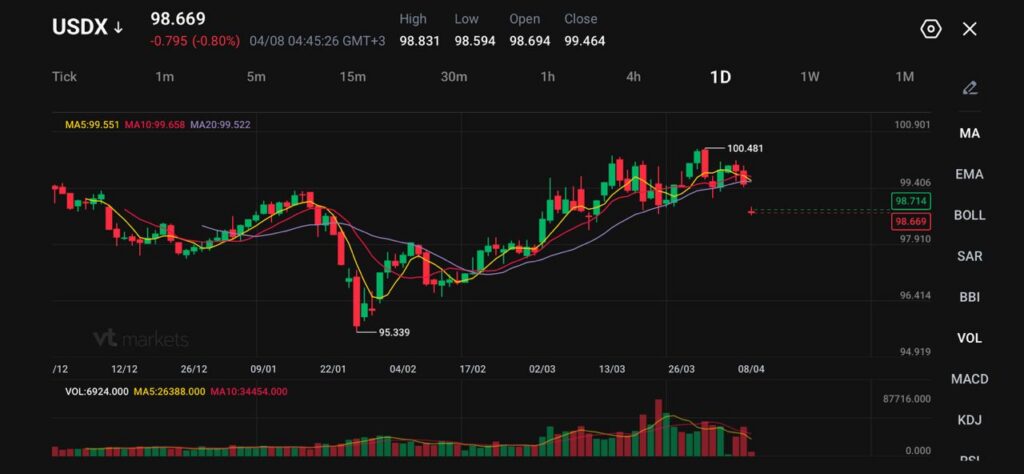
Key levels to watch:
- Support: 98.70 → 97.90 → 96.40
- Resistance: 99.40 → 100.00 → 100.50
The immediate focus is on the 98.70 support zone, which price is currently testing. A break below this level could open the path toward 97.90, where stronger support is likely to emerge.
On the upside, 99.40 is now acting as near-term resistance. A move back above this level would suggest a stabilisation in price and could lead to another attempt toward the 100.00 handle.
Overall, USDX is showing signs of short-term exhaustion after its recent rally. The rejection from the 100 level shifts the bias toward consolidation or a deeper pullback, unless buyers can quickly reclaim control above the 99.40–100.00 region.
What Traders Should Watch Next
The dollar now sits between easing war risk and persistent inflation risk. The truce has weakened the haven bid, but CPI can still rebuild support if price pressure stays sticky. The market will also keep watching whether the Hormuz reopening proves durable or starts to fray.
A stable ceasefire and softer inflation would likely pressure USDX further. A breakdown in either would likely pull buyers back into the dollar.
Learn more about trading Indices on VT Markets today.
Trader Questions
Why Did the Dollar Index Fall Toward 99?
USDX fell because the market pulled out part of the safe-haven premium after Trump delayed threatened strikes on Iranian civilian infrastructure by two weeks and described the move as a “double-sided ceasefire.” That reduced immediate demand for the dollar as a defensive asset.
Why Did Safe-Haven Demand Fade So Quickly?
The market had been holding dollars because of war risk, Hormuz disruption, and higher-for-longer Fed pricing. A temporary pause in escalation gave traders a reason to unwind some of that positioning, even though the broader conflict risk has not disappeared.
Does a Two-week Ceasefire Mean the Dollar Will Keep Falling?
Not necessarily. A temporary truce can weaken the dollar in the short term, but the move may stall if shipping risks return, if the ceasefire breaks down, or if inflation data keeps the Fed cautious. The market still needs proof that energy flows are stabilising.
Why Does the Strait of Hormuz Matter So Much for the Dollar Index?
Hormuz matters because it carries roughly 20% of global oil supply. When traders think the route may reopen, oil prices ease, inflation fears soften, and some of the dollar’s support fades. When the route looks threatened, the dollar usually regains ground.
Why Hasn’t the Dollar Fallen More Sharply?
Inflation risk is still limiting the downside. One-year US inflation expectations rose to 3.4% in March from 3.0% in February, and expected gasoline-price inflation jumped to 9.4%. That keeps the market from fully rebuilding a dovish Fed story.
Start trading now – Click here to create your real VT Markets account





