







Key Points
- S&P 500 trades at 6585.98, up 15.57 (+0.24%), after last week’s nearly 6% rally, its best weekly gain since late November.
- Futures turned softer on Monday, with Dow futures down 105 points (-0.2%), S&P 500 futures down 0.1%, and Nasdaq futures down 0.2%.
- March payrolls came in at 178,000, well above the 59,000 consensus, which improved the growth picture but made rate-cut hopes harder to rebuild.
US equities opened the week trying to hold onto a powerful rebound, but the tone stayed cautious. A report that US, Iranian, and regional mediators were discussing a potential 45-day ceasefire helped trim the earlier losses in futures, yet markets did not move into a clean risk-on mode because the chances of a full deal before Trump’s deadline were still seen as slim.
The market is still trading the gap between headline optimism and the reality that shipping, energy flows, and military threats remain unresolved.
That left the S&P 500 in a familiar spot. Buyers are willing to defend part of last week’s rally, but they are not treating the ceasefire story as a full resolution. Any rebound built on diplomacy alone still has to survive the next oil move and the next political headline.
The Tuesday Deadline Keeps Pressure on Sentiment
The market is also reacting to a very specific risk marker. Trump said Tuesday would be “Power Plant Day, and Bridge Day” in Iran if the Strait of Hormuz is not reopened, which gave traders a hard deadline to price. That kind of event risk keeps traders defensive because it compresses the window for negotiation and increases the chance of another sharp move in oil or yields.
That is why futures only partly recovered. Traders are not just asking whether talks are happening. They are asking whether a deal arrives in time to stop another escalation in infrastructure attacks and another jump in crude.
Last Week’s Rally is Now Being Properly Tested
The S&P 500 surged nearly 6% last week, while the Dow rose 3% and the Nasdaq jumped 4.4%. That rebound snapped a five-week losing streak and gave the market its strongest weekly performance since late November.
Monday’s session became the first real test of whether traders would defend those gains once geopolitical risk returned to the front of the tape.
That test matters because sharp weekly rebounds inside unstable macro conditions often fail unless the market gets confirmation from lower oil, calmer yields, or stronger growth data. Right now, traders only have one of those three in partial form.
Payrolls Improved the Growth Story, but Tightened the Rate Debate
The March jobs report added another layer of tension. Payrolls rose 178,000, triple the 59,000 consensus. That reduced the fear of an immediate growth rollover, but it also made it harder to argue for faster Fed easing. In this environment, better growth data is supportive for earnings, but it also works against valuation support if it keeps yields firm and delays rate cuts.
That leaves the S&P 500 balancing two opposing forces. The labour market is holding up better than feared, which helps the economic backdrop. At the same time, oil remains the bigger variable, and a stronger growth print does not help if it keeps the Fed cautious while energy prices stay elevated.
SP500 Technical Outlook
The S&P 500 is trading near 6586, attempting a modest rebound after the sharp sell-off that drove price down to the 6318 low. Recent price action shows a short-term recovery, with buyers stepping in after the decline, but the move higher remains tentative.
The broader structure still reflects a loss of momentum from the earlier highs near 7017, with the market now trying to stabilise rather than fully reverse.
From a technical standpoint, the trend has shifted to a more neutral-to-bearish tone. Price is still trading below the 20-day moving average (6596), which is flattening and acting as overhead resistance, while the 5-day (6572) and 10-day (6526) have started to turn higher, supporting the current bounce. This suggests short-term recovery momentum is building, but the broader trend has yet to confirm a reversal.
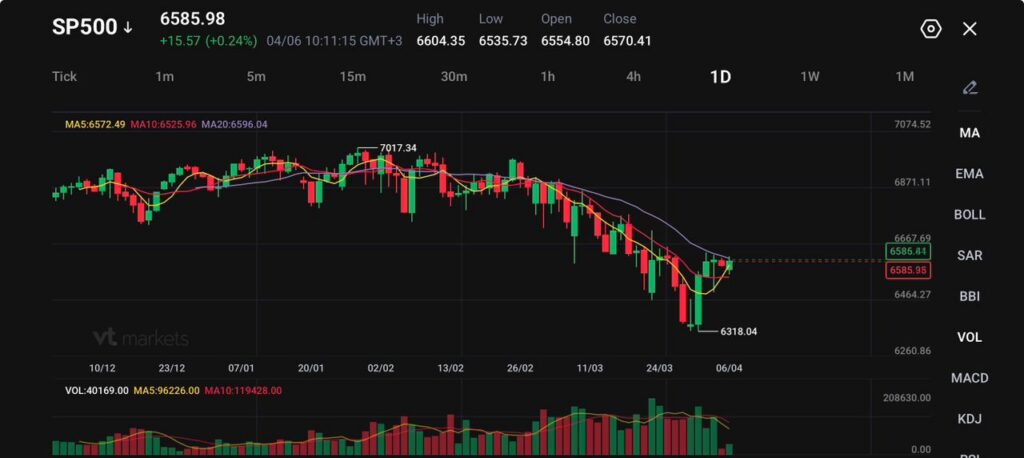
Key levels to watch:
- Support: 6535 → 6464 → 6318
- Resistance: 6600 → 6675 → 6870
The immediate focus is on the 6600 level, which aligns with the 20-day average and recent rejection zone. A sustained break above this area could extend the recovery toward 6675, where stronger resistance is likely to emerge.
On the downside, 6535 is acting as near-term support. A break below this level could see price retest the 6464 region, with further weakness exposing the 6318 low.
Overall, the S&P 500 is in a corrective phase following its earlier uptrend. The current rebound looks like an early-stage recovery, but unless price can reclaim and hold above 6600–6675, the risk remains tilted toward further consolidation or another leg lower.
What Traders Should Watch Next
The next move depends on whether diplomacy produces a real pause before Tuesday’s deadline, whether oil stays contained, and whether yields react more to jobs strength or war risk. If crude stays calm and the market keeps absorbing the 178,000 payroll print without a sharp rise in yields, the S&P 500 can keep defending last week’s gains. If the deadline passes without progress and oil jumps again, the index may struggle to hold the 6570 to 6600 area.
Learn more about trading Indices on VT Markets today.
Trader Questions
Why Are S&P 500 Futures Soft Again After Last Week’s Strong Rally?
Futures turned lower because the market is trying to price two opposing forces at once: a possible 45-day ceasefire and Trump’s Tuesday deadline tied to Iran and the Strait of Hormuz. That kept traders from chasing risk higher even after last week’s nearly 6% S&P 500 rally.
What is the Main Risk the Market is Watching Right Now?
The main risk is whether diplomacy arrives before the deadline or whether the conflict widens and hits energy infrastructure again. Markets are treating that as an oil-and-yields problem first, not just a geopolitical headline problem.
Why Does the Tuesday Deadline Matter So Much for Stocks?
A fixed deadline compresses the market’s window for optimism. If no deal emerges before then, traders may quickly reprice the odds of another escalation in oil, inflation, and risk aversion.
How Does the Strait of Hormuz Feed Into the S&P 500?
The Strait affects energy supply. If flows stay constrained, oil prices stay high, inflation pressure lingers, and companies face higher input and transport costs. That usually weighs on margins and makes equities harder to support.
Why Does the Jobs Report Complicate the Market Outlook?
March payrolls came in at 178,000 versus a 59,000 consensus. That supports the growth outlook, but it also makes Fed rate cuts harder to justify quickly, which limits valuation support for stocks.
Start trading now – Click here to create your real VT Markets account





