Forex currency pairs

There are many different trading tools, advanced features, and derivative types available to traders in the FX market, but all of these require a firm grasp of currency pairs — also known as forex pairs. Discover more about this important aspect of trading below.

Understanding forex currency pairs

As you learn how to trade on the forex market, you will often find yourself dealing with currency pairs. As the name suggests, these pairs represent two global currencies that are analysed together, and traders will speculate on the relative price movements of each currency in the pair.

Pairs are represented with a base currency on the left and a quote currency on the right. The base is the currency being bought, while the quote is the currency being sold. In the USD/AUD currency pair, the United States Dollar is the base currency and the Australian Dollar is the quote currency.

Along with the currency pair demarcation, there will also be an exchange rate. This shows traders how much of the quote currency will be required to purchase one unit of the base currency. In the case of the USD/AUD forex pair, the exchange rate may be A$1.47 for every US$1. On the forex platform, however, this will be represented to a higher degree of accuracy — perhaps 1.4723. A movement at the fourth decimal place of this exchange rate is known as a pip in the FX market. For some quoted currencies, such as the Japanese Yen (which has a much smaller denomination than the Australian Dollar), a pip will be a movement at the second decimal place. Traders need to keep an eye on pips as they assess market performance.

Trading with currency pairs

Traders can open a long or short position on currency pairs. A long position is essentially a buying position — in the above example, they would be long on the United States Dollar and short on the Australian Dollar at the same time. If one United States Dollar is equal to 1.4723 Australian Dollars, the trader in this example is hoping that this value increases, delivering them a profit.

If traders believe that the market will move in the opposite direction, they can open a short position on the currency pair. This means going short on the United States Dollar and long on the Australian Dollar, and the trader will want the 1.4723 rate to decrease — i.e. they want the AUD to strengthen against the USD.

If traders believe that the market will move in the opposite direction, they can open a short position on the currency pair. This means going short on the United States Dollar and long on the Australian Dollar, and the trader will want the 1.4723 rate to decrease — i.e. they want the AUD to strengthen against the USD.

If traders believe that the market will move in the opposite direction, they can open a short position on the currency pair. This means going short on the United States Dollar and long on the Australian Dollar, and the trader will want the 1.4723 rate to decrease — i.e. they want the AUD to strengthen against the USD.

Bear in mind that there are no guarantees when it comes to trading FX pairs. You can certainly research your position and base your decision on data-backed predictions, but the market can still move in a different direction from the one you expected. In other words, there is always a risk of loss.

Different types of forex currency pairs

You have a huge amount of flexibility when it comes to trading. As discussed above, you can open long or short positions, but you can also choose a wide range of different currencies to trade with. A forex pair may comprise any two currencies from around the world, although some types of pairs are traded more frequently than others. In addition, FX pairs may be divided into general categories.

●       Major currency pairs

Major currency pairs are the forex pairs with the highest trading volume in terms of frequency and the amount of money used in transactions. Recently, the four major currency pairs are the EUR/USD, the USD/JPY, the GBP/USD, and the USD/CHF (Swiss Franc), although this is subject to change in accordance with market forces and general trading habits. The AUD/USD is another pair that has traditionally featured on the major list, and this may be included within broader definitions of the major forex pairs.

Trading with major forex pairs is a popular choice because they tend to provide a more stable option than other types of pairs, as well as tighter spreads and more liquidity. However, even with major forex pairs, there are no guarantees, and the market may move in an unexpected direction.

●       Minor currency pairs

Minor currency pairs are traded less frequently than the majors but still enjoy a relatively high level of volume compared to other choices (see the exotic pair section below). This category generally refers to any pairs outside of the top four, and which don’t involve the United States Dollar. Common examples include the EUR/JPY, the GBP/CHF, and the AUD/NZD (New Zealand Dollar).

Compared to major forex pairs, minors are more volatile — something that can make them attractive to traders looking to make potential returns quickly. However, the risk of significant losses is high, and liquidity tends to be low. The spreads also tend to be broader for minor pairs, increasing the cost of opening a position.

●       Exotic currency pairs

Exotic pairs are essentially minor pairs but with a very low trading volume, and so they are off the radar of most mainstream traders. It is more difficult to research these pairs, and liquidity is usually very low. Volatility may also be high, which means exotic options are best reserved for more experienced traders or those with specific knowledge of geopolitical and economic conditions.

The CAD/SGD (Canadian Dollar/Singapore Dollar) is a popular choice for exotic pair traders, as is the EUR/TRY (European Euro/Turkish Lira). Some exotics also include the United States Dollar, such as the USD/SEK (Swedish Krona) and the USD/THB (Thai Baht).

●       Currency cross pairs

Currency cross pairs simply refer to a group of minors that do not involve the United States Dollar, but which used to require the USD as an intermediary. Exchanging the British Pound for the Japanese Yen, for example, once required an exchange from GBP into USD, and then USD into JPY — so the GBP/JPY pair would be considered a currency cross.

Currency pairs and leverage or margins

Understanding margins and leverage is important for traders learning the forex market. A margin is the amount of money that a trader must hold in their account in order to open and maintain positions. Each broker will have their own leverage requirement — if the margin is set at 5%, your account balance must remain at or above 5% of the value of all your open trades. If it falls below this level, a margin call is issued and positions may be liquidated.

You can also trade on the margin. In the 5% example, you would need to cover 5% of the position’s value with your own capital, while the broker covers the remaining 95%. This increases the potential for profit, but also significantly raises the risk.

Trading on leverage in FX works in a similar way but is expressed as a ratio. For example, you may borrow $20 from the broker for every $1 you commit from your account balance — expressed as a leverage of 20:1. In this example, the margin is still 5%, and a margin call will be issued if your account balance falls below this level.

Both margins and leverage enable traders to maximise their exposure when they trade with a currency pair. In both instances listed above, you would be controlling a position 20x greater than if you had not used leverage or traded on the margin. This means you will need to assess the movement of the currency pair carefully and be ready to close the position if the pair’s exchange rate moves too far the wrong way. Stop-loss tools can also help you, automatically closing the position if the currency pair’s exchange rate falls below a certain threshold.

Currency pairs and spreads

When you look at the value of a forex pair on the VT Markets platform, you will notice that there is a difference between the buying and selling price for the pair. This difference is known as the spread. The spread enables brokerage platforms and brokers to remain profitable, driving revenue from each position opened.

What does this mean for currency pairs themselves? Well, narrower spreads translate to lower transaction costs for the trader, and also indicate higher liquidity and lower volatility. The major forex pairs all feature narrower spreads, which is one reason why so many traders opt for these high-volume pairs.

Trade with currency pairs at VT Markets

Here at VT Markets, we provide an industry-leading platform designed to help traders secure the benefits of forex in a sustainable and responsible way. There are always risks to this type of trading, but our tools and features help you to make considered choices and data-backed decisions as you grow your understanding. Get started with our demo account, and then open real positions with the live trading account. Want to learn more about our platform? Get in touch with our team today.

FAQs

What are the most frequently traded currency pairs?

The most frequently traded currency pairs are known as the major forex pairs. These include the EUR/USD, the USD/JPY, the GBP/USD, and the USD/CHF (Swiss Franc), but this list may change along with fluctuations in the market. The AUD/USD is another frequently traded pair.

What are forex currency correlations?

A currency correlation is a slightly more complex entity on the forex market. It refers to the relative movements of two currency pairs against one another. These pairs may move in the same direction, suggesting some kind of causal relationship (although this is not always the case), or they may move in opposite directions to one another. Alternatively, the pairs may display no relationship at all, moving together at some times and moving oppositely at others.

What is the best currency pair?

The major currency pairs tend to display the highest liquidity, the lowest trading costs and the lowest levels of volatility in the market. As you learn how to trade forex, you will grow your own strategy and understand more about which pairs are best for you, but pairs in this category offer generally favourable conditions for traders of all backgrounds.

Forex currency correlations

In a general sense, correlation is something you’ll be looking for as you analyse and assess the forex market. While correlation does not always equal causation, it can still be useful in forecasting and predicting future market movements — techniques that will become increasingly important as you learn how to trade forex in a more advanced manner.

But, while correlations can be found in all forex data sets, currency correlations relate to something a bit more specific. So what are these currency pair correlations, and why do you need to know about them as a trader?

Understanding currency correlations and correlation trading in forex

When we discuss correlated forex pairs, we are basically talking about either three or four currencies arranged into two pairs. If one currency is shared between two pairs, there will be three currencies in total — and there will be four currencies if there is no such sharing. For example, if you are examining the AUD/USD and GBP/USD pairs, there are three currencies in total, but if you examine the AUD/USD and GBP/EUR pairs, there are four.

Forex correlation pairs are currency pairs that tend to exhibit movement patterns at the same time. If the movement of one pair appears to trigger the movement of another pair, there would be a correlation between the two.

But an FX correlation does not necessarily mean a move in the same direction. If an upwards or downwards movement of a certain pair appears to trigger the same in another pair, these pairs would have a positive correlation. If an upwards or downwards movement of a certain pair appears to trigger the opposite movement in another pair, these pairs would have a negative correlation.

This idea of “appearing to trigger” is important. Just because sets of currency pairs display a correlation does not mean they will always move in the expected direction. Nor does it mean that they will necessarily move to the same degree or with the same magnitude. There is always an element of uncertainty when it comes to trading on the forex market.

However, correlations do provide useful signals that traders can utilise as they make predictions and forecast future movements. With a careful, considered and conservative approach, you can start to grow your understanding and learn more about forex correlations and how they work.

Examples of positive and negative correlations

We’ve touched on positive and negative correlations above, but which currency pairs fall into these categories? Take a look at a few examples.

Positively correlating FX pairs

Positive forex correlation pairs are not all equal. Some will tend to correlate more closely, replicating each other’s movements almost exactly in some cases. Others will move only slightly in the same direction, but will show a repeated correlation over time.

Some of the most correlated pairs include:

  • The AUD/USD pair against the NZD/USD pair.
  • The EUR/USD pair against the GBP/USD pair.
  • The EUR/USD pair against the USD/CHF (Swiss Franc) pair.
  • The GBP/USD pair against the USD/CAD (Canadian Dollar) pair.
  • The GBP/USD pair against the USD/CHF pair.

Bear in mind that these pairs may not necessarily correlate at all times, and that strong correlations between other pairs may emerge over time.

Negatively correlating FX pairs

Just like with positive currency correlations, negative correlations are also far from equal. There will be some negatively correlating pairs that more closely match the magnitude of each other’s movements, while others may move only slightly. Identifying and understanding these negative correlations is an important part of forex trading.

Some examples of negatively correlating FX pairs include:

  • The USD/CHF pair against the EUR/USD pair.
  • The GBP/USD pair against the USD/CHF pair.
  • The USD/CAD pair against the AUD/JPY pair.
  • The USD/JPY pair against the AUD/USD pair.
  • The GBP/USD pair against the USD/JPY pair.

Again, bear in mind that negatively correlated forex pairs do not provide guarantees into future market movements. You will need to take care when you trade, and remember that a loss is possible even if you expect a strong correlation.

Analysing currency correlations

When you look at a currency pair, you will be looking at value movements measured in pips. Pips in fx are the smallest price movements that will register on the FX market trading platform, generally at the fourth decimal place. So, if a value increases from 1.4323 to 1.4325, this is a movement of two pips.

Pips are certainly important in terms of currency correlations, as it is these price movements that allow analysts to identify correlations in the first place. However, the level of correlation between two pairs is not measured in pips, but is instead represented as a coefficient. Most traders will use these coefficients to choose correlations, although they may also want to look at the pip movements of each pair.

The coefficient will be a value between -1 and 1. A negative value suggests a negative correlation, while a positive value suggests a positive correlation. A value of exactly -1 or exactly 1 means this correlation will happen 100% of the time — in realistic trading terms, you are not likely to see either of these numbers.

Instead, you’re likely to see a coefficient like -0.75 or 0.69 — a decimal representation of a number less than 1. The closer this decimal is to -1 or 1, the stronger the correlation trend. So, a coefficient of 0.91 demonstrates a stronger positive correlation than 0.72, and a coefficient of -0.89 suggests a stronger negative correlation than -0.61.

Trading with currency correlations

When you trade on the forex market, you are likely to use currency correlations in one of two ways.

●       Gathering evidence for forecasting

You may notice a trading signal or indicator that suggests a specific price movement for a currency pair. While these signals and indicators are useful when deciding on a trading strategy, it’s not unusual for traders to want to gather more information before they make a decision one way or another.

Looking at forex pairs that correlate with one another can provide this additional insight. For instance, you may predict that a pair is going to move in a specific direction, and you identify a history or correlation with another pair. A movement in this second pair will provide supporting evidence that suggests your prediction was correct, and you may decide to open a position as a result. You may also decide to increase your exposure to market forces by trading on the margin or by leveraging your forex position — just remember that this also raises the risk level for the trade. There are no guarantees of success, but this is an example of a considered strategy used by experienced traders.

●       Hedging other trades

Correlating forex pairs are also used in hedging strategies, where FX traders seek to mitigate the risk of one position by opening another. Understanding the correlations between different pairs is useful here, as traders can recoup some of their potential losses with a trade in the opposite direction.

The most obvious way to do this is to use negatively correlating forex pairs. You may open a position — either buying (long) or selling (short) on one currency pair, and then open the same position on a negatively correlating pair. If your first position fails, you will still make a return on the second position, provided that the correlation occurs as expected.

However, you can also hedge with two positively correlated pairs. To do this, you would open a position on the first pair — either a long or a short position — and then open the opposite position on the second pair. Again, if the first position fails, you would still make some return from the second position if the correlation is realised, mitigating your losses to some extent.

When you trade with currency pairs, you need to be aware of spreads. The spread is the difference between the buying and selling prices for a pair, and this essentially represents the fee you will need to pay to open a position. With hedging on currency correlations, you will be opening two positions rather than one, which means you’ll need to pay two sets of trading fees. This makes it doubly important to keep spreads in mind.

Begin trading currency pairs and analysing correlations with VT Markets

Use our platform to grow your trading experience and build your strategy. Set up a demo account to familiarise yourself with the market and our tools, then trade for real on a live trading account. Want to learn more about our platform? Get in touch with our team today.

FAQs

Which forex pairs are most correlated?

One way that traders try to realise the benefits of forex is by looking at correlations, but some correlations are stronger than others.

The AUD/USD and the NZD/USD, and the EUR/USD and the GBP/USD are two of the strongest positive correlations. Meanwhile, the USD/CHF (Swiss Franc) and the EUR/USD, and the GBP/USD and the USD/CHF display two of the strongest negative correlations. However, remember that this is subject to change, and the correlation is never guaranteed.

Which currency pairs work together?

To find the currency pairs that work best together, look at the exchange rate coefficient. This coefficient will be a number between -1 and 1. A coefficient of close to 1 represents a strong positive correlation, while a coefficient of close to -1 represents a strong negative correlation.

How is the currency correlation coefficient calculated?

It requires a complex calculation to arrive at the currency correlation coefficient. This calculation takes into account the mean value at closing for each pair over a specified time period. The mean closing value for Pair 1 is represented in the formula as X, while the mean closing value for Pair 2 is Y.

Using these values, the coefficient = ∑(X− X)(Y− Y) / √(X− X)² √(Y−Y)²

Most traders will use online tools built into the forex platform as they analyse coefficients, so they do not need to do this calculation themselves.

Exchange rate in forex

Exchange rates underpin the entire forex market, and you’ll need to know how to view, read and understand these rates as you develop your trading skills. Learn more in our guide.

Understanding exchange rates in forex

What is the exchange rate? The exchange rate in forex indicates how much of one currency is required to purchase a fixed amount — or one unit — of another. For example, it may require US$0.6 to purchase A$1, or it will require A$1.47 to purchase US$1. These values are subject to change.

Exchange rates are essentially the foundation of the forex — or foreign exchange — market. When you trade on this market, you will generally be working with a currency pair and speculating on the movement of the exchange rate between the currencies within this pair. One currency in the pair is the base currency — this is the ‘unit’ mentioned above. The other currency in the pair is the quote currency. The exchange rate is how much of the quote, or selling, currency is required to purchase one unit of the base, or buying, currency.

This is also important if you are trading with currency correlations. A currency correlation trade involves speculating of the relative movements of four currencies divided into two pairs. Understanding the exchange rate is critical for opening these more complex positions.

While the evolution of this exchange rate over time is what currency pair trading is based on, it is a factor in other trades too. Whether you are seeking to invest in a foreign market, or simply looking to make a currency trade ahead of an international trip, the exchange rate is something you’ll need to be aware of.

Reading the exchange rate

The exchange rate is measured in pips. Pips in forex refer to small movements of price, which will be at the fourth decimal place for most currency pairs, or at the second decimal place for pairs with quote currencies that have smaller denominations such as the Japanese yen. Observing these pip movements will help you to understand which direction the exchange rate is heading.

So how do you read this rate? It doesn’t matter what platform or service you use; the rate will be expressed in the same way — as a decimal value.

Let’s examine this by looking at the above example. In this case, we can make a currency pair of USD/AUD — the United States dollar is the base currency, and the AUD is the quote currency. This pair would be represented as USD/AUD 1.47 – which means 1.47 units of the AUD are required to purchase one unit of the USD, or A$1.47 per US$1.

Because the forex trading platform deals with a large number of different currencies from all over the world, the exchange rate will always be represented as a pair with the base and quote currencies both displayed. In other trading locations, such as at a physical exchange, you may only see a value for the quote currency. This is because it will be taken as given that the base currency is the local national currency.

How exchange rates are determined

How is currency valued? How are exchange rates determined? These rates are influenced by a wide array of different factors, which combine to make forex trading a complex but exciting endeavour.

Supply and demand is arguably the most obvious factor. If more people are buying a particular currency, and the market supply is not increasing in line with this, then the price of this currency will increase relative to others. If the opposite happens, or if supply outstrips demand for another reason, the price will fall.

Geopolitical factors will also play a major part. The United Kingdom’s exit from the European Union led to a significant fall in the relative value of the British pound, for example. However, it’s difficult to predict these market movements — economic sanctions against the Russian Federation led many to predict a decline for the Russian rouble, but this currency instead rallied against other major global currencies such as the United States dollar.

In this sense, exchange rates are not so much ‘determined’ as they are ‘dictated’ by market forces. There is no central committee overseeing the forex market, and rises and falls happen spontaneously. Even with careful research and forecasting, there are no guarantees in the market, and the exchange rate in FX may not move in the way you expected it to.

Fixed and floating exchange rates

To understand how exchange rates work, you need to recognise the difference between fixed and floating rates. As you learn how to trade forex and become more familiar with the market, you will notice that most currency pairs display a floating exchange rate. This means they are determined according to market forces. When supply and demand fluctuate, the rate of exchange in FX will fluctuate too.

Other currencies may not have a floating rate, but the rate will instead be fixed. This means the central bank of a particular country will peg the value of their own currency to that of another. The central bank achieves this by trading its own currency against its partner — usually the United States dollar but sometimes another form of currency.

The Saudi Arabian riyal is an example of this and will retain the same fixed rate against the United States dollar.

These currencies can still be used for speculation, as they are still subject to market forces. For instance, while the riyal will maintain the same value against the US dollar, it will fluctuate in relation to the European euro or the Japanese yen.

Exchange rates and spreads

Trading on the forex market is not free, and brokers and trading platforms need to secure revenue to keep themselves profitable. This is where forex spreads come into play.

When you view a currency pair and assess the exchange rate, you will notice that the price to buy and the price to sell the pair are not the same. There will be a disparity between the bid price (the buying price) and the ask price (the selling price), which is known as the spread.

Tighter spreads are more favourable for traders, as it reduces the cost associated with opening a position in the market. However, this spread may change over time in response to market forces, and this will have an impact on the cost of keeping each position open.

Exchange rates, leverage and margins

When you trade on the forex market, you will quickly encounter leverage and margins. Leverage in FX means borrowing money from the broker to supplement your own capital, and this will be expressed in a ratio. A position leveraged at 20:1, for instance, will involve borrowing $20 for every $1 of your own money you use to open the trade. Of course, this means the potential benefits of the forex trade increase significantly, but your potential losses increase too – this money will need to be paid back regardless of whether or not the trade is successful.

Margin trading works in a similar way, and you will still be borrowing money from the broker to supplement your own capital. However, the margin will be represented as a percentage. Opening a $1,000 position with a margin of 5% will require you to put up $50 of your own money, while the broker will make up the remaining $9,550. This is basically the same as using a 20:1 leverage to control a $1,000 trade. Again, the potential for profits increases, but so does the risk to the trader.

In both cases, you will incur a margin call if your available funds fall below the margin rate set by the broker. If this happens, you’ll need to close positions to bring your account back into line with requirements, or you’ll need to deposit funds directly. Failing to meet a margin call will result in positions being liquidated.

How does this relate to exchange rates? Well, it’s the movement of the exchange rate that drives the success of the trade. A movement of a few pips may not seem like much, but this can result in a significant rise or fall when leverage and margin trading is involved. If the exchange rate moves too far in an unexpected direction, a margin call may be issued. This means you need to take great care when working with these sorts of trades, implementing stop loss tools to provide additional protection.

Continue your trading journey with VT Markets today

Our VT Markets platform is among the market leaders, providing a variety of tools that beginners and more experienced traders can use as they navigate forex trading. Take a look at our demo account and get started. From here, move on to real trades with the live trading account. Want to learn more about our platform? Get in touch with our team today.

FAQs

What is the forex rate today?

Learning forex means learning to read and predict current and future fluctuations in foreign exchange rates. Trading platforms like the one provided by VT Markets will offer real-time forex data that gives you an exact picture of the currency rate.

Is forex the same as the exchange rate?

Forex stands for foreign exchange, so essentially forex and exchange rates are the same thing. The forex rate will not be exactly in line with the current exchange rate, due to the spreads that brokerage platforms use to generate revenue. However, these spreads will be small in most cases.

How does the exchange rate work in forex?

Exchange rates work according to market forces such as supply and demand. Increased supply that is not met by an equal increase in demand will result in a falling exchange rate. Increased demand without an increase in supply will result in a rising exchange rate. Geopolitical and social factors will also affect the rate of exchange.

Week Ahead: All Eyes on Inflationary Data from the US, UK and Australia

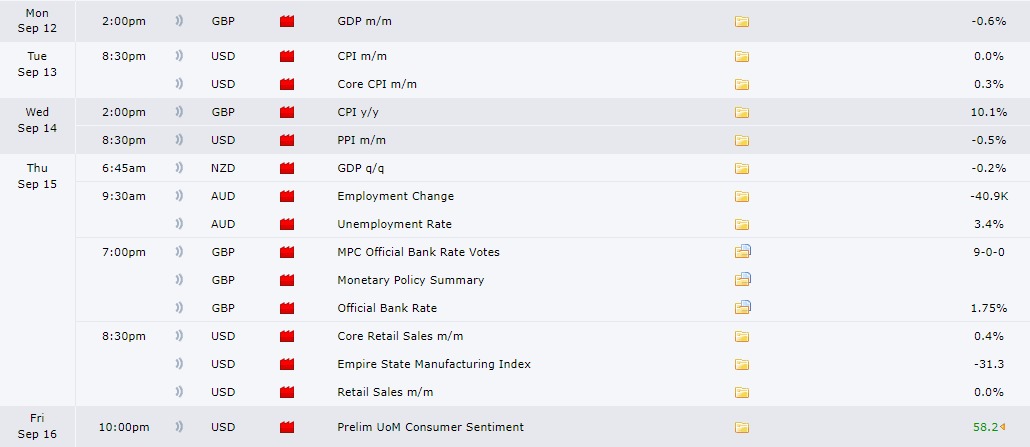
This week, investors will be eyeing inflationary data from the US, UK and Australia. 

The US will release its Consumer Price Index (CPI), Producer Price Index, and Retail Sales data. The market will be watching closely after more neutral labour data were released last week and after the Fed raised interest rates by 0.25%. 

The UK will also release data on CPI, GDP. Australia will release its employment data.

Image source: forexfactory.com

UK Gross Domestic Product | 12 September 2022

Gross domestic product in the UK shrank 0.6% in June from the previous month, following a downwardly revised 0.4% rise in May, according to data released by the Office for National Statistics on 12 September. Economists polled by Bloomberg expected an unchanged reading for July.

US Consumer Price Index | 13 September 2022

In July, consumer prices in the United States held steady from June, following a 1.3% jump in the previous month, which was the most significant rise since January 1992. Analysts expect consumer prices to slow slightly in July, falling 0.1%.

UK Consumer Price Index | 14 September 2022

The annual inflation rate in the United Kingdom reached 10.1% in July of 2022, up from 9.4% in the previous month. Experts predict it will fall below 10% again by the end of the year.

US Producer Price Index | 14 September 2022

In July, US producer prices unexpectedly fell 0.5% month-on-month, following a downwardly revised 1% rise in June. The decline in producer prices was driven by lower costs for agricultural products and energy. Producer prices are forecast to increase by 0.1% for August, after increasing 0.2% in July.

New Zealand Gross Domestic Product | 15 September 2022 

New Zealand’s economy declined 0.2% in the March 2022 quarter, following a 3% rise in the previous period. Analysts expect the economy will improve by 1.5% for the second quarter.

Australian Employment Data | 15 September 2022

Australia’s job market unexpectedly declined in July by 40,900 to 13.56 million; the nation’s unemployment rate dropped to 3.4%, a new record low. We can expect employment to remain positive and the unemployment rate to hold steady in August.

US Retail Sales | 15 September 2022

Markets were disappointed by a 0.1% decrease in retail sales in the US in July 2022, but they expected a 0.2% increase this month.

In July 2022, retail sales unexpectedly stalled in the US, disappointing markets that expected a 0.1% increase. This month, economists expect a 0.2% increase in retail sales figures.

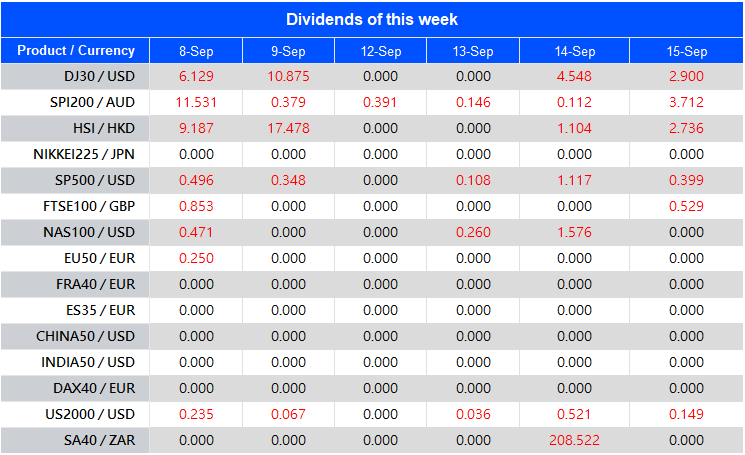
VT Markets The Adjustment Of Weekly Dividend Notification

Dear Client,

Warmly reminds you that the component stocks in the stock index spot generate dividends. When dividends are distributed, VT Markets will make dividends and deductions for the clients who hold the trading products after the close of the day before the ex-dividend date.

Indices dividends will not be paid/charged as an inclusion along with the swap component. It will be executed separately through a balance statement directly to your trading account, the comment for which will be in the following format “Div & Product Name & Net Volume ”.

Please note the specific adjustments as follows:

The above data is for reference only, please refer to the MT4/MT5 software for specific data.

If you’d like more information, please don’t hesitate to contact cs@vtmarkets.com.

Leverage in forex

Understanding leverage trading

What is leverage in forex? Leverage trading is a way to increase your exposure to market forces when you deal in foreign currency pairs. The forex market works according to laws of risk and reward — the greater the risk, the greater the potential reward. Therefore, the higher the leverage rate, the higher the potential return. However, this also increases the potential loss.

When you leverage a forex trade, you essentially borrow capital to supplement your money. Forex currency pairs move in pips — pips in forex are minimal price movements, so un-leveraged positions can only result in small profits and losses. By borrowing additional capital for leverage, you increase how much each pip movement is worth.

For example, if you trade with a leverage of 1:10, you are borrowing $10 for every $1 you put forward, and each pip is worth 10x the amount it would be without leverage. You will still need to pay this $10 back once you close your trade, which will be taken out of the profits of a successful position. You’ll need to pay this amount back if your position fails. This is why traders must be cautious and ensure they take the time to learn forex techniques before extending the leverage on their positions.

Calculating the leverage ratio

Leverage is generally represented as a ratio — for example, 1:10. The number on the left of the ratio represents the money you will put forward from your capital. In contrast, the number on the right represents the proportion you will borrow. With a 1:10 trade, you can use $100 of your own money to control a position of $1,000. With a 1:100 trade, this $100 will allow you to control a position with $10,000.

It’s important not to get carried away with leverage trading. Stick to your strategy, and only choose a leverage ratio you feel comfortable with. Don’t be tempted to push the boundaries, and stick to manageable levels of risk.

How to trade with leverage

The key benefit of forex leveraging is the profit potential, but you need a strong strategy if you are to stand a chance of realising this potential. This means understanding your risk tolerance and how much you are willing to borrow on your trade. Next, you’ll need to select a currency pair that best suits your strategy and choose a leverage ratio that aligns with your targets. Once these preliminary steps are complete, you can start to trade with leverage.

  • Put protective measures in place

Before opening your forex position, you need to have some protective measures. These tools will help you maintain a sustainable approach to trading and ensure that your position remains within strict parameters. The main tools you will use take profit and stop loss, and you may use these with other forex trading techniques such as FX futures

  • Take profit

Take profit will automatically close the trade once a certain profit level is reached. With forex trading, mainly leverage trading, you are not simply trying to achieve the maximum level of return from each position. Instead, you want to ensure that your profits remain within your broader strategy. This tool helps ensure your profits don’t reach unsustainable levels and you stay on track for long-term growth.

  • Stop loss

Stop loss works the same way as taking profit but in the opposite direction. This tool enables you to set a loss limit. If your position struggles and falls to this limit, it will automatically be closed, and you will absorb the losses. The tool ensures that losses do not become unmanageable and helps you keep within the initial strategy’s limits.

  • Open your position

Once you have chosen your leverage ratio and set your take profit and stop loss tools, you can open your position based on the current spot trading price. Open a buying position if you believe the currency pair’s value will increase, or open a selling position if you think it will fall in value. You should have a strategy for how long you expect to keep the position open.

  • Close your position

When you reach your predetermined endpoint for the position, you can close it. This means the position is no longer exposed to market forces, and you will take any profits and absorb any losses incurred while it remains open. You now need to pay back the capital you leveraged on the position, whether you made a profit or not.

Begin your forex trading journey at VT Markets — trade FX forwards and other derivatives

The VT Markets team provides an industry-leading forex platform, supporting traders executing forex swaps, opening FX options trades, and utilising leverage. Take a tour of our intuitive demo account and build your experience, or use a complete trading account to execute trades for real. Want to learn more? Reach out to our team today.

FAQs
What is a good leverage in forex?

It’s difficult to say what is a good level of leverage in forex simply because this is a personal choice for individual traders. A good rule of thumb for traders is to start small and work exclusively with manageable leverage levels. While increasing your leverage allows you to achieve greater profits, it also increases your exposure to risks and losses.

If you are new to trading with leverage, you should use 10:1 leverage as an absolute maximum. This means you put $1 of your capital forward and use leverage to borrow $10. Consider using lower leverage when you are starting or unsure, but never exceed this level.

What is 1 to 500 leverage?

1 to 500, commonly represented as 500:1, is a very high leverage ratio. In this example, you borrow $500 for every $1 you put forward from your capital reserves. While this is great if your trade is successful, as you are essentially multiplying your profits by 500, it exposes you to a very high level of risk. Even if you opened trade with only $10, you would need to borrow $5,000 to use as leverage, and this $5,000 will need to be paid back whether the trade is successful or not. This means if your trade fails, you could find yourself in a significant amount of debt.

This rate of 1 to 500 is typically the maximum level of forex leverage traders are permitted to use. Most traders will not open positions with this sort of leverage.

Can I use leverage in forex as a beginner?

Anyone can use leverage when they trade forex. However, it’s essential to understand that forex significantly increases your trade risk. As noted above, beginner traders should keep their rate of leverage low and manageable, limiting their exposure while they get used to this trading technique.

Using a demo account is even better for beginners wondering how to trade forex with leverage. With a demo account, you can practice using leverage just like an actual trade, except there is no risk because you are neither putting forward any money nor borrowing any. You can’t make a profit from a demo account, but you can learn valuable techniques that will help you further down the line.

Is it possible to trade forex without leverage?

Yes, it is possible to trade forex without leverage. You can put forward your own money without borrowing or leveraging any additional capital. This reduces your risk exposure but also reduces your exposure to profits. Traders who do not use leverage will have to make massive amounts of successful trades or put forward a high level of capital before they start to make significant profits.

With this in mind, most traders use little leverage when they trade. As they get more accustomed to using this, they can gradually increase their risk profile to increase profit potential. Of course, there are no guarantees, and even experienced traders can lose money when leveraging. Other forex strategies, such as OTC derivatives like FX forwards, do not always require leverage, although traders do have the choice of opening a structured leveraged forward contract.

How do I reduce risk when trading forex with leverage?

It is possible to manage and reduce risk while leverage trading. The most effective way to reduce risk is to keep the leverage ratio low. If you are leveraging at 5:1, you stand to lose considerably less money on a failed position than if you were leveraging at 20:1. Traders are always looking for the sweet spot of optimal risk exposure without trading in an irresponsible and unsustainable fashion.

Another way to reduce risk is to grow your experience slowly over time. Get used to trading on a demo account and then practice leverage trading with live positions, using small amounts of leverage at first as you develop your understanding. This helps to foster a sustainable approach to this trading strategy.

Give your trading capital a boost with VT Markets

VT Markets provides leverage of up to 500:1, allowing you to trade with more capital. This, coupled with an industry-leading trading platform, makes for an incredible trading experience for traders of any levels. Right now, you can take a tour of our intuitive demo account and build your experience, until you want to open a real account.

Pips in Forex

Understanding pips in forex

Pips in forex are the incremental price movements of currency pairs on the foreign exchange market. The term is an acronym for “price in percentage” or “percentage interest point”. When the price of a currency pair moves up or down, the extent of this movement is measured in pips, which are represented on the interface of your trading platform dashboard.

One pip is generally a tiny amount and worth far less than a single dollar and even less than a single cent. Despite this relatively small scale, pips are very important to traders — traders are working with such acceptable margins that they must remain aware of even the most minute price movements. These movements are instrumental as traders plan their strategies and examine their open positions.

Different definitions of trading pips

Trading pips can be defined in different ways. This is because the idea provides a valuable metric for traders examining the movements of the currency pairs. For currencies with tiny denominations, a pip may be defined differently to currencies with larger denominations.

For most currency pairs, a pip will be a movement at the fourth decimal place. The example of the AUD/GBP currency pair — comparing the Australian Dollar as the base currency and the British Pound as the quoted currency — this might be represented as 0.5768. So one Australian Dollar is worth 0.5768 British Pounds. If this value rises to 0.5769 or falls to 0.5767, this would be a movement of one pip.

But putting the pip at the fourth decimal place may be too precise in some cases. For instance, in the AUD/JPY pair — the Japanese Yen is the quoted currency; the Yen is a currency with tiny denominations, so we need to define a pip differently. With this currency pair, a pip would be found at the second decimal place, as a movement at the fourth decimal place is too small to provide any actionable insight.

Alternatively, some traders may want to view price movements in even greater detail. For example, they may decide to look at pipettes rather than pips — this means adding another decimal place to the reading. So, in the instance of the AUD/GBP pair — and most other pairs — a pipette will be at the fifth decimal place, ten times smaller than a pip. In the example of the AUD/JPY pair, the pipette will still be ten times smaller than the pip but will be found at the third decimal place.

How pips work with forex derivatives

Forex traders can use different techniques and strategies to approach the foreign exchange market. While all of these strategies, techniques and fx derivatives are different in their ways, they are united by one key aspect — all rely on price movements measured in pips. Take a look at how pips are used across these different forex strategies.

  • Pips and forex futures

When traders use forex futures contracts, they agree to buy a predetermined amount of a set currency at a locked-in price. Futures traders can use forex pips to examine whether or not the contract was the right choice, based on the price movement, although they will still be obliged to make the trade at the end of the contract period.

  • Pips and forex forwards

Forwards are similar to futures in that they are obligated to complete the trade and involve predetermined currencies, set periods, and locked-in prices. However, they are not traded on the exchange platform and are sold OTC (over the counter) via a broker. Traders will assess the success of the forward contract by examining price movements measured in pips.

  • Pips and forex options

Again, options involve predetermined factors such as currency type, time duration, and a locked-in purchase value. However, there is no obligation to complete the trade at the end of the contract period. With this in mind, traders will use pips to decide whether or not they should go through with the trade when the contract expires.

  • Pips and forex swaps

With a forex swap agreement, parties agree to trade one currency for an equivalent value of another over a set period. Interest is paid on the trade, and the transaction is reversed at the end of the agreement period. Pips are essential for analysing the progress of the trade, as well as for planning future swaps.

  • Pips and forex spot trading

Spots are not derivatives but an essential aspect of forex trading. Engaging in spot trading means opening positions based on the current value of a currency pair. Analysing pips helps traders to understand potential market movements as they decide whether or not to execute a spot trade.

How pips work with forex leverage

Pips are vital when it comes to using leverage in forex trading. When traders use leverage, they borrow capital to supplement their money. Traders can choose to use only a small amount of leverage, or they can leverage at a higher ratio, significantly increasing their exposure to market forces.

For example, a trader may choose to leverage a trade at a ratio of 10:1. This means that for every $1 they use to open the position, they borrow $10, achieving 10x the exposure. At 20:1, this rises to 20x, and so on. When leveraging, traders can potentially experience increased profits multiplied by the magnitude of the leverage ratio. However, the potential losses are multiplied too, so leveraging should be handled with extreme caution.

So what does this have to do with pips? Trading on leverage magnifies everything, including pip values. While a single pip movement may only result in a tiny profit or loss on an un-leveraged trade, leverage multiplies this value. At 10:1, each pip is worth 10x as much; at 100:1, each pip is worth 100x as much. Generally, these increases are limited at 500:1 — usually, the maximum amount of leverage permitted on a trading platform.

Pips and beginner traders

When beginners learn how to trade FX currency pairs, they will need to get used to the interface they are using while also growing their understanding of the tools and indicators necessary to execute trades. Pips are among the first things beginner traders will have to do.

As traders become more confident, they can use advanced indicators and tools to forecast future movements in the forex market. While these indicators and tools cannot guarantee future successes — and traders of all experience levels can suffer losses in the market — they help develop a more sophisticated and diverse strategy. However, traders need to know how to read and analyse pips to get to this point. Forex tickers and graphs are all based on information provided by these pips.

This is why demo accounts are so helpful as individuals learn how to trade forex. With a demo account, traders can get used to looking at incremental price movements and analysing the direction of these movements over time — all in a risk-free environment. As no money is changing hands, there is no potential for profit when using a demo account, but there is no potential for losses. This makes demo accounts a vital asset for traders starting on their journey.

The benefits of understanding forex pips

Gaining a solid understanding of pips provides many different benefits to forex traders. Learn more about some of the essential advantages: 

  • Quick and reliable insight

Perhaps the most significant advantage of understanding forex pips is gaining immediate insight. Forex price changes happen quickly and are delivered in real-time. As a result, traders need to be able to check their platform’s interface and understand these changes at a glance, and pips are a big part of this.

  • An understanding of past price movements

Pips also give traders the ability to view and understand past price movements. These price movements do not guarantee future movements in the same direction, but they help traders make informed predictions.

  • A more knowledge-based approach to leverage

Leverage effectively magnifies the impact of minute pip movements. Therefore, understanding pips is crucial for traders seeking to get the most out of their leveraged positions.

Experience world-class trading with VT Markets

Want to better understand how to maximise pips in your trading experience? Start trading now with VT Markets! Benefit from a beginner-friendly but highly competitive trading platform, with all the best tools, and advantageous trading conditions. You can open a demo account now to start trading with an award-winning broker, and graduate to a full account once you’re ready. Message us to learn more!

Benefits of forex

Key advantages of forex trading

As traders learn more about the forex market, and as they start to use the tools and features of their platform in an effective way, they can begin to realise a number of genuine advantages of forex trading. It’s important to remember that advantages are not guarantees, and there is no such thing as an infallible forex strategy. Despite this, there are many benefits of forex that are not necessarily found in other types of market trading.

High levels of liquidity 

Liquidity is a major benefit of trading forex. The forex market is one of the most liquid and volatile financial markets in the world, which means traders have the potential to quickly make profits on their positions. Even short-term scalpers and day traders can make profits in the market, provided that their strategies are effective and their predictions are correct.

Of course, this liquidity means the market can quickly move in the opposite direction too. There is no way to completely eliminate risk in this market, and even the most experienced traders may suffer significant losses.

Flexible trades across different market conditions

An important advantage of trading forex is the potential to make a profit even across different market conditions — although it should be noted that profits are never guaranteed, regardless of past market performance. 

Traders can decide to go long on a trade, which means they open a buying position in the anticipation that the value of a currency will increase over time. If this value does in fact increase, they will receive a profit. Alternatively, traders can open a selling position — also known as going short — if they expect that the value of the currency will fall during their trading window. If their prediction is correct, they will take a profit.

This enables flexible trading whether the market is growing or declining, giving traders more choice. There is always the risk that the market will move in the opposite direction, however, and traders should act cautiously and conservatively when they approach the FX market.

Relatively easy access to the market

It certainly takes time and effort to learn how to trade forex effectively, and traders 

should be willing to research and grow their experience in the long term, but it is still relatively easy to start out trading FX. This important benefit of forex trading can be easily achieved with a trading platform’s demo account.

With a demo account, users can access all of the tools and features that are available on the trading platform. They can view performance data, analyse the market in real-time, and make practice trades as part of their education and development. There is only one difference between a demo account and a live trading account — the risk. With a demo account, there is no risk, as no capital is required. This means there is no potential for profit, but no potential for losses either.

Traders should use the demo version of the platform to familiarise themselves with the forex environment. After they have grown confident in the market, they can graduate up to a live account and begin trading for real.

The ability to increase exposure through leverage

While changes happen quickly in the forex market, and currency prices change on a second-by-second basis, these movements tend to be small in the short term. When traders open their positions only for a short time, their market exposure is low — which means their potential profits and potential losses will be low too. 

It is possible to increase this level of exposure through a process known as leverage. Leverage in forex basically means to supplement the trader’s own capital resources with borrowed capital. This enables the trader to control positions worth far more than their own resources will allow — a significant forex benefit for experienced traders. 

Leverage is generally presented as a ratio. For 10:1 leverage, $10 is borrowed for every $1 taken from the trader’s own capital, and the trader controls a position worth 10x the amount they would have controlled otherwise. The leveraged capital will need to be paid back whether the trade results in a profit or not, which means traders need to take great care when using leverage.

The potential to build a diverse trading strategy

One of the reasons why forex trading has become so popular is its potential for diversity. Traders have a wealth of different choices at their disposal when they approach the FX market. These include the following:

  • FX options

An FX option is a contract that locks in place a set currency value for the duration of the trade. Once the contract reaches maturity, the trader has the option to complete the transaction, giving this derivative its name.

  • FX futures

FX futures are similar to options in that the currency value is locked in place for the duration of the contract. The futures derivative is a standardised contract traded on an exchange, and the trader is obliged to complete the transaction once the contract reaches maturity.

  • FX forwards

FX forwards also lock in a currency value over a set period of time, and — like with FX futures — there is an obligation to complete the transaction at the point of maturity. However, unlike futures, these derivatives can be customised to meet the needs of traders.

  • FX swaps

With an FX swaps derivative, there is still a time element, but the trade is executed at the beginning of the time period. A set amount of one currency is exchanged for an equivalent amount in another currency, and interest is paid on the trade. At the end of the swap period, the exchange is reversed.

  • FX spot trading

Spot trading is not an FX derivative, as it is based solely on the current market value of the currency in real-time. However, spot prices provide some of the underlying data to the forex derivatives listed above. 

Quick and straightforward insight with experience

As traders grow their experience and become familiar with using their forex platform’s dashboard, they can begin to achieve insight and understanding at a glance. With an intuitive and clearly presented interface, the trading platform will provide real-time information on the performance of currencies in the foreign exchange market. This in turn helps users to unlock numerous trading benefits as they develop into confident traders.

FX price movements are measured in pips. Pips in FX are small movements at the fourth decimal place of the currency value — or at the second decimal place in the case of quote currencies with a smaller denomination, such as the Japanese yen. Reading these movements, and analysing previous movements in the marketplace, gives users the opportunity to maximise the forex trading benefits they encounter.

A huge range of different currencies and currency pairs

As well as diversity in trading styles and derivative types, there is also diversity to be found in the currencies themselves. Currencies from all over the world are found on the forex market, and traders will be able to take advantage of this as they open and close positions.

From major pairs like AUD/USD (bringing together the Australian Dollar and the United States Dollar) to less commonly traded pairs like the EUR/TRY (the European Euro and the Turkish Lira), the forex market represents a wealth of potential for traders.

The chance to trade around the clock

The trading day is finite, and there are opening and closing times — for instance, the market will be closed at the weekend. However, during the week the market is open 24 hours a day. As forex is of global interest, trades are always being made. Even in the middle of the night in Australia, the European and American markets will be experiencing daytime trading rushes. 

This means the liquidity discussed above is an ever-present feature of the market during the trading week. Users often find this a useful benefit of trading forex, as they can build their strategy around their own schedule.

Enjoy the many benefits of trading with VT Markets

If you’re ready to trade forex, VT Markets welcomes you to its industry-leading platform. Reach the pinnacle of success with advantageous features like our swap-free accounts and excellent trading tools such as our award-winning VT Markets app, and ProTrader Tools powered by Trading Central

Start practicing now by setting up your demo account, and then graduate to a full account when you’re ready to secure the rewards. Contact us to learn more!

How to trade forex

How to trade forex: A beginner’s guide

Getting started in the forex market can be daunting, and traders may feel unsure of how to grow their understanding and develop their skills. Following a few simple steps can help traders to begin, although all would-be forex traders should recognise that this is a gradual process — sustainable and responsible trading requires care and caution, even among more experienced individuals.

Set up a trading account

Traders will need an account on a trading platform as they learn FX. This platform will provide the charts and tools required to analyse the market and will also offer the functionality required to open and close trades. The trader will also be able to manage their capital balance via this platform, adding and withdrawing funds when required.

Use a demo account to understand market movements

The trading platform will include a demo account, and traders are advised to use this demo version as they learn how to trade forex. The demo account is risk-free as there is no capital involved, which means no potential profit and no potential loss.

Analyse pips

When the value of a currency pair moves up or down, this movement is measured in pips. Pips in FX are incremental movements, usually at the fourth decimal place — and sometimes at the second decimal place for quote currencies with smaller denominations. While past performance does not guarantee future success, pip movements can help traders as they forecast which direction the market will travel in.

Choose a strategy

As individuals learn to trade forex, they will need to adopt a strategy and stick to it. Forex decisions are always strategic and will need to be aligned to a predetermined target, so traders will have to decide whether they are going to adopt a very short-term scalping strategy, a short-term day trading strategy or a longer-term approach. Short-term trading has smaller returns but also involves less risk.

Select a currency pair

With the strategy defined, traders can choose which currency pair they want to trade with. They will refer back to their strategy and their pip analysis as they decide this — a scalping strategy requires a currency pair exhibiting swift price movements, while longer-term strategies are more suited to currency pairs displaying consistent, aggregate growth over time.

Protect against losses

Traders can use stop-loss features that will automatically close the position if losses reach a certain level. This helps to keep the trader on track and within the bounds of their predetermined strategy. Take-profit tools are also useful here, as these will close the trade once a specified profit level is achieved — again, this helps to keep trades sustainable.

Decide on leverage ratios

Leverage in FX essentially involves borrowing money to supplement the amount of capital put forward. This is expressed as a ratio — in the example of 20:1 leverage, the trader borrows $20 for every $1 they commit from their own capital reserves. Exposure is increased, which means a greater profit potential, but also a greater risk of loss. Because of the increased risk, beginners should keep leverage low when they learn how to trade currencies on the forex market — inexperienced traders should 

never go beyond 10:1 leverage. They may use an even smaller ratio.

Open the position

Once everything is ready, the trader can open their position based on the current spot trading price, represented in real-time on the platform’s dashboard. They can open a buying position if they expect the value of the currency pair to appreciate — also known as going long — and can open a selling position (going short) if they expect it to fall in value. Ongoing analysis of price movements in pips, as well as the take-profit and stop-loss features, will help to make sure the trade remains sustainable.

Close the position

When the trader decides the time is right, they can close their position. Once the position is closed, the trade is no longer subject to rises and falls in the market, and the trader will take any profits and absorb any losses that have occurred while the position was open.

Different types of forex derivatives

Above, we’ve looked at what traders need to do as they open and close positions on the forex market. This is designed to be a relatively simple rundown of how you can make trades on the market, but there are other techniques and trade types that you may decide to incorporate into your strategy as you develop your skills.

  • Forex forwards

With forex forwards, individuals can customise a trading agreement with another party. They will set the currency to be traded, the trading price (which will be locked in for the duration of the contract) and the time period for the trade. These are OTC — over-the-counter — contracts, which are customised and traded via a broker.

  • Forex futures

FX futures are similar to forwards in that there is a set price, a set time and an obligation to complete the transaction. The difference is the customisability — futures cannot be customised and are instead traded on the exchange according to a standardised set of rules and parameters.

  • Forex options

Forex options work in a similar way to futures and forwards — they are executed with 

locked-in pricing and across a set time period. However, there is no obligation to complete the transaction at the end of the time period.

  • Forex swaps

With forex swaps, two parties agree to exchange equivalent amounts in different currencies. Each pays interest on the currency trade, and then the swap is reversed at the end of the agreement phase.

The benefits of forex trading

Trading forex provides a number of advantages for individuals, although it is important to always exercise caution during trading, as there are risks involved. Take a look at some of the main benefits of forex.

  • Traders can access the market with low levels of capital investment

It does not take huge amounts of capital investment to access the forex market. Traders can open and close positions with only small investments, and they can choose to leverage trades to increase their exposure if required. Leverage in forex significantly increases risk, however, so traders should bear this in mind.

  • Risk can be managed effectively

Stop-loss and take-profit tools help individuals to manage risk when trading forex. In addition to this, a conservative approach to leverage and proactive monitoring and assessment of market performance can further reduce the risk traders face. Remember that risk can never be eliminated completely, and there will always be an element of danger in the market.

  • There is a relatively easy learning curve

Traders can learn how to trade forex quickly and easily, developing a more sophisticated strategy as their knowledge grows. A demo account is also useful for anyone who wants to learn to trade forex in a risk-free environment.

  • Traders achieve exposure to a liquid market

Forex values can grow and fall very quickly, and the market is a volatile one. This is a good thing for traders, as it means there is a potential to make profits quickly, even on very short-term trades. Of course, this is a double-edged sword as traders may also experience losses.

  • It’s possible to trade even when a market is in decline

When trading forex, it is possible to go long (to open a buying position) or to go short (to open a selling position). This gives traders an element of flexibility, as they have the potential to make a profit whether the market is moving up or down. However, it’s important to remember that predictions are not always accurate, and there is always a risk of loss.

Take your trading to the next level with VT Markets

The forex market is the largest financial market in the world. Want to start trading and get familiar with the platforms? Practice with a demo account and trade with $100,000 virtual funds. With tight spreads and leverage of up to 500:1, VT Markets provides the best conditions to jumpstart your trading career. Try VT Markets’ trading conditions risk-free today.

FX futures

Understanding forex future contracts

A forex future contract — also known as a currency future because it involves the relative values of international currencies — is a method of trading in the foreign exchange market. Traders essentially agree to complete a transaction, purchasing an amount of one foreign currency in exchange for an equivalent amount of another.

The trade is not carried out straight away. Instead, the contract establishes a period of time, after which the transaction must be executed. This is an obligation, and there is no way for a trader to change their mind once the contract is enacted. The contract will also specify the exchange rate, which will be locked in for the full length of the contract.

Movements in the exchange rate will be measured in pips. Pips in FX are incremental changes in price and can be in the upwards or downwards direction. If the trader is buying currency, they are hoping that the price will move upwards, as this means they are essentially buying this currency at a cheaper, earlier rate.

FX futures contracts are traded via forex exchanges, and they are standardised. This basically means that the contract parameters are predetermined ahead of time, and the trader simply chooses which contract they wish to use. The trader cannot make any changes to this contract or alter its terms and conditions.

The forex futures contract in more detail

We have already looked at what a futures contract is and what it does, but let’s examine it in more detail. Each contract includes the following information:

  • The size of the contract — Represents the value of each currency in the futures contract. This value will be standardised, so it cannot be amended or customised.
  • The rate of exchange between the two currencies — This is defined at the current spot trading level and locked in for the duration of the contract.
  • The date of maturity and expiration — This is also known as the date at which the contract comes to an end and the deadline for settling the trade.
  • The contract’s maintenance margin — The minimum level of funds that a party must hold in their account to be able to service the contract.

This last point, the maintenance margin, may require further explanation. The idea of the maintenance margin is simply to ensure that there are enough available funds to complete the transaction at the end of the contract period. This protects the other party in the event that money is withdrawn from an account or if funds are depleted for another reason.

Difference between FX futures and spot trading

Unlike spot trading, FX futures are derivatives. In other words, the value of the trade is derived from the underlying data. Spot trades are not derivatives, as they depend only on the current value of the currency, represented in real-time via the forex platform’s interface. This is the key difference between the two forms of trading.

Forex futures are contracts with a number of different parameters. They relate to a specific currency traded on the forex market, in the same way that spot trading does, but this is where the similarities end. With futures contracts, there are also pricing parameters and duration parameters — the contract will be active for a set period of time, and the value of the currency will be locked in for this time period. This removes some of the uncertainty of trading.

Difference between FX futures and other kinds of derivatives

We’ve established that a forex futures contract is a currency derivative, but it is not the only type. When trading on the forex market, there are several other derivative choices to consider, each of which is different from an FX futures contract in its own specific way.

  • FX futures and FX forwards

Forwards are arguably the most similar derivative to futures. Both forwards and futures involve currency values that are locked in for the duration of the contract, and both carry an obligation that the trade be completed once the contract reaches maturity. The difference lies in the customisation of the contract. Forwards are sold over the counter via a brokerage service and can be customised to meet the individual needs of traders. Futures, on the other hand, are standardised and are sold via exchanges — they cannot be customised or altered.

  • FX futures and FX options

The main similarities between futures and options are the time component and the locked-in value. In both cases, the current spot price of the designated currency will be fixed for the duration of the contract. The main difference is that there is no obligation to complete the trade on an options contract, whereas the futures contract must be executed.

  • FX futures and FX swaps

In forex, swaps are an agreement to exchange an amount of one currency for an equivalent amount of another currency. Interest is paid on the currency amounts and the trade is reversed once the contract reaches its endpoint. This set duration is the main similarity between swaps and futures, but the two derivatives are inherently different in almost all other ways.

The benefits of forex future trading

There are a number of benefits of forex future trading that can make this type of derivative an attractive choice for those seeking to profit from their trade or use the forex market in another way. Bear in mind, however, that advantages and profits are not guaranteed, and there is always an element of risk when you are working with something as volatile as the forex market.

Forex futures represent an easy access point to currency derivative trading

As forex futures are standardised, it is relatively easy for users to learn how to trade forex derivatives. This is different from a forex forward, for example, that will need to be customised — futures traders simply select the contract they wish to use in their trade. It still takes time to develop a strong trading strategy, but beginners may find the learning curve to be gentler than with other forms of derivatives.

Futures contracts provide an element of certainty and predictability

The terms of the futures contract are set ahead of time, so there are no potential changes over the course of the contract’s duration. This provides an element of certainty and predictability — two things that can be difficult to find in the typically volatile foreign exchange market. It’s important to remember that this is not a guarantee that the trade will be successful, but at least the trader knows that the value of the currency is locked in while the contract is valid.

Standardisation improves transparency

When traders open a futures contract, they know exactly what they are getting. They can see the currency they will be working with, they know precisely how long the contract will be open and they know exactly what currency exchange rate will be applied. All this information is immediately available and cannot be changed, so there is no ambiguity or uncertainty for traders.

Futures have a diverse set of use cases

There are a number of different use cases associated with FX futures. One of the simplest is simply to access a required amount of foreign currency at a future date, without running the risk of an unfavourable exchange rate further down the line. Other use cases include speculation — the trader agrees to buy a set amount of foreign currency in the expectation that the value will have appreciated by the time the contract expires — and hedging.

In hedging, the trader takes out a futures contract to offset potential losses in other trades, creating a robust and sophisticated trading strategy. Finally, futures may be used to analyse and assess exchange and interest rates affecting different currencies while remaining protected against sudden price movements in the short term.

Futures can be leveraged to increase exposure

Without leverage, small value movements on the forex market may not translate to significant profit for the trader. Leverage in FX effectively increases the trader’s exposure to these price movements, and in turn, increases the potential return. Of course, this also means the potential for loss is magnified too, which is why traders should use leverage with extreme care and keep leverage ratios low while they are still learning forex.

Trade forex futures with an award-winning broker

At VT Markets, we provide an award-winning, industry-leading platform to help traders of any levels reach their goals and secure their rewards. With our client-first approach, low trading costs, and leverage of up to 500:1, we help them make the most of the forex futures market. The combination of the best tools and a trader-friendly experience makes VT Markets the right broker for you. Open a demo account today and contact us to learn more!

Back To Top
server

Witaj 👋

Jak mogę ci pomóc?

Porozmawiaj natychmiast z naszym zespołem

Czat na żywo

Rozpocznij rozmowę na żywo przez...

  • Telegram
    hold Wstrzymane
  • Już wkrótce...

Witaj 👋

Jak mogę ci pomóc?

telegram

Zeskanuj kod QR telefonem, aby rozpocząć czat z nami, lub kliknij tutaj.

Nie masz zainstalowanej aplikacji Telegram ani wersji Desktop? Skorzystaj z Telegram Web .

QR code