VT Markets The Adjustment Of Weekly Dividend Notification

Dear Client,

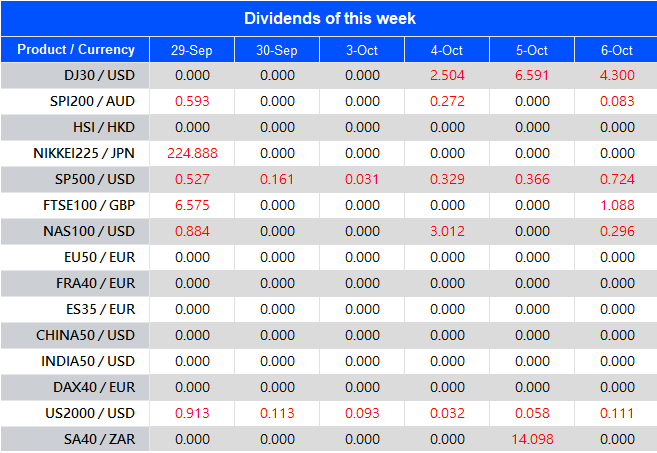
Warmly reminds you that the component stocks in the stock index spot generate dividends. When dividends are distributed, VT Markets will make dividends and deductions for the clients who hold the trading products after the close of the day before the ex-dividend date.

Indices dividends will not be paid/charged as an inclusion along with the swap component. It will be executed separately through a balance statement directly to your trading account, the comment for which will be in the following format “Div & Product Name & Net Volume ”.

Please note the specific adjustments as follows:

The above data is for reference only, please refer to the MT4/MT5 software for specific data.

If you’d like more information, please don’t hesitate to contact cs@vtmarkets.com.

VT Markets Launches 51 New ETFs Trading Options

Sydney, Australia, September 28, 2022  – VT Markets, an international multi-asset broker, is pleased to announce the addition of 51 ETF (exchange-traded fund) symbols to its multi-asset trading options. The addition allows its clients to track the performance of technology, energy, and mining sectors via popular symbols such as BKCH, BLOK, GLD, XLF, XOP, and more.

“We are truly excited to bring this new offer to our clients worldwide. Over the past months, we have seen an increasing demand for investment assets with relatively lower risks, lower cost and more exposure,” says Christopher Nelson-Smith, Director of VT Markets.

The newly added ETFs include a variety of trading instruments like stocks, bonds, and indices across multiple industries from different global exchanges. For instance, the ETFs for the technology sector include iShares U.S. Technology ETF (IYW) and Vanguard Information Technology ETF (VGT). The bond ETFs gives traders exposure to a wide selection of bonds diversified by type, issuer, maturity and region, including iShares Core U.S. Aggregate Bond ETF (AGG) and Vanguard Total Bond Market ETF (BND). 

“We welcome all traders, regardless of where you are in your trading journey, to join us and experience ETF trading on our world-class trading platform. We also offer a leverage of up to 33:1 for some of the key ETF symbols, providing traders with more opportunities to grow their accounts. In the near future, we are planning to add even more symbols to meet this popular demand,” he concluded.

For more information, please visit our website.

About the Company:

VT Markets is a regulated multi-asset broker with over ten years of experience in global financial markets. The broker has a presence in over 160 countries and won multiple international accolades including Best Customer Service 2021 and Best Affiliate Program 2022. They aim to make trading an easy, accessible, and seamless experience for everyone.

Week Ahead: US Initial Jobless Claims, CB Consumer Confidence, Canadian GDP

This week will see a much lighter schedule of data releases compared to last week.

Some significant releases to watch out for include the CB Consumer Confidence and Core PCE Price Index in the US and the Gross Domestic Product in Canada.

US CB Consumer Confidence | 27 September 2022

The US Consumer Confidence Index rose to 103.2 in August 2022, up from 95.3 in July. According to recent forecasts, Consumer Confidence in the US will increase more to 104, indicating that consumers are confident in the stability of their income and thus may be more inclined to spend.

Canadian Gross Domestic Product | 29 September 2022

According to Statistics Canada, the Canadian economy expanded by 0.1% in June. The agency’s latest estimate for July has the economy contracting 0.1% m/m from the previous month.

US Core PCE Price Index m/m | 30 September 2022

The Federal Reserve Board’s monthly report on consumer prices states that the CPI for Core PCE in the US, which excludes food and energy, rose 0.1% in July from a 0.6% increase in June.

Core PCE prices are projected to increase 0.3% in August.

VT Markets The Adjustment Of Weekly Dividend Notification

Dear Client,

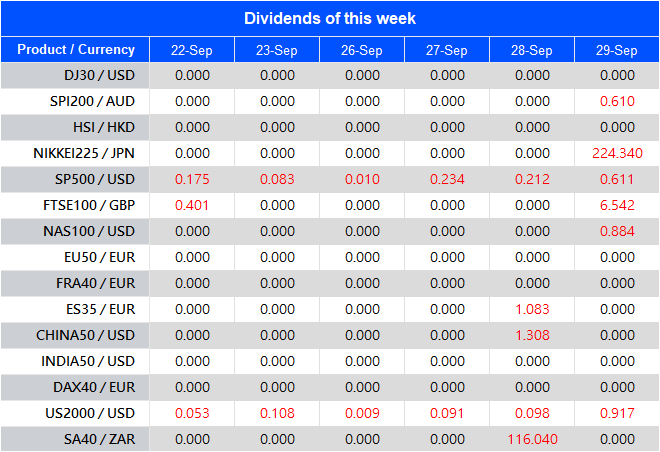
Warmly reminds you that the component stocks in the stock index spot generate dividends. When dividends are distributed, VT Markets will make dividends and deductions for the clients who hold the trading products after the close of the day before the ex-dividend date.

Indices dividends will not be paid/charged as an inclusion along with the swap component. It will be executed separately through a balance statement directly to your trading account, the comment for which will be in the following format “Div & Product Name & Net Volume ”.

Please note the specific adjustments as follows:

The above data is for reference only, please refer to the MT4/MT5 software for specific data.

If you’d like more information, please don’t hesitate to contact cs@vtmarkets.com.

VT Markets continues rapid global expansion

Sydney, Australia, September 21, 2022 — VT Markets, an international award-winning broker, was one of the exhibitors at the recently concluded iFX EXPO 2022 that took place in Bangkok from 13-15 September. 

The prestigious event was attended by industry leaders and top financial institutions who are looking to grow their businesses, network with clients and engage with people from different parts of the globe.

“We are honoured to be one of the exhibitors of iFX EXPO, the largest financial B2B exhibition in the world,” said Christopher Nelson-Smith, Director of VT Markets.

“VT Markets is one of the fastest growing brokers in the region and we have strategic plans to rapidly continue our global expansion. A huge financial event like this is a great opportunity for brokers like VT markets to share about our services and products, while also exchanging ideas with other top players in the industry,” added Nelson-Smith. 

Aside from being visible in multiple financial events, VT Markets is committed to bringing more new promotions and solutions to both institutional and retail clients. The fast-growing brokerage is currently offering over 1000 tradeable assets on its cutting-edge app and web trading platforms to better serve its global clientele.

For more information, please visit our website.

About the Company:

VT Markets is a regulated multi-asset broker with over ten years of experience in global financial markets. The broker has a presence in over 160 countries and won multiple international accolades including Best Customer Service 2021 and Best Affiliate Program 2022. They aim to make trading an easy, accessible, and seamless experience for everyone.

Week Ahead: Central Banks in Focus as Markets Await Next Steps

Four central banks will announce their interest rate decisions this week, with the Fed’s decision and its monetary policy the main focus.

Data releases from the US, Australia, Canada, Germany, the UK, and France will also take place this week.

Australia Monetary Policy Meeting Minutes | 20 September 2022

The Reserve Bank of Australia raised the cash rate by 50bps to 2.35% during its September 2022 meeting in line with market expectations.

The central bank said it aimed to keep inflation from 2% to 3% while maintaining economic growth. It announced that it would continue to raise interest rates gradually but that these hikes would not be performed according to any pre-set timetable, as the data received from incoming economic reports would influence the size and timing of these hikes.

Canada Consumer Price Index | 20 September 2022

According to Statistics Canada, Canada’s consumer price index rose 0.1% in July over the previous month. It was the third consecutive monthly gain and followed a 0.1% increase in June. Analysts predicted that the index would rise by another 0.1%.

US FOMC Statement and Fed Funds Rate | 22 September 2022

In its July 2022 meeting, the Fed raised the target range for the fed funds rate by 75bps to 2.25%-2.5%, the central bank’s fourth consecutive rate hike.

Investors were pricing in a more than 81% chance of another large 75bps hike in Fed funds futures by September.

Bank of Japan Outlook Report | 22 September 2022

The Bank of Japan voted 8-1 to maintain its key short-term interest rate at -0.1% for 10-year bond yields at around 0% during its July meeting.

In addition, the bank cut its 2022 GDP growth forecast to 2.4% from 2.9% in April, citing a slowdown in overseas economies and persistent supply chain issues due to the prolonged war in Ukraine.

Swiss National Bank Policy Rate and Monetary Policy | 22 September 2022

In its June meeting, the Swiss National Bank increased its policy rate by 50bps to -0.25%, surprising financial markets that had expected the central bank to leave its policy rate unchanged.

Analysts expect another 75bps rate hike.

Bank of England Official Bank Rate and Monetary Policy | 22 September 2022

The Bank of England raised its main rate by 50bps to 1.75% during its August 2022 meeting, the sixth consecutive rate hike, pushing borrowing costs to the highest since 2009.

Analysts expect another 50bps rate hike.

French Flash Services PMI | 23 September 2022

In August 2022, France’s Services PMI fell to 51.2 from 53.2 in July. This marked the fourth consecutive month of slowing growth in the services sector and its weakest expansion since April 2021.

Confidence among businesses sank to its lowest level since November 2020. The report cited concerns about the impact of still-elevated inflationary pressures on demand.

German Flash Manufacturing and Services PMI | 23 September 2022

Germany’s Manufacturing PMI fell to 49.1 in August of 2022, indicating that factory activity continued to decline for the second month and hit its lowest level since June 2020.

Flash Services PMI declined to 47.7 in August of 2022, indicating that services activity contracted for the second consecutive month and at the fastest pace since February 2021.

Analysts expect Germany’s Manufacturing PMI to fall to 47.1 and its Flash Services PMI reading to improve to 49.5.

UK Flash Manufacturing and Services PMI | 23 September 2022

The UK Manufacturing Purchasing Managers Index (PMI) fell to 47.3 in August, indicating that factory activity had contracted for the first time since May 2020. The UK Services PMI decreased to 50.9 in August 2022 after recording expansion for 18 months. The slowdown reflected higher inflationary pressures and a cost-of-living squeeze that instilled economic uncertainty and reduced client confidence.

Analysts expect the UK’s Manufacturing PMI to go above 50.2 and the Flash Services PMI to decline below 50.

US Flash Services PMI | 23 September 2022

The August US Services PMI declined to 43.7, its lowest reading since May 2020, from 47.3 in July. This pointed to the sharpest contraction in the services sector since May 2020.

The US Flash Services reading is expected to be better at 45.0.

VT Markets Offers Over 1000 Assets on Its Multi-Asset Trading Platform

Sydney, Australia, September 15, 2022 – VT Markets, an international award-winning broker, announced the addition of US, UK, and EU shares CFDs (contract for differences) to help traders diversify their portfolios. These newly added assets bring the total number of tradeable instruments to over 1000 on its trading platform.

This move is in line with the broker’s mission to make trading easier and more accessible for everyone. Christopher Nelson-Smith, Director of VT Markets shared, “We have been seeing an increase of requests from our clients to have more diversified products on our platforms, especially shares CFDs. I’m pleased to announce that our clients now have access to the CFDs of the biggest listed companies in the world.”

The broker now offers over 500 leveraged US shares CFDs, including Amazon, Apple, Google, Visa and many more giants across different industries. For UK shares CFDs, traders have access to over 100 top companies in the country such as Barclays, Vodafone Group, Lloyds Bank, and Unilever. For EU shares CFDs, its new addition includes ING Groep N.V., SAP, and L’Oreal.

“Our clients can choose from over 500 global giants in different regions, and trade on our intuitive trading platforms and mobile app. As always, they get to enjoy low trading cost, lightning speed execution, and the ability to go long or short. We are confident that this addition will offer more opportunities for traders to better manage their portfolio and meet their trading goals,” added Nelson-Smith.

For more information, please visit our website.

About the Company:

VT Markets LLC is a global and multi-asset broker regulated by the Cayman Islands Monetary Authority (CIMA).

With over ten years of experience in global financial markets, the broker has a presence in over 160 countries and won multiple international accolades including Best Customer Service 2021 and Best Affiliate Program 2022. They aim to make trading an easy, accessible and seamless experience for everyone.

VT Markets The Adjustment Of Weekly Dividend Notification

Dear Client,

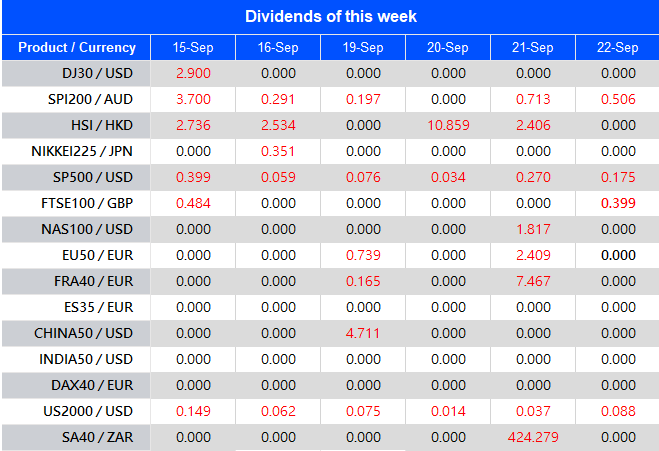
Warmly reminds you that the component stocks in the stock index spot generate dividends. When dividends are distributed, VT Markets will make dividends and deductions for the clients who hold the trading products after the close of the day before the ex-dividend date.

Indices dividends will not be paid/charged as an inclusion along with the swap component. It will be executed separately through a balance statement directly to your trading account, the comment for which will be in the following format “Div & Product Name & Net Volume ”.

Please note the specific adjustments as follows:

The above data is for reference only, please refer to the MT4/MT5 software for specific data.

If you’d like more information, please don’t hesitate to contact cs@vtmarkets.com.

Spreads in forex

Whether you are learning to trade forex for the first time or you have already spent years honing your FX strategy, spreads are something you need to know about. These important data points give you insight into how much your positions will cost, as well as offering other indications of market conditions.

But this is only a very basic overview. So what is a forex spread exactly, and what does this mean for traders? How do you read and analyse the FX spread data you encounter? Here’s what you need to know.

Understanding forex spreads

What are spreads in forex trading? A spread in forex relates to a currency pair or currency correlation and is a representation of the difference between the buying and selling prices for this particular pair on the FX market. The buying price is sometimes known as the bid price, while the selling price is known as the ask price. Spreads are not unique to forex, and traders in other financial markets — including the equities market — will need to be aware of the spread value and what it means.

To calculate the FX or money spread, you need to subtract the price to sell the currency pair (the ask price) from the price to buy the currency pair (the bid price).

Let’s look at the USD/AUD currency pair as an example. If the bid price is 1.46268 and the ask price is 1.46262, the difference between the two is 0.00006. This is the spread.

Remember that the spread will be represented in the form of pips — for the USD/AUD pair, a pip is a movement at the fourth decimal place. This means the spread would be 0.6 pips.

Forex spreads and trading costs

The forex spread value serves an important function — it tells traders how much they will need to pay when they open a position on the FX market. This is why it’s important to understand how to calculate the spread cost in forex.

To make this calculation, you will need to know the size of the position you plan to open and the spread value in pips.

So, in the above example, the spread was 0.6 pips or $0.00006.

Let’s say you are trading a standard lot of the currency in question — this is 100,000 units.

0.00006 x 100,000 = 6

The cost to the trader is $6.

The greater the spread, the greater the cost to the trader when they open a position in the market. This is why traders generally look for narrower, lower-cost spreads before they decide to open positions.

Spreads and leverage

Using leverage in forex is a popular technique for traders who want to increase their exposure to market forces. Generally, traders only have enough available capital to open small positions in the market — positions with relatively low levels of exposure. This means their potential returns — and their potential losses — are limited. You will either have to achieve success in a large number of trades to make a significant return or keep your position open for a very long period of time. Neither strategy guarantees that the trader will make money.

To enhance and augment exposure to risk and volatility, traders often turn to leverage. When you use leverage, you are borrowing capital with which to open your position. So, if you leverage a position at a ratio of 20:1, you are borrowing $20 for every $1 from your own trading account balance. This increases the potential benefits of a forex trade, but also increases the risk to the trader themselves. Basically, in the above example, potential returns are multiplied by 20 — but remember, you’ll also need to pay this leveraged money back after the transaction, so tread carefully.

Unfortunately, the spread will also be magnified when you choose to leverage a position, along with the trading costs. In the above example, you’ll pay 20x more to open your position than you would without leverage. Again, this is a reason to approach leverage with a careful and research-backed approach.

Spreads and margin calls

In some cases, a change in the spread may result in a margin call. Movements and changes to the spread volume are common and can be caused by changes in volatility or liquidity, as well as a range of global economic and geopolitical factors. However, significant movements can also cause problems and may result in the position being closed and liquidated.

Margin calls occur when traders are no longer able to service their open positions.

This can happen for a number of reasons — leverage and excessive losses are behind most margin calls, as traders can quickly find themselves out of their depth on a position if the market moves in an unexpected direction. FX spread changes can also trigger these calls if the cost of keeping the position open exceeds the available funds in the account. You may add funds to your account to keep the position open, or you may decide that the spread has become too unfavourable to continue, and instead accept the liquidation.

Grow your understanding of spreads and start forex trading at VT Markets

Here at VT Markets, we are proud to offer one of the leading forex platforms on the market. We have a range of tools to help beginner traders and more experienced FX veterans alike as they open positions and make trades. Use our demo account to build your confidence and to discover more about important trading aspects like spreads. Even if you have traded on other platforms before, it’s worth using this demo account to become familiar with how VT Markets works. Next, you can start trading for real with a live trading account. Want to learn more about our platform or forex spreads? Get in touch with our team today.

FAQs

Do spreads matter in forex?

Yes, spreads do matter in FX, and anyone who learns to trade forex needs to know about spreads. The greater the spread, the greater the cost that traders will incur when they open a position on a certain currency pair. Traders will have to pay particular attention to the spreads on currency pairs they want to trade and will need to factor this into their strategy.

Are forex spreads the same as pips?

FX spreads are not the same as pips. Pips in forex are incremental measurements that help traders to understand which way the market is moving — representing a movement at the fourth decimal place of the currency value in most cases, or the second decimal place for currencies of smaller denominations.

But pips and spreads are linked. This is because pips are used to measure the size of the spread. The buying and selling prices of the two currencies in a pair will be measured in pips, and the difference between these values will tell you the spread.

Why are forex spreads so high?

Forex spreads vary greatly, and there are a number of factors that can cause them to widen beyond ordinary or expected levels.

Periods of low liquidity result in higher spreads — when exchanges close at the end of the trading week, spreads will become wider.

High volatility in the market will also result in high spreads, as trading platforms and brokers seek to mitigate some of the risk that comes from this sort of trading environment.

Spreads may increase ahead of a major economic or geopolitical news event that will impact exchange rates in forex. The spread will respond to market uncertainty.

High forex spreads may also be caused by a significant market shock, such as a financial crash somewhere in the world.

What does a high spread mean in forex?

A high spread means that there is a significant difference between the buying and selling values of a currency pair. If trades are made when spreads are high, the cost to the trader is greater — this is why traders generally look for lower spreads when they approach currency pair positions.

A high spread may also provide an indication of the condition of the market. Higher spreads often indicate that volatility is high and liquidity is low for a particular currency pair.

What is a good spread in forex?

It’s difficult to identify exactly what is a good forex trading spread, simply because different trading strategies have different requirements. Scalper trading, for example, may benefit from periods of high volatility and the rapid price movements that result from this. Generally speaking, though, traders want spreads to be as low as possible, indicating low volatility and high levels of liquidity. This is because the transaction cost will be lower.

Spreads vary across different currency pairs and through different market conditions. The average spread for the USD/CAD currency pair, for example, will be around 2.0, while the average for the EUR/JPY currency pair will be around 1.8. Anything below this level can be considered a good spread. Analysing the market via your trading platform will help you to understand more about good and bad spreads for specific markets.

Margin in forex

Trading in the forex market generally involves speculating on the movements of currency pairs and predicting whether the market will move up or down. But as with any form of trading, there is more to it than this, and there are a number of different aspects you’ll need to be aware of as you approach the market. The FX margin is one of these aspects.

Understanding margins

What does the margin mean when trading forex?

The margin level in forex is a designated amount of funds that you will be required to keep in your account at any one time. If you do not have these funds available in your account, you will not be able to open positions in the market and you won’t be able to make trades. 

The exact amount of money you need to keep in your account will vary according to the broker you are working with. Some brokers will require that more money is kept in your account in order to guarantee open positions. In other words, they will have a high FX margin requirement, while others will require less. The broker will make this known in the form of a percentage, showing you how much balance you need to retain in relation to your open positions.

So, if the broker has a 5% margin requirement for forex trading, and you open a trade with $10,000, you’ll need to keep $500 in your account for the full active duration of the trade. If your balance falls below this level, trades can be closed and liquidated as a result. This means it is important to remain aware of pip movements. Pips in FX are incremental price movements, usually at the fourth decimal place of the currency pair value. The pip movement will tell you which way the market is travelling and will give you an indication of whether you are approaching your margin or not.

If you are trading without leverage, FX margins do not pose too much of a problem — a small percentage of a low-value trade is not too difficult to maintain. However, margins become more important when trading on leverage, as this enables traders to open positions of far greater value, pushing the margin requirement up. More on this below.

The margin trading technique

The FX margin is not just something that traders need to be aware of, but it’s also something they can use to their own advantage by trading on the margin — although this requires a very careful approach, and there are no guarantees of success.

Trading on the margin essentially means you cover the margin requirement percentage and the broker covers the rest. So, returning to the above example, you would have to put down $500 to meet the 5% margin requirement, and the broker would put down the remaining $9,500 to cover the full $10,000. From here, you will need to ensure that you have enough funds in your account to cover this margin at all times – essentially maintaining a $500 balance to control a $10,000 trade.

This can be attractive for traders working with currency pairs and currency correlations, as it enables greater exposure to market forces – and therefore greater potential benefits from forex trading – with only a relatively small investment of your own capital. However, this is a risky strategy and should be used with great caution. When you trade on the margin in this way, you are borrowing funds directly from the broker, and these funds will need to be paid back.

Let’s say you decided to open the margin trading position we’ve looked at above, putting down $500 to control a $10,000 trade. If this position falls to 92% of its original worth – $9,200 – you have lost your $500 margin and are also responsible for the loss of $300 of the broker’s money. This will result in a margin call. In other words, you will have to cover this loss and bring your balance back up to 5% of the initial position. In order to protect themselves and their funds, brokers will require that you meet this margin call and will simply liquidate the position if you do not meet this requirement.

So, while margin trading can help traders to increase their profits, it also significantly increases the risk they face during trading.

The margin call in more detail

A margin call can happen whether you are trading on the margin, trading on leverage, or even if you are only operating a standard trading position.

Basically, if you are trading on the margin or on leverage, the broker will need to guarantee the money they have lent to you. This means you will need to keep a certain level of capital in your account, according to the margin percentage requirement. Even if you have not borrowed any money from the brokerage to open the position, you will still need to cover any spread changes or maintenance costs associated with the trade, and so the margin level will still apply. If the available funds in your account fall below the margin level, a margin call will be issued.

When a margin call happens, you’ll need to make sure you have enough funds in your account to continue. You may decide to add more funds to cover the losses and restore the FX margin level. This may be a good idea if you feel that the losses are only temporary and your predictions indicate larger gains in the long term.

Alternatively, you can choose to close certain active positions to bring your account back into line with trading parameters. It is best to do this before a margin call is made, as the broker will automatically start closing positions if your funds drop below a certain level, and this can cause you to lose your invested capital.

Closing winning trades will increase your account balance and may help to avoid a margin call, while closing losing trades will limit your losses as you keep your account within the required parameters. Bear in mind you may still lose money or miss out on future trading successes from winning positions, but you will still be required to close these positions to avoid or to meet a margin call.

Stop loss tools are also useful here. A stop loss will automatically close your position once it falls below a certain level. Typically, these are used to prevent excessive losses and to help you to keep within your longer-term trading strategy. However, they are also very useful in avoiding margin calls. The exchange rate in forex can be volatile and may move up or down unexpectedly. With this in mind, an automated tool like stop loss provides you with valuable protection.

Managing available funds, open positions, and margin requirements is an important part of learning how to trade forex. Achieving success in this tricky balancing act is certainly not easy but is a necessary skill for traders seeking to become more experienced.

The difference between margin and leverage in forex trading

What is the difference between margin and leverage in forex trading? At first glance, the two concepts appear to be almost the same. Both involve borrowing additional funds that allow you to control a far larger position than your available funds would allow, and both require you to remain aware of the margin level at all times. However, trading on leverage in forex is fundamentally different from margin trading in the way it is represented.

Leverage trading is defined according to a ratio. For example, you may open a position with 25:1 leverage – this means for every $1 of your own money you put up for the trade, you are borrowing $25. To control a $10,000 position, you’d need to put up $400.

Margin trading is defined according to a percentage. This percentage shows you the amount of capital you will need to hold in your account if you are to keep your active positions open. So, a margin of 4% would be the same as trading a position with 25:1 leverage, as 100/25 = 4. You’d still need to put up the same $400 to control a position with $10,000 if you were trading with a margin of 4%.

You’ll still need to be aware of the margin requirement, whether you are margin trading or leverage trading. If the available funds fall below this amount, you’ll still need to modify this to avoid a margin call, no matter which approach you are using. Utilising a margin percentage can help you to keep this requirement in mind, and this can be useful for traders as they learn forex.

Start trading with VT Markets today

The VT Markets platform is one of the market leaders, with a range of tools for beginners and more experienced traders alike. Try our demo account to get started, then move on to real trades with the live trading account. Want to learn more about our platform or forex spreads?  Get in touch with our team today.

FAQs

How is the FX margin requirement calculated?

The FX margin requirement is calculated according to the amount of protection the broker or lender desires. Larger FX margins provide more protection, as the trader needs to keep a higher proportion of the active trade value in their account to service the position.

What is a 5% margin in forex?

A 5% margin in forex means you will need to keep 5% of the value of the active trade in your account at all times. If your account balance falls below this level, your broker may decide to liquidate the trade automatically.

How much margin do I need in forex?

Each broker can set their own margin requirements, so this will vary between trades. The margin will be expressed as a percentage. So, if you’re operating a $1,000 with a 5% margin, you’ll need to keep $50 in your trading account for as long as the position is open.

Back To Top
server

Witaj 👋

Jak mogę ci pomóc?

Porozmawiaj natychmiast z naszym zespołem

Czat na żywo

Rozpocznij rozmowę na żywo przez...

  • Telegram
    hold Wstrzymane
  • Już wkrótce...

Witaj 👋

Jak mogę ci pomóc?

telegram

Zeskanuj kod QR telefonem, aby rozpocząć czat z nami, lub kliknij tutaj.

Nie masz zainstalowanej aplikacji Telegram ani wersji Desktop? Skorzystaj z Telegram Web .

QR code