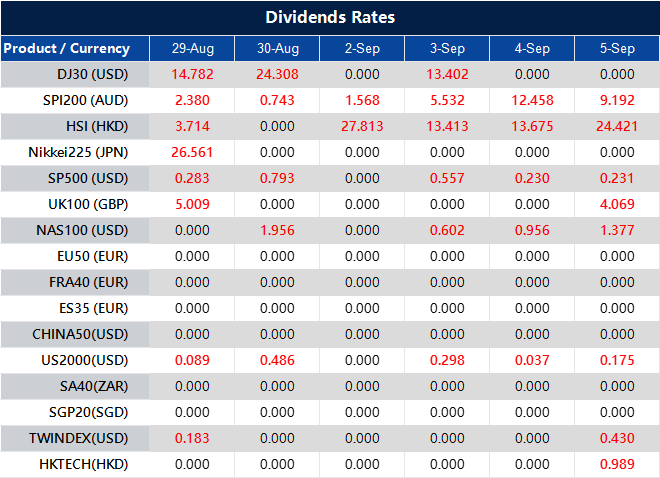
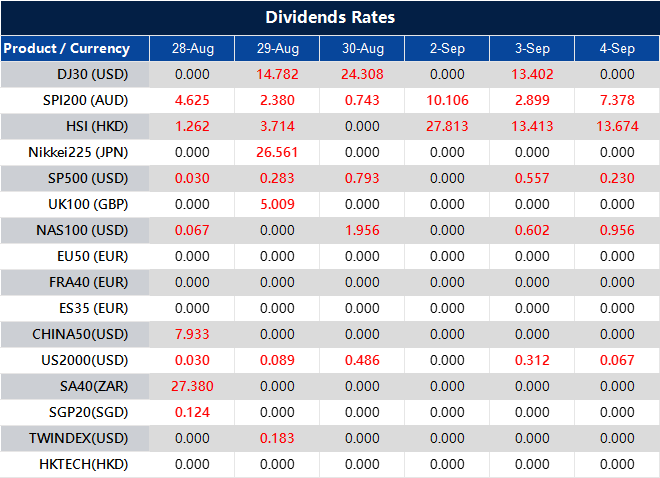
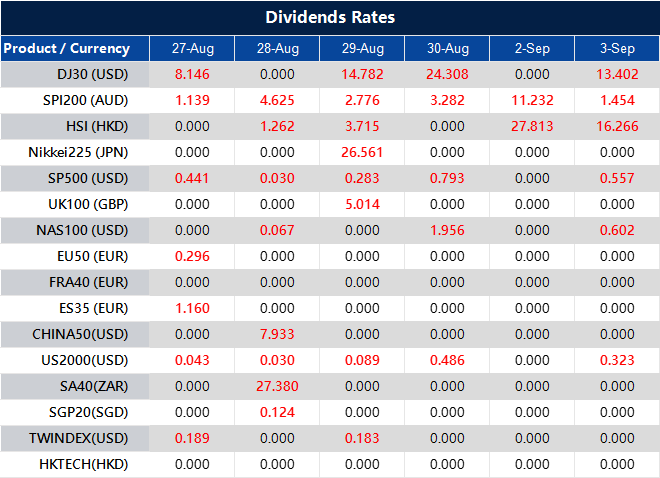
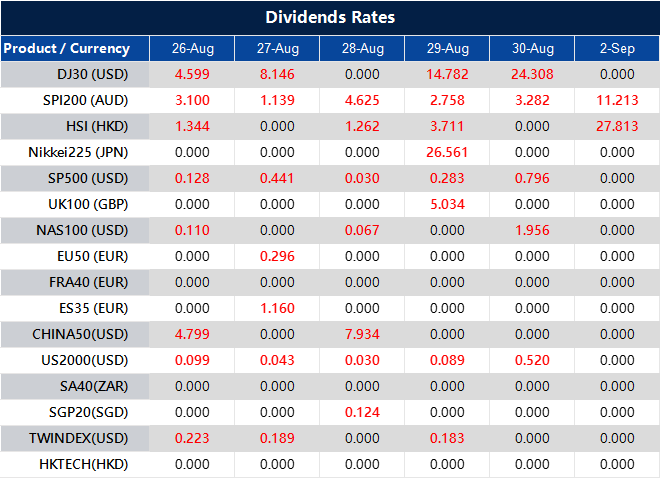
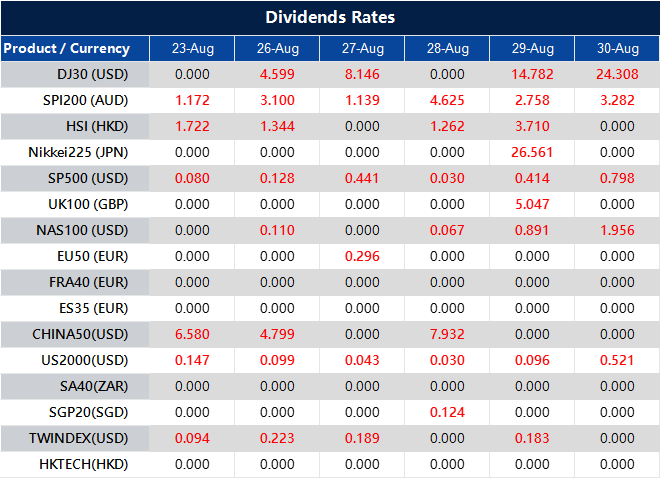
Please note that the dividends of the following products will be adjusted accordingly. Index dividends will be executed separately through a balance statement directly to your trading account, and the comment will be in the following format “Div & Product Name & Net Volume ”.
Please refer to the table below for more details:
The above data is for reference only, please refer to the MT4/MT5 software for specific data.
If you’d like more information, please don’t hesitate to contact info@vtmarkets.com.
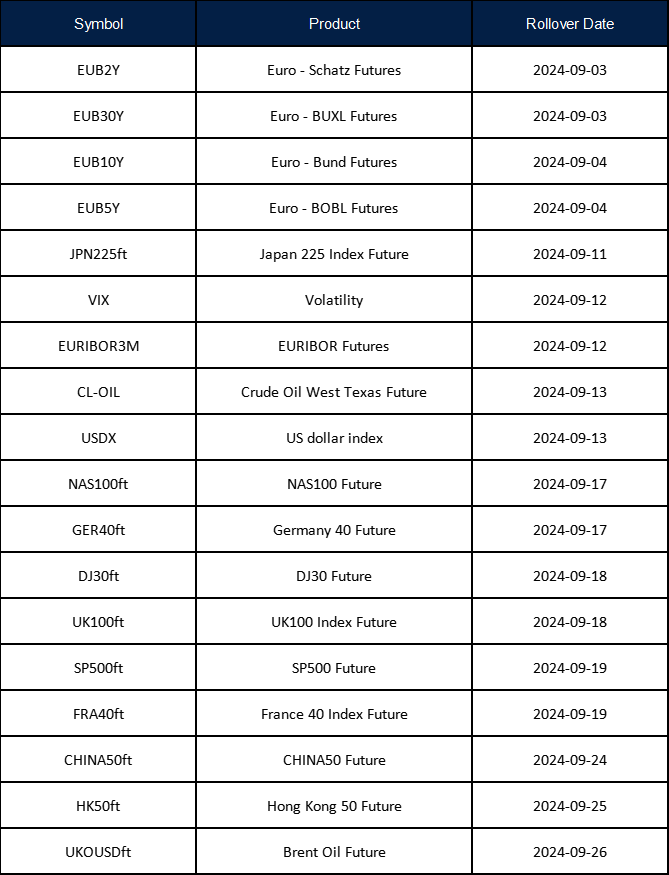
New contracts will automatically be rolled over as follows:
Please note:
• The rollover will be automatic, and any existing open positions will remain open.
• Positions that are open on the expiration date will be adjusted via a rollover charge or credit to reflect the price difference between the expiring and new contracts.
• To avoid CFD rollovers, clients can choose to close any open CFD positions prior to the expiration date.
• Please ensure that all take-profit and stop-loss settings are adjusted before the rollover occurs.
• All internal transfers for accounts under the same name will be prohibited during the first and last 30 minutes of the trading hours on the rollover dates.
If you’d like more information, please don’t hesitate to contact info@vtmarkets.com
Please note that the dividends of the following products will be adjusted accordingly. Index dividends will be executed separately through a balance statement directly to your trading account, and the comment will be in the following format “Div & Product Name & Net Volume ”.
Please refer to the table below for more details:
The above data is for reference only, please refer to the MT4/MT5 software for specific data.
If you’d like more information, please don’t hesitate to contact info@vtmarkets.com.
Even though inflation has cooled down a lot since its peak of 9.1% in June 2022, it’s still remains high, and there’s no telling if it might creep up again.
Elon Musk and Warren Buffett have some similar advice for dealing with inflation. Musk once tweeted that when inflation is high, it’s usually better to own things like a home or stocks in companies you believe in, rather than holding onto cash.
What are your thoughts about probable inflation rate over next few years?
As a general principle, for those looking for advice from this thread, it is generally better to own physical things like a home or stock in companies you think make good products, than dollars when inflation is high.
I still own & won’t sell my Bitcoin, Ethereum or Doge fwiw.
The second half of Musk’s tweet echoes investing wisdom from Warren Buffett, CEO of Berkshire Hathaway. Back in 2009, during the tail end of the Great Recession, Buffett told shareholders that one of the best ways to guard against inflation is to own a piece of “a wonderful business.”
His reasoning? No matter what happens to the dollar’s value, a great business will always have demand for its products.
In case you missed, here’s another reason why the dollar could be losing its value in the near future.
Not all investments react the same way to inflation. Some are pretty much immune to its effects, and a few might even thrive when inflation rises. Here are 4 inflation-proof investment strategies to keep you at ease during economic uncertainty.
4 inflation-proof strategies to help you sleep better during economic uncertainty
Gold
Gold is often seen as a hedge against inflation, especially in countries where the local currency is losing value. In these places, people turn to gold or other strong currencies when their own currency fails. Since gold is a tangible asset, it generally holds its value.
However, gold isn’t a perfect inflation hedge. When inflation goes up, central banks usually raise interest rates. In this environment, holding gold, which doesn’t generate yields, can be less advantageous compared to assets that do, especially when interest rates—and yields—are high.
Commodities
Commodities are an essential part of the global economy, encompassing items like grain, precious metals, oil, natural gas, and even foreign currencies and financial instruments. They often serve as a barometer for inflation, with their price movements reflecting broader economic trends.
Commodities have shown resilience to bouts of inflation and have been a hedge for bonds and stocks, according to Goldman Sachs Research. They also offer protection for portfolios to volatility from elections and geopolitical events. https://t.co/mjU2LETgwFpic.twitter.com/f00Qc1FhZV
When the price of a commodity rises, it generally indicates increased production costs, which can, in turn, drive up the prices of goods derived from these commodities. This relationship links commodities closely with the Consumer Price Index (CPI), a key measure of inflation. As commodity prices climb, they can contribute to higher CPI readings, signaling rising overall inflation.
However, commodities are also known for their volatility. Prices can fluctuate widely due to changes in supply and demand, geopolitical events, or economic conditions. For instance, disruptions in oil supply from geopolitical conflicts can cause oil prices to spike, influencing inflationary pressures across various sectors.
Treasury bills, notes, and bonds
US Treasury bonds are debt instruments issued by the U.S. government, and they pay interest as well as return the principal amount when they mature. They’re favoured because they have a high credit rating and are considered very safe, making them a reliable choice for consistent income, especially for retirement portfolios.
However, the value of U.S. Treasuries is influenced by interest rates, which change in response to inflation. When interest rates rise, Treasury prices usually fall, and when rates drop, Treasury prices generally increase.
Bills, with maturities of one year or less, are sold at a discount and have interest rates based on their price. Notes and bonds have fixed interest rates. The value of these securities drops when interest rates rise because new securities offer higher rates. Longer-term bonds are more affected by interest rate changes than shorter-term ones, so they can be more volatile.
Cryptocurrencies
Cryptocurrency, especially Bitcoin, is a solid bet against inflation because it has a fixed supply of 21 million coins—unlike fiat money, which can be printed endlessly. Since Bitcoin isn’t controlled by any government, it stays stable even when traditional currencies are losing value.
For example, people in Venezuela used Bitcoin to protect their savings when their money lost value. Plus, Bitcoin is easy to access and trade, making it a smart choice to keep your wealth safe when inflation hits.
Bottom line
A diversified portfolio is the best hedging strategy
Don’t just hold on to cash! Market conditions can change unpredictably, it’s important to diversify your portfolio and assets.
Even if inflation isn’t a concern, having a range of assets across your portfolio helps manage risk and capitalise on various opportunities.
Please note that the dividends of the following products will be adjusted accordingly. Index dividends will be executed separately through a balance statement directly to your trading account, and the comment will be in the following format “Div & Product Name & Net Volume ”.
Please refer to the table below for more details:
The above data is for reference only, please refer to the MT4/MT5 software for specific data.
If you’d like more information, please don’t hesitate to contact info@vtmarkets.com.
Please note that the dividends of the following products will be adjusted accordingly. Index dividends will be executed separately through a balance statement directly to your trading account, and the comment will be in the following format “Div & Product Name & Net Volume ”.
Please refer to the table below for more details:
The above data is for reference only, please refer to the MT4/MT5 software for specific data.
If you’d like more information, please don’t hesitate to contact info@vtmarkets.com.
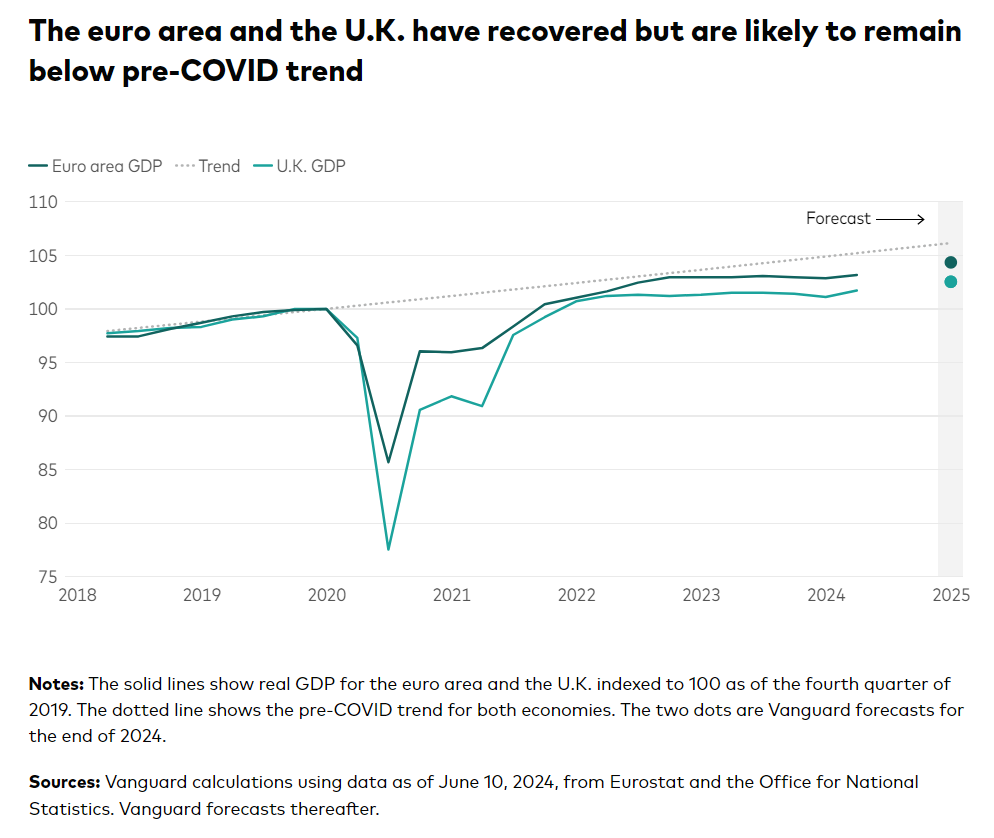
As we navigate through the second half of 2024, the European and UK economies are showing signs of recovery after facing significant challenges in recent years. The aftermath of the pandemic, energy crises, and persistent inflation have tested the resilience of these economies. However, recent data and forecasts suggest a cautiously optimistic outlook for the year ahead.
Economic indicators and stock market outlook
The first half of 2024 has brought mixed news for the European and UK economies.
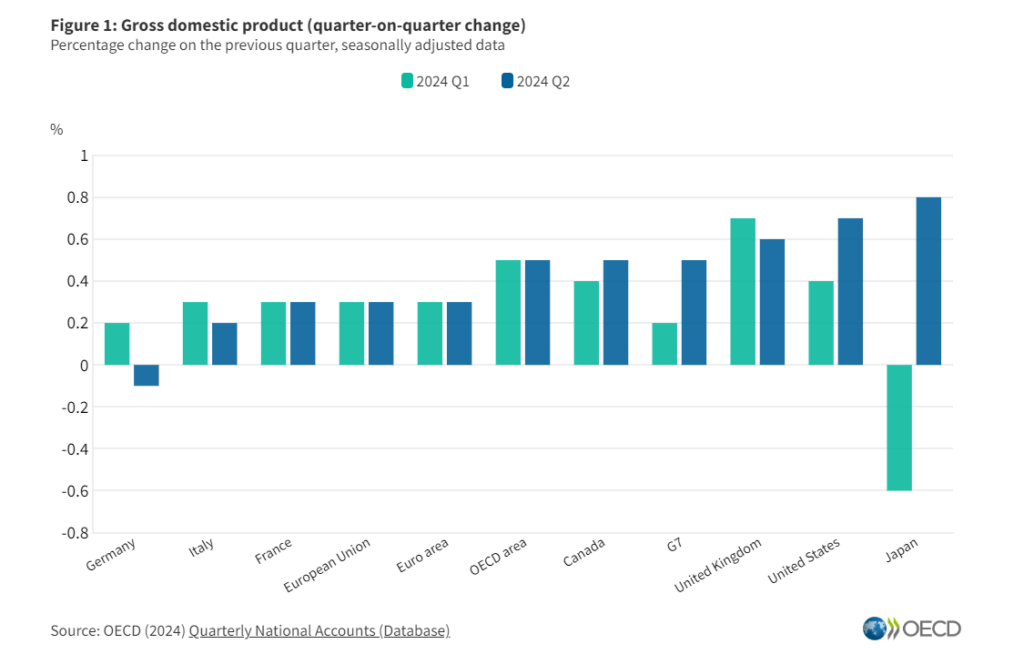
The euro zone economy expanded by 0.3% in both the first and second quarters of 2024, surpassing expectations and marking a clear break from the technical recession experienced in the latter half of 2023.
However, this growth has not been uniformed across the region. Germany, the euro zone’s largest economy, unexpectedly contracted by 0.1% in the second quarter, while countries like Latvia, Sweden, and Hungary also experienced GDP contractions.
The UK economy has shown more robust growth, expanding by 0.7% in the first quarter and 0.6% in the second quarter of 2024. However, growth flattened in June, partly due to heavy rain affecting retail sales and a doctor’s strike impacting healthcare activity.
Looking ahead, the Bank of England has revised its growth forecast for the UK upward to 1.25% for 2024, a significant improvement from the previous 0.5% projection. However, they anticipate slower growth in the latter half of the year, with 0.4% in Q3 and 0.2% in Q4.
For stock market enthusiasts, the outlook remains cautiously positive, with the STOXX 600 expected to reach 540 points by the end of 2024, implying a roughly 5% gain from August 2023 levels. The STOXX50E is projected to rise to 5,038, a 3.4% increase, while Germany’s DAX is forecasted to reach 19,000, representing a 3.1% gain.
Key sectors driving recovery
The recovery continues to be uneven across sectors. While services are crucial to overall economic health, they face ongoing challenges in price normalisation.
Manufacturing, particularly in Germany, shows signs of weakness but has potential for improvement as global conditions enhance.
Several sectors are positioned for growth in 2024. Technology hardware and semiconductors are expected to benefit from ongoing digital transformation trends. The banking and insurance sectors may thrive in an environment of changing interest rates.
Utilities, particularly those focused on renewable energy, are likely to see growth as Europe continues its push towards sustainable energy solutions.
Government and central bank policies
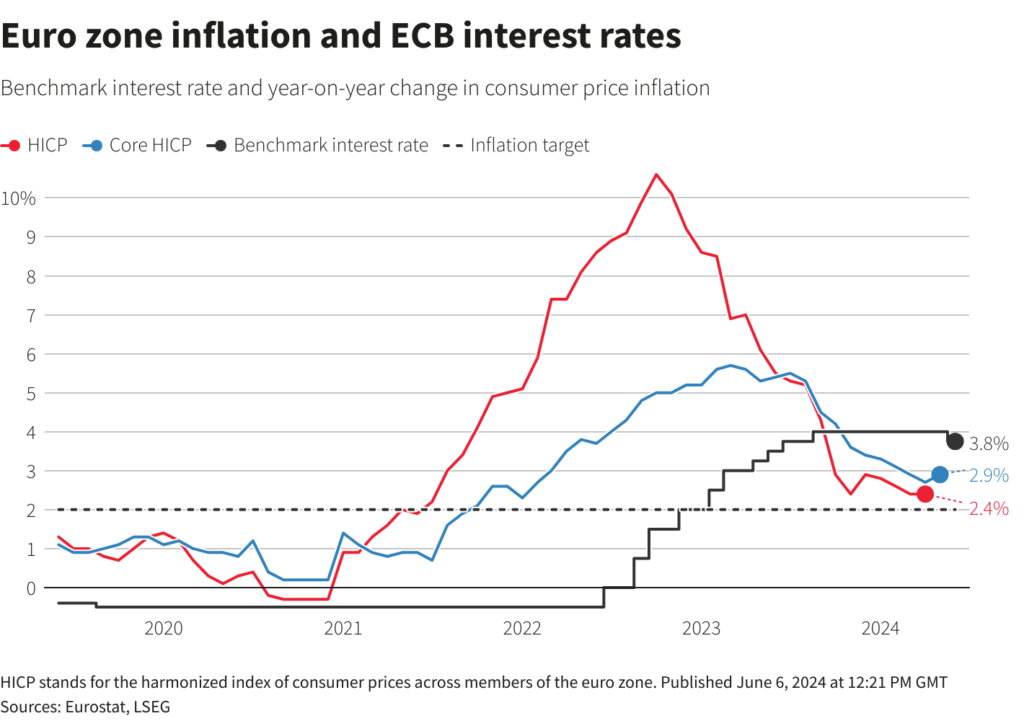
Central bank policies continue to play a crucial role in shaping the economic landscape in 2024, with inflation remaining a key focus prompting careful adjustments to monetary policy.
The European Central Bank (ECB) has already taken action this year, cutting its key interest rate from 4.00% to 3.75% on August 8. While the ECB recently kept rates steady, discussions are ongoing about a potential further cut in September, contingent on economic conditions and inflation trends.
Meanwhile, the Bank of England has been more aggressive in its approach, implementing two rate cuts thus far in 2024. The first reduction brought the rate down from 5.25% to 5.00%, with a second cut anticipated to lower it further to 4.75%. These moves align with the Bank’s revised growth forecasts and demonstrate a careful navigation of economic challenges.
These measured steps by both central banks reflect their delicate balancing act between supporting economic growth and keeping inflation in check. The policies are seen as essential to fostering economic recovery without reigniting inflation.
However, both institutions may continue to adopt a cautious approach due to persistent inflationary pressures, particularly in the services sector.
The possibility of additional adjustments later in the year remains open as central banks continue to closely monitor economic indicators. This ongoing vigilance underscores the complex nature of managing monetary policy in the current economic climate, where supporting growth must be balanced against the risk of overheating the economy.
Challenges and risks
Despite the positive outlook, several challenges and risks remain.
The uneven recovery across euro zone countries, particularly Germany’s contraction, highlights the fragility of the economic rebound.
The UK’s long-term growth figures are concerning, with output per head still 0.8% lower than pre-pandemic levels and overall growth of just 2.3% since Q4 2019.
Business investment in the UK was 1.1% lower in Q2 2024 compared to the previous year, indicating ongoing uncertainties. Productivity issues, exacerbated by Brexit-related challenges, continue to weigh on the UK’s economic performance.
Geopolitical tensions and potential supply chain disruptions continue to pose risks to the recovery. Additionally, the moderation of wage growth, while helpful for inflation control, could impact consumer spending power.
Opportunities for traders
For traders, 2024 presents a landscape of both opportunities and challenges. Sectors benefiting from structural shifts, such as technology and renewable energy, may offer growth potential.
The anticipated rate cuts could lead to broader market gains beyond just large-cap stocks, providing opportunities for diversification.
Traders should consider focusing on companies with strong fundamentals and those positioned to benefit from long-term trends like digital transformation and the transition to green energy.
The varying performance across euro zone countries also suggests opportunities in markets showing stronger growth, such as Ireland.
Seize these prospects by investing in EU and UK stocks with VT Markets, which also provides daily market analysis to help you make informed decisions and optimise your trading strategy.
Conclusion
As 2024 unfolds, the European and UK economies are showing signs of recovery, though progress is gradual and uneven. Economic growth, inflation control, and central bank policies will shape this recovery’s path.
Traders should stay informed and maintain a diversified strategy to navigate the markets effectively. The economic landscape remains complex, with varied performances across the euro zone and challenges in the UK. Continuous learning, careful analysis, and prudent risk management are crucial for success in this evolving environment.
Please note that the dividends of the following products will be adjusted accordingly. Index dividends will be executed separately through a balance statement directly to your trading account, and the comment will be in the following format “Div & Product Name & Net Volume ”.
Please refer to the table below for more details:
The above data is for reference only, please refer to the MT4/MT5 software for specific data.
If you’d like more information, please don’t hesitate to contact info@vtmarkets.com.
As part of our commitment to provide the most reliable service to our clients, there will be MT4 server maintenance this weekend.
MT4 Maintenance Hours:
24th of August 2024 (Saturday) 08:00 – 13:00 (GMT+3)
Please note that the following aspects might be affected during the maintenance:
1. The price quote and trading management will be temporarily disabled during the maintenance. You will not be able to open new positions, close open positions, or make any adjustments to the trades.
2. There might be a gap between the original price and the price after maintenance. The gaps between Pending Orders, Stop Loss and Take Profit will be filled at the market price once the maintenance is completed. It is suggested that you manage the account properly.
Please refer to the MT4 software for the specific maintenance completion and marketing opening time.
Thank you for your patience and understanding about this important initiative.
If you’d like more information, please don’t hesitate to contact info@vtmarkets.com