Los pares de divisas más negociados en forex

Los 10 pares de divisas más negociados para operar

¿Cuáles son los mejores pares de divisas para operar? Si esta pregunta tuviera una respuesta sencilla, aprender a hacer trading en forex y especular sobre los movimientos de las divisas sería mucho más fácil. Sin embargo, no es tan simple. La elección de los mejores pares de divisas para operar es una decisión personal y depende exclusivamente de tu estrategia de trading.

No obstante, analizar los pares de divisas más negociados en el mercado puede ser útil. Esto te da una idea de las opciones más líquidas al operar con divisas, además de brindarte una gran cantidad de datos valiosos que pueden ayudarte a desarrollar tus estrategias futuras.

EUR/USD — Euro europeo y Dólar estadounidense

El par de divisas EUR/USD es el más negociado en el mercado en términos de volumen y frecuencia de operaciones. En el trading forex, este alto volumen genera impulso, lo que hace que las parejas de divisas más negociadas sean muy populares entre los especuladores del mercado de divisas. Esto se debe a su alta liquidez, lo que contribuye a mantener los spreads ajustados.

Los traders deben estar atentos a las decisiones de la Banco Central Europeo (BCE) y la Reserva Federal de los Estados Unidos (Fed). Estas instituciones financieras establecen los tipos de interés, que determinan el valor relativo de las divisas. Si una de ellas sube los tipos de interés en comparación con la otra, su divisa puede apreciarse, lo que indicará si el trader debe abrir una posición larga o corta.

USD/JPY — Dólar estadounidense y Yen japonés

El par USD/JPY sitúa al Dólar estadounidense como divisa base y al Yen japonés como divisa cotizada. A veces se le conoce como “gopher”, y es otra opción altamente líquida para los traders. Su liquidez está respaldada por el alto volumen de negociación del Yen japonés en el mercado asiático, que representa una parte significativa del mercado mundial de forex.

La Reserva Federal establece los tipos de interés del USD, mientras que el Banco de Japón (BoJ) dicta las tasas de interés internas del Yen. Los traders deben estar atentos a los cambios en estos tipos para definir su estrategia de trading en USD/JPY.

GBP/USD — Libra esterlina y Dólar estadounidense

Con la Libra esterlina como divisa base y el Dólar estadounidense como divisa cotizada, el par GBP/USD es conocido entre los traders de forex como “cable”. Este apodo se debe a la larga historia de negociación de esta pareja, haciendo referencia a los cables submarinos que se usaban antiguamente para ejecutar transacciones transatlánticas.

Los traders deben estar atentos a las decisiones de la Reserva Federal de los Estados Unidos (Fed) y del Banco de Inglaterra (BoE) en Londres. Ambas instituciones influyen directamente en el rendimiento de la Libra esterlina en relación con el Dólar estadounidense.

AUD/USD — Dólar australiano y Dólar estadounidense

Los traders suelen llamar a la pareja AUD/USD “el Aussie”, simplemente porque el Dólar australiano ocupa la posición de base, mientras que el Dólar estadounidense es la divisa cotizada. Aunque existen otras parejas con el Dólar australiano como divisa base, el AUD/USD es el más negociado y líquido, razón por la que recibe este apodo.

El Banco de la Reserva de Australia (RBA) establece la tasa de interés oficial del país, por lo que los traders deben seguirla de cerca en comparación con la tasa de interés de la Reserva Federal. Además, el Dólar australiano depende en gran medida del desempeño de los recursos naturales, que son un pilar fundamental de la economía australiana.

USD/CAD — Dólar estadounidense y Dólar canadiense

El par USD/CAD también se encuentra en esta lista, con el Dólar estadounidense en la posición base y el Dólar canadiense como divisa cotizada. Esta pareja de divisas es conocida como “el loonie”, un apodo tomado de la moneda física del Dólar canadiense.

Además de los tipos de interés en ambos países, los traders deben seguir de cerca el precio del petróleo en el mercado global. Este factor es clave para la economía canadiense y afecta directamente el valor del Dólar canadiense en relación con el Dólar estadounidense al sur de la frontera.

USD/CNY — Dólar estadounidense y Yuan chino

Este par de divisas coloca al Dólar estadounidense como la moneda base y al Yuan chino como la moneda cotizada. Siendo las dos economías más grandes del mundo, Estados Unidos y la República Popular China tienen una gran influencia en el mercado forex, lo que ha llevado a que esta pareja se convierta en una de las más negociadas a nivel global.

El gobierno central chino mantiene un control significativo sobre la economía del país y el valor de su moneda. De manera intencional, ha permitido la depreciación del Yuan — también conocido como Renminbi — en relación con otras monedas globales. Esto hace que el USD/CNY sea una pareja única en esta lista, y su volatilidad potencial ha aumentado en los últimos años debido a la guerra comercial y las tensiones políticas entre ambas naciones.

USD/CHF — Dólar estadounidense y Franco suizo

Cuando los traders operan con pares de divisas en una plataforma de trading forex, pueden notar la presencia del término “Swissie”, un apodo para la pareja Dólar estadounidense / Franco suizo (USD/CHF).

El Franco suizo (CHF) se considera una moneda estable, por lo que los traders pueden sentirse atraídos a invertir en el CHF durante momentos de incertidumbre en los mercados financieros. Sin embargo, cuando el mercado es estable, es menos probable que los traders recurran al Franco suizo. A pesar de esto, el USD/CHF, o Swissie, sigue siendo uno de los pares de divisas más negociados.

USD/HKD — Dólar estadounidense y Dólar de Hong Kong

Una de las parejas de divisas más negociadas en los últimos años ha sido el Dólar estadounidense y el Dólar de Hong Kong (USD/HKD). Esta es una entrada algo única en esta lista debido a la relación entre ambas divisas. La moneda cotizada, el HKD, está directamente vinculada a la moneda base, el USD, lo que significa que su valor sube y baja en función de los movimientos del Dólar estadounidense.

A pesar de esto, sigue habiendo espacio para la especulación. El Dólar de Hong Kong puede fluctuar varios centavos arriba o abajo con respecto al valor actual del Dólar estadounidense. Cuando se extrapola a valores y volúmenes de operaciones más grandes o a operaciones con apalancamiento en el mercado de divisas, estas fluctuaciones pueden seguir representando movimientos significativos.

EUR/GBP — Euro europeo y Libra esterlina

La pareja de divisas EUR/GBP, que coloca al Euro europeo como divisa base frente a la Libra esterlina como divisa cotizada, es una de las opciones más interesantes del mercado. Esto se debe a la especulación geopolítica y económica que ha afectado a esta región en los últimos años. Aunque el Reino Unido nunca adoptó el Euro, fue miembro de la Unión Europea hasta hace algunos años. Su salida ha provocado fuertes fluctuaciones en el valor relativo de ambas monedas.

Por supuesto, las fluctuaciones y la volatilidad no siempre son malas noticias para los traders. Muchos buscan activamente este tipo de movimientos del mercado, lo que ha convertido al EUR/GBP en una de las parejas más populares para la especulación. Sin embargo, se recomienda a los traders operar con cautela.

USD/KRW — Dólar estadounidense y Won surcoreano

La décima y última pareja en esta lista de las divisas más negociadas es el USD/KRW. En esta pareja, el Dólar estadounidense vuelve a ocupar la posición de moneda base, mientras que el Won surcoreano es la moneda cotizada.

El rápido crecimiento económico de Corea del Sur en las últimas décadas, junto con su posición como líder en el sector tecnológico global, ha generado un gran interés en su moneda. Y, por supuesto, el Dólar estadounidense sigue siendo una de las divisas más operadas en el mundo, lo que lo convierte en una opción natural como moneda base.

Algunos aspectos a tener en cuenta al operar con pares de divisas

La lista anterior no es definitiva. Las parejas de divisas más negociadas en el mercado pueden cambiar en cualquier momento, con algunas ganando popularidad y otras perdiendo relevancia. A la hora de elegir los mejores pares de divisas para operar, es fundamental seguir los movimientos del mercado, analizar el panel de control de tu plataforma de trading e identificar tendencias.

Analizar el mercado también significa seguir de cerca los pips. En el trading de forex, los pips representan pequeños movimientos que suelen encontrarse en la cuarta posición decimal del valor de una pareja de divisas. Sin embargo, en divisas con denominaciones más pequeñas, como el Yen japonés (JPY) o el Won surcoreano (KRW), estos cambios pueden aparecer en la segunda posición decimal. Aunque un pip puede parecer insignificante, puede representar una cantidad significativa en operaciones de gran tamaño. Incluso en operaciones más pequeñas, los movimientos de pips determinan si la posición es rentable o no.

Opera con las principales parejas de divisas en VT Markets

En VT Markets, proporcionamos a los traders herramientas y plataformas diseñadas para mejorar su experiencia en el mercado. Esto puede incluir operar con las divisas más negociadas, así como con pares emergentes y exóticos. Sea cual sea tu estrategia de trading, comienza con una cuenta demo y luego abre posiciones reales en una cuenta de trading en vivo.

¿Quieres saber más? Ponte en contacto con nuestro equipo hoy mismo.

Week ahead: All eyes on US Non-Farm Employment Change and FOMC Meeting Minutes

The US will release the Non-Farm Employment Change and FOMC Meeting Minutes this week. 

The Non-farm Employment Change is expected to show a total of 220,000 jobs added in December, down from the 263,000 jobs added in November. Forecasters also expect the Unemployment Rate to remain unchanged at 3.7%. 

Meanwhile, the Minutes from the Federal Open Market Committee will shed further light on policy intentions going forward.

Here are the key market events for the week ahead:

Swiss Consumer Price Index (4 January)

The Consumer Price Index in Switzerland stood at 0% in November of 2022, unchanged from the previous month. 

Analysts expect the index to decrease by 0.3% in December.

US ISM Manufacturing PMI (4 January)

The US Institute for Supply Management’s Manufacturing Purchasing Managers Index fell to 49 in November 2022 from 50.2 in October, its first contraction since May 2020.

Analysts expect the index to remain at 49.

US JOLTS Job Openings (4 January)

US job openings dropped by 353,000 to 10.3 million in October 2022, according to the JOLTS report. This may indicate that demand for workers has started to slow amid a softer economic forecast and higher interest rates.

Analysts expect that the number of available jobs will decrease more in November to 10.1 million.

FOMC Meeting Minutes (5 January)

In its last monetary policy meeting of 2022, the Federal Reserve raised the fed funds rate by 50bps to 4.25%-4.5%. This was its seventh consecutive rate hike.

The Fed expects that interest rates would reach 5.1% in 2023, 4.1% in 2024, and 3.1% in 2025.

ADP Non-Farm Employment Change (5 January)

The US private sector added only 127,000 jobs in November of 2022, below economists’ expectations.

Economists expect ADP Non-Farm to create another 150,000 jobs in December.

Canada Employment Change (6 January)

In November 2022, 10,100 jobs were added to the Canadian economy, while the unemployment rate stood at 5.1%, decreasing from the previous month’s rate of 5.2%.

Analysts predict that employment will grow by an additional 60,000 positions over the next month, with the unemployment rate to stand at 5.2%.

US Non-Farm Employment Change (6 January)

The US non-farm payrolls report for November showed an increase of 263,000 jobs following a downwardly revised 284,000 gain in October. The unemployment rate was unchanged at 3.7%, close to September’s 3.5%.

Analysts expect the unemployment rate to remain unchanged at 3.7% while non-farm payrolls will increase by 220,000 for December.

US ISM Services PMI (6 January)

The US Institute for Supply Management’s Services Index jumped to 56.5 in November from 54.4 in October. It is expected to decline slightly to 53 in December.

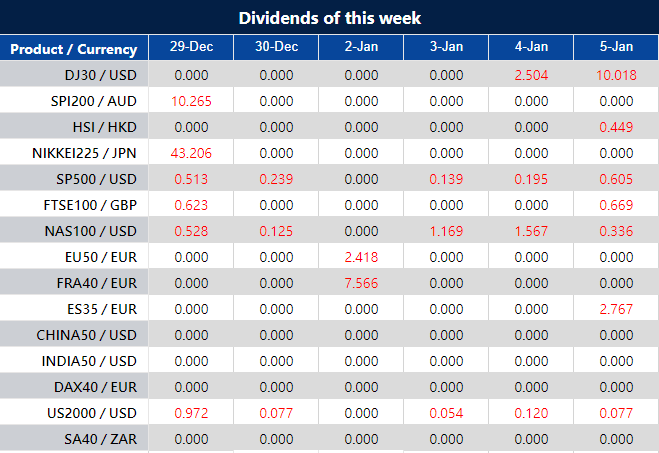
Weekly Dividend Adjustment Notice – December 29, 2022

Dear Client,

Please note that when constituent stocks of a market index generate dividends, VT Markets will make dividends and deductions for clients who hold the products after the close of the day before the ex-dividend date.

The dividends will not be paid/charged as an inclusion along with Swap. It will be executed separately in your account and the record will be annotated as “Div & Product Name & Net Volume”.

Please note the specific adjustments as follows:

The above data is for reference only, please refer to the MT4/MT5 software for specific data.

If you’d like more information, please don’t hesitate to contact cs@vtmarkets.com.

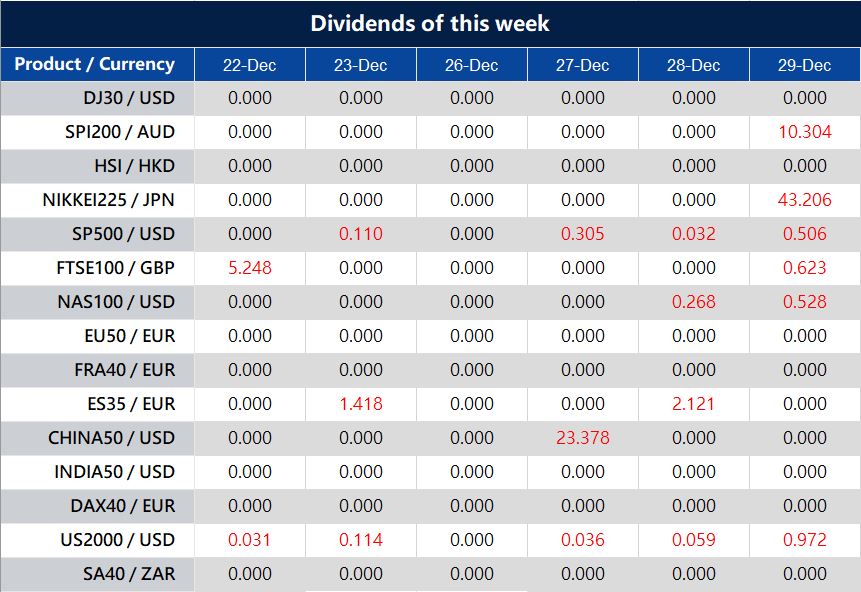
Weekly Dividend Adjustment Notice – December 22, 2022

Dear Client,

Please note that when constituent stocks of a market index generate dividends, VT Markets will make dividends and deductions for clients who hold the products after the close of the day before the ex-dividend date.

The dividends will not be paid/charged as an inclusion along with Swap. It will be executed separately in your account and the record will be annotated as “Div & Product Name & Net Volume”.

Please note the specific adjustments as follows:

The above data is for reference only, please refer to the MT4/MT5 software for specific data.

If you’d like more information, please don’t hesitate to contact cs@vtmarkets.com.

Week ahead: Markets to focus on BoJ rate statement and Canada’s CPI

The financial markets will be monitoring the Bank of Japan policy statement this week. The central bank is expected to keep its short-term interest rate at -0.1%, the same as the previous month. 

Meanwhile, Canada will also be under scrutiny, as its Consumer Price Index is expected to rise by 0.4% in November.

Here are the upcoming events for this week:

Bank of Japan Monetary Policy Statement (20 December)

In its October policy statement, the Bank of Japan kept its key short term interest rate at -0.1% and that for 10-year bond yields around 0%. However, it revised its inflation forecast to 2.9% from 2.3% in July, citing surging prices of energy, food, and durable goods.

Analysts expect the bank to keep its policy unchanged for this month.

Canada’s Consumer Price Index (21 December)

Canada’s Consumer Price Index (CPI) increased by 0.7% in October over the previous month. According to analysts, Canada’s CPI is expected to rise a further 0.4% in November.

Canada’s Gross Domestic Product (23 December)

The Canadian economy expanded by 0.1% in September, reversing an upwardly revised 0.3% increase in August.

Economists expect the country’s gross domestic product to be unchanged in October.

US Core PCE Price Index (23 December)

The US Core PCE Price Index, excluding food and energy, increased by 0.2% month-on-month in October compared with 0.5% in September.

Analysts expect the index to rise by another 0.2% in November.

VT Markets Establishes Position As Leading Brokerage in 2022

VT Markets, a global multi-asset broker, has announced their overall company performance for 2022. This year, they have further established their position as one of the fastest-growing, most innovative and best-performing brokerages in the industry. 

Significant growth was observed in two key areas of their trading platform — total number of active traders and total volume of trade. Since 2021, the total number of active traders on VT Markets surged by 140%, while the total trading volume saw a 125% increase.

VT Markets’ success was driven by an emphasis on innovation, product diversification and expansion into newer markets. The brokerage ventured beyond traditional trading products, and offered more diverse instruments such as indices, bonds, and ETFs. They also expanded their business operations globally. 

In the last quarter of the year, VT Markets also launched their exclusive loyalty program, VT Markets ClubBleu. This rewarding initiative was put in place as recognition for its clients  who have played a key role in contributing to the growth of the company. 

When reflecting upon the huge strides that VT Markets has taken the past year, Chris Nelson-Smith, Director at VT Markets, commented, “We’re proud of how far we’ve come as a brokerage, and of all the outstanding results we’ve achieved this year. Our customer-centric approach is testament to how much we recognise and value our clients who have unreservedly been an integral part of our long-term success. We are truly grateful for their support, and we promise to continue providing reliable products and personalised services to cater to their needs.”

“We are committed to continuing to develop our offerings to keep up with the changing markets and industry trends so that we can continue to be industry leaders. We look forward to emulating the successes we’ve achieved so far, and  would like to extend our sincerest thanks to all of our clients for their continued trust in VT Markets,” Chris Nelson-Smith added. 

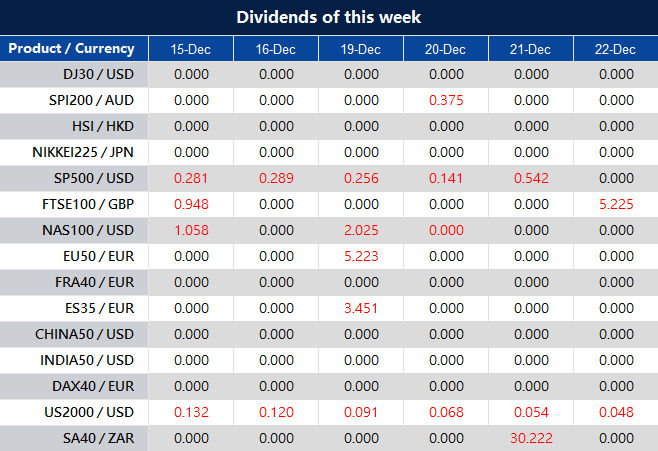
Weekly Dividend Adjustment Notice – December 15, 2022

Dear Client,

Warmly reminds you that the component stocks in the stock index spot generate dividends. When dividends are distributed, VT Markets will make dividends and deductions for the clients who hold the trading products after the close of the day before the ex-dividend date.

Indices dividends will not be paid/charged as an inclusion along with the swap component. It will be executed separately through a balance statement directly to your trading account, the comment for which will be in the following format “Div & Product Name & Net Volume ”.

Please note the specific adjustments as follows:

The above data is for reference only, please refer to the MT4/MT5 software for specific data.

If you’d like more information, please don’t hesitate to contact cs@vtmarkets.com.

Week ahead: All eyes on CPI data from US and UK, and Fed interest rate decision

The upcoming financial week will be filled with economic data and speculation, as inflation and interest rate decisions will be announced by most central banks.

The CPI inflation figures in the US are expected to rise by 0.3% in November, which might signify another slowdown in inflation. The financial markets will pay close attention to these figures as they could impact the Fed interest rate decision.

The UK Consumer Price Index annual inflation rate is expected to rise to 11.3% in November.

Meanwhile, the Swiss National Bank (SNB), Bank of England (BoE), and European Central Bank (ECB) are scheduled to announce their monetary policy decisions this week.

Here are the financial market updates for the week ahead:

​​UK Gross Domestic Product (12 December)

In September, UK Gross Domestic Product contracted by 0.6% month-on-month, following a downwardly revised 0.1% decline in August.

UK GDP is expected to increase by 0.4% in October.

US Consumer Price Index (13 December)

October’s US CPI increased 0.4% month-on-month, slowing the annual inflation rate in the US to 7.7% in October, the lowest since January 2022. 

Analysts predict that November’s CPI will increase slightly by 0.3%, to 7.6%.

UK Consumer Price Index (14 December)

The CPI annual inflation rate in the UK jumped from 10.1% in September to 11.1% in October, and analysts expect that it will further rise to 11.3% in November.

Fed Interest Rate Decision (15 December)

The Federal Reserve increased its benchmark interest rate by 75bps, to 3.75% – 4% in November, which marks the sixth consecutive hike and the fourth three-quarter point increase.

Jerome Powell, the current Fed chairman, has hinted that the Fed may scale back the pace of its interest rate hikes come December. Analysts believe the Fed will raise the federal funds rate by 50bps this month.

SNB, BoE, ECB Rate Statement (15 December)

Monetary policy decisions by the SNB, BoE, and ECB are being closely monitored this week.

SNB increased its interest rate by 75bps and is forecast to increase by a further 50bps in December to 1%.

BoE voted to raise interest rates by 75bps to 3% in November, with interest rates expected to increase by 50bps to 3.5%.

ECB increased its key interest rate by 75bps. Analysts forecast ECB to raise another 50bps in December.

US Retail Sales (15 December)

The US retail sales rose 1.3% month-on-month in October after a flat reading in September.

According to analysts, retail sales is either expected to maintain at 0.0%, or fall by 0.1% in November.

Eurozone, UK, and US Flash Services and Manufacturing PMI (16 December)

French and German Flash Services PMI declined in November. However, an increase was recorded in their manufacturing PMI.

On the other hand, UK Flash Services and Manufacturing PMI remained the same in November from the previous month. In the US, Flash Services PMI fell from October to November.

Flash Services PMI in France and Germany is expected to decline in December, with UK and US figures forecast to rise. Manufacturing PMI in the UK, France, and Germany may also decline for this month.

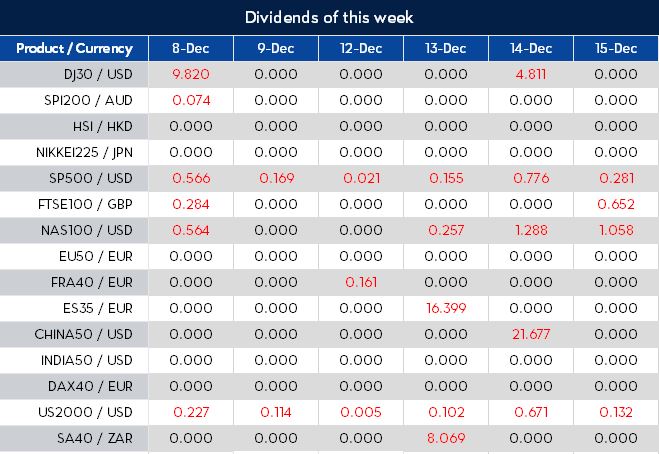
Weekly Dividend Adjustment Notice – December 08, 2022

Dear Client,

Please note that the dividends of the following products will be adjusted accordingly. Index dividends will be executed separately through a balance statement directly to your trading account, and the comment will be in the following format “Div & Product Name & Net Volume ”.

Please refer to the table below for more details:

The above data is for reference only, please refer to the MT4/MT5 software for specific data.

If you’d like more information, please don’t hesitate to contact cs@vtmarkets.com.

Week ahead: Will RBA and BoC further raise interest rates?

The Reserve Bank of Australia and the Bank of Canada are expected to further raise interest rates this month. Investors are watching for signs that suggest policymakers will follow through with another hike.

Here are some of the market events to watch this week:

US ISM Services PMI (5 December)

The ISM Services PMI index in the US fell from 56.7 in September to 54.4 in October, missing market expectations of 55.5. This points to a slowdown in the growth of the services sector since May 2020.

Analysts expect another decline in the index, to 53.9 in November.

RBA Rate Statement (6 December)

The Reserve Bank of Australia (RBA) raised the cash rate by 25bps to 2.85% at its November meeting. The board cited concerns over rising inflation in Australia and signalled that further increases were likely necessary.

Analysts predict that RBA will raise interest rates by 25bps to 3.10% this month.

Australian Gross Domestic Products Q/Q (7 December)

Australian gross domestic product (GDP) grew by 0.9% in Q2 of 2022. However, some economists forecast that Australia may enter a recession by 2023 with an unemployment rate of 4.5%.

For Q3, analysts expect GDP to rise to 1.1%.

BOC Rate Statement (7 December)

In October, the Bank of Canada increased its overnight rate by 50bps to 3.75%. This was below the market expectations of an aggressive 75bps hike. Such a move has led to borrowing costs hitting their highest levels since 2008, and added to the 350bps increase in interest rates over the current tightening cycle.

Analysts expect BoC to raise interest rates further by 25bps to 4% this month.

US PPI (9 December)

The PPI for final demand in the US increased 0.2% in October. This was the same as the downwardly revised 0.2% increase in September.

Analysts expect another increase in the US PPI of 0.3% in November.

US Prelim UoM Consumer Sentiment (9 December)

The University of Michigan’s Consumer Sentiment index for the US in November was revised to 56.8, up from a preliminary reading of 54.7.

The December index is expected to be 55.

Back To Top
server

Hola 👋

¿Cómo puedo ayudarte?

Chatea con nuestro equipo al instante

Chat en vivo

Inicia una conversación en vivo por...

  • Telegram
    hold En espera
  • Próximamente...

Hola 👋

¿Cómo puedo ayudarte?

telegram

Escanea el código QR con tu teléfono para iniciar un chat con nosotros, o haz clic aquí.

¿No tienes instalada la aplicación o la versión de escritorio de Telegram? Usa Telegram Web .

QR code