Back

The perfect storm: Understanding the 2024 global stock market downturn

The 2024 global stock market downturn has sent shockwaves through financial circles worldwide. In just three weeks, approximately USD 6.4 trillion has been wiped off, and Monday’s decline stunned even the most experienced traders.

With major indices like the Nasdaq and Nikkei 225 experiencing significant drops, understanding what led to this downturn is crucial. This article aims to demystify the events of the market downturn, providing clear and practical insights to help everyday investors navigate these turbulent times.

What happened?

In early August 2024, global stock markets experienced a significant crash driven by fears of an impending recession.
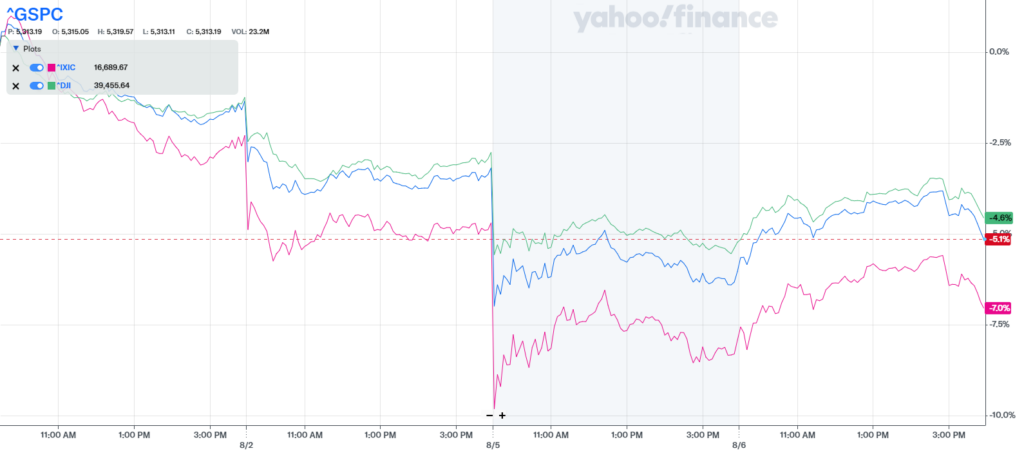
The downturn began on Monday, August 5, triggered by disappointing earnings reports and a weak July jobs report. Major indices fell sharply: the S&P 500 dropped 2.9%, the Nasdaq 4.5%, and the Euro Stoxx 2.7%.
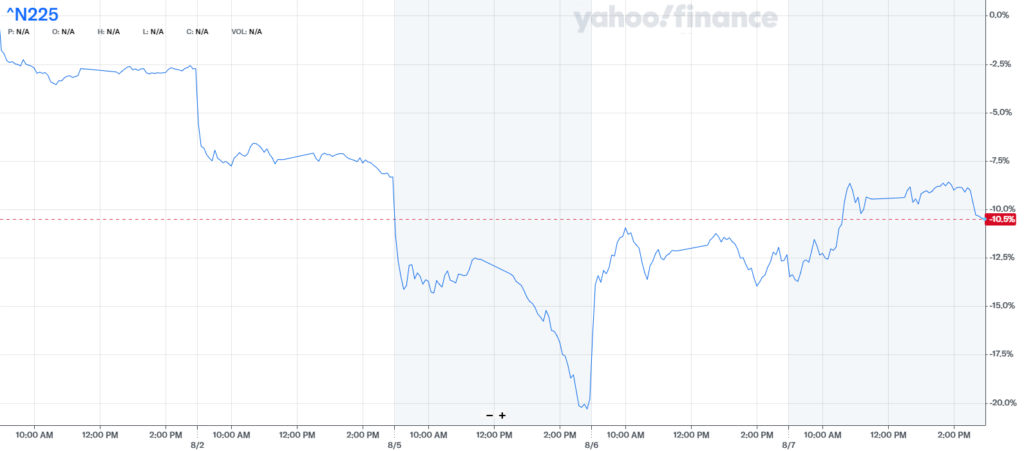
Asian markets fared even worse, with the Nikkei plummeting 12.4%, Taiwan’s TAIEX falling 8.4%, and South Korea’s KOSPI decreasing 8.8%. Australia’s ASX 200 closed 3.7% lower, marking its largest one-day drop since May 2020.
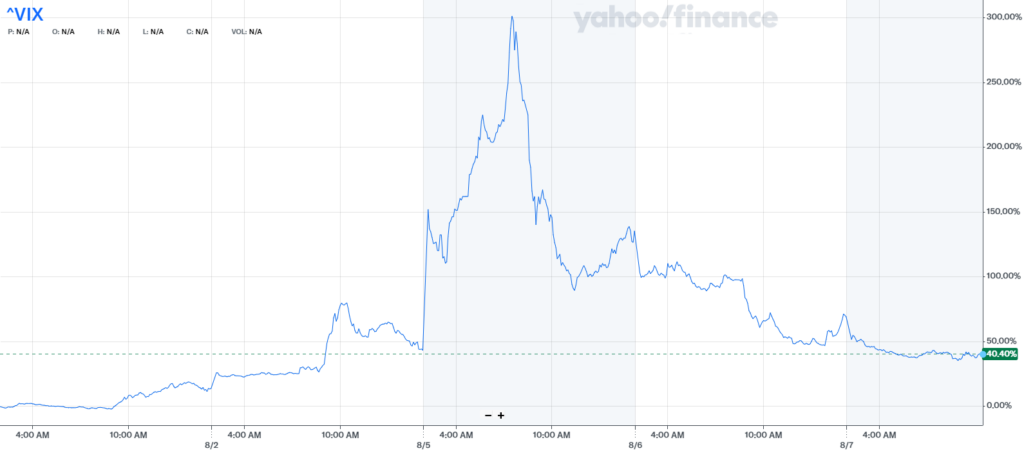
The VIX index, which measures market volatility, surged to multi-year highs of 65.7, only surpassed by the peaks of 96.4 during the 2008 financial crisis and 85.5 during the COVID-19 pandemic.

Key catalysts

Several factors combined to create this perfect storm in the global markets:

1. Poor earnings reports

The collapse was partly triggered by disappointing earnings reports from major companies like Amazon, which missed revenue estimates by USD 1 billion, and Intel, whose earnings per share plummeted by 30% compared to the previous quarter. These reports not only fell short of market expectations but also highlighted broader economic weaknesses.

2. Weak economic indicators

A weak July jobs report further fuelled recession fears. Nonfarm payrolls grew by just 114,000 in July, significantly below the downwardly revised 179,000 in June and the Dow Jones estimate for 185,000. The unemployment rate edged higher to 4.3%, its highest since October 2021, triggering an economic rule on recessions. This suggests that the economy might be cooling down faster than anticipated.

3. Interest rate changes

Japan’s surprise interest rate hike played a crucial role in the market turmoil. The Bank of Japan raised rates by 15 basis points, which led to the unwinding of the popular yen carry trade. This move sent shockwaves through the global financial markets, contributing significantly to the sell-off. The sell-off in Japanese markets intensified on Friday, 2 August, with the TOPIX index dropping by 6.14% and falling 13.4% from its peak on 11 July. Foreign investors pulled nearly USD 5 billion out of Japanese stocks over the last two weeks of July, and domestic funds also became net sellers of their own market.

4. Major stake adjustments

Berkshire Hathaway’s decision to drastically reduce its massive Apple stake by approximately 50% sent shockwaves through the market. This move by Warren Buffett’s conglomerate, which now boasts a record-breaking cash hoard of USD 277 billion, sparked concerns among investors. Many interpreted this as a potential loss of confidence in the overall stock market, even from the legendary investor himself.

Regional impacts

The impact of the market collapse varied across different regions, each experiencing its own set of challenges:

Asia

Japan’s Nikkei 225 experienced a dramatic fall, wiping out all of its gains for the year. The Bank of Japan’s interest rate hike not only affected the Nikkei but also led to significant declines in other Asian markets. South Korea’s Kospi and Taiwan’s TAIEX saw some of their worst performances in decades, driven by substantial drops in semiconductor stocks like Samsung Electronics and TSMC.

Australia

The ASX 200’s decline was led by losses in IT stocks, although the country’s strong commodity sector helped cushion the blow somewhat. Major mining companies like BHP and Rio Tinto saw relatively smaller declines, indicating a degree of resilience in the face of broader market turmoil.
Cryptocurrencies

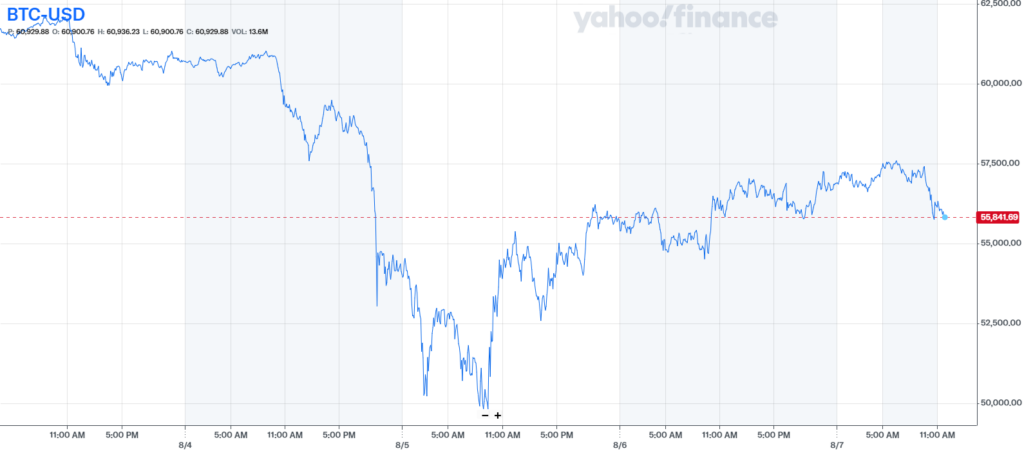
Bitcoin and other major cryptocurrencies also took a hit. Bitcoin lost 19% of its value since Friday, crashing below USD 50,000. This decline reflected a broader risk-off sentiment gripping the markets, as investors moved away from volatile assets.

Broader economic concerns

The market collapse has reignited fears of a global recession, driven by differing central bank strategies. The Bank of Japan raised interest rates by 0.25% to 0.75% to tackle inflation, while the Federal Reserve chose not to cut rates, adding to global uncertainty and volatility.

Geopolitical tensions have also heightened investor anxiety. Increased conflicts in the Middle East, particularly between Iran and its neighbours, have disrupted oil supplies and spiked crude oil prices. Additionally, the U.S. presidential election cycle has become increasingly unpredictable, with key candidates presenting conflicting economic policies. These factors, combined with existing economic weaknesses, have created a turbulent environment for the markets.

What it means for traders

For traders, the market downturn can be both daunting and confusing. Here are some practical steps to navigate these uncertain times:

1. Immediate actions: Avoid panic selling. It’s important not to make hasty decisions based on short-term market movements. Instead, reassess your portfolio and consider whether your current investments align with your long-term financial goals.

2. Long-term strategies: Diversification is key. Ensure that your portfolio is diversified across different asset classes to spread risk. Focus on value investments and maintain a balanced portfolio to withstand market volatility.

3. Opportunities and risks: Market downturns can present buying opportunities. If you have a long-term investment horizon, consider taking advantage of lower prices to buy quality stocks at a discount. Be cautious and conduct thorough research before making any investment decisions. For up-to-date insights and analysis that can help you navigate these market conditions, consult VT Markets’ daily market reports.

Conclusion

The 2024 global stock market downturn has undoubtedly created a challenging environment for investors. However, by understanding the factors that led to this downturn and adopting a strategic approach, traders can navigate these turbulent times. Stay informed, remain patient, and focus on long-term investment strategies to weather the storm and potentially benefit from the eventual market recovery.
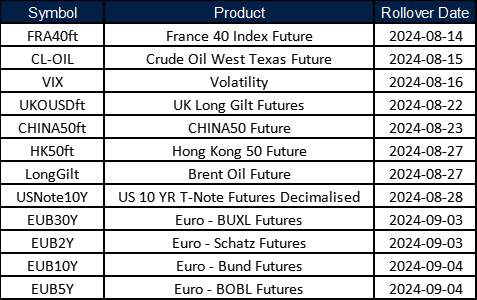
August Futures Rollover Announcement – Aug 7,2024

Dear Client,

New contracts will automatically be rolled over as follows:

Please note:

• The rollover will be automatic, and any existing open positions will remain open.

• Positions that are open on the expiration date will be adjusted via a rollover charge or credit to reflect the price difference between the expiring and new contracts.

• To avoid CFD rollovers, clients can choose to close any open CFD positions prior to the expiration date.

• Please ensure that all take-profit and stop-loss settings are adjusted before the rollover occurs.

• All internal transfers for accounts under the same name will be prohibited during the first and last 30 minutes of the trading hours on the rollover dates.

If you’d like more information, please don’t hesitate to contact info@vtmarkets.com.

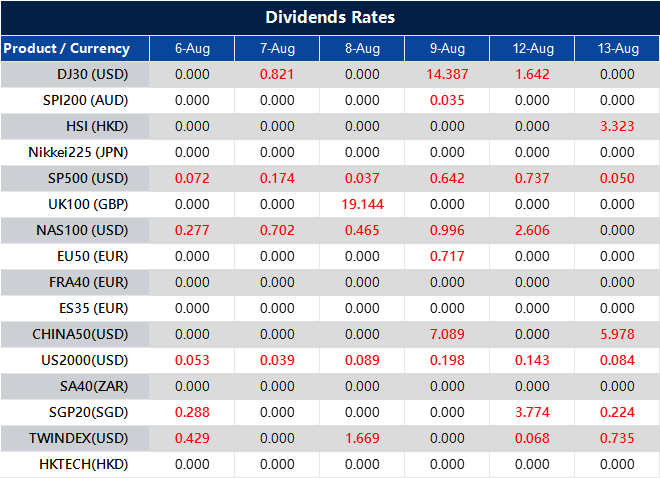
Dividend Adjustment Notice – Aug 7,2024

Dear Client,

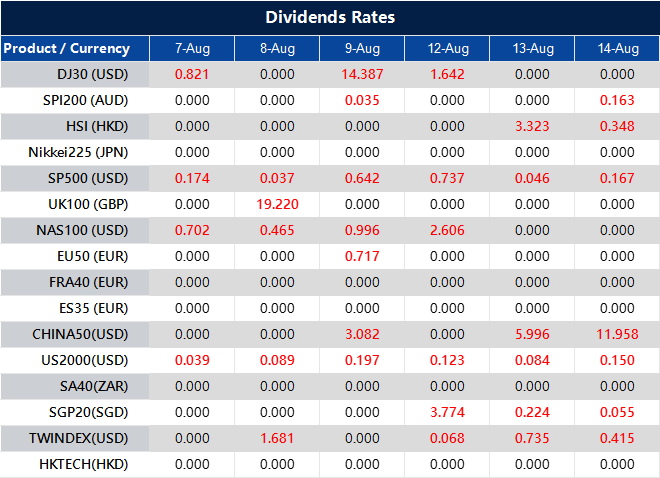
Please note that the dividends of the following products will be adjusted accordingly. Index dividends will be executed separately through a balance statement directly to your trading account, and the comment will be in the following format “Div & Product Name & Net Volume ”.

Please refer to the table below for more details:

The above data is for reference only, please refer to the MT4/MT5 software for specific data.

If you’d like more information, please don’t hesitate to contact info@vtmarkets.com.

The glamour of trend trading

Capturing the hottest moments in the market

Imagine the market as a bustling red carpet event, where every asset is a celebrity and every trader a paparazzi. Cameras flash, and eyes dart, seeking the hottest stars – the trends. In this fast-paced world, trend trading emerges as a strategy that not only keeps up with the glamour but also reaps the rewards of being in the right place at the right time. 

Trend trading, akin to snapping a perfect photo of a celebrity at their peak, involves identifying and riding market trends.

The allure is undeniable: A trend trader follows the momentum of the market, capturing gains as the asset price moves in a consistent direction. 

What is trend trading? 

Trend trading is a strategy that involves analysing the price momentum of an asset in one direction – either up or down – and making trades based on the perceived continuation of this trend.

This approach capitalises on the idea that “the trend is your friend,” allowing traders to ride the waves of market movements. 

Traders use various tools and indicators to identify trends, such as moving averages, trendlines, and momentum indicators like the Relative Strength Index (RSI).

These tools help in pinpointing the start and end of a trend, ensuring traders can enter and exit positions at optimal points. 

The tools of the trade 

Just like how a paparazzi needs a good camera, a trend trader requires specific tools to spot and follow trends. Here are some key instruments in the arsenal of a trend trader: 

Moving averages 

Moving averages smooth out price data to help identify the direction of a trend. The two most commonly used types are the Simple Moving Average (SMA) and the Exponential Moving Average (EMA).

Traders often use the 50-day and 200-day moving averages to gauge the overall trend. 

Trend lines 

Drawing trend lines on a chart helps traders visually identify the direction of the trend. An upward trend line is drawn by connecting the successive higher lows, while a downward trend line connects the lower highs. 

Yes. YES. Nuff’ said

Technical indicators 

Indicators like the Relative Strength Index (RSI), Moving Average Convergence Divergence (MACD), and Bollinger Bands provide additional insights into the strength and potential continuation of a trend.

These tools can signal overbought or oversold conditions, helping traders make informed decisions. 

Strategies to be successful in trend trading 

Trend trading can be implemented through various trading strategies, each with its unique approach to capturing market movements. Here are some popular ones: 

Following the trend 

This straightforward strategy involves identifying the direction of the trend and entering trades in the same direction.

For instance, if the market is in an uptrend, traders look for buying opportunities. Conversely, in a downtrend, they seek selling opportunities. 

Trade the breakout 

Breakout traders look for key levels of support and resistance. When the price breaks through these levels, it often signals the beginning of a new trend.

Traders enter positions as soon as the breakout occurs, aiming to capture the momentum of the new trend. 

Make your entry during the pullback 

In a trending market, prices often retrace or pull back before continuing in the original direction. Pullback traders wait for these retracements and enter positions at more favourable prices.

This strategy aims to capitalise on temporary price corrections within a trend. 

Examples of trend trading 

Apple (Symbol: AAPL) 

The stock price of Apple has exhibited strong trends over the years. During its meteoric rise from 2009 to 2020, trend traders who entered into buy positions of AAPL when they identified an upward trend and held onto them profited significantly.

By following the trend and avoiding the urge to sell during minor pullbacks, these traders maximised their returns. 

Euro vs US dollar (Symbol: EURUSD) 

The EURUSD currency pair is one of the most traded in the forex market. Its price movements often exhibit clear trends.

For example, during the period of 2017 to 2018, EURUSD experienced a strong uptrend. Trend traders who recognised this upward momentum and entered buy positions profited as the euro strengthened against the dollar. 

The pros and cons of trend trading 

Here are the reasons why you should use trend as your friend, and what you should be looking out for when you decide to deploy trend trading as your strategy. 

Pros 

  • Simplicity: Trend trading is straightforward and easy to understand. 
  • Profit potential: It allows traders to capitalise on significant market movements. 
  • Flexibility: Can be applied to various markets, including stocks, forex and commodities. 

Cons 

  • Market Dependency: Relies heavily on the market trending in a clear direction. 
  • Timing: Requires precise timing for entry and exit to maximise profits and minimise losses. 
  • Volatility: Sudden market reversals can lead to significant losses. 

Use trends as your friend as you navigate the financial markets 

Trend trading, much like the pursuit of a paparazzi for the perfect shot, requires a keen eye, patience, and the ability to act swiftly. By understanding market trends and employing effective strategies, traders can capture the biggest market movements and turn them into profitable opportunities.

As with any trading strategy, continuous learning and adaptation are key to long-term success. Explore 1000+ assets being offered by VT Markets and tart your financial trading journey today! 

Open a live account 

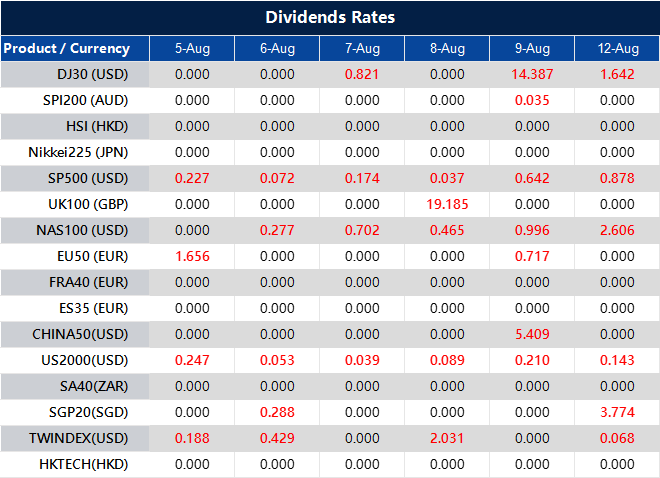
Dividend Adjustment Notice – Aug 6,2024

Dear Client,

Please note that the dividends of the following products will be adjusted accordingly. Index dividends will be executed separately through a balance statement directly to your trading account, and the comment will be in the following format “Div & Product Name & Net Volume ”.

Please refer to the table below for more details:

The above data is for reference only, please refer to the MT4/MT5 software for specific data.

If you’d like more information, please don’t hesitate to contact info@vtmarkets.com.

Un Guide Complet pour un Compte de Trading Forex

Guide Complet pour Ouvrir un Compte de Trading Forex

Avoir un compte de trading est essentiel pour quiconque souhaite s’aventurer dans le monde du trading Forex. Ce guide détaillé vous explique tout ce que vous devez savoir sur les comptes de trading, comment en ouvrir un, et les avantages qu’ils offrent.

Qu’est-ce qu’un Compte de Trading ?

Un compte de trading est un compte ouvert auprès d’un courtier qui permet aux individus d’acheter et de vendre des actifs financiers. Ces actifs incluent les devises, les actions, les matières premières et les ETFs.

Types de Comptes de Trading

  • Compte de Trading Standard (STP) : Offre des fonctionnalités de base pour le trading de différents actifs.
  • Compte de Trading Démo : Utilisé pour pratiquer le trading sans risquer de l’argent réel.
  • Compte de Trading RAW ECN : Fournit un accès direct au marché avec des spreads réduits.
  • Compte de Trading Sans Swap : Conçu pour être conforme aux principes de la finance islamique, sans intérêts.

Pourquoi Ouvrir un Compte de Trading ?

Accès aux Marchés Financiers

Avec un compte de trading, vous pouvez accéder à une large gamme de marchés financiers. Cela vous permet de diversifier votre portefeuille et d’exploiter différentes opportunités de trading.

Outils et Ressources de Trading

Les comptes de trading offrent généralement accès à des outils et ressources de trading avancés. Cela inclut des plateformes de trading, des graphiques, des analyses techniques et des signaux de trading.

Flexibilité

Un compte de trading offre une flexibilité pour trader à tout moment et depuis n’importe où. Les plateformes de trading en ligne et les applications mobiles rendent cela possible.

Comment Ouvrir un Compte de Trading ?

Choisir un Courtier

La première étape consiste à choisir un courtier de confiance. Recherchez des courtiers réglementés offrant des conditions de trading transparentes et des frais compétitifs.

Remplir le Formulaire d’Inscription

Après avoir choisi un courtier, remplissez le formulaire d’inscription en ligne. Vous devrez fournir des informations personnelles et financières.

Vérification de l’Identité

Les courtiers exigent généralement une vérification de l’identité. Cela inclut l’envoi de documents tels qu’une pièce d’identité et une preuve de résidence.

Effectuer un Dépôt

Une fois votre compte vérifié, effectuez un dépôt initial. La plupart des courtiers offrent plusieurs méthodes de dépôt, y compris les virements bancaires et les cartes de crédit.

Avantages d’un Compte de Trading

Accès à des Leverage

Un compte de trading vous permet d’utiliser l’effet de levier pour augmenter votre exposition au marché. Cela signifie que vous pouvez contrôler une plus grande position avec un capital limité.

Diversification

Un compte de trading vous permet de diversifier vos investissements en accédant à différents marchés et actifs. Cela réduit les risques et augmente les opportunités de profit.

Outils de Gestion des Risques

Les comptes de trading offrent des outils de gestion des risques comme les ordres stop-loss et take-profit. Ces outils aident à limiter les pertes et à sécuriser les gains.

Stratégies de Trading pour Compte de Trading

Day Trading

Le day trading consiste à acheter et vendre des actifs dans la même journée. Cette stratégie profite des fluctuations de prix à court terme.

Swing Trading

Le swing trading implique de maintenir des positions sur plusieurs jours ou semaines. Il vise à profiter des tendances intermédiaires du marché.

Trading de Position

Le trading de position consiste à maintenir des positions à long terme. Cette stratégie est basée sur des analyses fondamentales et techniques approfondies.

FAQ sur le Compte de Trading

1. Qu’est-ce qu’un compte de trading démo ?

Un compte de trading démo est un compte qui permet de trader avec de l’argent virtuel. Il est utilisé pour pratiquer et tester des stratégies sans risquer de l’argent réel.

2. Quels documents sont nécessaires pour ouvrir un compte de trading ?

Vous aurez besoin d’une pièce d’identité (comme un passeport ou une carte d’identité) et d’une preuve de résidence (comme une facture de services publics ou un relevé bancaire).

3. Quelle est la différence entre un compte de trading standard et un compte RAW ECN ?

Un compte standard offre des fonctionnalités de base tandis qu’un compte RAW ECN offre un accès direct au marché avec des spreads réduits.

4. Puis-je ouvrir plusieurs comptes de trading ?

Oui, de nombreux courtiers permettent d’ouvrir plusieurs comptes de trading. Cela peut être utile pour tester différentes stratégies ou pour séparer les types d’actifs.

5. Quels sont les frais associés à un compte de trading ?

Les frais varient selon les courtiers, mais peuvent inclure des spreads, des commissions, des frais de dépôt/retrait et des frais d’inactivité.

6. Comment puis-je déposer des fonds sur mon compte de trading ?

Vous pouvez déposer des fonds par virement bancaire, carte de crédit, portefeuille électronique, et parfois par crypto-monnaies.

7. Qu’est-ce qu’un ordre stop-loss ?

Un ordre stop-loss est une instruction donnée à votre courtier pour vendre un actif lorsque son prix atteint un certain niveau. Il aide à limiter les pertes.

8. Quels sont les risques du trading avec effet de levier ?

L’effet de levier peut amplifier vos gains, mais aussi vos pertes. Une mauvaise gestion de l’effet de levier peut entraîner des pertes importantes.

9. Comment puis-je retirer de l’argent de mon compte de trading ?

Les retraits peuvent être effectués via les mêmes méthodes que les dépôts, comme les virements bancaires, les cartes de crédit et les portefeuilles électroniques.

10. Pourquoi est-il important de diversifier son portefeuille ?

La diversification réduit les risques en répartissant les investissements sur différents actifs et marchés. Cela augmente les chances de profit à long terme.

Conclusion: Ouvrez Votre Compte de Trading Aujourd’hui

Ouvrir un compte de trading est la première étape vers la réussite dans le trading Forex. En choisissant un courtier de confiance et en utilisant les outils et ressources disponibles, vous pouvez maximiser vos opportunités de profit. Commencez votre aventure de trading dès aujourd’hui et explorez le potentiel du marché Forex.

Pour plus d’informations et pour ouvrir votre compte de trading, visitez VT Markets.

Dividend Adjustment Notice – Aug 5,2024

Dear Client,

Please note that the dividends of the following products will be adjusted accordingly. Index dividends will be executed separately through a balance statement directly to your trading account, and the comment will be in the following format “Div & Product Name & Net Volume ”.

Please refer to the table below for more details:

The above data is for reference only, please refer to the MT4/MT5 software for specific data.

If you’d like more information, please don’t hesitate to contact info@vtmarkets.com.

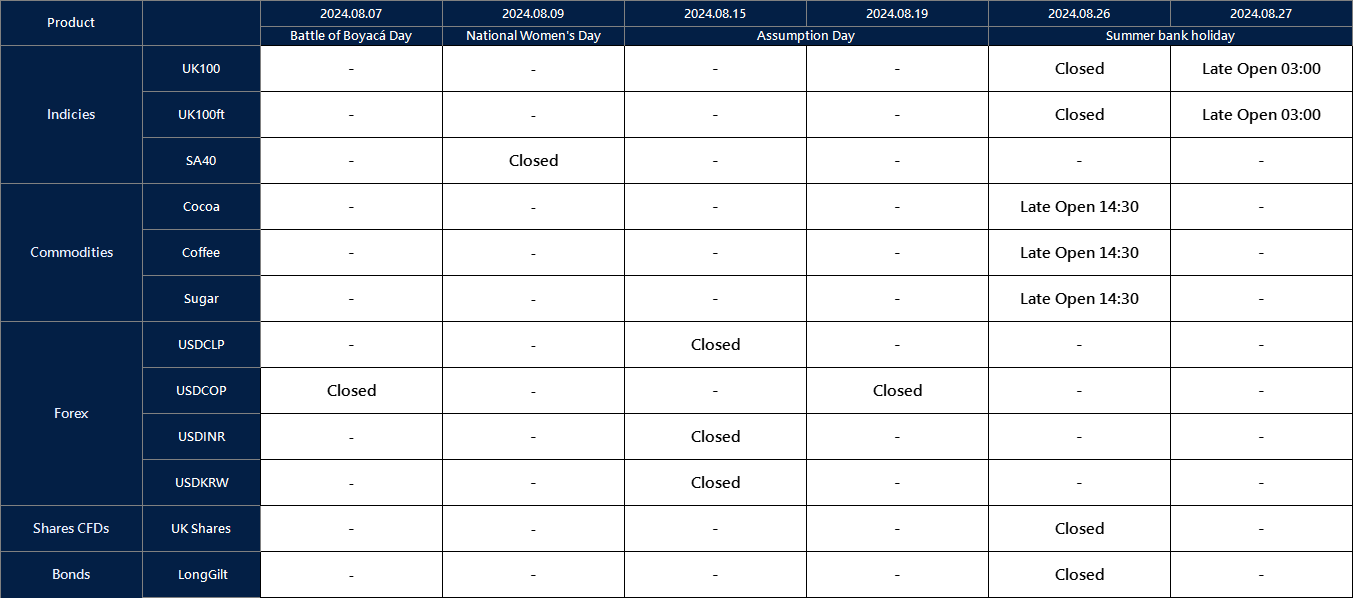
Notification of Trading Adjustment in Holiday – Aug 5, 2024  

Dear Client,

Affected by international holidays, the trading hours of some VT Markets products will be adjusted. Please check the following link for the affected products:

Notification of Trading Adjustment in Holiday

Note: The dash sign (-) indicates normal trading hours.

Friendly Reminder:
The above data is for reference only, please refer to the MT4/MT5 software for specific data.

If you’d like more information, please don’t hesitate to contact info@vtmarkets.com.

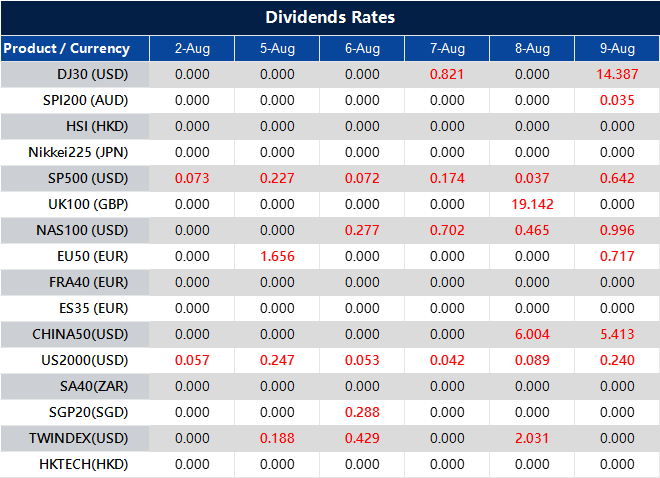
Dividend Adjustment Notice – Aug 2,2024

Dear Client,

Please note that the dividends of the following products will be adjusted accordingly. Index dividends will be executed separately through a balance statement directly to your trading account, and the comment will be in the following format “Div & Product Name & Net Volume ”.

Please refer to the table below for more details:

The above data is for reference only, please refer to the MT4/MT5 software for specific data.

If you’d like more information, please don’t hesitate to contact info@vtmarkets.com.

Notification of Server Upgrade – Aug 1, 2024

Dear Client,

As part of our commitment to provide the most reliable service to our clients, there will be MT4 server maintenance this weekend.

MT4 Maintenance Hours:
03th of August 2024 (Saturday) 09:00 – 13:00 (GMT+3)

Please note that the following aspects might be affected during the maintenance:
1. The price quote and trading management will be temporarily disabled during the maintenance. You will not be able to open new positions, close open positions, or make any adjustments to the trades.
2. There might be a gap between the original price and the price after maintenance. The gaps between Pending Orders, Stop Loss and Take Profit will be filled at the market price once the maintenance is completed. It is suggested that you manage the account properly.

Please refer to the MT4 software for the specific maintenance completion and marketing opening time.

Thank you for your patience and understanding about this important initiative.

If you’d like more information, please don’t hesitate to contact info@vtmarkets.com

Back To Top
server

Bonjour 👋

Comment puis-je vous aider ?

Discutez immédiatement avec notre équipe

Chat en direct

Démarrez une conversation en direct via...

  • Telegram
    hold En attente
  • Bientôt disponible...

Bonjour 👋

Comment puis-je vous aider ?

Telegram

Scannez le code QR avec votre smartphone pour démarrer un chat avec nous, ou cliquez ici.

Vous n’avez pas l’application ou la version de bureau de Telegram installée ? Utilisez plutôt Telegram Web .

QR code